Nestled amidst the majestic wilderness of Vietnam’s Northwest, the magnificent geomorphological formation popularly known as the “Dinosaur Spine” (Song Lung Khung Long) is situated in Chieng Cong Commune (formerly part of Hang Cho Commune), Moc Chau District, Son La Province. In essence, it is a razor-sharp, precarious mountain ridge stretching across valleys blanketed in swirling clouds. From a geological perspective, this is a unique natural tectonic wonder formed by fault movements in the Earth’s crust millions of years ago, creating a hogback ridge that runs for kilometers at an average elevation of over one thousand meters above sea level. Flanking both sides of the ridge are bottomless chasms, where small streams carve deep into the mountain’s heart to form water-gathering ravines in a classic feng shui configuration of “coiling dragon and crouching tiger,” concentrating the spiritual energy of the Northwest’s earth and sky.
Looking at its historical roots and indigenous cultural space, from time immemorial, this ridge served not merely as a natural boundary separating tribal domains, but also as a strategic bottleneck along the frontier defense line. In feudal historical records, particularly under the Nguyen Dynasty and royal decrees of the Le Dynasty, the ancient land of Moc Sam served as a solid bulwark shielding the Northern Delta from movements originating from the upper reaches of the Da River. The imprints of Thai and Hmong chieftains who held this land for generations remain faintly visible through an ancient network of trails—former border trade routes once bustling with porters carrying salt, medicinal herbs, and brocade across Mu Tong Peak to connect commerce between mountainous principalities.
In the collective consciousness of the indigenous Black Thai and Hmong communities, this dragon-backed mountain range is closely tied to legends of mountain deities, river spirits, and epic migrations in search of land to establish settlements. According to village elders, the crest of this ridge was once a sacred site for performing rain-praying ceremonies and offering sacrifices to the guardian deity (Phi Muong) to protect crops and ensure peace for the villages below. Although the rustic, modern-sounding name “Dinosaur Spine” has only emerged over the past decade through the lens of young explorers and travel journalism, beneath that linguistic veneer lies centuries of deep geological and humanistic heritage.
Today, through the lens of heritage planning and sustainable tourism development by cultural management authorities, this landmark has transcended the boundaries of a spontaneous “check-in” spot to become an icon of adventure tourism and geological research in Son La. The harmonious blend of treacherous terrain, a year-round sea of floating clouds, and authentic ethnic cultural values has transformed this place into a benchmark for the pristine, majestic, yet poetic beauty of the Moc Chau highlands—worthy of preservation and reverence within the flow of Vietnamese cultural history.

Building upon its historical sediments and indigenous cultural depth, the Dinosaur Spine emerges as a grand geological masterpiece sculpted by the invisible hand of nature amidst the Northwest wilderness. Boasting a unique landform with a high, sharp ridge undulating gracefully like the spine of a colossal prehistoric creature, this scenic wonder creates an unprecedentedly powerful visual field. Deep abysses drop away on both sides of the ridge, opening up an expansive panorama stretching to the horizon, where mountain clouds and brisk winds gather across all four seasons. The uniqueness of this topographic structure lies in its sheer vertical drop and narrow crest, just wide enough for a slender footpath worn down by human footsteps over generations, forming a breathtakingly graceful curve slicing through mid-air.
At every hour of the day, the landscape here drapes itself in a different resplendent cloak, shifting unpredictably under the effects of natural light. To capture the full essence of this marvel, professional photographers and leading travel magazines frequently share two classic, unmissable camera angles. The first vantage point sits at the central elevation of the ridge, where the lens can encompass the entire sinuous curve of the trail perched halfway through the clouds, creating the illusion of walking along a silk ribbon suspended in the sky. The second angle is located on a protruding rocky outcrop at the far western tip, framing a sweeping view over the deep valley below, complete with terraced rice fields cascading like stairways to heaven and ethnic villages peeking through wisps of evening cooking smoke.
Regarding ideal lighting conditions, sunrise from 5:00 AM to 6:30 AM is the most coveted golden hour for capturing million-view frames. At this time, the sea of clouds sinks low, drifting right beneath your feet and mingling with the first warm golden rays of dawn piercing through the morning mist, tinting an entire corner of the sky pink and creating an infinite sense of depth. Meanwhile, sunset ushers in a tranquil, mysterious, and deeply nostalgic beauty as the fading twilight casts a brilliant reddish-orange glow across the brooding primeval forest. Everything converges to form a pinnacle visual space, affirming the timeless aesthetic value of a landmark meant not merely to be admired, but to touch the deepest chords of the soul.

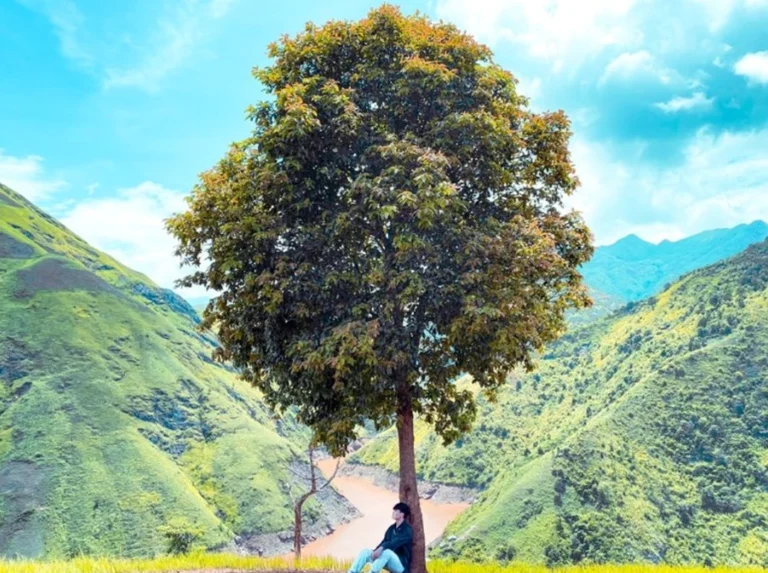
Upon setting foot on the “Dinosaur Spine” in Chieng Cong Commune, Moc Chau District, Son La Province, travelers are immediately swept into an overwhelming and challenging real-world adventure. The trekking trail leading up to the ridge demands patience and endurance as you conquer steep, sheer inclines flanked by yawning chasms where billows of mist skim low across the ground. That initial sense of vertigo quickly gives way to utter awe upon reaching the highest summit, taking in one of the grandest natural panoramas in the Northwest region. From here, a picturesque landscape unfolds with undulating mountain ranges rolling like ocean waves, deep valleys below, and the Da River meandering gracefully like a silver ribbon under brilliant golden sunlight—evoking an extraordinary feeling of freedom, expansiveness, and humbling smallness before the vast wilderness.
Beyond the spectacular natural scenery, a journey of discovery here is also an opportunity for travelers to quiet their minds through profound spiritual and cultural experiences. Through the animistic worldview of the Black Thai and Hmong people, every gust of wind, grove of trees, and mountain slope harbors the spirits of deities and ancestors. Standing before this sacred expanse, visitors feel as though all the hustle and bustle of urban life is washed away, reaching a state of absolute inner stillness. From there, the journey can continue down to the cool, refreshing waters of nearby rivers and streams, where travelers can drift aboard rustic wooden boats, leisurely admiring moss-covered cliffs and listening to the mountain winds whisper timeless tales.
An experience in this historic land would be incomplete without a culinary encounter featuring its remarkably unique and renowned local cuisine. After hours of strenuous mountain trekking, travelers can gather around a glowing hearth to savor a feast rich with the flavors of the mountains and forests, prepared by the local ethnic people themselves. Indulge in the fragrant aroma of sticky rice grilled in bamboo tubes (com lam), smoky dried buffalo meat richly seasoned with mac khen (forest pepper) and doi seeds, crispy grilled stream fish dipped in spicy cham cheo sauce, paired with a cup of leaf-fermented corn wine brimming with warm hospitality. The subtle fusion of magnificent nature, spiritual cultural depth, and distinctive local gastronomy turns every step along the “Dinosaur Spine” into a vivid, unforgettable memory for anyone fortunate enough to visit this sacred land.

To enjoy a fulfilling trip exploring the “Dinosaur Spine” landmark in Moc Chau, equipping yourself with practical travel tips is essential. Due to its rugged high-mountain terrain, the site is open freely to visitors year-round without a fixed entrance fee. Travelers can visit at any time of day; however, the ideal hours are early morning for hunting drifting clouds or late afternoon to catch the sunset descending over the valley. The best time of year to visit is from autumn through the following spring, when the weather is dry, the skies are clear blue, and travel conditions are favorable.
The most optimal route from Moc Chau town center follows the national highway or inter-communal roads leading into the Chieng Cong Commune area. Because the stretch from the foot of the mountain up to the ridge consists mainly of steep, rocky, and winding dirt tracks, the safest and best-suited vehicles are semi-automatic motorbikes ridden by experienced drivers or high-clearance 4WD cars. For travelers unaccustomed to navigating treacherous mountain passes, hiring a local motorbike taxi (xe om) from homestays at the base of the mountain is an exceptionally smart choice to ensure absolute safety throughout the journey.
As this is not merely a scenic natural landmark but also a cultural and spiritual space deeply intertwined with the daily lives of ethnic minorities, visitors should choose neat, practical attire suitable for trekking—such as athletic shoes with good grip, comfortable stretch clothing, and a light jacket, as winds on the summit blow very strongly. Additionally, dressing modestly, respecting traditional cultural spaces, maintaining public cleanliness without littering, and asking permission before photographing local residents are indispensable rules of respectful travel etiquette that will make your journey all the more meaningful and complete.
To enjoy a seamless getaway and take in the full splendor of the Dinosaur Spine without worrying about arranging transportation, booking tickets, or planning itineraries, travelers can opt for VDS Travel’s premium all-inclusive Moc Chau tours. Each tour is thoughtfully designed to optimize photo check-in times when the scenery is at its most breathtaking, accompanied by experienced guides well-versed in local culture alongside top-tier hotel and culinary service standards.