In the heart of modern Tokyo, where towering skyscrapers of glass and steel rise tirelessly into the clouds, ancient Senso-ji Temple (浅草寺) stands in quiet serenity as an eternal witness to time. The history of the oldest Buddhist temple in the Kanto region did not begin with opulent imperial decrees, but rather with a miraculous legend along the Miyato River, the historic precursor to the silt-rich Sumida River. Tracing back to 628 CE—the thirty-sixth year of the reign of Empress Suiko during the vibrant Asuka period—early Buddhist culture had only recently crossed the sea from the Korean Peninsula into Japan. One misty morning as pale fog blanketed the water, two impoverished local fisherman brothers, Hinokuma Hamanari and Hinokuma Takenari, rowed out to cast their nets for a livelihood, yet caught not a single fish all morning.
Strangely enough, every time they cast their hemp-woven net and hauled it up from the swift current, what emerged tangled in the mesh was not a catch from the river, but a small statuette radiating an unearthly golden glow. Even after respectfully returning the sacred image to the deep river and moving their boat to different fishing grounds, the statue miraculously drifted back into their net time and again. Recognizing an extraordinary spiritual sign, the Hinokuma brothers reverently carried the image back to the village of Asakusa. Upon examining the relic, learned village elder Hajino Nakamoto immediately recognized it as a manifestation of Sho-Kannon, the Bodhisattva of Infinite Compassion. Deeply moved by this grace descending into the mortal world, the devout leader made a decision that forever transformed the destiny of the land: he took monastic vows, consecrated his serene private residence into a modest Buddhist hall, and devoted himself day and night to worship and chanting before the sacred Kannon image.
From that humble thatched sanctuary nestled beside wild riverside reeds, the spiritual seed took deep root across centuries of historical upheaval. By the feudal Kamakura and Muromachi periods, Senso-ji’s reputation for spiritual efficacy had spread far beyond a small fishing village to draw the devotion of powerful samurai warriors—including Shogun Minamoto no Yoritomo himself. However, the pivotal turning point that elevated the temple to its golden zenith and shaped bustling Asakusa arrived during the Edo period. After unifying Japan, Shogun Tokugawa Ieyasu officially designated Senso-ji as the supreme prayer temple for the Tokugawa clan, anchoring a protective spiritual balance guarding the northeastern direction of Edo Castle.
Special patronage from the Tokugawa Shogunate not only endowed the temple with grand halls and auxiliary shrines, but also transformed Asakusa into a dazzling crossroads of religious devotion and thriving townspeople culture. Yet Senso-ji’s thousand-year history was not spared modern tragedy. On the night of March 10, 1945, devastating World War II firebombing raids reduced most of the priceless wooden temple complex—including the magnificent Main Hall (Hondo)—to smoldering ashes. Though flames appeared to have erased the ancient sanctuary forever, the indomitable spirit of Japan’s clergy and citizens wrote a remarkable chapter of rebirth. Through heartfelt donations from millions of devotees across the archipelago, the Main Hall was swiftly reconstructed in 1958 using earthquake-resistant reinforced concrete, faithfully preserving Edo-period artistic proportions while standing as an immortal symbol of renewal against the trials of time.
Located in the heart of Tokyo’s historic Taito Ward, Senso-ji rests on level ground imbued with deep geomantic significance within the famed Shitamachi (“low city”) district. Sitting gracefully along the western bank of the Sumida River, the temple has drawn vitality since its founding from the fertile coastal plain of Tokyo Bay. Viewed through traditional East Asian geomancy, the gentle curve of the Sumida River acts as a water belt gathering auspicious energy and commercial prosperity for the surrounding quarter. When Shogun Tokugawa Ieyasu inaugurated the Edo Shogunate and redesigned the capital, Senso-ji—together with Kanei-ji Temple on Ueno Hill—was positioned as a spiritual guardian defending the northeast, known in Yin-Yang and Five Elements cosmology as the “Demon Gate” (Kimon), deflecting negative forces to safeguard the peace of the realm.
The temple’s setting is organically tied to the region’s evolution from a quiet Asuka-period fishing hamlet into the most prosperous metropolis in Japan. Senso-ji’s spatial layout adheres strictly to the classical axial symmetry of East Asian Buddhist architecture, anchored along an immutable north–south sacred axis. Beginning at the imposing Kaminarimon (Thunder Gate) at the southern entrance, spiritual energy flows straight down the 250-meter Nakamise shopping approach before converging at the Hondo Main Hall and soaring five-story pagoda. Spaces unfold progressively in depth, guiding visitors step by step from the lively bustle of the secular world into the serene stillness of the Buddhist realm, buffered by spacious courtyards and ancient ginkgo and cherry trees that temper the microclimate.
Surrounding Senso-ji, Shitamachi was far more than a geographical counterpoint to the elevated Yamanote hills of the samurai aristocracy—it formed the beating cultural soul of Edo townspeople life. Blessed with easy access to both river transport and bustling markets, Asakusa blossomed into a hub of traditional crafts, folk theater, and classic Edo gastronomy. Across the four seasons, Senso-ji moves in harmony with the Kanto plain: delicate pink cherry blossoms drifting beside the Sumida in spring, lush emerald foliage in summer, golden carpets of ginkgo leaves in autumn, and quiet blankets of snow crowning upturned temple eaves in winter—creating a spiritual oasis intimately connected to the vibrant city beyond its gates.
Within modern Tokyo’s urban fabric, Senso-ji occupies one of the capital’s most strategic transit hubs, bridging a millennial past with a dynamic future. Its central location is served by an extensive rail network including the Tokyo Metro Ginza Line—Asia’s oldest subway line—the Toei Asakusa Line, the Tobu Skytree Line, and the Tsukuba Express. This seamless web places the temple at the heart of a lively cultural triangle linking the green heritage expanse of Ueno Park to the west, historic Sumida Park along the river to the east, and bustling Akihabara Electric Town to the south.
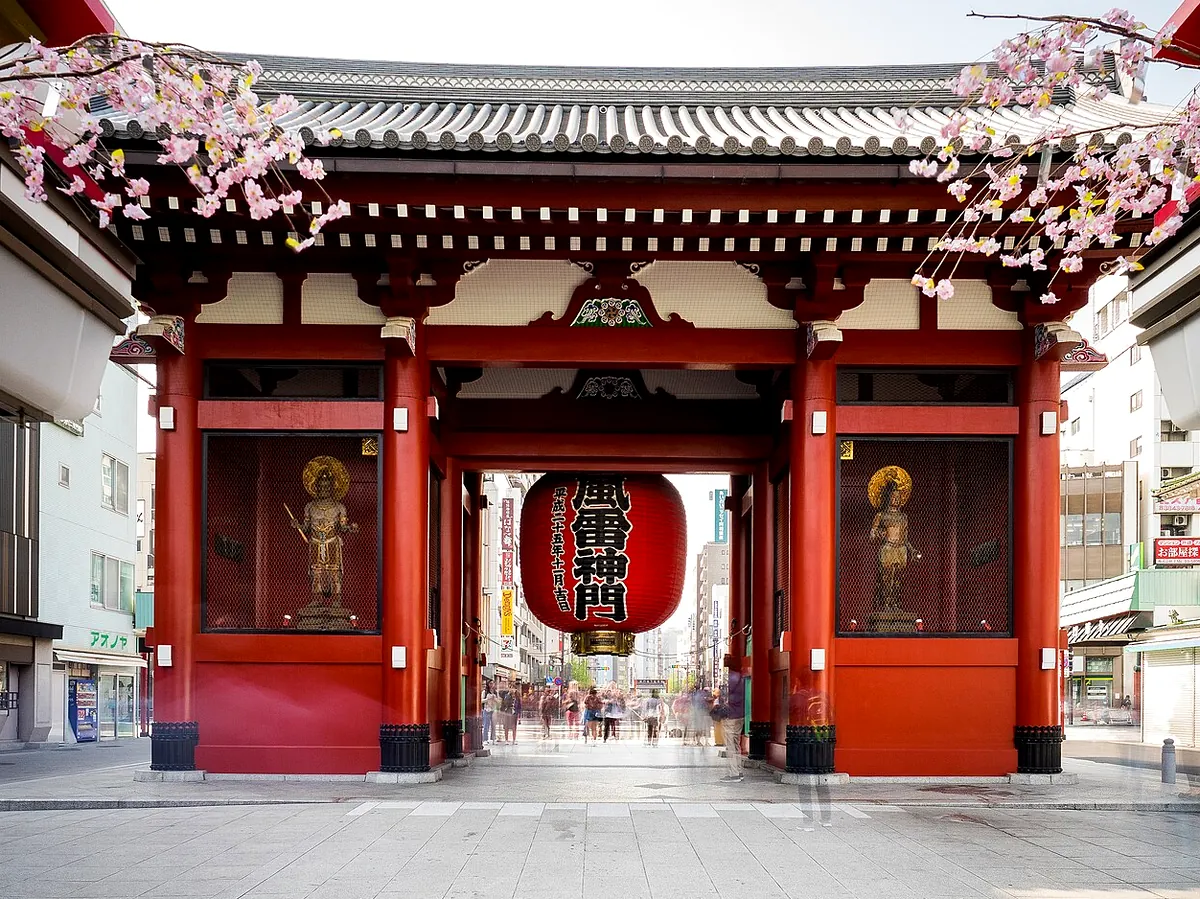
Aligned along its classical north–south sacred axis, the Senso-ji complex unfolds as an architectural progression transitioning gracefully from worldly clamor to tranquil sanctuary. Greeting visitors at the outer threshold is Kaminarimon—officially named Furaijinmon, the “Wind and Thunder God Gate.” Standing proudly in Asakusa since the early Heian period, this vermilion-lacquered timber gate has become an enduring visual emblem of Tokyo thanks to its colossal crimson silk Chochin lantern weighing roughly 700 kilograms suspended squarely in the center, its wooden base intricately carved with a coiling dragon by master Kyoto artisans. Flanking the passageway are fierce statues of Raijin, the God of Thunder clutching a ring of drums, and Fujin, the God of Wind bearing a windbag—guardians warding off calamity and protecting the sanctuary across centuries.
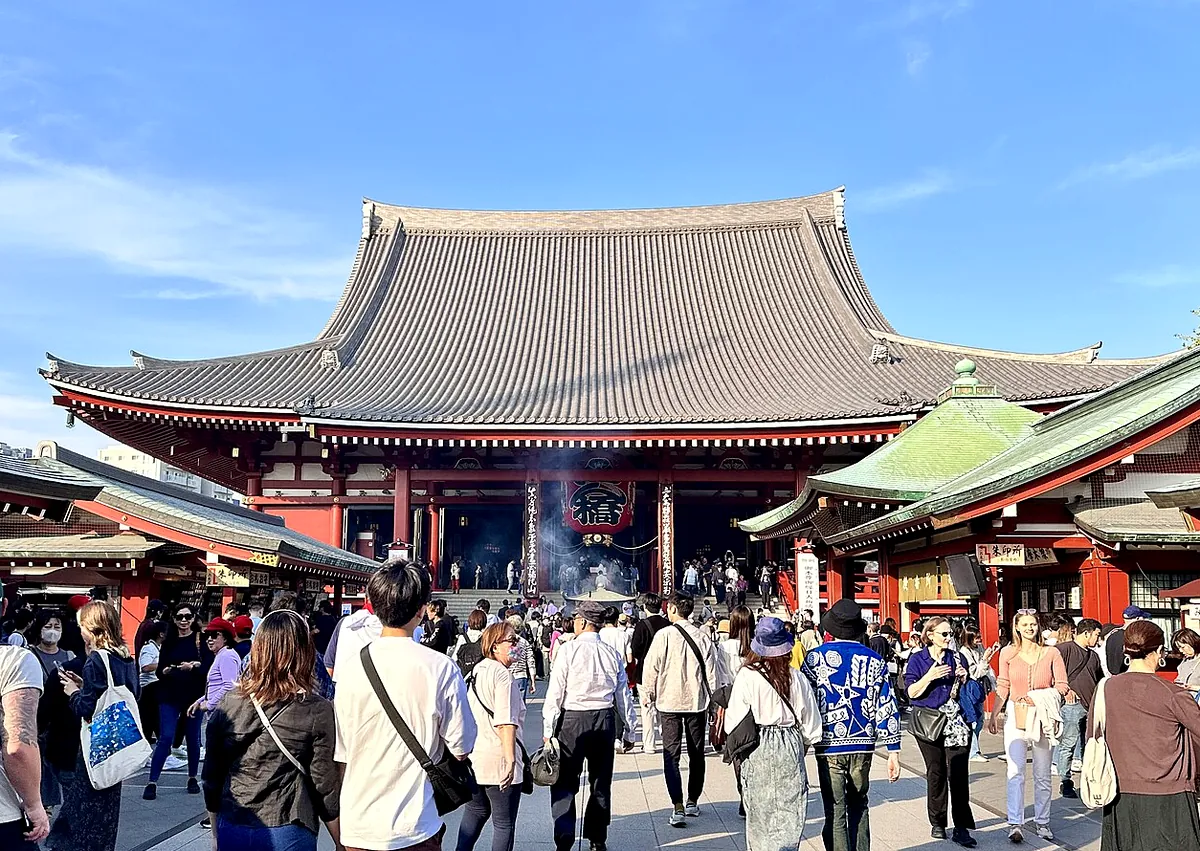
Passing beneath Kaminarimon, visitors step onto Nakamise-dori, a straight 250-meter pilgrimage avenue ranking among Japan’s oldest shopping streets, dating back to when Shogun Tokugawa Ieyasu established his capital in Edo. Nearly ninety traditional shops lined beneath uniform tiled roofs form a living cultural gallery preserving Edo townspeople spirit—filled with the sweet aroma of freshly baked red-bean Ningyo-yaki cakes, the crisp snap of hand-grilled Senbei rice crackers, and vivid displays of folding fans and silk hair ornaments. Far from diminishing the temple’s sanctity, this lively promenade serves as a transitional buffer gently easing pilgrims out of everyday distractions before approaching the sacred halls.
At the northern end of Nakamise-dori, the courtyard opens before Hozomon, the “Treasure House Gate,” a massive two-story structure built in grand tower style. Its upper story serves as a secure sutra repository safeguarding rare editions of the Buddhist canon and priceless national cultural treasures. Hanging dramatically on the inner side of the gate is a pair of colossal Waraji straw sandals weighing 500 kilograms each, painstakingly woven from harvested rice straw by hundreds of devotees from Murayama in Yamagata Prefecture. Symbolizing the mighty stride of the temple’s Nio guardian deities to ward off evil, these giant sandals also testify to the enduring spiritual bond between rural farming communities and Tokyo’s historic temple.
Rising to the southwest of the main courtyard is Gojunoto, the Five-Story Pagoda, soaring 53.3 meters into the sky as the second-tallest Buddhist pagoda in Japan. Reconstructed using advanced seismic-resistant engineering while faithfully replicating every Edo-period bracket and eave proportion, its five tiers symbolize the five foundational elements of Buddhist cosmology: Earth, Water, Fire, Wind, and Sky. Enshrined at the pinnacle are sacred relics of Shakyamuni Buddha gifted by the Royal Family of Sri Lanka, anchoring a spiritual focal point that draws devotion from across the world.
The spiritual heart of the entire complex converges at the Hondo, also known as Kannondo (Hall of Kannon). Crowned by a sweeping hip-and-gable Irimoya roof clad in blue-gray titanium tiles, the main hall resembles a thousand-petaled lotus sheltering humanity. Outside on the stone terrace stands the monumental bronze Jokoro incense burner, where pilgrims waft fragrant clouds of smoke over their heads and shoulders to purify karma and pray for health and peace. Stepping across the wooden threshold reveals a magnificent interior adorned with dramatic ceiling murals of dragons and celestial maidens painted by master artists Kawabata Ryushi and Domoto Insho. Deep within the gleaming gilded altar resides the sacred hidden image (Hibutsu) of Bodhisattva Kannon retrieved from the Sumida River centuries ago—permanently veiled from human eyes yet radiating timeless compassion to all who come to pray.
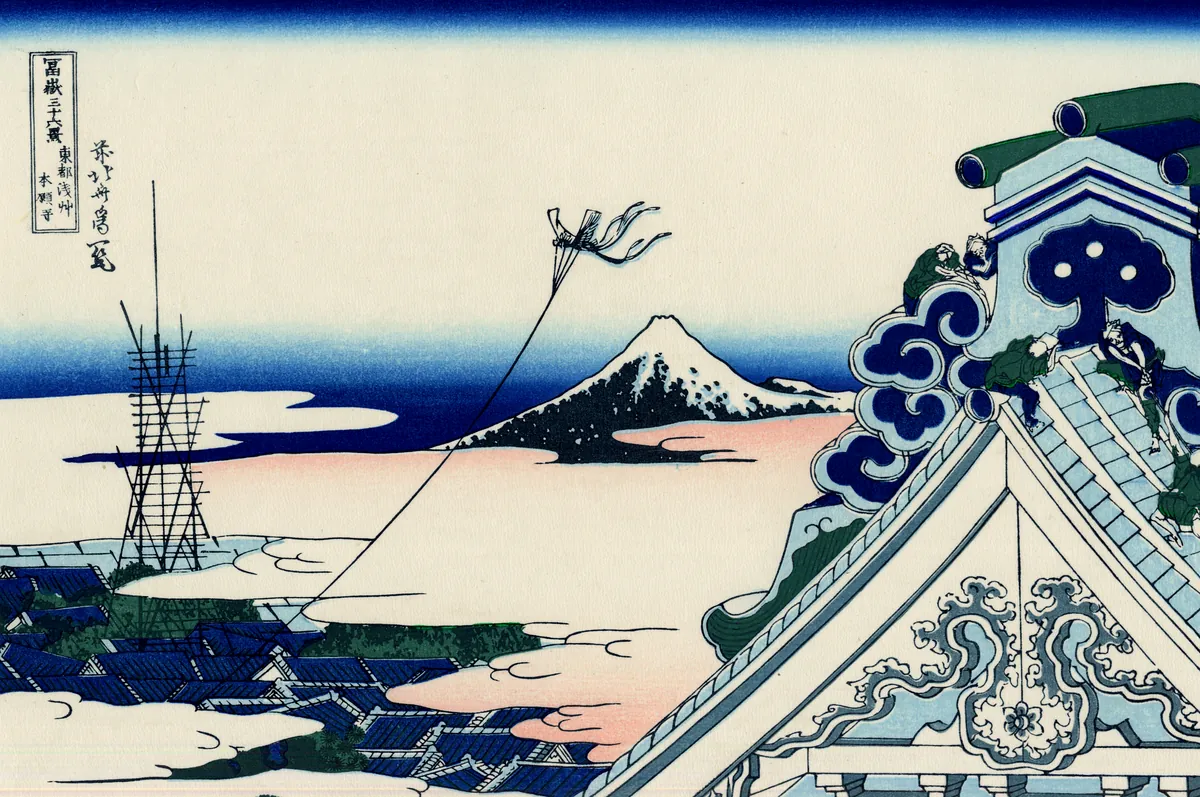
As crimson sunset glow fades behind Tokyo’s western horizon and the Sumida River turns deep indigo, ancient Senso-ji sheds its daytime bustle to enter an enchanting nocturnal symphony of light. The architectural night illumination of this millennial sanctuary was masterfully designed by world-renowned lighting artist Motoko Ishii to commemorate the 400th anniversary of the Tokugawa Shogunate’s establishment of Edo. Under her visionary direction, discreetly concealed fixtures sculpt the historic grounds in warm gold and luminous vermilion light, accentuating the rich cinnabar lacquer of Kaminarimon and Hozomon in a display at once ethereal and majestic against Tokyo’s deep night sky.
The radiant centerpiece of this quiet evening tableau is the 53-meter Five-Story Pagoda rising west of the Main Hall. Precision-calibrated beams illuminate every steeply pitched roof tier and intricate multi-tiered bracket modeled on classical Heian-period Buddhist architecture. Down at Kaminarimon, the massive 700-kilogram red silk lantern donated by industrialist Konosuke Matsushita glows like a warm suspended sun, while uplights beneath its dragon-carved cedar base highlight the bold calligraphy of the Thunder Gate and cast soft reflections across flagstones worn smooth by millions of pilgrims over centuries.
Beyond monumental temple halls, Asakusa after dark hosts a unique “silent visual exhibition” stretching along the 250 meters of Nakamise-dori. After 6:00 PM, once crowds thin and souvenir stalls pull down their shutters, an unexpected open-air art gallery appears known as the Asakusa Emaki (Asakusa Picture Scrolls). All eighty-nine metal roll-down shop shutters are painted with vivid murals rendered in the style of traditional Ukiyo-e woodblock prints. Strolling down the lantern-lit promenade in quiet solitude feels like turning the pages of an illustrated chronicle of Shitamachi—depicting the legendary Golden Dragon Dance, the exuberant Sanja Matsuri festival with massive mikoshi portable shrines carried by crowds, and graceful Edo-period geisha and Kabuki actors.
In lively contrast to the serene temple grounds after 9:00 PM is the warm, down-to-earth camaraderie along Hoppy Dori, a narrow culinary lane running right outside Senso-ji’s western wall. Less than a hundred meters long, this nostalgic alley preserves the free-spirited atmosphere of old Edo townspeople through cozy open-front taverns draped in bright orange vinyl curtains. Beneath warm bulbs and drifting steam from simmering pots of rich miso-braised beef tendon stew (nikomi), glasses of Hoppy malt beverage and sake clink amid cheerful local conversation—completing an evening portrait of Asakusa where sacred stillness and vibrant human warmth coexist effortlessly.
Stepping away from the fragrant incense smoke of Senso-ji’s Main Hall, travelers are naturally drawn into a labyrinth of flavors nurtured across centuries in Shitamachi—the historic riverside lowland where Edo-period culinary traditions still pulse with life. Far more than quick snacks for passing pilgrims, the foodscape surrounding the temple is a living museum of family craftsmanship in which every specialty is woven into local folklore, dynastic shifts, and the unpretentious yet deeply refined palate of old Tokyo.
Right along Nakamise-dori leading toward the temple gates, the sweet aroma of toasted batter and butter wafts from heavy cast-iron molds baking iconic Ningyo-yaki cakes. Originating during the Meiji era in a nearby theater district before taking permanent root in Asakusa, Ningyo-yaki are edible miniature sculptures celebrating local spiritual life. In the practiced hands of third- and fourth-generation artisans, light sponge batter is poured around smooth, sweet azuki red bean paste and baked into shapes of the Kaminarimon lantern, the five-story pagoda, or peaceful temple doves. Biting into one piping hot reveals delicate bean sweetness encased in a lightly crisp golden crust—feeling like a warm blessing straight from the temple gates.
Sharing the stone-paved avenue with Ningyo-yaki is Kaminari-okoshi, an iconic crisp confection boasting a history spanning more than two centuries back to the mid-Edo period. Its name borrows “Kaminari” directly from the Thunder Gate, while “okoshi” carries the auspicious double meaning of “rising up” and “prospering.” Puffed rice grains are folded into golden malted syrup and roasted peanuts, pressed flat on wooden boards, and cut into neat squares. Its rich caramel-like sweetness and satisfying crunch have long made Kaminari-okoshi a favored good-luck souvenir carried home by merchants and pilgrims alike.
Wandering deeper into side lanes around the temple precinct, passersby are lured by the inviting sizzle of bubbling sesame oil at family-run Age-Manju stalls. Distinct from traditional steamed buns, Asakusa’s Age-Manju are dipped in a light batter and deep-fried in fragrant sesame oil until their exterior turns crisp and golden brown. The irresistible contrast between a crunchy, nutty crust and warm, velvety sweet red bean filling makes it an unforgettable treat—especially on brisk winter days in Asakusa.
As dusk settles over the Sumida River, Shitamachi’s culinary energy shifts to sizzling hot griddles tucked inside cozy backstreet eateries serving local specialty Monjayaki. Born during lean economic times in the late Edo era and popularized in the Meiji period as hearty working-class fare, this savory pan-fried batter blends finely shredded cabbage, dried squid, shrimp, and flavorful dashi stock poured directly onto a blazing-hot steel griddle. Diners use miniature metal spatulas (hagashi) to press bits of the savory batter directly against the hot plate until crisp and caramelized at the edges—a convivial, hands-on meal where social boundaries dissolve over shared griddles.
No culinary pilgrimage to Asakusa is complete without pausing at a historic riverside restaurant along the Sumida to savor charcoal-grilled eel over rice (Unadon). Since the Edo period, the fertile Sumida River supplied prized wild freshwater eel to Tokyo gourmets. Across centuries, heritage eel houses have upheld the classic Kanto-style preparation: eels are butterflied from the back, steamed tender to render excess fat, basted in dark, glossy heirloom tare sauce passed down through generations, and grilled over glowing binchotan white charcoal. Melt-in-your-mouth fillets lacquered in deep sweet-savory glaze atop steaming Japanese rice encapsulate the patience, refinement, and thousand-year heritage of storied Asakusa.
Senso-ji’s outdoor temple grounds remain open twenty-four hours a day, welcoming visitors to stroll through serene courtyards at dawn or admire the lantern-lit halls after sunset. However, the Hondo Main Hall itself opens for worship from 6:00 AM (6:30 AM during winter from October through March) and closes promptly at 5:00 PM. To reach historic Asakusa effortlessly without getting lost in Tokyo’s vast rail network, the subway is by far the most convenient option. Simply ride the Tokyo Metro Ginza Line to Asakusa Station (Exits 1 or 3), the Toei Asakusa Line (Exit A4), or the private Tobu Skytree Line; after a pleasant five-minute walk along lively streets, the towering Kaminarimon gate and its giant red lantern appear straight ahead.
Stepping onto the sacred grounds of Kinryuzan (Golden Dragon Mountain), what truly enriches a visit is not merely snapping souvenir photos, but understanding and practicing authentic Japanese temple etiquette. Before approaching the Main Hall, pause at the Chozuya purification pavilion on the right side of the main approach. This ritual cleansing follows a graceful sequence: hold the wooden ladle (hishaku) in your right hand to scoop water once, pour a little over your left hand, switch hands to rinse your right hand, then cup water in your left palm to rinse your mouth discreetly—never touching your lips directly to the ladle—before tilting the ladle vertically so remaining water washes down the handle for the next visitor. Next, stop before the smoking bronze Jokoro incense burner in the courtyard, where pilgrims gently wave fragrant smoke over their heads, shoulders, or aching joints in the centuries-old belief that sacred incense clears the mind and promotes good health.
Beside the worship hall, drawing an Omikuji paper fortune for a modest 100 yen offers a memorable cultural ritual. After dropping a 100-yen coin into the wooden offering box, shake the cylindrical metal container (mikuji-tsutsu) with both hands until a numbered bamboo stick slides out, then open the matching wooden drawer to retrieve your fortune slip. Senso-ji is famous for preserving the traditional Muromachi-era ratio of “bad fortune” (Kyo) slips as a reminder to remain humble and mindful through life’s uncertainties. If you draw a “great blessing” (Daikichi), fold it neatly into your wallet as a keepsake; if you draw an unfavorable fortune, simply tie the strip onto the designated wire racks on the temple grounds to leave the misfortune behind in the Buddha’s care.
Alongside respectful temple etiquette, planning a rewarding visit to Asakusa means managing your schedule wisely and avoiding common tourist pitfalls. While the surrounding old town offers celebrated street treats like red-bean ningyo-yaki cakes and traditional nara-zuke pickles, bargain group tours sometimes cut temple sightseeing down to a hurried rush in order to squeeze in mandatory stops at commissioned duty-free shops. Choosing a transparent, no-forced-shopping itinerary lets you savor the timeless grace of Asakusa at an unhurried pace—from the quiet elegance of the five-story pagoda to centuries of history etched into fragrant cypress beams. To experience the cultural depth of Japan seamlessly without commercial distractions, consider booking a thoughtfully crafted all-inclusive Japan tour package.