Nestled deep within the vast wilderness of Pleiku, Chu Dang Ya emerges as a majestic creation of nature, where time stands still across ancient layers of lava and the epic echoes of the Central Highlands. According to geodetic records and military maps, the center of this volcanic crater lies at approximately $14^circ 03’15″N$ and $108^circ 02’40″E$, in Chu Dang Ya Commune, Chu Pah District, Gia Lai Province. Not only is it an iconic ecotourism stop, but it is also a priceless geological heritage site bearing witness to Earth’s tectonic activity millions of years ago. The inverted-funnel crater features a shallow basin cradled by fertile basalt soil weathered over tens of millennia, fostering a singular ecosystem that is at once fiercely untamed and softly poetic.
Viewed through the lens of linguistics and cultural anthropology, the name Chu Dang Ya carries the deep indigenous imprint of the Jrai people (specifically the Jrai Pat or Ham subgroups). In their ancestral dialect, “Chu” signifies mountains or high peaks, while “Dang Ya” means “wild ginger root” or “wild turmeric.” Consequently, Sino-Vietnamese scholars have often referred to it as “Son Khuong Son”—the Mountain of Wild Ginger—reflecting the primeval flora that once blanketed its slopes. The name not only mirrors the region’s early botanical ecology, but also serves as an invisible thread binding humanity to nature, where every toponym holds a story of survival and the intimate bond between local communities and Mother Earth.
Within the cultural and spiritual realm of the Jrai people, Chu Dang Ya reigns as a sacred sanctuary blessed with the auspicious feng shui terrain of “Coiled Dragon, Crouching Tiger” (Hoi long ngoa ho). To the southwest, the mountain faces the imposing Chu Nam Peak—the sheltering roof of the Central Highlands’ gong cultural space—while to the east it borders the ancient valley system of the Ba River basin (Kroong Pa). Rising independently amid a belt of crimson basalt, Chu Dang Ya has become a nexus of vital energy where the sacred spirits of heaven and earth converge, preserving ethnic memories through timeless epic chants (Ho mon).
Across the sweep of history, Chu Dang Ya has been celebrated by cultural authorities, geologists, and both domestic and international media as one of the most stunning unspoiled destinations on the planet. Devoid of the grandeur of royal palaces or ancient temple complexes, Chu Dang Ya’s value lies in its prehistoric archaeological layers and millions of years of geological sediment. Here, every late autumn and early winter, the brilliant yellow of millions of wild sunflowers blanketing the slopes awakens the fierce vitality of the basalt earth, transforming a seemingly dormant volcano into an enduring symbol of eternal life—a sublime harmony between geological history and the sacred cultural soul of Vietnam.
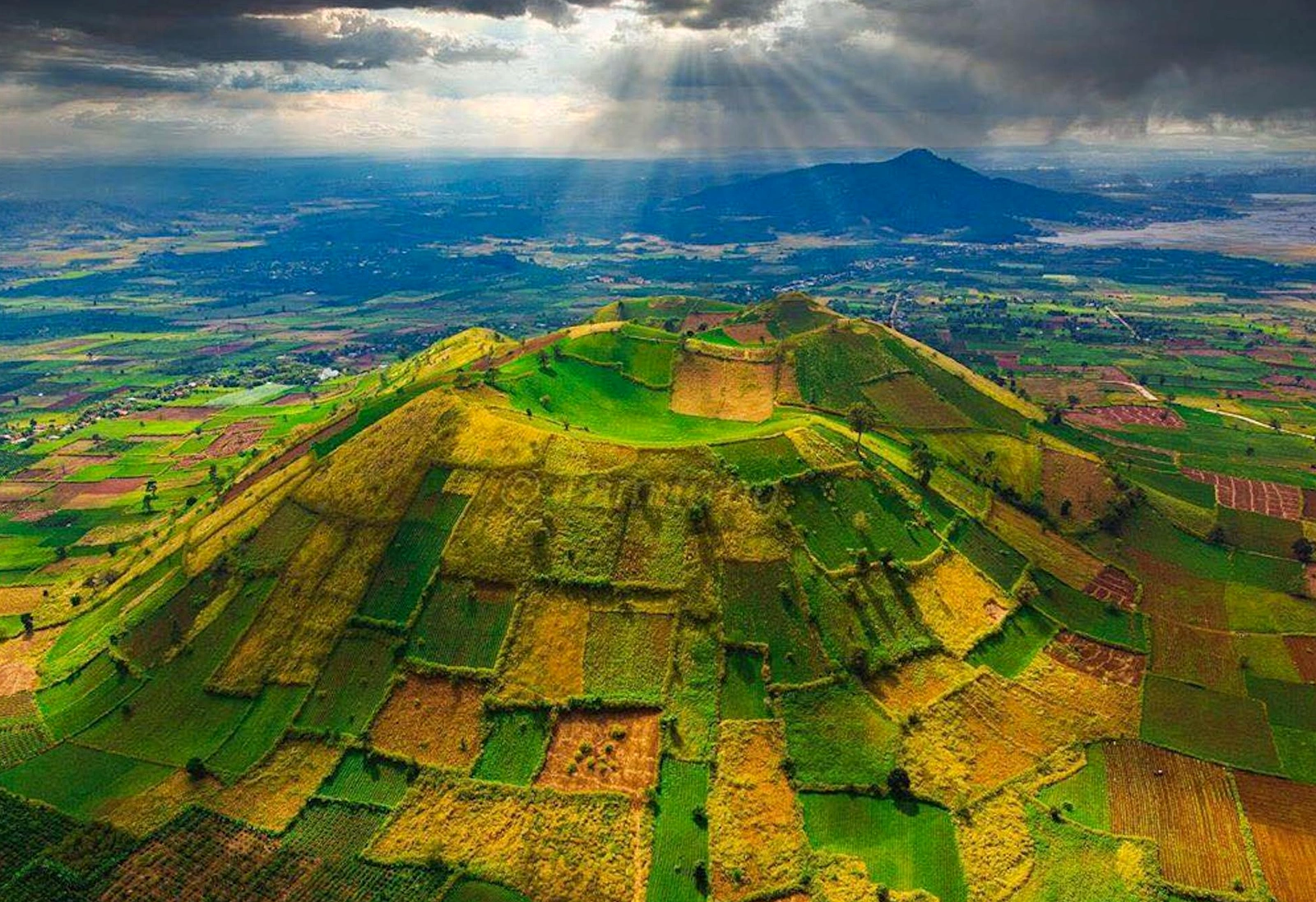
Hidden amidst the vast wilderness of the Central Highlands, Chu Dang Ya stands as a magnificent natural architectural masterpiece sculpted by Mother Nature over millions of years of geological upheaval. Unlike the quiet antiquity of moss-covered Cham towers or the regal solemnity of Nguyen Dynasty palaces, Chu Dang Ya’s allure lies along the border between primeval wilderness and the vibrant life force of crimson basalt soil. Seen from afar, this dormant volcano makes an immediate impression with its distinctive inverted-funnel structure: steep outer flanks that open up into a wide, tranquil basin at the summit. Shaped by time and weathering, the volcanic basalt here has transformed into a rich, fertile soil layer, allowing native ecosystems to thrive and draping the entire landscape in a lush green carpet year-round.
What gives Chu Dang Ya its magnetic charm is its magical transformation across the seasons, turning the volcano into a living museum of landscapes. During the rainy season, roughly from June to October, the entire mountainside is submerged in the endless emerald hues of terraced fields, meadows, and thriving patches of corn and sweet potatoes tended by the Jrai people. Yet this natural canvas reaches its visual pinnacle in the dry season, from late October to early November, when millions of wild sunflowers burst into bloom all at once. At this time, the colossal volcano appears draped in an imperial robe of radiant golden-orange, flowing gracefully along the contours of the funnel-shaped crater. The interplay of golden wild sunflowers, signature red basalt earth, and a boundless azure sky creates breathtaking spatial depth that captivates every traveler and photographer who sets foot here.
To capture the true spirit of this geological heritage site, professional photographers and leading travel magazines have pinpointed two classic vantage points. The first “million-view” photo spot sits right along the crater rim (the heart of the funnel), allowing you to frame the entire sweeping basin in a single shot. The golden window for this angle is at sunrise (from 5:30 AM to 6:30 AM), when the day’s first sunbeams pierce through delicate veils of morning mist clinging to the wild sunflower petals, creating an ethereal, misty glow steeped in Central Highlands mythology.
The second coveted vantage point is the highest spot along the southwestern slope, gazing out toward the majestic Chu Nam Peak in the distance. The ideal time to shoot here is at sunset (from 4:30 PM to 5:30 PM). As dusk settles, warm golden light floods the basalt valley, casting long shadows across the ridges to create dramatic, three-dimensional relief. Snapping a photo at this moment rewards you not only with an extraordinary landscape shot, but also with the deep, sacred pulse of heaven, earth, and primeval culture converging in the highlands.
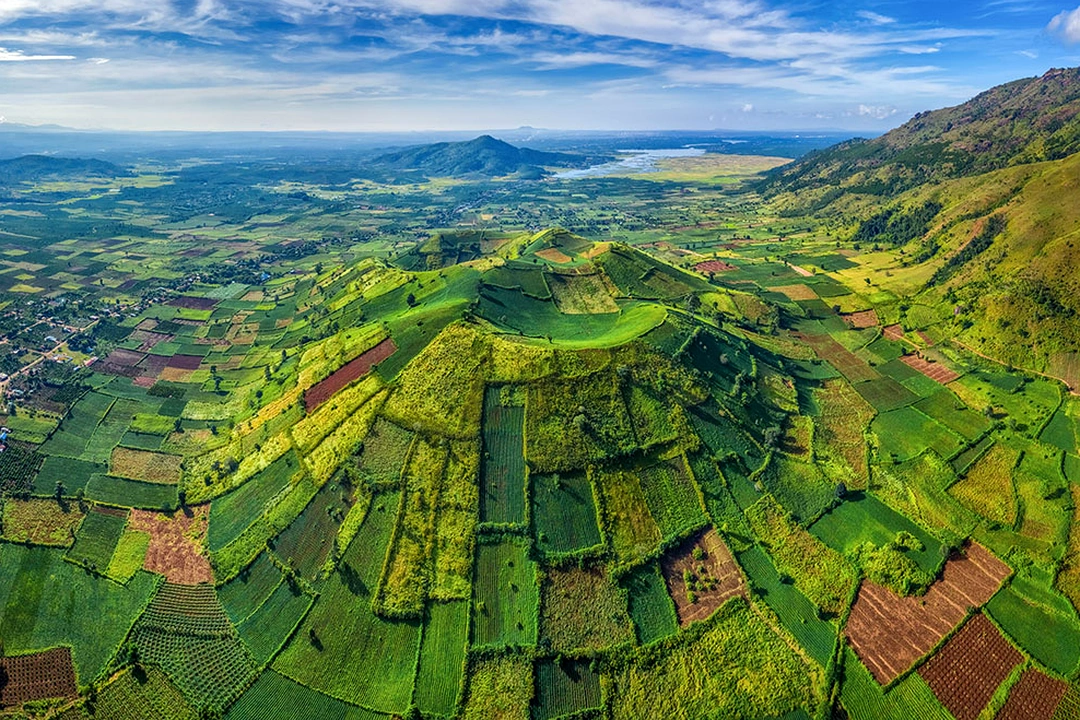
Arriving at Chu Dang Ya, visitors do more than encounter a million-year-old geological wonder—they step into a living indigenous cultural space where the heartbeat of the Central Highlands echoes with every footstep. Exploring this ancient volcano begins along a winding red-basalt dirt trail, where each stride feels like listening to the resonant story of Earth’s past beneath your feet. Though the ascent can be steep and demanding in stretches, the reward is an overwhelming surge of awe as the horizon opens wide before you. The higher you climb, the crisper and fresher the air becomes, carrying the earthy fragrance of wild grasses, open skies, and mountain breezes that awaken a pure sense of freedom.
Standing on the crater rim and gazing down, the giant basin unfolds like a monumental ink-wash painting carved by nature’s own hand. Depending on the season, Chu Dang Ya dons vivid new attire that leaves every onlooker spellbound. In the rainy months, vibrant green plots of corn, sweet potatoes, and wild grass carpet the deep funnel floor, radiating untamed vitality. Toward year’s end, as the dry season arrives on cool mountain breezes, the entire mountainside ignites in the golden brilliance of millions of blooming wild sunflowers. Standing amid that wide-open expanse, taking in the majestic silhouette of Chu Nam Peak to the southwest and endless green basalt valleys below, travelers feel both humble before nature’s grandeur and blessed with a rare, profound stillness of soul.
Beyond visual splendor, an experience at Chu Dang Ya reaches deep into the spiritual culture and daily life of the indigenous Jrai people. Amid sacred mountain surroundings—revered as the dwelling place of deities in local animist beliefs—visitors feel as though they are paying homage to an untainted natural sanctuary. Stories told beside glowing hearths by village elders about the mountain’s origins and bountiful harvests passed down through tribal memory offer priceless anthropological insight. Here, the connection between modern travelers and primeval cultural roots happens effortlessly and deeply, through warm glances, sincere smiles, and the distant chime of gongs drifting through air scented with ripe red coffee cherries.
No journey through this legendary basalt land is complete without savoring its renowned highland culinary specialties bursting with forest flavors. Right at the foot of the mountain or in neighboring villages, visitors are welcomed with authentic local dishes such as bamboo-grilled chicken fragrant with wild mac khen pepper, sticky rice cooked in bamboo tubes (com lam) made from aromatic upland grains, and smoked mountain meats infused with woodsmoke, served with spicy lemon-basil salt. Sharing a warm sip of traditional jar wine (ruou ghe) fermented with forest leaves alongside the children of the highlands lets travelers truly experience the heartfelt hospitality of the Jrai people. Together, these unforgettable encounters with scenery, culture, and cuisine make Chu Dang Ya a destination that lingers forever in the hearts of all who visit.
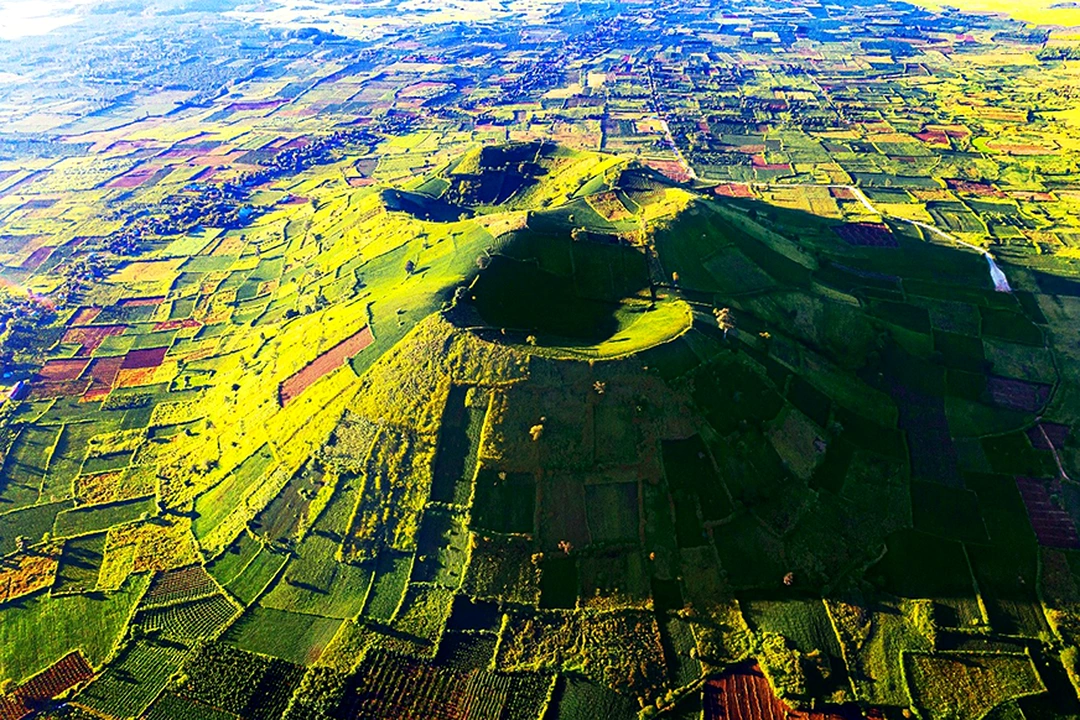
Chu Dang Ya is one of the most captivating natural attractions in the Gia Lai highlands, drawing scores of visitors with the untamed majesty of its million-year-old volcanic crater. To ensure your exploration goes smoothly and rewardingly, knowing practical details about visiting hours, transportation, and preparation is essential.
Regarding visiting hours, the Chu Dang Ya scenic area is open freely to visitors every day of the week with no fixed closing times. However, the best times of day to set out are early morning (from 5:30 AM to 8:00 AM) or late afternoon around sunset. During these hours, the lighting is at its finest, the air is crisp and refreshing, and you avoid the harsh midday highland sun. As for admission costs, visiting and photographing the area is completely free of charge for all travelers.
The best route from central Pleiku City is to head northeast along National Highway 14, then turn left at the Bien Ho (Sea Lake) junction onto Provincial Road 671, continuing through Chu Dang Ya Commune in Chu Pah District. The total distance is roughly 30 kilometers, taking about 45 minutes by motorbike or car. Visitors are advised to opt for a motorbike or a high-clearance vehicle to easily navigate the red-basalt dirt trails leading right up to the foot of the mountain.
The finest time of year to visit is at the end of the rainy season, roughly from October to November. During this period, the brilliant golden glow of millions of blooming wild sunflowers blankets the hillsides, creating a breathtaking natural spectacle. Conversely, during the rice harvest season (around January to February), the landscape transforms into shimmering shades of gold across the terraced fields nestled at the base of the volcano.
When packing your outfit, opt for neat, breathable clothing and wear athletic shoes or hiking boots with solid traction to stay safe on steep, rocky, and slippery red-dirt slopes. Additionally, because this is an indigenous cultural space deeply tied to the spiritual life of the Jrai people, please dress modestly and respectfully, never litter, and help protect both the natural scenery and local community heritage.
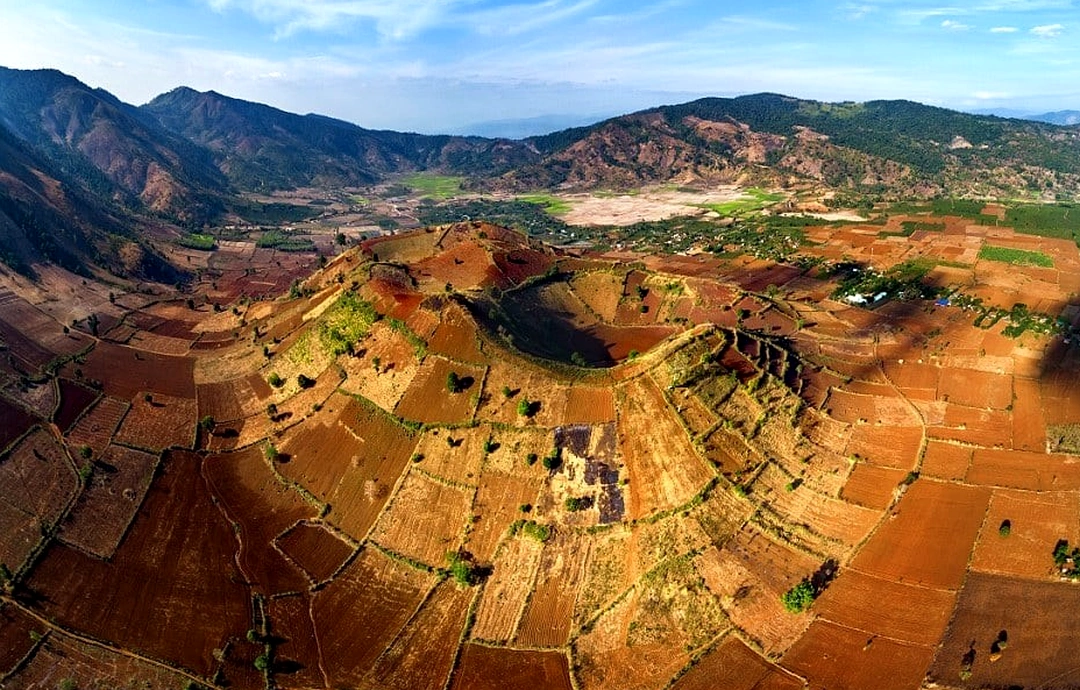
To enjoy a seamless getaway and take in the full beauty of Chu Dang Ya without worrying about arranging transportation, attraction tickets, or daily itineraries, travelers can choose VDS Travel’s premium all-inclusive Gia Lai tour packages. Every itinerary is thoughtfully timed for photo check-ins when the scenery is at its most radiant, accompanied by knowledgeable local guides well versed in regional culture alongside top-tier hotel and dining standards.