Located about five kilometers west of the ancient city of Lin’an, in the Jianshui region of the Honghe Hani and Yi Autonomous Prefecture, the Double Dragon Bridge (Shuanglong Bridge) stands as a magnificent link between the natural landscape and the turbulent currents of Southern history. Looking back to the 30th year of the Qianlong era (1765), this frontier land suffered from severe isolation whenever heavy waters arrived. During the rainy season, the Lujiang River would surge with violent waves, completely severing the vital transport artery connecting Lin’an Prefecture to Shiping and the fertile lands of southwestern Yunnan. Understanding the hardships of the people and the stagnation of trade, local gentry and wealthy families raised funds and mobilized the most skilled stonemasons to carve the first three sturdy stone arches across the main channel of the Lujiang River, giving birth to the predecessor of this famous ancient bridge.
However, the magnificent appearance of this landmark today is tied to an unexpected geological turning point in the 19th year of the Daoguang era (1839). At that time, the Tachong River suddenly changed its course, flowing to merge with the Lujiang River right in front of the old bridge, causing the riverbed to widen unexpectedly by over a hundred meters and leaving the three original arches stranded in the middle of the flooded banks. Faced with an urgent threat to local livelihoods, the then-Prefect of Lin’an, along with the prominent Zhang and Zhu families, initiated a major financial campaign across the county. A miraculous feat of engineering followed as they built fourteen additional stone arches extending northward, seamlessly connecting them with the three Qianlong-era arches to create a majestic seventeen-arch bridge, commonly known by the locals as the Seventeen-Arch Bridge. This historic expansion not only tamed the fierce river junction but also secured the mineral transport artery for the renowned Gejiu tin mines, while ensuring smooth passage for horse caravans laden with goods along the legendary Tea Horse Road.
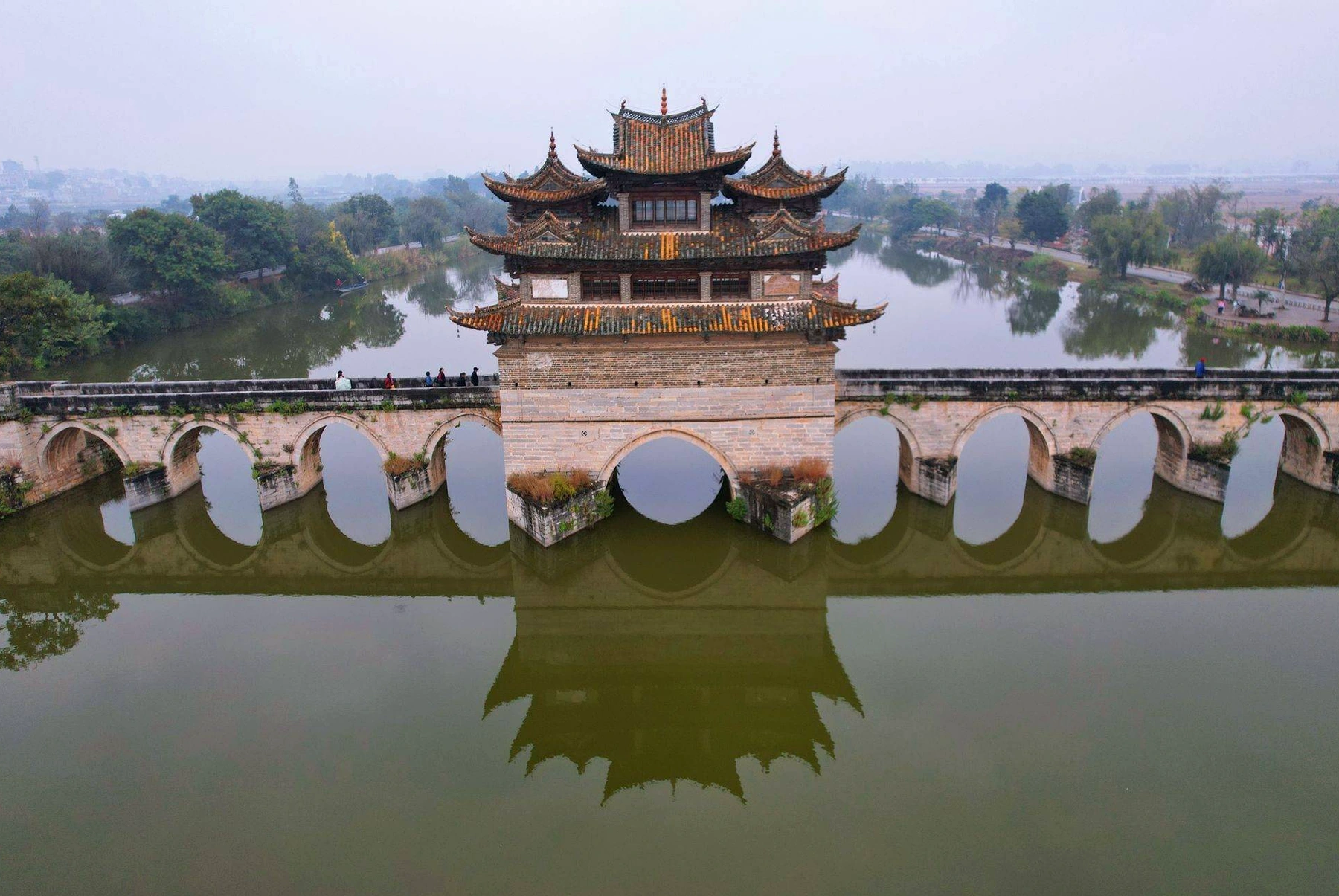
Viewing the panorama from the water, the ancient stone bridge appears like a sublime, silent natural scene with the rhythmic, winding arches facing the wind across the calm lake. At the very center of the bridge, a traditional multi-story pavilion rises proudly with elegant, upturned tiled roofs, casting a perfect, symmetrical reflection onto the mirror-like water. The surrounding space is enveloped by lush greenery growing along the banks, with distant, hazy mountains appearing under a deep blue sky dotted with drifting white clouds.
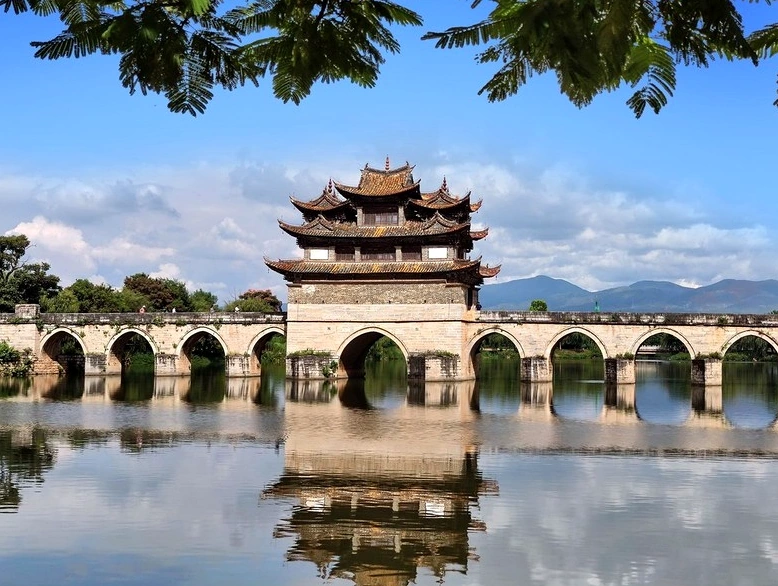
Despite its incredibly sturdy slate construction, the structure could not avoid the harsh scars of wartime. In the 6th year of the Xianfeng era (1856), the flames of the Du Wenxiu uprising spread across the Dianxi and Diannan regions, causing the magnificent pavilions on the bridge to be completely burned down, leaving only the desolate stone deck exposed to the elements. It took four decades, from the 22nd to the 24th year of the Guangxu era (1896-1898), for the Lin’an Prefectural Supervisor to officially initiate a large-scale restoration. Under the hands of skilled craftsmen, the massive three-story main pavilion in the center and two auxiliary pavilions at the ends were fully reconstructed, firmly establishing the unique “bridge-pavilion integration” architectural style, which harmonizes the art of arch bridge construction with the essence of traditional Oriental palace architecture.
Through many historical changes, the structure was included in the list of key provincial conservation sites of Yunnan in 1965, before being declared a Major Historical and Cultural Site Protected at the National Level by the State Council in May 2006. The stature of the Double Dragon Bridge once led China’s leading bridge expert, Mao Yisheng, to express his full admiration, ranking the structure alongside thousand-year-old legends like the Zhaozhou Bridge or the Lugou Bridge, and honoring it as the second-largest ancient stone arch bridge in all of China. The proud silhouette of the seventeen stone arches spanning the junction of the Lujiang and Tachong rivers has thus transcended local boundaries, appearing on national postage stamps and becoming an immortal testament to the water management wisdom and extraordinary construction skills of the ancients.
Presenting impressively at the geographical coordinates of 23°36’51” North latitude and 102°47’28” East longitude, the Double Dragon Bridge lies entirely within the low-lying basin of the famous Red River tectonic fault zone. This is a spectacular hydrological convergence point between two vital waterways of ancient Lin’an: the Lujiang River and the Tachong River. The natural flooded basin terrain created a fertile wetland, where silt deposited over millions of years formed rich banks. Laying the foundations for a massive bridge project at this very flooded intersection not only required a thorough understanding of hydrology but also demonstrated the masterful ecological spatial vision of the ancestors.
According to traditional Chinese Feng Shui, the terrain here possesses the full spiritual energy of the “Double Dragon Convergence” structure. The name Double Dragon stems from the soft, winding shapes of the Lujiang and Tachong rivers, which look like two giant dragons coiling from the distant mountains to meet in the calm wetland. To tame the erratic nature of the floods and retain prosperity for the entire Jianshui basin, the sages of the past built a sturdy stone bridge like a rainbow spanning the waves. The structure acts as a solid bolt, fulfilling the mission of “locking the water gate,” turning the rushing currents into a tranquil lake, helping to accumulate spiritual energy, preventing flood disasters, and bringing long-lasting prosperity to the villages.
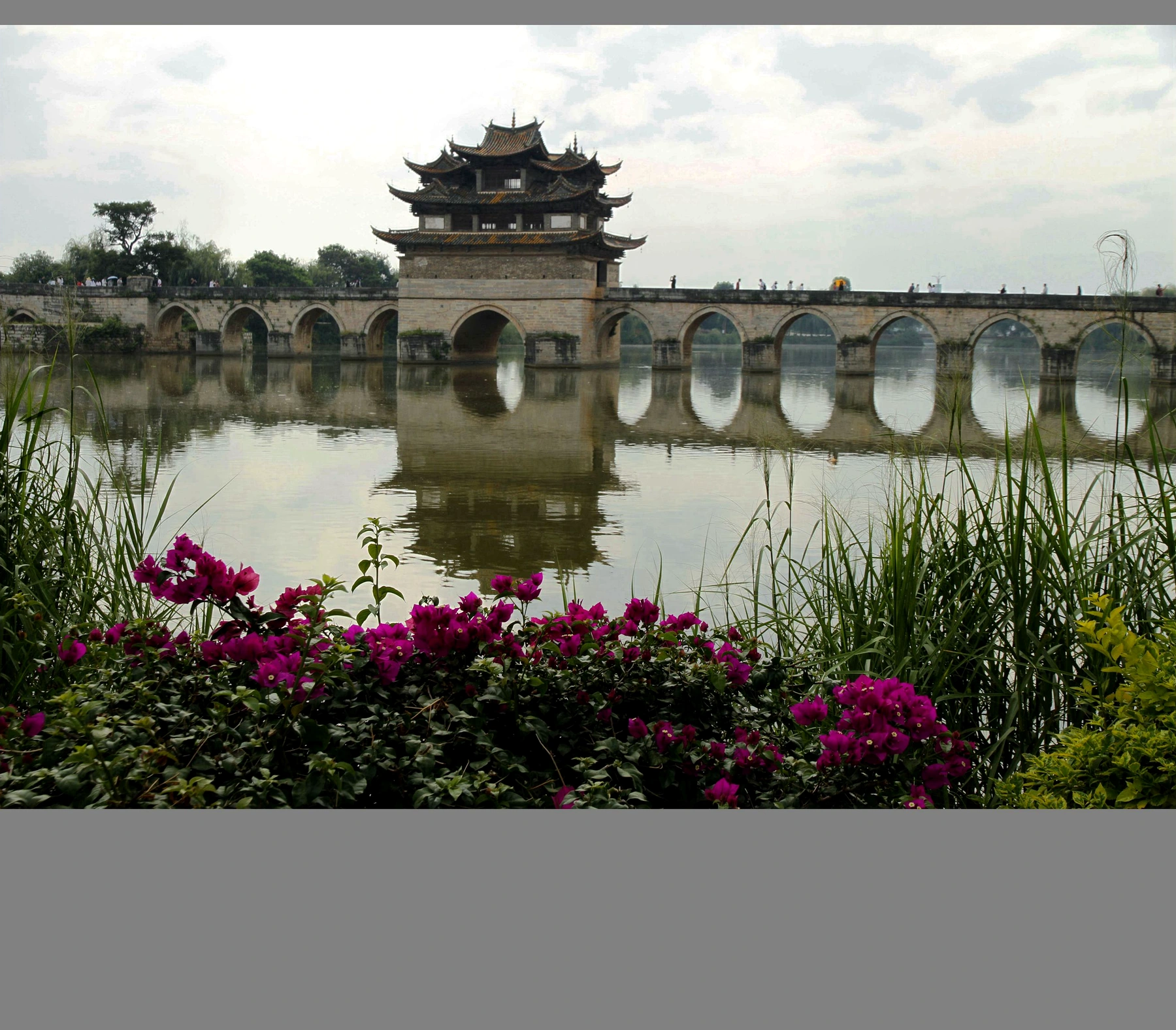
From a panoramic perspective, the multi-span stone bridge proudly stretches across the banks, gracefully supporting the simple rhythm of rural life. The centerpiece of the bridge’s design is a multi-story ancient pavilion that stands tall and proud, distinguished by its sweeping, upturned eaves that reach out in all four directions—a hallmark of traditional Oriental palace architecture. This perfectly symmetrical architectural complex casts a flawless reflection onto the vast, calm lake, which acts like a giant mirror reflecting the earth and sky. In the distance, rolling mountains fade into the vast, clear blue sky, creating a picturesque, serene, and deeply moving landscape.
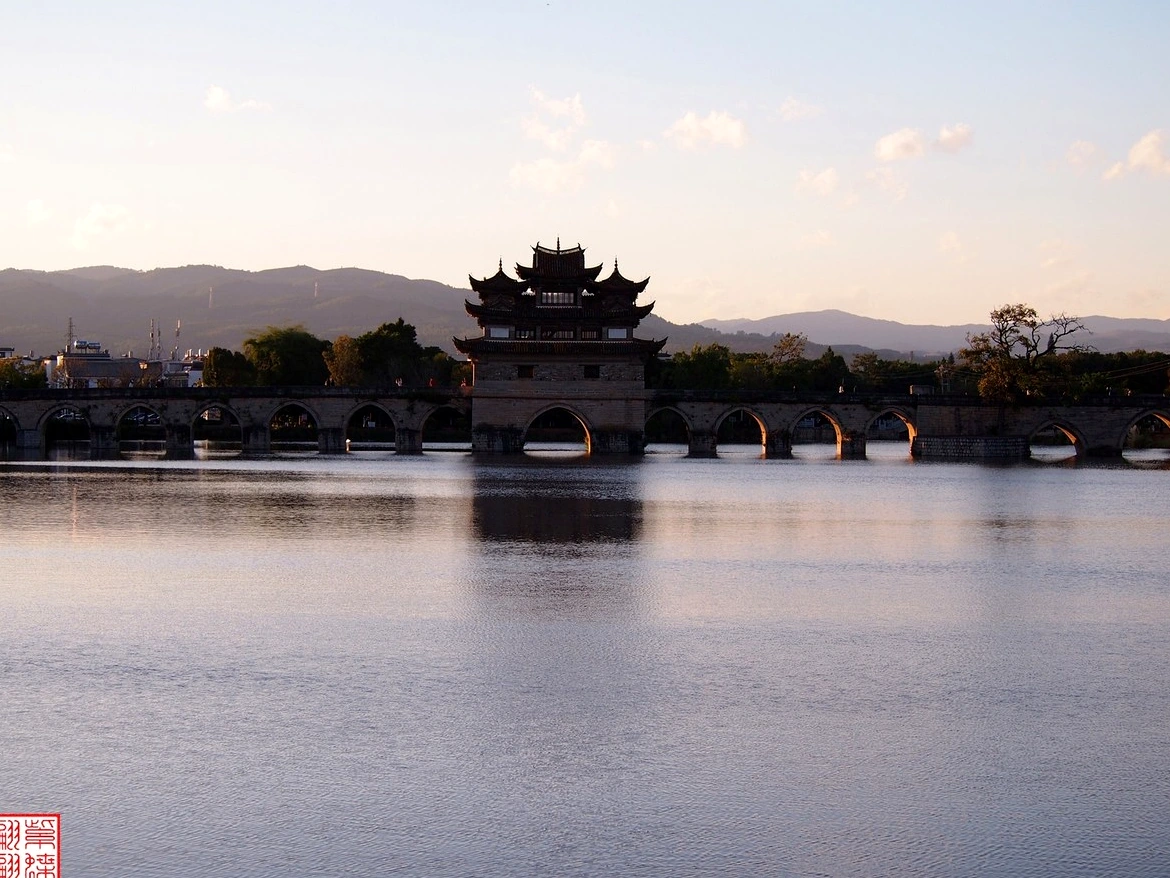
The landscape surrounding the Double Dragon Bridge (Song Long Bridge) is a rhythmic transition between the raw beauty of nature and the abundance created by human hands. Both ends of the bridge are framed by the gentle red-soil hills characteristic of the Yunnan Plateau, interspersed with flooded rice paddies and vast lotus ponds that change their hues with the seasons. In summer, the sweet fragrance of lotus flowers fills the air, with green leaves and vibrant blossoms embracing the mossy stone pillars. Come autumn and winter, the water becomes crystal clear and perfectly still, creating a tranquil sanctuary far removed from the bustle of the city.
The most magnificent and poetic moment at this feng shui masterpiece is at sunset. As the fiery red sun slowly dips along the lower reaches of the Ta Chong River, the golden twilight gilds every stone arch and curved roof, painting the scene known as the “Double Dragon Sunset,” a legendary sight in this region. The lake surface becomes a mirror without a ripple, reflecting the glowing evening sky and birds fluttering back to their nests amidst the misty haze, perfectly recreating the breathtaking “Geese Landing on a Calm Lake” scene—a testament to the sublime harmony between the land’s spirit and human ingenuity.
Only by admiring the Double Dragon Bridge from the confluence of the two banks can one truly grasp the scale of this structure, hailed as the premier ancient stone bridge in the Diannan region. With a bridge body length of 148 meters (reaching 153 meters including the approach ramps, with actual geodetic measurements at 148.26 meters), the structure resembles a sturdy stone ribbon spanning the rushing water. The bridge deck maintains a width of 3.0 to 3.8 meters, providing ample space for horse-drawn carriages, porters, and merchants who have traversed it for generations. To withstand the destructive force of upstream flash floods, ancient engineers widened the bridge piers at the base to 5.2 meters, shaping them into sharp, water-splitting prows to dissipate the kinetic energy of the current. The bridge rises 9 meters above the water, gracefully supporting 17 uniform semi-circular stone arches. The mechanical highlight is the central arch, which boasts the widest span of 5.8 meters, before the height and symmetry gradually taper toward the bridge abutments with spans narrowing from 4.2 meters to 2.8 meters, sketching a gentle parabolic curve that creates a graceful visual rhythm above the blue waves.
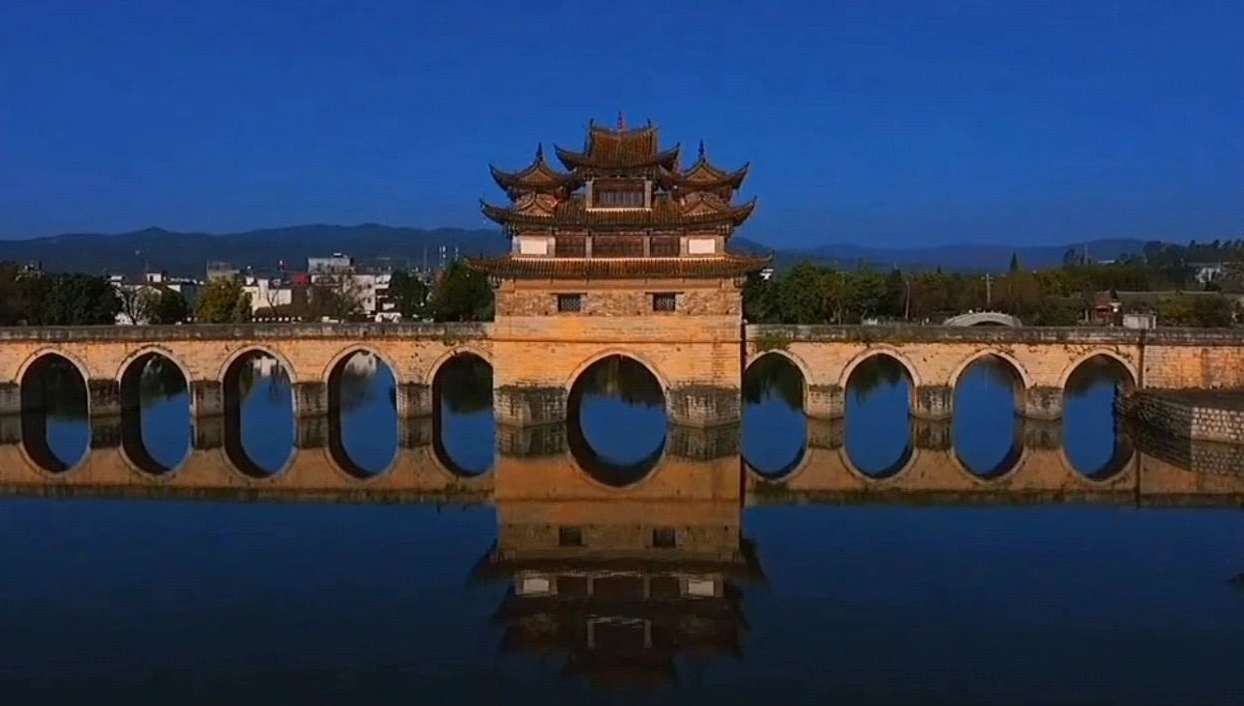
The engineering miracle of the Double Dragon Bridge also lies in the craftsmanship and connection of tens of thousands of bluestone and sandstone blocks quarried from the high mountains. Under the skilled hands of folk stonemasons, each block was precisely carved using the yin-yang mortise-and-tenon method, fitting perfectly without the need for steel reinforcement. The load-bearing horizontal stone courses were locked with dovetail-shaped iron cramps, known locally by the rustic term “iron swallows” (or “iron carrying poles”). The joints between these massive stone blocks were sealed absolutely tight with a traditional biological mortar: a mixture of pure slaked lime, concentrated glutinous rice water, and natural forest resin. This durable organic binder is capable of absorbing elastic deformation from geological tremors along the plateau’s fault lines while preventing erosion from the muddy, turbulent floodwaters over the centuries.
Nestled peacefully along the spine of the stone bridge is a complex of three moss-covered pavilions built in the “Xieshan” (gabled) architectural style, creating a spacious three-dimensional rhythm. Guarding the two ends of the bridge are two small, two-story pavilions with elegant multi-tiered roofs; they are not merely shelters from the rain and sun, but are actually calculated gravity-loading blocks (hydraulic counterweights) designed to anchor the stone pier system firmly into the riverbed. Standing proudly at the central arch is the grand pavilion known as the “Diannan Daguan Pavilion“—also called the West-Facing Daguan—reaching a height of 20 meters (with some local ancient records suggesting it approached 29 meters). This three-story octagonal pavilion was constructed entirely using sophisticated “dougong” (bracket set) joinery, interlocking multi-layered wooden beams securely without the use of a single iron nail. Supporting the weight of the entire grand pavilion standing in the middle of the river are six ancient tree trunks, each with a diameter of up to 60 centimeters and a continuous length of 25.7 meters, extending from the bridge deck all the way to the upper roof frame.
The roof of the central pavilion is covered in glazed ceramic tiles that reflect a turquoise hue under the frontier sun, with upturned eaves soaring high in a “flying eaves” style, resembling mythical birds spreading their wings against the blue sky. Stepping inside the Diannan Grand Pavilion, the ancient artistic space reveals itself brilliantly through intricate relief carvings and murals on the beams and wooden walls. The master craftsmanship vividly recreates classic legends such as “Three Visits to the Thatched Cottage,” honoring the virtue of respecting the wise, and “The Eight Immortals Crossing the Sea,” symbolizing the spirit of overcoming turbulent waters. The exemplary harmony between scientific hydraulic engineering and imperial aesthetics has created an immortal image: “long bridges lying over the waves, pavilions soaring into the void” – a long stone bridge resting like a coiled dragon upon the water, supporting ancient pavilions that seem to float ethereally in the air.
As the final turquoise sunset of the remote Diannan region fades behind the rolling mountains, the confluence of the Lu River and the Ta Chong River begins a spectacular visual transformation. Moving away from the stillness of an ancient monument weathered by the Qianlong and Daoguang dynasties, the Shuanglong Bridge dons a shimmering golden robe of contemporary visual technology. An underwater LED artistic lighting project, designed with green and low-carbon standards, is meticulously arranged along the riverbed, cleverly turning the water into a giant reflective mirror. Soft spectral bands embrace every stone segment, highlighting the graceful curves of the seventeen moon-shaped arches and the majesty of the three triple-eaved pavilions, with their wide-spreading eaves and intricate bracket systems rising into the quiet space.
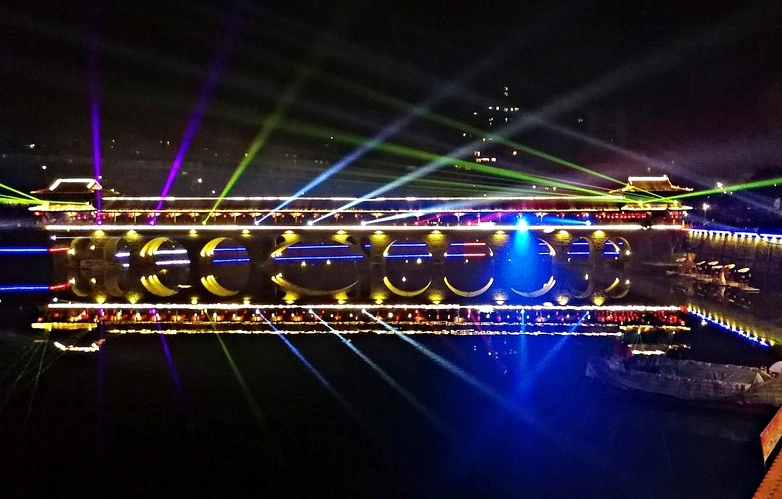
The most magical moment reaches its peak on clear, breezy nights, when nature and human craftsmanship find a miraculous intersection. As the moon hangs suspended in the night sky of Jianshui, its brilliant light shines through each monolithic stone arch, blending with the soft artificial light reflecting from the water to perfectly recreate the “Seventeen Moon Shadows” spectacle—an optical wonder where seventeen moons appear to shimmer simultaneously, blurring the lines between reality and illusion across the ancient river. Standing on the bank, each archway feels like a sparkling portal in time, drifting the traveler’s consciousness back to the distant memories of the ancient Southwest.
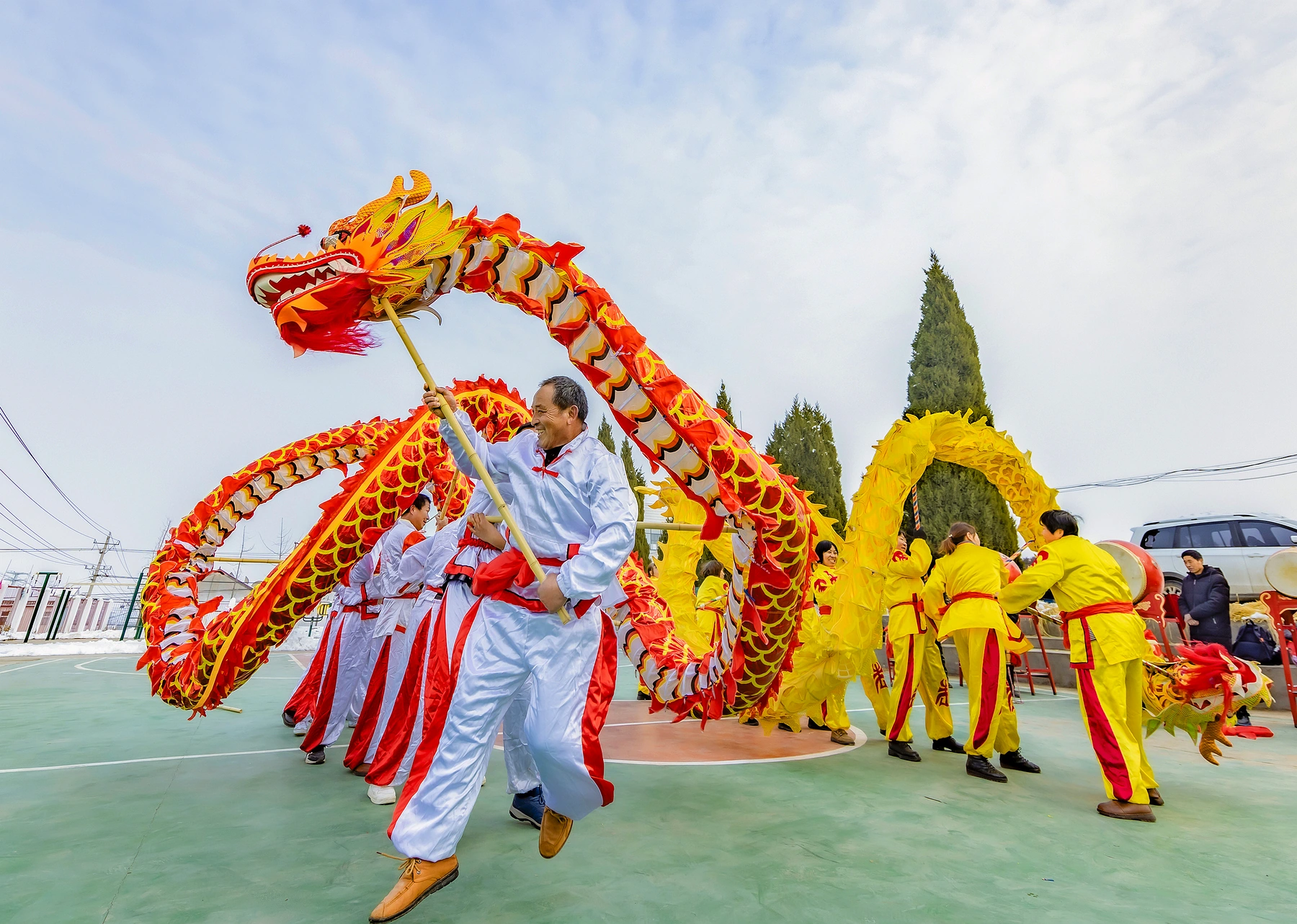
The pulse of the Diannan night does not stop at static art but is vividly awakened by immersive, culturally rich live performances. Amidst the vast expanse of water, the deep, resonant sounds of traditional instruments from the Hani and Yi ethnic groups of the Honghe Prefecture rise up, blending with the melodies of the erhu, bamboo flutes, and soul-stirring folk songs. The night reaches its climax when performers showcase the intangible cultural heritage of “Molten Iron Flower” dancing on the water. Thousands of sparks from iron melted at over a thousand degrees Celsius are tossed into the air, colliding to create a fiery meteor shower that falls into the dark river, complemented by the flickering flames of a brilliant torch ritual, illuminating the entire river landscape to the awe of the audience.
The harmony of the night continues to spread, carrying the rhythm of life upstream and guiding visitors into the nearby ancient village of Wanyao. Here, the workshops of the famous Jianshui Purple Pottery remain lit throughout the night, opening up a unique artistic night market where visitors can feel the softness of clay on a traditional potter’s wheel or sip rich Pu-erh tea beside an ancient kiln. At the foot of Shuanglong Bridge, high-end riverside camping tents emerge amidst the lush green grass, offering a quiet, upscale retreat. Listening to the water gently lapping against the thousand-year-old stone pillars, watching the faint lights from the ancient bridge, and breathing in the scent of sweet grass in the dewy night, one truly understands the slow, refined, and enchanting essence of Jianshui after dark.
Beyond captivating travelers with the architectural wonder spanning the Hejiang and Lusong rivers, the land around Shuanglong Bridge opens up a rich, thousand-year-old culinary heritage, where the traditional flavors of the former Lin’an Prefecture blend enduringly into daily life. Through the many shifts of history, the local culinary culture has preserved its pristine authenticity, drawing from the beautiful landscape of the Honghe basin as the source for delicacies famous throughout the Diannan region.
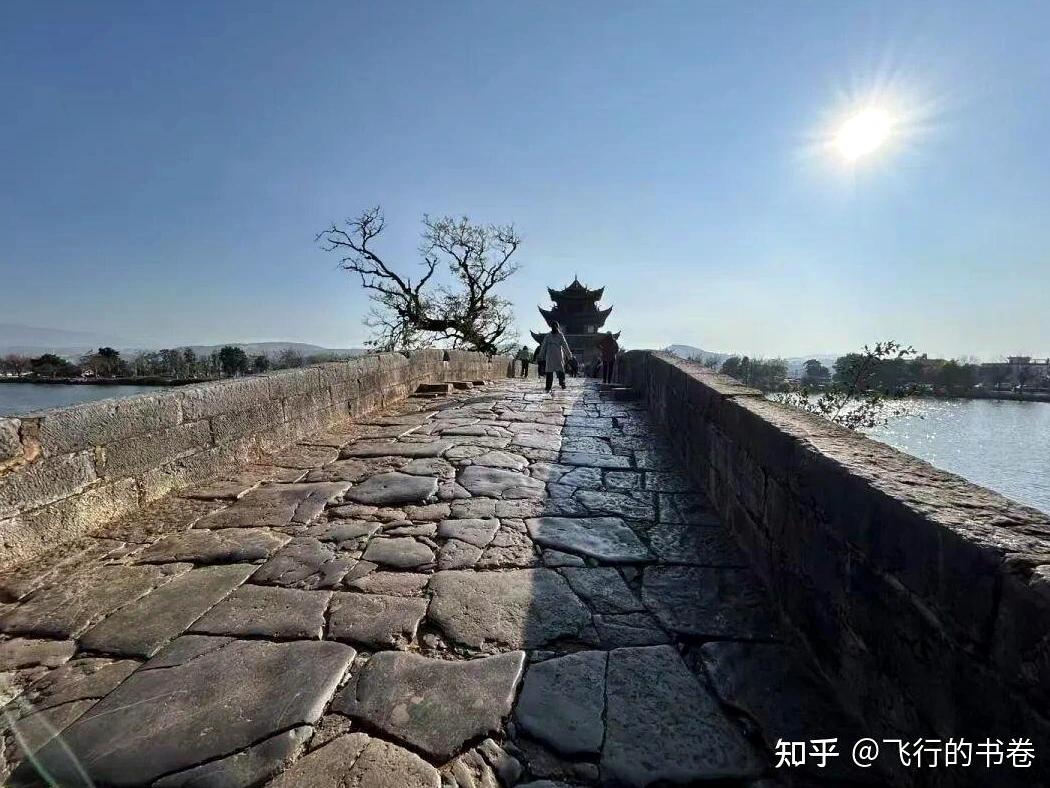
Viewed from the calm water, the ancient stone bridge stretches out with a deck paved in rugged gray-blue stones, bearing the marks of time and millions of travelers’ footsteps. At the left end of the bridge stands a majestic multi-story pavilion in the traditional East Asian wooden architectural style, contrasting gracefully with the bare-branched ancient tree on the right, reaching its gnarled limbs toward the clear sky. Bright sunlight from a high angle casts long shadows on the rustic stone surface, highlighting groups of people strolling leisurely amidst the backdrop of rolling mountains and distant green forests.
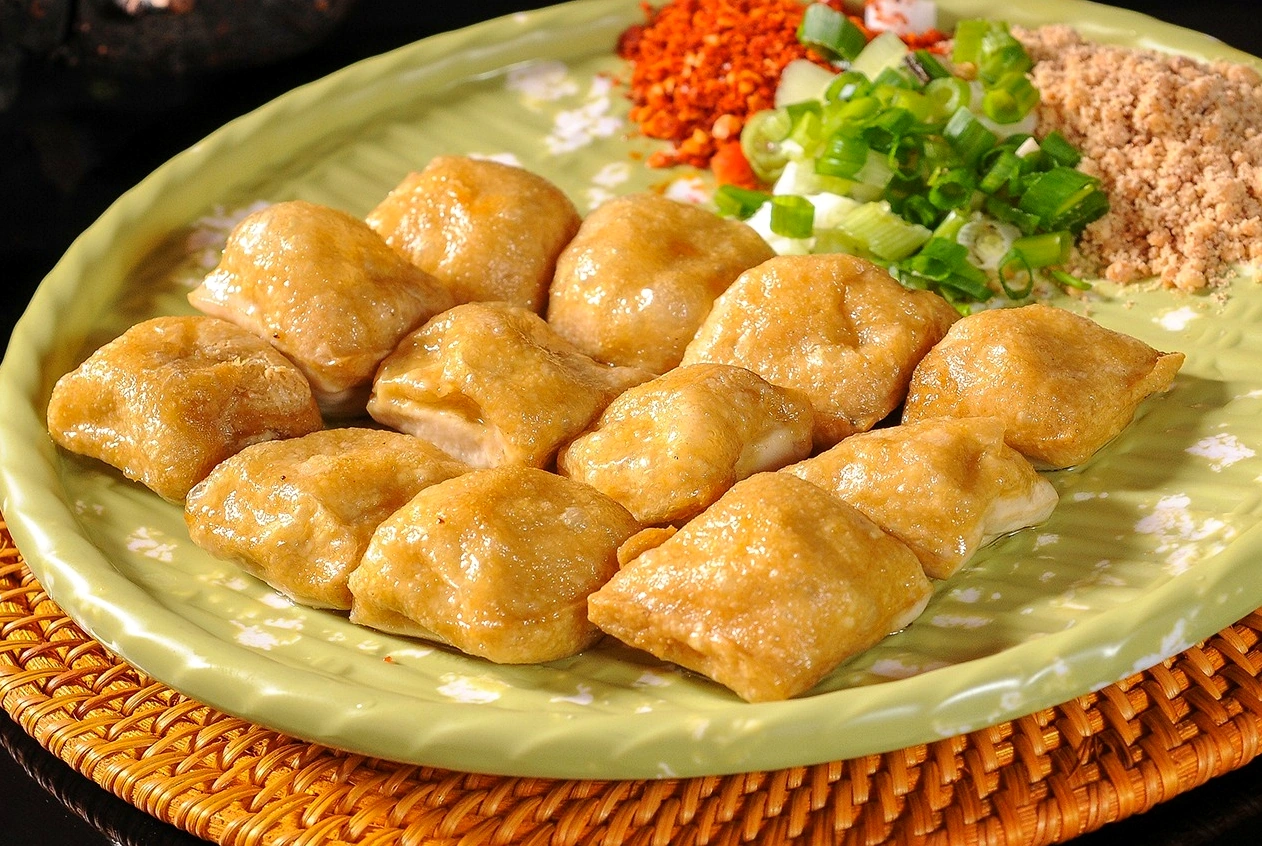
The most distinct rustic culinary experience is the Ximen grilled tofu, a humble delicacy tied to the sweet groundwater of the famous Da Ban Jing ancient well. Local soybeans are soaked, infused with mineral water from the deep well, and pressed into small squares about two finger-widths wide, then undergo a special natural fermentation process to achieve the ideal soft and chewy texture. On an iron grate over glowing charcoal, each piece of tofu puffs up, turning a glossy golden yellow and releasing an intoxicating, savory aroma. Diners gather to warm themselves by the glowing coals, dipping the crispy, airy tofu into a dish of chili powder with Sichuan peppercorns or a bowl of cilantro soy sauce drizzled with fragrant sesame oil. The most fascinating touch in this dining custom is the traditional method of counting corn kernels for payment: for every block of tofu eaten, the vendor drops a dried corn kernel into a small ceramic bowl—as rustic and sincere as the character of the ancient town’s people.
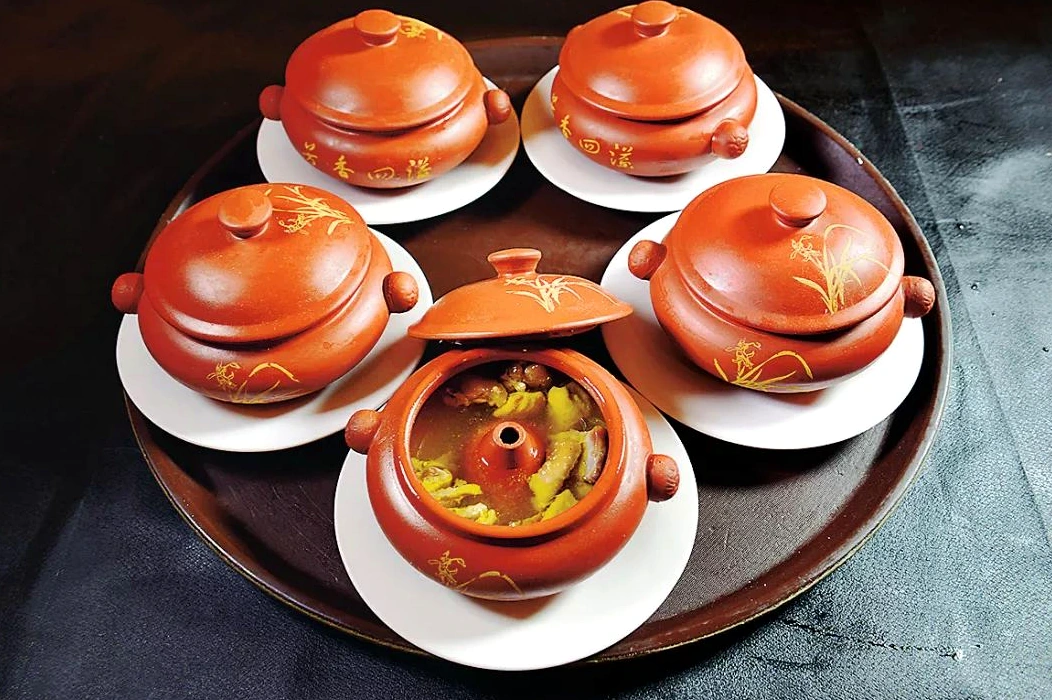
Stepping into a formal banquet, Jianshui steam-pot chicken reigns as an invaluable treasure of Yunnan cuisine. The soul of this dish lies in the handcrafted purple pottery pot with a unique steam nozzle rising from the center of the base. Free-range chicken is chopped into uniform pieces and arranged skillfully with crushed fresh ginger, crunchy sweet bean sprouts, or a few slices of nutritious Panax notoginseng, without adding a single drop of plain water. Placed over a pot of boiling water, the steam shoots directly through the central ceramic tube and condenses on the tightly sealed lid, dripping down to create a clear, golden broth that is naturally sweet and concentrates the very essence of heaven and earth.
The unique local flavors are clearly reflected in a steaming bowl of “crossing-the-bridge” rice noodles, where the broth is simmered continuously for eight hours from pork bones and old chicken, topped with a layer of golden goose fat to maintain a boiling temperature that instantly poaches thin slices of fresh fish fillet, pork loin, and fresh bean sprouts before adding the chewy, fragrant Honghe red rice noodles. The sensory experience concludes elegantly with a rose pastry baked according to the traditional Lin’an recipe, fragrant with spring nectar, sipped alongside aged Pu’er tea in a wood-fired purple pottery cup, leaving a lingering, profound aftertaste like the peaceful century-old flow beneath the Shuanglong Bridge.
Unlike many heavily commercialized tourist destinations in Yunnan, the 17-arch Shuanglong Stone Bridge remains open 24 hours a day and is completely free of charge. To begin the journey to admire this masterpiece of ancient hydraulic architecture, the most ideal starting point for Vietnamese travelers is the Lao Cai – Hekou international border gate. From the border town of Hekou, visitors can choose a road journey of about 156 km along the G8011 Kaihe Expressway, taking about two and a half hours by inter-provincial bus through rolling limestone mountains before entering the Jianshui basin. If you prefer a smooth ride on the rails, the Yumen railway network is the optimal solution, with modern high-speed trains or express trains departing from Hekou North Station, taking only one hour and 35 minutes to two hours and 10 minutes to leisurely arrive at Jianshui Station.
A mode of transport rich in nostalgia and historical flavor is boarding the Jianshui ancient town mini-train. Restored on the foundation of a century-old one-meter narrow-gauge railway initiated by the French in the modern era, the vintage wooden train takes visitors on a leisurely journey from Lin’an Station, through vast green corn plains toward Tuanshan ancient village. On this heritage voyage, the train makes a 30-minute stop at Shuanglong Bridge Station—just enough time for those who want to observe the rustic life by the water and capture timeless, weathered footage alongside the wooden train and the ancient stone bridge.
To capture the majestic beauty of the seventeen arches facing the wind and waves, seasoned photographers always remember the coordinate on the south bank, about 80 meters to the east. Standing at this position, using a wide-angle lens with a focal length of 24mm to 35mm will help capture the entire symmetrical structure of the bridge, which is over 140 meters long, along with its three pavilions reflecting on the surface of the Lu River. During the dry season, the water level recedes to reveal riverbanks, opening a golden opportunity for travelers to descend to the dry riverbed and head straight to the space beneath the eighth and ninth arches. The curved sandstone arches then transform into a perfect natural frame, creating the backdrop for backlit photos with deep artistic resonance. In particular, the moment the sunset casts a brilliant orange-gold hue onto the glazed tiles of Zhenyuan Pavilion is also the time when the narrow-gauge steam train chugs along in the background, creating a beautiful intersection between early 20th-century machinery and silent, feudal architecture.
To fully enjoy the serenity of this ancient sacred mountain site, travelers should be discerning and firmly decline offers from low-cost tour groups priced under 2,000 RMB. These “negative-price” or “zero-dollar” tours often slash the visit to the ancient bridge to a mere twenty-minute “glance from horseback,” intentionally leaving time to coerce visitors into shopping stops for memory foam mattresses or highland herbal shops. A true, meaningful journey requires choosing a pure, non-shopping experience, allowing yourself one and a half to two and a half hours to leisurely walk along the stone slabs worn smooth by the passage of time. Travelers can also rest assured as the Yunnan provincial government now enforces strict tourism oversight through the 12345 support hotline and a 30-day unconditional return policy at designated shopping locations.
Careful preparation regarding your route, lighting conditions, and mindset will help you capture the full, solemn antiquity of this national heritage site. To realize your dream of witnessing this elegant architectural marvel reflecting on the Hejiang River without worrying about complex logistics, exploring a comprehensive tour package is the perfect stepping stone to open the door to a dignified and peaceful cultural journey in Jianshui.