Standing tall at the border river confluence in Hekou Yao Autonomous County, within the Hani and Yi Autonomous Prefecture of Honghe in Yunnan Province, Chengguang Pagoda (河口承光塔) rises like an enduring cultural monument recording the tides of southern history. Within the geopolitical landscape of ancient Chinese dynasties, Yunnan had long served as a distinctive buffer frontier situated between the imperial heartland and neighboring southern realms and polities. A pivotal turning point shaping administrative governance across this territory occurred in 1276—the thirteenth year of Zhiyuan during the Yuan Dynasty—when the Yunnan Branch Secretariat was formally established, opening an era of more structured, direct central imperial jurisdiction over the distant frontier.
Continuing through history across the Ming and Qing dynasties, social and political structures along this southernmost strip underwent deep strategic shifts. That era saw persistent implementation of policies settling Central Plains migrants to farm and fortify the borderlands alongside “gaitu guiliu” (replacing hereditary local tusi chieftains with court-appointed magistrates). Across Yunnan, historic pagodas from various eras clustered around the Dianchi Lake and Erhai Lake basins of ancient kingdoms while dotting minority regions along the southern frontier. Along the borderlands, each pagoda carried more than religious architectural value—serving as a spiritual landmark symbolizing cultural presence and diplomatic authority at key gateways.
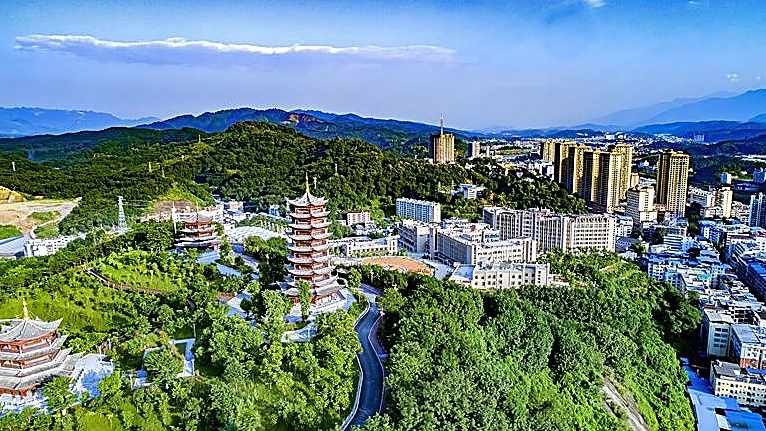
Occupying a prime river-and-land crossroads between southern Yunnan and northern Vietnam, Hekou early on formed a vital military and commercial link along the Southwest Silk Road (the storied southern silk route). From an early strategic defense and skirmish point under loose “tusi jimi” frontier arrangements, the ground where Chengguang Pagoda stands lived through dramatic modern shifts: from treaty-era trade openings and the historic Yunnan–Vietnam Railway spanning two centuries, to its transformation into one of today’s busiest international trade crossings. The pagoda stands watching silt-red waters roll by, recording shifts in people, goods, and border agreements.
Embedded within the name “Chengguang” (承光) lies a deep philosophical outlook and political aspiration passed down across generations. The two characters carry the symbolic wish to receive and bask in the radiance of sun and moon while guarding the southern borderlands—meaning the site welcomes the light of heaven and earth while fulfilling a feng shui duty to anchor peace along the southern frontier. Blending central frontier guardianship with diverse local heritage gives the pagoda a distinct spirit, lifting it above mere brick and stone into an enduring symbol amid changing times.
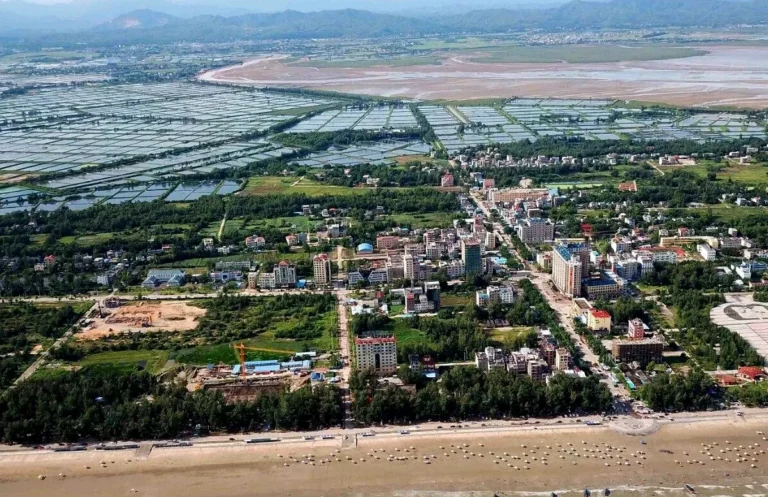
Rising gracefully at the southern edge of Honghe Prefecture in Yunnan Province, Chengguang Pagoda in Hekou commands a strategic, commanding position in the China–Vietnam border landscape. Set on a narrow plain where two major rivers meet, the pagoda sits right at the historic confluence where the silt-red Yuan River (Red River) joins the clear waters of the Nanxi River (Nam Thi River). From this vantage point, looking across the natural border waterway reveals the lively streets of Lao Cai Province—opening a cross-border view at once sweeping and rich with a thousand years of trade. Where the two rivers meet not only marks a clear natural boundary, but also cradles local cultural life across shifting eras.
In terms of natural topography, the pagoda is firmly sited on an elevated riverside terrace overlooking the frontier town. Behind it rise the bold, undulating ridges of the Ailao Mountains, forming a lush, layered green screen at its back. Paired with open space ahead where two large rivers merge and roar southward, this setting achieves a classic “backing onto mountains facing water” composition prized in traditional architecture.
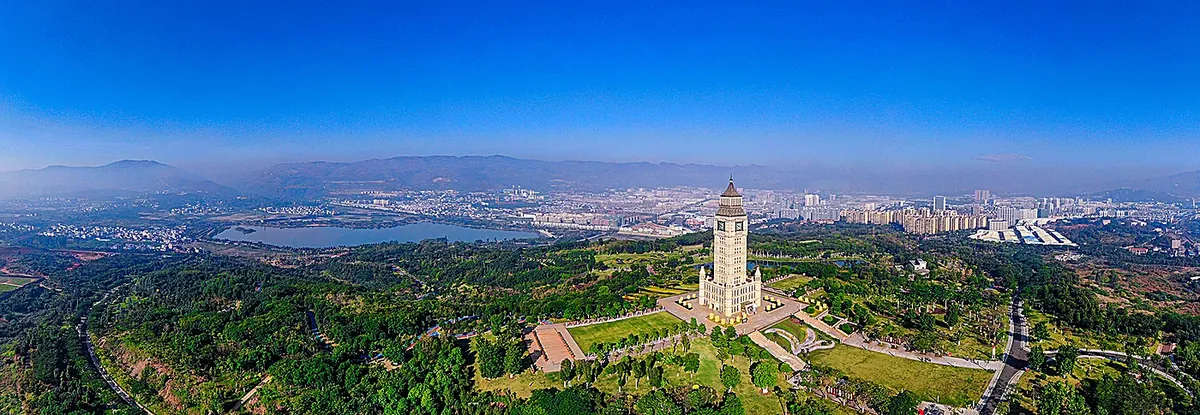
Through the lens of traditional geomancy, the river confluence where the Yuan and Nanxi rivers meet acts as a crucial “water gate” for a broad basin. In Eastern spatial thought, flowing water represents fortune, vitality, and prosperity; where swift currents swirl out through a border pass, vital energy risks dispersing along the outgoing stream. Chengguang Pagoda fulfills the core feng shui role of “guarding the water’s tail”—anchoring the downstream outlet so vital energy does not slip away, locking in fortune, and stabilizing the frontier dragon vein while serving as a spiritual anchor reinforcing scholarly learning and cultural refinement on the border.
Spatial planning here reaches completeness by uniting five key elements—mountains, rivers, town, border pass, and pagoda—into a cohesive frontier ensemble. The towering Ailao range forms a sturdy foundation, merging rivers supply endless vitality, historic and modern streets frame the scene, a neighboring international border gate represents commercial sovereignty, and the pagoda’s spire rising into the blue sky marks territorial identity. Seen from across the river, the pagoda’s silhouette against twilight mountain skies is more than a standalone structure—it is a tangible cultural marker linking people with timeless frontier scenery.
Standing beside the border waters where the Red River and Nam Thi River converge, Chengguang Pagoda in Hekou emerges as a remarkable cultural landmark uniting refined traditional Chinese pagoda standards with distinctive southern Yunnan craft. The structure blends dense-eave and multi-eave brick-and-stone pagoda traditions of the Central Plains with antique pagoda forms of Diannan (southern Yunnan). Its overall silhouette follows strict symmetry, rising with calm, composed dignity. Every geometric line reflects classical architectural canons—balancing height, eave projection, and girth to achieve harmony between earth and sky amidst Hekou’s mountains and rivers.
In on-site construction, the pagoda’s scale reflects painstaking engineering built to outlast time. Its supporting base uses natural granite and dark bluestone quarried from ancient southwestern strata, dressed smooth and joined tightly. This solid foundation helps the pagoda weather subtropical frontier rains and sun while resisting natural ground tremors. Rising up the body, builders applied a progressive vertical taper—gradually reducing radius and area tier by tier. This technique lightens the visual weight of solid masonry while creating a subtle upward illusion that makes the spire seem to reach toward the clouds, keeping a graceful, rustic air while preserving solemnity.
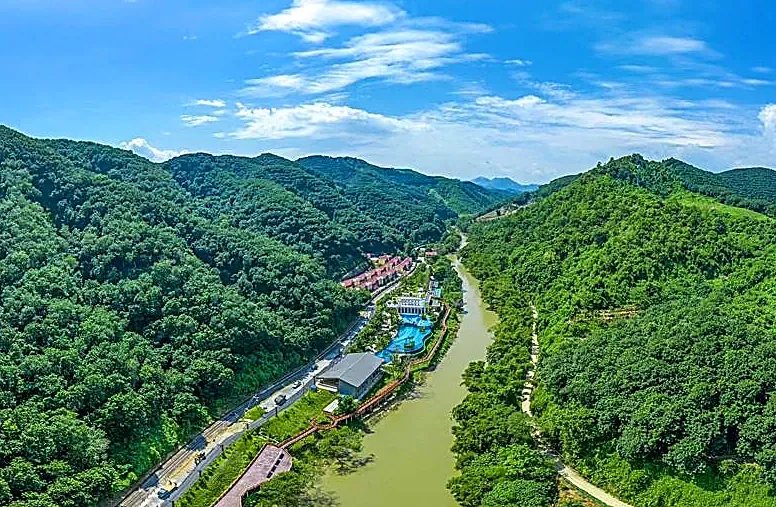
The artistic peak of Chengguang Pagoda gathers across every roof tile and bracket tier. Roofs feature sweeping upturned eaves and corner tips reaching gracefully into the sky, opening views in every direction. Supporting the projecting eaves are intricate multi-tiered dougong brackets fitted with precision joinery without metal welds. Especially notable is the molded relief brickwork along pagoda friezes, where Buddhist cloud-and-lotus motifs mingle with Daoist mythical beasts and eight-trigram emblems alongside Confucian-inspired plaques. Beyond Han motifs, carvings weave in geometric patterns and stylized animals reflecting southern Yunnan ethnic groups—turning the exterior into a rich relief tapestry of frontier cultural exchange.
Inside the pagoda, spatial atmosphere contrasts with its stately exterior, inviting quiet contemplation. Vertical movement follows a pavilion-like layout with landings, corridor niches, and winding stone stairs hugging the interior wall in a winding path leading into quiet depths. Each stage of climbing opens onto solemn shrine niches holding bronze or stone statues bathed in natural light filtering through arched window openings. Each window not only brings in daylight and cross-ventilation, but also frames a living view over bustling Hekou streets and rolling border ridges—making Chengguang Pagoda a treasured architectural legacy of southwestern building craft.
As the last light of day slips behind the layered mountains of southern Yunnan, the border town of Hekou enters an enchanting shift of color and sound. Modern three-dimensional architectural lighting paired with frontier light art switches on in unison, turning Chengguang Pagoda into the brightest focal point at the river confluence. Against deep night falling over the border basin, the classical tower glows like a golden pagoda cast in the mortal world—capturing poetic imagery of a golden tower gleaming over twin rivers and illuminating a border town. Warm light wraps the old brick body, creating layered visual depth that feels both solemn and alive with modern frontier trade.
Lighting design here thoughtfully highlights the traditional structural details that give Chinese architecture its soul. Delicate accent strips trace roof ridges, capturing the poised upward reach of the spire and the sweeping curves of layered eaves. Seen from multiple angles, upturned corners spread like phoenix wings in the night sky and cast crisp reflections across the swirling waters of the Red and Nanxi rivers. What makes the evening light show truly unique is a poetic cross-border dialogue: warm golden light from the pagoda shines down onto the border waters, blending with glowing lights reflected from the Lao Cai bank across the way into a vivid scene of border prosperity and neighborly harmony.
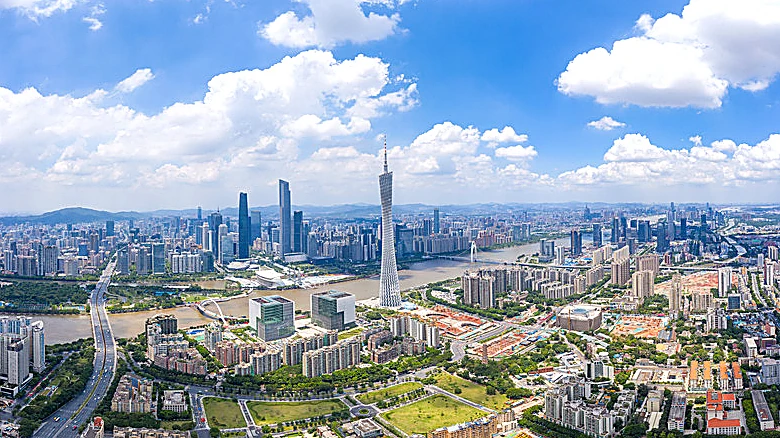
Looking down from the towering spire to ground level, visitors step straight into a lively local night rhythm. The broad stone plaza at the base and the riverside promenade become a beloved evening gathering spot for locals and travelers alike. Breezes sweeping in from the river confluence clear away daytime warmth, offering a pleasant place to cool off and unwind. Unhurried strolls along granite railings, lively conversation in both Vietnamese and Chinese, and traditional music from local women’s folk dance groups create a warm, welcoming atmosphere where distant boundaries fade.
Evening light and night life around Chengguang Pagoda grow even richer with tempting flavors drifting from nearby food lanes. Inviting aromas of charcoal skewers dusted with Sichuan chili powder and aromatic pepper, the distinct savory richness of famous grilled stinky tofu, or warm bowls of silky Hekou rice rolls topped with sweet-and-sour house sauce draw walkers in. Sitting at a small riverside eatery over a warming glass of corn spirit—enjoying borderland bites while watching the illuminated pagoda shimmer on the river—captures the calm, open spirit of a place where cultures have met for a millennium.
Resting peacefully along the border where the pagoda’s reflection meets the silt-red Red River, Chengguang Pagoda marks not only a historic spot, but also a lively hub for distinct borderland cuisine. Thanks to its role as a key crossing linking rugged southern Yunnan with southern plains, dining around the pagoda blends culinary traditions of local groups—such as the Hani, Yao, and Dai—with cross-border China–Vietnam flavors. Amid evening river mist, charcoal smoke, fresh chili heat, and fragrant mountain herbs come together in a hearty, down-to-earth food culture.
Among the area’s best-known specialties is Hekou little rolled rice noodles (xiao juan fen). Crafted using traditional hand-steaming skills, pure rice-flour sheets are remarkably thin, translucent, and tender, rolled tightly around savory minced pork stir-fried with wood-ear mushroom and fragrant shiitake. The dish’s crowning touch is its tangy-spicy dipping sauce made to a secret recipe using fresh lime or lemon juice instead of ordinary vinegar, blended with crushed bird’s-eye chili, aromatic garlic, and highland herbs. Crisp citrus brightness and chili warmth paired with smooth rice wrappers and rich filling awaken the palate and take the edge off humid Red River valley air.
Wandering narrow streets curving below the old pagoda, visitors easily spot everyday culinary cross-pollination in the slow drip of Vietnamese phin coffee beside house eaves and crisp, golden-baked banh mi loaves. A crusty baguette filled with savory char siu pork, rich pate, crisp sweet-and-sour pickles, and fresh cilantro—carrying clear Indochinese influences—has become a familiar breakfast staple woven into local daily life over generations. Sitting at a small tea table, sipping bitter-sweet condensed-milk phin coffee while looking up at the historic pagoda against border clouds, geographic borders give way to shared daily warmth.
Border cuisine here also carries strong highland character from Honghe Prefecture. Honghe dry duck is famed for firm, lean meat cooked with prickly ash (ma qao), black cardamom, and local corn spirit for a distinctive savory sweetness. Nearby, a bowl of Mengzi Crossing-the-Bridge noodles features a glossy layer of chicken oil keeping rich bone broth piping hot, ready to cook paper-thin meat slices and crisp greens. Local flair also shines in Dai-style lemongrass-and-chili fish grilled in split bamboo or sizzled beef stir-fried with crisp, sour bamboo shoots—turning sweet, sour, salty, and spicy notes into a vivid taste of the southern frontier.
Reaching Chengguang Pagoda on Yunnan’s borderlands combines modern transport links with recent history. Traveling from inland Chinese cities such as Kunming or Mengzi, visitors can take high-speed trains along the Kunming–Yuxi–Hekou railway through mountain scenery straight to Hekou North Station. From the station square, a local city bus or taxi along Binhe Avenue beside the Nam Thi River takes you right to the hillside where the pagoda stands. For travelers coming from the Vietnamese side, after clearing exit formalities at the Lao Cai International Border Gate, the historic Ho Kieu Bridge across the red river leads straight into Hekou town—putting Chengguang Pagoda within a short walk or quick ride from the crossing.
Experiencing Chengguang Pagoda and its surroundings works best in sync with shifting daylight. Morning and early afternoon are ideal for climbing up to view the pagoda, admiring weathered gray brick and intricate Qing-era Buddhist bracket work up close while taking in the border town waking up. In late afternoon, head over to the nearby Honghe viewing terrace to watch the scenic confluence where silt-red Red River waters merge with emerald-tinted Nam Thi waters flowing south. After dark, the pagoda base and riverside street glow with red lanterns extending toward the China–Vietnam style street, inviting visitors into the lively evening rhythm of the border night market.
Because the pagoda sits right along a key international border zone, visiting calls for care and strict respect for frontier rules. Always carry valid travel documents—whether a passport with a Chinese visa or a border travel permit—and keep health declaration slips and border entry/exit stamps safely with you. While surrounding grounds welcome visitors for sightseeing, follow all security signs, do not fly drones without authorization, and strictly avoid pointing cameras or phones toward military posts, border stations, or restricted defense zones.
Rounding out a visit to the monument with local food is all the more rewarding when you pick your spots thoughtfully. Around Binhe Road and the trade market, choosing long-standing local eateries with clear pricing or strong reviews on Dazhong Dianping helps you enjoy authentic regional flavors with peace of mind. Be sure to try hot char siu buns, crisp grilled stinky tofu with Yunnan chili powder, or grilled sturgeon from the Honghe region. For an itinerary that balances heritage sightseeing with borderland life without paperwork stress, consider joining our culturally rich Hekou Discovery tour package.