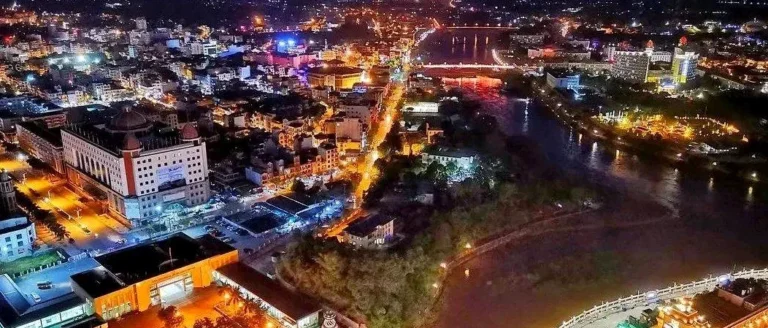
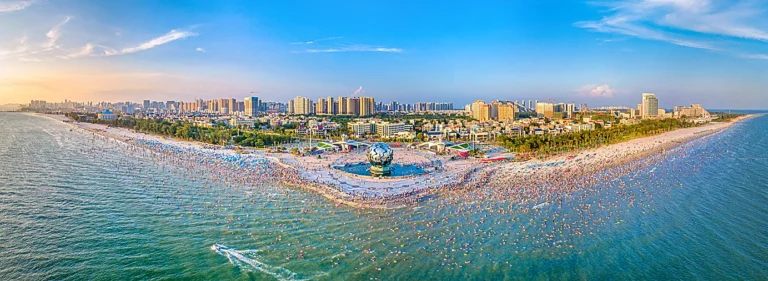
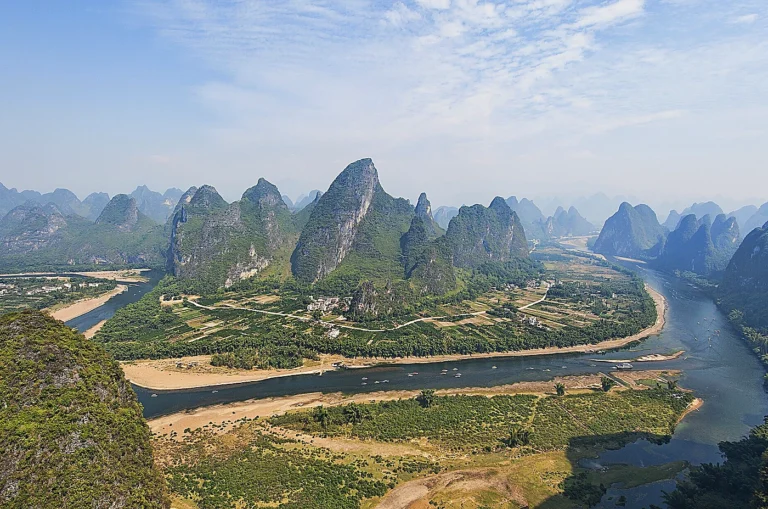
Set quietly along the northern bank of the historic Beilun River, directly across from Vietnam’s northeastern border city of Mong Cai, Dongxing—within Fangchenggang Prefecture in Guangxi Province—has long served as a vital trade gateway and vibrant cultural crossroads. Amid the lively commercial pulse of this border town, Dongxing Western Street emerges as a striking, poetic contrast where Western-inspired architectural lines rise in the heart of southern China. More than a leisure spot or photo backdrop, it stands as a vivid symbol of cross-border openness and global exchange in a border city shaped over centuries.
Looking back through history, Dongxing began taking administrative and commercial shape during the Ming Dynasty, spanning more than four hundred years of historical change. During the 1940s, the area served as a key international transshipment hub linking the mainland with Southeast Asia while northern sea routes faced blockades. Generations of river and overland trade fostered an outward-looking local character welcoming to diverse architectural styles. Stepping into Western Street brings an immediate shift in scenery, feeling almost like crossing into a corner of Paris or Vienna.
Dongxing’s cultural appeal is further enriched by the presence of China’s Kinh (*Jing*) ethnic community, centered largely across the coastal “Three Islands” (*San Dao*) of Jiangping and nearby Wanwei along the Gulf of Tonkin. Over more than five centuries of settlement along the coast, Kinh residents of Vietnamese ancestry have preserved their language, *hat dum* antiphonal songs, resonant *dan bau* monochord music, and communal hall (*Dinh*) festivals while weaving seamlessly into local life. This interplay between coastal Kinh heritage and modern town life gives Neo-Classical Western-style facades in Dongxing a rich cultural backdrop along Guangxi’s coast.
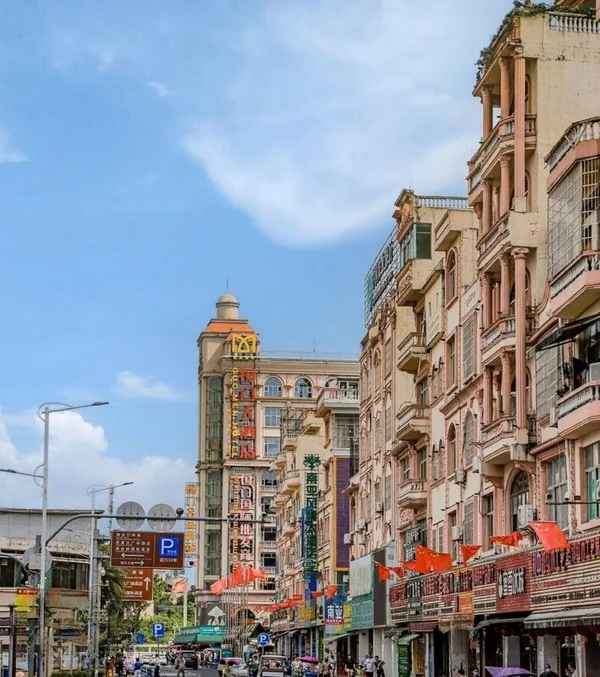
Architecturally, Dongxing Western Street draws on nineteenth-century European Neo-Classical design blended with Baroque and Renaissance touches. Continuous street-front rows maintain a balanced height of roughly four to five stories and above, pairing ground-floor retail with upper residences or offices. Corinthian pilasters frame graceful arches, wrought-iron balconies finished in matte black stand out against cream, beige, and soft pastel facades, and slate-gray Mansard roofs and pediment reliefs evoke classic European boulevards.
The street layout centers on a broad pedestrian promenade paved with slip-resistant stone that complements surrounding facades. Covered arcades shelter strollers from sudden subtropical coastal showers, while decorative fountains and vintage-style cast-iron streetlamps casting warm amber light turn the avenue into an inviting public space for shopping, strolling, and outdoor events.
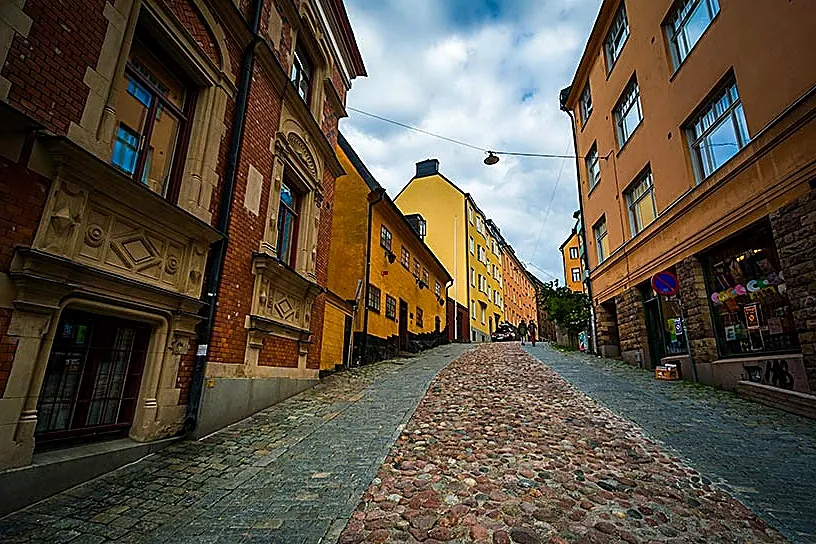
As sunset settles along the Beilun River and evening arrives, Dongxing Western Street undergoes a vivid visual shift. Architectural lights outline cornices, arches, and spires against the night sky, casting a warm golden glow over polished stone paving. During festivals, Western-style facades meet traditional red lanterns, lively chatter in both Chinese and Vietnamese, and celebratory fireworks lighting up the border sky.
After dark, exploring Western Street pairs naturally with regional street food and tea culture from Guangdong and Guangxi. Shops and stalls serve steaming beef milk hot pot, chili-and-Sichuan-pepper grilled skewers, and hot bamboo steamers of shrimp and asparagus dumplings, alongside roasted oolong milk tea shops and crispy fried stinky tofu—blending European-inspired surroundings with down-to-earth southern Chinese flavors.
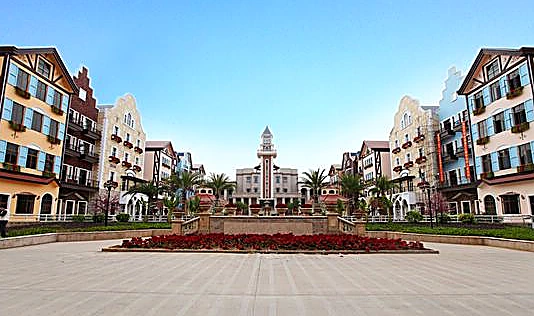
For photography enthusiasts, quiet early mornings or twilight blue hour offer soft, dramatic light across the facades. Symmetrical colonnades and open intersections frame soaring roofs and arched details cleanly, while the contrast between modern outfits and classical reliefs creates photogenic corners from attic windows to granite steps.
Reaching Western Street is convenient thanks to Dongxing’s location just across the Beilun River Friendship Bridge from Mong Cai, roughly a hundred meters away. Eligible visitors traveling on border-area trips often use a border pass (*Sổ thông hành biên giới*) issued with a valid citizen ID and white-background photo rather than a standard visa; after clearing border inspection at Mong Cai and crossing the Beilun River bridge, electric three-wheelers or local taxis reach the street in just a few minutes.
To get the most out of a visit, pair Western Street with nearby cultural sights around town—such as morning visits to Wanzhong Temple, Guandi Temple, or Wanxiang Pagoda beside the river, followed by Wanzhong Market or Guizhou Pedestrian Street. Travelers booking an all-inclusive Dongxing tour package can also visit Wanwei Beach and the Kinh Ethnic Museum before spending the evening strolling Western Street.
A few practical tips help keep your trip smooth: carry small-denomination cash or set up mobile QR payment apps in advance since many shops favor digital payments; watch the one-hour time difference between China and Vietnam so you return before border-gate closing; and consider a guided cross-border tour service if you prefer hassle-free border processing and local support.
Blending into the daily rhythm of this lively border city, Dongxing Western Street links memories of historic coastal trade with modern port-town energy—offering a distinctive, welcoming stop along Guangxi’s southern frontier in any season.