Standing majestically at the most bustling intersection in Kunming, the Golden Horse and Jade Rooster Archways (Jinma Biji Archways) have long been the visual soul and an eternal spiritual symbol of the Yunnan region. These imposing gateways are not merely magnificent wooden commemorative structures; they serve as a portal through time, connecting the thousand-year-old legends of the ancient Dian Kingdom with the grand, shifting currents of Chinese dynasties. Having weathered countless upheavals, the ravages of war, and multiple reconstructions, the pair of archways remains standing with dignity, acting as a cultural compass that perfectly reflects the Eastern philosophical identity regarding the absolute harmony between astronomy, geography, and human consciousness.
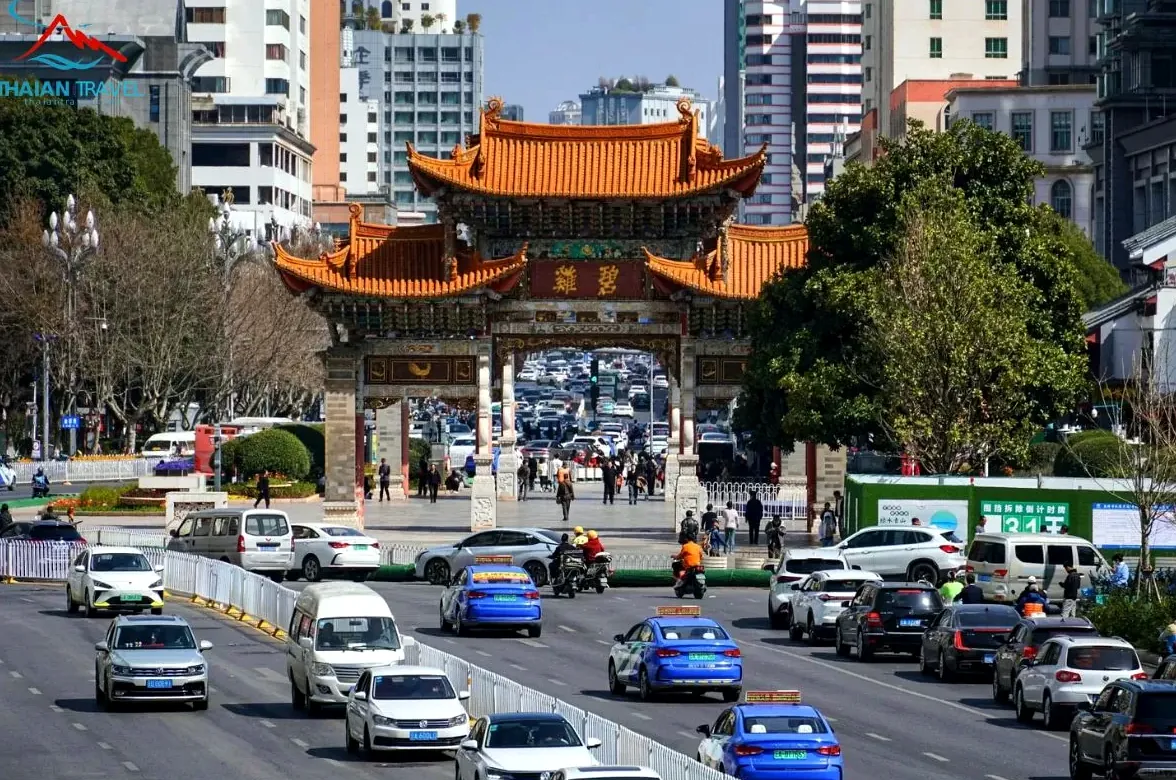
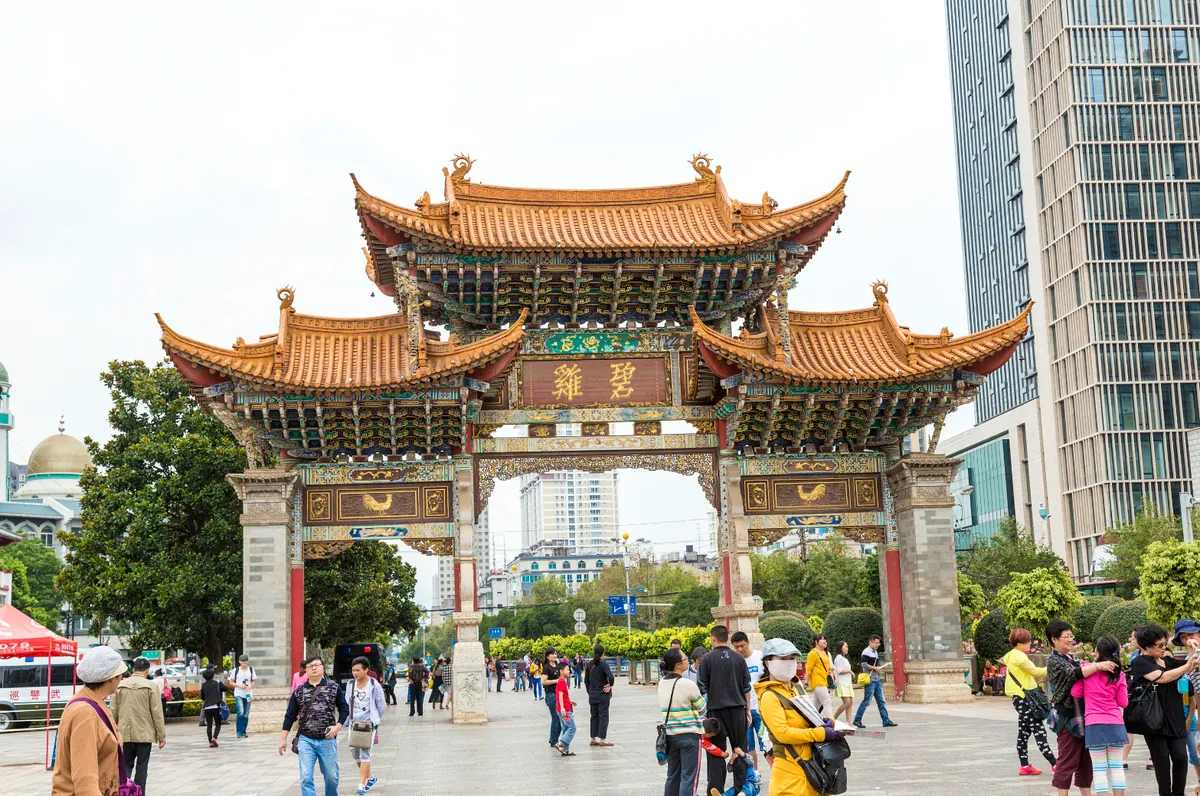
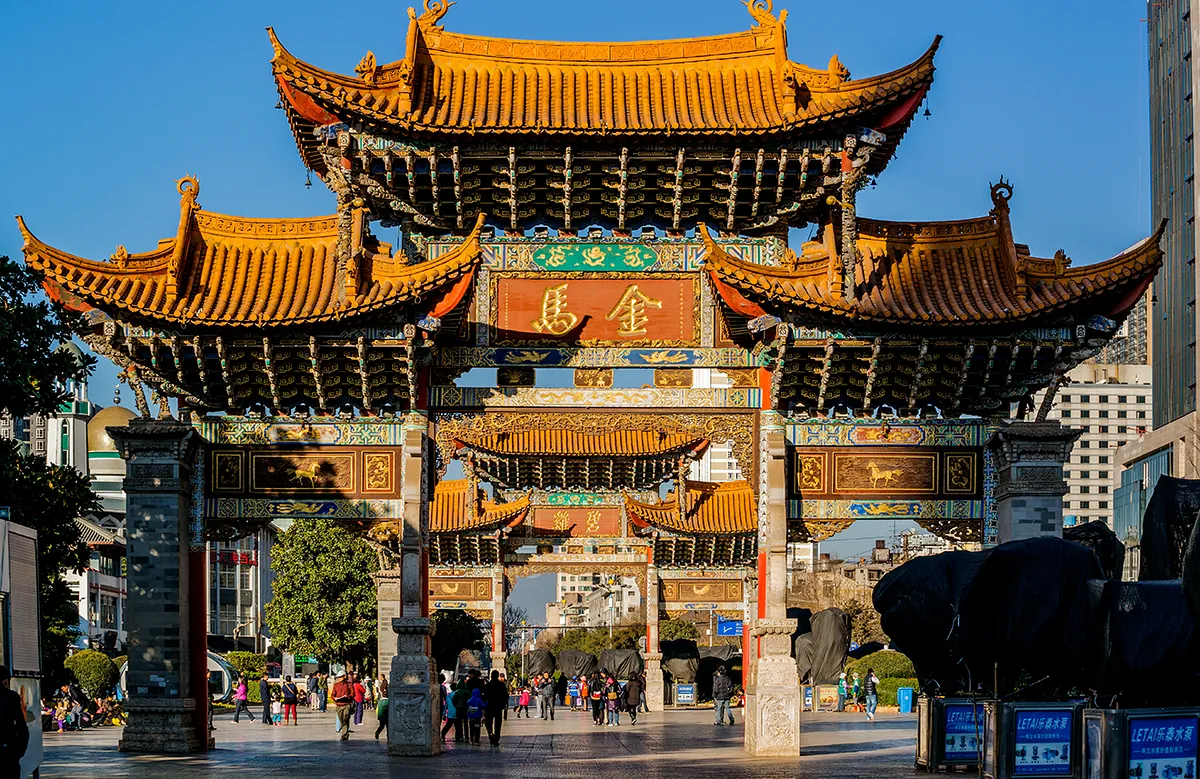
Vividly presented to posterity is a masterpiece of traditional wooden architecture, featuring a three-bay, four-pillar design that rises twelve meters high, standing proudly against the expansive highland sky. A complex multi-tiered bracket system supports the sweeping, curved roofs covered in shimmering glazed tiles, where the upturned eaves are adorned with intricate relief carvings of dragons, flowers, and birds. A brilliant red-lacquered and gold-gilded plaque on the main facade displays four elegant characters, supported by massive ironwood pillars anchored firmly into stone bases carved with cloud and wave patterns. The entire structure exudes a profound, ancient aura that dialogues rhythmically with the modern urban life surrounding it.
The historical origin of the structure is officially recorded in the Xuande era of the Ming Dynasty, a period when the imperial court consolidated its control and shaped the urban spatial structure of the Yunnan capital. However, the soul of this landmark is deeply rooted in Western Han Dynasty legends, linked to the story of Emperor Xuan of Han sending the scholar Wang Bao to search for two miraculous creatures guarding the south: the Golden Horse and the Jade Rooster. In terms of geomancy (feng shui), these names correspond perfectly to the two sacred mountain ranges embracing the Kunming basin: the majestic Golden Horse Mountain guarding the east and the verdant Jade Rooster Mountain reflecting its image on the waters of Dianchi Lake to the west. The creation of these archways was a way of mapping the landscape into the heart of the city, transforming the natural scenery into a symbol of imperial power and the sacred protection of heaven and earth.
The history of the Golden Horse and Jade Rooster Archways is also a mirror reflecting the most intense shocks of the times. In the mid-19th century, the flames of the Xianfeng-Tongzhi wars completely razed the original Ming Dynasty wooden structures, turning the center of Kunming into desolate ruins. It was not until the tenth year of the Guangxu reign of the Qing Dynasty that the then-Viceroy of Yun-Gui, the renowned official Cen Yuying, initiated a grand restoration, gathering the most skilled woodworkers and carvers from the southwest to resurrect the two archways based on their classic architectural prototypes. Under the meticulous direction of this official, the project not only regained its former glory but also established the unique astronomical wonder known as “The Intersection of Gold and Jade,” a phenomenon where the shadows of the two archways interweave under the magical alignment of the full moon and the setting sun during the Autumn Equinox, occurring once every sixty years.
Although it suffered further serious damage during the social upheavals of the latter half of the 20th century, the architecture of the Golden Horse and Jade Rooster Archways was accurately reconstructed based on ancient texts and archival drawings from the Guangxu era. Every corner of the roof, every grain of wood, and the relative distance between the two arches were strictly preserved to maintain the mechanical calculations and astronomical concepts of the ancestors. Over more than half a millennium, the Golden Horse and Jade Rooster Archways have stood as an indomitable witness to history, marking the footsteps of emperors, envoys, and generals, as well as generations of ordinary residents, fully preserving the urban memory and the endless cultural depth of the magnificent Yunnan land.
Since the dawn of time, the Kunming basin has been enveloped by the spectacular mountains and rivers of the Yunnan-Guizhou Plateau, where the spiritual energy of heaven and earth converges through winding mountain ranges. In terms of natural geography and traditional feng shui, the center of Kunming possesses a solid layout resembling the “left dragon, right tiger” formation, with the valiant Golden Horse Mountain guarding the east and the rolling Jade Rooster Mountain standing watch in the west. The presence of the Golden Horse and Jade Rooster Archways at this vital intersection is not merely an urban architectural mark, but a crucial feng shui node designed to gather the vital energy of the two sacred mountains, connecting the plateau’s dragon vein with the vast, calm waters of Dianchi Lake to the south.
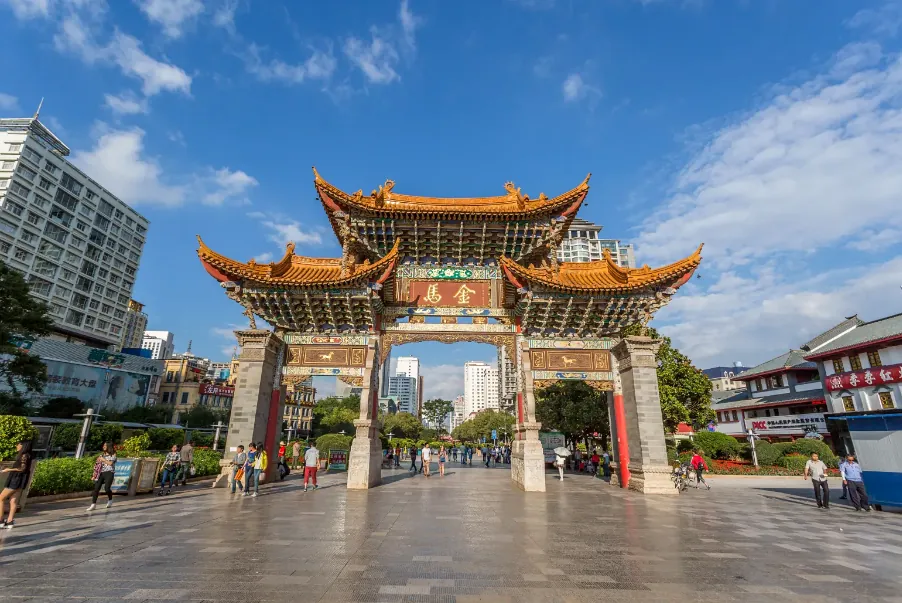
Admiring the archway cluster standing tall in the expansive central square, travelers are easily overwhelmed by the symmetrical beauty and majesty of these two three-bay, four-pillar, seven-story red-lacquered and gold-gilded wooden structures. The Golden Horse Archway faces east to welcome the sunrise, while the Jade Rooster Archway faces west to bid farewell to the sunset, highlighted by a multi-tiered system of sweeping, curved eaves covered in shimmering glazed tiles that reflect the clear highland sky. Massive ironwood pillars are anchored deep into sturdy stone bases, supporting intricate, interlocking bracket sets that create a grand architectural perspective—both elegant and profound—defining a sacred boundary between the bustling city life and an eternal spiritual space.
First conceived during the Xuande era of the Ming Dynasty, the spatial planning of the two archways reflects profound Eastern philosophical insights into the balance of Yin and Yang and the fluid nature of the Five Elements. The site is positioned along the Jinbi Avenue, running east-west and intersecting the north-south axis of San Shi Street, creating a focal point calculated with precise ancient astronomical orientation. Ancient scholars believed the east belonged to Wood, corresponding to spring and the Zhen trigram, where the golden steed brings the sunlight; while the west belonged to Metal, corresponding to autumn and the Dui trigram, where the jade phoenix catches the setting moon. The placement of the two archways exactly sixty paces apart not only creates a rhythmic visual openness in the heart of the old town but also shapes an energy field that regulates the microclimate for the entire core of the city-state.
The topographical wonder and peak Feng Shui calculations of this site are fully realized through the spectacular astronomical phenomenon known as “Jinbi Jiaohui” (The Intertwining of Gold and Jade). Every sixty-year sexagenary cycle during the Autumn Equinox, as the sun sets behind the Biche Ridge in the west and the full moon rises above the Jinma Peak in the east, the brilliant sunset and the cool moonlight simultaneously illuminate the two archways. Under the refractive effect of the precise optical angle on the plateau, nearly two thousand meters above sea level, the shadows of the two massive archways gradually stretch across the flat ground, drawing closer until they intertwine into a perfect, unified whole. The blending of the solar and lunar shadows in this fleeting moment is a powerful testament to the ancients’ absolute mastery of celestial movements in relation to the local terrain.
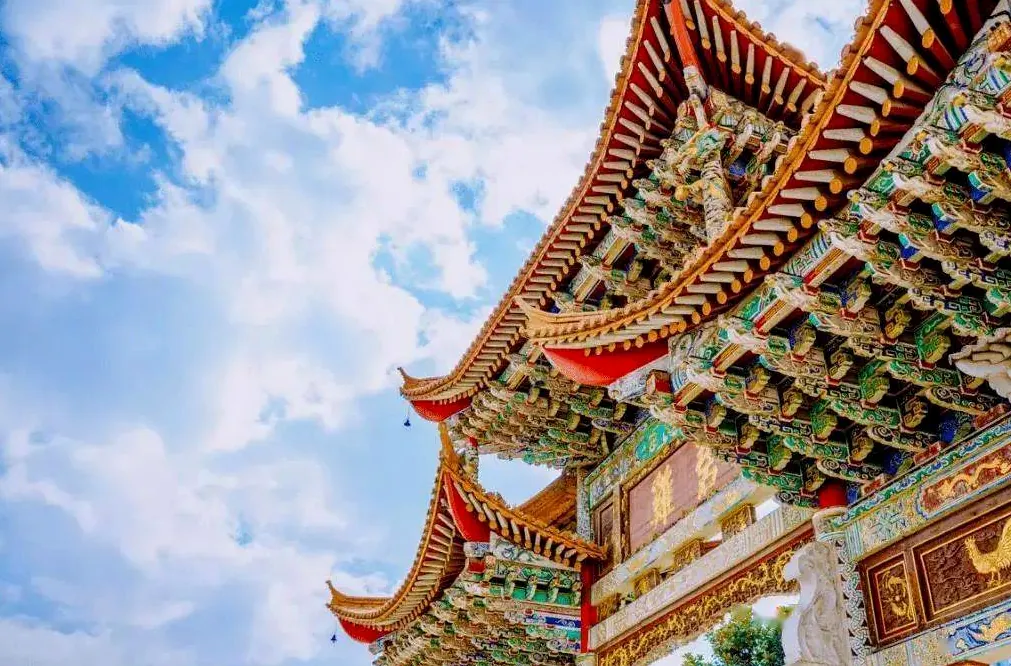
The natural landscape surrounding the Jinma Biji Archways is further enriched by the vitality of the Panlong River, which meanders through the east before flowing into Dianchi Lake. Cool, humid breezes from the vast lake, spanning hundreds of square kilometers, blow in with the southern monsoon, blending with the pure air from the pine-covered mountains that surround the area on all sides. This creates an open, temperate atmosphere, as if it were eternal spring. The tight integration between the symmetrical man-made architectural axis and the surrounding mountain ranges and abundant water veins has transformed these archways into a Feng Shui treasure, preserving the very soul of the Kunming region through the passage of time.
A close-up of the archways reveals masterful woodworking techniques, featuring complex, multi-layered dougong bracket systems that firmly support seven tiers of gracefully curved roofs covered in shimmering glazed tiles. Four massive ironwood pillars stand tall on sturdy bluestone bases, supporting vibrant gold-leafed plaques inscribed with the majestic characters “Jinma” and “Biji.” Every detail of the relief carvings—swirling dragons, dancing phoenixes, rolling clouds, and floral motifs on the crossbeams—reaches the standard of Ming imperial style, exuding a regal, magnificent aura without losing its soft, serene charm amidst the clear skies of the Yunnan plateau.
Delving into the spatial structure, the Jinma Biji Archways represent the pinnacle of traditional wooden mortise-and-tenon joinery, built entirely without iron nails. This allows the entire structure to possess both the flexibility to withstand seismic activity and the durability to endure the changes of history. The ingenious combination of the three-bay, four-pillar, seven-story architectural style creates a multi-layered visual rhythm, where the staggered eaves reach out like the wings of a phoenix in flight. The golden glazed tiles on the Jinma archway symbolize the brilliant sun and the masculine power of the East, while the blue glaze on the Biji archway evokes the mystical spirit of the feminine moon of the West. The entire system of beams, columns, and brackets is painted in vermilion and gold, accented with auspicious patterns, clouds, and mythical creatures according to strict imperial standards, reflecting the extraordinary talent of the master southern carpenters of the seventeenth century.
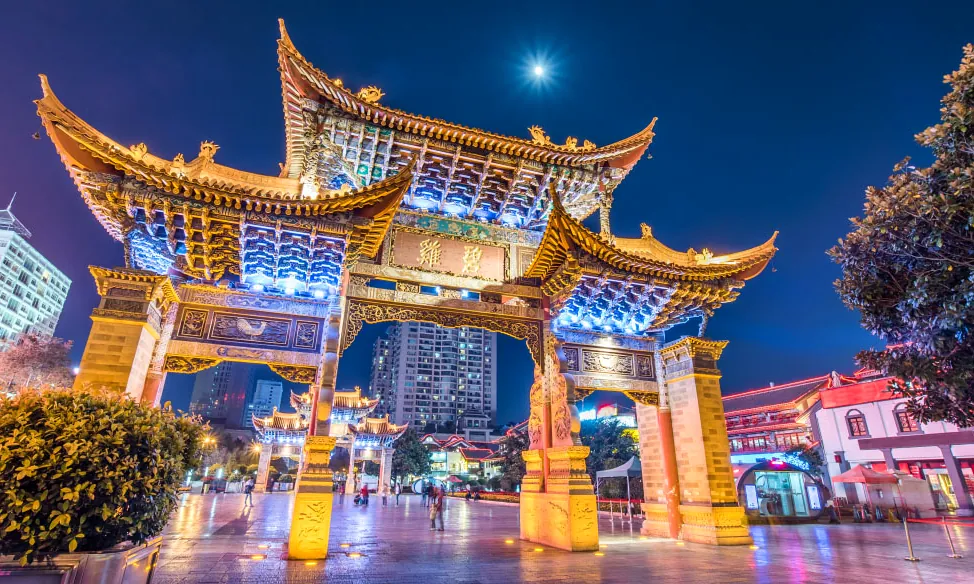
The core value that makes this complex extraordinary lies not only in its scale but also in the principles of Eastern astronomy and the I Ching, calculated with precision down to the very degree. The symmetry axis of the two archways is perfectly aligned with the path of the sun and moon in the Kunming sky. Every sixty years, on the Autumn Equinox, when the sun sets behind the Biji mountain ridge in the west and the full moon rises above the Jinma peak in the east, the spectacular natural phenomenon known as “Jinbi Jiaohui” occurs. The rays of the setting sun and the bright moonlight shine from opposite directions, stretching the shadows of the two archways across the ground until the shadows of the two roof structures intersect and entwine in the center of the square. This is a unique visual wonder that serves as a testament to the master wisdom of ancient scholars and architects, transforming two inanimate archways into a giant astronomical clock that measures the rhythm of the universe.
Having weathered the vicissitudes of history—from its initial construction during the Ming Dynasty to its destruction in the fires of war—the Jinma Biji Archways have undergone numerous major restorations with massive investment to faithfully recreate their original appearance based on ancient graphic records. The comprehensive reconstruction project at the end of the twentieth century cleared thousands of square meters of central urban land, expanding a solid bluestone-paved plaza that connects seamlessly with the ancient pedestrian street of San Shi Jie and rows of traditional Lingnan-style merchant houses. The surrounding commercial and community space is meticulously planned with an artistic lighting system that highlights every detail of the dougong brackets when night falls, turning this place into a vibrant hub of cultural exchange. Standing in the breezy plaza, travelers not only admire a magnificent architectural feat but also clearly feel the powerful continuity between the essence of ancestral heritage and the vibrant vitality of a modern metropolis.
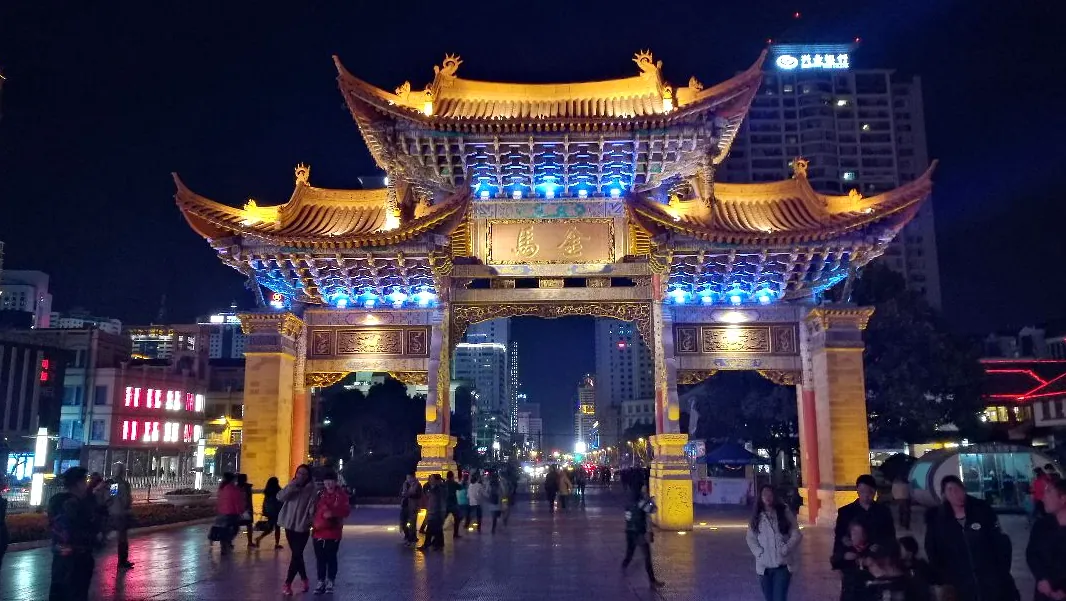
As night falls over the Yunnan-Guizhou Plateau, the Jinbi Plaza transforms into a spectacular visual stage, where the Jinma and Biji archways glow proudly in the heart of Kunming. A sophisticated edge-lighting system embraces every curve of the glazed roof tiles, illuminating the complex three-story dougong brackets and the gold-leafed dragon and phoenix reliefs on the vermilion-painted wood. Under the warm golden glow intertwined with the mystical turquoise light cast from the granite marble base, the two ancient towers stand majestically opposite each other, casting imposing shadows against the deep night sky, creating a scene as magnificent as a gilded painting amidst the pulse of contemporary life.
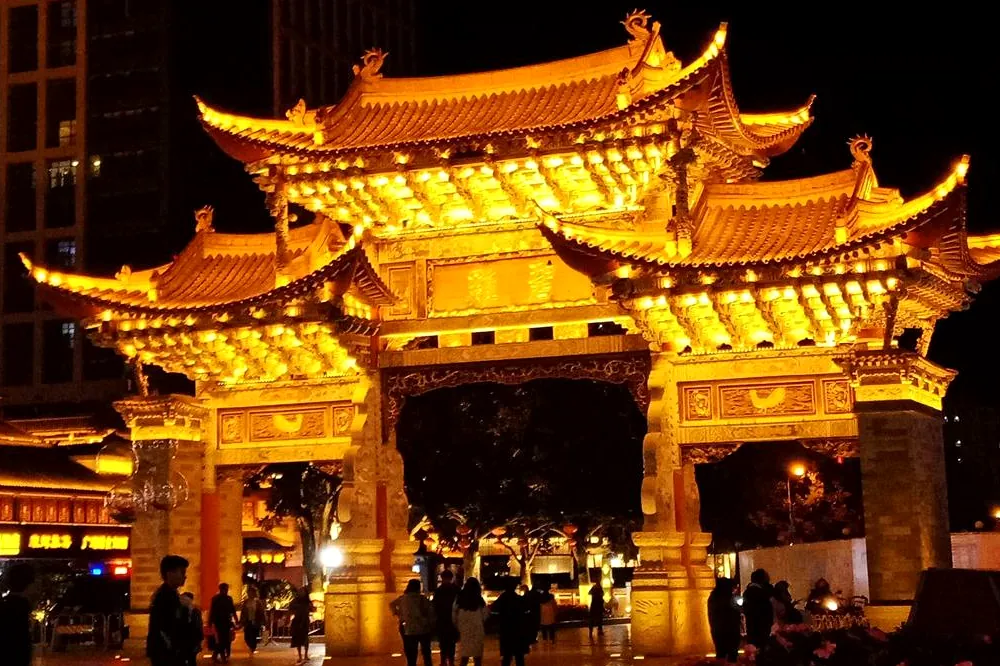
The lighting art at this heritage site serves not only an aesthetic urban purpose but also as an effort to reinterpret the famous optical phenomenon known as “Jinbi Jiaohui” (The Intertwining Radiance of Gold and Jade) through modern light. According to local records, during the Mid-Autumn Festival every sixty-year cycle, when the sun sets in the west casting the shadow of the Biji Archway to the east, and the full moon rises in the east casting the shadow of the Jinma Archway to the west, the two giant shadows gradually shift and intersect in the middle of the road. Today, lighting engineers have cleverly arranged corresponding spectral bands, causing the golden glow representing the Divine Horse and the turquoise light representing the Divine Rooster to converge on the slate-paved floor, evoking a magical story of the thousand-year harmony between the sun and the moon.
Enveloping the tranquil space of the two archways is the endless, vibrant pulse of Kunming by night. As soon as the sunset fades, the thousands-of-square-meter plaza becomes a natural cultural rendezvous for locals and travelers alike. The rustic sounds of the erhu blend with the lively rhythms of folk dances performed spontaneously by Yi and Bai ethnic girls beside the stone steps. Crowds stroll slowly toward the adjacent Nanping and Jinbi pedestrian streets, where Republic-era architecture is brilliantly illuminated, showcasing a magical blend of deep heritage and the youthful, liberal urban lifestyle of the land known as the “Spring City.”
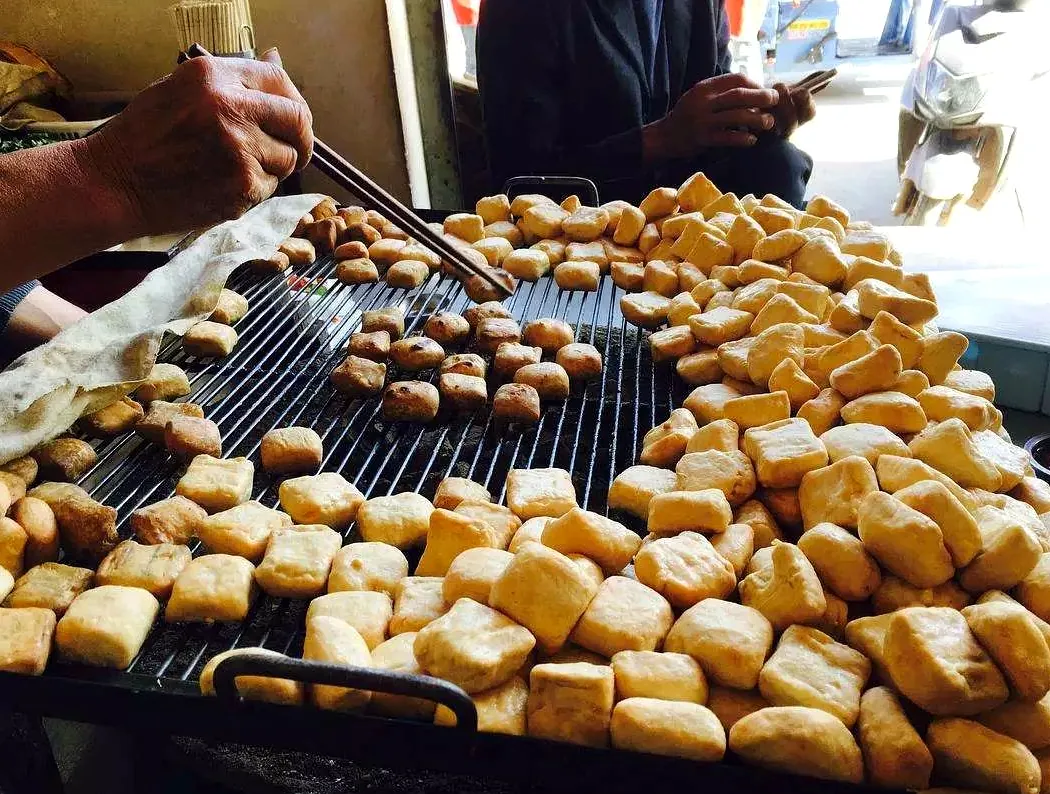
A night tour of the Jinma Biji Archways would not be complete without the warm, inviting flavors from the night food alleys that permeate the air. In the characteristic cool breeze of the plateau, steam rises from traditional “cross-bridge” rice noodle shops, where rich chicken broth is simmered for hours, served with thinly sliced meat and fresh wild vegetables. Nearby, on glowing charcoal grills, pieces of Shiping tofu are grilled until puffed and crispy, dipped in spicy Yunnan chili powder. The herbal aroma from rose pastry stalls blends with the deep, bittersweet notes of aged Pu-erh tea at roadside teahouses, creating a multi-layered culinary journey that awakens every sense of the traveler.
As the night deepens and the bustling city sounds gradually give way to silence, the Jinma Biji Archways retreat into the solemnity of a 600-year-old wooden structure. Standing in the space between the two twelve-meter-high towers, looking up at the curved eaves reaching toward the starry night sky, one can easily feel the slow passage of time. Here, the light of modern civilization does not erase the past; rather, it protects and honors the spiritual and historical values carved by ancestors into every piece of wood since the dawn of the Ming Dynasty.
Standing impressively in the historical heart of the Spring City, the area around the Jinma Biji Archways has long been a hub for the unique Dian cuisine of Yunnan. Strolling through the ancient San Shi alley to Xiangyun Street or the nearby Nanping pedestrian street, the rich scents of charcoal, mountain herbs, and the savory flavors of traditional dishes drift into the cool plateau air, leading visitors on a multi-layered gastronomic journey. The cuisine here is not merely a combination of fresh ingredients but a cultural heritage accumulated over hundreds of years of trade along the legendary Ancient Tea Horse Road.
Holding a place of honor in the culinary map around the archway is the legendary “Crossing-the-Bridge” rice noodles (Guo Qiao Mi Xian). Originating from Mengzi County, this dish reached its peak of refinement at century-old establishments like Jianxin Yuan, a famous noodle house founded during the Qing Dynasty under the reign of Emperor Guangxu. Enjoying a bowl of these noodles in the Jinma Biji area is a truly aesthetic culinary ritual. The broth is simmered for over half a day using pork marrow bones, old hens, and the famous Xuanwei ham, then ladled into massive glazed ceramic bowls where a layer of golden chicken fat seals in the intense heat. Diners then add paper-thin slices of ingredients—pork loin, chicken breast, Dianchi Lake carp fillet, pork liver—along with fresh quail eggs, pine mushrooms, sweet pea shoots, and scallions. The incredible heat cooks the meat in the blink of an eye before the chewy, fresh rice noodles are added, resulting in a broth that is clear, sweet, fragrant, and profoundly deep in flavor.
Beyond the rice noodles, the steam-pot chicken dish embodies the pure wellness philosophy of Yunnan imperial cuisine. This dish must be prepared in a signature Jianshui purple clay pot featuring a hollow steam pipe protruding from the center. Native chicken is chopped into uniform cubes and marinated with fresh ginger, scallions, and cardamom, with absolutely no water added to the pot. When placed over a large pot of boiling water for four to five hours, high-pressure steam rises through the hollow pipe, condensing into drops of clear, sweet broth as pure as morning dew. The soup essence blends perfectly with slices of Wenshan Panax notoginseng or the famous Zhaotong Gastrodia, offering a fragrant herbal aroma that nourishes the body and warms the hearts of weary travelers.
Along the slate-paved alleys surrounding the Jinma Biji Square, the street food scene comes alive with rustic snacks that carry the distinct local character. No one can resist the intoxicating aroma of freshly baked rose cakes—a flaky, multi-layered pastry filled with fresh Damask rose petals harvested from the Anning Valley, mixed with rock sugar and wild honey. Nearby, glowing charcoal grills are busy roasting “Erkuai,” a thick cake made from premium glutinous rice that is steamed and pounded until smooth, then grilled until puffed and brushed with a sweet and spicy bean paste sauce, rolled up with crunchy pickled vegetables and a golden-fried dough stick. Beside them, naturally fermented Shiping tofu grilled over charcoal releases a signature savory aroma; dipped in tongue-numbing wild pepper chili powder and paired with a glass of plum fruit wine or young rice wine, it completes a culinary experience that is rich, diverse, and deeply rooted in the soul of ancient Yunnan.

Located in the heart of the spring city of Kunming, the Jinma and Biji archways stand tall like two century-old screens, blending solemn antiquity with the vibrant rhythm of modern urban life. Rows of glazed tiles shimmering under the highland sun, intricately layered bracket sets, and brilliant red-and-gold lacquered plaques attract travelers from all over to stop and admire. As night falls, the artistic lighting system highlights the brilliant gold of Jinma and the legendary emerald green of Biji, creating a magical scene amidst the bustling Jinbi Road.
As a public square integrated with a commercial pedestrian street, the Jinma Biji Archways are open to visitors twenty-four hours a day, seven days a week, with no admission fees. However, the most ideal time to fully appreciate the magnificence of the two archways is at sunset, when the brilliant lighting system is illuminated from around 7:00 PM to 11:00 PM. This is a magical moment where the fading daylight meets the magnificent night, immersing visitors in a space that blends nostalgia with the vibrant energy of Kunming at night.
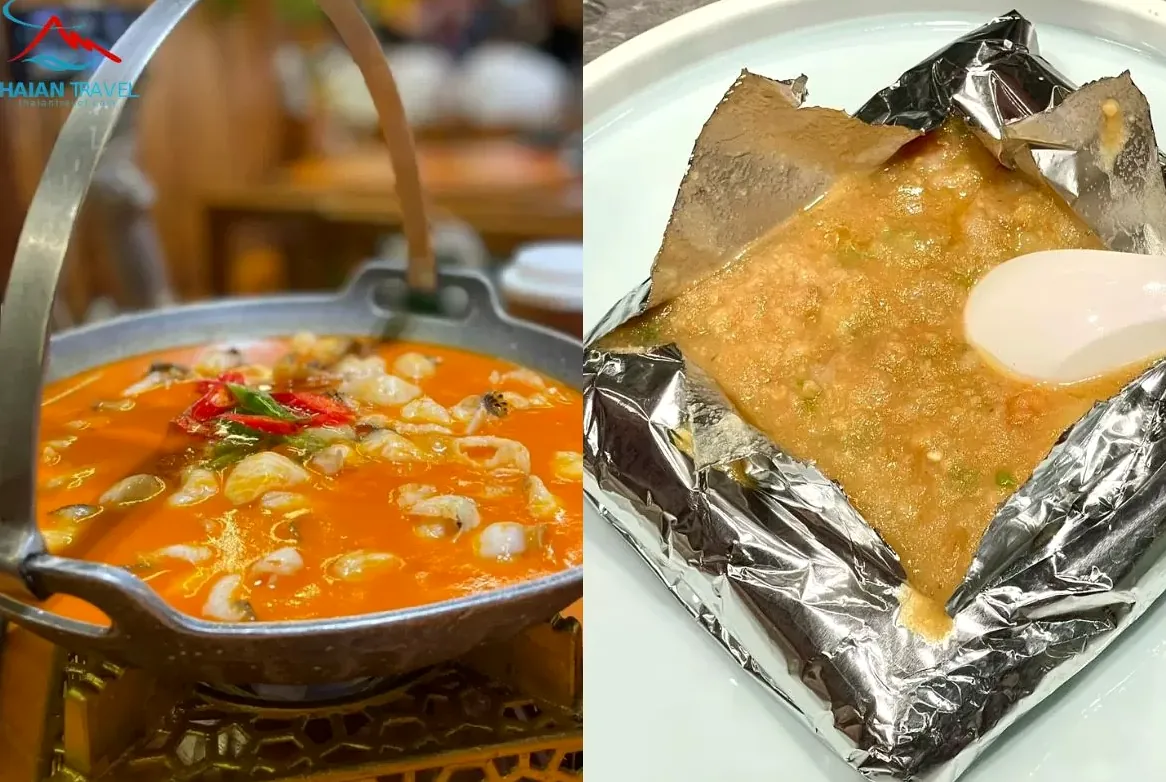
The highly developed public transportation system in the capital of Yunnan makes reaching this landmark complex extremely convenient. From the city center or Kunming Railway Station, visitors can choose to travel by Metro Line 3 and get off at Wuyi Road Station, or take Metro Line 1 and Line 2 to Dongfeng Square Station, followed by a less than ten-minute walk through tree-lined streets to reach the archway. Additionally, dozens of city bus routes such as 3, 4, 62, or A1 have stops right at the Jinbi intersection, providing maximum flexibility for independent travelers.
Situated at an average altitude of nearly 1,900 meters above sea level, Kunming is blessed with a mild climate year-round, though there is a significant temperature difference between day and night. Even on sunny summer days, the late afternoon air carries a highland chill, making it essential to pack a light jacket, sunscreen, and sunglasses. Regarding payments, most traditional shops around Nanping Pedestrian Street or the nearby Nancuong Night Market accept cashless payments via international e-wallets. Travelers simply need to link their bank cards before the trip to easily enjoy famous local delicacies like crossing-the-bridge noodles or fragrant rose cakes.
For travelers departing from Vietnam, the overland route via the Lao Cai international border gate to Hekou followed by a high-speed train directly to Kunming, or a direct flight to Kunming Changshui International Airport, are the two most popular and time-efficient travel options. While current tourist visa procedures are quite streamlined, carefully preparing your identification documents, arrival cards, and pre-installing local map applications will ensure a smoother exploration. If you are looking for a journey that is both culturally and historically profound, yet completely relaxing without the hassle of complex logistics, you may consider booking an all-inclusive tour package to fully savor the ancient charm of the Yunnan highlands.