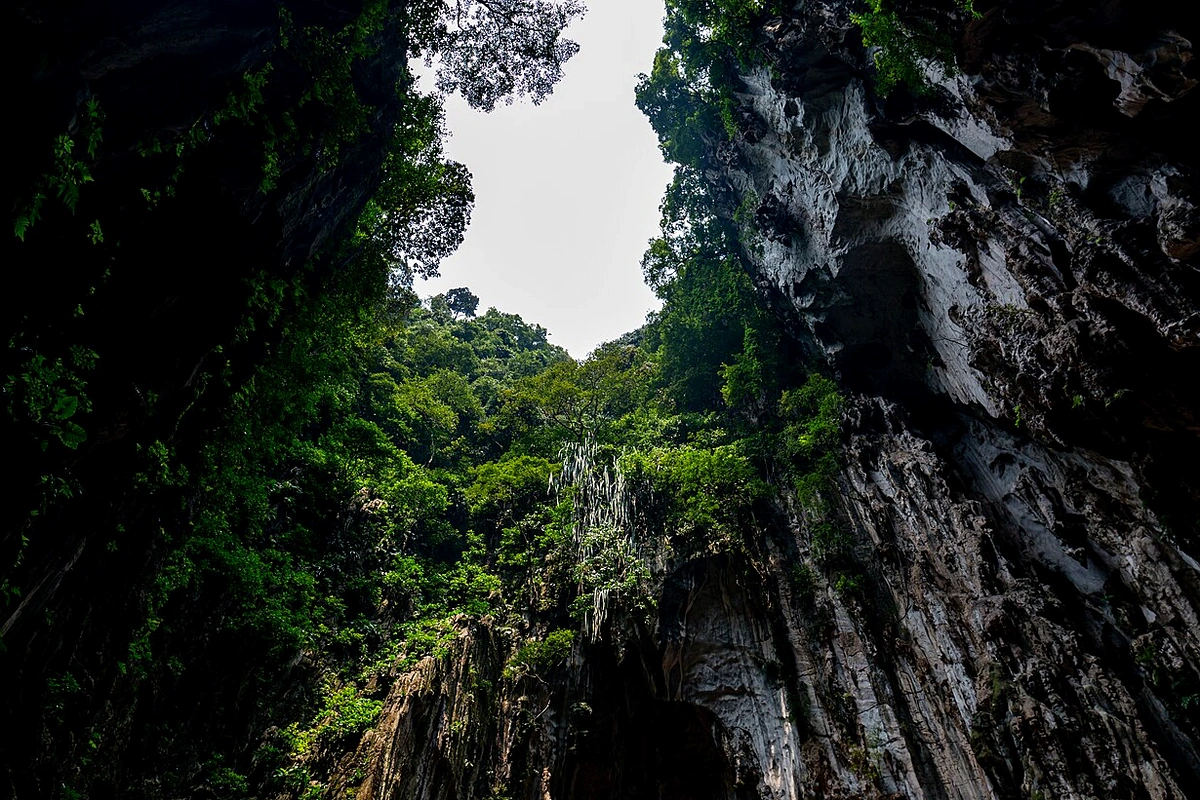
The Batu limestone cave complex, situated in Gombak roughly 13 kilometers north of downtown Kuala Lumpur, Malaysia, rises dramatically above the sweeping plains of the Malay Peninsula like a monumental edifice sculpted by nature over hundreds of millions of years. Geologically, this mass of stalactites and stalagmites belongs to the Kuala Lumpur Limestone formation, originating during the Devonian and Silurian periods and undergoing complex tectonic uplift to emerge as a towering natural fortress amid humid tropical lowlands. The defining geographical centerpiece of the site is a limestone hill rising more than 100 meters above sea level, housing an interconnected network of caverns—most notably Temple Cave (also known as Cathedral Cave), whose ceiling soars 100 meters high with natural openings that allow shafts of sunlight to pour down, creating an ethereal sanctuary both physically imposing and deeply mystical.
The modern history of Batu Caves is closely intertwined with the exploration of the region and the arrival of Tamil immigrants from India during British colonial rule on the Malay Peninsula. Long before becoming a major religious center, these caverns served as temporary shelters for indigenous Temuan Orang Asli tribes during hunting and foraging expeditions through the primeval rainforest. A pivotal transformation occurred in the late 19th century, when a visionary Tamil trader and community leader named K. Thamboosamy Pillay noticed that the main cavern’s distinctive entrance archway resembled the shape of the Vel—the celestial spear wielded by Lord Murugan, the Hindu deity of war and wisdom. In 1881, he consecrated a temple to Lord Murugan inside the cavern, marking the birth of a sacred landmark on the cultural map of Southeast Asia.
Transforming the shadowy depths of the cavern into an accessible sanctuary required extraordinary dedication from the Hindu community in Malaysia over subsequent decades. In 1892, the Thaipusam festival was celebrated at Batu Caves for the first time, drawing tens of thousands of devotees and establishing the site as the spiritual heart of the overseas Indian diaspora. To manage pedestrian flow and connect massive crowds of pilgrims from the base of the hill to the lofty main cavern entrance, temple administrators and engineers constructed wooden steps in 1895, later replacing them with a sturdy concrete staircase totaling 272 steps—a climb that to this day tests the endurance and devotion of every visitor ascending to the cave threshold.
Through the trials of modern history—from the Japanese occupation during World War II to the independence of the Federation of Malaya in 1957—Batu Caves stood resilient as a silent witness to the cultural and political synthesis of this pluralistic nation. During the wartime years, portions of the caves were used for storage or shelter, yet the sacred core remained fiercely protected by the community. As Malaysia entered an era of rapid economic growth and nation-building founded on unity in diversity, federal authorities recognized Batu Caves not merely as the heritage of the Hindu community, but as a national cultural treasure worthy of preservation amid rapid urbanization across the surrounding Klang Valley.
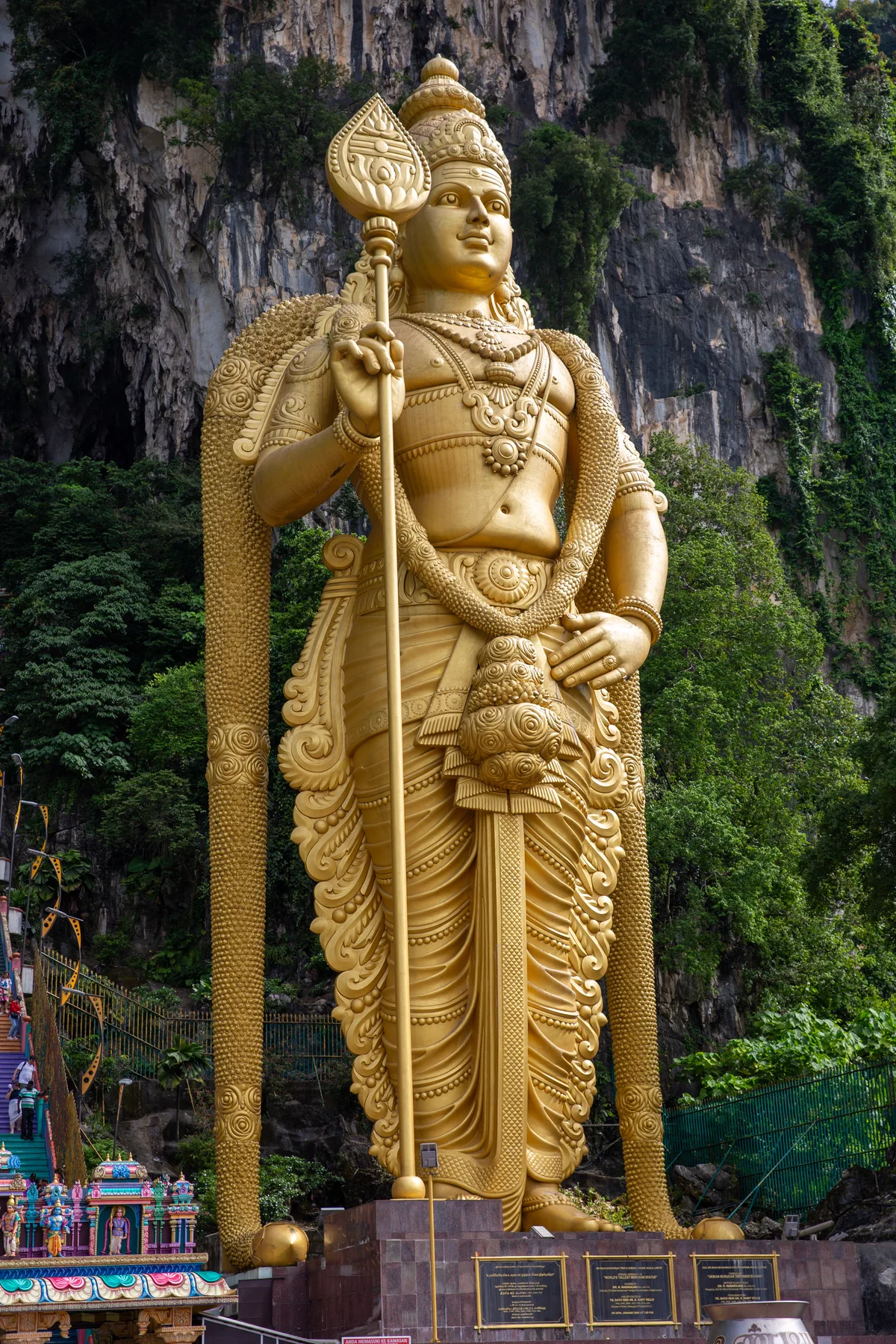
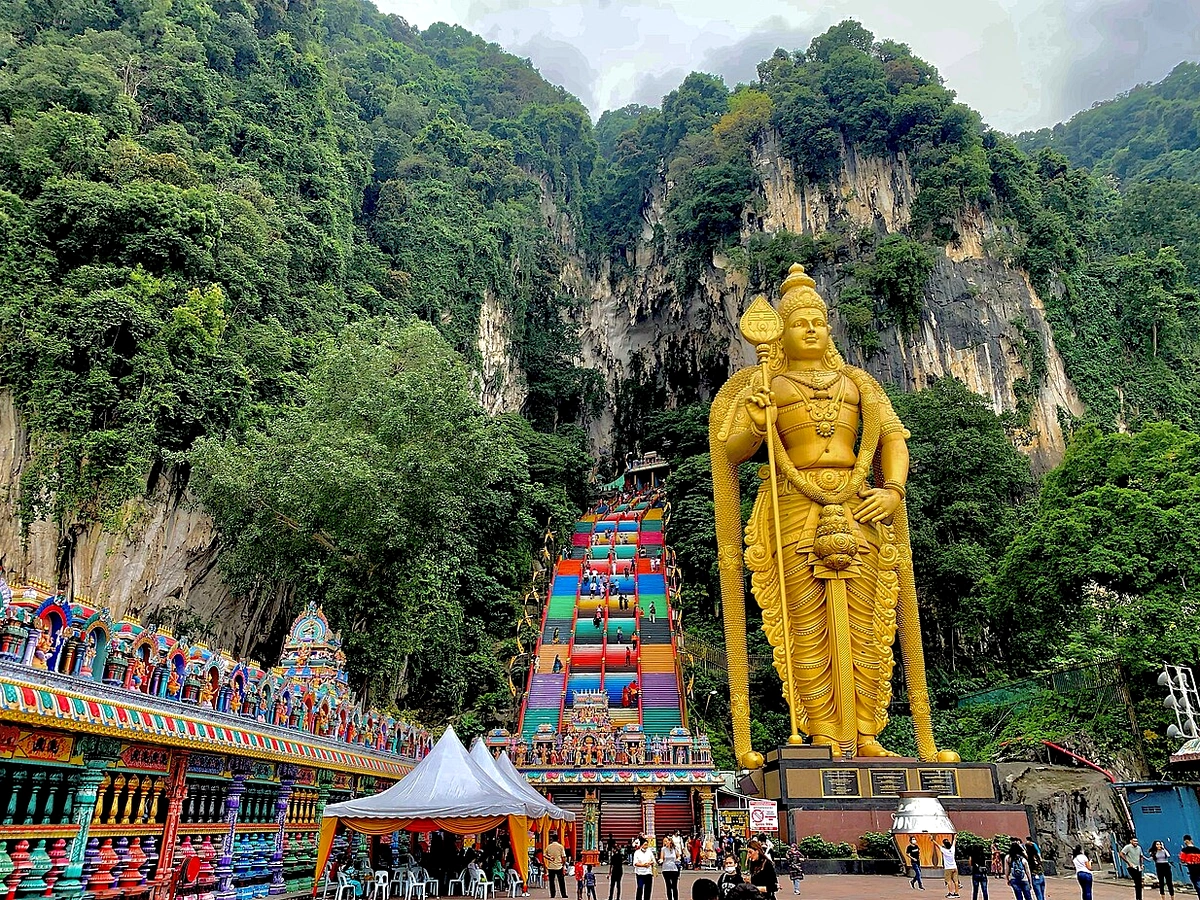
The international iconic stature of Batu Caves was cemented with the unveiling of the towering Lord Murugan statue in 2006, following years of painstaking craftsmanship by sculptors from India. Standing nearly 43 meters tall, the monument was constructed using 300 tons of structural steel and 1,500 cubic meters of reinforced concrete, coated in hundreds of liters of imported gold paint—making it the tallest statue of a Hindu deity outside India. Beyond creating a breathtaking visual beacon visible from kilometers away, the monument reshaped the forecourt plaza into an enduring emblem of devotion, architectural ambition, and the vitality of the Malaysian Tamil community in a globalized era.
The cultural value and social resonance of Batu Caves shine brightest during the annual Thaipusam festival, Malaysia’s second-largest religious gathering after the Muslim holy month of Ramadan. During the Tamil month of Thai—typically falling in January or February—millions of devotees dressed in vibrant yellow and saffron converge here to perform acts of penance and thanksgiving, carrying elaborately decorated shrines known as Kavadi attached with skewers and hooks piercing the skin as expressions of gratitude and spiritual purification. Transcending a conventional religious observance, Thaipusam has become a global cultural phenomenon attracting ethnographers, photographers, and international travelers eager to witness one of the modern world’s most vivid living expressions of ancient Eastern tradition.
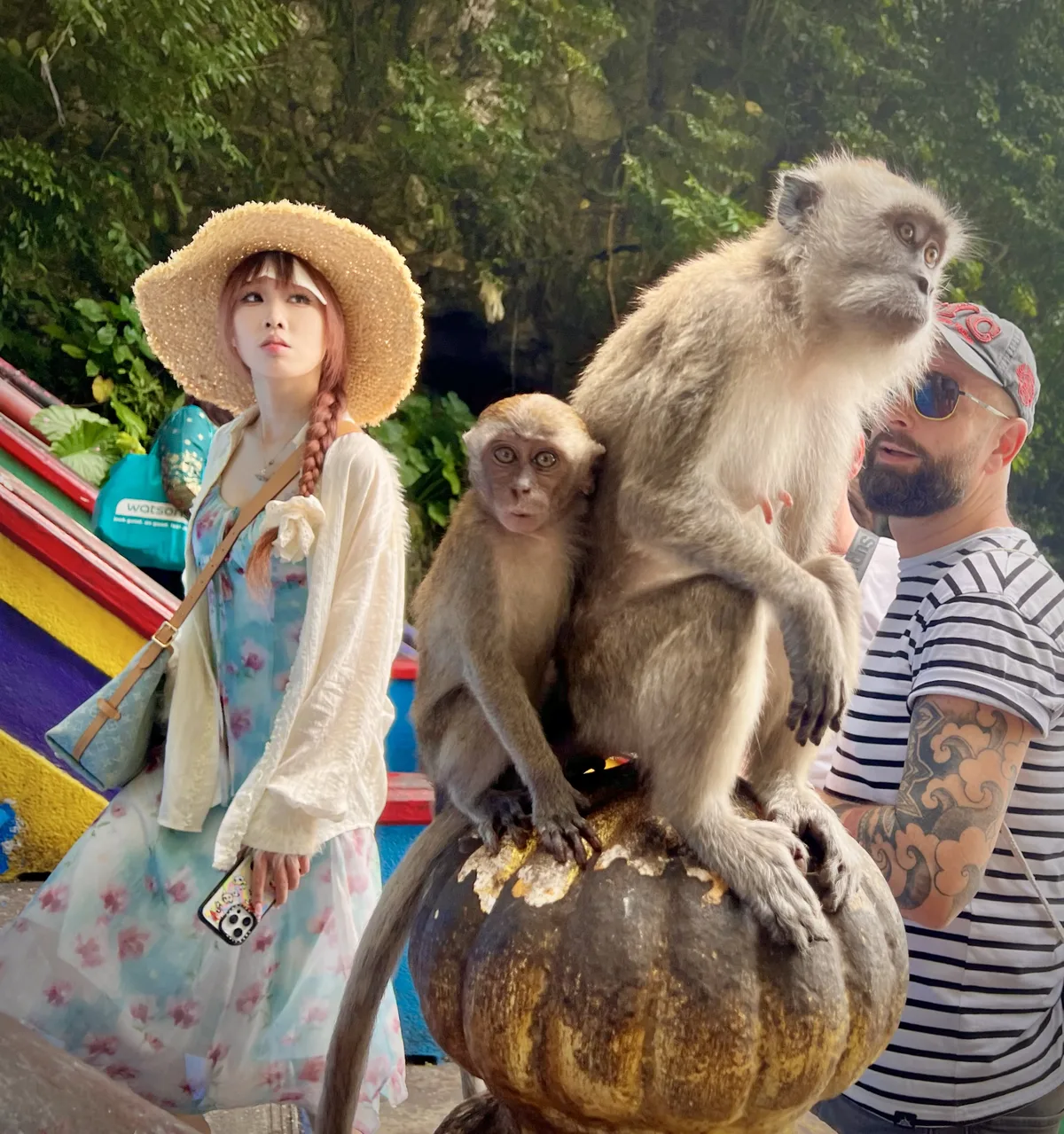
Alongside its spiritual and historical significance, the natural ecosystem surrounding Batu Caves contributes vital scientific value, harboring endemic flora and fauna specially adapted to karst limestone habitats. Sheer cliff faces provide a home for troops of long-tailed macaques (Macaca fascicularis), wild birds, and hundreds of insect species within a delicate limestone-hill forest ecosystem. Conservation initiatives led by government agencies and non-governmental organizations work continuously to balance religious tourism with the preservation of geological formations and million-year-old speleothems inside adjacent caverns such as Dark Cave and Art Gallery Cave.
Over more than a century of transformation from a remote limestone outcrop into one of the foremost spiritual and cultural landmarks of the Malay world, Batu Caves has affirmed the enduring vitality of tradition amidst rapid modernization. The seamless union of natural geological wonder with human craftsmanship, intellect, and unwavering faith has forged a complete human heritage site—serving not only as the spiritual epicenter of Hinduism in Southeast Asia, but also as a living monument to cultural harmony, religious diversity, and enduring identity in the 21st century.
The Batu limestone cave complex on the Malay Peninsula represents one of Southeast Asia’s oldest geological formations, estimated to have originated roughly 400 million years ago during the Devonian Period. This natural formation began with the accumulation of shells, corals, and primitive marine organisms on the floor of a shallow tropical sea, which tectonic uplift gradually raised above sea level to form towering limestone massifs within the Bukit Takun karst ecosystem. Across subsequent geological epochs, mildly acidic groundwater dissolved calcium carbonate, hollowing out an intricate multi-tiered cavern system—highlighted by Temple Cave (Cathedral Cave), a sacred chamber whose vaulted ceiling rises 100 meters above the cavern floor.
Stepping across the threshold of Temple Cave reveals a vast vaulted interior spanning thousands of square meters, illuminated by natural daylight streaming through ceiling openings formed by ancient roof collapses centuries ago. Traditional architects and sculptors ingeniously utilized natural rock alcoves, stalactites, and stalagmites to house smaller shrines (sannithanam) dedicated to Hindu deities including Lord Shiva, Lord Ganesha, and above all Lord Murugan, the guardian deity of the Tamil people. Built using traditional fired brick, lime-sand mortar, intricately carved teakwood, and vividly painted plaster reliefs in classic South Indian Dravidian style, these interior shrines posed formidable engineering challenges due to high subterranean humidity—requiring specialized moisture-resistant mortars and carefully engineered subsurface drainage to channel rainwater seeping through overhead limestone fissures.
Spatial planning across the complex extends beyond Temple Cave to neighboring zones such as Dark Cave and Art Gallery Cave, each distinguished by unique structural features and functions. Situated to the left along the cliffside, Dark Cave stretches roughly two kilometers into an untouched subterranean ecosystem minimally altered by artificial lighting, sheltering dozens of specialized cave-dwelling species including fruit bats, trapdoor spiders, and cave-adapted lizards. To safeguard this fragile habitat, lighting is kept strictly low-impact, paired with non-invasive wooden boardwalks resting lightly above the stone floor to protect million-year-old calcite formations. Meanwhile, Art Gallery Cave and Ramayana Cave at the foot of the hill employ reinforced cement modeling and traditional sculpture to vividly depict Hindu epics through hundreds of colorful statues, creating a semi-open-air sculptural museum.
Visitor infrastructure across the complex requires rigorous crowd and spatial management by heritage stewards and the local temple board. Welcoming three to five million pilgrims and sightseers annually—and surging to hundreds of thousands during the multi-day Thaipusam festival—stairways and walkways endure immense structural loads. Engineers have implemented one-way pedestrian flow systems along stairwells and main concourses to prevent bottlenecks and safeguard the concrete steps, while continuously upgrading waste management, drainage, and lighting with corrosion-resistant materials such as stainless steel and natural granite built to endure saturated tropical humidity.
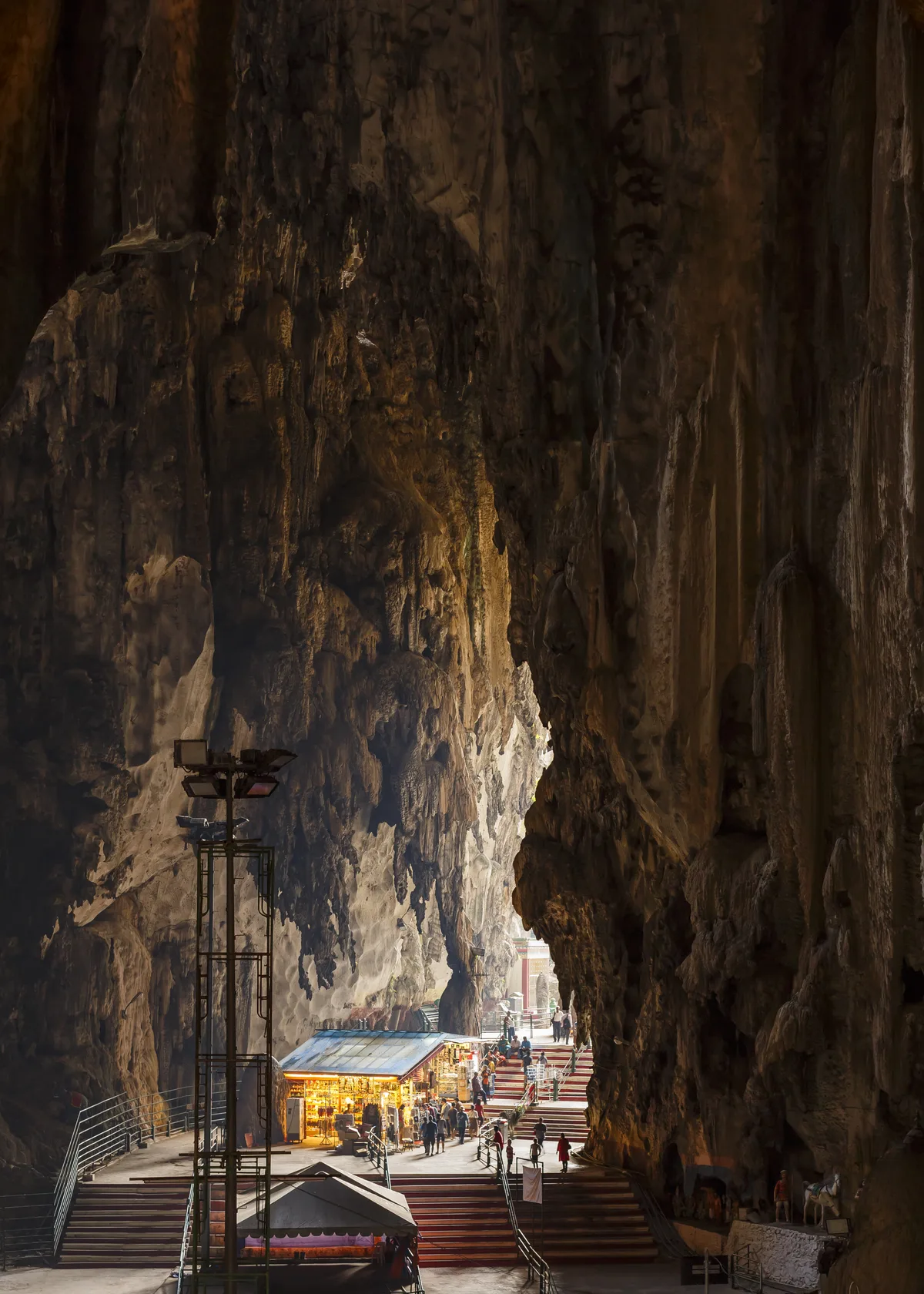
Architectural conservation here balances preserving natural geological formations with meeting the demands of modern cultural tourism. Microclimatic shifts inside the caverns—generated by body heat and moisture from thousands of daily visitors—can slow speleothem growth and encourage algae or moss on historic shrine surfaces. Consequently, geologists and structural engineers monitor limestone stability using electronic sensors while maintaining strict ecological buffer zones around the base of the hill to regulate surrounding commercial construction, ensuring this fusion of million-year-old geology and sacred architecture endures intact for future generations.
Located in Selangor State roughly 13 kilometers north of Kuala Lumpur, the karst landform of Batu Caves dates back approximately 400 million years. Geologically, it stands as a majestic testament to weathering and crustal uplift, where carbonic-acid-rich rainwater slowly carved deep caverns adorned with dramatic stalactites and stalagmites. Yet Batu Caves’ historical and anthropological richness extends far beyond raw geology, shaped profoundly by layers of Hindu culture nurtured by Tamil immigrants arriving on the Malay Peninsula from the late 19th century onward. The union of rugged natural rock with refined South Indian sacred artistry transforms the site into a living museum of singular architecture, where every step, alcove, and sculpture embodies Eastern cosmology and philosophy.
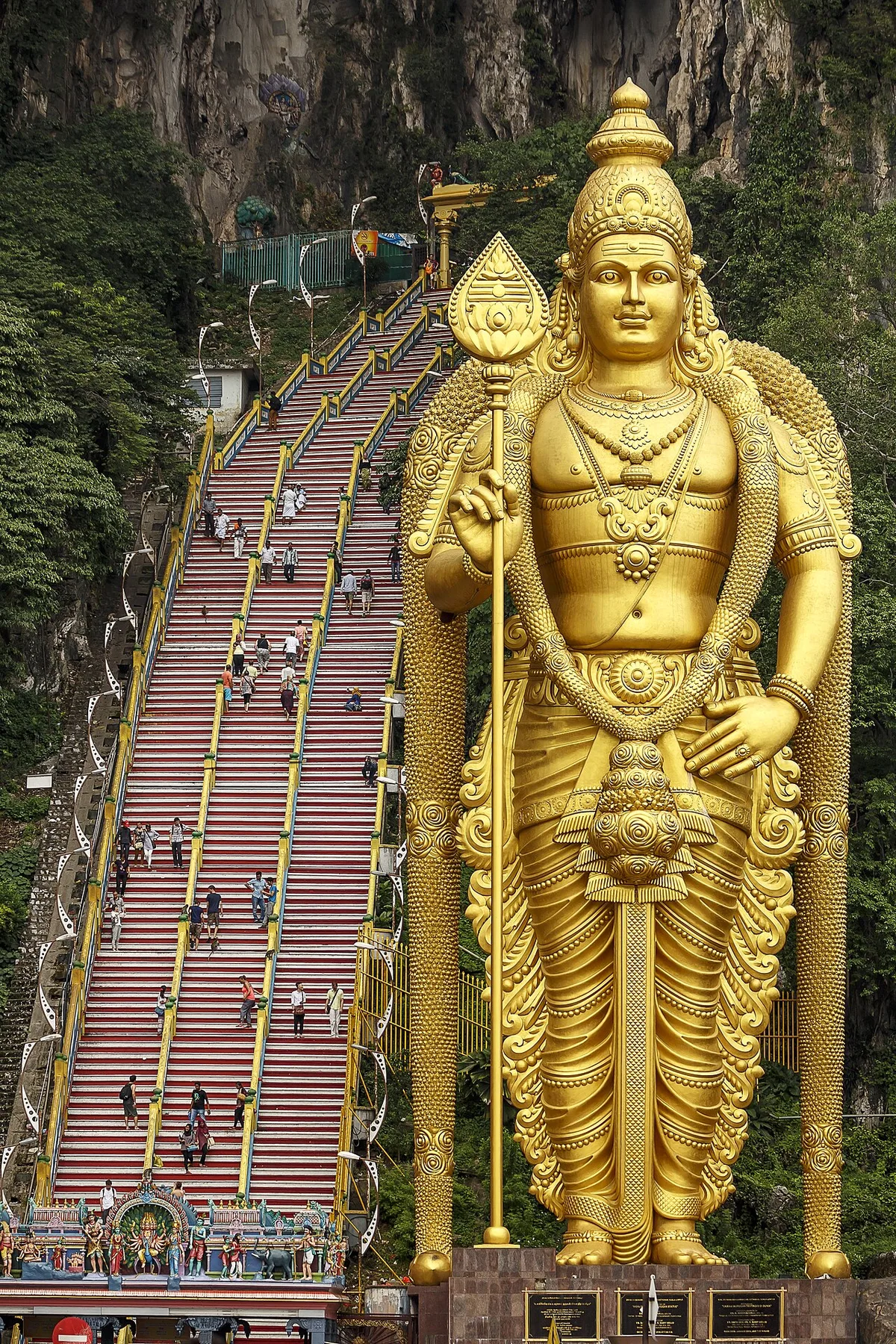
Entering the sacred precinct begins at the expansive forecourt dominated by the colossal Lord Murugan statue, inaugurated in 2006 after twelve years of meticulous sculpting. Rising 42.7 meters high, it is the world’s tallest statue of Lord Murugan and one of the tallest Hindu deity statues globally, crafted from 300 tons of structural steel, 1,500 cubic meters of concrete, and 300 liters of gold paint imported from Thailand. Executed strictly according to classical South Indian iconographic canons, the statue depicts the deity of war and wisdom standing majestically with his right hand holding the sacred spear Vel—symbolizing penetrating wisdom and supreme power to vanquish ignorance and evil. Its pedestal and plaza layout are proportioned with axial symmetry to draw the pilgrim’s gaze upward, inspiring reverence before a transcendent guardian.
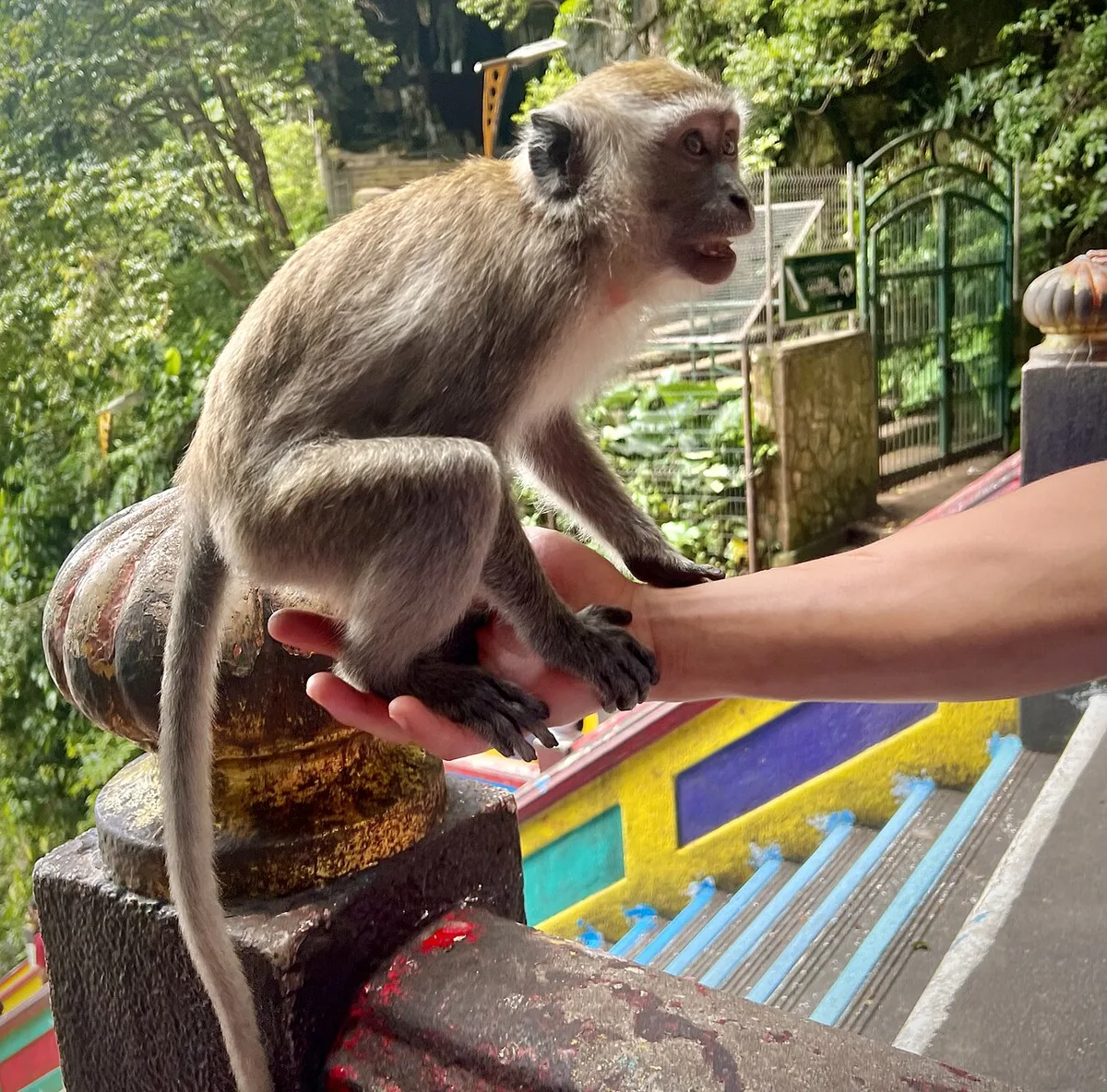
Leading visitors up to the main cavern threshold is the iconic flight of 272 stone steps, painted in a vibrant spectrum of colors in 2018 that climbs dramatically toward the sky. In Hindu spiritual philosophy—particularly Shaiva Siddhanta tradition—ascending these 272 steep steps represents far more than physical exertion; it symbolizes purifying the soul by overcoming 272 forms of worldly illusion, temptation, and ignorance. Along the ascent, native karst ecology reveals itself in shade-loving ferns, chattering long-tailed macaques, and weathered limestone cliffs, guiding visitors through a tangible transition from outer urban bustle into sacred stillness inside the mountain.
Crossing into the main cavern—known as Temple Cave or Cathedral Cave—the interior opens dramatically beneath a ceiling soaring nearly 100 meters high, where natural skylight apertures channel brilliant shafts of sunbeams onto ornate shrines below. The architectural centerpiece consists of inner sanctums (Sannidhi) built against the limestone walls in classic South Indian Dravidian style, crowned with intricately sculpted miniature Gopuram towers. Constructed of brick, lime plaster, and fine timber, these shrines feature richly detailed bas-reliefs portraying Lord Shiva, Goddess Parvati, Lord Ganesha, and Lord Kartikeya alongside hundreds of polychrome figures illustrating episodes from the Mahabharata and Ramayana—rendered with graceful contours, flowing drapery, and serene yet commanding expressions.
Beneath the main temple level, Dark Cave unveils an invaluable archaeological and biological world preserved largely intact since American naturalist William Hornaday explored it in the late 19th century. Unlike Temple Cave, Dark Cave remains untouched by monumental temple construction, safeguarding pristine stalactites, stalagmites, columns, and flowstone curtains formed over millions of years of mineral-rich dripping water. It shelters dozens of specialized troglobitic species—including fruit bats, rare trapdoor spiders, centipedes, and eyeless cave insects—within a delicate closed ecosystem. Guided educational tours operate under strict conservation protocols to protect fragile growing calcite crystals in perpetual darkness and high humidity.
At the foot of the limestone massif sit Art Gallery Cave and Museum Cave, purpose-built chambers showcasing sculptures, murals, and artifacts illuminating Hindu philosophy and the history of Malaysia’s Indian community. Their entrances and interiors burst with hundreds of brightly painted statues depicting intricate mythological narratives—from cosmic battles between deities and Asuras to teachings on rebirth and karma. Crafted by master artisans from Tamil Nadu using traditional lime-plaster modeling and mineral-and-plant pigments, every mural and sculpture adheres to sacred proportions codified in the Shilpa Shastras, where each hand gesture (mudra), posture (tribhanga), and emblem carries deep spiritual symbolism.
Ultimately, the architectural and cultural depth of Batu Caves lies in its seamless synthesis of two seemingly opposite realms: the primeval, immutable majesty of million-year-old geology and the vibrant, intricate devotion of human sacred art. Preserving both tangible monuments and the living spiritual heritage of Hinduism in Southeast Asia, Batu Caves stands as an unmatched open-air sacred masterpiece where ancient stone is infused with history, artistry, and reverence.
Rising above its origins as a 400-million-year-old geological formation, Batu Caves in Selangor pulses as a living sanctuary of culture and devotion. Daily life here follows a timeless cadence uniting primordial nature with vibrant Hindu ritual. Every hour of the day casts a distinct mood over the cliffs, reflecting the spiritual life of Malaysia’s Tamil community and the rich cultural tapestry of the Malay Peninsula as shifting sunlight turns the towering limestone massif into a natural theater of worship and everyday life.
As dawn breaks over the eastern horizon of Kuala Lumpur, Batu Caves awakens in crisp, tranquil stillness. Morning begins with the resonant chime of bronze bells from the Sri Subramaniar Swamy Temple at the foot of the hill, greeting early pilgrims and travelers. Soft golden light filters through wisps of morning mist, illuminating the 42.7-meter golden statue of Lord Murugan and his towering Vel spear in radiant metallic luster against emerald tropical foliage clinging to sheer cliffs. At this early hour, the rainbow-hued staircase remains quiet save for the measured footsteps of priests preparing morning prayers and long-tailed macaques foraging among the branches, while cool morning air carries the delicate fragrance of temple incense before daytime crowds arrive.
By midday and early afternoon, morning serenity gives way to vibrant energy as thousands of pilgrims and international visitors ascend the 272 steps toward the 100-meter-high cavern. Traditional Nadaswaram wind music and rhythmic Tavil drums echo from the lower shrines, creating a rich South Indian soundscape. Forecourt vendors arrange trays of crisp murukku snacks, chilled fresh coconuts, and fragrant white jasmine garlands offered in worship. Inside Temple Cave, sunlight streaming through natural ceiling openings pierces drifting clouds of incense to form tangible pillars of light illuminating intricate shrines, while temple bells and Sanskrit chants reverberate powerfully off ancient stone walls.
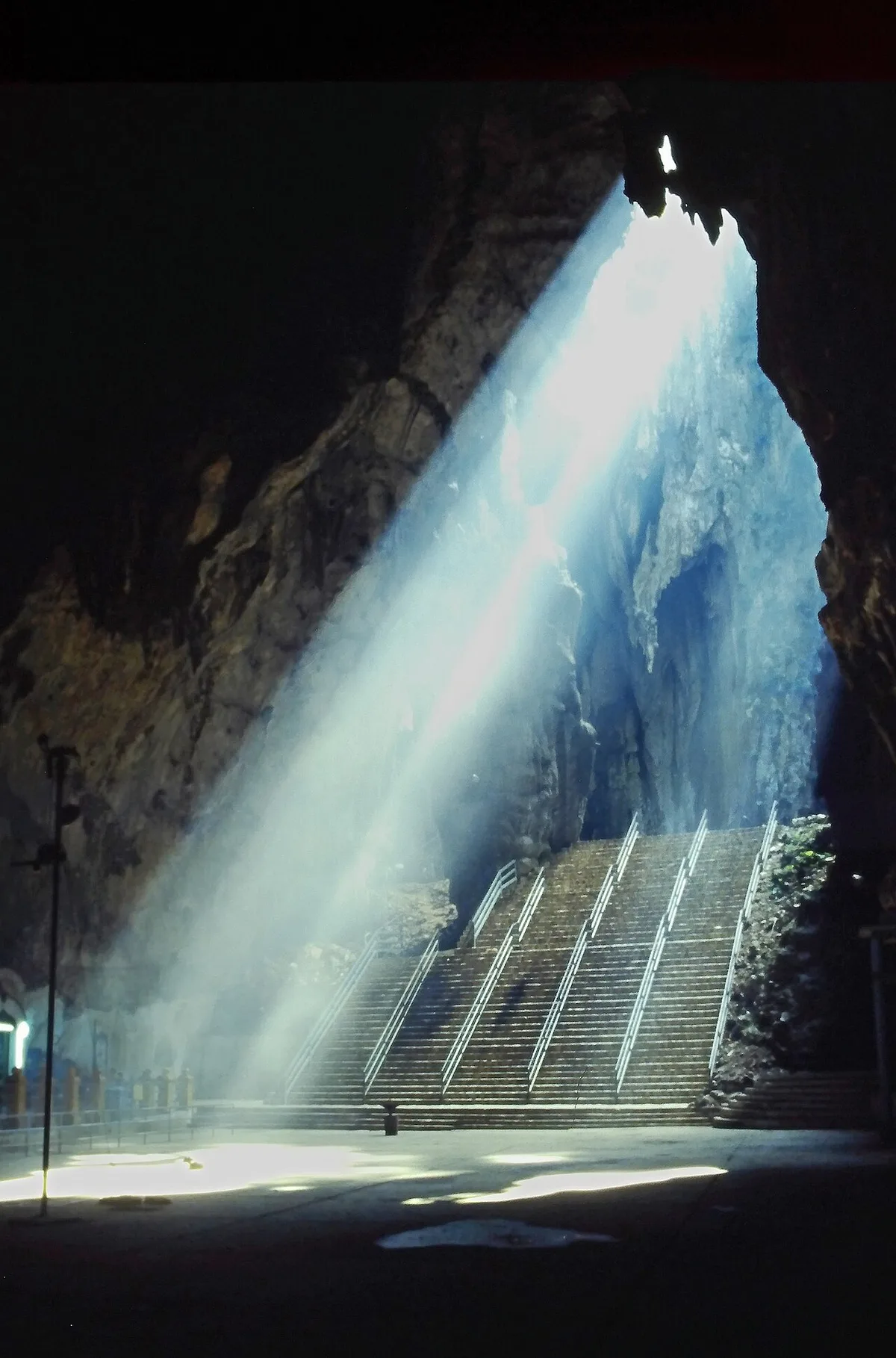
As dusk approaches, Batu Caves transitions into a more contemplative, serene mood. Slanting afternoon rays bathe ancient limestone cliffs in warm amber and crimson hues before fading into twilight. Crowds gradually thin, restoring quiet reverence to the mountain sanctuary as priests perform evening Aarti fire offerings—purifying the air with camphor flames and blessings—before closing the main shrine doors for the night. Once darkness falls, architectural floodlights illuminate the golden statue of Lord Murugan and temple gateways against the dark hillside, while evening insects replace daytime bustle to complete a daily rhythm guided by nature and faith.
The pinnacle of spiritual and artistic vitality arrives during major festivals, above all Thaipusam in the Tamil month of Thai (January or February). Over these days, Batu Caves becomes the focal point of the global Hindu world as millions gather for pilgrimage, penance, and thanksgiving to Lord Murugan. Devotees perform Kavadi Attam—a stirring ritual combining rhythmic devotional dance with extraordinary physical endurance—carrying ornate Kavadi frames adorned with peacock feathers and fresh flowers, often anchored with metal hooks and skewers while in a state of deep spiritual trance. Chants of “Vel! Vel!” mingle with thunderous drums to create an unforgettable atmosphere of collective faith and emotion.
To fully appreciate the architectural and natural grandeur of Batu Caves, seek out key vantage points along your route. The most commanding panorama awaits at the very top of the 272 steps outside Temple Cave, offering sweeping views across Kuala Lumpur’s northern suburbs where modern high-rises contrast dramatically with ancient limestone cliffs. Another rewarding perspective lies inside Dark Cave, where guided conservation walks reveal fascinating cave-adapted wildlife such as trapdoor spiders and fruit bats beneath dramatic subterranean formations—rounding out a portrait where millions of years of natural history meet living human devotion.
Beyond its status as a 400-million-year-old geological marvel and sacred Hindu landmark, Batu Caves anchors a vibrant culinary ecosystem where South Asian gastronomy weaves seamlessly into Malaysia’s multicultural tapestry. Since Tamil communities settled around the limestone foothills in the late 19th century, authentic South Indian culinary traditions have flourished here—where every dish embodies wellness philosophy, ritual hospitality, and ancestral memory beneath sacred banyan trees and colorful temple towers.
Dining around Batu Caves is deeply rooted in Tamil Nadu culinary traditions, highlighted by classic banana-leaf meals served on fresh green banana leaves in place of plates. Beyond symbolizing purity, serving hot steamed rice atop a banana leaf releases natural polyphenols that infuse the food with subtle aroma and aid digestion. A traditional banana-leaf feast features fluffy white rice accompanied by seasonal vegetable stir-fries (poriyal), thick spiced lentil stews, tangy mango or lime pickles, crisp papadam wafers, and rich curries fragrant with cumin, coriander, mustard seeds, and fresh curry leaves. Flavor balance follows ancient Ayurvedic principles, harmonizing all six tastes—sweet, sour, salty, bitter, pungent, and astringent—to nourish body and mind.
Traditional South Indian breads and steamed cakes further showcase the artisanal mastery of local cooks. Dosa—thin, fermented rice-and-lentil crepes—are ladled onto vast cast-iron griddles brushed with sesame oil or pure ghee, emerging lacy and crisp at the edges yet tender at the center, served alongside fresh coconut-and-green-chili chutney and tangy tamarind sambar. Equally beloved is idli, cloud-soft steamed rice-and-lentil cakes symbolizing purity and often offered during temple rituals before being shared with devotees as blessed prasadam. Centuries-old soaking, fermentation, and spice-tempering methods remain faithfully preserved right at the gateway to modern Kuala Lumpur.
Beverage culture around Batu Caves celebrates the theatrical craft of Teh Tarik (“pulled tea”) alongside traditional South Indian filter coffee. A beloved Malaysian cultural icon bridging Malay, Indian, and Chinese communities, Teh Tarik is prepared by pouring strong Ceylon black tea blended with sweetened condensed milk back and forth between two metal mugs up to a meter apart—aerating the drink to create a velvety frothy crown while cooling it to ideal sipping temperature. During major festivals like Thaipusam, charitable thanneer panthal refreshment stalls line the approaches, distributing free hot Teh Tarik and fresh coconut water to sustain pilgrims along their journey.
The streets and markets surrounding the Batu Caves commuter station and Jalan Batu Caves form a bustling culinary corridor fragrant year-round with aromatic spices. Along colonial-era shophouses accented with Indian architectural motifs, spice merchants display open sacks of golden turmeric, whole black peppercorns, cinnamon bark, cardamom pods, and cloves imported from southern India. Passersby can watch bakers slap dough onto the blazing clay walls of traditional tandoor ovens to bake blistered naan, while glass display cases glisten with saffron-soaked jalebi spirals and golden chickpea-flour laddu sweets.
Dining customs around Batu Caves also celebrate communal generosity, most visibly during vegetarian community feasts (annadhanam) held on full-moon days and major religious festivals. Preparing and sharing food with others is revered as a sacred act of hospitality honoring both the divine and fellow human beings. Sitting side by side at long banana-leaf-lined tables and eating respectfully with the right hand in traditional fashion offers travelers an intimate connection to living heritage—proving how ancestral flavors carried across oceans have taken root to enrich Malaysia’s diverse culinary landscape.
Planning a visit to Batu Caves in Gombak, Selangor—roughly 13 kilometers north of central Kuala Lumpur—benefits from thoughtful logistical preparation and cultural awareness. Carved from sedimentary limestone over 400 million years old and standing as the largest Hindu pilgrimage center outside India, Batu Caves rewards travelers who understand local tropical weather, convenient rail connections, and sacred temple etiquette.
Climatically, Malaysia lies in an equatorial zone characterized by year-round warmth between 25°C and 35°C and high humidity frequently exceeding 80 percent. Rather than four temperate seasons, Selangor experiences rainfall shifts governed by the Southwest and Northeast monsoons. The wetter season from October through March often brings heavy late-afternoon or evening thunderstorms, whereas May through July tends to be drier with intense midday sunshine. The most comfortable months to visit Batu Caves are the transitional periods from February to April and August to September, when rainfall eases and early mornings feel pleasantly mild.
The best time of day to arrive is early morning between 7:00 AM and 9:00 AM, when temperatures are coolest, tour crowds are minimal, and visitors can quietly observe morning temple rituals. Starting early also makes climbing the 272 steps to Temple Cave far more comfortable before midday heat peaks. Afternoon hours between 3:00 PM and 5:00 PM often bring dramatic sunbeams angling through the cavern skylight—ideal for architectural and geological photography—though visitors should be prepared for occasional late-afternoon tropical showers.
Transit connections from central Kuala Lumpur to Batu Caves are convenient and affordable. The most direct and economical option is the KTM Komuter train on the Seremban Line, departing from major hubs like KL Sentral or Kuala Lumpur Station and terminating directly at Batu Caves Station right beside the temple entrance in roughly 30 minutes—bypassing northbound road congestion altogether.
Alternatively, Rapid KL public buses (such as Route 11 from Chow Kit or GOKL connections) serve the area, though travel times vary with traffic along Jalan Ipoh. For door-to-door convenience, ride-hailing apps like Grab and licensed taxis offer direct transfers from Bukit Bintang or KL Sentral at reasonable fares—an especially practical choice for small groups of three or four travelers seeking flexible timing.
Modest attire is strictly enforced at Batu Caves in accordance with Hindu temple etiquette. Both men and women must cover their shoulders and knees before ascending the main staircase. Sleeveless tops, backless shirts, short skirts above the knee, and shorts are not permitted; visitors dressed inappropriately will be required to rent or purchase a sarong wrap at the checkpoint for a small fee. Wearing breathable sleeved shirts paired with long trousers or below-the-knee skirts—along with supportive sneakers or slip-on shoes that are easy to remove before entering inner sanctums—ensures both comfort and respect.
Visitors should also exercise caution around the large troop of wild long-tailed macaques inhabiting the cliffs and staircase. Accustomed to crowds, these monkeys readily snatch loose plastic bags, snacks, sunglasses, hats, or phones. Never tease the monkeys, hold food openly in your hand, or approach closely for selfies, as they can become aggressive and transmit infections through scratches or bites. Keeping belongings zipped away and refraining from littering helps protect both visitors and the surrounding karst ecosystem.
Regarding admission fees, entry to the main Temple Cave is completely free every day from early morning until evening. Separate admission tickets apply to specialized side attractions at the base of the hill, including guided conservation tours of Dark Cave and cultural exhibits inside Cave Villa. Carrying a small amount of cash in Malaysian Ringgit (MYR) is helpful for sarong rentals, shoe storage, bottled water, and small forecourt snack stalls that may not accept digital payments.
Finally, pace yourself physically and bring a personal bottle of water, as climbing 272 steep steps in tropical humidity can quickly cause dehydration; travelers with heart conditions, high blood pressure, or knee concerns should take frequent breaks along the ascent. Observing active worship quietly and respectfully ensures a warm welcome from the local community and turns a visit to Batu Caves into a deeply memorable cultural and geological journey.
To experience this journey seamlessly alongside a local guide, explore our curated Singapore – Malaysia – Malacca – Genting 5D4N tour with a thoughtfully planned itinerary.