Tucked away in the northwest of Beijing’s ancient city, the history of the Summer Palace began to take shape more than eight centuries ago, originating in the Jin Dynasty when the Jingshan Imperial Garden was established on Wengshan Hill in 1153. By the Yuan Dynasty, the genius water conservancy expert Guo Shoujing achieved a hydraulic feat by reorganizing the entire underground water system from Jade Spring Mountain, transforming the pristine, marshy Wengshan Lake into a strategic reservoir supplying the Tonghui Canal—the vital waterway that sustained the capital of Dadu at the time. During the Ming Dynasty, in the seventh year of the Hongzhi era (1494), the ancient Yuanjing Temple was built right on the hillside, turning this place into one of the most serene and scenic spots in the imperial and aristocratic suburbs of the capital.
The magnificent appearance of the royal garden truly transformed brilliantly in the 15th year of the Qianlong Emperor’s reign (1750) under the Qing Dynasty, when the Emperor issued an edict launching an unprecedented scale of grand renovations to establish Qingyi Garden (Garden of Clear Ripples). The project was initiated for two ultimate purposes: to celebrate the sixtieth birthday to express boundless filial piety to Empress Dowager Chongqing and to complete Beijing’s inner-city water management network. The Emperor ordered Wengshan Hill to be renamed Longevity Hill (Wanshou Shan), while mobilizing tens of thousands of laborers to dredge and triple the size of the old lake to create the vast Kunming Lake, drawing inspiration from the charming beauty of West Lake in Hangzhou and mirroring the Kunming Pool of Emperor Wu of Han for naval training purposes. This was accompanied by the construction of the picturesque West Causeway and the bustling Suzhou Street, which replicates a lively water town. The entire project was completed in the 29th year of Qianlong (1764), consuming over 4.8 million taels of silver from the Imperial Household Department’s treasury.
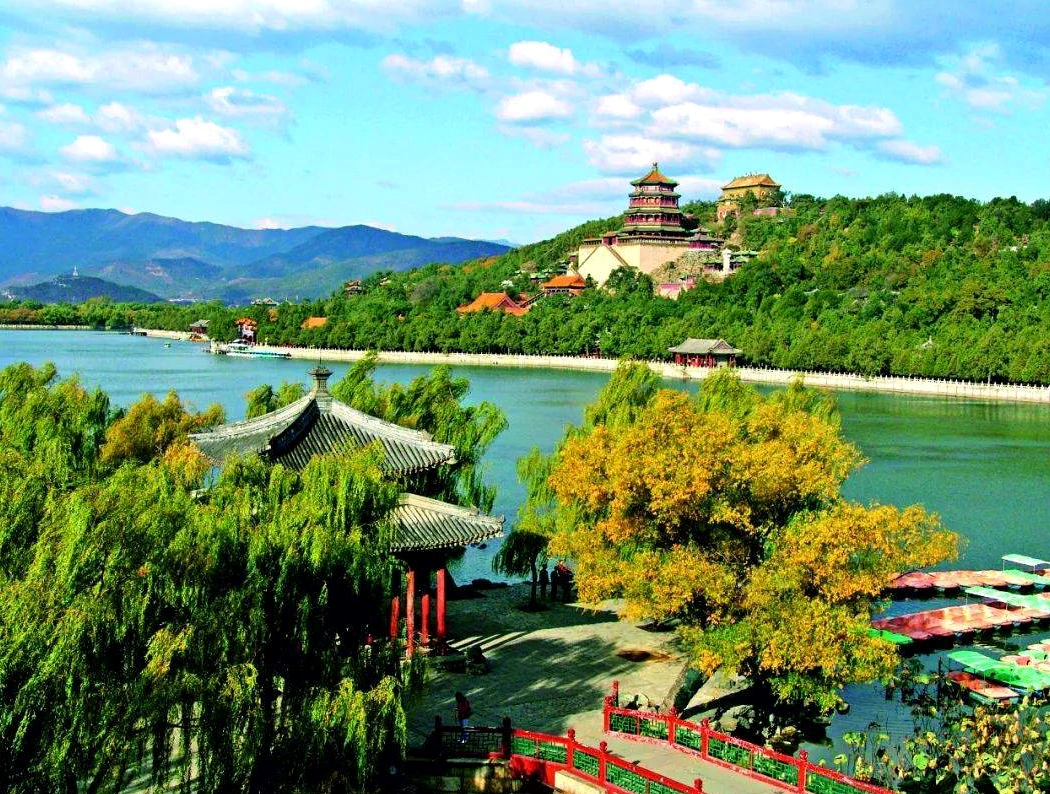
The entire panorama of the garden emerges like a giant ink wash painting, where the expansive waters of Kunming Lake embrace the majestic reflection of Longevity Hill standing tall against the blue sky. On the gently sloping hillsides, various clusters of temples, pagodas, and pavilions with glazed tile roofs are solemnly hidden among layers of lush pine and cypress trees that remain green all year round. Dotted across the lake’s curves are arched bridges painted in deep vermillion, casting shimmering reflections on the calm water, creating an exquisite blend of the supreme authority of northern imperial architecture and the lyrical, elegant charm of the Jiangnan landscape.
However, this magnificent imperial garden could not escape the tragic whirlpool of turbulent times. In October 1860, the tragic event known as the Gengshen National Humiliation struck during the Second Opium War, when the Anglo-French Allied Forces, under the brutal command of Lord Elgin, set ablaze a fury that reduced the entire famous Three Mountains and Five Gardens palace complex to ruins. The sea of fire raged day and night, turning hundreds of priceless wooden palaces into desolate ashes, leaving behind only sturdy metal and stone structures such as the Bronze Pavilion and the body of the Seventeen-Arch Bridge standing alone amidst the desolate ruins.
It was not until the 14th year of the Guangxu era (1888) that the royal garden was revived under a new name when Empress Dowager Cixi announced her resumption of control, returning symbolic power to Emperor Guangxu and using the pretext of retirement to rename the place the Summer Palace (Yiheyuan), meaning “cultivating harmony and peace.” This reconstruction event was linked to a shocking historical scandal of the Qing Dynasty, when Northern Minister Li Hongzhang and Prince Chun Yixuan secretly embezzled a huge budget of 20 to 30 million taels of silver originally allocated for purchasing modern ironclad warships for the Beiyang Fleet, diverting it to dredge lakes and build palaces for their own pleasure. The direct consequence of this action was the horrific defeat of the Qing navy against the Empire of Japan in the fierce naval battle of Jiawu between 1894 and 1895.
The garden’s turbulent destiny continued to be battered when the Eight-Nation Alliance invaded and looted in 1900, forcing Cixi to order a second major restoration after returning to the capital in 1902. When the feudal regime collapsed, the former emperor Puyi began opening part of the garden for ticket sales in 1914, before it was officially converted into a public park for the people in 1924. Overcoming numerous ups and downs and the flames of war, in 1998, UNESCO solemnly honored the Summer Palace as a World Cultural Heritage site based on criteria (i), (ii), and (iii), recognizing it as the absolute peak of traditional Oriental landscape garden art.
Located in Haidian District, about fifteen kilometers northwest of the Forbidden City, the Summer Palace spans a magnificent scale of up to two hundred and ninety hectares. Amidst the vast space of this premier scenic spot of the capital, the waters of Kunming Lake occupy three-quarters of the total area, resembling a giant mirror spanning over 2.2 square kilometers reflecting the sky and clouds. This special geographical position is not a mere natural coincidence, but the supreme crystallization of the Qing imperial court’s feng shui planning philosophy, turning a once low-lying swamp into a symbol of eternal power and peace.
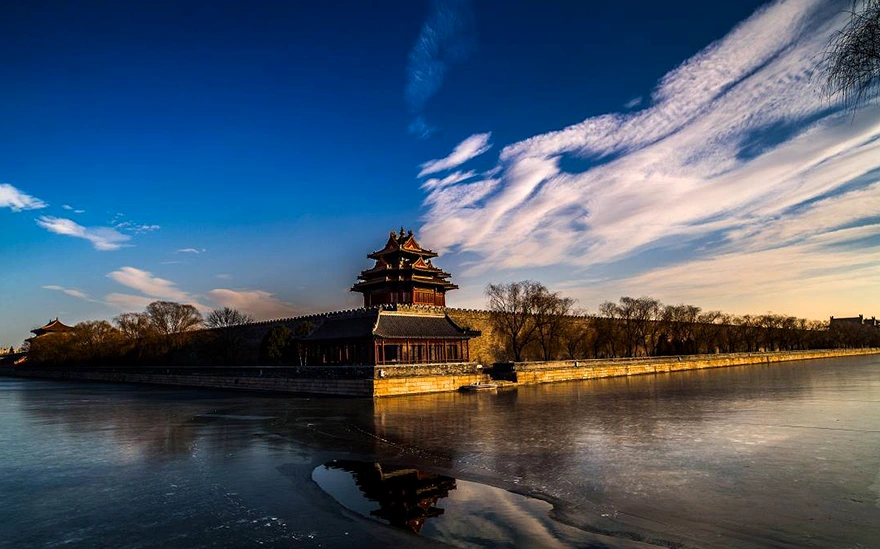
According to orthodox Eastern feng shui principles, the Summer Palace is an exemplary embodiment of the majestic “Backing the Mountain and Facing the Water” topographical structure. The entire palace complex takes the 60-meter-high Longevity Hill as a solid backing behind it, symbolizing the boundless longevity of the emperor and the peace and prosperity of the state. In front of this majestic hilltop lies the open, bright hall of the vast Kunming Lake, which gathers abundant water energy to accumulate wealth and auspicious energy for the court. The water source nourishing the lake’s bed is channeled from the majestic Western Hills and the pristine Jade Spring Mountain, creating a continuous underground dragon vein that allows the vital energy of heaven and earth to condense completely into the royal garden.
Accenting this consummate feng shui structure is the technique of “Borrowing Scenery” (Tá Cảnh) – the supreme artistic mastery of borrowing peripheral landscapes perfected by the classical Chinese garden school. The talented landscape architects during the Qianlong era did not enclose the space with stifling fortress walls; instead, they opened up the vista of Kunming Lake to capture the silhouette of the ancient pagoda atop Yuquan Mountain and the hazy, undulating ridges of the distant Western Hills as a natural backdrop. The boundary between man-made structures and the vast, open nature of the North seems to blur, turning the boundless scenery beyond ten thousand miles into an inseparable soul of the royal garden.
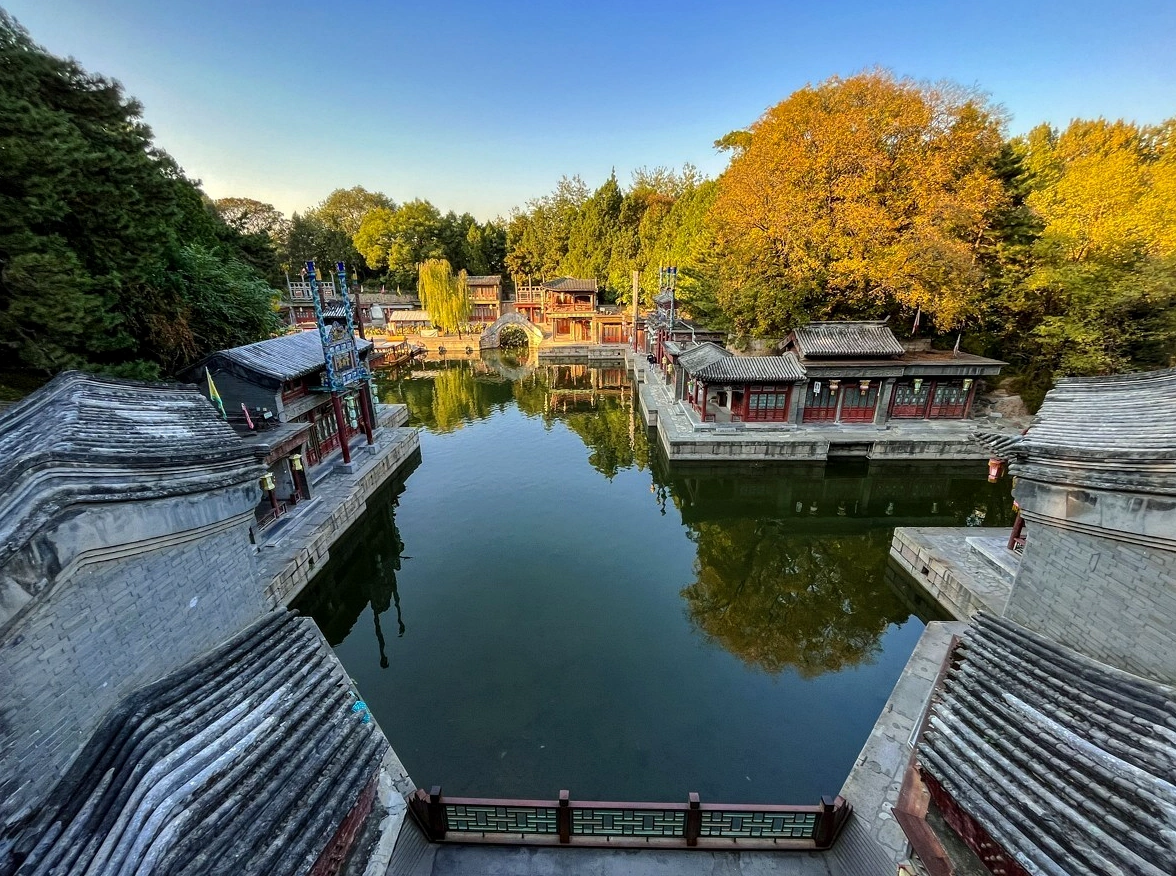
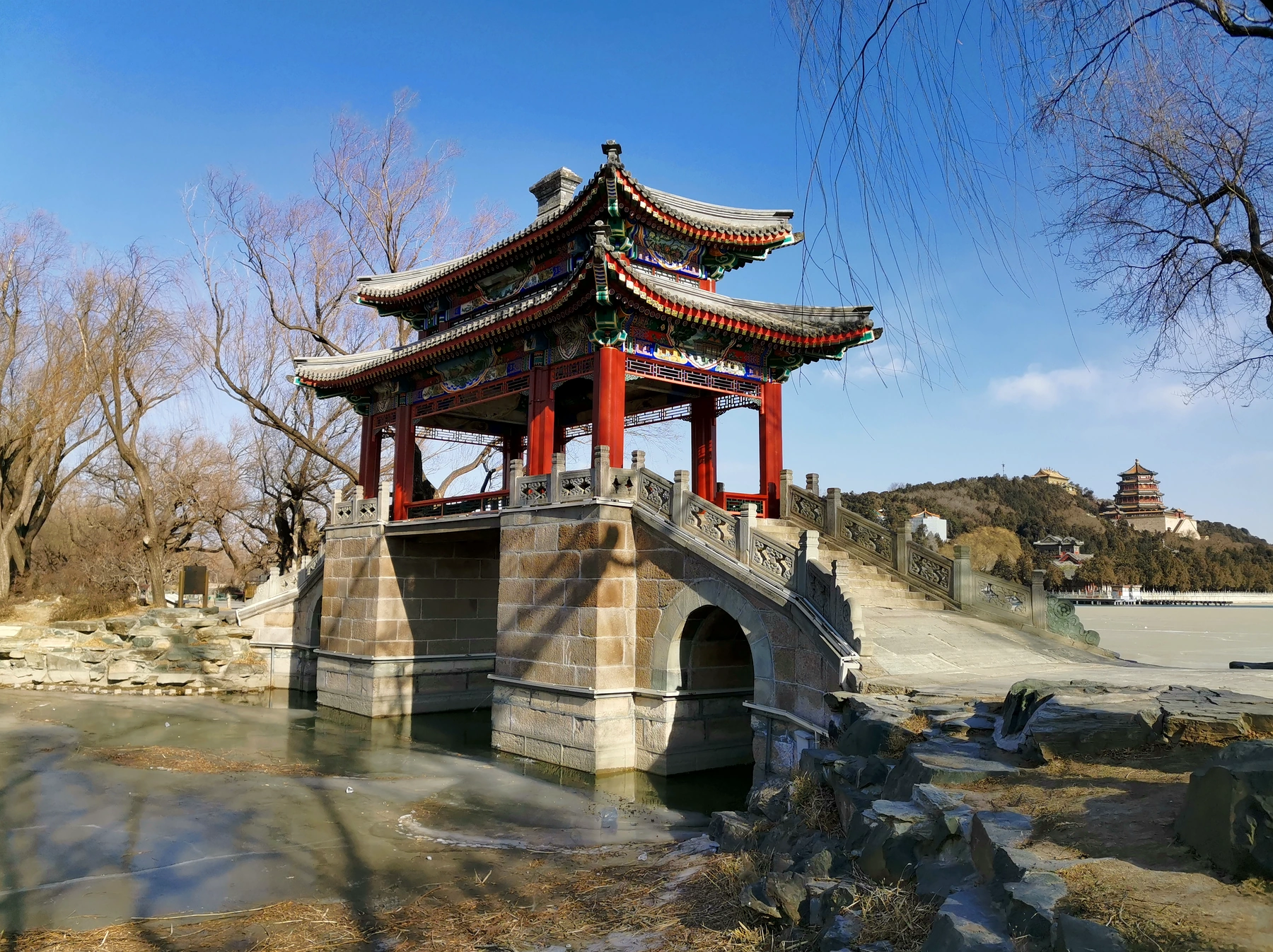
This exquisite harmonious beauty is vividly present in a quiet corner of the lake, where the mirror-like water reflects the elegant silhouettes of traditional buildings with gracefully upturned tiled eaves and the vermilion doors characteristic of imperial architecture. The pavilions nestle modestly beneath lush green ancient trees dotted with the vibrant gold of seasonal foliage, creating a color symphony that is both solemn and poetic. Farther away, across the crystal-clear water, a small, gently arched stone bridge connects the two banks, guiding the beholder’s footsteps into an ethereal realm resembling a majestic space.
Not stopping at borrowing the mountains and rivers of the North, the Summer Palace is also a nostalgic recreation of the soft scenery of the affluent Jiangnan water towns. Along the western shore of Kunming Lake, the imperial court had a long dike built named the West Dike (Xi Di), perfectly mimicking the structure of the legendary Su Dike on West Lake in Hangzhou. Along the dike, weeping willows gently sway their green branches in the breeze, interspersed with six exquisite stone bridges of various shapes, most notably the Jade Belt Bridge (Ngọc Đới) with its slender, jade-girdle-like arch. This soft dike brings the fresh, romantic, and gentle charm of southern water culture to blend into the arid grasslands of the northern realm, completing a one-of-a-kind landscape wonder under the Chinese sky.
Planned according to the philosophy of the “unity of heaven and man,” the overall Summer Palace is the ultimate crystallization of Qing dynasty imperial garden art, clearly divided into three functional zones deeply imbued with political symbolism and royal life. Right next to the main gate is the court administration area centered around the Hall of Benevolence and Longevity (Ren Shou Dian), where Empress Dowager Cixi and Emperor Guangxu held court, received foreign envoys, and decided national affairs. Directly behind it is the private residential palace area, highlighted by the luxurious and magnificent Hall of Joyful Longevity (Le Shou Tang) reserved exclusively for the Old Buddha, adjacent to the Hall of Jade Ripples (Yu Lan Tang) – a place stained with tragedy as it became the site where Emperor Guangxu was placed under house arrest for a decade following the failure of the Hundred Days’ Reform. Finally, occupying more than three-quarters of the area is the giant sightseeing zone surrounded by the vast water and mountain scenery of Longevity Hill and Kunming Lake.
From the panoramic view across the tranquil waters of Kunming Lake, the entire Summer Palace unfolds like a grand ink wash painting in the heart of the capital. The foreground features calm, clear blue water reflecting the sky and clouds, where royal boats and tourist vessels gently glide near willow-shaded piers. The background looms with the slopes of Longevity Hill covered in dense pine and cypress trees, embracing traditional palace complexes with layers of glazed tile roofs hidden among lush green foliage. Standing proudly at the highest point is the imposing Tower of Buddhist Incense (Fo Xiang Ge), reaching upward majestically and connecting smoothly with the long, winding corridor hugging the shoreline, creating an imperial architectural entity that is both solemn and in absolute harmony with nature.
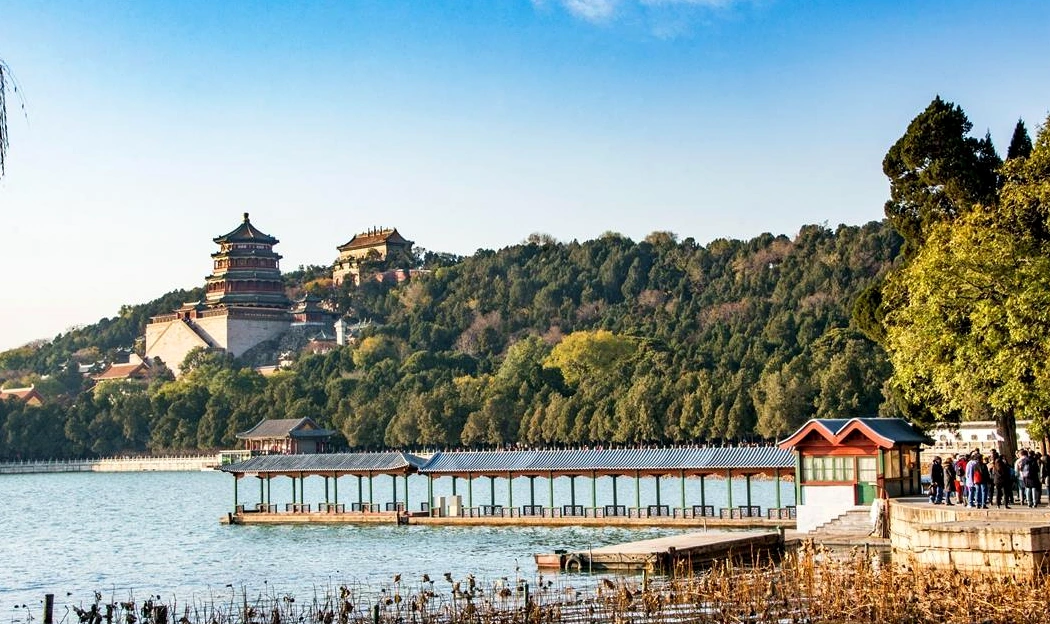
The architectural heart of the garden reigns on the southern slope of Longevity Hill, following a strictly symmetrical Sacred Way axis. Impressively present in all its majesty on a massive 21-meter-high granite pedestal is the Tower of Buddhist Incense (Fo Xiang Ge) – a 41-meter-high, three-story, four-eaved octagonal wooden pagoda that serves as the supreme visual focal point of the entire estate and houses the bronze statue of the Thousand-Armed, Thousand-Eyed Guanyin Buddha cast during the Ming dynasty. Adjacent to the base of the tower is the Hall of Dispelling Clouds (Pai Yun Dian), a lavish palace dedicated to celebrating Cixi’s extravagant birthday ceremonies and where princes and ministers knelt to offer congratulations. Nestled on the western slope of the Tower of Buddhist Incense is the Hall of Dispelling Clouds’ Bronze Pavilion (Bao Yun Ge), a monolithic cast-bronze marvel weighing up to 207 tons, a miraculous structure that has survived intact through two historic devastating fires by the Anglo-French allied forces in 1860 and the Eight-Nation Alliance in 1900.
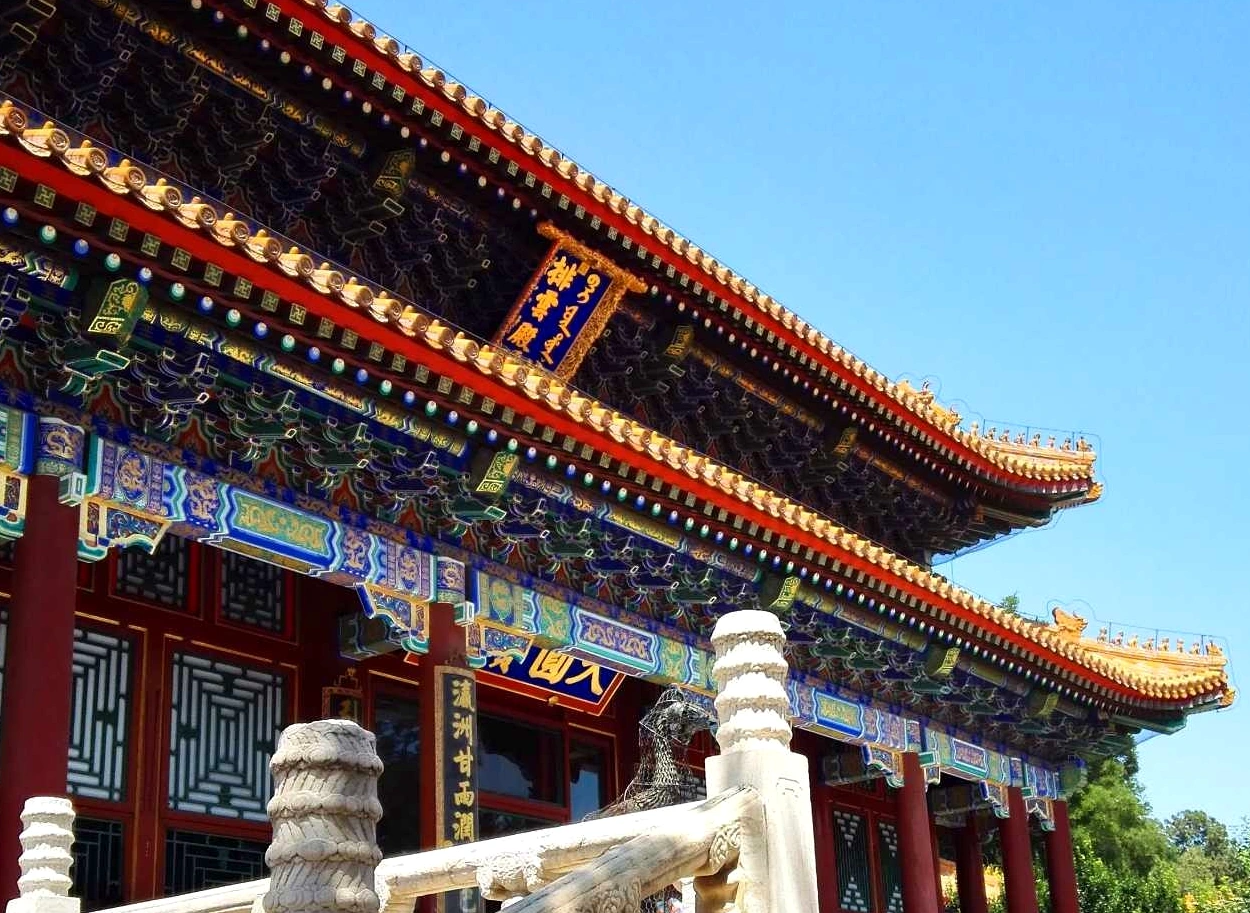
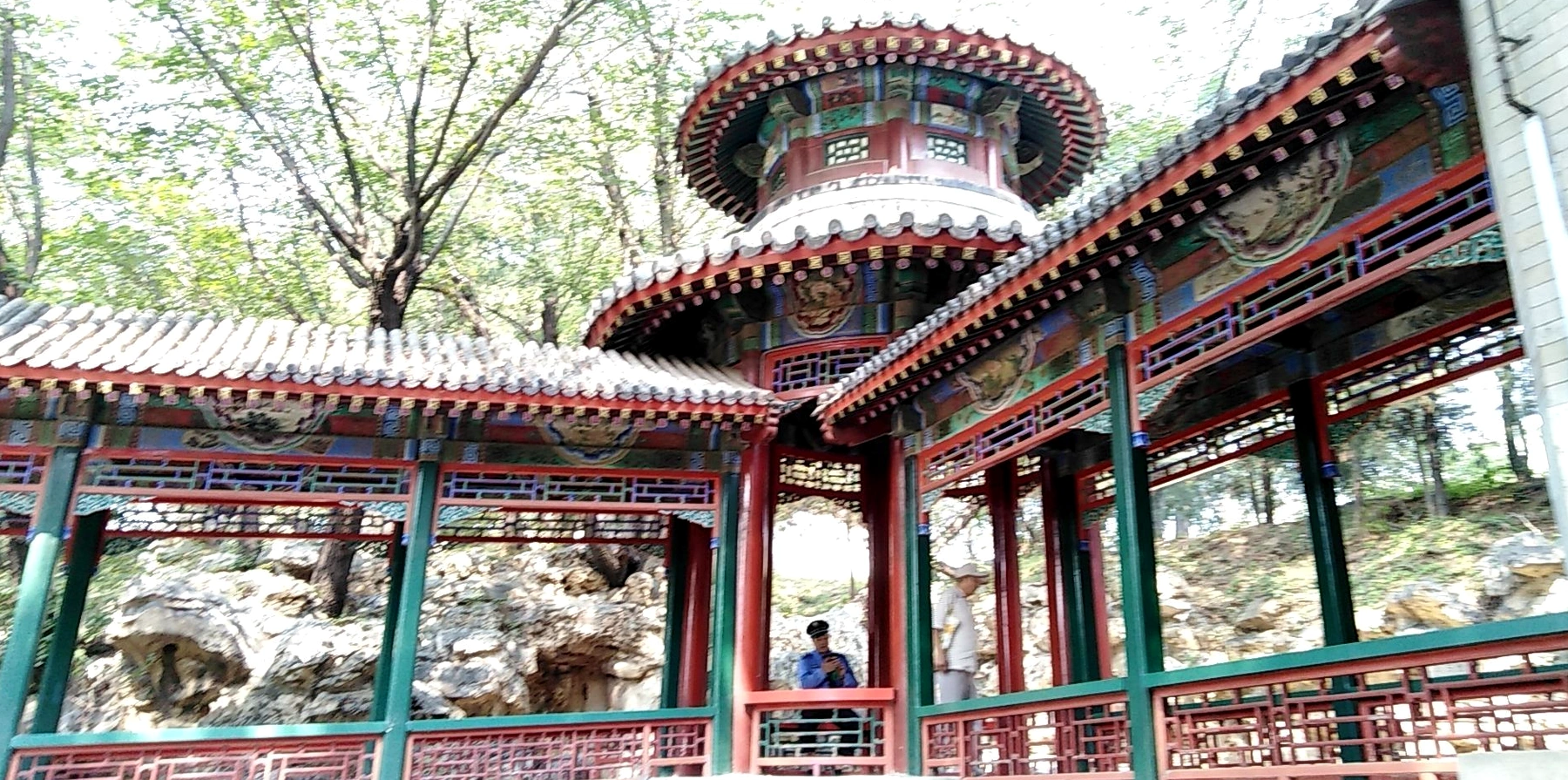
Following the gentle slopes of the mountain along the edge of Kunming Lake is the Long Corridor (长廊), recognized by the Guinness World Records as the longest wooden corridor on the planet, with a total length of 728 meters divided into 273 interconnected sections. Far exceeding its practical function of shielding the imperial jade feet from rain and sun while they enjoyed the scenery, the Long Corridor is truly a priceless open-air art museum, preserving more than 14,000 exquisite colorful murals adorning every crossbeam and tie beam. Through the talented brushstrokes of ancient court artisans, the picturesque landscapes of the Jiangnan region and countless classic episodes from the Four Great Classical Novels—Romance of the Three Kingdoms, Journey to the West, Water Margin, and Dream of the Red Chamber—come vividly to life.
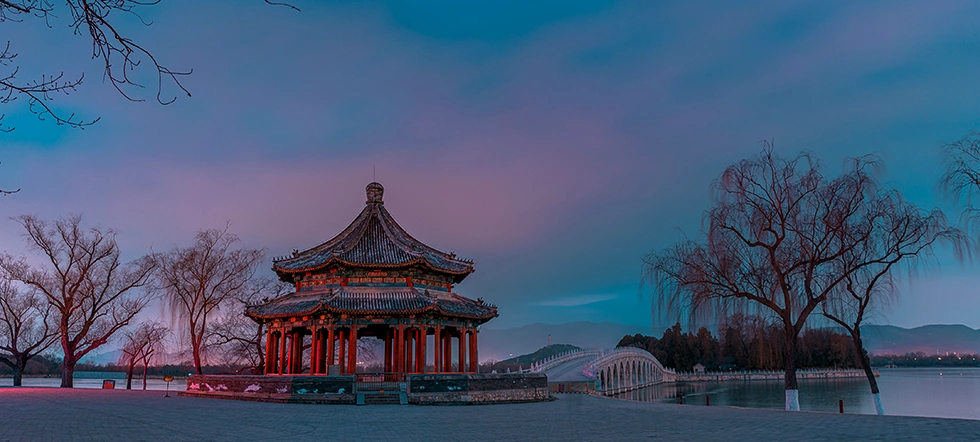
The symmetry and ingenious transformation in the garden planning are further attested by two famous waterside pavilions at either end. Nestled peacefully along the northwest shore is the Marble Boat (Qingyan Boat), a 36-meter stone boat with a hull carved from a solid piece of sturdy white marble, supporting a multi-story structure strongly influenced by Western architecture featuring imported stained glass following its 1893 restoration, embodying a profound political philosophy of rock-solid peace and stability. Directly opposite to the south is the Seventeen-Arch Bridge, stretching 150 meters long and 8 meters wide, proudly bridging the eastern shore to South Lake Island, immensely famed for the 544 meticulously carved stone lion statues lining its balustrades, each possessing a unique, non-repeating expression and posture.
As dusk gradually falls over the imperial capital, the Summer Palace sheds its daytime bustle to don a magnificent imperial robe woven from contemporary lighting artistry. The nightlife at the Summer Garden unveils a completely distinct dimension of sightseeing, where the solemnity of the Qing Dynasty blends seamlessly with delicate artistic lighting technology. From early evening onward, the artistic lighting system begins operating, transforming the towering Tower of Buddhist Incense atop Longevity Hill into a gold-plated spiritual lighthouse against the deep blue sky. The brilliant radiance from the three-tiered, eight-eaved pagoda cascades down onto the surface of Kunming Lake, creating a shimmering reflection that gently ripples with the small waves lapping against the granite embankments.
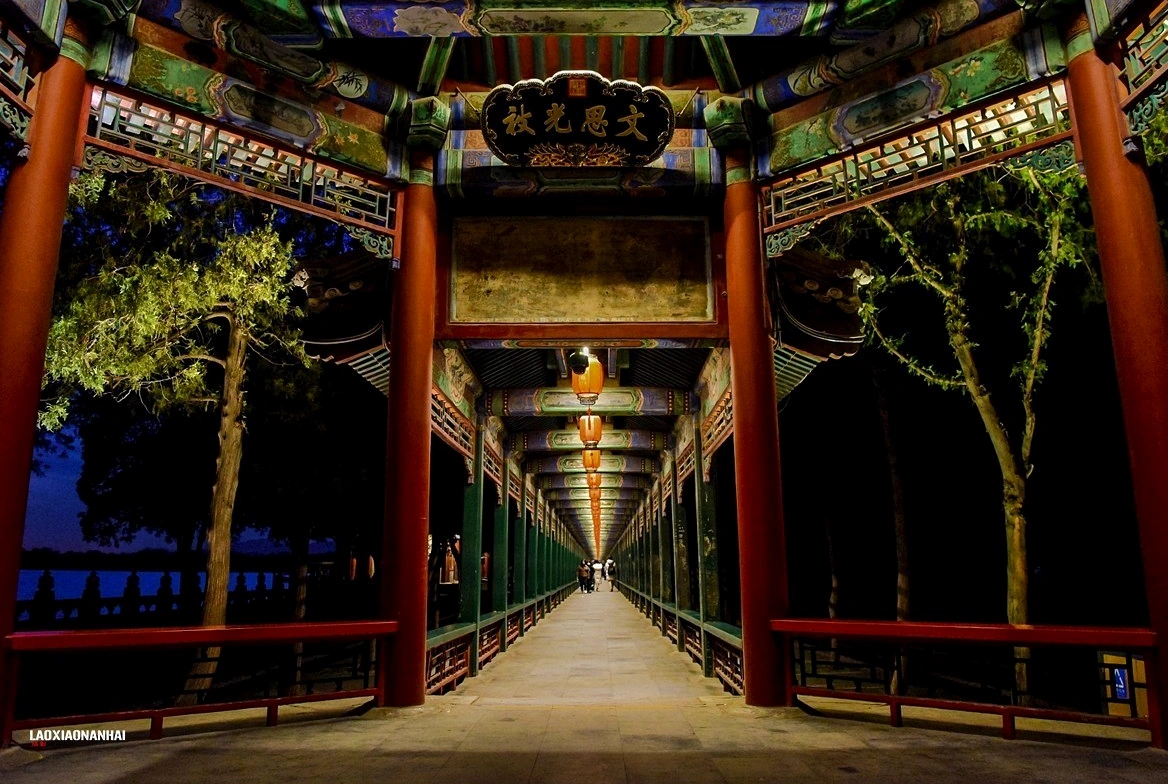
Strolling along the Long Corridor after 5:00 PM, visitors step into an enchanting corridor of time. As darkness casts shadows over the hillsides, soft, warm golden lights cleverly concealed behind the purlins begin to illuminate hundreds of red-painted, gold-gilded wooden columns. This exquisite light fully enhances the more than fourteen thousand meticulous color murals on the crossbeams, vividly recreating tales from Journey to the West, Romance of the Three Kingdoms, or ancient floral, bird, and landscape motifs. The contrast between the warm red tones of the interior architecture and the mystical blue hues of the night sky by the lakeshore opens up a deeply poetic perspective, attracting souls passionate about imperial art photography.
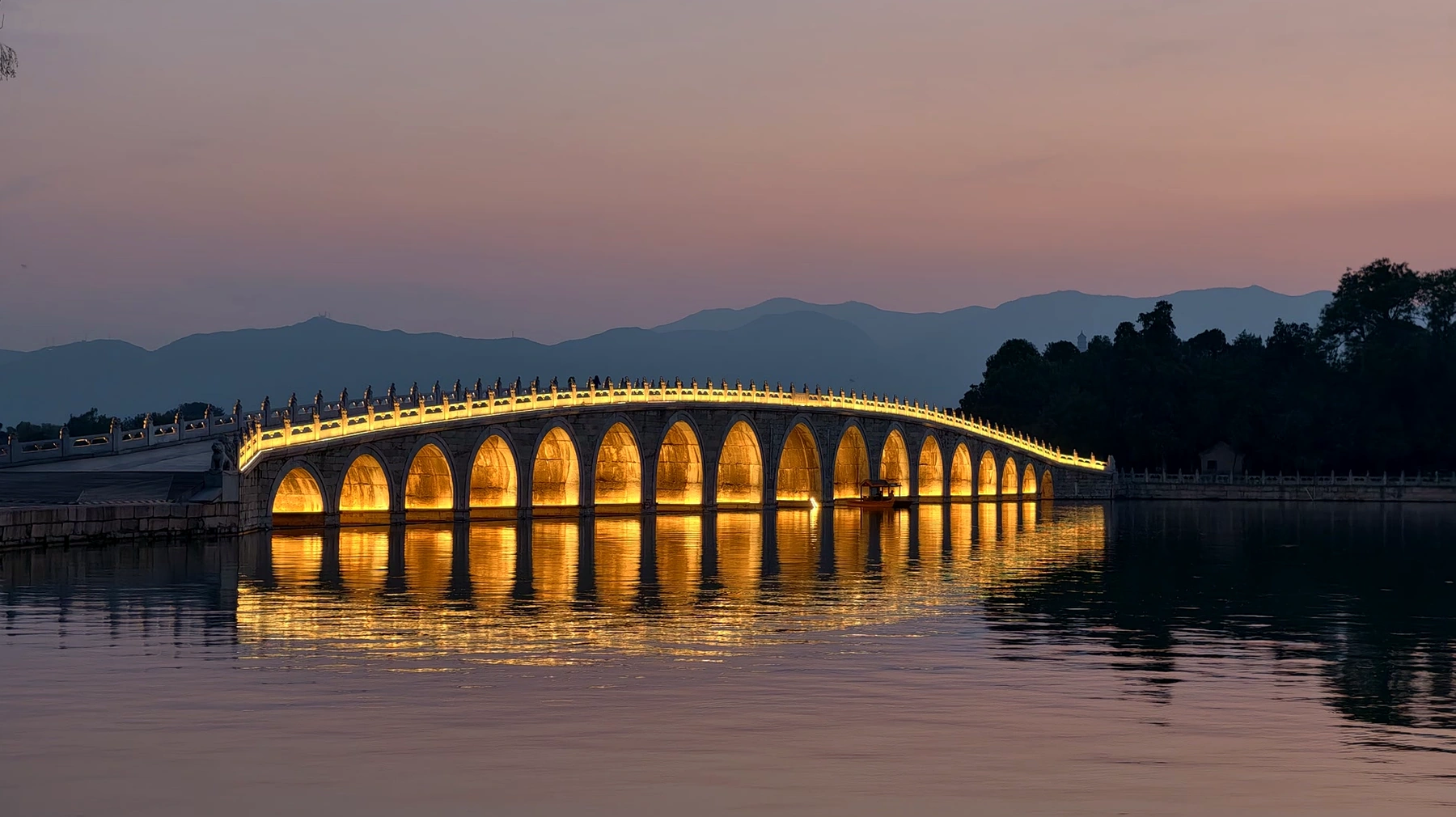
The most precious highlight of the Summer Palace’s nocturnal scenery converges at the Seventeen-Arch Bridge, which proudly stretches out to connect the eastern shore with South Lake Island. The ancient stone bridge with its graceful arches is illuminated by a warm golden light strip, perfectly reflecting its shimmering silhouette onto the calm surface of Kunming Lake like a giant mirror. From this expansive viewpoint, in the distance, the contemplative silhouettes of the Western Hills and dark green trees cast their shadows against the twilight sky, creating a perfectly balanced composition between human artistry and the natural scenery of northern Beijing.
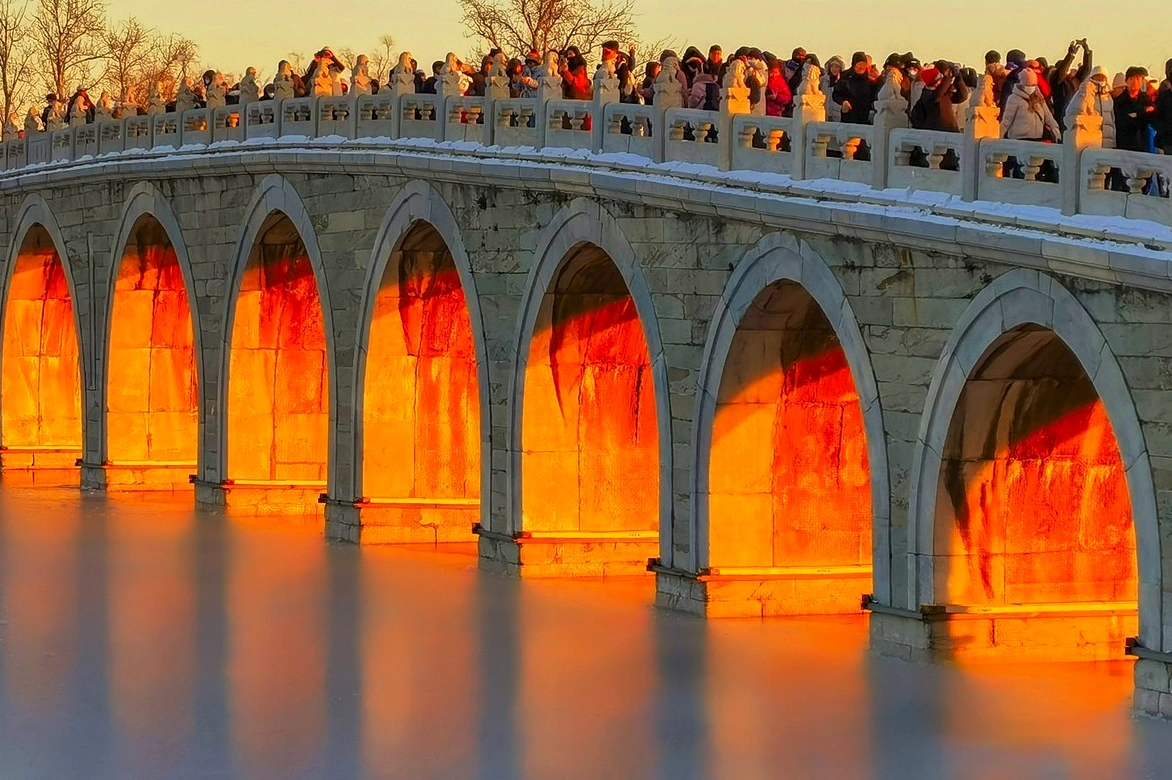
This nocturnal scenery is also a magnificent continuation of an architectural astronomical marvel known as the Golden Light Tunnel (Kim Quang Xuyên Động). Every year during the Winter Solstice, the low angle of the late afternoon sun shines directly through all seventeen stone bridge arches, creating a magical gold-gilded spectacle that astonishes tens of thousands of visitors. When this brief natural moment concludes, artificial lighting art takes over, accurately replicating the streams of golden light piercing through the stone arches, preserving the ethereal charm of the bridge throughout the night. This beauty is not only a visual delight but also a testament to the profound knowledge of Emperor Qianlong’s imperial architects in calculating the paths of celestial bodies and light.
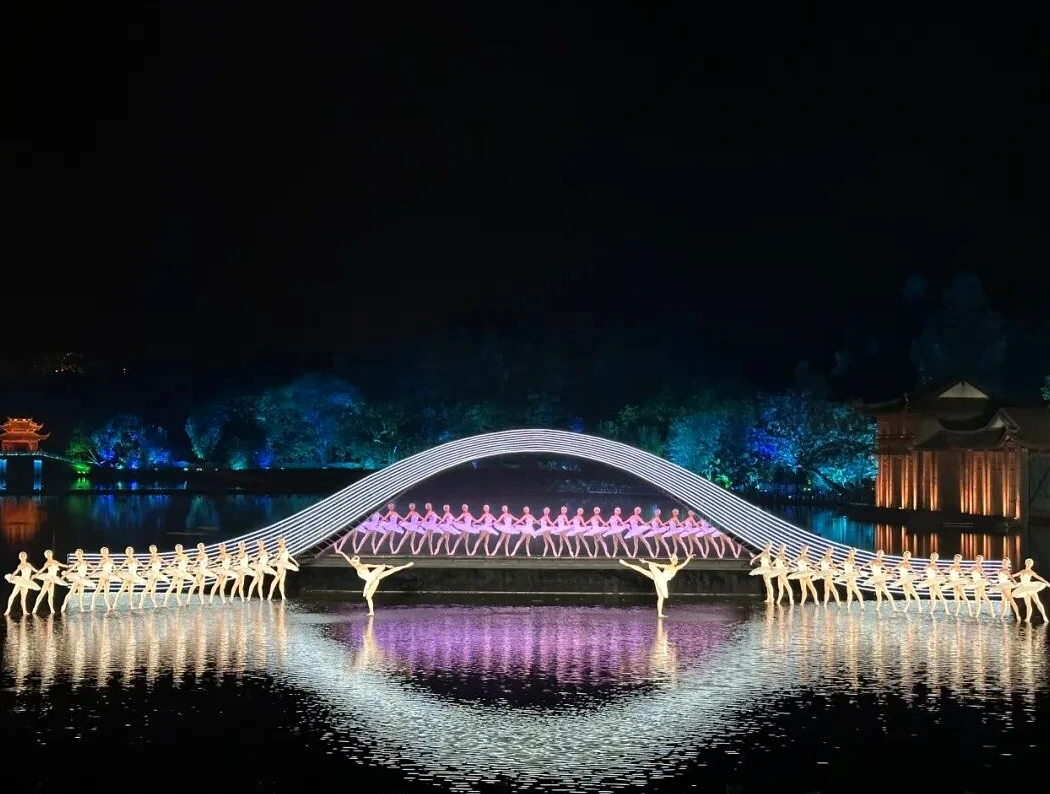
To meet the growing trend of nighttime tourism economics, the Summer Palace has gradually extended its visiting hours until 8:00 PM during peak seasons, opening up opportunities to admire the heritage in an entirely new way. The Yiheyuan Artistic Lighting project, combined with live-action Manchu theatrical performances on the waters of Kunming Lake, is gradually being perfected. Amidst the open space scented with summer lotus fragrance or the chilly wind of early winter, court music melodies blend with the graceful dances of performers in imperial attire, recreating the lavish banquets once held under Empress Dowager Cixi and transporting visitors into the golden dreams of oriental feudal history.
A journey to admire the stunning scenery of the Summer Palace would be incomplete without experiencing the pinnacle of imperial culinary art—where the most lavish banquets of the Manchu royal family were once prepared. Standing proudly right at the foot of Longevity Hill, the Tingli Pavilion (meaning Listening to Orioles Sing) is an ancient theater built by Emperor Qianlong and was once the venue where Empress Dowager Cixi entertained court officials and foreign envoys. Today, this rare heritage site faithfully preserves the original recipes recorded in the Qing Dynasty’s Imperial Kitchen archives, opening a gateway for diners to step back into the imperial flavors of the past.
Diners stopping by Tingli Pavilion have the opportunity to taste a simplified version of the Manchu-Han Banquet—the pinnacle of elaborate culinary traditions blending Manchu and Han flavors. Standing out on the dining table is the double-boiled Eight-Treasure soup infused with precious medicinal herbs, shimmering golden fish maw and shark fin in a rich sauce, or fresh crispy tribute fish drizzled with an exclusive imperial secret sauce. Alongside rare delicacies from land and sea, the royal cuisine here is also famous for its refined pastries that once conquered the strict palate of the Empress Dowager. The golden, soft, and snow-like melting Yellow Pea Cake (Wudou Huang) helps cool down the sultry summer days; the Donkey Roll (Ludagun) made from chewy, fragrant glutinous rice flour wrapped with sweet red bean paste and rolled in golden soybean flour; alongside the crispy, fragrant imperial minced meat flatbread (Roumo Shaobing), inspired by Empress Dowager Cixi’s bizarre culinary dream and brought to life by talented court chefs.
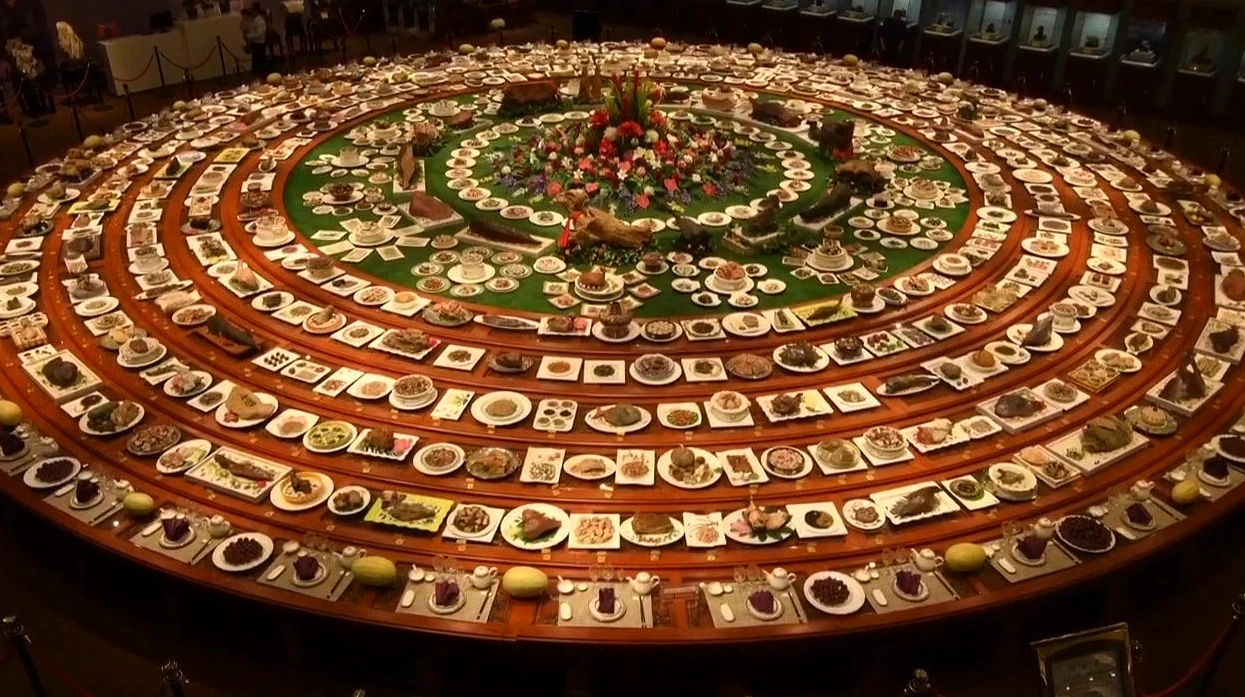
Leaving the main hall banquet behind, the space adjacent to the garden leads visitors to an elegant afternoon tea experience at Aman Summer Palace. Situated behind somber grey brick walls with traditional siheyuan courtyard structures, this place fully recreates the refined lifestyle of the ancient nobility with premium teas such as Pre-Qingming Longjing or aged Pu-erh, served alongside meticulously crafted royal-style pastry trays. Sipping warm tea amidst the gentle melodies of the guzheng zither and gazing at the weeping willows casting shadows over the tranquil water, travelers can almost touch the leisurely and luxurious pace of life in the magnificent forbidden palace.
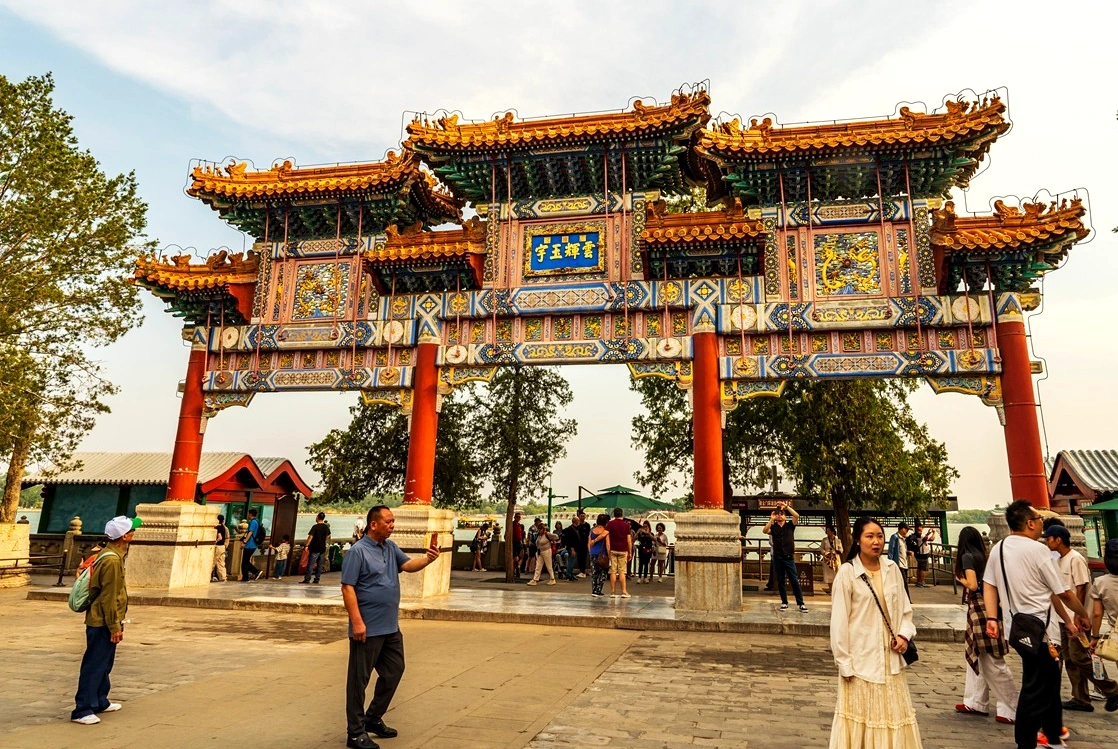
Right along the pathway leading to the lakeside landscape complexes, a towering paifang archway rises proudly with its multi-tiered curved tile roof stacked gracefully, showcasing the pinnacle of traditional timber architectural art. Vibrant red pillars support a complex dougong bracket system, highlighted at the center by a striking cobalt blue plaque inscribed with ancient Chinese characters, resembling a frozen imprint of time amidst the imperial grounds. As streams of people leisurely stroll through the gateway, they are greeted by the serene, sparkling blue waters of the lake and lush shaded trees, embracing a tranquil atmosphere deeply imbued with the bygone charm of the imperial capital.
Stepping out of the Summer Palace grounds into the Haidian District, the capital’s culinary map unfolds in a rich new dimension with famous heritage dishes of the imperial city. The legendary Peking roast duck presents itself through two renowned schools of preparation: Bianyifang, which utilizes a closed-oven roasting technique to preserve the juicy tenderness of every meat slice, and Dadong or Sijiyinfu, which employs an open-oven fruitwood roasting method to achieve a shatteringly crisp, amber-hued skin with a subtle, pure aroma. Travelers should also not miss the bubbling charcoal-fired copper hot pot of sliced mutton from the Donglaishun brand, where paper-thin mutton slices are swished to just-right tenderness in crystal-clear broth, then dipped generously into a rich, savory sesame paste mixed with its signature fermented chive flower sauce. Concluding the feast is a traditional bowl of soybean paste noodles (Zhajiangmian), featuring chewy fresh noodles thoroughly tossed in a rich minced pork and fermented bean paste sauce alongside crisp, refreshing cucumber, perfectly preserving the rustic yet profound culinary soul of this millennial capital.
To fully absorb the grandeur of the Summer Palace imperial garden without exhausting one’s physical energy or falling into commercial tourist traps, travelers must master the strict operational regulations of this royal heritage site. Regarding opening hours, the park applies two seasonal schedules: the peak season runs from April 1 to October 31, open from 6:00 to 20:00 (admission stops at 19:00); the off-peak season starts from November 1 through March 31, welcoming visitors from 6:30 to 19:00 (ticket scanning stops at 18:00). To preserve the landscape structure and regulate visitor flow, management strictly enforces a real-time, identity-verified ticket purchasing policy through the Beijing Forestry Parks Bureau’s WeChat mini-program 1 to 7 days prior to departure. International travelers are required to present their original physical passport at the electronic turnstiles to cross-reference registered biometric data, completely eliminating the possibility of using hand-to-hand paper tickets or unofficial intermediaries.
The transportation infrastructure connecting the Summer Palace with central Beijing is extremely diverse, flexibly meeting all travel needs. Metro Line 4 takes visitors directly to Beigongmen Station; from Exit D, it is just a 150-meter stroll to the North Gate. For those wishing to approach from the majestic main palace axis, visitors can take Line 4 or Line 16 to Xiyuan Station, exit from Exit C2, and walk about 450 meters to reach the East Palace Gate. Those who enjoy a leisurely pace can choose the Xijiao Light Rail Line, boarding at Bagou Station to arrive at the tranquil, willow-lined West Palace Gate. In particular, a truly regal experience is the 60-hour [Wait: 60-minute] Nanuchanghe Waterway journey, departing from the Beijing Exhibition Hall pier or Zizhuyuan Park, drifting along the historic imperial canal once used by Empress Dowager Cixi to travel from the palace to the Summer Palace to escape the summer heat, leading straight into the solemn Water Gate of the royal estate.
To optimize the journey across the massive area of nearly three hundred hectares without wasting energy climbing uphill against the flow, a standard three-and-a-half-hour exploration routine is recommended by field experts, starting from the East Palace Gate. After passing through the gate, visitors will successively admire the Hall of Benevolence and Longevity—where the two Empress Dowagers held court, turn toward the magnificent three-tiered Deheyuan Grand Theater, visit the secluded Hall of Joyful Longevity, and then leisurely stroll along the Long Corridor to admire thousands of exquisite landscape paintings. Next, the group will head toward the Cloud-Dispelling Hall complex to conquer the towering Buddhist Incense Tower atop Longevity Hill, before descending to the pier to view the unique Stone Boat. From here, purchasing a royal boat ticket to cruise across the calm waters of Kunming Lake to South Lake Island allows legs to rest while strolling across the seventeen-arch stone bridge carved with a thousand intricate stone lions, paying respects to the legendary bronze ox guarding the waters, and gently exiting via the New Palace Gate (Xingongmen) where major roads always have buses and taxis ready for quick departure.
Alongside mapping out your route, recognizing low-cost tourism variations in the capital Beijing is vital to preserving a top-tier cultural experience. Travelers must be extremely cautious against “Zero-Dollar” super-cheap tour invitations, where field time at the imperial garden is slashed to a mere hurried forty minutes by the lake, in order to spend the majority of the time forcing guests into designated establishments such as fake Tong Ren Tang pulse-reading sessions, steeply discounted jade sales, Pixiu wealth charms, or memory foam mattresses. The wisest and most civilized choice is to register for pure sightseeing itineraries (Pure Play), guaranteeing three and a half to five hours immersed in heritage. Regarding immigration procedures, international travelers can now take advantage of the convenient 144-hour visa-free transit policy at Beijing Capital International Airport (PEK) or Daxing Airport (PKX), or apply for a group visa of three to five days through officially authorized tour operators.
To enjoy a seamless journey without the hassle of arranging transfer vehicles or booking complex identity-verified tickets, travelers can consider booking the comprehensive tour package, scientifically designed to deliver the most graceful and profound moments of appreciating Beijing’s imperial architecture.