In the late 1980s, the Pearl of the Orient stood at a historical crossroads as its urban pulse began to outgrow the capacity of the severely congested Kai Tak Airport in the heart of the Kowloon Peninsula. Amidst a complex geopolitical landscape marked by profound shifts, the colonial administration under Governors David Wilson and later Chris Patten decided to realize a visionary project of the century: the ‘Airport Core Programme’ (ACP), often referred to by contemporaries as the ‘Rose Garden Project’ (香港玫瑰園計劃). With a staggering budget exceeding 200 billion Hong Kong dollars, this grand plan was not merely about creating a new international airport on Chek Lap Kok island; it also launched a monumental conquest of the sea, with the Tsing Ma Bridge (青馬大橋) as its beating heart—a two-tier suspension bridge masterpiece designed to open a vital artery from the urban center to the remote coastline.
On May 25, 1992, the first shovels officially broke ground, initiating a magnificent construction effort led by the renowned international consortium Costain – Mitsui – Trafalgar House Construction, under the expert technical guidance of the UK’s Mott MacDonald group. Overcoming the harsh storms of the South China Sea and the pressure of historical deadlines, two towering concrete bridge pylons, each over two hundred meters high, were spectacularly completed in June 1995. Shortly thereafter, from December 1995 to March 1996, the engineering feat of aerial spinning took place day and night, weaving tens of thousands of high-tensile steel wires across the Ma Wan Channel to create a giant steel yoke capable of supporting both a highway network and a high-speed urban railway system.
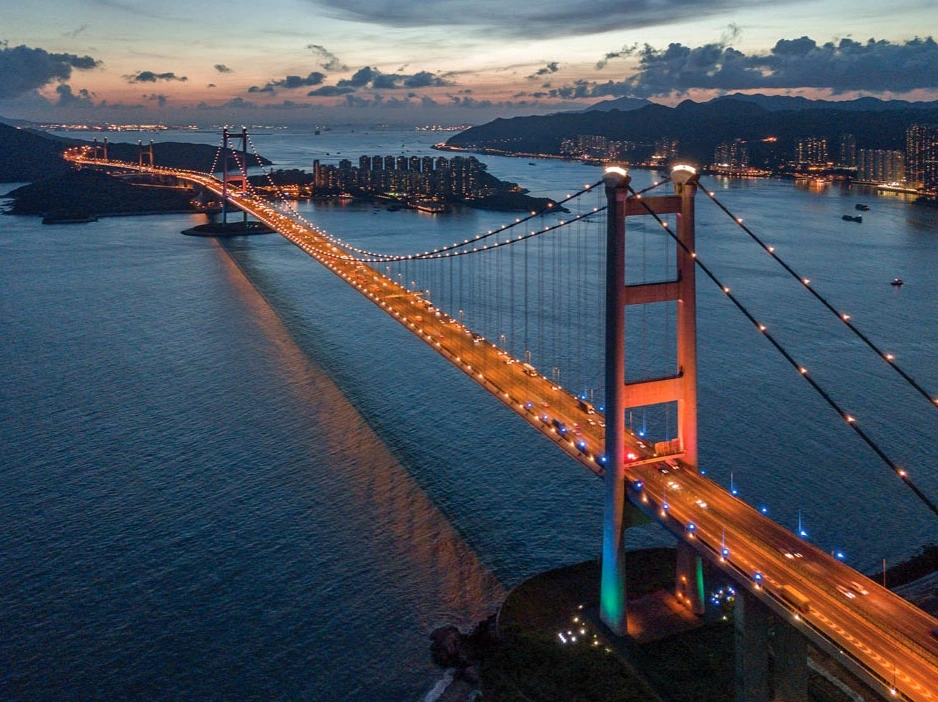
As night falls over the Ma Wan Channel, the entire Tsing Ma Bridge appears like a glowing ribbon draped across the dark waters. A high-tech lighting system bathes the towers and suspension cables in a regal golden hue, contrasting sharply with the layered silhouettes of distant mountains under a cloudy sky. At both ends of the coast, the skyscrapers of the Pearl of the Orient shimmer with countless urban lights, reflecting their magnificent radiance onto the calm ocean surface, carving out a masterpiece of scenery that harmonizes human engineering with the grandeur of nature.
As the final intricate stages were completed, April 27, 1997, entered local history with a grand state inauguration ceremony, attended by former British Prime Minister Margaret Thatcher and Governor Chris Patten. On May 22, 1997, the Tsing Ma Bridge officially welcomed its first commercial vehicles to roll across its windy deck, just five weeks before the sacred historical moment of July 1, 1997, when Hong Kong was officially handed over to the People’s Republic of China. This strange coincidence of timing transformed the bridge not only into a mechanical wonder spanning the sea but also into an immortal witness to a transitional era, connecting the colonial past with the volatile integration period of this special territory.
Located at a strategic chokepoint in the west of Hong Kong, the Tsing Ma Bridge stands tall across the Ma Wan Channel, establishing a vital link between the islands of Tsing Yi (青衣) and Ma Wan (馬灣). In traditional East Asian Feng Shui, the name Tsing Ma (青馬) is a perfect combination of two ancient terms, signifying the reconnection of a long-severed ‘dragon vein’ between the Kowloon mainland and the prosperous outlying islands. This location acts as a bolt securing the treacherous sea gate, channeling the flow of prosperity from the bustling inner city directly to Lantau Island and the mega-project of Chek Lap Kok International Airport. Planning the bridge on such complex terrain not only solved a critical transportation problem but also established a Yin-Yang balance, harmonizing the intense power of ocean waves with the stillness and solidity of ancient granite.
Surveying the overall terrain, the coordinates of the Tsing Ma Bridge offer a rare and spectacular panoramic view, surrounded by layers of mountains and water. Looking north, the structure captures the full tranquility of Sham Tseng Bay and the winding ridges of the majestic Tai Mo Shan range, which act as a screen against cold northern winds. Conversely, to the south, the bridge opens up a vast space toward the busy shipping lanes of Victoria Harbour, glittering with lights and the distant horizon of the South China Sea. This prime location creates a unique intersection between the pulse of one of the world’s busiest port industries and the pristine geological folds formed over millions of years of natural evolution.
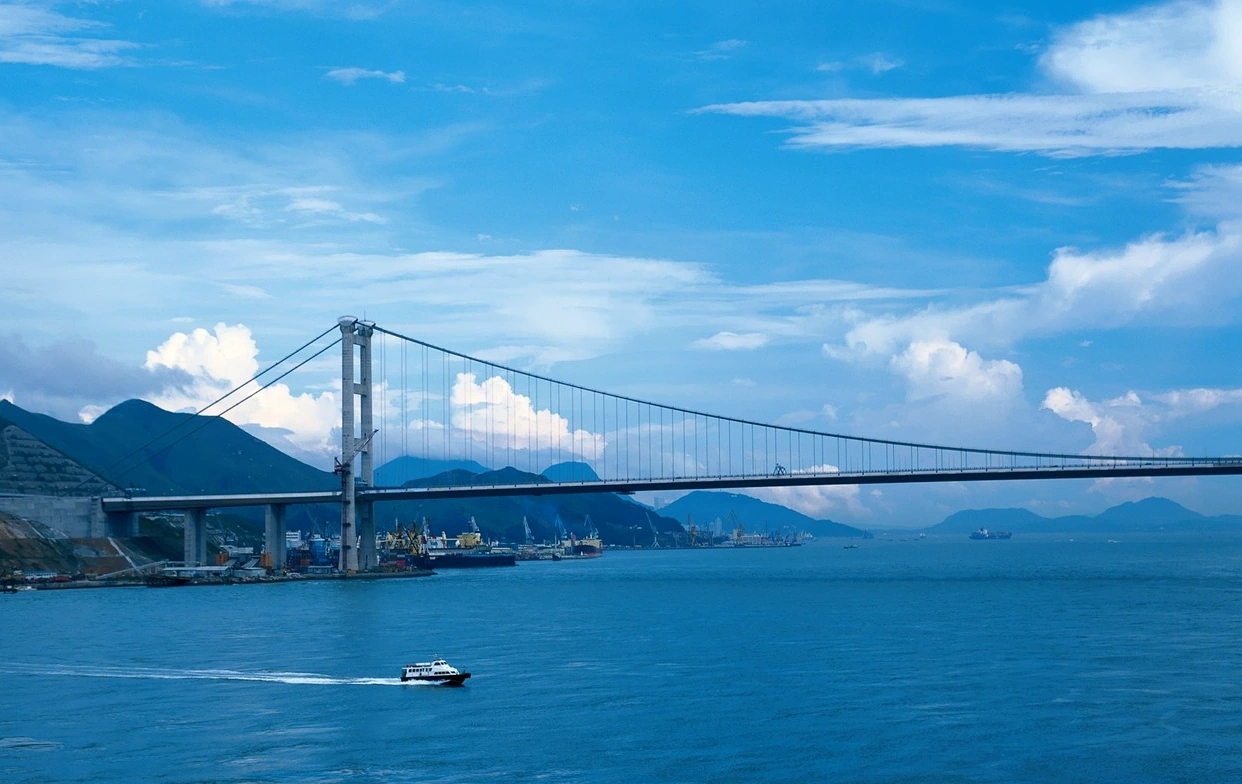
From a panoramic coastal vantage point, the Tsing Ma Bridge emerges proudly like a giant steel ribbon draped across the deep blue waters of the Ma Wan Channel. In the background, rolling hills draped in the lush green of tropical forests stretch out, punctuated by a clear sky with wisps of pure white clouds. In the foreground, the tranquil water is occasionally rippled by a small boat passing through, creating a poetic contrast between the magnificent, angular scale of the man-made suspension structure and the simple, rhythmic life of the Hong Kong islands.
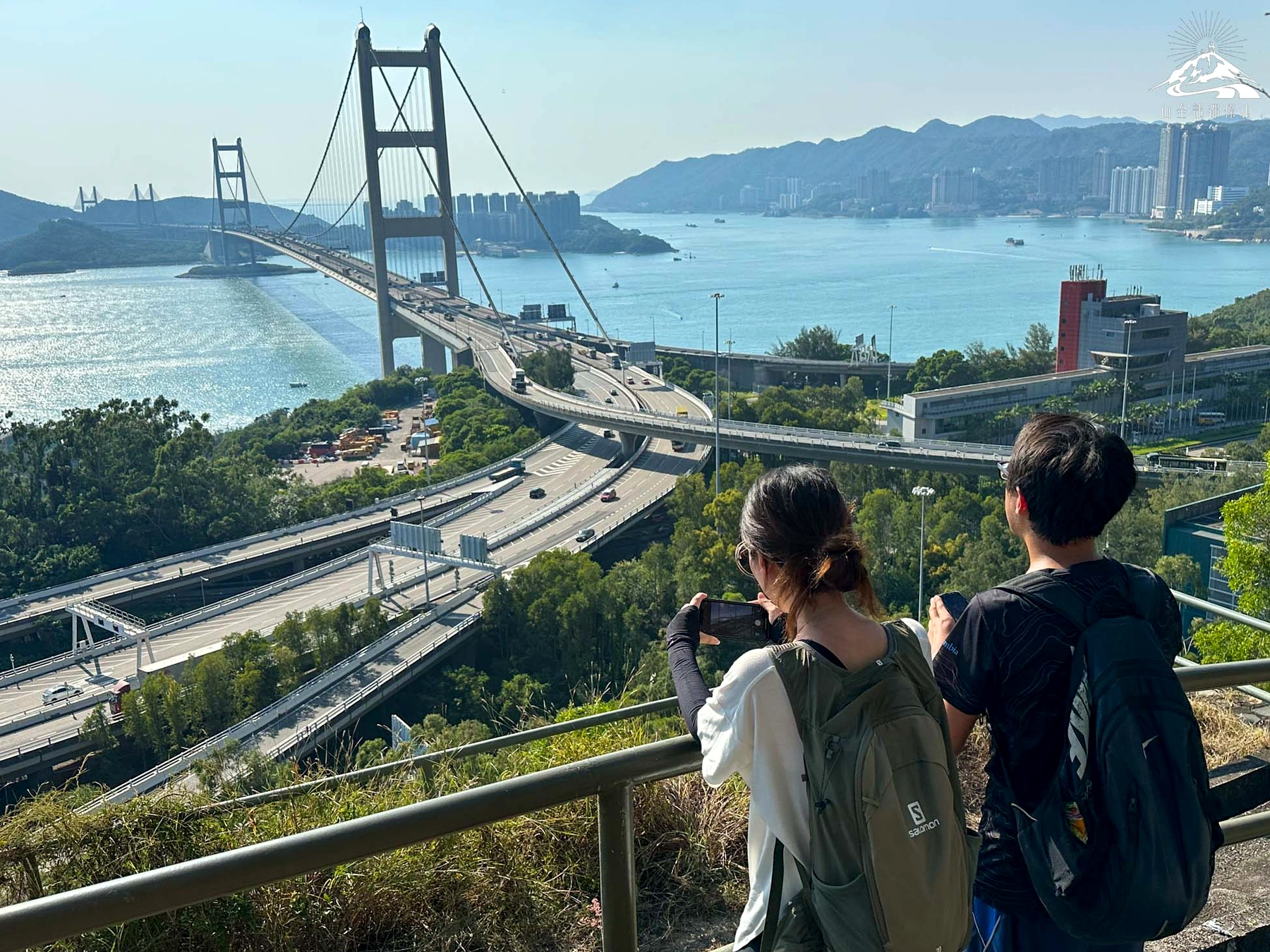
To fully appreciate the harmony between the natural terrain and this engineering marvel, visitors often head to Tsing Yi Hill and walk along the Tsing Yi Nature Trail. Following the gentle slopes shaded by young pines and wild grass, various viewpoints gradually reveal a vast, three-dimensional landscape. From the breezy summit, the entire massive suspension bridge is captured in one’s field of vision, standing proudly above the calm, jade-colored sea. As the sunset paints the Lantau horizon red, the bridge towers cast long shadows over the golden-gilded waves, turning this place into a pinnacle where pristine natural beauty meets the modern architectural achievements of the Orient.
Hailed as one of the greatest civil engineering marvels of the 20th century, the Tsing Ma Bridge stands as a proud testament to humanity’s extraordinary ability to build against the backdrop of harsh nature. This strategic infrastructure project consumed a massive budget of 7.144 billion Hong Kong dollars, establishing its position as the world’s longest suspension bridge carrying both road and rail traffic at the time of its inauguration—an unprecedented record held for 19 long years until 2016. In terms of spatial scale, this steel ribbon features a main span of 1,377 meters, while the total length of the entire route reaches 2,160 meters. Rising majestically from the saltwater are two massive bridge towers standing 206 meters above sea level, supporting the deck at a height of 54.6 meters and creating a generous vertical clearance of 62 meters, allowing the world’s largest container ships to safely pass beneath the structure.
Hidden behind the bridge’s cloud-like, graceful silhouette is an amount of heavy industrial material beyond the imagination of contemporary observers. The load-bearing heart of the entire structure lies in two massive main cable bundles with a diameter of up to 1.1 meters, meticulously braided from 33,400 high-tensile galvanized steel wires, each with a cross-section of just 5.38 millimeters. If all these ultra-durable steel wires were connected, the total measured length would reach 160,000 kilometers, equivalent to four times the Earth’s circumference. The suspension cables alone weigh 26,700 tons of steel, combined with over 50,000 tons of structural alloy steel and more than 500,000 tons of solid concrete used to reinforce the anchorages deep within the coastal granite, creating a mechanical foundation impervious to any geological tectonic shifts.
The revolutionary breakthrough in the architectural design of the structure is the aerodynamic double-deck truss solution, precisely calculated to minimize wind resistance and turbulence. The top deck is an open-air roadway with six lanes designed for speeds of 100 km/h, offering panoramic ocean views for commuters. Conversely, the bottom deck is enclosed as a solid aerodynamic box, housing two high-speed urban rail lines—the MTR Airport Express operating at 135 km/h and the Tung Chung Line—alongside two emergency road lanes. Thanks to this unique enclosed box design that reduces wind pressure, the transport artery of Hong Kong remains operational and perfectly safe even when tropical cyclones above level 8 sweep across the strait with furious winds exceeding 300 km/h.
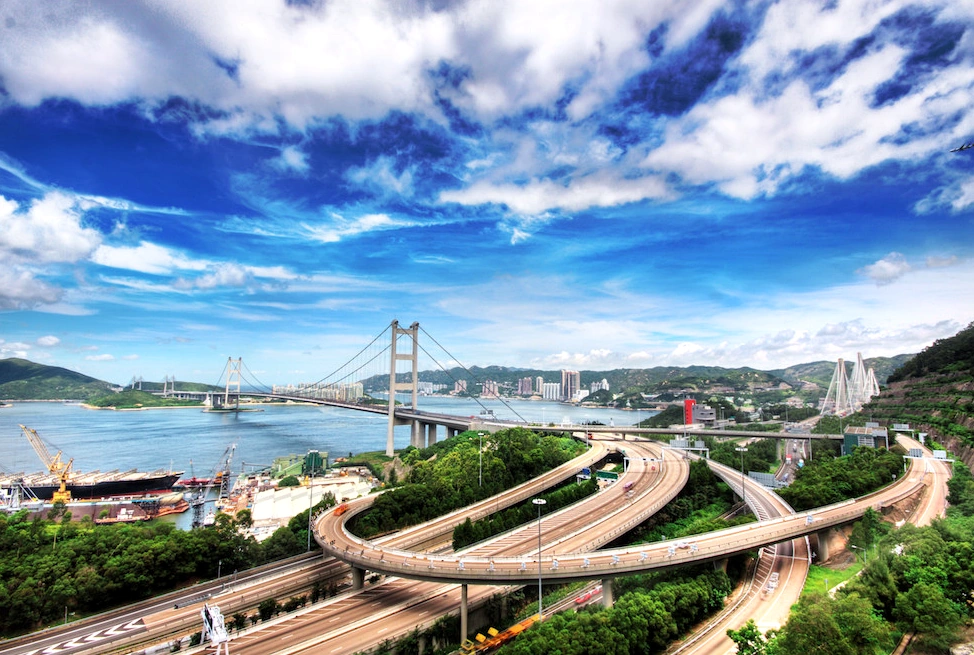
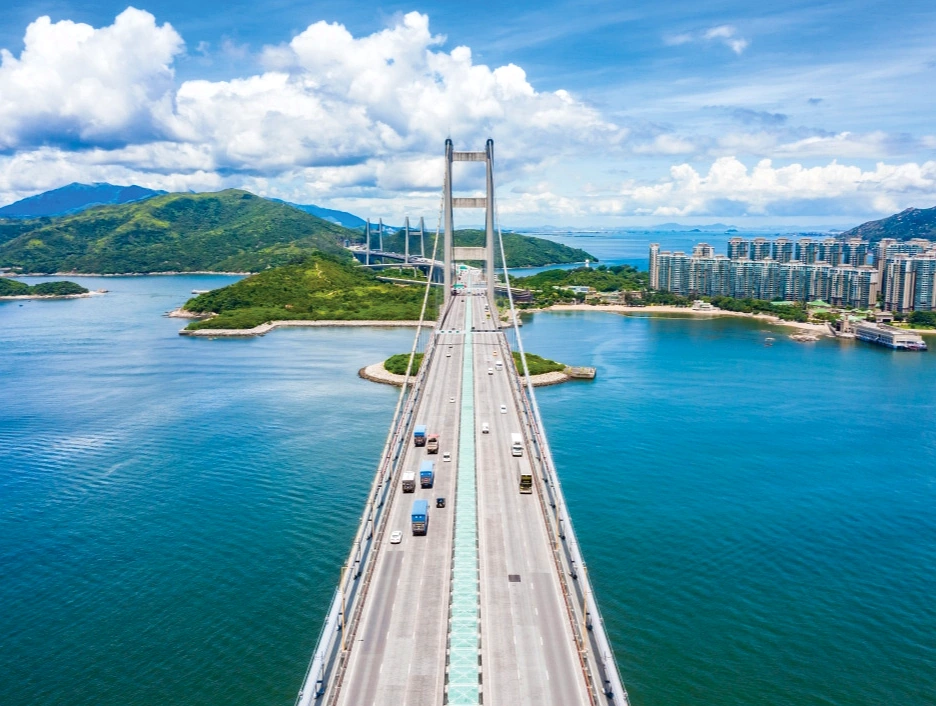
Admiring the entire structure from a high, expansive vantage point, the magnificent suspension bridge resembles a metallic galaxy draped across the deep blue waters of the strait, connecting rolling islands lush with greenery. On the highway deck, streams of vehicles move busily like persistent blood vessels circulating through the heart of the archipelago. Far away on the right bank, the modern urban area appears magnificent with a series of coastal high-rises standing straight against a clear sky filled with drifting white clouds, creating a vivid contrast between this engineering marvel and the peaceful island nature.
The delicate harmony between millimeter-precise engineering standards and the aesthetic of the port city’s urban landscape has elevated this structure far beyond its role as a mere transportation link. Every curve of the roadway, every interlocking steel truss designed to withstand high winds, and the meticulous calculations of its gradient reflect the pinnacle of modern construction intelligence. The Tsing Ma Bridge does not merely serve as a gateway connecting the Kowloon Peninsula to the Hong Kong International Airport; it stands as a testament to the mastery over nature, transforming the challenges of complex terrain and harsh oceanic climates into an eternal architectural symbol that breathes in rhythm with the bay’s development.
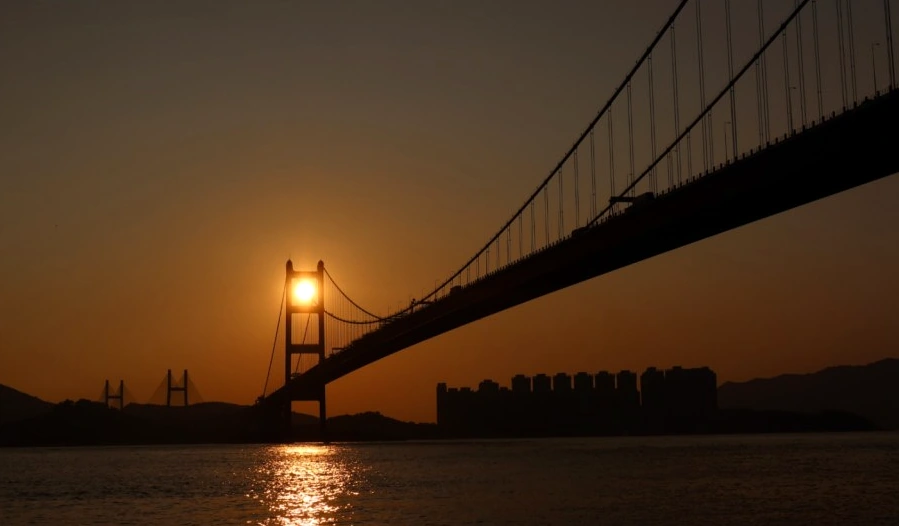
As the sun begins to set over the dark waters of the Ma Wan Channel, the Tsing Ma Bridge enters its most spectacular transformation of the day. Between 5:30 PM and 6:45 PM daily, the golden hour creates a surreal backdrop as the sun slowly dips behind the rolling Lantau Island mountains. The sky shifts magically from vibrant orange-gold to a dreamy deep purple, creating a profound contrast with the dark blue water below. The entire massive steel girder structure, which carries the cold, geometric appearance of modern engineering by day, suddenly transforms into a silent relief silhouetted against the magnificent southern sunset.
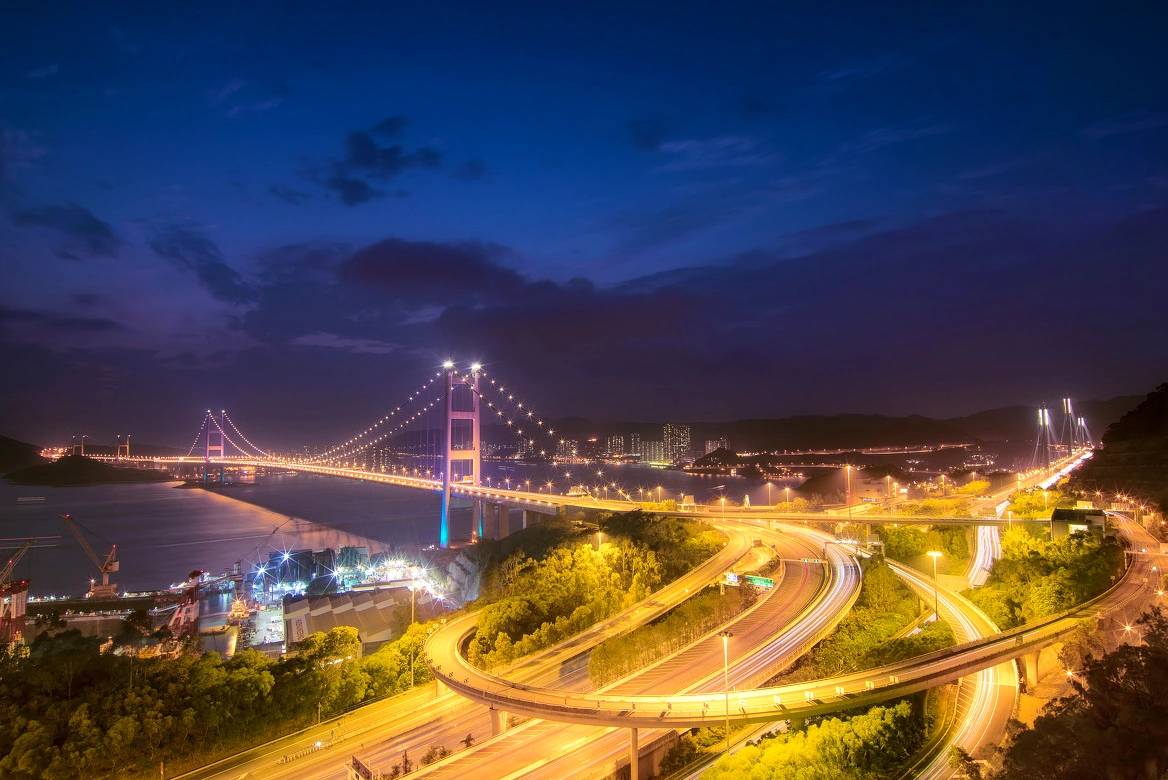
The night truly begins when the high-tech architectural lighting system awakens along the entire sea-crossing structure. Thousands of specialized high-power lamps are intricately mounted along the two main suspension cables that curve and embrace the 206-meter-tall bridge towers, turning this transport artery into a giant glowing ribbon draped across the sea. The rhythmic coordination of the light spectrum transforms the bridge into a luminous wonder amidst the ocean, reflecting thousands of shimmering rays onto the choppy waters of the busy shipping channel.
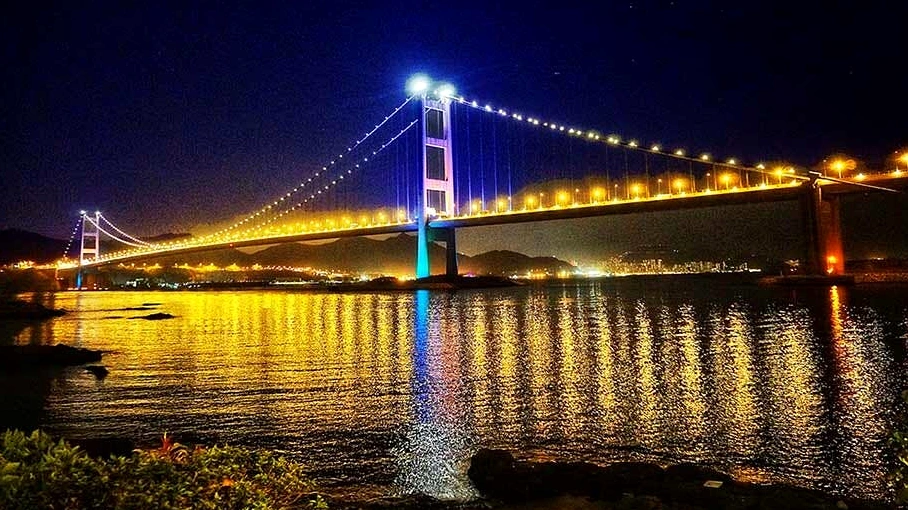
Amidst the quiet night, the bridge emerges magnificently as a masterpiece of light spanning the vast waters of Hong Kong. The massive towers emit a mystical blue hue that contrasts harmoniously with the warm yellow lights running along the bridge deck and the proudly curved suspension cables. This brilliant light reflects onto the calm water, creating shimmering, multi-colored reflections like scattered gold and jewels, while in the distance, the dark silhouettes of the mountains and the faint lights of the coastal urban landscape complete the scene.
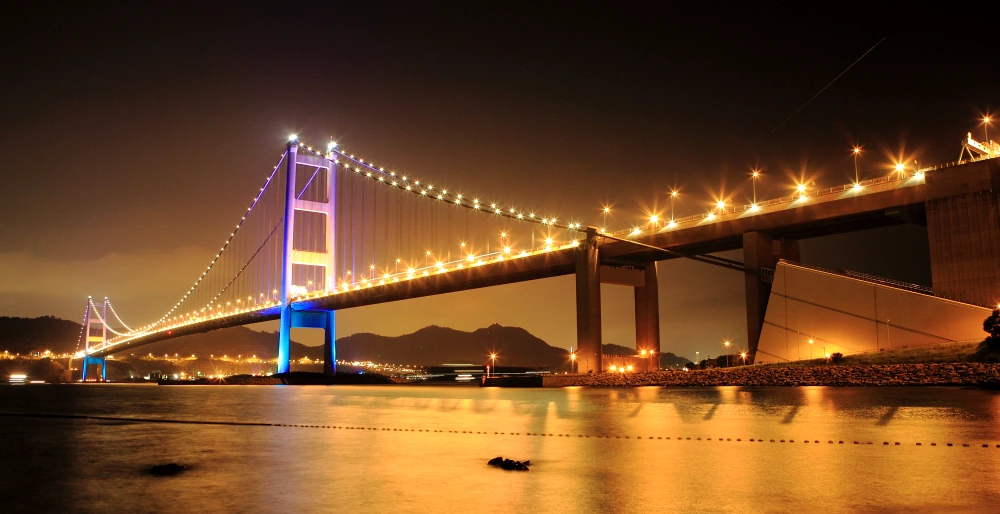
To fully experience the awe of this structure at night, travelers often head to Tung Wan Beach on Ma Wan Island. From this stretch of fine sand, the upward view opens up an extraordinary visual field, where visitors can admire the complex, glowing steel trusses up close right above their heads, and hear the sound of waves mingling with the deep, rhythmic hum of high-speed trains passing through the bridge. From another perspective, yacht cruises departing from Victoria Harbour offer the privilege of a panoramic view from afar, where guests glide smoothly through the breezy waters to watch the proud Tsing Ma Bridge stand alongside the elegant Ting Kau Bridge, weaving a magnificent tapestry of light across the ocean.
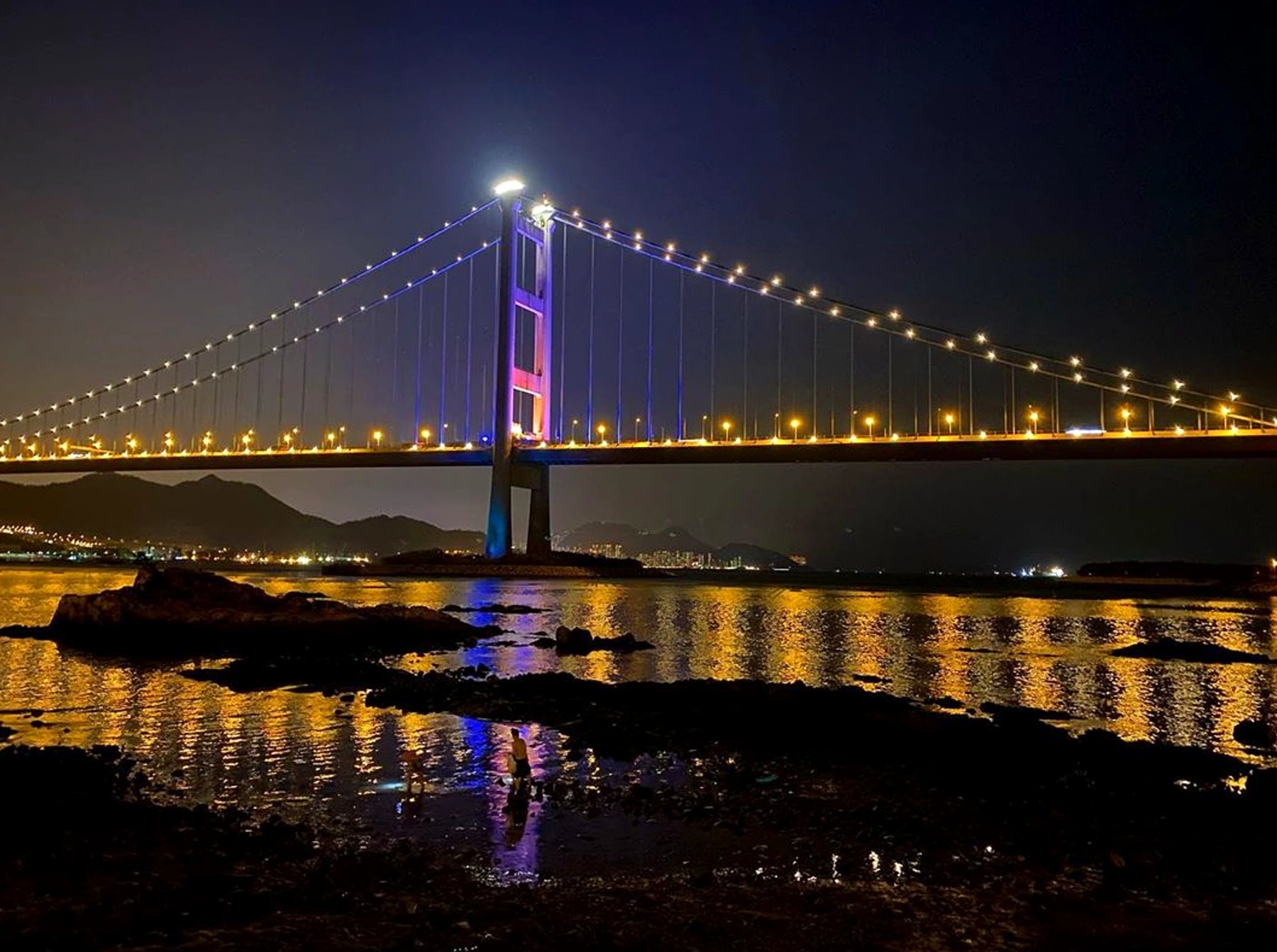
Beyond standard static lighting effects, the future of this historic bridge is tied to the Airport City’s spatial expansion strategy. Pioneering projects are gradually integrating interactive art projection technology and seasonal 3D mapping onto the bridge towers and cable pylons. This plan promises to elevate this vital infrastructure into a large-scale visual stage, where technological art blends with engineering heritage to tell the story of Hong Kong’s vibrant spirit every time the sun sets.
The Tsing Ma Bridge is not only marked by engineering marvels spanning the sea but also opens up a culinary space rich in Lingnan flavor. The distinctiveness of the local cuisine is tied to the vibrant shifts in the landscape, where modern life intersects with traditional culture that has taken deep root through generations of coastal residents.
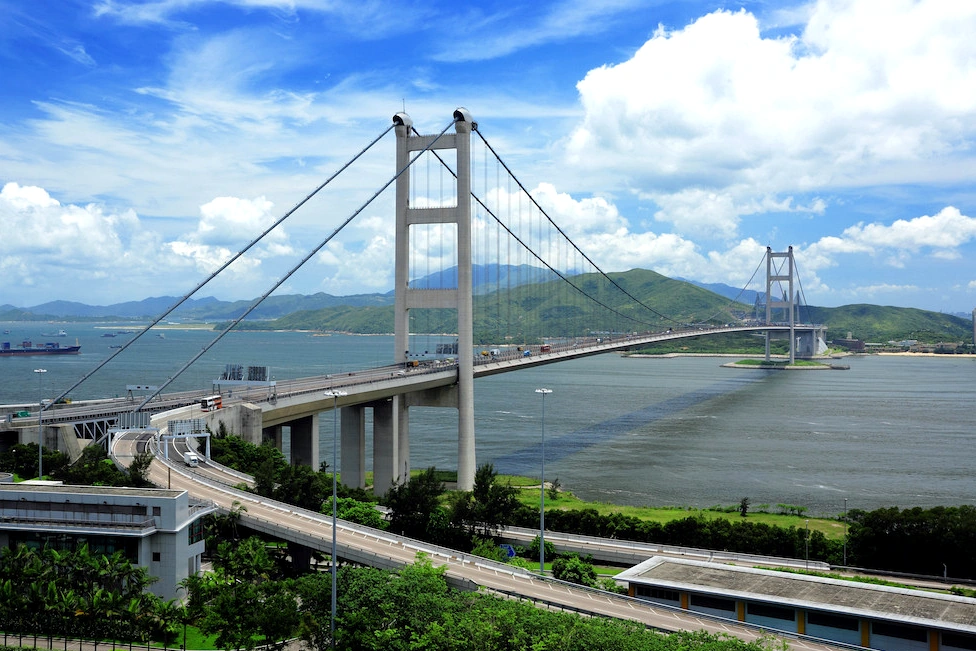
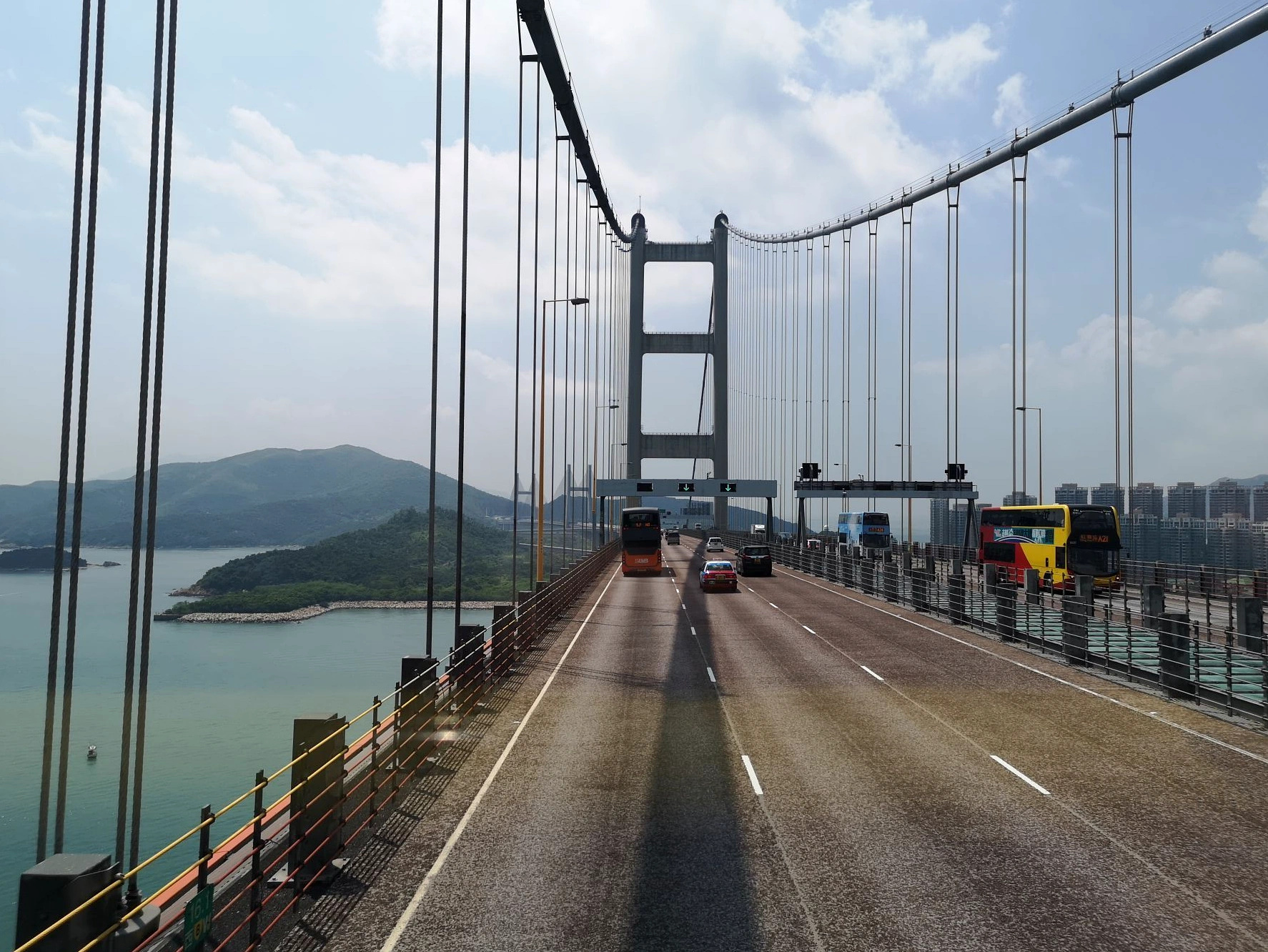
A close-up view from the upper deck of the Tsing Ma Bridge reveals a magnificent panorama of a modern transport artery in the heart of Hong Kong’s waters. Under a sky with drifting clouds, wide lanes bustling with cars and iconic double-decker buses rush past, nestled against a system of suspension cables that reach up to towering pylons. Casting your gaze to the left, the vast blue water embraces distant islands and rolling mountain ranges, creating a stunning visual contrast with the dense, bustling urban skyscrapers on the eastern shore.
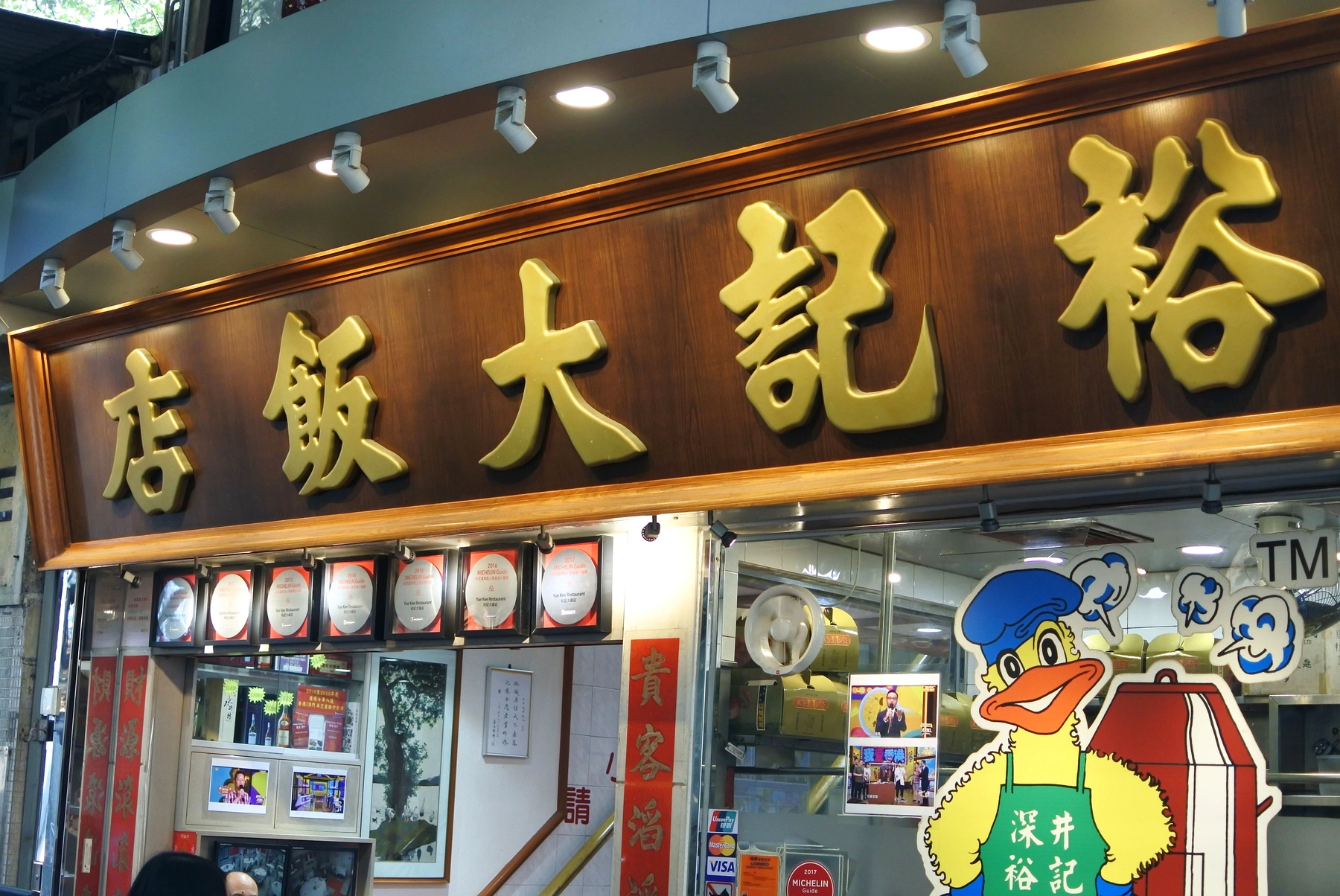
Just three kilometers from the northern end of the bridge, the ancient village of Sham Tseng, nestled against the mountainside, has long been hailed by gourmets as the premier sanctuary for roast goose in Hong Kong. Among the kitchens that have been firing up for decades, Yue Kee Roast Goose stands tall as a witness to culinary history since 1957. Each plump goose is strictly selected, marinated in secret traditional herbal recipes, and roasted in traditional charcoal-fired clay ovens. Through the skillful hands of the chefs, the skin reaches a crispy, golden-brown perfection, concealing tender, succulent meat infused with a rich, smoky aroma. Nearby, Chan Kee Roast Goose asserts its position with a technique that combines crispy skin with a delicate sweet and sour plum sauce, skillfully balancing the richness to leave an unforgettable lingering taste on the palate.
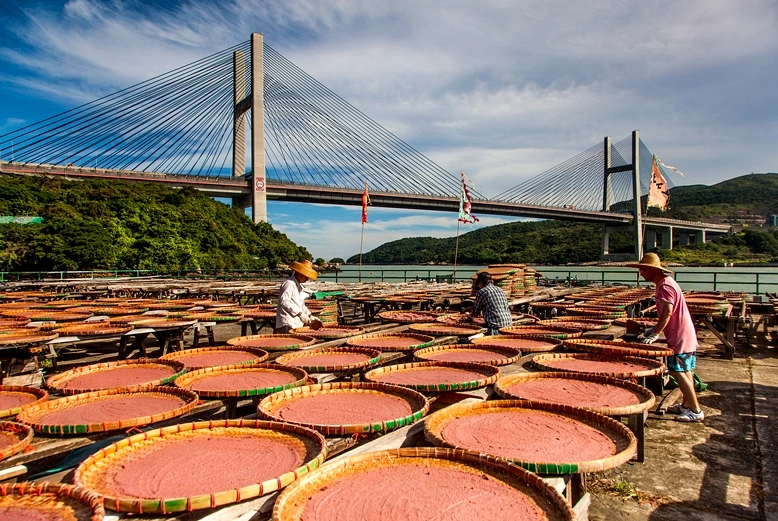
Leaving Sham Tseng and crossing the water to Ma Wan Island, located right at the foot of the giant bridge, the culinary experience shifts to the salty flavors of the sea at the Ma Wan seafood street. Under the shadow of the magnificent suspension bridge casting its silhouette over the rippling bay, local eateries display tanks of fresh seafood caught by fishermen that very day. Diners should not miss the fresh sea crab steamed with vermicelli, infused with fragrant ginger and scallion sauce, where the translucent noodles soak up the pure, sweet essence of the crab meat. The plate of salt and pepper mantis shrimp, crispy and charred with golden fried garlic, offers a rustic yet elevated twist to enjoy while listening to the gentle lapping of waves against the boat side.
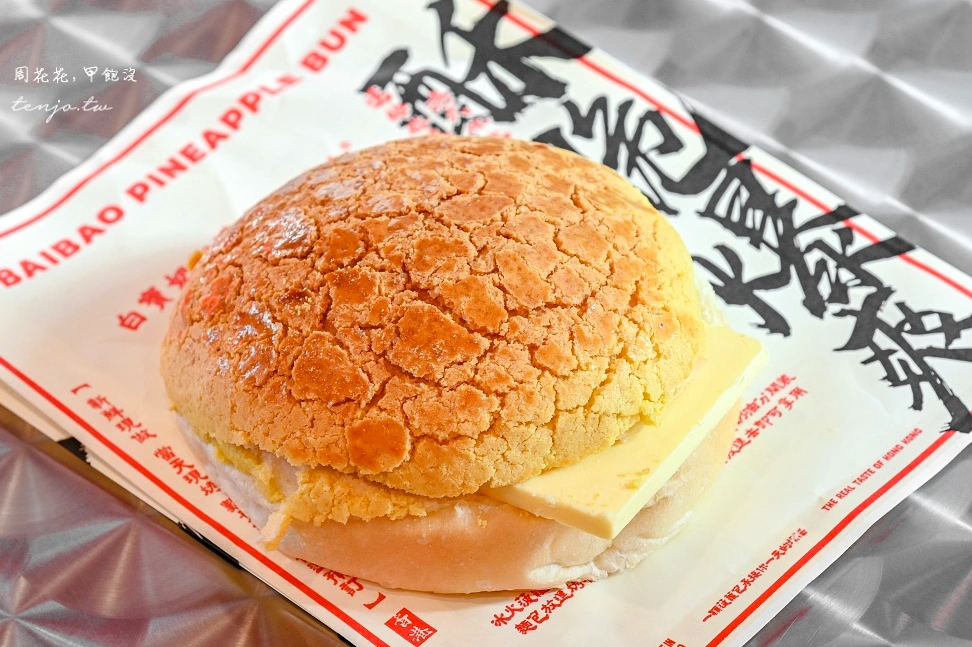
Returning to the southern side in Tsing Yi district, the culinary space takes on a more urban feel through traditional afternoon tea shops. This is where diners seek out the famous Hong Kong-style silk stocking milk tea, filtered through multiple layers of silk to create a smooth, rich texture that blends perfectly with creamy condensed milk and a deep, bold tea flavor. Accompanying the hot tea is French-style buttered toast drenched in sweet syrup, or a piping hot pineapple bun fresh from the oven with a crispy, cracked crust, sandwiching a thick slice of cold butter that melts slowly. That sweet, rich, and warm flavor not only dispels the strong winds from the Tsing Ma strait but also preserves the memories of a simple yet timeless street food culture.
To fully admire the magnificence of the Tsing Ma Bridge, visitors should choose the period from October to January, when Hong Kong enters the dry autumn and winter season, with cool breezes and ideal clear skies offering visibility of over 15 km. The most prized location to enjoy a panoramic view of the structure standing tall amidst the strait is the Lantau Link Visitor Centre and Viewing Platform, impressively situated on the hillside of the northwestern tip of Tsing Yi Island. From this observation deck, the entire expanse of winding cables and the massive bridge span stretching toward Ma Wan Island appear spectacular under the sunset or at night, when thousands of high-pressure lamps light up like a string of golden pearls. Additionally, choosing a front-row seat on the upper deck of airport bus routes like A21 or A22 also provides a breathtaking direct view as you glide through the windy upper level of the great bridge.
Reaching the Lantau Link Viewing Platform is quite convenient thanks to Hong Kong’s standardized public transport network. Visitors can take the MTR subway to Tsing Yi Station, follow Exit A1, and then catch the green minibus route 308M, which runs directly to the entrance of the exhibition area and viewing platform. For those who want to directly experience the extraordinary mechanical structure of the bridge, the MTR Airport Express, connecting Chek Lap Kok Airport to Kowloon, is an unmissable experience. The train glides through the enclosed lower deck at speeds of up to 135 km/h, where passengers can hear the rhythmic hiss of steel wheels on the tracks while catching glimpses of the massive, intricate steel trusses supporting the immense traffic load overhead.
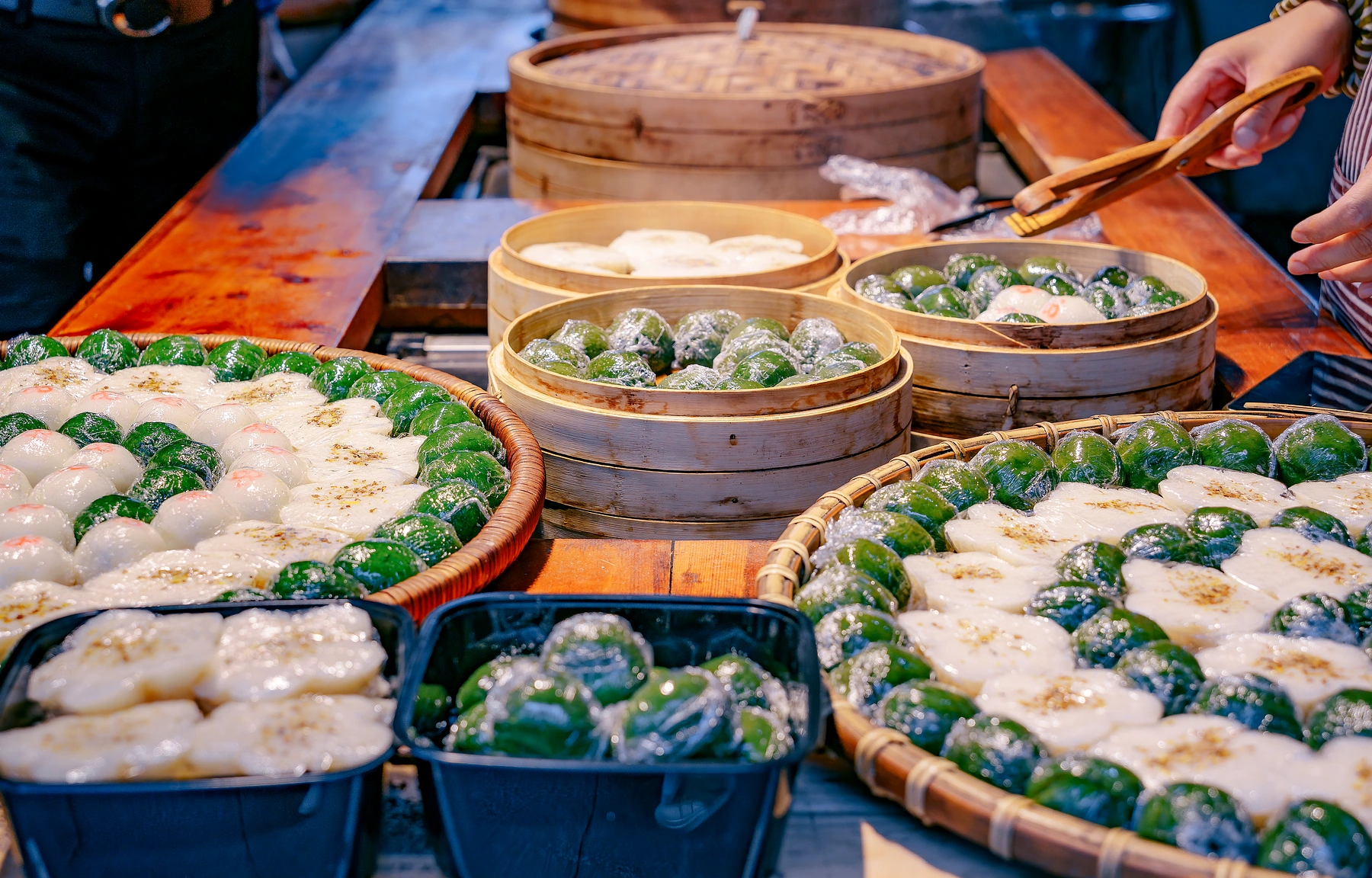
After hours of admiring these monumental engineering marvels, nearby traditional markets offer a rustic charm with local delicacies. On simple bamboo trays and steaming bamboo steamers, a myriad of traditional cakes are artfully displayed, from round, vibrant green mugwort rice cakes with a delicate flavor to thin, snow-white rice flour cakes topped with fragrant toasted sesame seeds. Wooden tongs pick up each hot, chewy, and earthy-scented cake, providing a warm culinary experience that perfectly balances the glitz and modernity of these century-defining structures.
Regarding immigration procedures, the Hong Kong government currently applies a very convenient electronic visa policy for Vietnamese tourists. Applicants can submit an application for a multiple-entry e-visa valid for two years, allowing a stay of up to 14 days per visit, with an online processing time of just 5 to 7 working days. This streamlined mechanism makes realizing a trip to explore the Ma Wan Channel and top-tier infrastructure projects easier than ever, completely eliminating previous cumbersome administrative barriers.
However, for a truly fulfilling trip, travelers need to be particularly wary of traps from “zero-dollar tours” or unusually deeply discounted travel packages ranging from 8 to 10 million VND. These low-quality itineraries often cut sightseeing time to force tourists into closed shopping venues in Hung Hom or To Kwa Wan, where feng shui items, titanium bracelets, or counterfeit rubber mattresses are sold at inflated prices. Instead, prioritizing “No Shopping / Pure Sightseeing” itineraries certified by the Travel Industry Authority (TIA) under the Travel Industry Ordinance (Cap. 634) will ensure maximum protection and peace of mind for travelers. Preparing carefully, from travel schedules to placing your trust in a standardized all-inclusive tour package, is the key to capturing the proud beauty of the Tsing Ma Bridge and the vibrant rhythm of life in the South.