Tracing back through ancient chronicles, the Hong Kong archipelago did not begin with towering glass skyscrapers or lavish avenues, but took root in quiet fishing villages nestled along granite bays during the Neolithic era. In 214 BC, under the reign of Qin Shi Huang, the region was formally incorporated into ancient China as part of Nanhai Commandery. The name “Hong Kong”—transliterated from the Cantonese for “Fragrant Harbour”—originated from the thriving trade in prized agarwood incense harvested from native *Aquilaria* trees across the Lingnan region. Fragrant timber from the New Territories was transported down to Shek Pai Wan, modern-day Aberdeen Harbour, before setting sail along the Maritime Silk Road toward bustling trading ports in the Middle East and southern seas, opening the history of a rugged yet proud seafaring gateway.
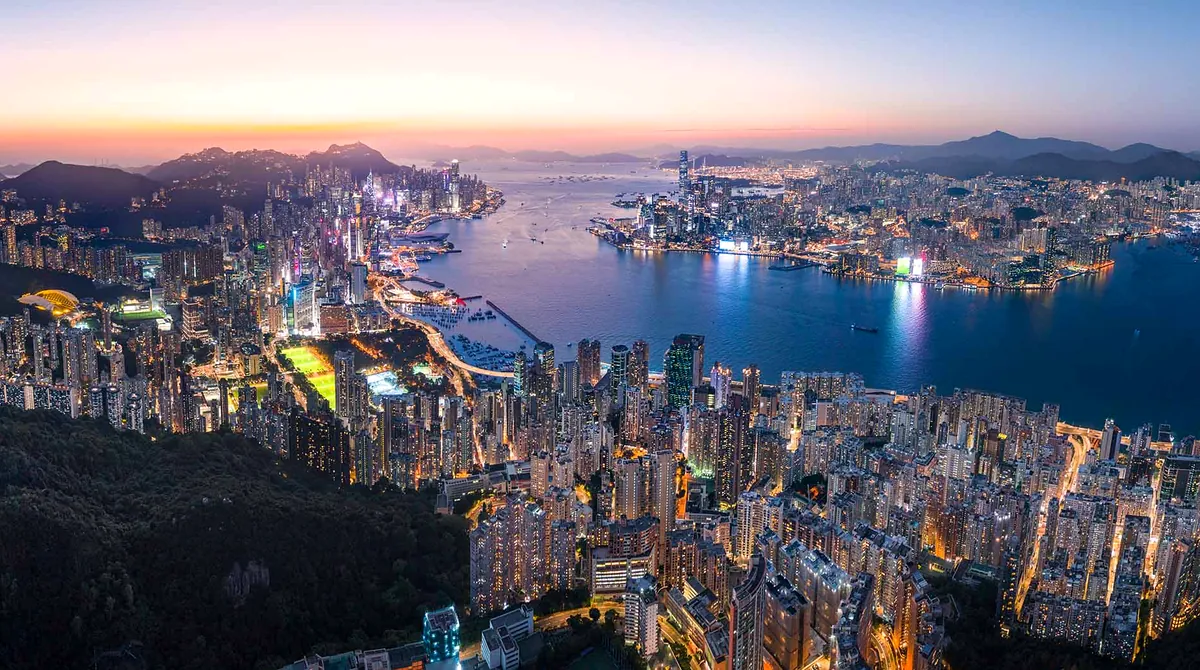
The panorama of Victoria Harbour unfolds like a supreme architectural masterpiece, where deep emerald waters mirror hundreds of skyscrapers rising like a sheer curtain wall of steel and glass toward the clouds. Once a natural deep-water anchorage sheltering ocean-going junks from typhoons in early centuries, the harbour is cradled today between the graceful shoreline of the Kowloon Peninsula and the steep slopes of Victoria Peak. Beneath gossamer morning mist or golden sunset light across the bay, the dramatic interplay between rugged mountain terrain and extraordinary human engineering defines an urban skyline unmatched anywhere in East Asia.
The tides of history left a poignant mark during the twilight of the Southern Song Dynasty. Between 1277 and 1279, fleeing the relentless advance of Mongol armies, young emperors Song Duanzong and Song Bing retreated southward with their court, turning the Kowloon Peninsula into their final makeshift imperial seat. The inscribed boulder bearing the three characters “Sung Wong Toi” (Terrace of the Sung Kings) on Ma Tau Wai Hill still stands through the ages as a silent witness to the tragic final chapter of the Song court. Entering the Ming and Qing dynasties, the territory came under Xin’an County, where local social structure crystallized around the “Five Great Clans”—Tang, Hau, Pang, Liu, and Man. Together they cultivated fertile valleys and built *wai* (walled villages)—fortified settlements enclosed by deep moats and brick walls to defend against coastal pirates.
The decisive turning point reshaping Hong Kong’s destiny arrived in the nineteenth century with the two Opium Wars. In 1842, following military defeat, the Qing court was forced to sign the Treaty of Nanking, ceding Hong Kong Island in perpetuity to the British Empire. Following further conflict in 1860, the Convention of Peking ceded the southern tip of the Kowloon Peninsula along with Stonecutters Island. Finally, to secure a broader defensive buffer and commercial hinterland, the 1898 Convention for the Extension of Hong Kong Territory leased the New Territories and 235 outlying islands for 99 years. First Governor Henry Pottinger laid the earliest foundations of the City of Victoria, transforming a sparsely populated coastline of rocky fishing hamlets into Asia’s premier financial and maritime entrepôt.
Enduring three years and eight months of harsh Japanese occupation from 1941 to 1945 during World War II, the resilient port city rose swiftly from wartime ashes. Waves of industrious migrants bringing capital, technical expertise, and extraordinary grit sparked rapid industrialization, propelling Hong Kong into the ranks of the “Four Asian Tigers.” At midnight on June 30, 1997, as the Union Jack lowered and the bauhinia flag of the Hong Kong Special Administrative Region rose, a century and a half of colonial rule officially concluded—ushering in the “One Country, Two Systems” era with an enduring identity at once deeply traditional and boldly modern.
Positioned at the eastern mouth of the Pearl River Delta, Hong Kong commands a natural geomantic layout prized by classical masters as a masterpiece of “embracing mountains and gathering waters.” Its dragon spine originates in the soaring massif of Tai Mo Shan in the New Territories, branching southward into nine undulating hill ridges forming the Kowloon Peninsula—likened to nine dragons coiling down toward the sea. Directly across the narrow strait sits Hong Kong Island backed firmly by Victoria Peak, turning Victoria Harbour into a wind-sheltered, deep-water “treasure basin” gathering prosperity and vital energy from every direction before flowing into the South China Sea.
From the breezy observation terraces atop Victoria Peak, the sweeping panorama of Hong Kong weaves a captivating tapestry uniting rugged nature with monumental human ambition. Mirror-still Victoria Harbour rests between two dramatic shores: a dense forest of steel-and-glass skyscrapers soaring along Central’s waterfront on one side, and misty green mountain ridges rising behind the Kowloon Peninsula on the other. Iconic green-and-white double-decker ferries slice cleanly across blue waters, forming a living bridge between primeval granite peaks and the ceaseless pulse of a global maritime metropolis.
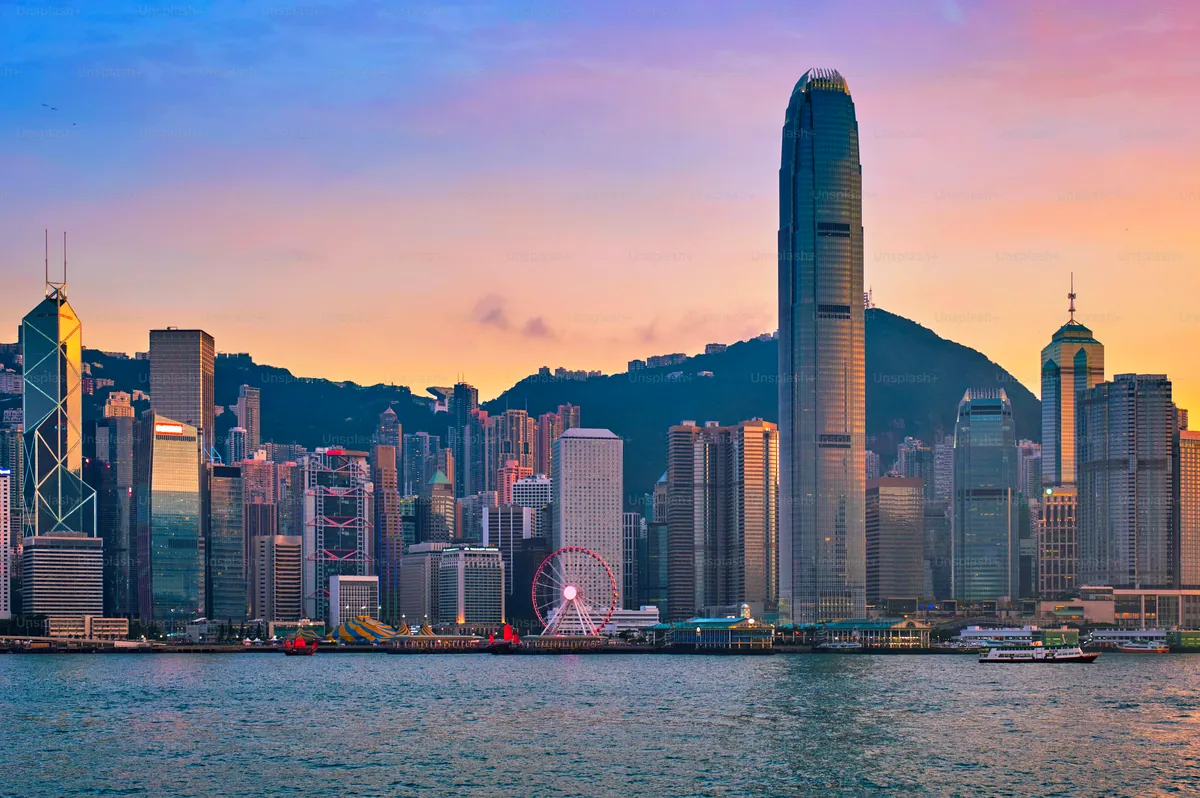
Rather than constraining urban growth, Hong Kong’s dramatic topography inspired a distinctive architectural philosophy blending traditional feng shui wisdom with Western modernism. Locals have long believed commercial prosperity depends on preserving unobstructed dragon veins descending from mountain ridges straight to the sea. Along coastal hillsides such as Repulse Bay and Pok Fu Lam, towering residential complexes incorporate massive rectangular voids known as “dragon gates”—allowing mountain dragons an unobstructed passage down to drink from the bay. Right in Central’s financial core, the celebrated architectural dialogue between I.M. Pei’s sharp-edged Bank of China Tower and Norman Foster’s HSBC Main Building—with its open ground-level plaza channeling sea breezes freely beneath—stands in architectural history as a classic study in urban geomancy.
Behind its record-breaking density of skyscrapers, more than 1,110 square kilometers of Hong Kong’s landmass consists predominantly of steep hills and cliffs born from Jurassic volcanic activity. To overcome acute land scarcity, colonial authorities and Chinese merchants initiated ambitious land reclamation projects beginning in the mid-nineteenth century—most notably the Praya Reclamation Scheme championed by Sir Paul Chater, pushing the shoreline outward to create vital arteries like Des Voeux Road and Connaught Road. Remarkably, urban expansion never came at the expense of green space: under Governor Murray MacLehose, the 1976 Country Parks Ordinance protected over 40% of Hong Kong’s territory, giving the city one of the highest ratios of wild nature immediately adjacent to a global financial center anywhere on Earth.
As a result, Hong Kong’s landscape maintains a remarkable yin-yang equilibrium. Just behind the neon-drenched shopping avenues of Tsim Sha Tsui and Causeway Bay winds the MacLehose Trail across the untouched peaks of the Sai Kung Peninsula, where million-year-old hexagonal volcanic columns meet sapphire waves. Further west, Lantau Island rises from the sea crowned by the majestic bronze Tian Tan Buddha at Ngong Ping, offering an expansive spiritual sanctuary. Anchored firmly between steep peaks, deep harbour waters, and vertical towers, Hong Kong possesses a singular character—reaching boldly into the future while keeping its roots anchored in timeless geography.
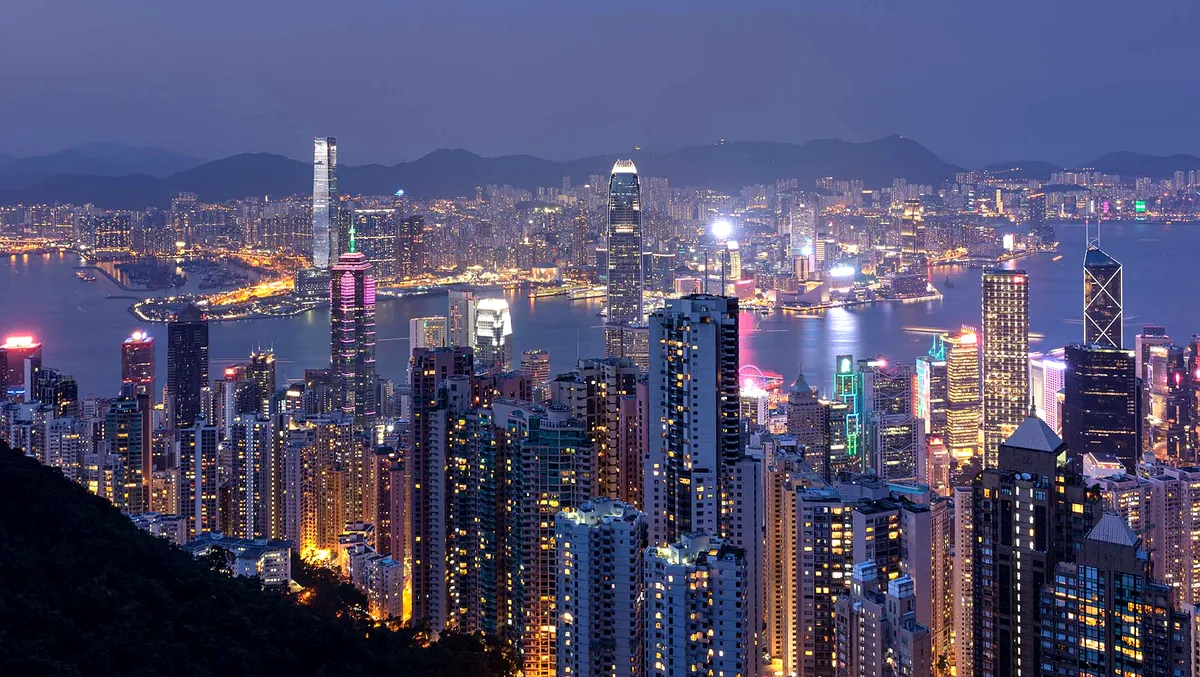
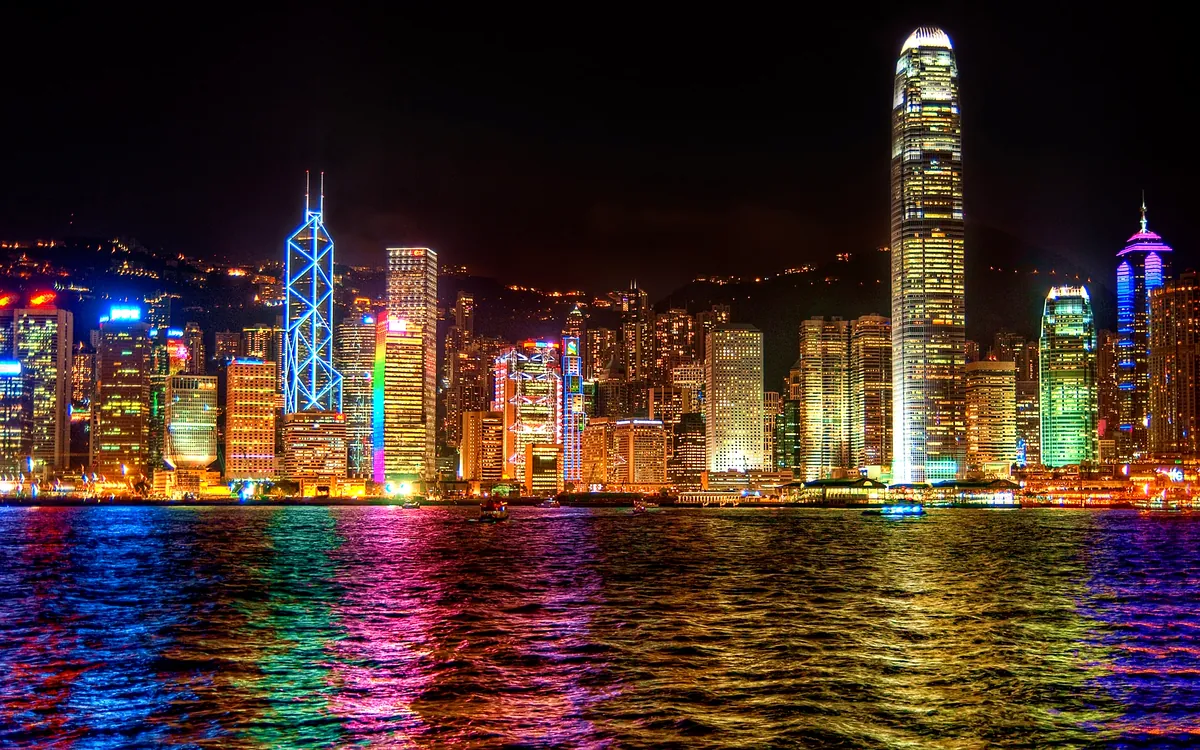
From the viewing terraces atop Victoria Peak, Hong Kong at dusk unfolds as a breathtaking visual spectacle of dancing lights shimmering across the calm waters of Victoria Harbour. The waterfront skylines of Central and Admiralty blaze with hundreds of densely packed skyscrapers soaring skyward opposite bustling Kowloon across the narrow strait. The vivid contrast between the deep velvet night sky and a multi-colored matrix of neon and architectural lights captures a global financial capital where engineering reaches extraordinary heights amidst precipitous mountains.
With more than seventy percent of its natural terrain composed of steep hills and woodland, Hong Kong faced one of the most demanding urban planning challenges on the planet. Scarce flat land compelled architects to build vertically, giving rise to an unmatched multi-tiered, hyper-dense metropolis. Beyond sheer height, the genius of this urban fabric lies in its seamless multi-level pedestrian connectivity: the covered Central–Mid-Levels Escalator stretches over 800 meters up steep hillside grades to link the financial district with residential neighborhoods above, working in tandem with elevated footbridges to keep pedestrians flowing smoothly above street-level traffic.
Defining Hong Kong’s architectural soul is the fascinating dialogue between cutting-edge modernism and traditional Lingnan feng shui principles. Revereing the maxim “sheltering wind and gathering vital energy,” locals regard the alignment between Victoria Peak behind and Victoria Harbour in front as a supreme conduit of prosperity, ensuring billion-dollar landmarks incorporate geomantic guidance from the earliest blueprints. Foremost is the HSBC Main Building designed by Norman Foster, costing over five billion Hong Kong dollars upon completion: suspended steel trusses elevate the entire structure above an open public plaza, letting auspicious mountain energy flow unimpeded through the ground atrium toward the harbour, guarded at the entrance by a pair of stately bronze lions.
Steps away, I.M. Pei’s Bank of China Tower evokes the silhouette of rising bamboo shoots reaching skyward for vitality and steady growth. Its crisp triangular space-frame steel geometry sparked lively debate among feng shui practitioners and inspired legendary tales of energetic interplay among neighboring financial towers. Even along scenic coastal bays like Repulse Bay, luxury high-rises deliberately incorporate huge open “dragon gates” through the center of their facades so mountain-dwelling dragons enjoy an unobstructed flight path down to the sea.
Hong Kong’s engineering prowess shines equally in massive reclamation works and subterranean infrastructure—from reclaiming hundreds of hectares to build Hong Kong International Airport at Chek Lap Kok to boring cross-harbour road and rail tunnels beneath Victoria Harbour. The entire metropolis operates like a precision-calibrated machine, uniting world-class civil engineering with deep Eastern cultural sensibility to transform glass, steel, and granite into living monuments of human ingenuity.
As sunset fades behind Victoria Peak, Hong Kong sheds its brisk daytime pace to don an evening gown woven from millions of dazzling lights. The Victoria Harbour skyline becomes a mesmerizing visual symphony as icons like the International Finance Centre soar into an ink-black sky, casting shimmering reflections of gold, emerald, and violet across tranquil waters—an unforgettable portrait of a harbour city that never sleeps.
The nightly highlight of Victoria Harbour is *A Symphony of Lights*, recognized by Guinness World Records as the world’s largest permanent outdoor light and sound show. At precisely 8:00 PM each evening, more than forty landmark towers lining both Kowloon and Hong Kong Island synchronize in a choreographed dance of razor-sharp laser beams, sweeping searchlights, and glowing LED facades. Along the Tsim Sha Tsui Promenade and Avenue of Stars, visitors listen to an orchestral score broadcast in sync while traditional red-sailed *Aqua Luna* Chinese junks glide gracefully across the water, evoking the golden age of East–West maritime trade.
Across the harbour, tucked along the gentle slopes of Central, Lan Kwai Fong offers an entirely different nocturnal rhythm. Originally a flower-hawker lane and colonial-era produce market, this historic L-shaped cobblestone enclave has evolved into Asia’s premier nightlife hub. After dark, stylish cocktail bars, craft lounges, and intimate jazz clubs spill music into the street as international travelers and local finance professionals mingle outdoors along steep granite steps—embodying the open, cosmopolitan energy of a freewheeling global city.
Contrasting Central’s polished glamour, nightlife at Temple Street Night Market in Yau Ma Tei preserves the gritty, cinematic soul of classic Hong Kong decades past. Beneath traditional entrance archways and glowing red lanterns, the kilometer-long market comes alive with warm bulbs illuminating stalls of handicrafts, silk fans, and vintage vinyl records. Near Tin Hau Temple, traditional Cantonese opera singers and *erhu* fiddlers perform beside fortune-tellers reading palms and *I Ching* bamboo sticks, while open-air *dai pai dong* food stalls fill the air with the irresistible aroma of spicy chili crab, crispy oyster omelets, and sizzling claypot rice.
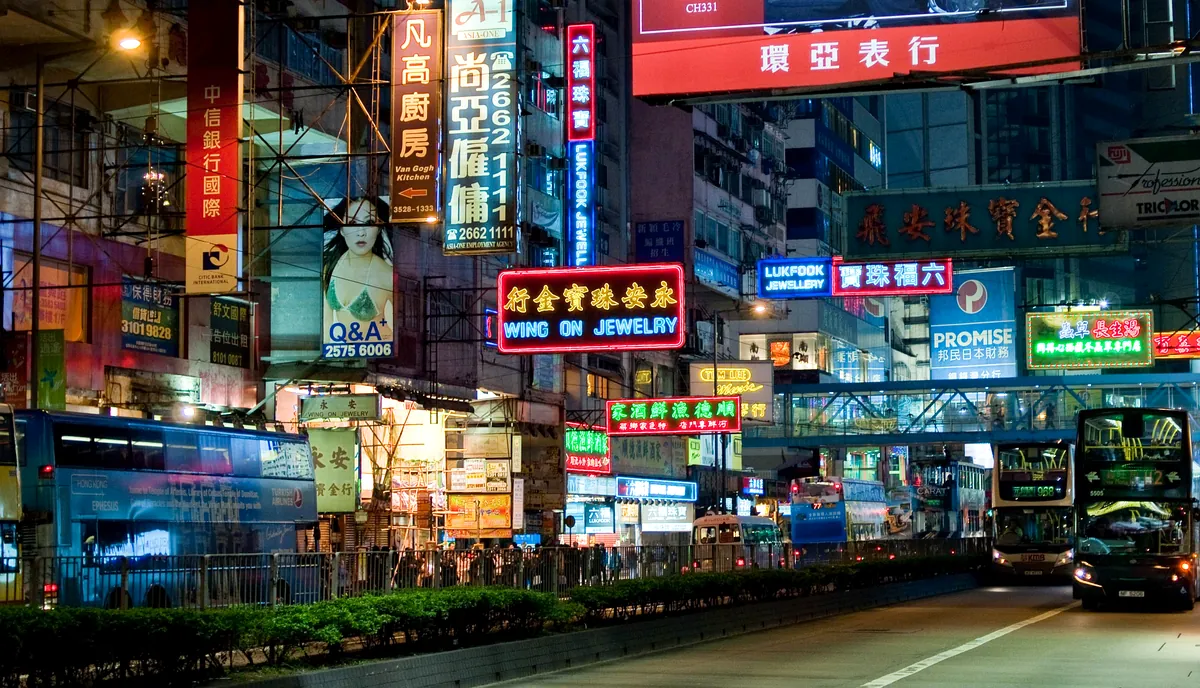
No evening in Hong Kong feels complete without experiencing its iconic neon aesthetic—the visual signature immortalized in the films of Wong Kar-wai. Although many hand-bent glass neon signs have gradually given way to modern lighting, the spirit of neon endures as living visual heritage: across the harbour in West Kowloon, the massive M+ Facade screen illuminates the waterfront with contemporary digital artworks inspired by classic neon glow, proving that Hong Kong’s nocturnal artistry mirrors the resilient vitality of the Pearl of the Orient.
After dark, major Kowloon thoroughfares like Nathan Road and Jordan glow with a hypnotic tapestry of crimson, emerald, and amber signage suspended overhead. Through deep urban canyons framed by towering apartment blocks, iconic red double-decker buses glide smoothly past bustling crowds heading toward steaming late-night eateries—a quintessential cityscape that raises the curtain on Hong Kong’s captivating culinary world.
Everyday Hong Kong dining is distilled inside *cha chaan teng* (Hong Kong-style cafés), born from the creative fusion of Western culinary influences and postwar Cantonese ingenuity. In the 1950s, when formal European restaurants remained exclusive to colonial elites, local cooks adapted Western dishes to Cantonese tastes—giving rise to velvety “silk-stocking” milk tea strained through fine cloth bags, *yuanyang* (a bold blend of coffee and milk tea), golden honey-and-butter French toast, and warm, crackly-crusted pineapple buns (*bo lo bao*) sandwiching a thick slab of cold salted butter that melts slowly on the tongue.
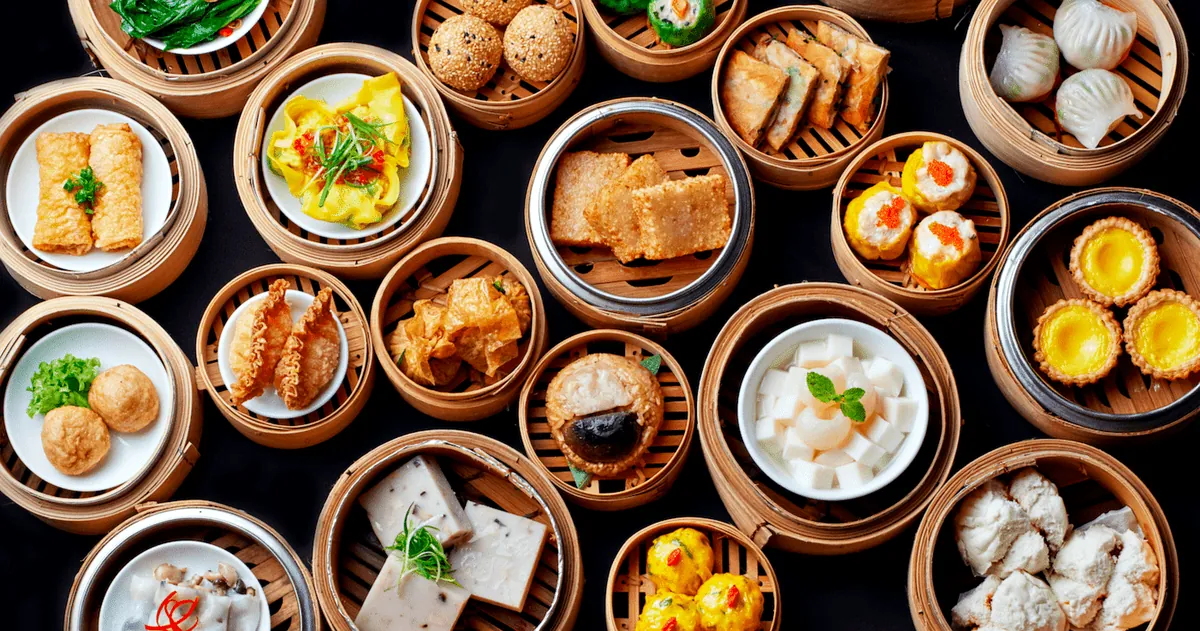
At the pinnacle of Hong Kong’s culinary heritage stand *yum cha* (tea drinking) and the art of *dim sum*, distilling centuries of Lingnan gastronomy. Far more than a meal, *yum cha* is a cherished social ritual complete with subtle table etiquette—such as tapping two fingers lightly on the tabletop to thank whoever pours your tea, a custom traced to Qing Emperor Qianlong traveling incognito in southern China. Inside steaming bamboo baskets appear translucent *har gow* shrimp dumplings pleated with thirteen delicate folds, crab-roe-topped *siu mai*, and silky *cheong fun* rice noodle rolls glazed with house-brewed sweet soy sauce—living up to dim sum’s poetic meaning, “to touch the heart.”
Stepping out from refined tea houses, Hong Kong’s street-food scene bursts with flavor at glossy *siu mei* (Cantonese roast meat) shop windows hung with crisp-skinned roast goose perfumed with five-spice and black cardamom alongside char-edged honey *char siu* barbecue pork. By night, licensed open-air *dai pai dong* street kitchens fire up roaring woks to capture elusive *wok hei* (“breath of the wok”)—tossing smoky beef *ho fun* noodles alongside steaming bowls of springy shrimp wonton noodles in dried-flounder and pork-bone broth that embody the resilient, flavorful spirit of the city.
Starting your morning with a classic *yum cha* session sets the ideal tone for exploring Hong Kong. Looking down over a round table crowded with steaming bamboo baskets arranged around a pot of fragrant Oolong tea—revealing crystal shrimp dumplings, roe-crowned *siu mai*, fluffy split-top *char siu bao*, flaky egg tarts, and golden fried treats—lets you savor the authentic rhythm of local life before diving into the city’s bustling avenues.
To navigate one of the world’s finest public transit networks effortlessly, pick up an all-purpose Octopus Card as soon as you land at Hong Kong International Airport at Chek Lap Kok. High-frequency MTR subway trains link Kowloon and Hong Kong Island every two to four minutes, while historic double-decker “Ding Ding” trams (operating since 1904) offer a nostalgic, unhurried ride past neon-lit streets in Wan Chai and Causeway Bay. Crossing Victoria Harbour aboard the iconic Star Ferry for a modest fare is far more than simple transit—it is a romantic voyage through more than a century of maritime history.
Understanding Hong Kong’s daily clock makes sightseeing much smoother. This is a late-rising city that blooms after dark: most luxury malls, galleries, and lively Mong Kok street markets open around 10:30 or 11:00 AM and buzz until midnight, whereas neighborhood *cha chaan teng* cafés and wet markets come alive at 6:00 AM with fresh pineapple buns and hot milk tea. The finest season to visit runs from October through late December, when crisp autumn-winter weather brings comfortable temperatures between 18°C and 24°C, dry skies, and freedom from summer humidity and typhoons.
Regarding entry formalities, Vietnamese citizens traveling to Hong Kong must obtain a valid electronic visa (e-Visa) via the Hong Kong Immigration Department’s online portal. At border control, officers issue a small printed Landing Slip rather than stamping passports; keep this slip safely until departure, as it is required for hotel check-in and exit clearance. While contactless payment is widespread, carry a supply of Hong Kong Dollar (HKD) banknotes, as many heritage eateries and *dai pai dong* stalls accept cash only. Observing local etiquette—such as standing on the right side of MTR escalators and tapping two fingers on the table when served tea—adds depth and warmth to every cultural encounter.
Mastering practical essentials from entry slips and transit cards to dining customs ensures a smooth, rewarding visit to this captivating East–West crossroads. For travelers eager to experience both historic heritage and dazzling modern energy without worrying about complex logistics, joining a well-crafted all-inclusive China tour package opens the door to an effortless, unforgettable journey.