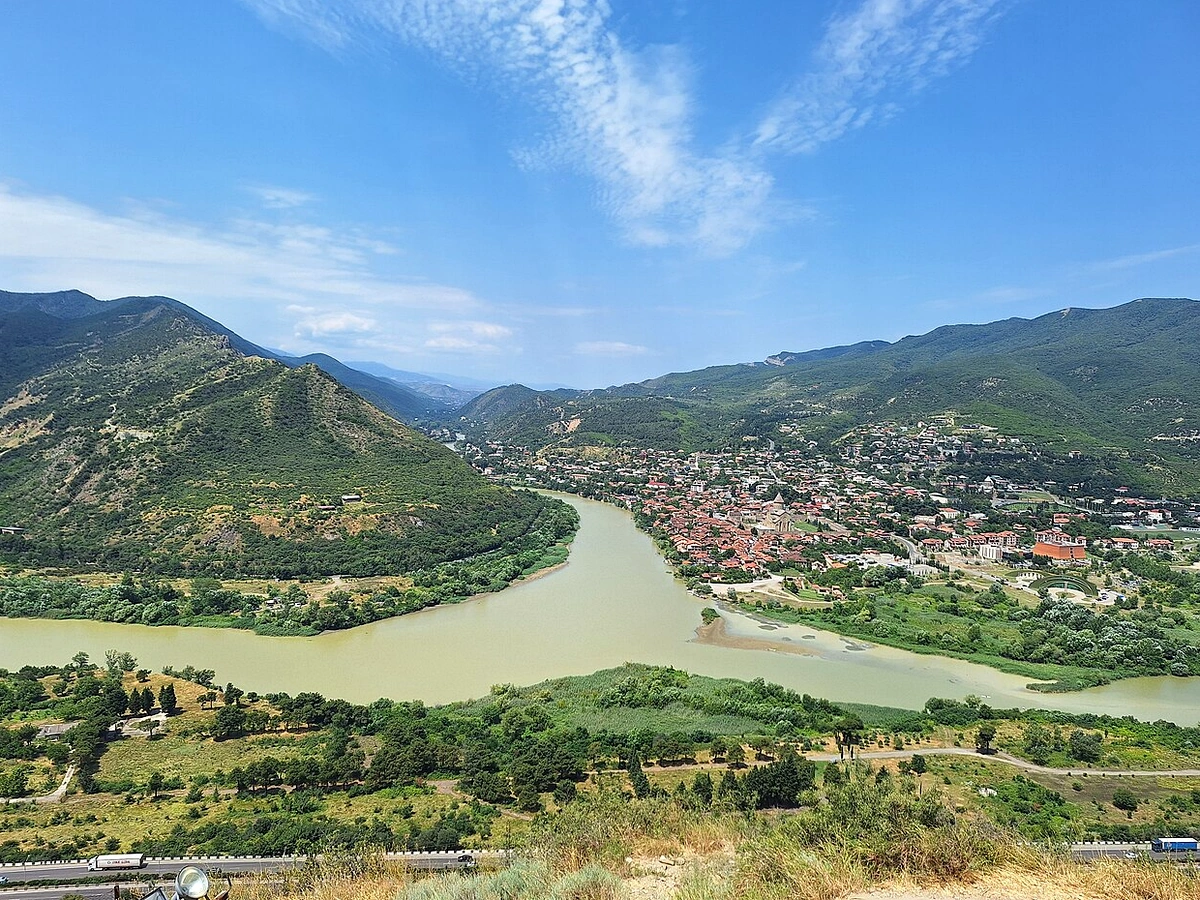
Along the relentless flow of time, where the sacred confluence of the Mtkvari and Aragvi rivers creates a deep green valley, the ancient capital of Mtskheta emerges like a living historical chronicle written in stone and the lifeblood of Georgia. Turning back the pages of ancient chronicles, the founding origins of this land trace back to the centuries bordering the dawn of the era, where the milestone of birth is linked to the footsteps of Mtskhotos—the legendary hero who laid the first bricks to build the ancient Kingdom of Iberia. From those primitive beginnings, Mtskheta was not merely a center of political power but also the cradle nourishing the cultural and spiritual identity of the entire Iberian populace before the light of history truly shone brightly from the 3rd century BC to the 5th century AD, the golden age when the city served as the supreme capital of the kingdom.
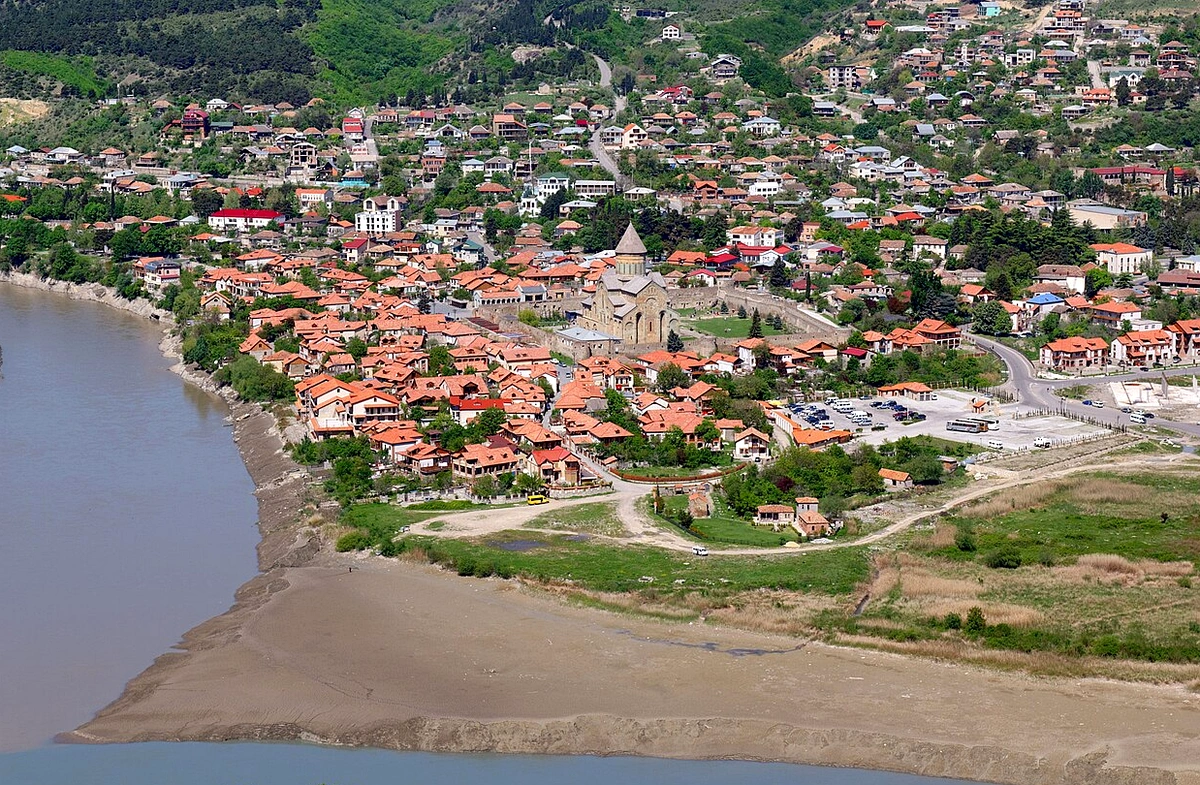
The greatest transformation in Mtskheta’s long history bears the decisive mark of King Mirian III. In 337 AD, under the profound ideological guidance of Saint Nino—who brought the cross made of grapevine branches to this land, King Mirian III officially proclaimed Christianity as the state religion of Iberia. This historic decision turned Mtskheta from a secular capital into the second Jerusalem of the Caucasus region, where spirituality intimately intertwined with the state’s power structure. Although by the late 5th century, King Vakhtang I Gorgasali—an outstanding figure with strategic vision—decided to move the capital to Tbilisi to expand military and commercial development space, Mtskheta’s supreme religious status never wavered. It still retained its complete role as the beating heart of faith, the coronation site, and the burial place of Georgian monarchs.
Yet, Mtskheta’s historical journey has never been a smooth path. On the contrary, it is an epic of blood and tears in the face of fierce historical upheavals. Situated at a strategic crossroads between Asia and Europe, this land has endured countless tempests of foreign invasion from the world’s most powerful empires. Sequentially across eras, from the devastation of Arab invasions, the sweeping forces of the Seljuks, the lightning-fast assaults of the Mongol armies to the bloody expansionist ambitions of the Polish-Persian empires, Mtskheta sank into a sea of fire time and again, its temples and ramparts ruthlessly destroyed. However, the resilient vitality of the ancient capital is like a flower growing on stone, rising strongly after every wither. Despite destruction, generations of Georgians stood steadfastly, preserving every inch of sacred soil and safeguarding core cultural values.
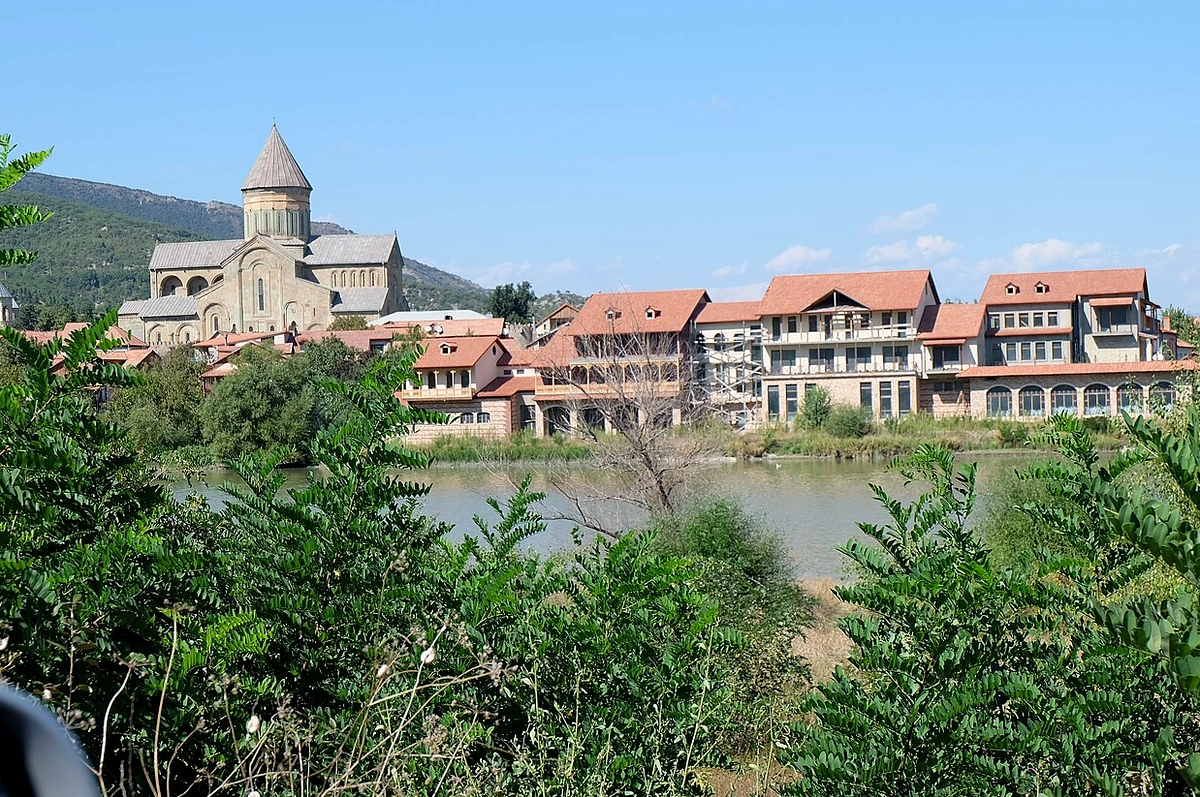
Miraculously, through all of history’s turbulent vicissitudes, Mtskheta has still preserved intact brilliant testimonies to a martial and scholarly civilization. Hidden within the heart of this ancient city are priceless cultural heritages, typically exemplified by ancient stone-carved texts utilizing the sacred Asomtavruli and Nuskhuri scripts—the oldest writing systems of the Georgians, testifying to an independent literature and scholarship that flourished centuries ago. The fortress ruins and majestic cathedrals standing tall through wind and rain are not simply architectural structures; they are history books written in stone, telling stories of loyalty, ironclad faith, and the enduring aspiration for freedom of a nation that has triumphed over all adversities in human history.
Exploring the Ancient Capital of Mtskheta Georgia (姆茨赫塔) cannot be considered complete without covering the geographical strata and architectural planning philosophy that have shaped this sacred land over millennia. Tucked away at the intersection of two historical and natural currents, Mtskheta emerges as a vivid testament to the ancients’ art of site selection and capital establishment. Through the perspective of both Eastern and Western cultural researchers, the geography of this ancient capital recalls supreme principles of survival space, where terrain, water flow, and religious structures harmonize to form a unique architectural landscape entity in the South Caucasus region.
According to archaeological records and ancient urban planning studies, Mtskheta is situated right at the strategic confluence of the Kura (Mtkvari) and Aragvi rivers. This geographical location not only provided abundant water and fertile alluvial soil favorable for agriculture and commerce since dawn but also created an exquisite feng shui terrain, perfectly matching classical standards of traditional landscape architecture. Viewed from above, the natural structure here sketches a picture of a “supreme” terrain in Eastern geography: backing onto majestic mountain ranges shielding against storms, while facing forward to welcome vigorous vital energy from two major water currents winding around the capital. The combination of perilous mountainous terrain and enveloping water creates a “qi-gathering and wind-concealing” space, protecting the capital from external incursions while retaining prosperity for the ruling dynasty.
The technical construction and spatial layout process of ancient Mtskheta demonstrated the visionary foresight of the Iberian kingdom’s architects. The entire initial city-state was planned based on absolute respect for the natural terrain rather than rough leveling or modification. City walls, palaces, and noble residences were erected using large-block stone assembly techniques without mortar, combined with traditional fired bricks, utilizing the natural slopes of hillsides to optimize defensive capabilities and drainage. The transportation system at the time was also designed to follow river valleys and ridgelines, providing convenience for merchant boat traffic between the Black Sea and the Caspian Sea while exercising comprehensive control over the vital arteries of the legendary Silk Road.
The most magnificent highlight in Mtskheta’s architectural landscape is the presence of Jvari Monastery (季瓦尼修道院). This masterpiece religious structure was erected spectacularly right on top of a precipitous hillside slope, standing impressively at the exact vantage point overlooking where the Kura and Aragvi rivers merge as one. From the perspective of cultural history researchers, the commanding presence of Jvari Monastery was not merely a choice of construction technique but also carried profound spiritual philosophical depth. The cathedral reaches up toward the clouds, standing steadfast against the sheer cliff face, forming an upward vertical axis connecting heaven and earth. Simultaneously, it establishes an invisible yet immensely powerful spiritual visual axis: from above, the monastery overlooks the entire ancient capital below, embodying the supreme authority of Christianity protecting the royal throne.
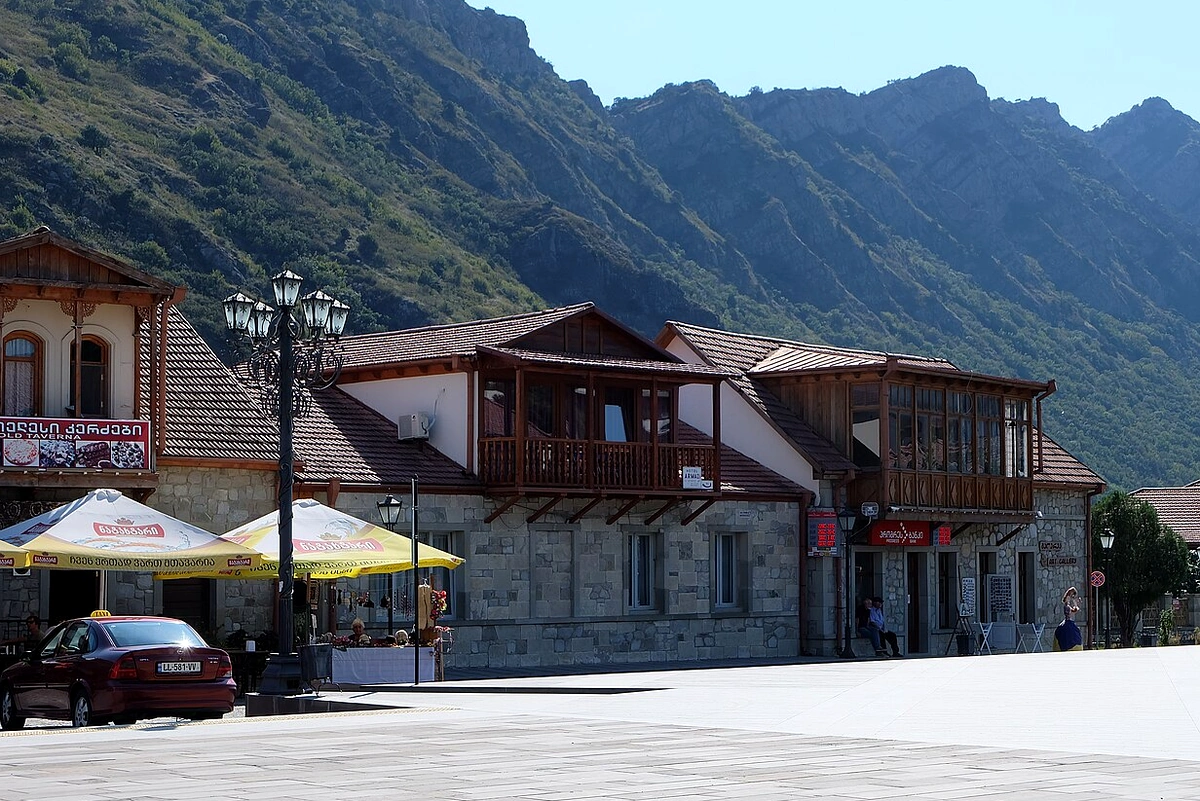
The reciprocal relationship between Jvari Monastery on the high cliff and the capital Mtskheta at the mountain foot created a cultural landscape of global symbolic significance. It is a silent yet authoritative dialogue between secular royalty—where Iberian kings once reigned, promulgated decrees, and developed commerce—and divine theocracy—where Christian faith rooted itself deeply into the Georgian national consciousness after Saint Nino preached. Through historical fluctuations and the alluvial sedimentation of the Kura and Aragvi rivers, which continue to embrace temple ruins, the silhouette of Jvari Monastery still stands proudly reflecting in rushing waters, telling an enduring story of an urban and landscape planning masterpiece that has overcome historical trials to become humanity’s priceless heritage.
Humble beside the surging Kura River, Mtskheta emerges not only as a memory museum of the Caucasus region but also as a true marvel of ancient architectural art and spatial planning. Stepping into this sacred space, travelers are instantly overwhelmed by the superb volumetric mindset and timeless stone construction techniques of Georgian master architects. Here, technical mastery does not merely stop at sturdy walls or majestic domes, but is the perfect fusion of orthodox Christian theology and exquisite geometric proportion philosophy, turning every lifeless stone into solemn symphonies echoing through millennia of history.
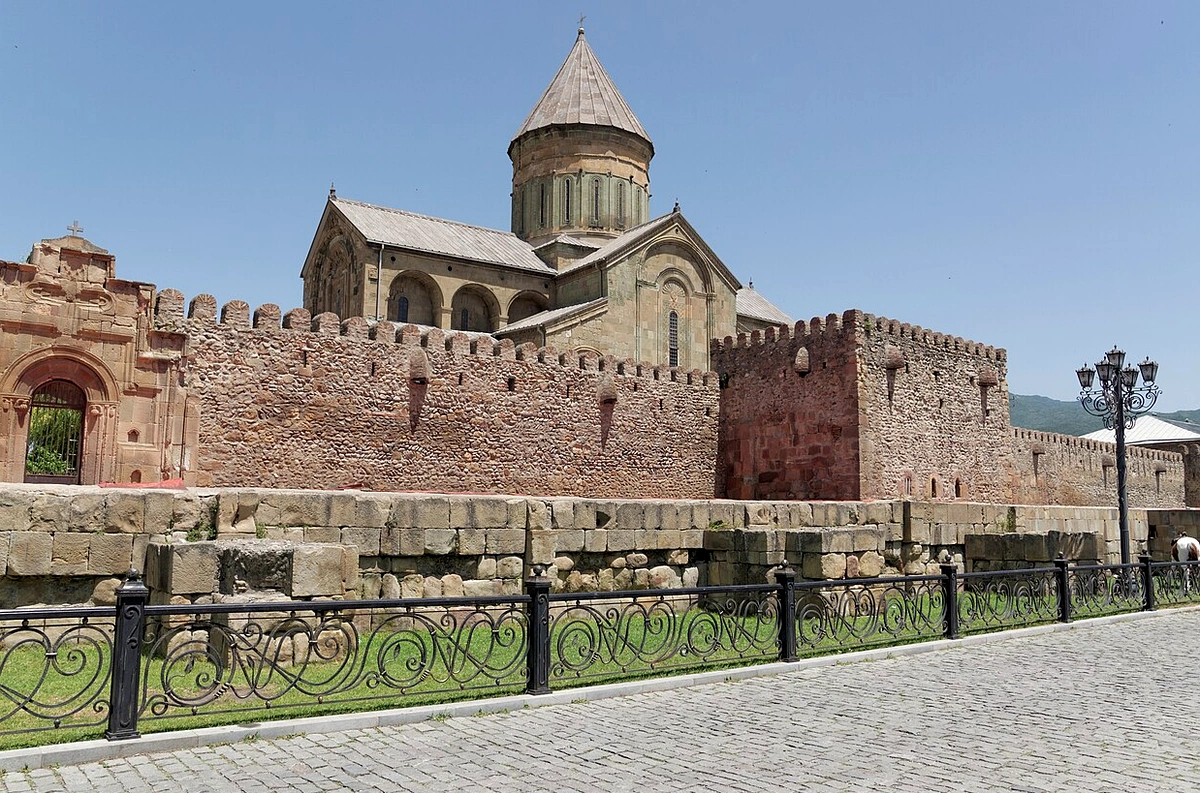
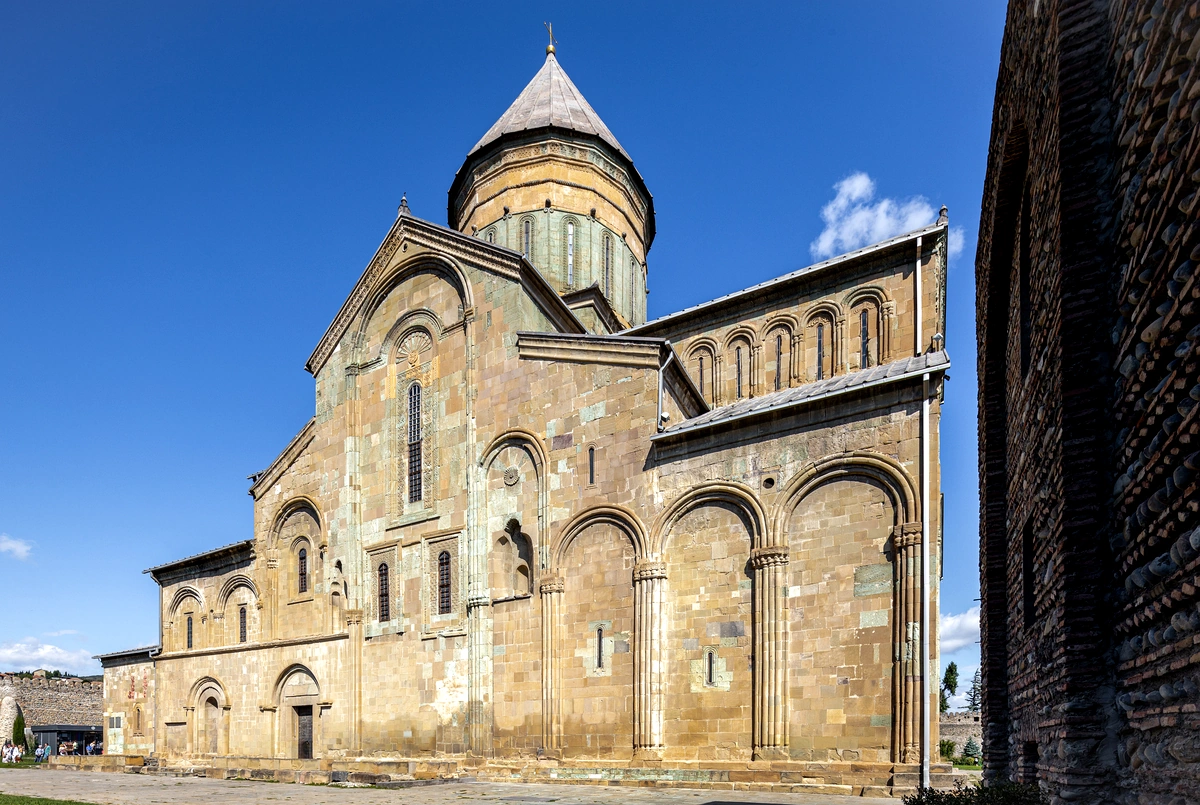
The pinnacle of monolithic stone architecture in the ancient capital is Svetitskhoveli Cathedral, also known as the Living Pillar Cathedral, an architectural masterpiece whose appearance was shaped in the 11th century, specifically between 1010 and 1029. Viewed from afar, the structure stands majestic and imposing with a masonry block structural system built in the classic cross-domed architectural style of the Byzantine and Caucasian worlds. The practical scale of the building makes anyone who sets foot there respectful: the overall length along the East-West axis reaches approximately 65 meters, while the width along the North-South axis spans about 53 meters. Soaring into Mtskheta’s sky is the towering dome roof exceeding 40 meters, creating a spiritual vertical axis capturing the gaze and shaping the entire surrounding ancient urban space.
The exterior surface of Svetitskhoveli Cathedral is a priceless outdoor stone sculpture gallery. Medieval artisans skillfully decorated the enclosure walls with blind arcade bands running along the wall bodies, delicately combined with relief carvings of religious iconography, figures of saints, symbolic grapevines, and legendary beasts. Sunlight illuminates sandstone and limestone blocks at different times of day, creating magical color shifts from pale yellow to silver-gray and contemplative pinkish hues. Inside, the space opens expansively thanks to large load-bearing pillars, where natural light is modulated through narrow high windows, illuminating ancient fresco layers that are slowly fading over time yet retain the sacred soul of a golden age.
Leaving the grand space of the ancient capital center and heading up the high hillside overlooking the confluence of the Aragvi and Kura rivers, Jvari Monastery appears as a more graceful and normative architectural mark. Built between 586 and 605 AD, Jvari is celebrated by world art historians as the supreme prototype, the origin of the tetracontch or four-apse domed church architectural lineage in Georgia. The miracle making Jvari’s eternal value lies not only in its perilous mountain-clinging geographical location, but also in the fact that the entire spatial proportion of the structure strictly adheres to classical golden ratio rules.
Every angle and distance from the central dome to auxiliary spaces at Jvari results from meticulous geometric calculations, allowing the structure to achieve absolute balance visually and spiritually. Jvari’s four-apse structure creates a centralized converging space where pilgrims standing anywhere can feel the protective embrace of the sanctuary. Stone crafting techniques here reached high sophistication with neatly cut stone blocks fitted tightly together without modern binding agents, yet standing resilient against severe earthquakes and war destruction over the past fifteen centuries.
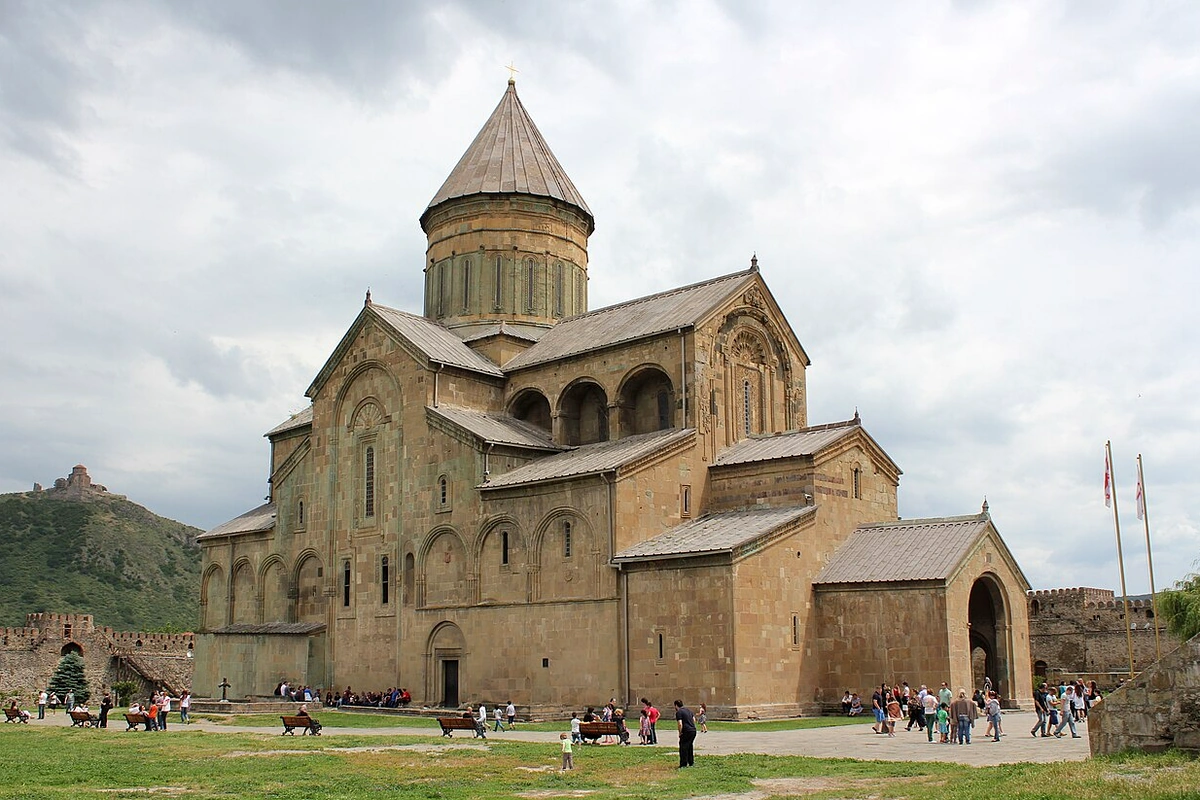
The combination of Svetitskhoveli’s grand, imposing scale and Jvari’s refined, golden-ratio standard paints a panoramic picture of architectural civilization’s peak at Mtskheta. This is not only evidence of ancient Georgians’ peak stone crafting talent, but also a symbol of enduring spiritual cultural depth, where physical spatial forms and metaphysical thoughts merge as one, leaving humanity with heritage lasting through the ages.
When night falls over the valley at the confluence of the Aragvi and Mtkvari rivers, the Ancient Capital of Mtskheta Georgia (姆茨赫塔) sheds its ostentatious daytime cloak to sink into a nostalgic, quiet yet evocative space. Unlike modern tourist cities that often abuse blinding neon lights, Mtskheta chooses an entirely opposite aesthetic philosophy: maximum restraint and delicate attention down to every touch point. Local authorities and urban planners implemented a rigorous night lighting design, turning thousand-year-old architectural heritage into living entities of darkness and light, where past and present harmonize in a deep, mellow note.
Strolling along the pedestrian old town at dusk, visitors clearly feel this artistic intent through public lighting systems. There are no soulless high-pressure lamp posts; instead, artisan-forged wrought iron wall lanterns following traditional prototypes appear, combined with in-ground LED lighting emitting a soft golden glow. That light caresses ancient cobblestones lining the streets, reflecting onto timber-framed walls and wood panels of houses deeply imbued with ancient Iberian architectural marks. Every detail is calculated to avoid harming the original beauty of the heritage space while evoking peaceful, unhurried feelings for those seeking sanctuary for their souls.
Looking up at the hillside slopes and ancient town center, symbolic structures like the 6th-century Jvari Monastery or 11th-century Svetitskhoveli Cathedral emerge majestic and mystical under the hand of light. All floodlighting systems here utilize color temperatures ranging from 2700K to 3000K, creating characteristic warm golden lighting. This hue not only highlights the full beauty of ancient basalt and limestone structures but also recreates the flickering light of monastery candles over centuries. Every arched architectural mass and carved molding stands out against the deep night sky, creating a powerful yet elegant visual effect fitting for a sacred space.
During peak tourism nights, Mtskheta’s night life does not stop at the stillness of stone and light, but resounds with melodies from antiquity. Along the romantic Mtkvari River bank, community cultural spaces are ignited by traditional art performance programs. Here, polyphonic singing—an intangible cultural heritage honored by UNESCO—is performed by local artists in traditional choxa attire. Their heroic, rustic, and philosophical sounds blend with river winds blowing from the valley, touching the deepest emotions of listeners. Simultaneously, modern water screen projection shows are cleverly arranged on the water surface, telling tales of the formation of the Iberian dynasty, Queen Nino’s conversion to Christianity, and the holy land’s enduring journey through historical trials.
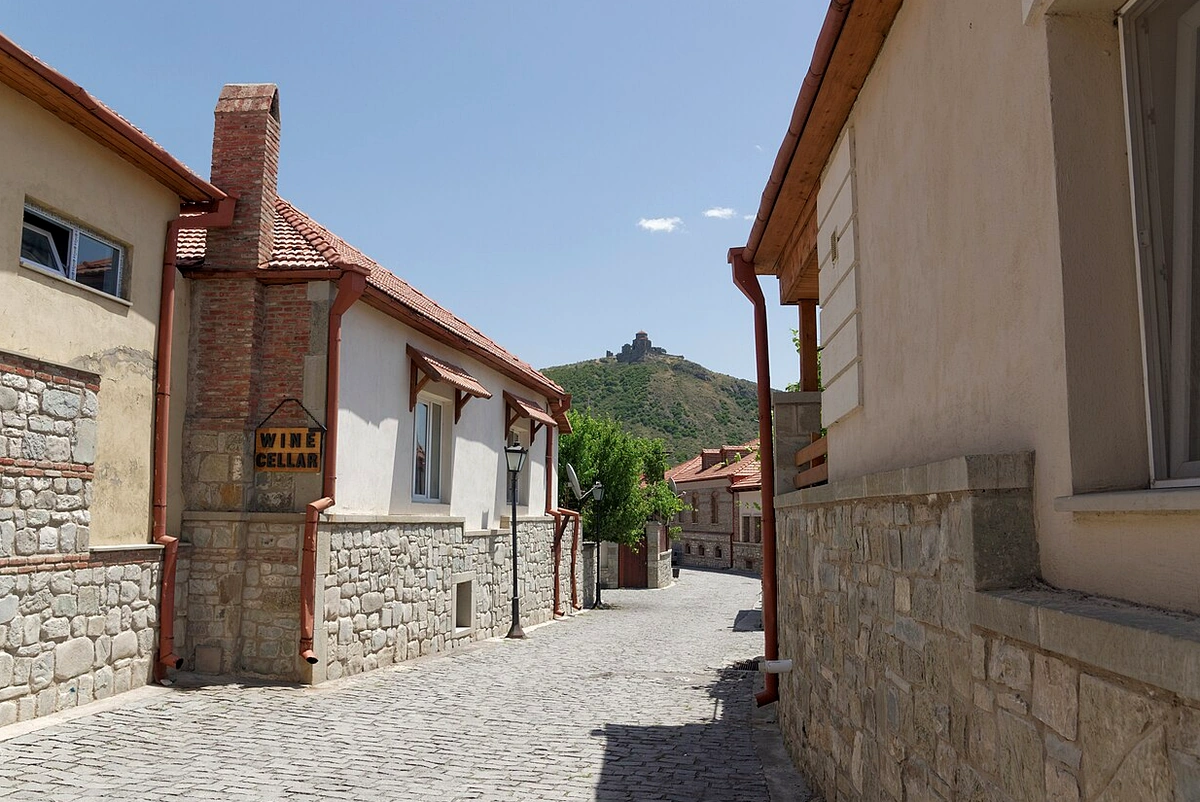
Mtskheta’s nighttime dining and art appreciation space also carries a unique color, unhurried and uncrowded. Traditional wine cellars (marani) beneath ancient brick-vaulted cellars open their doors to welcome guests amid the rich aroma of wine made from millennia-old qvevri grape varieties. Sitting at rustic oak wood tables, sipping amber wine rich in flavor alongside mtsvadi barbecue fragrant with charcoal smoke, visitors listen to panduri strings echoing from room corners. Amidst the chill of the Caucasus night, Mtskheta emerges not just as an open-air architectural museum, but a genuine living space where traditional culture is preserved with utmost respect, and where every traveler can find the deepest quietude for their soul.
Discovering the cultural depth of the ancient capital of Mtskheta (姆茨赫塔) is incomplete without embarking on a journey into the indigenous culinary world, which preserves ancestral secrets from millennia past. Unlike the flashy nature of modern cities, the local cuisine carries a rustic, unpretentious yet extremely refined character of the legendary Caucasus land. Along the tree-lined path heading toward the gentle Mtkvari River, diners are easily seduced by wispy smoke mixed with the rich aroma of grapevine wood and herbal spices emanating from long-standing traditional eateries.
The most representative and vibrant ambassador of ancient capital culinary culture is Salobie restaurant, a riverside legend that has become a must-visit spot for anyone eager to trace Georgian flavors back to their roots. Salobie’s name is tied to dishes carrying national soul, prepared according to traditional manual methods across generations. Sitting under vine-shaded eaves in a time-honored space, diners enjoy culinary highlights that have nurtured generations of Mtskheta’s people through historical ups and downs.
One of the classic appetizers making this land famous is Lobio (洛比奧), a traditional red bean stew slow-cooked in characteristic clay pots. Plump, firm red beans are simmered until tender with onions, garlic, cilantro, mashed walnuts, and secret spices, creating a smooth, rich mixture imbued with the flavors of earth and sky. When enjoyed, Lobio is always served with mchadi, hot pan-seared cornbread that is crispy outside yet soft and pliable inside, accompanied by tangy sweet-and-sour pickles that stimulate the taste buds of distant guests.
Furthermore, the traditional dining table in Mtskheta cannot lack Khachapuri (卡查普利) in its distinctive local version. Unlike other regions across Georgia, the baked cheese bread here features a unique structure and proportion of dough combined with Sulguni cheese filling, creating a golden crust fragrant with buttery richness and stretchy melted cheese pulling apart invitingly the moment the steaming hot bread is torn.
Blending perfectly with these rich dishes is Mtsvadi (Mtsvadi – 姆茨赫塔變體香草烤肉), the renowned skewered barbecue prepared using the most authentic techniques. Freshly marinated lamb or pork cuts are threaded onto metal skewers or fresh tree branches, then slowly roasted over glowing embers of old grapevine wood. This manual roasting process helps the meat retain its inner juiciness while the outer crust is seared golden with a characteristic smoky aroma. When plated, Mtsvadi is drizzled with Tkemali sauce made from wild sour plums, offering a mellow acidity that perfectly balances the meat’s richness.
The culinary experience in the ancient capital of Mtskheta would be incomplete without the presence of famous amber wine (琥珀酒). Locals faithfully maintain the traditional Qvevri fermentation method inside giant clay jars buried deep underground, strictly adhering to the nation’s millennia-old winemaking heritage. Sipping swirling amber wine with the natural tannin bitterness of grape skins and hints of dried fruit, diners feel as though the entire flow of time, history, and culture of this thousand-year-old holy land is saturating every single cell.
Exploring Georgia’s ancient capital of Mtskheta becomes complete when travelers equip themselves with practical knowledge regarding schedules, optimal transportation, and strict religious conduct rules at this UNESCO World Heritage site. As the spiritual heart of the entire Caucasus nation, Mtskheta always welcomes pilgrims and travelers with openness, while simultaneously demanding absolute respect for a sacred space that has existed for millennia.
Regarding sightseeing schedules, the city’s two paramount symbolic structures open to visitors for free with strict management hours. The heart of the ancient capital—Svetitskhoveli Cathedral (生命之柱主教座堂)—opens daily from 08:00 to 19:00, allowing visitors to leisurely admire the grand sanctuary architecture and learn about Christ’s sacred robe. Meanwhile, Jvari Monastery (季瓦尼修道院), nestled peacefully on a breezy hilltop overlooking the legendary confluence of the Mtkvari and Aragvi rivers, opens slightly later from 09:00 to 20:00 daily. Knowing these exact schedules helps travelers proactively arrange itineraries, especially to capture the magnificent golden hour light when dusk falls over the ancient Mtskheta valley from Jvari hill.
Traveling from the capital Tbilisi to Mtskheta is extremely convenient given the geographic distance of only about twenty kilometers north. Travelers can choose an authentic local experience by heading to Tbilisi’s famous Didube bus station, then catching dedicated marshrutka minibuses at very economical fares running continuously throughout the day, taking less than half an hour to reach the ancient capital’s gateway. For those prioritizing privacy, speed, and maximum comfort, using the Bolt online ride-hailing app from any point in Tbilisi straight to Mtskheta is a perfect solution, transparent in pricing and allowing complete personal schedule autonomy without worrying about price gouging or language barriers.
However, the make-or-break factor determining the trip’s success is strict adherence to behavioral rules when entering the sacred space of the Georgian Orthodox Church. Local culture and church laws explicitly state that women entering sanctuary interiors must wear headscarves (or shawls) to cover their hair, and must wear skirts falling below the knees or wrap-around skirts covering their legs. For men, regulations strictly forbid shorts or trousers above the knee and require hats to be removed immediately upon crossing the church threshold. Furthermore, an immutable rule every traveler must remember is the absolute prohibition of photography and filming inside most sanctuary areas to protect the silence, solemnity, and original sacredness of the holy site.
Besides cultural highlights and behavioral rules, budgeting for a trip to Mtskheta is quite affordable. Since most major historical monuments here do not charge admission fees, travelers’ budgets are mainly spent on transit, traditional dining at riverside restaurants serving famous Mtsvadi barbecue and Qvevri wine, and small purchases of churchkhela candies or handicrafts as souvenirs. For an opportunity to fully experience all cultural, historical, and magnificent landscape features not only in ancient capital Mtskheta but extending across the entire legendary Caucasus region professionally, safely, and profoundly, travelers can review detailed itineraries via the 2-Country Caucasus Tour program to prepare for inspiring worldly explorations.