Tracing the annals of history back to the Lycus River Valley in southwestern Turkey, the ancient city of Hierapolis rises majestically like an epic carved in stone, capturing the extraordinary intersection of imperial might and dramatic geological upheaval. This sacred ground was founded in the late 2nd century BCE under King Eumenes II of the Attalid dynasty, rulers of the powerful Hellenistic Kingdom of Pergamon. The name Hierapolis carries a profound dual meaning: it translates as the “Sacred City” in ancient Greek while also honoring the graceful Hiera—wife of the legendary hero Telephus and revered priestess of the Anatolian Mother Goddess Cybele. Perched along the edge of a one-of-a-kind limestone plateau, the city was initially established as a fortified military outpost, yet the warm, bicarbonate-rich mineral waters bubbling up from deep underground soon transformed it into a world-renowned healing and spa sanctuary across antiquity.
When Roman legions annexed Pergamon into their expanding empire, Hierapolis entered a golden age under the stability of the Pax Romana. Even so, the city’s destiny remained inextricably bound to the volatile tremors of the Earth’s crust. A catastrophic earthquake in 17 CE leveled many of its earliest structures, and a devastating tremor in 60 CE during the reign of Emperor Nero nearly obliterated its classical Hellenistic architecture. Driven by civic resilience and abundant wealth generated by its thriving thermal resort economy, Roman architects swiftly rebuilt the metropolis from the ashes according to grand monumental Roman urban planning. Massive blocks of travertine were quarried and sculpted into sweeping colonnaded avenues, palatial Roman bath complexes, a tiered semicircular theater seating tens of thousands, and an intricate subterranean aqueduct network—turning Hierapolis into one of Asia Minor’s most opulent urban masterpieces.
Entering the Eastern Roman era, Hierapolis underwent a historic spiritual transformation to become one of the foremost sacred centers of early Christianity in the region. This reverence stems from Saint Philip, one of the twelve apostles of Jesus, who arrived here to preach and suffered martyrdom in 80 CE. After Christianity became the state religion of the Byzantine Empire, an octagonal Martyrium church and tomb commemorating Saint Philip were proudly erected atop the city’s upper hill, drawing millions of pilgrims from across the Mediterranean to pray and immerse themselves in its purifying waters for centuries.
The tides of history continued to turn as Hierapolis passed through successive eras of rule after the 12th century. The city fell in turn to the Seljuk Turks, weathered the rivalries of the Anatolian Beyliks, and was eventually incorporated permanently into the mighty Ottoman Empire. Over these epochs, gleaming white travertine deposits cascading down the hillside over millennia cloaked the slopes in snow-white splendor, giving rise to the local Turkish name Pamukkale, meaning “Cotton Castle.” The Ottomans cherished these thermal springs as a priceless gift of nature, preserving traditional bathing culture amid Roman ruins and rich Eastern mystique.
One of the most breathtaking legacies surviving today is Cleopatra’s Antique Pool, a natural wonder born directly from historical calamity. In the 7th century CE, another violent earthquake tore open the earth, toppling the ornate marble colonnades of the adjacent Temple of Apollo. Fluted columns, arches, and sculpted relief pedestals plunged intact into a natural sinkhole brimming with warm, effervescent mineral spring water. Local legend holds that Queen Cleopatra of Egypt herself bathed here to preserve her ageless beauty, leaving behind an archaeological swimming pool unlike anywhere else on Earth—where modern-day travelers can glide through warm emerald waters and touch two-thousand-year-old fragments of history resting peacefully on the pool floor.
Set along the northern edge of the Büyük Menderes Valley—the winding river known as the Maeander in ancient Greek epics—the city-state of Hierapolis commands an elevated plateau in present-day Denizli Province. Geographically, this heritage complex straddles the dramatic transition zone between a balmy Mediterranean climate and the harsh continental climate of Anatolia, where dry winds sweeping down from the central plateau meet terraced limestone slopes. Backed by towering Mount Çökelez and overlooking the fertile ancient plains of Phrygia, Hierapolis held supreme strategic value from both a military and classical ecological standpoint, uniting abundant warm springs, crisp mountain air, and a gentle slope ideal for enduring urban design.
The geological foundation behind this extraordinary landscape originates from a deep tectonic fault zone running beneath the plateau, making the region one of the most active geothermal hotspots in Western Asia. Hidden deep beneath the complex strata of the Çökelez range, underground aquifers are superheated by geothermal energy from the Earth’s crust, dissolving vast quantities of minerals—chief among them calcium bicarbonate. Under immense hydrostatic pressure, this mineral-rich water surges upward through seismic fissures at a constant temperature of 35°C to 36°C. Upon reaching the open atmosphere, a sudden drop in pressure triggers rapid carbon dioxide degassing, precipitating solid calcium carbonate out of solution. Over millennia of uninterrupted mineral deposition, this pure physicochemical reaction sculpted gleaming white travertine terraces cascading down the mountainside like giant frozen seashells—creating a surreal geological wonder unmatched anywhere in the world.
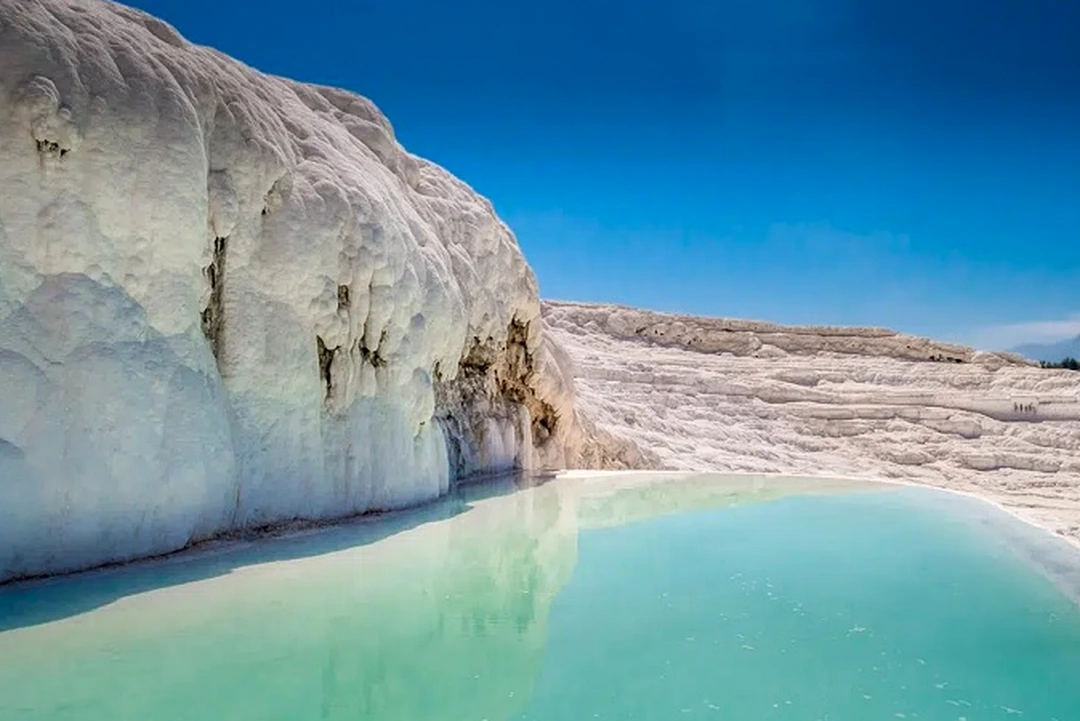
At the very heart of this natural hydrothermal network lies the Antik Havuz basin, celebrated by posterity as Cleopatra’s Antique Pool. The pool occupies a deep fault-line depression where underground springs emerge at their purest—completely free of silt or sediment, crystal-clear down to every pebble resting on the bottom. When the devastating 7th-century earthquake struck the civic heart of Hierapolis, it collapsed the majestic Ionic and Corinthian porticoes surrounding the sacred precinct directly into this geothermal basin. Rather than erasing its beauty, nature and time transformed the sunken ruins into an extraordinary underwater archaeological museum. Warm thermal water wells up continuously in millions of tiny effervescent bubbles that cling to fallen Roman marble columns, turning an imperial therapeutic bath into an ethereal living tableau where ancient ruins and natural vitality merge into one.
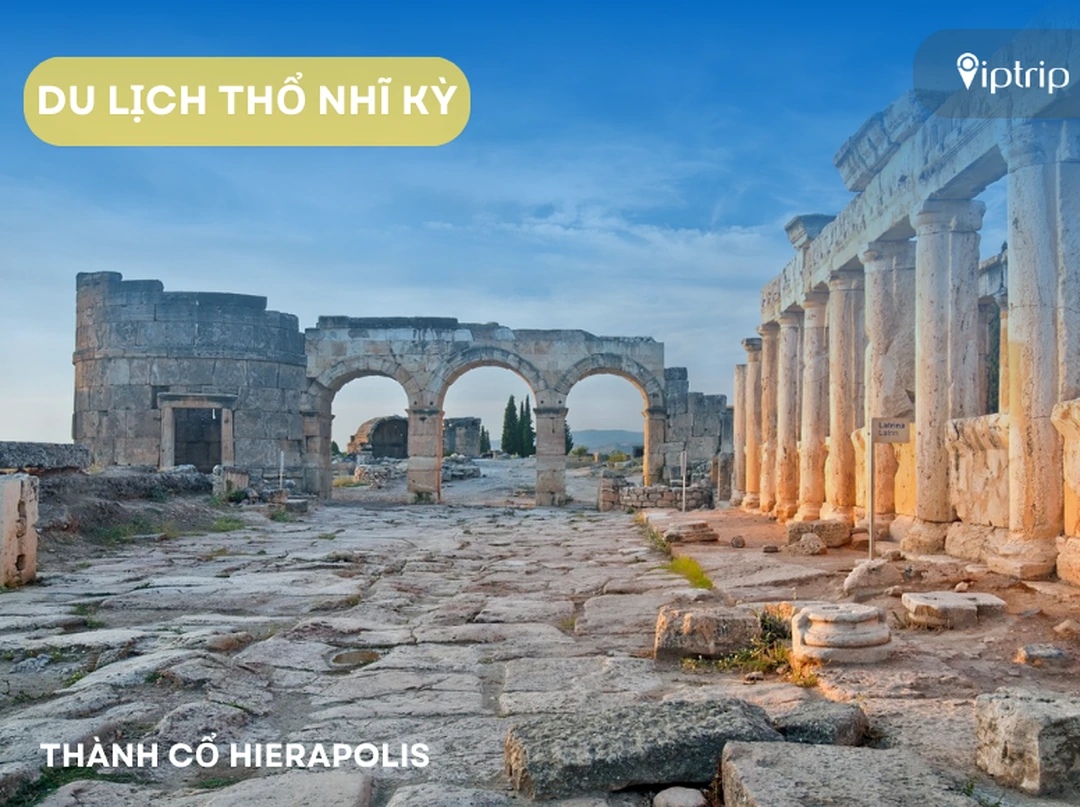
Working with the terraced topography and underground fault network, Roman engineers during the city’s heyday executed a textbook orthogonal urban plan. The main thoroughfare, the Plateia—or Decumanus Maximus—spanned nearly fourteen meters wide, paved with thick monolithic marble slabs running along the hillside to link monumental city gates. Harnessing natural elevation drops, an ingenious hydraulic system of interlocking terracotta pipes and carved stone channels distributed mineral-rich thermal water from the upper slopes straight to expansive Thermae bath complexes, ornate public Nymphaea fountains, and residential quarters. Right beside these thermal vents, ancient builders intentionally situated the Plutonion—a sacred cavern dedicated to Hades, ruler of the underworld—where dense geothermal carbon dioxide accumulated near ground level, turning a hazardous fault-line phenomenon into a mystical sanctuary that anchored religious authority across Asia Minor.
Surveying the entire heritage complex, archaeologists marvel at the seamless synergy between geological artistry and ancient engineering prowess. The centerpiece of the resort experience here is the Antik Havuz, widely known as Cleopatra’s Pool. Architecturally, the basin originally functioned as an expansive open-air atrium courtyard framed by proud Corinthian colonnades belonging to the Temple of Apollo sanctuary and bustling Roman porticoes dating to the 1st and 2nd centuries CE. Its architectural allure lies not in towering walls standing against the sky, but in classical stonework shimmering mysteriously beneath crystal-clear mineral water.
The catastrophic 7th-century earthquake brought down the surrounding arches, roofs, and marble colonnades, submerging them permanently inside the deep natural basin. Instead of salvaging the stone, geology and time curated a breathtaking submerged museum. Swimmers glide past fractured fluted column shafts, brush against ornate marble plinths, and admire carved acanthus leaf friezes and ancient architraves scattered across the pool bed. Geothermal springs feed the basin nonstop at a soothing 36°C to 38°C, infused with sodium, calcium, magnesium bicarbonate, and countless champagne-like carbon dioxide microbubbles that envelop the ancient stones and turn them into living sculptures shaped by millennia of mineral flow.
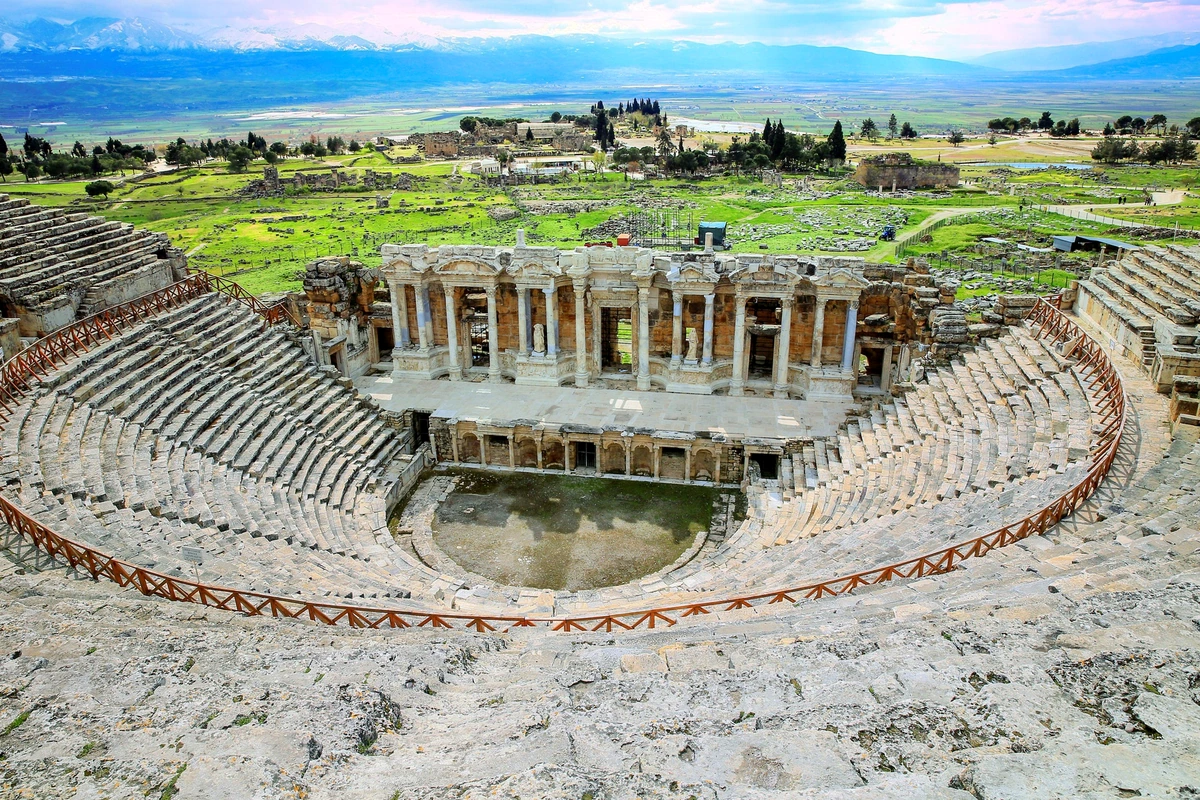
Stepping out of the ancient waters and ascending the gentle hillside brings you to a monumental testament to Roman architectural perfection: the Ancient Theater of Hierapolis (Hierapolis Tiyatrosu). Constructed and grandly expanded under Emperor Septimius Severus in the late 2nd century CE, this colossal venue seated between 10,000 and 12,000 spectators, serving as the beating cultural heart for festivals, drama, and gladiatorial spectacles across the Lycus Valley. Nestled firmly into the natural slope of the hill, the theater exploits the terrain’s incline to achieve sweeping sightlines and astonishing acoustic clarity, carrying an actor’s voice effortlessly from the stage to the highest tier of seats.
The semicircular seating bowl (cavea) is divided into two distinct tiers by a broad horizontal walkway known as the diazoma, paired with precisely engineered vaulted passages and vomitoria exits capable of emptying ten thousand spectators within minutes. The finest artistic craftsmanship is concentrated on the opposing two-story stage building (scaenae frons). Rising dramatically with dozens of columns supporting triangular pediments and ornamental arches, its facade showcases intricate mythological friezes depicting the birth of Apollo, the huntress goddess Artemis, ecstatic dances honoring Dionysus, and imperial Roman sacrificial rites. Enduring gray granite and white marble surfaces have withstood the ravages of centuries, preserving the aesthetic zenith of a brilliant civilization perched above white travertine cliffs.
As crimson twilight fades behind the silhouette of Mount Cadmus and dusk settles quietly over the Lycus Valley, Hierapolis steps into an entirely different dimension—one where the golden legacy of the Roman Empire meets contemporary architectural lighting artistry. In antiquity, nightlife in this famed spa city never truly slept. Under Roman emperors from Hadrian to Septimius Severus, Hierapolis ranked among Asia Minor’s most glamorous gathering places, its evenings illuminated by thousands of olive-oil torches guiding aristocrats to lavish symposion banquets lasting until dawn. Lyre music drifted through colonnaded halls alongside endless Stoic philosophical debates, while behind the granite walls of the Temple of Apollo, priests conducted secret nocturnal rites beside the Plutonion—the legendary Gate of Hell exhaling toxic vapors from the depths of the Earth.
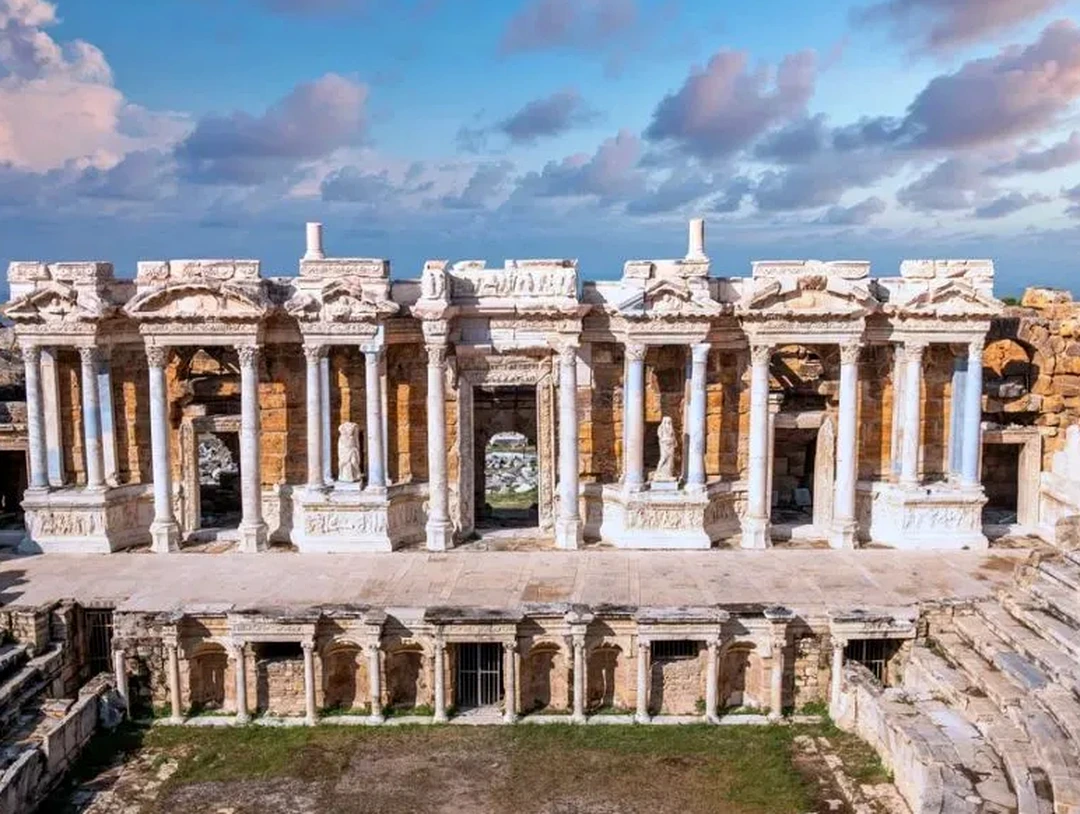
Carrying forward that millennia-old spirit of wonder, Hierapolis by night is dramatically reborn through precision architectural lighting installed under strict World Heritage conservation standards. The centerpiece of this nocturnal tableau is the Ancient Theater of Hierapolis, carved seamlessly into the hillside for over ten thousand spectators. Bathed in the warm golden glow of carefully angled floodlights, 45 tiers of marble seating and the three-story scaenae frons adorned with Greek mythological reliefs awaken in solemn majesty against a velvet-black sky. Standing inside the wind-swept amphitheater surrounded by echoes of antiquity, visitors can almost imagine the stage curtain rising at any moment for a classical tragedy by Euripides or Sophocles.
Just a few hundred paces away, Cleopatra’s Antique Pool takes on an utterly contrasting nocturnal allure. Wisps of mineral steam rich in bicarbonate and calcium sulfate drift ethereally off the 36°C water, curling around dew-kissed oleander bushes and palm trees. High-tech underwater spotlights pierce the crystal-clear depths, illuminating the entire submerged colonnade of white Ionic marble columns toppled by the 7th-century earthquake. Beneath a bright Anatolian moon, effervescent mineral waters embrace the sunken architectural relics, creating a mystical aquatic sanctuary that feels like stepping into a timeless dreamscape.
Stretching more than two kilometers to the north lies the Necropolis—the largest ancient cemetery in all of Anatolia, containing over 1,200 stone tombs, tumulus mounds, and imposing Roman sarcophagi. In contrast to the theater’s warm grandeur, lighting across the necropolis is calibrated to a cool spectral tone, casting solitary, contemplative shadows across dry hillside grasses. This vast burial ground served as the final resting place for nobles, wealthy merchants, and hopeful invalids who journeyed from every corner of the Mediterranean seeking healing waters only to breathe their last here. Under the quiet night sky, moss-covered limestone tombs seem to whisper timeless reflections on mortality and human transience beneath the cosmos.
Capping off this enchanting evening, cultural hospitality awaits at traditional teahouses tucked along the foot of the hill, where travelers can unwind over a glass of red wine fermented from ancient indigenous Phrygian grape varieties. In the crisp, dry highland breeze, the mouthwatering aroma of Denizli tandır kebab—slow-roasted to melt-in-your-mouth tenderness inside clay pit ovens for hours—paired with wood-fired bazlama flatbread welcomes visitors into the genuine warmth of a land where East and West converge.
Exploring the heritage of Hierapolis and soaking in the warm mineral waters of Cleopatra’s Pool would be incomplete without savoring the distinctive culinary landscape of Denizli. Positioned at a vibrant cultural crossroads between the mystical Phrygian highlands and the fertile Aegean coast, local gastronomy reflects a thousand-year-old philosophy of wellness in which the purest gifts of the land are prepared using ancestral techniques passed down across generations.
Crowning the region’s culinary repertoire is the celebrated Denizli Kebabı, an iconic roast lamb dish crafted through an unchanged centuries-old method. Unlike heavily spiced Middle Eastern kebabs, Denizli lamb is sourced exclusively from young sheep grazing freely on the slopes of Pamukkale, using prime cuts with zero marinades or seasonings so the meat’s pure natural sweetness shines through. Large cuts are skewered on long iron rods and suspended inside domed brick ovens fueled solely by seasoned oak wood embers. Guided by veteran pitmasters who regulate heat by instinct, the meat roasts slowly for hours until its crisp, amber skin gives way to butter-soft, succulent flesh. Best of all is the traditional dining ritual: forks and knives are set aside in favor of eating by hand, tucking piping-hot shreds of lamb into freshly baked pide flatbread soaked in rich lamb drippings alongside thinly sliced onions and fire-roasted tomatoes.
Alongside the rustic simplicity of spit-roasted lamb, this ancient region proudly preserves Babadağ Keşkeği, a ceremonial delicacy inscribed on UNESCO’s Representative List of the Intangible Cultural Heritage of Humanity. Prepared for festivals, weddings, and community feasts around Mount Babadağ, Keşkeği is a hearty harmony of whole-grain wheat and lamb or beef slow-simmered in massive copper cauldrons. Its defining soul lies in the rhythmic pounding process: strong village men take turns beating the simmering mixture with heavy wooden mallets for hours until every grain of wheat breaks down and melds seamlessly with shredded meat into a velvety porridge. Ladled hot and crowned with sizzling melted butter infused with vibrant red chili flakes, the dish delivers deep, comforting richness symbolizing community solidarity and gratitude for a bountiful harvest.
Hierapolis cuisine also captures the humble ingenuity of rural mountain life through Çaput Aşı, a clever dish born from highland resourcefulness. Rather than using tender fresh vine leaves as in conventional sarma, locals gather autumn grape leaves after harvest, dry them, rehydrate them in warm water, and roll them neatly around rice or bulgur wheat seasoned with wild mountain herbs. Packed tightly into deep earthenware pots and simmered gently over glowing embers, the subtle tang of dried vine leaves infuses the nutty grains, creating a deeply savory, rustic flavor found nowhere else.
To recreate the regal banquets once enjoyed by Roman aristocrats vacationing in Hierapolis, local culinary historians have also revived an Apicius-inspired honey and olive oil lamb stew known as Antik Dönem Usulü Ballı ve Şifalı Zeytinyağlı Kuzu. Prepared with tender, collagen-rich lamb neck (gerdan), the meat is braised slowly in cold-pressed Aegean extra-virgin olive oil, pure Phrygian wildflower honey, ground coriander seed, pearl onions, and a splash of naturally fermented grape vinegar. Balancing delicate acidity, gentle sweetness, and ancient herbal aromatics, this restorative dish not only replenishes vitality after a thermal soak but also serves as an edible time capsule into classical antiquity.
Planning a smooth visit to Hierapolis and Cleopatra’s Antique Pool starts with understanding the operating rhythm of the Hierapolis Archaeological Site (Hierapolis Ören Yeri). The ancient gates open to visitors at 08:00 AM and close at 19:00 during the sun-drenched summer months, when late afternoon light bathes the Lycus Valley in gold; in winter, hours shorten to 08:00–17:00 to ensure visitor safety before dusk settles across the Anatolian plateau. One crucial ticketing detail that frequently catches travelers off guard is the split admission policy. While the Turkish Museum Pass (Müze Kart) grants full access to the grand Roman Theater, Colonnaded Street, and sprawling Necropolis, Cleopatra’s Antique Pool (Antik Havuz / Kleopatra Havuzu) operates under a separate concession. Visitors are welcome to stroll freely around the shaded garden perimeter, but entering the warm, mineral-rich thermal waters among sunken marble columns requires purchasing a separate swimming ticket at the central pool counter.
Reaching this millennia-old sanctuary is remarkably straightforward thanks to Denizli Province’s well-connected transport network. Most travelers arrive via domestic flights landing at Denizli Çardak Airport, situated roughly 65 kilometers east of the archaeological zone. From the airport terminal, dedicated shuttle buses connect directly to Denizli’s central bus station (Denizli Otogarı). On the lower level of the terminal, local minibuses known as dolmuş depart every 15 to 20 minutes straight to either the North Gate or South Gate of the Pamukkale-Hierapolis complex. Along the winding drive, southwestern Turkey’s rugged terrain gradually gives way to a colossal white travertine cliff rising like a shimmering glacial fortress against the clear sky.
Once inside the core heritage zone, adhering strictly to conservation regulations enforced by the Turkish Ministry of Culture and Tourism is every visitor’s shared responsibility. To protect the fragile calcium carbonate (travertine) terraces from physical erosion and staining, site authorities strictly prohibit shoes, sandals, and socks anywhere on the white limestone formations. Be sure to bring a reusable cloth tote or waterproof bag to carry your footwear while walking barefoot up the gentle slope linking the lower town to the upper plateau. Feeling the textured mineral stone beneath your soles as warm thermal streams rush over your feet is an unforgettable sensory thrill—though caution is essential, as patches of mineral-rich silt can be slippery.
When bathing in the Antik Havuz, hydrotherapy specialists advise limiting your soak to an ideal window of 45 to 60 minutes. Maintained at a steady 36°C, the water carries an exceptionally high concentration of dissolved minerals alongside millions of effervescent carbon dioxide bubbles; lingering too long can trigger sudden drops in blood pressure or physical fatigue caused by rapid transdermal mineral absorption. Furthermore, because the pool bed preserves an authentic 7th-century earthquake collapse, fluted Ionic and Doric column shafts and carved marble fragments lie scattered across the crystal-clear floor. Swimmers should move mindfully through the water to avoid scraping against submerged stone edges or historic architectural blocks.
A full day exploring Hierapolis calls for thoughtful attire and steady hydration. Spanning hundreds of hectares across an open, breezy hillside with minimal natural shade, the archaeological park requires a wide-brimmed hat, UV-blocking sunglasses, reef-safe sunscreen, and supportive walking shoes with reliable traction for traversing the vast Necropolis valley. Breathable, moisture-wicking clothing and plenty of drinking water will keep your energy high throughout the day. To experience this mesmerizing union of geological wonder and monumental history without worrying about logistics or complicated transfers, consider joining an all-inclusive Turkey tour package designed to connect every heritage highlight seamlessly.