Nestled in the bustling heart of southern China’s metropolis, the Yuexiu hill range resembles a chronicle written in stone and flora, bearing witness to over two millennia of Lingnan’s eventful history. The origins of this cultural space date back to the Nanyue Kingdom, spanning from 204 BC to 111 BC. After founding the state and proclaiming himself king, Zhao Tuo—known as the Prince Wu of Nanyue, and later revered as Emperor Wu of Nanyue—chose Yuewang Mountain, the region’s most strategic hill at the time, to erect the Chaohan Terrace. This sacrificial altar gazed far northward toward Chang’an, the capital of the Western Han court, not only symbolizing the delicate tributary diplomacy between the vassal state and the imperial court but also officially establishing the first political landscape at the gateway of the wild southern frontier.
Through millennia of dynastic transitions, the strategic importance of the hill grew even more critical upon entering the Ming Dynasty. In the 13th year of the Hongwu era (1380 AD) under the reign of the Hongwu Emperor Zhu Yuanzhang, Marquis of Yongjia Liang Zhen and Regional Military Commander Zhu Liangzu undertook a massive restoration and expansion of Guangzhou’s city walls, extending them northward. Right at the highest point of Yuexiu’s dragon vein, the majestic five-story Zhenhai Tower was erected with the feng shui intent of suppressing independent royal energy in the south while serving as a heavily guarded frontline fortress protecting the coastal maritime border. To reinforce the defense line, the imperial court constructed a sturdy wall stretching over 1,100 meters, winding along the mountain slopes using distinctive red sandstone blocks, transforming the hill into an impregnable military stronghold safeguarding the entirety of urban Guangzhou.
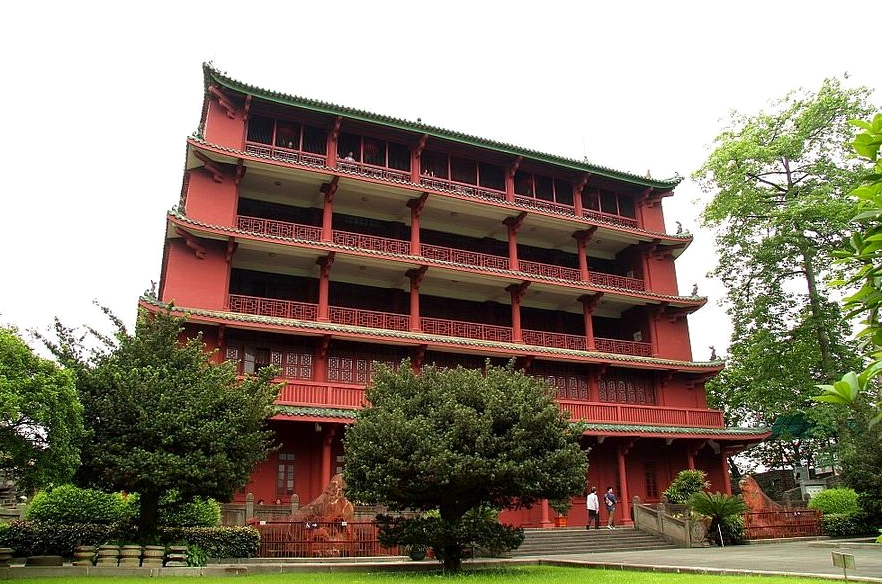
During the Qing Dynasty, which lasted from 1644 to 1912, this land continued to be the epicenter of fierce military conflicts. Amidst the fiery turmoil of the Revolt of the Three Feudatories and the outbreak of the Second Opium War, Zhenhai Tower suffered heavy bombardment and destruction, requiring five major restorations to maintain its status as the supreme military observation post controlling the lifeline of the Pearl River. The hilltop is also where the Southern Ming Dynasty shed its final drops of blood, evidenced by the mausoleum of Emperor Shaowu (Zhu Yuyue) and loyal generals who sacrificed their lives when the Eight Banner forces flooded the stronghold, leaving a tragic and heroic mark deep within the mother earth.
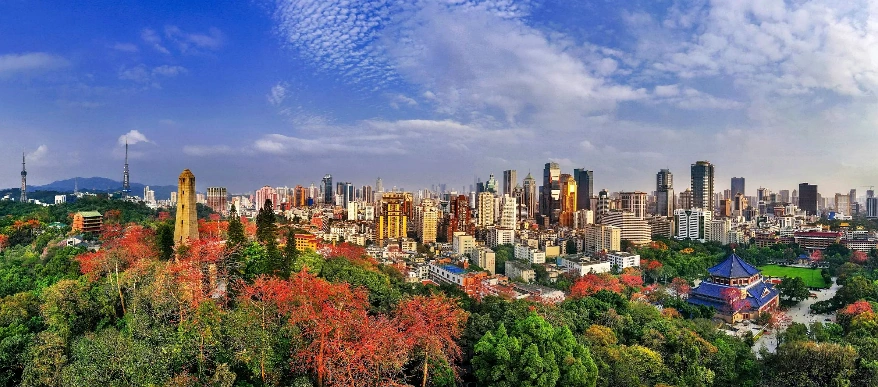
Entering the Republic of China era from 1912 to 1949, the function of this historic land underwent a monumental shift. Pioneer revolutionary Sun Yat-sen was the first to propose removing feudal and military barriers to transform the entire Yuexiu Mountain into a grand public park serving the citizens and urban community. Bringing this vision to life between 1928 and 1929, distinguished architect Lü Yanzhi led the design and construction of the towering monolithic granite Sun Yat-sen Memorial Monument atop Yuetai Ridge, creating a flawless spatial symmetrical axis with the Sun Yat-sen Memorial Hall located right at the foot of the mountain. During this reconstruction phase, the ancient Zhenhai Tower was also reinforced with a modern reinforced concrete beam-and-column system, officially converting its function into the Guangzhou Museum, opening its doors for the public to admire local archaeological treasures.
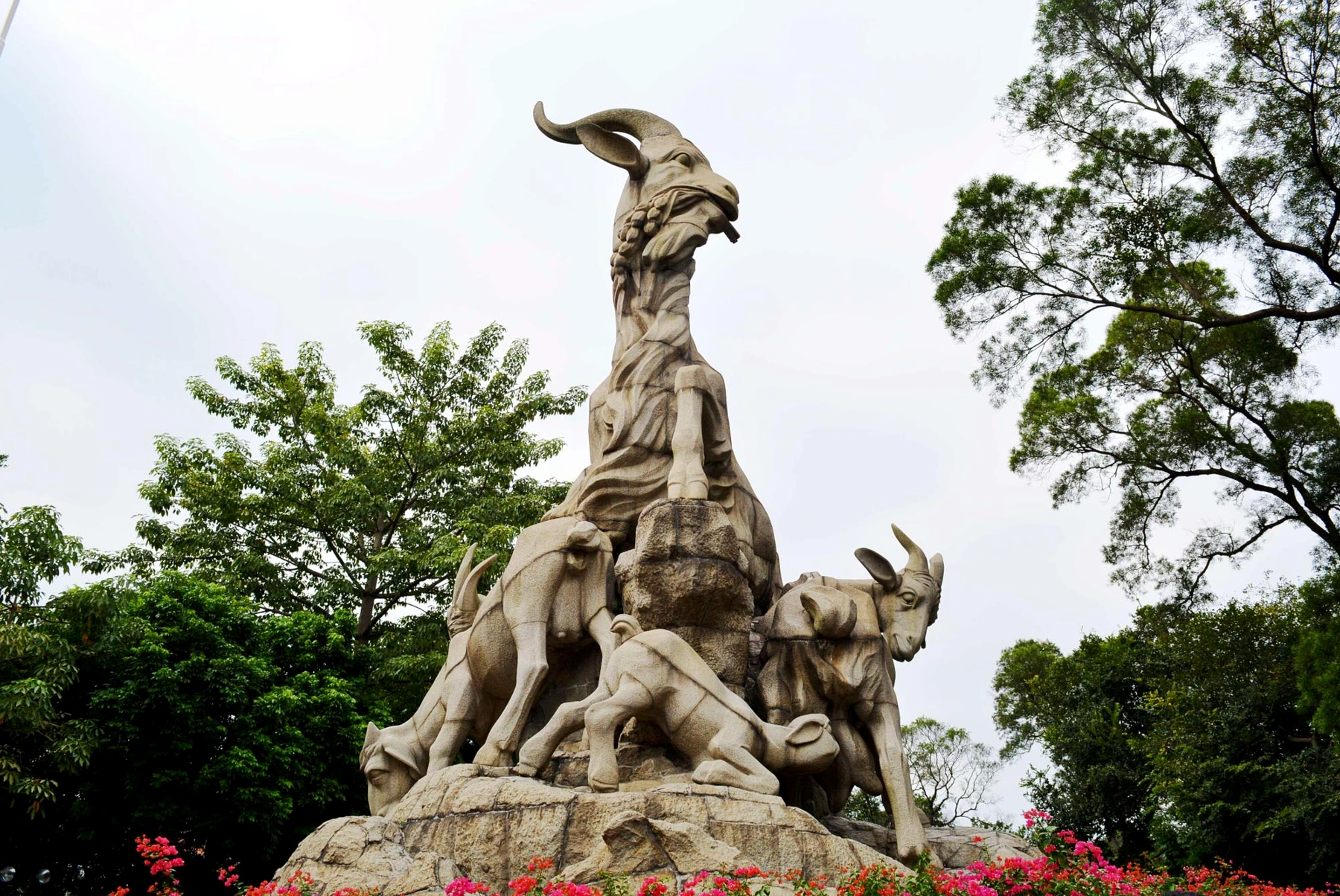
Under the administration of the People’s Republic of China, Sun Yat-sen’s aspiration to turn the hill into a people’s garden was fully realized when Yuexiu Park officially opened to welcome visitors in 1952. By 1957, Premier Zhou Enlai personally reviewed and approved the master planning scheme to make this place a model People’s Cultural Park. The symbolic soul of the entire City of Rams was fully elevated in 1959, when renowned sculptor Yin Xichang alongside two artisans Chen Bantong and Kong Jiuchuan completed the Five Rams Statue complex sculpted from over a hundred solid granite blocks, recreating the legend of five immortals bestowing grain seeds to banish famine. Since the historic milestone of completely abolishing entrance fees in 2005, the park has officially become an expansive green heritage site where a millennium of history seamlessly blends into the daily lives of local residents.
From the perspective of traditional Chinese feng shui and geography, the Yuexiu mountain range holds the position of the principal dragon vein anchoring the northern side of all Guangzhou. Bearing ancient names through various eras such as Yuewang Mountain or Guanyin Mountain, this undulating dragon-like hill range has served since ancient times as a sturdy screen shielding against northern cold drafts and gathering auspicious vital energy flowing down across the lower Pearl River delta. Not only acting as a spiritual sanctuary sheltering the City of Rams through numerous historical vicissitudes, this prime terrain also creates a rare mild microclimate, making it the source that nurtures the prosperity and abundance of the southern metropolis for millennia.
Spanning an expansive area of up to 860,000 square meters—equivalent to 86 hectares—Yuexiu Park proudly holds its position as the largest downtown public ecological space in Guangzhou city. Its topography is a breathtaking integration of nature, formed by seven rolling hills winding continuously and undulating amidst vast stretches of greenery. To achieve perfect balance according to the principles of yin-yang and geomancy, human hands across generations have skillfully crafted a system of three magnificent artificial lakes: Beixiu Lake, Nanxiu Lake, and Dongxiu Lake. The interweaving of gently sloping terrain and calm water surfaces not only enhances aesthetics but also acts as a natural air conditioner, alleviating the sweltering tropical heat and purifying the atmosphere for the entire core administrative and financial district of Yuexiu District.
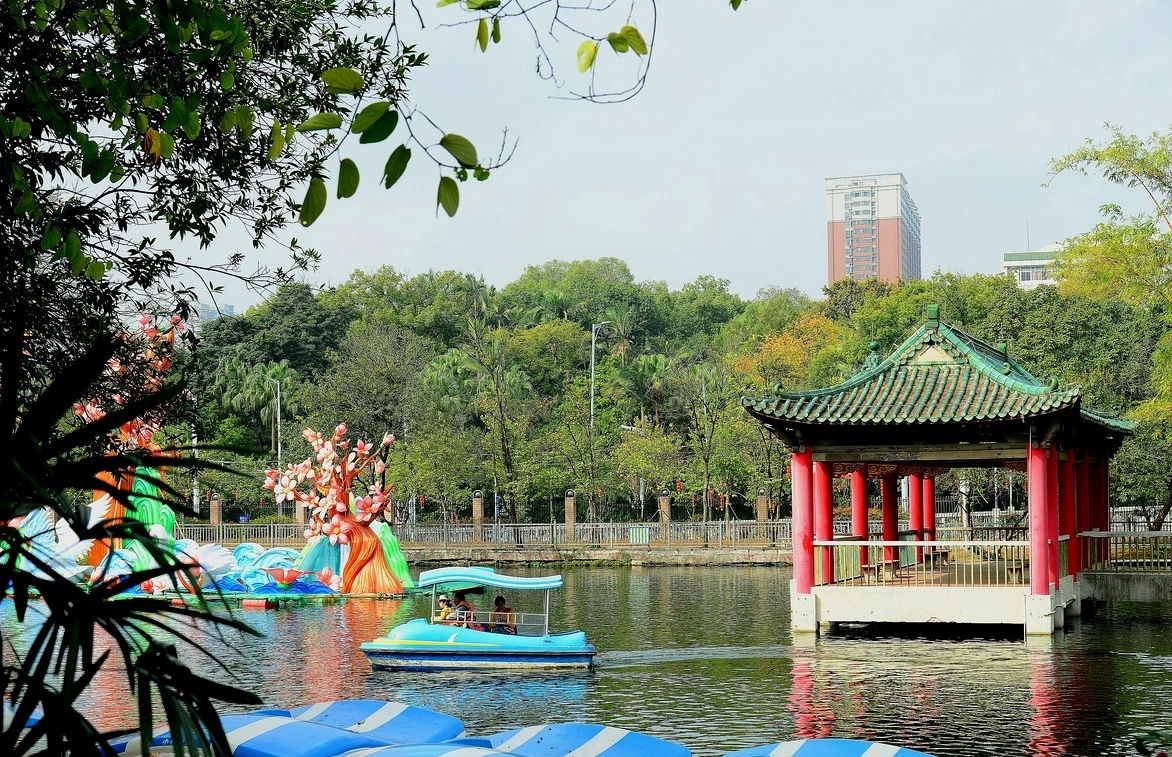
The mirror-like surface of the lake opens up a space of absolute tranquility, highlighted by an octagonal pavilion in classic Chinese style, distinguished by its elegant green tiles and proud red pillars standing right at the water’s edge. On the gently rippling blue waves, a bright green pedal boat carries travelers leisurely through the fresh air, leaving peaceful wakes behind. On the opposite shore, vibrant decorative landscapes mimic cherry blossom groves and rockeries, nestled under the shade of lush, ancient trees, while in the distance, the silhouettes of modern skyscrapers rise in the background, creating a poetic contrast between contemporary life and serene stillness.
The natural ecosystem of the park is characteristic of a humid subtropical monsoon forest, with dense, multi-layered vegetation that remains lush year-round. Wandering deep into the hillsides, visitors can easily encounter giant red-banyan trees and many century-old banyans with tangled aerial roots plunging deep into the earth. Along the somber red sandstone cliffs, the fascinating natural phenomenon of “walls embracing trees, trees embracing walls” comes to life as root systems weave and tighten around mossy stones and ancient ramparts, creating a primitive, ancient scene reminiscent of a secluded primeval forest in the heart of a metropolis.
It is this marvelous blend of hilly terrain, expansive lakes, and primeval greenery that has led the landmarks of Yuexiu Mountain to be consistently honored in the “Eight Sights of Yangcheng” throughout history, from the Yuan and Ming dynasties to the present day. Even as the flow of time constantly reshapes the surrounding cityscape, the feng shui structure and natural landscape here remain a priceless green lung, serving as the soul of the fertile Guangzhou region.
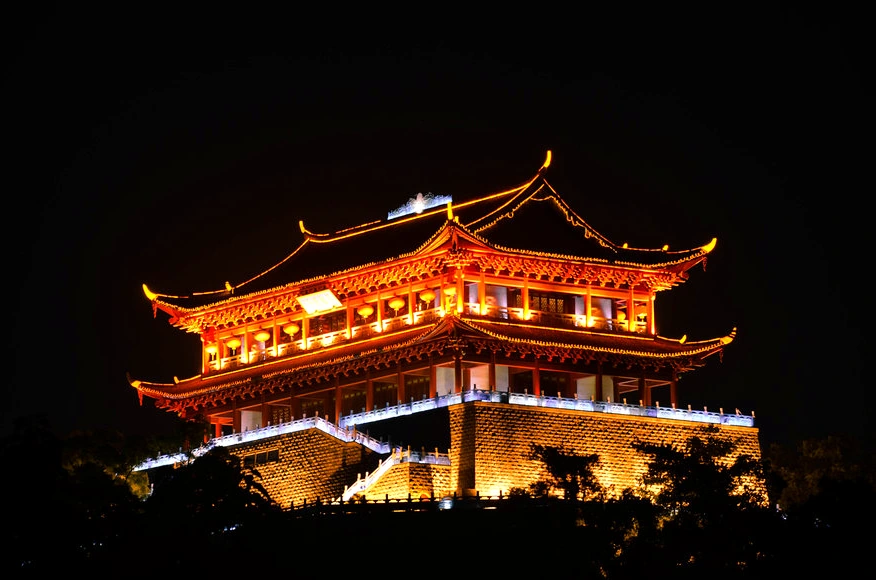
From the perspective of landscape organization and heritage planning, Yuexiu Park is not merely an urban green space but a defensive and spiritual architectural ensemble deeply imbued with Lingnan feng shui from the ancient and medieval periods. Standing impressively at the strategic throat of Yuexiu Mountain is the most magnificent and ancient structure: Zhenhai Tower, a five-story building standing 28 meters tall, 31 meters wide, and 16 meters deep. Built on a foundation of red sandstone characteristic of the southern soil, with a solid thickness of over 3 meters, the tower is overwhelming with its vibrant vermilion walls contrasting sharply with the long, emerald-green glazed tiles. The roof system of Zhenhai Tower strictly adheres to the “Chongtian Jiuji” style—a multi-tiered roof with nine levels of water drainage, a construction standard reserved exclusively for imperial palaces and temples. The symmetrical five-story structure not only served as an observation deck for the Pearl River waterways in the past but also conveys the philosophy of the Five Elements, corresponding to the five directions to suppress maritime energy and protect the peace of the southern region.
Right under the shade of the ancient trees near Zhenhai Tower, the ruins of the Ming Dynasty city wall wind like a stone ribbon, connecting the thousand-year history of Guangzhou. The original wall once reached a total length of 1,136 meters; today, the core conservation area preserves over 200 meters in its original state without crude restoration. The base of the wall is crafted from square-cut Lingnan red sandstone, while the upper body uses large gray fired bricks specially made during the Hongwu era of the Ming Dynasty under Emperor Zhu Yuanzhang. This is the only remaining Ming-era fortification in the heart of the modern city, reflecting the military mindset of utilizing rugged natural terrain to build steel-like defenses. The lifeblood of the complex is also connected by a historical axis consisting of 498 monolithic stone steps, leading pedestrians from the foot of the mountain through the ancient Ming gate arch directly to Guanyin Peak.
At the highest point of Guanyin Peak, the Sun Yat-sen Monument rises toward the sky like a giant brush, reaching a height of 37 meters. The entire structure is built entirely from gray granite blocks quarried from the local mountains, blending Western memorial styles with traditional East Asian brush-tower aesthetics. The front of the monument features a grand stele inscribed with the full text of the “Testament of the Premier” in gilded letters, drafted by the Central Executive Committee of the Kuomintang; every stroke exudes the indomitable spirit of a turbulent historical era. Hidden deep within the solid stone tower is a spiral staircase system consisting of exactly 207 monolithic stone steps, leading directly to the observation deck at the top, where visitors can enjoy a panoramic view of the magnificent Yuexiu mountains blending with the vibrant life of the city below.
The park’s sculptural art reaches its expressive peak at Mugu Hill with the Five Rams Statue, an eternal symbol associated with the name “Yangcheng” (City of Rams) of this land. This massive sculpture stands 11 meters tall with a volume of approximately 53 cubic meters, perfectly assembled from 130 natural gray granite slabs using mortise-and-tenon techniques so precise that the joints are almost invisible. The composition vividly depicts the five divine rams: the lead ram stands proudly on a rugged rock, its mouth holding a stalk of grain, symbolizing the hope for “abundant harvests” and eternal prosperity, while four smaller rams gather at its feet in lively poses of grooming, nursing, and watching. Through the ingenious fusion of Western realistic anatomical language and the soft, symbolic techniques of Lingnan painting, this complex has transformed a corner of the tropical forest into an open-air sculpture museum full of philosophical depth and humanistic value.
As twilight fades behind the dense hills of Yuexiu, the tranquil atmosphere of this urban primeval forest quickly gives way to a mesmerizing visual feast. Modern artistic lighting systems have been meticulously calculated to fully honor the ancient heritage values. On the high hillside, the majestic Zhenhai Tower, with its five stories of traditional architecture, glows in a somber crimson, standing proudly against the dark sky and evoking the pioneering spirit of the early Ming Dynasty. Not far away, the Five Rams Statue complex, carved from solid granite, is outlined with warm golden light, clearly defining the powerful muscles of the five legendary rams, creating the sensation that deities have descended to protect the prosperity of the City of Flowers.
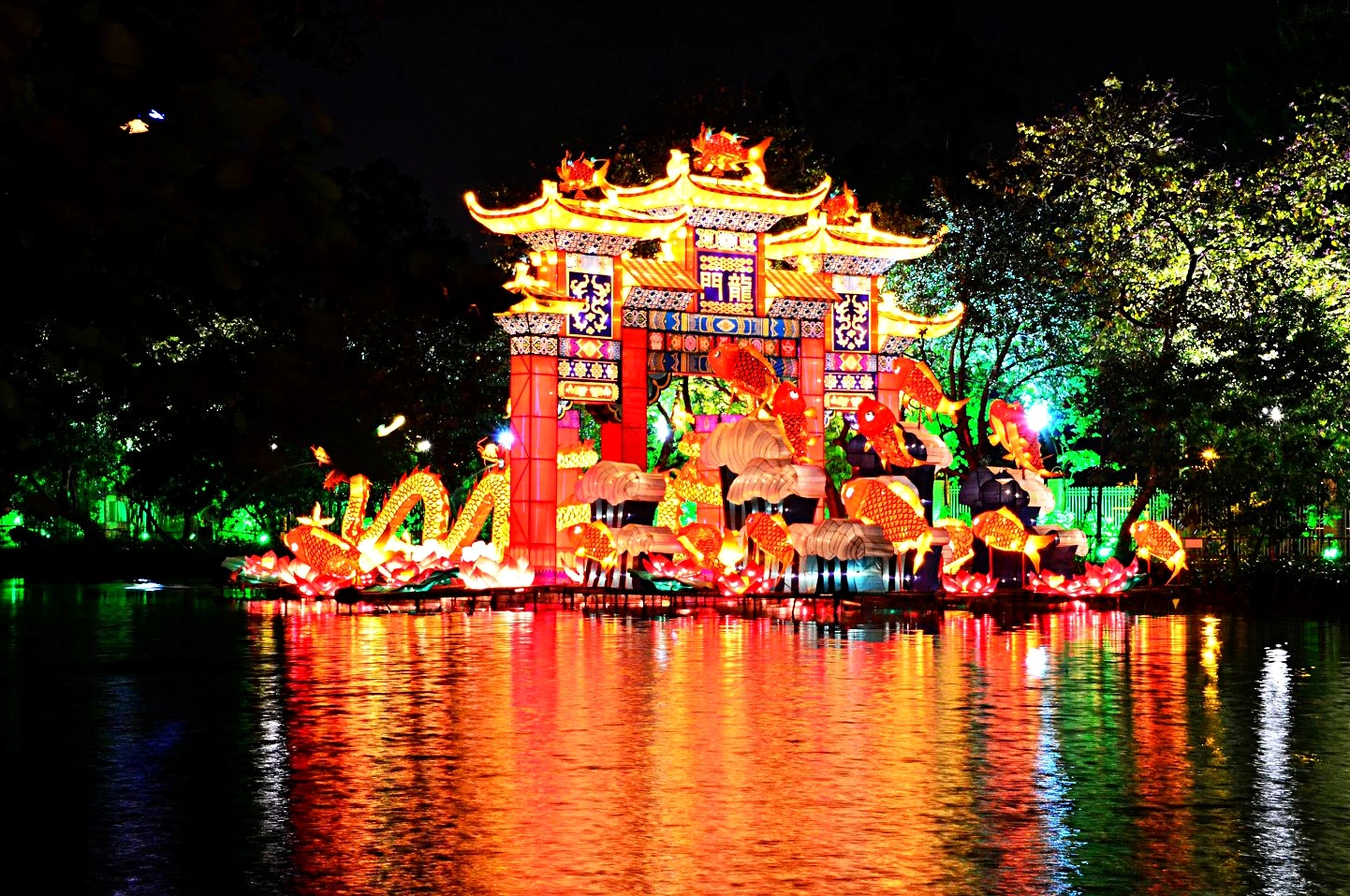
When the traditional lantern festival season arrives, the park transforms into a magnificent scene reminiscent of a grand spectacle. At the center, a majestic gateway glows with the characteristic curved rooflines of Lingnan culture, radiating a splendid golden light. Floating on the calm lake surface in front of the gate are lantern clusters shaped like winding golden dragons, carps leaping over the dragon gate, and giant lotus flowers blooming in deep pink, casting shimmering, magical reflections on the water. All around, ancient trees are illuminated with bands of turquoise and warm yellow light, blending together to create a vivid and enchanting nocturnal light art masterpiece.
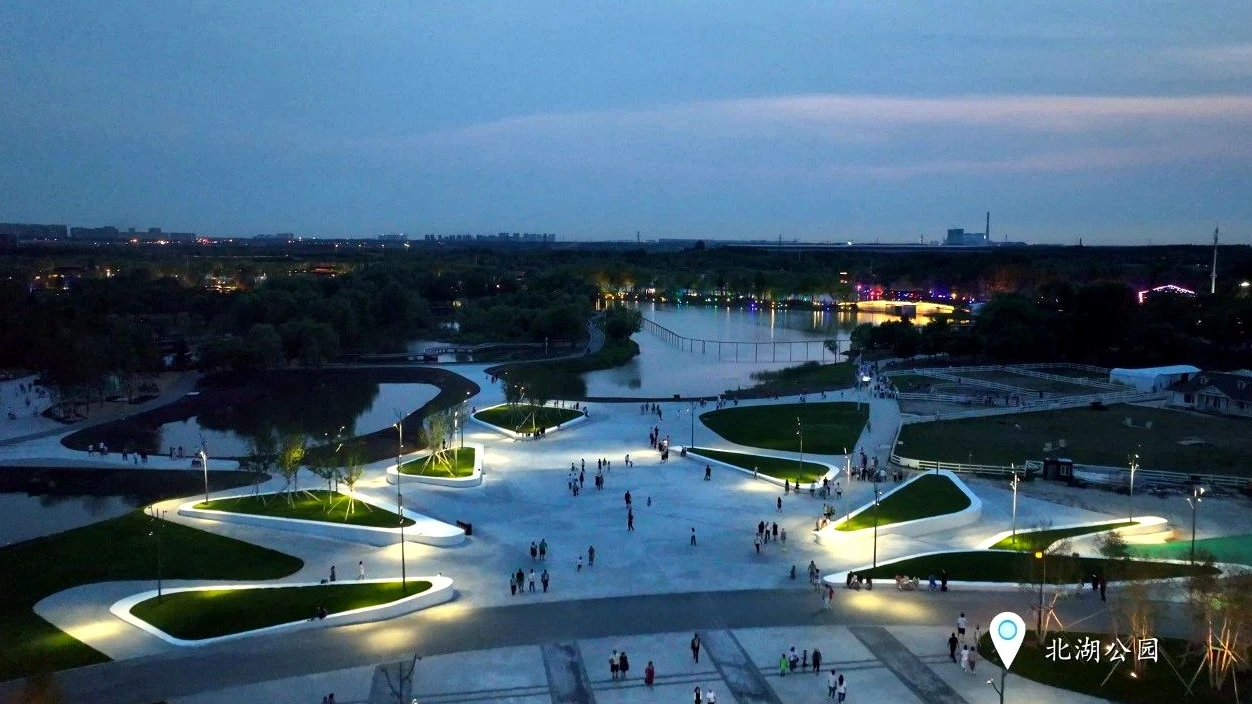
Moving away from the central architectural axis, the daily nocturnal rhythm of the locals reveals a poetic space full of life by the artificial waters. Beixiu and Dongxiu Lakes become giant mirrors capturing the vibrant colored lights reflected from the skyscrapers of Yuexiu District and the bustling Huanshi Zhong Road. Visitors can leisurely row boats across the calm lake, listening to the wind whispering through the weeping willows along the shore and watching the shimmering reflection of urban life. Along the winding stone bridges and granite embankments, folk culture clubs often gather spontaneously; the shrill sound of the erhu blending with traditional Cantonese opera creates a deep, nostalgic atmosphere in the heart of the bustling city.
More than just a peaceful green space, Yuexiu Park holds a prominent position on the North-South cultural axis of Guangzhou. Leaving the shaded canopy of the grounds, the landscape transitions naturally through People’s Park and quickly merges into the sea of brilliant lights of the Beijing Road pedestrian street. Here, a thousand-year-old archaeological path is preserved intact under transparent glass, interspersed with night food courts rich in Lingnan flavors. From this bustling area, it takes only a few minutes of walking to reach the Tianzi Pier on the breezy Pearl River, where you can take in the panoramic view of the shimmering urban skyline of the Nanyue land at night.
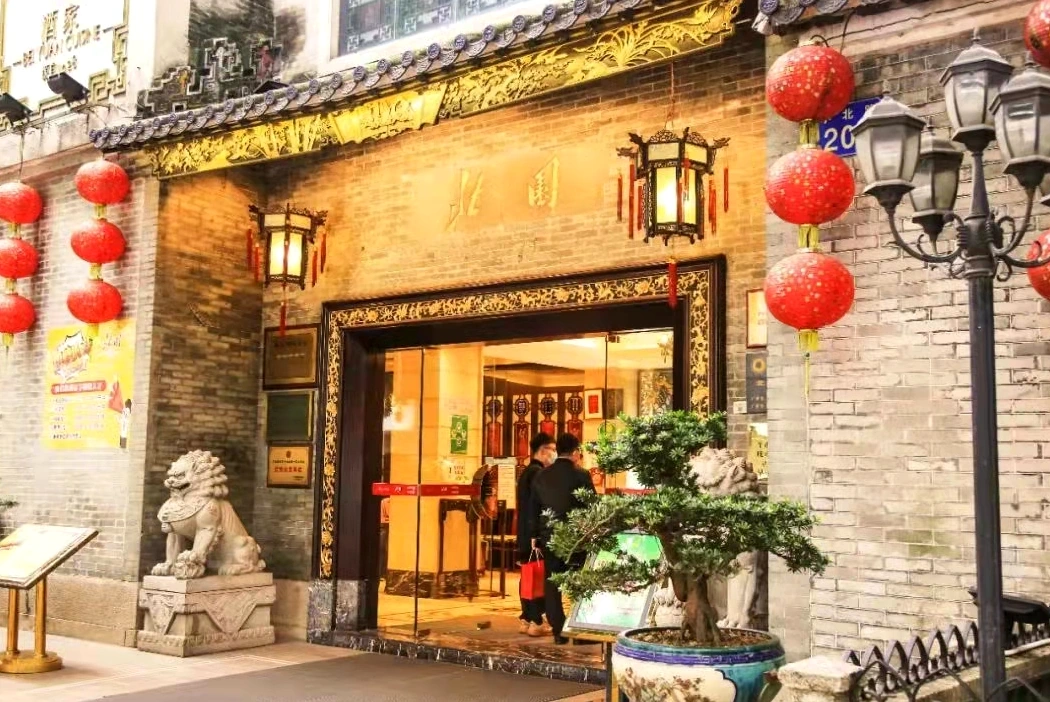
The ancients once summarized the essence of human life through the famous saying “Food is in Guangzhou,” and a trip to Yuexiu Hill would hardly be complete without a journey to awaken your taste buds among the legendary garden restaurants. Nestled peacefully at 202 Xiaobei Road, just a two-hundred-meter stroll from the park’s Northeast Gate, Beiyuan Restaurant stands like a living museum of Lingnan culinary art. Along with Nanyuan and Panxi, it forms the trio of the most illustrious “Great Garden Restaurants” in the Canton region, boasting an ancient campus with winding pavilions, mossy rockeries, stone bridges over koi-filled ponds, and exquisite Manchu-style stained glass windows that reflect the brilliant sunlight. This culinary space is not merely a place to enjoy flavors, but also a sanctuary preserving the elegant character of scholars and poets from days of yore.
Graceing the banquet tables of Beiyuan Restaurant are dishes that have become part of local culinary legend, most notably the renowned Shanshui Tofu. Legend has it that this tofu originated from filtering the sweet spring waters flowing from the underground veins of Yuexiu Mountain, simmered with selected soybeans to create a texture so silky it seems to dissolve the moment it touches the tip of the tongue, leaving behind the pristine, refreshing aftertaste of nature. Meanwhile, the Beiyuan Imperial Shrimp Dumplings showcase the pinnacle of Hong Kong and Cantonese dimsum craftsmanship, featuring exactly thirteen textbook semi-circular pleats on a crystal-clear dough wrapper, perfectly enveloping fresh, snappy tiger prawns combined with a hint of rich pork fat. Gourmet food lovers never miss the Red Rice Cheung Fun—red rice rolls wrapped around a golden, crispy fried net and fresh shrimp filling, served with a savory peanut soy sauce that creates a delightfully contrasting and crave-worthy texture.
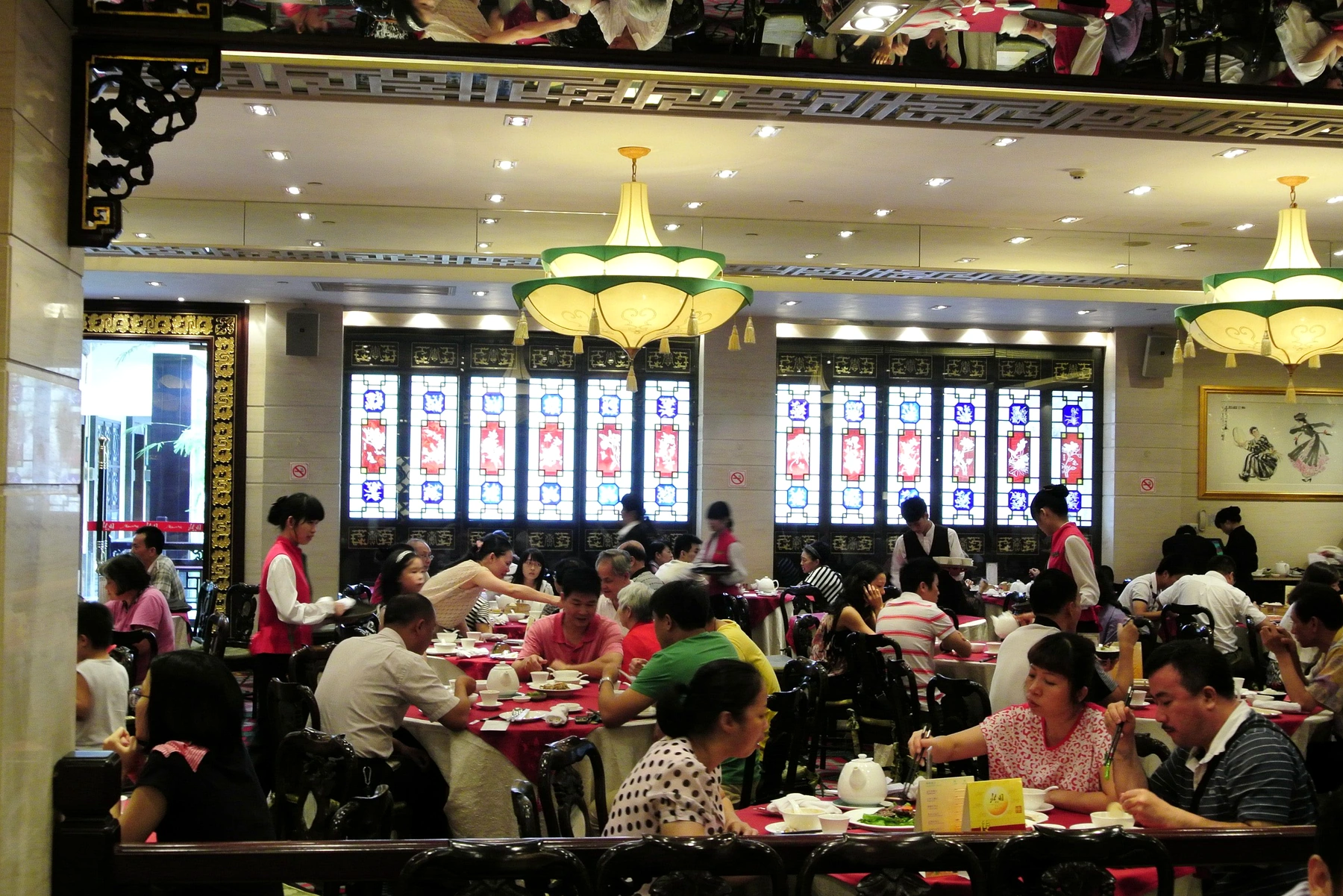
For those seeking a dining experience that blends harmoniously with serene nature, Luhuxiang Yuan, standing proudly right inside the park by the waters of Dongxiu Lake, is an irreplaceable rendezvous. This traditional tea pavilion is nestled beneath lush ancient trees, opening up expansive views of the rippling blue lake and deep green forests. The culture of “tan cha”—leisurely tea-tasting and sipping “yi zhong liang jian” (one pot of tea, two baskets of dimsum)—reaches absolute tranquility here. Amidst the pure, rising steam of Pu’er or Tie Guan Yin tea, the clattering of bamboo steamers holding salted egg yolk lava buns and crab roe siu mai, combined with the sound of the wind rustling through leaves, delivers a rare sense of peace in the heart of the bustling metropolis.
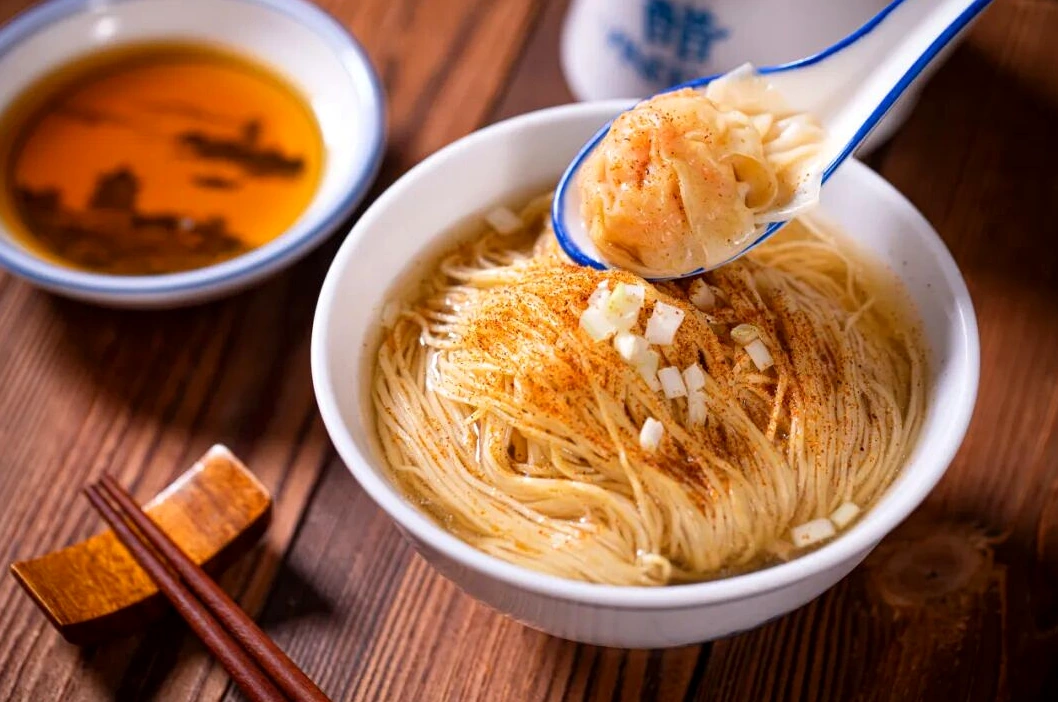
Leaving the regal garden space and stepping through the West Gate toward Jiefang North Road, a world of street food unfolds with rustic yet flavorful local recipes. The most captivating highlight is Bamboo-Pressed Noodles (Zhu Sheng Mian), a traditional noodle variety meticulously kneaded by artisans who sit on a large bamboo pole, using their whole body weight for hours to press wheat flour and fresh duck eggs together without adding a single drop of water. These legendary, golden, chewy noodles are dropped into a rich broth simmered from pork marrow bones, aromatic grilled flounder, and sweet dried shrimp. The culinary feast concludes perfectly with a bowl of Shunde Double-Skin Milk featuring two rich, silky-smooth layers of buffalo milk skin, or a bowl of black Guilinggao (turtle jelly) infused with sarsaparilla and traditional herbs, offering a pleasantly bitter, refreshing taste to cool down and revitalize the body after a long day of exploration.
Exploring the sprawling green lungs of Yangcheng (Guangzhou) is best completed when travelers grasp practical details regarding operating hours and the public transit network. The entire park is open completely free of charge from 6:00 AM to 10:00 PM daily, providing convenient conditions for visitors to stroll freely. However, if you wish to enter Zhenhai Tower to admire the artifacts of the Guangzhou Museum, visitors should note the symbolic admission fee of ten yuan per person, and that this historical site is regularly closed for maintenance on Mondays. The most convenient access method is taking Metro Line 2, stopping precisely at Yuexiu Park Station (越秀公园站) and exiting through Exit B1 to head straight to the magnificent main gate exquisitely built above the Jiefang North Road axis. For travelers arriving via high-speed train at Guangzhou South Station, the journey takes only about thirty-five minutes across sixteen stops without needing any transfers.
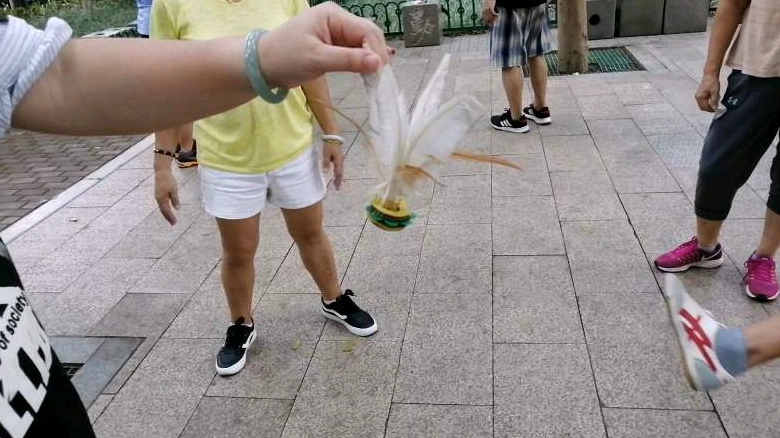
The rhythm of life and character of this historical hill transform wonderfully throughout the day, requiring travelers to carefully choose their departure times. The period from 6:30 AM to 8:30 AM is the ideal time to absorb the soul of local Lingnan daily life, as hundreds of local seniors gather beneath ancient banyan trees to practice Tai Chi, play shuttlecock, and hang singing birdcages that chirp melodiously in the morning mist. Conversely, if the goal of the trip is to capture breathtaking photography, the golden hour from 3:30 PM to 5:30 PM is prime time. At that moment, the slanting afternoon sunlight filters through the leaves, casting a magnificent amber hue upon the five tiers of blue glazed tile roofs of Zhenhai Tower and highlighting the heroic, muscular contours of the Five Rams Stone Statue.
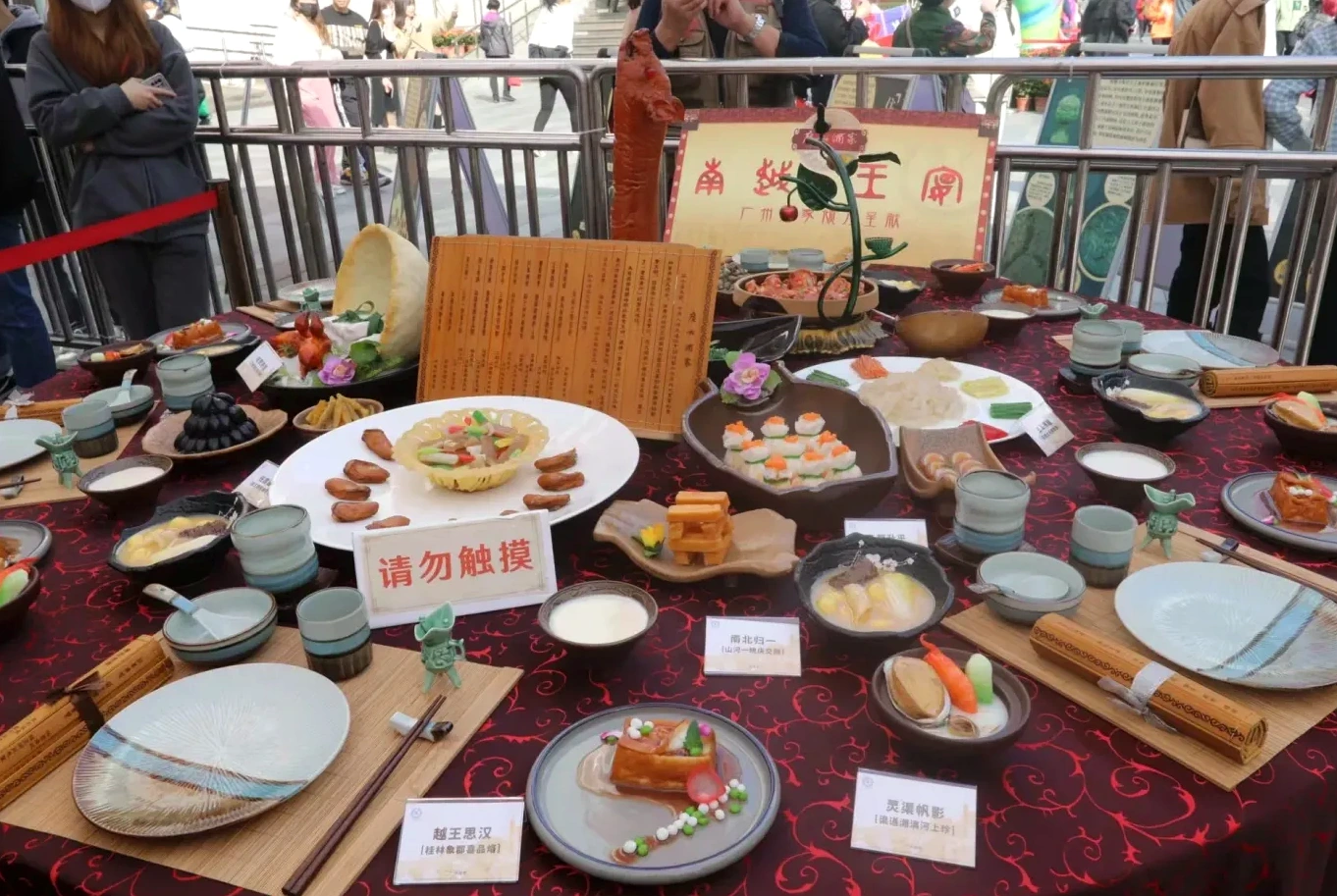
Not only immersed in natural scenery, visitors to the cultural exhibition spaces near the Yuexiu Park premises also have the opportunity to admire traditional grand banquets simulating the pinnacle of Cantonese culinary art. On a solemn long table covered with red brocade embroidered with classic patterns, dozens of exquisite porcelain bowls, plates, and tureens are elaborately displayed, vividly recreating famous delicacies from the Ming and Qing dynasties with detailed explanatory Chinese character nameplates. Each jade cup and red chopstick is arranged with precision under the admiring gaze of guests behind the barrier, opening up a profound picture of culinary heritage.
A crucial, practical tip for those setting foot in the southern capital for the first time is to be extremely wary of cheap tour traps or zero-dollar tours in disguise. Many cheap commercial group tours often just drop off guests to rush through the Five Rams Statue area for thirty to forty-five minutes to snap a quick souvenir photo, then urge travelers onto buses to move to enclosed shopping spots such as the Baoshou Tang traditional medicine pharmacy, jade centers, or latex mattress workshops with hidden commissions of up to forty to sixty percent. To fully appreciate the layers of historical knowledge that this millennial land preserves, travelers should allocate two and a half to three and a half hours for a self-guided stroll or seek purely sightseeing itineraries that say no to designated shopping stops.
Essential items for a leisurely stroll among the gentle hills of Yuexiu should prioritize soft-soled shoes with good grip, lightweight and sweat-absorbent clothing, and pre-installed e-passports and QR code payment applications to easily order herbal tea or buy museum tickets. For travelers who wish to approach this land in a relaxing, complete manner and completely avoid all commercial hassles, choosing to accompany an in-depth all-inclusive tour package will be the optimal solution to enjoy the cultural depth without losing peaceful moments of contemplation.