Originating from the pristine underground springs of Weng Mountain during the Jin, Yuan, and Ming dynasties—which once supplied jade streams to the entire imperial capital—the northwestern region of Beijing was long regarded as a geomantically auspicious dragon vein. Entering the 15th year of the Qianlong reign (1750), amidst the dazzling peak of the High Qing era, Emperor Qianlong personally issued an imperial decree to construct a royal garden named Qingyi Garden (Garden of Rippling Ripples) as a birthday gift for the sixtieth diamond jubilee of Empress Dowager Chongqing. The most talented master craftsmen were summoned from across the Jiangnan water towns to create an unprecedented artificial wonder. The entire Weng Mountain was stripped of rocks, built up with earth, and renamed Wanshou Mountain (Longevity Mountain) to symbolize the empress dowager’s longevity; simultaneously, the ancient Kunming Lake was expanded and dredged deeply, named Kunming Lake after Emperor Wu of Han’s historical naval training grounds. The massive project consumed nearly 4.48 million taels of pure silver over 15 continuous years, officially opening in 1764 and becoming the standard benchmark for Eastern imperial gardens.
Yet, those glorious times could not escape the storms of history. In October 1860, the flames of the Second Opium War raged fiercely; Anglo-French allied forces under the command of Lord Elgin and General Montauban broke in, looted countless treasures, and burned the illustrious Three Mountains and Five Gardens complex to the ground. The raging fire burned for days and nights, turning all palaces and pavilions made of precious wood into ashes, leaving behind only a few sturdy brick, stone, and bronze structures like the Tower of Buddhist Incense (Baoyunge) or the Sea of Wisdom (Zhihuihai) standing alone amidst the desolate ruins. It was nearly three decades later, in the 14th year of the Guangxu reign (1888), that Empress Dowager Cixi decided to resurrect this garden as a retreat to rest behind the ruling curtain. She forced the imperial court and Prince Chun (Yixuan) to divert a large portion of the budget from the Beiyang Fleet modernization fund to restore the garden. Under the exceptional talent of architect Lei Shichang from the illustrious Yangshi Lei family, the structure was reborn and officially renamed Yiheyuan (Summer Palace), meaning the cultivation of harmony and peace.
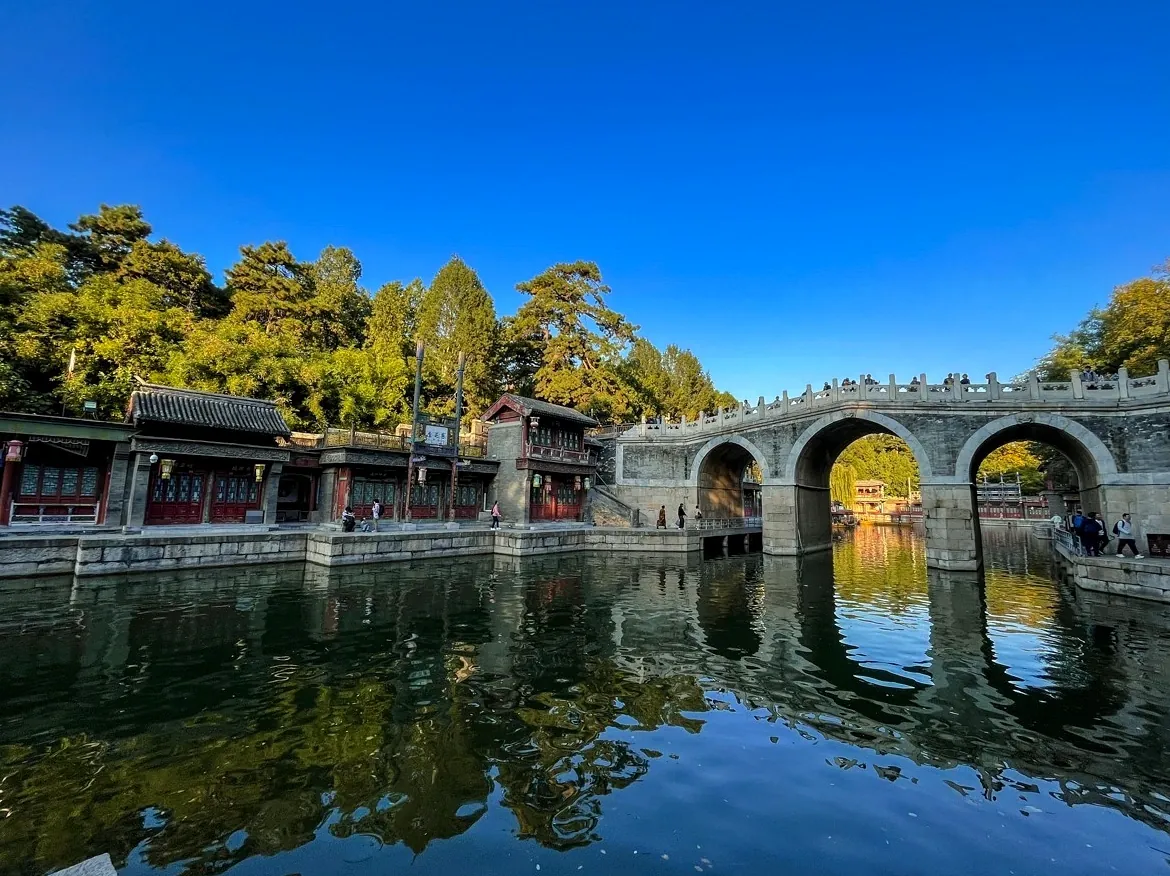
Through the historical vicissitudes of time, the landscape and waters here still retain the serene and solemn character of an imperial resort. Standing out amidst the expansive space is an ancient stone bridge with graceful arched spans stretching across the clear, calm water, resembling a soft silk ribbon reflecting the clouds and sky. Adjacent to the bridge spans, traditional imperial architecture presents itself solemnly with upturned glazed tile roofs, walls, and red-lacquered wooden doors imbued with the imprints of time. The entire ancient architectural complex nestles gracefully beside rows of lush, cool green trees beneath a deep blue sky, creating a poetic and magnificent natural scenery that recalls the golden age of Chinese imperial landscape architecture.
Historical tragedy repeated itself in 1900 when the Eight-Nation Alliance occupied Beijing, and the Summer Palace suffered heavy devastation once more. Only after the imperial court signed the Boxer Protocol and the royal family returned from Xi’an did Empress Dowager Cixi empty the treasury to carry out the final large-scale renovation from 1902 to 1903 to restore its original appearance before the Qing dynasty officially collapsed. In 1924, after Emperor Puyi left the Forbidden City, the forbidden palace gates officially closed the feudal era and opened as a public park serving the masses. In 1998, the United Nations Educational, Scientific and Cultural Organization (UNESCO) officially inscribed the Summer Palace onto the World Heritage List under criteria (i), (ii), and (iii), honoring this masterpiece as the pinnacle symbol of Oriental landscape garden design, where human craftsmanship and natural magnificence blend into a flawless unity.
Located in Haidian District, about fifteen kilometers northwest of the center of the Forbidden City, the Summer Palace sits at a strategic bottleneck within the famous “Three Mountains and Five Gardens” scenic area of the prosperous Qing dynasty. Along with Old Summer Palace (Yuanmingyuan), Changchun Garden, Jingming Garden, and Jingyi Garden, this imperial garden was not merely a luxurious secondary palace to escape the stuffiness of the imperial city, but the ultimate crystallization of feng shui philosophy and Oriental landscape planning techniques. The low-lying Haidian land of the past was a convergence of countless underground springs and natural lakes, recognized by imperial architectural masters as an exceptionally rare sacred land gathering spiritual energy amidst the vast plains of the North.
The overall scale of the Summer Palace spans an area of approximately three hundred hectares, equivalent to nearly three square kilometers. A rare and unique feature for a northern imperial garden is that water surfaces account for up to three-quarters of the total area, meaning about 2.2 square kilometers belong to the vast Kunming Lake basin. This golden ratio not only creates a picturesque landscape of mountains and waters but also forms a mild microclimate completely different from the dry, hot summers of downtown Beijing. The cool breeze rising from the lake, sheltered by weeping willows and mountain shadows, turns this place into an ideal refreshing oasis for emperors to retreat for governance and recuperation.
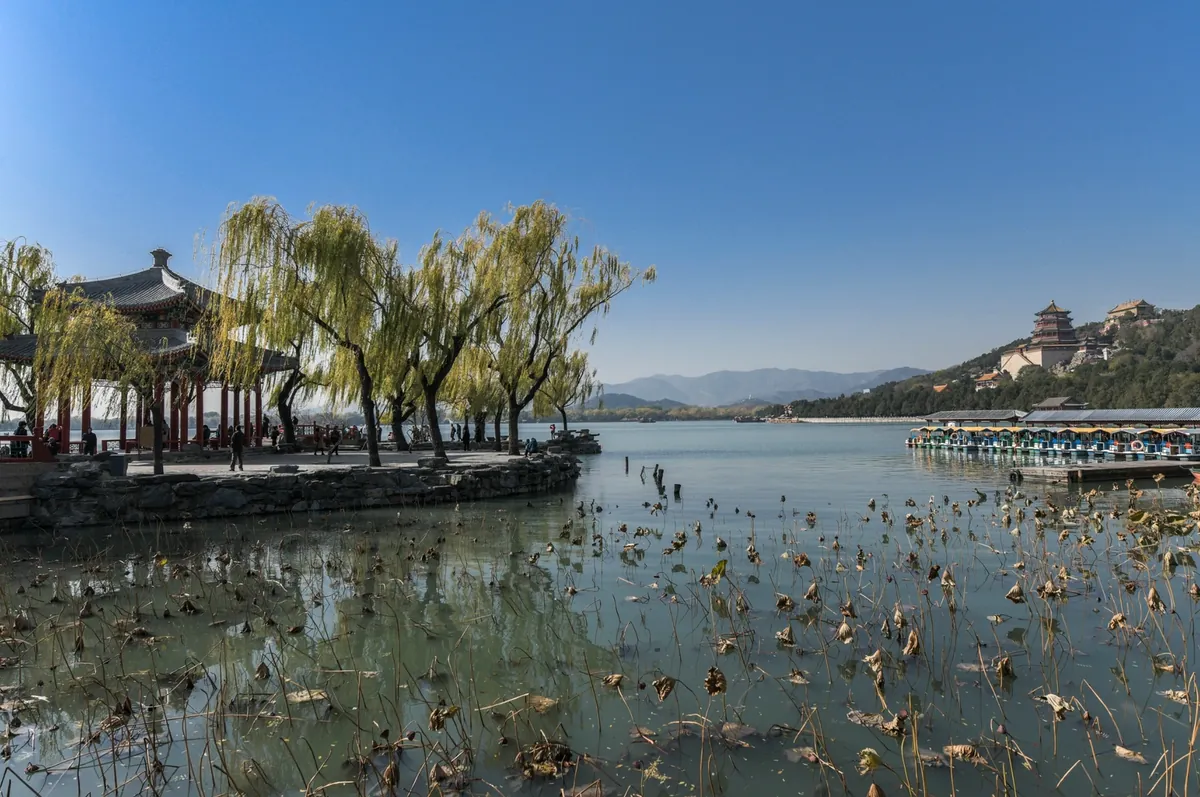
In terms of imperial feng shui, the Summer Palace operates along the classic “backing the mountains and embracing the water” axis, creating a flawless equilibrium between static and dynamic, yin and yang. The majestic Longevity Hill serves as the “mountain pillow”—a solid, protective backing to the north—while the expansive Kunming Lake stretches out to the south as the “bright hall gathering water,” where the vital energy of heaven and earth accumulates and thrives. Even more astonishing is the feat of artificial topography: the entire massive volume of earth and rock excavated during the deepening of Kunming Lake was transported and deposited directly onto Longevity Hill. Human ingenuity intervened in nature masterfully, turning barren mounds into a magnificent feng shui mountain that acts as a solemn foundation for the imperial grounds.
The pinnacle of classical Chinese garden artistry here is found in the breathtaking technique of “borrowed scenery” (tá cảnh). Rather than enclosing themselves behind rigid fortress walls, the architects opened up vistas to the vast peripheral landscape. Standing by the shores of Kunming Lake, visitors are astonished to see the rolling peaks of the Western Hills and the proud silhouette of the Jade Peak Pagoda atop Yuquan Mountain—tens of miles away—appearing as if they are right before their eyes. By borrowing the lush greenery and pristine waters of the greater natural world as a majestic screen framing the lake, the Summer Palace completely blurs the boundary between the man-made and the natural, capturing the entire universe within a single imperial gaze.
As dusk falls and darkness gradually envelops the capital, the Summer Palace dons a mystical, regal beauty alongside Kunming Lake. Reigning majestically on the slopes of Longevity Hill, the Tower of Buddhist Incense glows brightly like a jade pagoda against the night sky, illuminating the multi-tiered architectural axis running along the stone terraces. At the foot of the tower, the corridors and pavilions along the shore cast thousands of warm golden lights onto the tranquil surface of the water. Interspersed across the gentle ripples are magnificent imperial dragon boats, decorated with lights and flowers, gliding softly through the night to create a stunning nocturnal scene that brings to life the romantic splendor of a prosperous golden age.
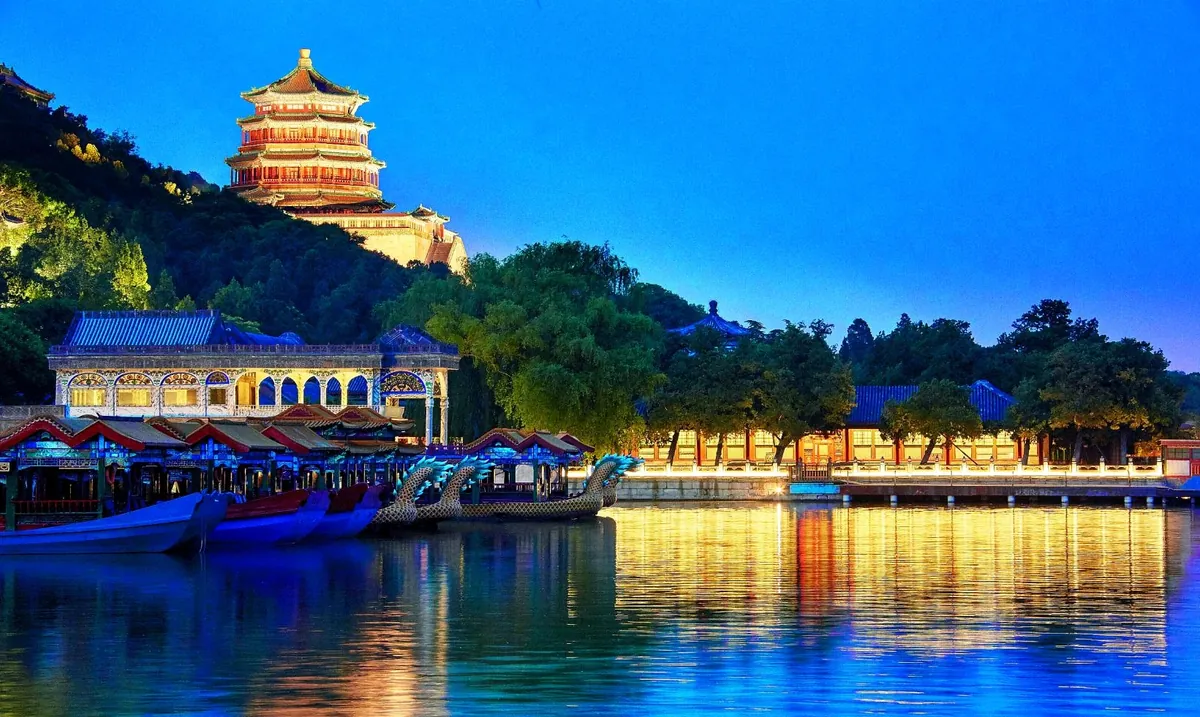
The organic integration of natural terrain, feng shui principles, and landscape architecture has transformed the Summer Palace into an immortal model of classical civilization. Every stone bridge, lakeshore willow, and embankment slope was calculated with precision, serving both to regulate the water systems of the capital’s periphery and to fulfill the empire’s aspiration for eternal prosperity. This space is a hymn to the philosophy of the unity of man and nature, where human hands achieved absolute harmony with the natural world, creating a landscape masterpiece that stands firmly amidst the shifting currents of history.
The entire layout of the Summer Palace is planned around the feng shui philosophy of “backing mountains and facing water,” clearly demarcated into two major zones: the towering Longevity Hill and the expansive Kunming Lake. The central focal point of the space is the symmetrical architectural axis running straight up the mountainside, beginning at the Hall of Dispelling Clouds with its brilliant yellow glazed tiles—where Empress Dowager Cixi once celebrated the most lavish birthday ceremonies of the Qing Dynasty. Rising further up is the Tower of Buddhist Incense, the visual heart of the imperial garden featuring an octagonal, three-story, four-roof structure standing 41 meters tall atop a 21-meter granite terrace, where a solemn bronze statue of the Thousand-Hand, Thousand-Eye Guanyin from the Ming Dynasty is enshrined amidst swirling incense. Reigning at the highest point atop Longevity Hill is the Sea of Wisdom (Zhihuihai), a Hall Without Beams built entirely of fire-resistant bricks and granite without any wooden support beams, its exterior surface embedded with over a thousand brilliant yellow and turquoise glazed ceramic Buddha statues, standing resiliently through the fierce major fire of 1860.
Following the northern shoreline is the Long Corridor, a masterpiece of a winding veranda recognized by the Guinness World Records as the longest in the world. With an exact length of 728 meters comprising 273 sections connected by 548 pillars, the structure resembles a soft silk ribbon connecting the lakeside palaces to the steps leading up the mountain. Throughout the journey, four quadrilateral pavilions named Liu Jia, Ji Lan, Qiu Shui, and Qing Yao are artfully arranged to represent the transition of the four seasons: spring, summer, autumn, and winter. Decorative art reaches its peak as the crossbeams preserve over 14,000 hand-painted color artworks depicting the lush landscapes of Jiangnan alongside classic tales excerpted from Romance of the Three Kingdoms, Journey to the West, Dream of the Red Chamber, and Investiture of the Gods.
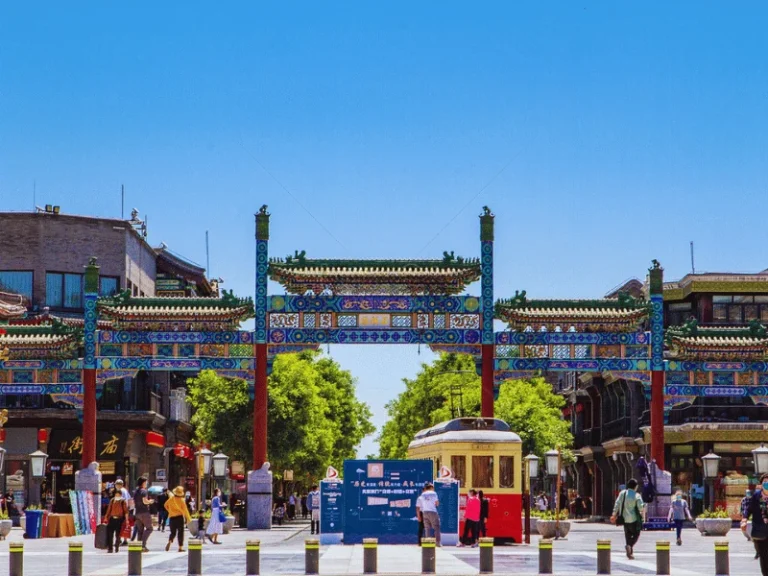
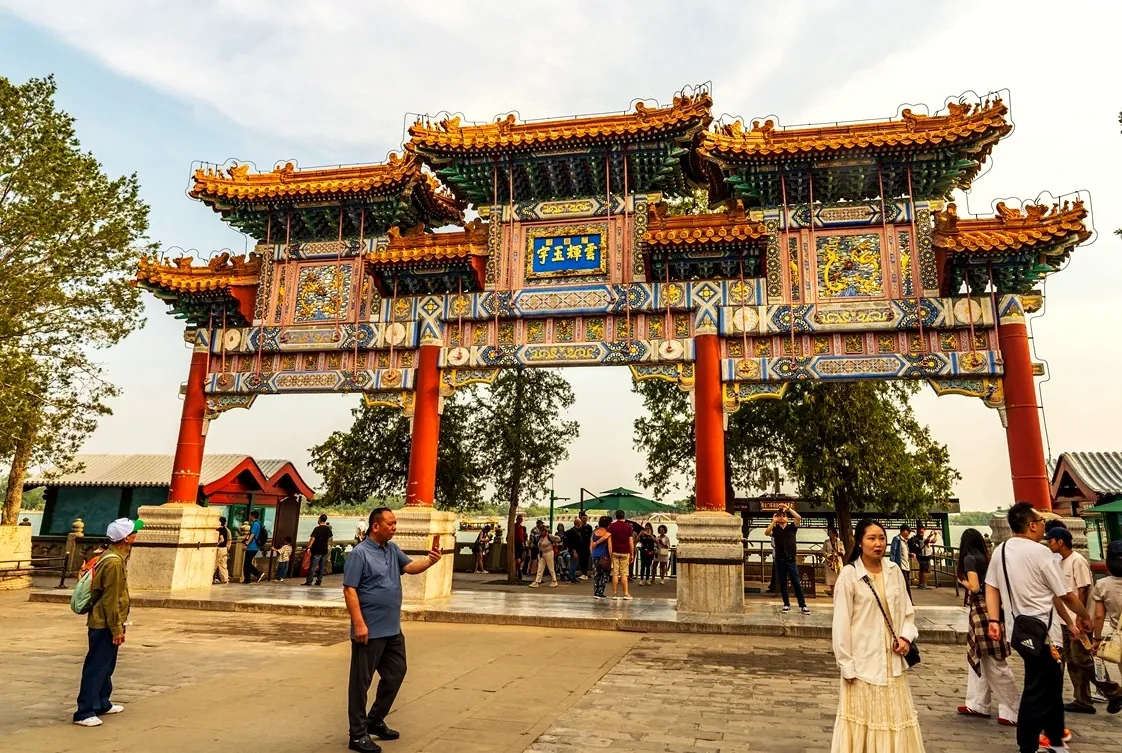
Present along the pathways connecting the scenic axes is a majestic traditional paifang (memorial gateway), an exemplary symbol of northern imperial carpentry and fine arts. The structure stands out with its multi-tiered, gracefully curved tiled roof system, harmoniously combined with vibrant patches of crimson, gold, and blue contrasting sharply on every intricately carved dougong bracket detail. Right in the center of the gate is a deep blue plaque inscribed with ancient Chinese characters, drawing a steady stream of visitors walking beneath the cool, leafy shade, opening up a panoramic view overlooking the calm waters of Kunming Lake just beyond.
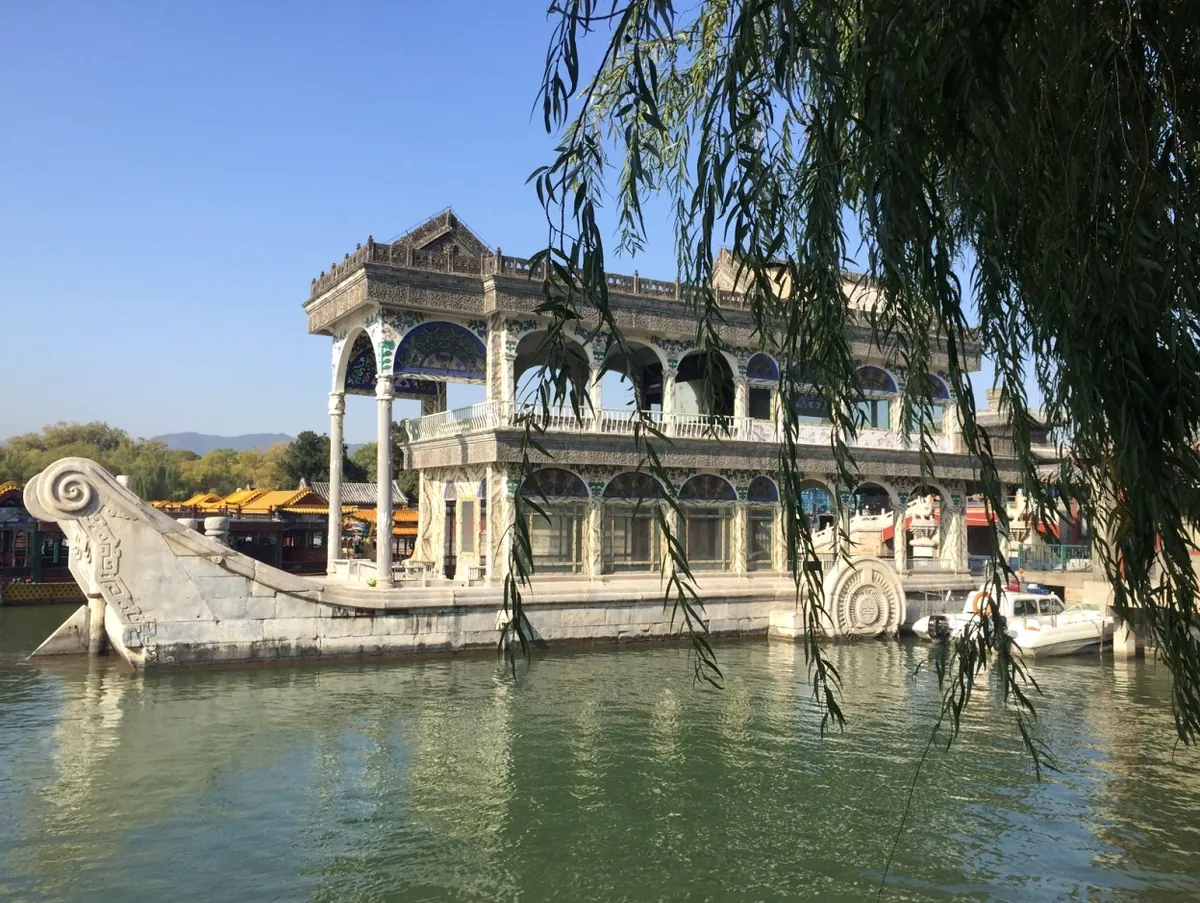
The water systems and waterfront structures of the Summer Palace also conceal profound metaphors of power and cultural nostalgia. Quietly nestled in the northwest corner is the Marble Boat (Qingyan Fang), a 36-meter-long stone boat carved from a single block of white marble, with its upper structure built of wood painted in faux-granite European style. It embodies the political aspiration for “clear rivers and calm seas” as well as the philosophical implication that while water can both float and overturn a boat, only a sturdy stone vessel can safeguard an eternal dynasty. Stretching across the azure lake to South Lake Island is the Seventeen-Arc Bridge, a 150-meter-long and 8-meter-wide stone arched bridge featuring balustrades carved with over 500 uniquely expressed stone lions. Venturing into the back-hill water channel, Suzhou Street opens up a vibrant waterfront marketplace scene, faithfully recreating the bustling commerce of the region around Suzhou and Hangzhou to alleviate the homesickness of the emperors and concubines.
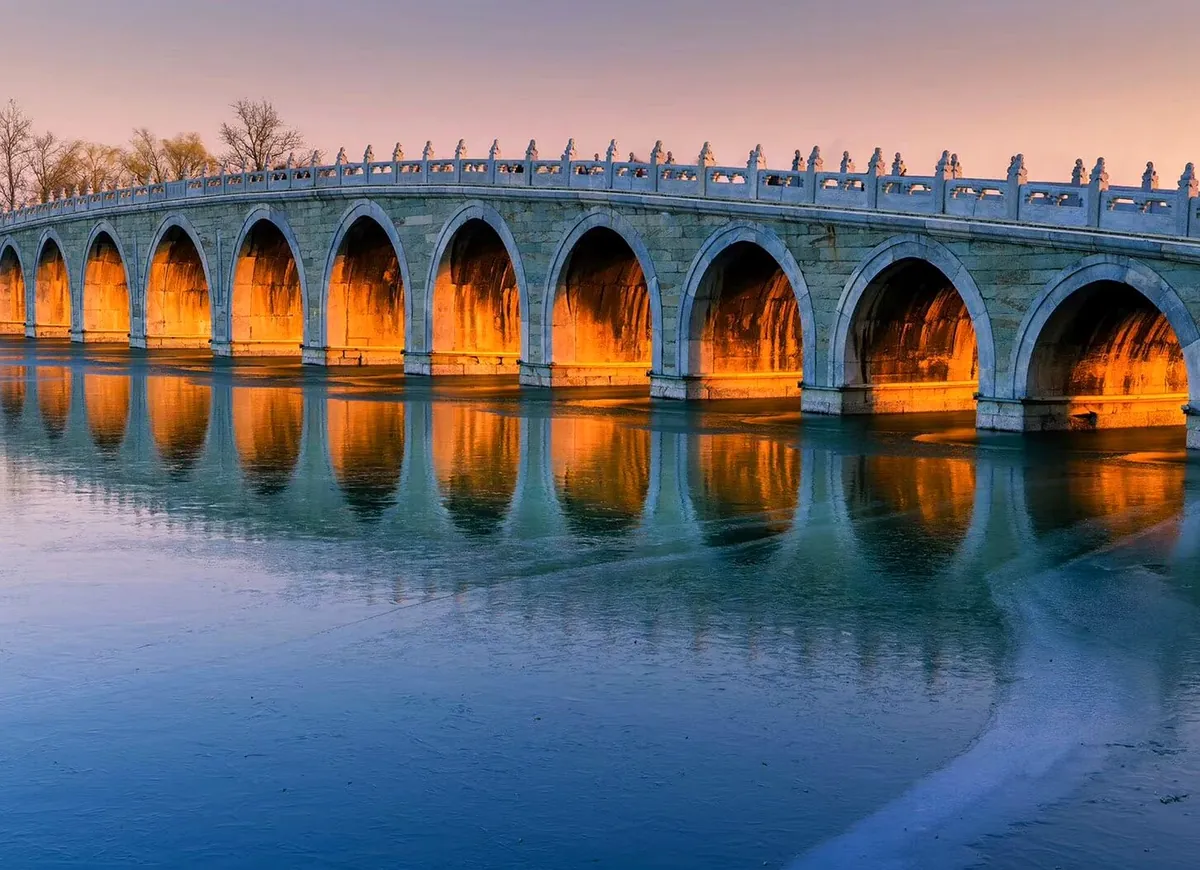
Quite distinct from brightly lit artificial metropolises or commercialized scenic areas that over-rely on mechanical projection technology, the Summer Palace at dusk unveils a peak visual art space created by the laws of astronomy and the masterful hands of Qing dynasty planners. The beauty of the evening glow and nightfall at the imperial garden does not stem from bustling noises, but rather from the exquisite harmony between nature’s natural light, the solemn contours of ancient palace structures, and the pristine tranquility of the vast Kunming Lake surface.
The most transcendent and rare visual highlight in the heritage lighting art here is the magnificent optical phenomenon known as the “Golden Light Piercing the Caves” (Jin Guang Chuan Dong). Every year around the Winter Solstice—falling between December 15th and 25th—when the sun sets at its lowest oblique angle of the entire annual orbit, an unprecedented canvas of light reveals itself during the golden hour from 3:30 PM to 4:30 PM. The honey-tinted, reddish late-afternoon sunlight precisely threads through, shining straight across the fronts of all seventeen arch openings of the Seventeen-Arc Bridge connecting the east bank to South Lake Island. The entire row of ancient stone arches suddenly bursts into a shimmering amber-gold radiance, sparkling and reflecting upon the partially frozen surface of Kunming Lake. This creates a magical halo stretching across the water, drawing hundreds of thousands of researchers and international photographers to marvel at this masterpiece combining mathematics, astronomy, and advanced feng shui principles.
As the twilight deepens, the final rays of sunlight paint the glazed tile roof of the Tower of Buddhist Incense (Foxiang Ge), which stands majestically atop Longevity Hill, while the distant shadow of the Xishan Pagoda stretches across the gently rippling waves of Kunming Lake. This scenery resembles a sublime, mysterious landscape freshly lifted from the brush of an ancient master painter, where the boundary between reality and illusion, between magnificent crimson palaces and untamed nature, seems to dissolve. At dusk, the imperial garden space transforms into a silent performance piece, where visitors need no staged theater to listen to the cold wind carrying the lake’s moisture as it blows through the granite stone steps, sinking their consciousness deep into the layers of memory belonging to the bygone Qing dynasty.
Contemporary breath is subtly integrated into the historical space through digital heritage preservation projects and extended reality (XR) technology applications. The heritage site has completed 3D spatial scanning using a LiDAR system with millimeter-level precision, combined with a smart monitoring sensor network to track microclimate deformations along the famous Long Corridor. Notably, at the ruins dating back to the Qingyi Garden era—which were reduced to ashes during the turmoil of 1860—modern visitors can use digital scanning devices to trigger augmented reality interaction technology. All the magnificent crimson pavilions once lost in historical ashes are vividly recreated with an authentic lighting simulation system, opening up a shimmering digital museum under the night sky without intruding upon or affecting the physical core of the heritage site.
To absolutely protect the priceless wooden architectural complex and preserve a peaceful habitat for migratory waterbirds residing at Kunming Lake, the core area of the Summer Palace enforces extremely strict nighttime management regulations. The management board resolutely controls artificial light pollution, refraining from organizing glaring laser music festivals or installing high-capacity luminous signage that could ruin the traditional paint and the solemn atmosphere. The imperial garden chooses to step back from the dazzling hustle of the city, nestling into the profound shadows of the ancient capital to retain the inherent tranquility and dignity of the royal palace at dusk, turning every twilight moment here into a rare soul-cleansing experience.
A journey to admire the Summer Palace would be incomplete without experiencing the flavors of Qing Dynasty imperial banquets, where royal culinary art reached its peak of sophistication. Impressively situated right on the majestic northwest bank of Kunming Lake, Tingli Guan was originally an elegant pavilion where Empress Dowager Cixi used to attend court concerts and appreciate traditional opera. Today, this living heritage site has transformed into a premier heritage restaurant, accurately recreating the essence of the Manchu-Han Imperial Banquet along with the royal feasts once served to the Manchu court. Amidst lingering agarwood fragrance and the sound of traditional instruments, diners have the opportunity to taste the Kunming Lake sweet and sour carp, featuring a crispy golden crust encapsulating snow-white fish meat, enveloped in a delicate, sweet-and-sour amber sauce. The famous Longevity Banquet tables here further pamper the taste buds with a bowl of ethereal saffron and bird’s nest soup, along with imperial pumpkin cakes intricately carved into royal lotus flower shapes, symbolizing boundless longevity and everlasting regality.
Alongside culinary delicacies, the royal food culture associated with the Summer Palace preserves its soul through refined imperial dim sum, crystallized from the craftsmanship of the imperial kitchen’s master chefs. Yellow pea cake was once the favorite dessert of the Old Buddha during every spring season. Premium split peas, after being soaked, are boiled until tender, rubbed through a fine copper sieve to a velvet-smooth texture, blended with pure rock sugar, and naturally condensed into golden blocks that melt instantly on the tongue with a pristine aftertaste. Equally famous is Ai Wo Wo, a traditional glutinous rice pastry dating back to the Ming Dynasty and specially praised by the Qianlong Emperor; the fragrant, chewy glutinous rice dough envelopes a filling of crushed walnuts, roasted black sesame seeds, and rich osmanthus honey. Accompanying the tea table is also the Poria cocos pastry, as thin as a silk sheet, sandwiching spleen-tonifying and mind-calming poria essence combined with wild honey and nutty pine kernels, expressing the profound dietary therapy philosophy of traditional Eastern medicine.
From the magnificent walls of the Summer Palace extending out to Haidian District and the center of the Beijing capital, the culinary map continues with symbols that stand the test of time. At the top of the list of famous flavors is Beijing roast duck with its two contrasting schools of thought spanning centuries. While Bianyifang remains loyal to the secretive closed-oven roasting technique dating back to the Ming Dynasty, using indirect heat to keep the duck skin plump and infused with a gentle aroma, Quanjude elevates the open hanging-oven roasting method, using fruit tree firewood such as old apple and pear trees to subtly smoke every succulent slice of meat beneath a glass-like crisp reddish-brown skin. When chilly northerly winds sweep across Kunming Lake and freeze the water’s surface, culinary connoisseurs of the capital head to Donglaishun to enjoy clear-broth copper pot mutton hot pot. Thinly sliced fresh Mongolian mutton, cut as thin as cicada wings, is quickly swirled through the light, flavorful boiling broth and dipped into rich sesame paste sauce, accented with a warm, fragrant Chinese chive flower oil.
Concluding the culinary journey of the imperial city is the renowned aristocratic official cuisine, exemplified by the essence of Tan Family cuisine. Created by aristocratic officials serving in the imperial city, the Tan family’s cooking art ignores hasty seasoning and instead worships slow simmering, stewing premium shark fin and abalone in a rich, golden aged-chicken broth for tens of hours. The combination of southern sweet warmth and northern robust textures in each aristocratic braised dish not only recreates the luxurious lifestyle of the past, but also affirms that the cultural space of the Summer Palace remains forever intertwined with the regal culinary standards and the finest essence of Chinese civilization.
To fully appreciate the masterpiece of the Summer Palace royal garden architecture without confusion, mastering the operating hours and ticket management system is a prerequisite. The royal garden divides its schedule into two distinct seasons: The peak season (running from April 1st to October 31st) is open from 06:00 to 20:00, with scenic areas and inner palaces ceasing guest entry at 18:00, and a panoramic combo ticket price of 60 RMB (including main entrance ticket, Foxiang Pavilion, Deheyuan Grand Theater, Suzhou Street, and the Garden Art Museum); the off-peak season (from November 1st to March 31st of the following year) is open from 06:30 to 19:00 with a combo ticket price of 50 RMB. Currently, the heritage management board applies a 100% real-name ticketing policy using international passports through WeChat or Alipay digital service portals. Meanwhile, to preserve the ancient wooden structures and granite flooring under the pressure of overcrowding, the Summer Palace has established a strict instantaneous visitor capacity cap of no more than 45,000 visitors at any given time and a maximum daily intake limit capped at 86,000 visitors.
The transportation infrastructure connecting central Beijing to the Summer Palace is diverse and modern. Beijing Subway Line 4 brings visitors directly to Beigongmen Station, where stepping out of Exit C allows direct access to the North Gate of the royal garden; while Line 16 stops at Xiyuan Station, where visitors exiting from Exit C2 can walk about 400 meters to behold the majestic East Gate. For those wishing to admire the peaceful suburban landscape, the Xijiao Light Rail Line conveniently connects at the Summer Palace West Gate station. Particularly, those fascinated by ancient imperial flavors can experience the royal waterway route via dragon boats departing from the Beijing Exhibition Center Pier, cruising down the winding South Changhe River to cut through the water straight into the heart of Kunming Lake, perfectly recreating Empress Dowager Cixi’s historic royal sightseeing excursion.
With a vast total area of up to 290 hectares, a well-planned sightseeing route following the principle of “one-way without backtracking or climbing steep slopes” helps visitors maximize their physical energy. Start your journey from the ancient East Palace Gate, proceed to the Hall of Benevolence and Longevity – where the Emperor and Empress Dowager once reviewed memorials and received Western envoys; turn to the Hall of Jade Orchards – the sorrowful inner palace that imprisoned Emperor Guangxu after the Hundred Days’ Reform; and then step into the elegant Hall of Joyful Longevity shaded by peonies, the regal resting place of the Old Buddha. Afterward, stroll along the 728-meter Long Corridor adorned with thousands of vibrant landscape murals, visit the imposing Hall of Dispelling Clouds, and climb to the top of the Tower of Buddhist Incense to take in the panoramic view of Kunming Lake and Longevity Hill. Follow the gentle northern shore to admire the famous Marble Boat (Qingyan Fang), board a ferry across the lake to South Lake Island, stroll across the 17-Arch Bridge to admire the exquisite carved stone lions, and exit smoothly through the Xinjian Palace Gate, which features a spacious parking lot and transfer station.
An essential tip when visiting the Summer Palace is to remain highly vigilant against “cheap tours” or “0-dollar tours” that often trap travelers. Many untraditional travel agencies lower tour prices below actual costs, forcing local tour guides to compensate for losses by cutting the Summer Palace visit down to a superficial 45 to 60 minutes. This precious time is then replaced by herding visitors into shady shopping hubs such as street-style pulse-diagnosing pharmacies, jade shops, latex mattress factories, or silk workshops with exorbitant prices. Wise travelers should proactively choose “No-Shopping Tour” products strictly protected under Article 35 of the China Tourism Law, ensuring a full 3.5 to 4.5 hours inside the garden to deeply absorb its historical value and leisurely cruise on an imperial dragon boat.
To optimize your entire journey, freeing yourself from language barrier hassles when booking timed-entry tickets while guaranteeing pure sightseeing rights without shopping pressure, traveling with an expertly designed itinerary is the ultimate solution. You can explore the comprehensive Beijing – Suzhou – Hangzhou – Wuzhen – Shanghai 7D6N tour to fully enjoy the cultural depth of the Summer Palace and the famous Jiangnan heritage chain in the most relaxing and dignified manner.