Viewed from the breezy shores of Shenzhen Bay—once a tranquil stretch of mangrove swamps and oyster-farming tidal flats on the ancient Nanshan Peninsula—Shenzhen Talent Park (深圳人才公园) stands proudly like a triumphal hymn composed of stone, water, and light. Unlike ancient gardens imbued with the royal imprints of northern feudal dynasties or the poetic water-and-mountain landscapes of the misty Jiangnan region, this space was born from a unique, modern historical transformation. When the Shenzhen Special Economic Zone entered its fourth decade of economic miracle-making since the grand tide of Reform and Opening-Up, this land miraculously metamorphosed from a minor maritime agricultural and fishing outpost on the South China Sea into a world-leading technological innovation metropolis. Amidst surging currents of change, Shenzhen realized that its foundational strength and most vital “genetic code” crafting the city’s extraordinary profile did not lie in continental shelves or finite resources, but in human intellectual capital—talents from the five continents gathering here to dedicate their youth and minds.
Planned and constructed as the nation’s first city-level urban park taking “talent” as its soul, this work represents the tangible realization of an era-defining guiding philosophy: “Respecting knowledge, respecting talent” (尊重知识、尊重人才). It honors millions of outstanding individuals—from pioneering combat engineering soldiers who detonated blasting charges to carve roads at the Shekou construction site during early days, up to leading scientists, technology engineers, and international scholars who propelled Shenzhen to new heights. Rather than erecting distant monuments, the municipal government chose to dedicate a diamond strip of land along the waters of Houhai Bay to carve out a vast outdoor humanistic museum, transforming abstract development philosophies into a public landscape language full of symbolism and inclusivity.
Each sub-district within the park is arranged coherently along a profound cultural contextual axis, guiding visitors into a living dialogue between arduous memories and a brilliant future. The central highlight of the historical lineage is the Commemorative Wall (纪年墙), which portrays glorious milestones in the special zone’s development journey, marking pivotal policy decisions and the bursting waves of intellectual migration across eras. Continuing that emotional current is the Talent Star Avenue (人才星光大道) and the Academician Corridor (院士长廊), honoring outstanding scientists from the Academy of Sciences and Academy of Engineering alongside distinguished international experts who contributed to this land’s rise. Each honorary plaque, fingerprint, and passionate maxim of these sages is exquisitely cast, gleaming brilliantly beneath the shade of financial skyscrapers reaching straight into blue skies.
Accompanying this humanistic depth is the Talent Sculpture Group (人才雕塑群) and Talent Square (人才广场), where contemporary plastic arts merge smoothly with mathematics, physics, writing, and peak algorithmic symbols. This interweaving affirms a universal truth: a metropolis striving toward the open sea relies not merely on reinforced concrete structures, but must take talent remuneration and cultural inclusivity as its root survival roots. Standing beside the central lake edge watching crystal waters blend with a magnificent skyline, anyone senses that Shenzhen Talent Park is not merely an ecological landscape project, but truly an eternal humanistic monument recording the heroic epic of one of East Asian urban history’s greatest transformations.
Situated in a prime location within the Houhai sub-district of Nanshan District, Shenzhen Talent Park possesses a pivotal geographical coordinate lying right at the intersection of two strategic nuclei: the development backing point of the Guangdong-Hong Kong-Macao Greater Bay Area and the Shenzhen Bay Super Headquarters Base Zone. Its landscape space is defined by exceptionally expansive and rigorous boundary directions: stretching eastward along the arterial Shahe West Road, backing firmly westward against Keyuan South Avenue and Dengliang Road, touching bustling Haide 3rd Road to the north, while connecting seamlessly southward with Dongbin Road and extending along the Shenzhen Bay coastal corridor. Through seamless organic connectivity with the Shenzhen Bay park system running along the coast, the entire area has established a continuous coastal ecological corridor, creating an extremely sturdy mountain-backed ocean-facing posture for the southern region’s premier technology center.
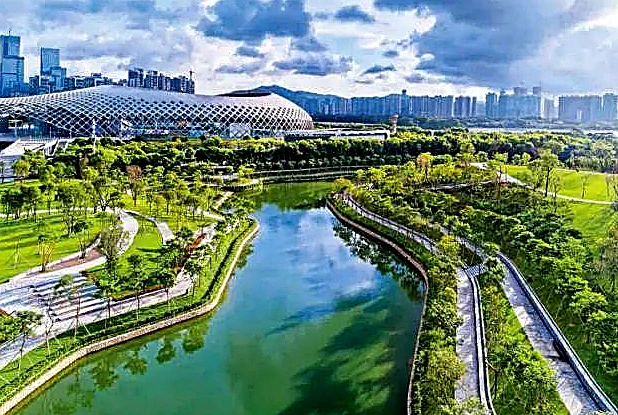
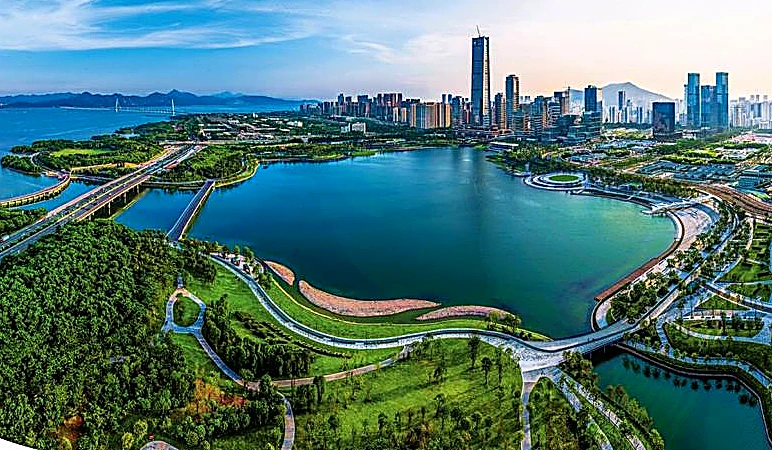
The most prized geomantic highlight in the park’s topography planning is the inner lake operating according to natural diurnal tidal rhythms, brilliantly actualizing the philosophy of “guiding the ocean into the park”—opening pathways for open sea waters to flood inward and embrace the inner grounds. Unrestrained within stagnant artificial lake structures, the vast water surface here breathes alongside ocean pulses, welcoming rising and ebbing tides from Shenzhen Bay to purify and circulate vital energy ceaselessly. Under traditional Eastern geomantic perspectives, water governs wealth, while the circulation of natural tidal currents symbolizes the convergence of the bright hall gathering water, where heavenly and earthly quintessence settles to nourish favorable energy for the talent-gathering land. The lake not only regulates local microclimates but becomes a gigantic mirror reflecting shifting skies, dissolving boundaries between artificial works and natural creation.
The terrain here is shaped around the spatial composition of “mountains and sea gazing at each other, city and water blending as one”—meaning mountains and oceans watch over one another while prosperous urban landscapes merge smoothly with pristine waters. The expansive water mirror of the inner lake harmonizes rhythmically with verdant landscape strips, forging a precious ecological buffer zone relieving visual and thermal pressure accumulated from dense skyscraper forests of adjacent Houhai centers. Standing by the water’s edge, visitors deeply perceive a marvelous yet perfectly balanced contrast: one side features hurried, urgent life alongside cold glass-and-steel architectural blocks soaring into the sky, while the other features calm waters rippling gently beneath native vegetation shade. The blending between the “dynamic” tide currents and the “static” lake surface establishes a flawless yin-yang balanced geomantic structure within the mega-city.
Ingenuity in topographic planning is similarly reflected in how architects respect natural folds of coastlines and tidal flats, turning this location into an ideal stopover for migratory birds along international flyways. Sea breezes carrying salty scents sweep across flooded shorelines, glide over expansive lakes, and drift gently deep into financial districts, delivering cool, pristine atmospheres across all seasons. The sophisticated interweaving of natural hydrological structures and modern landscape architecture turns Shenzhen Talent Park into an exemplary model of next-generation planning, where natural landscapes never yield before urbanization marching steps, but instead become the nurturing cradle of human intellectual blossoming.
The birth of Shenzhen Talent Park marks a breakthrough milestone in contemporary urban planning thinking, where landscape architecture arts blend with the philosophy of honoring human resources. Master planning was entrusted to renowned design institute AUBE Conception—celebrated for integrated landscape planning solutions achieving international aesthetic and functional standards. Spanning a total area reaching 770,000 square meters, equivalent to 77 hectares, the work showcases perfect proportional correlation between water surfaces and continental vegetation. Among them, central landscape lake surfaces occupy 300,000 to 330,000 square meters, harmonizing with 440,000 square meters of land area. A rare feature for a central mega-park is that total constructed floor area of artificial works sits modestly at roughly 4,939 square meters, ceding complete space to grass, trees, and flowers as green coverage ratio hits an impressive 77%, accompanied by a scientifically arranged mechanized parking ecosystem maximizing infrastructure relief for the entire Houhai Bay zone.
Regarding spatial structure, the park is organized under multi-layered functional zoning languages, taking core inner lake landscape zones as the microclimate-regulating heart for the entire complex. Encompassing these tranquil waters is a dual ecological corridor featuring continuous winding waterside walkways, forging a breathtaking visual field connecting humans to Shenzhen Bay skyscrapers. Along this vibrant circulation axis, functional sub-districts are forged with distinct identities: strings of talent transit stations linking academic exchange spaces, comprehensive libraries featuring transparent glass architectures reflecting water surfaces for cultural research and discussions, alongside picnic camping lawns dedicated to youth and young scientists seeking creative inspiration beneath expansive skies and clouds.
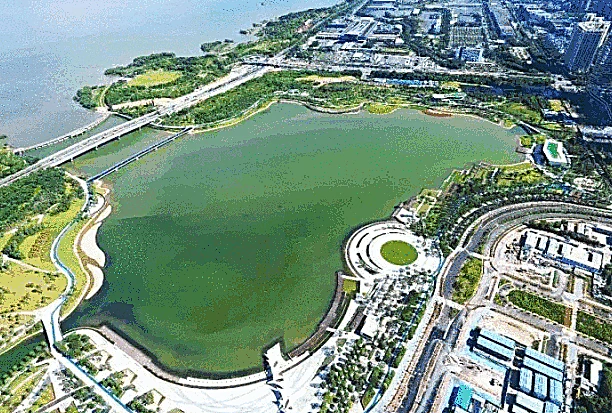
Beyond surface landscaping, technology and infrastructure engineering values elevate further through phase two expansion spanning roughly 125,500 square meters. The project was triumphantly honored as a model work under Shenzhen City‘s standard sponge city program. Under skilled hydraulic engineers and environmental architects, the park is equipped with low-impact development engineering ecosystems. Multi-layered rain gardens, natural depressed green patches, and high-end water-permeable ecological paving bricks interwoven delicately across walkways act as a colossal biological filtration and circulation filter. This smart mechanism enables the mega-park to store, purify, and reuse abundant coastal rainwater, minimizing urban flood pressures and forging a resilient ecological buffer, establishing the work as a pioneering symbol for global megacity sustainable development trends.
As dusk descends upon Shenzhen Bay shores, Talent Park sheds daytime serenity to transform into a peak visual grandstand, where lighting technology and contemporary architecture perform a magnificent nocturnal symphony. Acknowledged by architectural scholars and international travelers as Shenzhen’s finest urban skyline observatory, the waterside space here opens expansive vistas. This space is far more than a public amusement park by night, operating as a colossal outdoor visual art performance piece where boundaries between inner lake calm waters and soaring reinforced concrete blocks dissolve entirely beneath magical spectra of millions of sophisticated light beams.
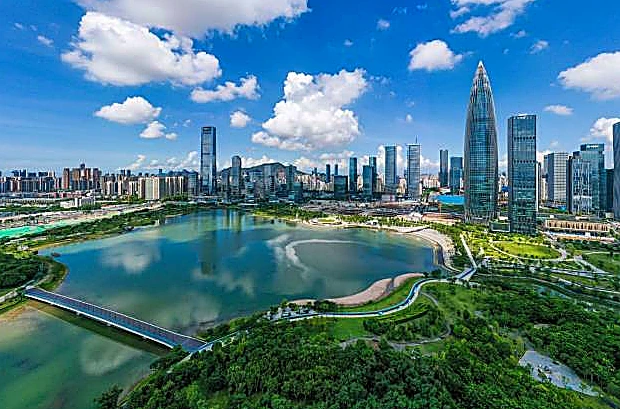
The central visual highlight capturing attention is the futuristic architectural cluster of the Shenzhen Bay Super Headquarters Base sitting across the water. Most prominent among them is the China Resources Headquarters Tower soaring 392.5 meters high, an architectural masterpiece affectionately dubbed “Spring Bamboo” (春笋)—a youthful spring bamboo shoot surging powerfully from the earth. When night blankets the bay, the tower’s curving glass surfaces and neighboring skyscrapers light up simultaneously during large-scale light shows. Advanced LED strips programmed delicately transform massive glass facades into living art projection screens. Lights shift rhythmically, rolling like vibrant digital waves or gracefully painting motifs honoring human talent and the pioneering spirit of the technological era.
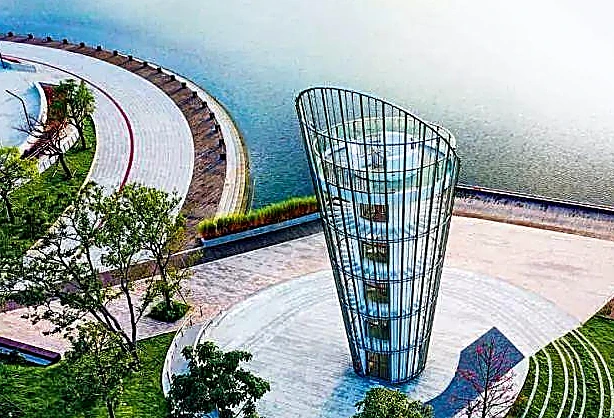
Visual arts at Talent Park exist not only on high skies but imbue gentle ripples across expansive inner lakes. Beneath subtropical sea breezes blowing strongly from the strait, brilliant radiance from the Spring Bamboo tower and super-tall skyscraper clusters casts reflections upon waters, forging natural scenery featuring multi-layered, shimmering, and magical light reflections. Neon hues, turquoise, and metallic lighting blend with waves, softening rigidity across steel structures and turning urban landscapes into half-real, half-dreamy realms. This coordinate serves ideally for global photographers setting tripods, patiently capturing long-exposure light trails of magnificent color shifts across Shenzhen’s skyline.
Nighttime life here transcends static observation, surging with active vitality backed by smart infrastructure arranged along watersides. Encompassing the lake is a multi-kilometer star-lit running track equipped with smart running step systems combined with floor-level guide lighting strips emitting gentle, glare-free illumination. Across specialized pathways, active sports life unfolds dynamically through groups of night joggers, residents strolling to catch refreshing sea breezes, and young friends conversing animatedly. The skillful fusion of high-tech aesthetics, human-centric urban lighting solutions, and coastal ecological landscapes turns Talent Park into a brilliant symbol for modern urban living styles, where humanity and light harmonize within enchanting nocturnal cultural spaces.
Connecting with winding running paths along Shenzhen Bay and intellectual tribute monuments at Talent Park are prosperous culinary rhythms of the Houhai commercial district in Nanshan District alongside adjacent Yuehai sub-district. This zone has long been regarded as the quintessential culinary intersection of the entire Guangdong-Hong Kong-Macao Greater Bay Area, gathering sophisticated cooking arts of millennium-old Guangfu culinary traditions alongside Shenzhen’s rich profile during transitions from coastal fishing villages to global metropolises.
Present right beside the park belt, legendary heritage culinary brand Spring Mansion (春满园) opens standard morning tea spaces preserving heirloom dim sum craft across generations of veteran chefs. Early morning banquets for locals and tech intellectuals start with red rice noodle rolls featuring delicate translucent red rice wrappers encasing golden crunchy fresh prawns, paired with superior savory sweet soy sauce. Furthermore, steaming bamboo baskets feature crystal shrimp dumplings with translucent wrappers revealing fresh pink prawns drenched in sweet broth, alongside crispy golden thousand-layer durian pastries radiating rich aromas upon breaking crunchy crusts.
Alongside refined dim sum, culinary maps surrounding Talent Park celebrate masterworks tied to Shenzhen’s history and terroir, notably renowned Guangming roasted squab—honored with the special title “White Phoenix” across the special zone. Squab are selected strictly by weight and age, marinated in secret sauces and roasted over precise flames so outer skin reaches paper-thin crispness while inner meat stays tender and richly fragrant. Accompanying this are Shating oysters—Shenzhen’s coastal treasures featuring long-standing farming traditions, delivering rich, sweet, ocean-flavored oyster meat when steamed with aromatic garlic. Classic Cantonese roasted meats like Shenjing roast goose with crispy skin and rich fat paired with sweet-and-sour plum sauce, or honey char siu gleaming in amber tones, sketch a prosperous food picture honoring southern master seasoning arts.
As dusk descends upon Houhai Lake and skyscrapers light up brilliant nightscapes, streets enclosing the park captivate diners with dessert shops and street snack stalls bearing Shenzhen-Hong Kong cross-border flavor imprints. Travelers easily locate traditional high glutinous rice cakes steamed in small clay bowls with sweet red bean paste, or soothing taro coconut dessert soups easing coastal summer heat. Alongside spicy garlic chili chicken wings awakening olfactory senses on street corners, this rich culinary picture provides physical energy replenishment while standing as a profound cultural slice proving how Shenzhen honors traditional culinary souls alongside modern breakthroughs.
As an urban welfare work with iconic municipal stature across the special zone, Shenzhen Talent Park maintains a completely free open policy 24/7 for all citizens and travelers. Accessing this open coastal landscape space along Houhai Bay is unhindered by admission fee barriers, facilitating dawn strolls in quiet serenity or sparkling nighttime urban contemplation. Nonetheless, visitors should note that specialized on-site utilities such as the Talent Bookstore (人才书吧) or public community service stations (便民驿站) operate solely during specific administrative hours, typically welcoming guests from 9:00 AM until late evening.
Shenzhen’s public transit infrastructure brings travelers to the park swiftly and accurately via top-tier urban rail transit networks across the Greater Bay Area. Metro Line 2 (Shekou Line) and Line 11 (express lines linking Bao’an International Airport to downtown) offer optimal choices, where you alight at Houhai Station (后海站) or Keyuan Station (科苑站). From station exits, a 15-minute stroll across Nanshan District’s tree-lined avenues or blending into local life via public shared bicycles leads straight to the park’s South or West gates. During holidays or major vacations, Houhai Bay parking lots experience severe congestion; prioritizing green transit via metro saves substantial time and prevents urban transit hassles.
Ideal timing to fully admire shifting park beauty spans from 4:00 PM extending into dusk. As sunset descends across the bay, brilliant orange-red hues reflect upon expansive central lakes, contrasting poetically with glass-and-steel skyscrapers. Immediately following sunset, magnificent light shows from corporate headquarters clusters—highlighted by China Resources Group’s “Spring Bamboo” tower—illuminate the entire skyline. When planning camping to breathe fresh air, locate designated tent camping areas (帐篷露营区) while strictly obeying civilized behavioral rules, protecting landscape cleanliness and minimizing impacts on meticulously tended native vegetation.
Nestled deep within southern coastal subtropical climate belts, the park possesses aquatic ecosystems interwoven with lush vegetation, which also hosts numerous insects and forest mosquitoes at nightfall. Travelers should prepare insect repellent sprays, anti-allergy medications, and breathable long sleeves when planning night strolls along watersides. Furthermore, coastal solar radiation is relatively harsh by day; sun umbrellas, sunglasses, and sunscreen remain indispensable items keeping bodies comfortable throughout exploration journeys.
For international travelers arriving from Vietnam, journeys to Shenzhen require careful preparation regarding immigration procedures and digital payment methods. Depending on entering via land border crossings like Luohu or Futian from Hong Kong or flying directly into Shenzhen Bao’an International Airport, complete tourist visas prior to departure. Shenzhen operates almost entirely on cashless economies; accordingly, set up and authenticate international bank cards on WeChat Pay or Alipay apps early for smooth transit, vending machine, or dining payments. Simultaneously, activated eSIMs ensuring seamless mobile network services serve as vital assistants for navigating subterranean transit maps and locating prized viewpoints.
To enjoy every moment at this iconic stopover without worrying about connecting itineraries or language barriers, accompanying a scientifically designed journey such as the Guangzhou – Shenzhen 4D3N Tour serves as an ideal suggestion to experience the seamless fusion of future technology and expansive nature across Houhai Bay.