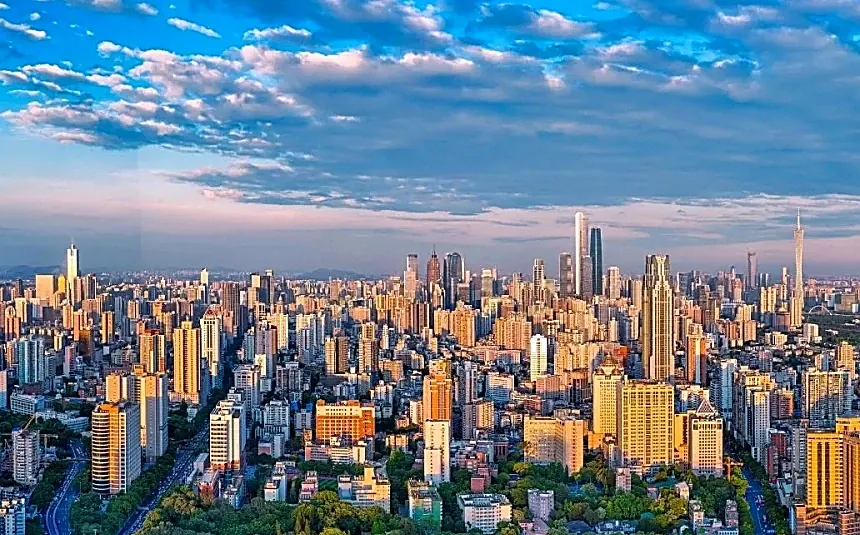
Reclining on the fertile expanse of Southern China, where the Pearl River has for millennia carried merchant vessels outward across the Maritime Silk Road, Guangzhou City has consistently held the paramount commercial lifeline position of the populous nation. Nevertheless, the modern profile of its contemporary textile and garment industry only truly turned a completely new historical page on January 8, 1993, when the Guangzhou Baima Fashion Market (广州白马服装市场) officially opened its doors for business. Born right amidst the powerful vitality of economic reform transitions from the early 1990s, Baima forged a landmark revolution by becoming the first commercial complex nationwide to break away from the model of open-air torn canvas stalls, pioneering the relocation of all trading activities inside a modern, enclosed high-rise tower.
This century-defining shift transformed the Baima building—located opposite the Guangzhou Railway Station—into a gigantic magnet drawing entire capital streams and merchants from all four directions. Barely a year after opening, this landmark created a financial earthquake by triumphantly snatching the championship crown during the evaluation of markets achieving transaction scales surpassing one hundred million RMB in Guangzhou. Streams of people marching incessantly from northern provinces alongside merchants from Hong Kong, Taiwan, and Southeast Asia flooded glowing floors, creating an unprecedented bustling transaction arena. Every bale of fabric and novel design template radiated outward from here into every alleyway, turning the South Huan Shi road area into the beating pulse of prosperity for the entire mainland apparel distribution network.
Not stopping at the achievements of a purely wholesale center made of bricks and stalls, Baima’s management board soon revealed a forward-looking vision before the digital transformation wave. When the internet remained an unfamiliar concept to the majority of traditional small-scale merchants, back in 1998, Baima pioneered establishing a specialized web portal named Baima Clothing Network (白马服装网). This proactive strategic move activated the first online and physical integrated model in textile wholesale history, erasing geographical distances between industrial sewing workshops and agency networks across the realm. The milestone of twenty enduring, prosperous years was solemnly summarized in 2013 through a massive specialized monograph entitled “The Baima Legend” (白马传奇). The book was not merely a chronicle recording a market’s ups and downs, but systemized and elevated the entire management philosophy into the renowned “Baima Model,” becoming a practical textbook studied and emulated by economists and the nationwide business community.
Entering the high-quality transformation era spanning 2010 to 2022, Baima was no longer satisfied acting as a cheap bulk-commodity transit station. The legendary commercial building persevered through deep cleansing and repositioning, transforming itself into a cradle incubating national-brand stature. Throughout that twelve-year journey, it nurtured and elevated 78 member commercial households to achieve “China Apparel Growth Brand” certification, while empowering 35 partner units as “Outstanding Distributors of China’s Fashion Industry,” thereby cementing its status as a model wholesale textile benchmark on nationwide rankings. Today, with the official establishment of the “China Original Design Brand Base,” Baima has completed a breathtaking metamorphosis: evolving from a mere trading pitstop into a sanctuary protecting the intellectual property of young designers, a trend-generating hub, and a brilliant fashion symbol along the Pearl River banks.
Contemplating the terrain of the Guangzhou Baima Fashion Market through geomantic and human-geographical lenses of Lingnan, one easily perceives how it impressively presides over a rare commercial energy vortex of ancient Yangcheng. Situated centrally within prestigious Yuexiu District, this commercial complex fully inherits millennial vital energy originating from Yuexiu Mountain—the sacred mountain bound to the legendary myth of five rams holding rice spikes descending to earth to bless the people of Guangdong with prosperity. Baima’s terrain achieves the classic “backing mountains and facing water” standard, backing firmly against the sturdy granite dragon vein of verdant Yuexiu while facing crystal waters that gather energy and store wealth at Liuhua Lake Park. The blending between static mountain qi and the ceaselessly circulating vital energy of expansive waters forges the “encompassing mountains and embracing waters” geomantic layout, shielding against urban malevolent qi while nurturing abundant favorable energy, turning it into an authentic wealth-gathering basin in the heart of the metropolis.
Regarding urban spatial planning and transport infrastructure, Baima Market occupies the very choke point of Zhanan Road, within the core sub-district of the renowned Liuhua commercial sphere. From the moment the opening-up door unlocked new opportunities for the entire South China coastal strip, this territory became a golden link connecting vast inland China with international seaports along the South China Sea. Proximity to the imposing Guangzhou Railway Station and Guangdong Interprovincial Bus Station turns it into a brilliant “Southern Gateway,” welcoming boundless human streams flooding in daily and nightly. The endless flow of vehicles and goods passing Baima’s threshold resembles tributaries surging toward the open sea, generating the remarkably auspicious “water governing wealth” geomantic phenomenon, turning every inch of ground at this bustling intersection into pure gold for wholesale apparel tycoons.
Far from standing isolated as an architectural island, the presence of the Baima Fashion Market is established as a “dragon head”—a pioneering leader guiding a modern specialized market ecosystem among the finest in the region. Encompassing the Baima building is an interconnected network of legendary fashion high-rises such as Hongmian, Tianma, Yuma, and Yima, forging a clustered layout bearing a “stars surrounding the moon” configuration. This mutual generation within urban landscape space spawns a continuous Bagua battle array, where colossal wholesale customer traffic from five continents entering the zone immediately gets swept into an endless consumption vortex, circulating capital seamlessly from tower to mall without escaping outward.
Alongside the bustling hustle of cross-border trade, natural landscapes surrounding this sub-district possess a precious ecological buffer owing to Liuhua Park’s multi-layered vegetation. Sprawling ancient banyan trees and water coconut palms reflecting upon tranquil lake waters just steps away act as natural filters, absorbing thermal energy generated by intense commercial transactions and modern urban noise. Benign breezes carrying refreshing moisture from the lake frequently sweep across avenues leading into Baima Market, bringing serenity and composure to merchants seeking inventory sources, forging perfect balance between lightning-fast urbanization and timeless natural tranquility.
Rising proudly at the heart of Yuexiu District’s bustling commerce, the Baima Fashion Market grand edifice stands as a monumental symbol of Guangdong’s breathtaking apparel industry transformation. Spanning a total construction area approaching nearly 60,000 square meters across ten solid stories, this structure is far more than an ordinary trading center, systematically planned as a multi-functional international commercial exhibition complex. The overall architecture exudes imposing modernity with decisive geometric lines, fully reflecting industrialization thinking and aspirations to reach far beyond for a millennial seaport entering economic market zenith.
Baima’s spatial structure is meticulously calculated based on traffic routing principles and commercial function optimization along vertical axes. Basement B1 is designed as a large-scale underground parking garage, resolving heavy freight transport pressures for interprovincial cargo networks arriving daily. Floors one through eight comprise modern multi-functional commercial exhibition spaces, gathering thousands of elegantly decorated stalls modeled after high-end boutique showrooms. Crowning the building is the top floor, reserved for luxury offices and high-end business negotiation centers, offering isolated quiet spaces for million-dollar export contract signings between fashion houses and global partners.

Inner commercial stratification adheres to rigorous product positioning principles, forging a clear and specialized shopping map. Lower floors concentrate high-end women’s fashion with exquisite needlework, followed by zones dedicated to original design bases—incubating independent local designers showcasing distinct creative languages. Higher up lie domains of refined men’s suits, leather goods, trendy fur collections catching international runway trends, alongside high-quality foreign trade brands serving high-standard markets like Europe, America, Japan, and East Asia.
The building’s enduring vitality and colossal operational efficiency are backed by top-tier technical infrastructure. Interior spaces constantly maintain ideal temperatures despite scorching southern summers via high-capacity central air conditioning. Passenger and cargo flows circulate smoothly through heavy-duty passenger elevators, super-sized freight elevators for bulky loads, and interconnected two-way escalators. Combined with smart 24/7 security and fire monitoring networks, Baima has forged a complete value chain fusing display marketing, precise logistics, trade fairs, and trend launches under a single solid roof.
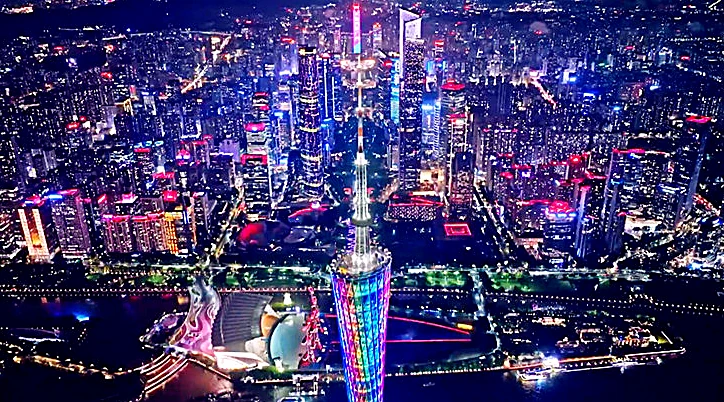
As sunset fades behind ancient mahogany trees in Yangcheng, the intersection between West Huan Shi Avenue and Zhanqian Road dons a completely different visual attire. Baima Fashion Market’s imposing facade glows brilliantly under thousands of multi-colored neon bulbs and high-resolution LED screens spanning hundreds of square meters. Flashing lights continuously screen international fashion films, turning this massive architecture into a glowing lighthouse amid Yuexiu District’s bustling traffic. Though ground-floor glass doors close in late afternoon to conclude daytime wholesale cycles, interior spaces never fall silent, shifting instead to a powerful operational state of nighttime mercantile life.
The moment small merchants finish auditing ledgers, sidewalks and surrounding streets transform into a colossal live stage for cross-border logistics. This is when Lingnan commercial life’s most vivid performance lays bare: loud tearing sounds of thousands of wide packing tape rolls sealing blue-and-white striped woven sacks, metal pushcarts rattling with towering apparel bundles, and echoing calls in Cantonese and Mandarin by weathered porters. Hundreds of thousands of packages containing cutting-edge apparel samples departing daytime stalls are rapidly sorted, securely strapped, and loaded straight onto heavy trucks lined up outside, launching overnight journeys to international seaports, airports, and intercontinental distribution centers.
Alongside the bustling loading dance of transport lifelines, nighttime lighting artistry in the Baima sub-district weaves magical links with surrounding heritage landscapes. Just a short walk southwest, Liuhua Lake’s flat waters mirror soft yellow lights from lakeside buildings, evoking tales of Southern Han Dynasty imperial consorts floating flower petals down currents. Adjoining this is the Dongfang Hotel—carrying deep Lingnan garden architecture imprints featuring curved tile roofs and serene verandas—emitting warm light blending with the solemn emerald silhouette of Yuexiu Park in the distance, where Zhenhai Tower stands guard over ancient city souls across historical vicissitudes.
The harmonious interweaving of serene historical landmarks with golden monetary currents flowing beneath colored lights crafts an exceptional urban night experience. Rising wisps of smoke from street food carts carry rich aromas of Teochew beef meatballs, crispy stinky tofu, and tangerine peel milk tea, comforting international merchants after grueling negotiation days. Standing at this glowing intersection late at night, travelers truly perceive the millennial heartbeat of an ancient commercial capital where Pearl River civilization heritage never ceases evolving to nourish global fashion streams.
Nestled peacefully at the cultural and historical intersection of Old Yuexiu and Liwan districts, Baima Fashion Market maintains bustling commerce while resting amid renowned Cantonese culinary hubs. Following tense negotiations amid seas of fabrics, international merchants and travelers wander toward antique streets redolent of tea fragrances. Here, “eating in Guangzhou” traditions endure, anchored in morning tea rituals known as “one pot, two pieces”—a fragrant tea pot cleansing the mind accompanied by two steaming baskets of dim sum.
Within walking distance from Baima Market’s main entrance, early morning dim sum maps burst to life with two centennial legends: Tao Tao Ju and Dian Dou De. Seated beside windows carved with Manchu patterns, diners awaken palates with the “Four Heavenly Kings” of dim sum: crystal shrimp dumplings with gossamer wrappers revealing pink prawns and crunchy bamboo shoots; yellow pork siu mai topped with crab roe; char siu buns bursting naturally like flower petals with sweet rich sauce; and golden egg tarts with crispy layers encasing silky smooth egg custard.
Seeking regal banquets from golden eras, diners cross the main thoroughfare to enter expansive culinary spaces surrounding Liuhua Park. Here, the legendary Southern Country Banquet at Dongfang Hotel faithfully recreates imperial Lingnan banquets. Adjoining this, the Liuhua branch of Guangzhou East China Seafood Restaurant and Nanhai Fishing Village in Yuexiu District serve as benchmarks for authentic live seafood prep, where star groupers and lobsters retain pure ocean sweetness. Interspersing tradition is contemporary flair at Macau Street, offering graceful fusions of skilled Lingnan cooking and Portuguese herb-infused flavors.
Leaving grand establishments behind, Old Guangzhou alleys around Baima Market captivate travelers with bustling folk market sounds. Chopping knives rhythmically striking wooden blocks announce freshly roasted Shenjing geese with amber-crisp skin enclosing juicy meat paired with sweet-and-sour plum sauce. Nearby rests honey-glazed char siu with charred edges smelling of charcoal. Missing Yinji’s handmade rice noodle rolls—where fresh rice batter steams thin as cicada wings, sliding past minced beef and heirloom soy sauce—is unthinkable. At dusk, clay pot rice pots firing up on charcoal emit rich lap cheong aromas, with fluffy rice grains clinging to golden, crispy crusts below.
The native flavor symphony concludes purely and elegantly with heirloom sweets at Nantian Milk Company. Hot ginger milk bowls combining warming ginger juice with rich buffalo milk congeal via natural chemical reactions. Additionally, snow-white Double-Skin Milk featuring two delicate condensed milk layers delivers refreshing sweetness, soothing palates after bustling trade days while etching memories of warm, hospitable Guangzhou.
Standing majestically at a premier commercial coordinate in Yuexiu District, right beside the historic Guangzhou Railway Station—witness to Lingnan economic transformations—Baima Fashion Market boasts near-perfect transport accessibility. Visitors and international merchants easily reach this fashion sanctuary via modern metro networks: simply board Metro Line 2 or Line 5, alight at Guangzhou Railway Station (广州火车站), and stroll through Exit D4 or G. Following a two-to-three-minute walk along bustling West Huan Shi Avenue, Baima’s imposing, light-filled architecture appears instantly. Ring roads and specialized commercial buses ensure seamless round-trips to Baiyun International Airport or Guangzhou South Railway Station, preventing trade schedules from urban congestion.
Baima operates under Asian wholesale biological clocks, opening for early visitors around 7:00 AM and closing around 6:00 PM when final shipments are sealed. Unlike chaotic budget markets like Saha, Baima positions itself as a capital of mid-to-high-end women’s fashion and exclusive designer workshops. Meticulous needlework, imported materials, and trendy silhouettes price factory-direct goods slightly higher than average. For individual travelers seeking unique garments without bulk quantities, weekends (Friday to Sunday) or spring-summer to autumn-winter seasonal sample clearance events are ideal. Shop owners then remain most open to selling single sample pieces at prices sometimes half of original retail tags.
Entering the labyrinth of glamorous stalls, communication unlocks wholesale price floors. Inquiries via standard retail habits immediately relegate buyers to high retail brackets. Seasoned traders instead use professional shorthand: rather than asking prices, say “zen me na” (怎么拿 – wholesale purchasing methods) or “yi shou ji jian” (一手几件 – full size runs per color batch). Uttering these concise phrases transforms vendor attitudes from greeting casual shoppers to negotiating with veteran clients, opening factory-direct wholesale sheets and garment inspections.
Completing closed-loop supply chains, ground floors and surrounding perimeters feature dispatch stations of mainland delivery giants like SF Express and Deppon Logistics. Travelers witness master packaging featuring waterproof shrink wrap, multi-layered corner-reinforced cartons, and heavy-duty tape ready for cross-border air cargo. Simultaneously, preparing e-payment apps like Alipay or WeChat Pay linked to international cards alongside retaining shopping receipts for airport customs export declarations ensures smooth trips. To immerse in this bustling port’s vitality and curate trendy apparel firsthand, explore the carefully designed itinerary of the Guangzhou – Shenzhen 4D3N Tour, uniting cultural discovery with peak fashion insights.