Amidst the prosperous metropolitan picture of modern Guangzhou city, Dafo Temple stands like a towering stone-and-timber witness spanning over a millennium of ups and downs. The origins of this ancient sanctuary date back to the turbulent Five Dynasties and Ten Kingdoms period, specifically during the Southern Han Dynasty lasting from 917 to 971. At that time, founding Southern Han Emperor Gaozu Liu Yan was a monarch deeply devoted to Buddhism and possessed a passionate zeal for the art of constructing palaces and monasteries. To align with heavenly star movements and pray for his dynasty’s endurance, he issued an imperial decree implementing an unprecedented spiritual planning project: establishing twenty-eight grand monasteries at the four cardinal directions and corners of the ancient capital, symbolizing the Twenty-Eight Mansions system of the night sky. Within that distinctive cosmological structure, the predecessor of Dafo Temple was erected under its initial name, Xintang Temple, marking the birth point of one of the most enduring Buddhist sanctuaries in the Lingnan realm.
Through fierce military conflicts as the Southern Han Dynasty waned and gave way to the Song and Yuan eras, Xintang Temple was repeatedly devastated by the smoke and fire of war and the erosion of time. By the Yuan Dynasty, upon the sacred ground of ancient ruins, local residents and monks jointly reconstructed the monastery, renaming it Futian Hermitage (Phúc Điền Am) with the aspiration of planting blessings for countless subjects. Entering the Ming Dynasty, the sanctuary underwent major expansions to enlarge its imposing scale and was renamed Longzang Temple. A remarkably unique historical period unfolded here during the Ming era, when the temple’s solemn grounds were requisitioned to serve as the Circuit Intendant’s General Headquarters Sub-Office—the official agency responsible for security, patrols, and judiciary affairs across the coastal region. The strange interweaving of pure Zen meditation grounds and criminal yamen offices carved a rare historical imprint deeply embedded within local cultural currents.
The most important historical turning point shaping the ancient temple’s appearance and brilliant renown down to the present day unfolded in the early Qing Dynasty. In the second year of Kangxi (1663), following turbulent dynastic transitions between the Ming and Qing, Pingnan King Shang Kexi—governing the South at the time—aroused great compassionate intent. He voluntarily allocated his entire royal stipend to fund the reconstruction of the entire temple grounds with unprecedented grandeur. This magnificent restoration project gathered Lingnan’s finest artisans, dedicating efforts to erect the expansive Mahavira Hall imbued with Qing imperial court architectural language, featuring sturdy hardwood beams enduring for millennia.
The most radiant miracle during the second Kangxi year major reconstruction was the successful casting of three colossal Buddha statues made of pure brass, solemnly enshrined at the center of the Mahavira Hall. Under ancient artisans’ divine craftsmanship, three majestic statues symbolizing the Buddhas of the Three Times were completed with extraordinary dimensions: each statue soaring up to three zhang and six chi (over ten meters tall) and weighing over ten thousand catties of solid bronze. The magnificent presence, radiating miraculous golden light from the three giant bronze statues, astonished scholars, monastics, and commoners across the region. From that historic event, former names like Futian Hermitage or Longzang Temple were completely transferred to the designation Dafo Temple (Great Buddha Temple), officially inscribed in imperial annals and popular consciousness.
From a heritage research perspective, Guangzhou’s Dafo Temple is not merely a Buddhist worship establishment, but a living encyclopedia preserving multi-layered historical strata of Guangfu culture across centuries. From Liu Yan’s geomantic planning imprint during early Southern Han, Yuan Dynasty benevolent aspirations, Ming official authorities’ presence, to Shang Kexi’s royal stipend donation to rebuild the Zen gate during Kangxi’s reign, all have blended into every timber grain and stone slab here. Those millennial relics transform the temple into an eternal museum of memory, guiding travelers across time thresholds to fully contemplate the vicissitudes of ancient Chinese history.
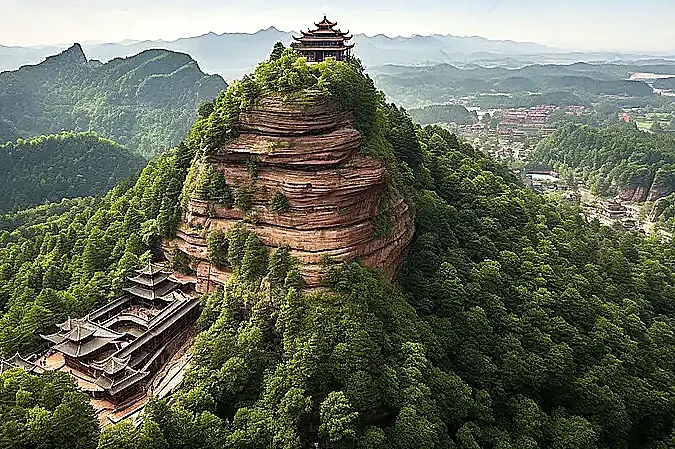
Accurately located at No. 21 Huitangzhong Street, Huifu East Road, Yuexiu District, Dafo Temple nestles west of the renowned Beijing Road pedestrian street and right along the southern flank of the Guangbai commercial complex. Across dozens of centuries of mapping charts in the Lingnan region, this position serves as a vital choke point along the millennial traditional central axis of ancient Guangzhou. From the era of pioneering ancient urban order, this area possessed distinctive geomantic terrain, inheriting vital energy originating from the majestic Baiyun Mountain range, winding past Yuexiu hills, and accumulating before flowing toward the Pearl River. Enshrining the sanctuary along this prosperous route aimed not merely at propagating the Dharma, but shouldered the mission of an eternal geomantic anchor, regulating dragon veins and safeguarding spiritual energy across the southern realm.
Tracing stone inscriptions and ancient gazetteers, the sanctuary’s original geomantic structure was intimately tied to Southern Han imperial court astrological geomancy. Upon establishing his dynasty in Guangzhou, the Southern Han imperial family applied astronomical divination, planning ancient monasteries corresponding to the Twenty-Eight Mansions layout across the skies to act as a spiritual fortress protecting the realm. Within that celestial-terrestrial network, the temple acted as a vital stellar anchor, absorbing sun and moon essence to transform into vitality for humanity. Through large-scale renovations during the Ming and Qing dynasties, the sanctuary’s terrain was further reinforced under front-hall rear-chamber rules, harmonious left-and-right symmetry, and mountain-backed water-facing postures, embodying orthodox Chinese geomantic philosophy.
Entering the era of lightning-fast modernization, surrounding landscape appearances transformed dramatically as bustling commercial high-rises, brilliant LED signs, and relentless crowds enclosed all four sides. Yet that dramatic interweaving forged a spatial structure prized under “concealing tranquility within bustling markets” and “great reclusion amidst cities” philosophies. The temple’s boundaries act like a magical energy filter; stepping across temple gates instantly silences the deafening urban din, yielding to soothing wind chimes, drifting incense aromas, and an ethereal, secluded tranquility. The sharp contrast between surging worldly currents outside and serene Zen meditation inside establishes a dynamic-static interactive energy field, turning this location into a rare spiritual oasis soothing citizens’ minds.
Resonating with geomantic advantages is the organic landscape linkage with the millennial ancient road relic along Beijing Road, where strata of cultural layers from Tang, Song, Yuan, Ming, and Qing dynasties remain visible beneath protective glass. Imposing presence adjacent to this living archaeological axis prevents Dafo Temple from standing isolated as a solitary relic, tying it closely to Guangzhou’s continuous historical flow. Natural landscaping within the compound is meticulously tended with bluestone-paved courtyards, shaded ancient tree clusters, and year-round lush tropical vegetation, helping moderate microclimates, welcome cool breezes, and dispel urban heat. All converge to establish a planning entity both rigorous in geomancy and harmonious with nature amidst the modern metropolis.
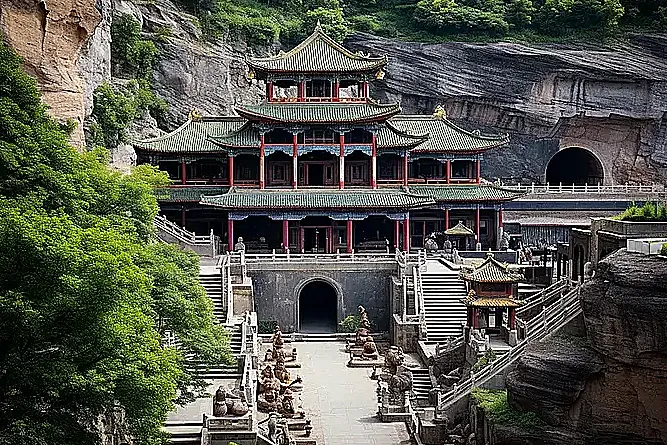
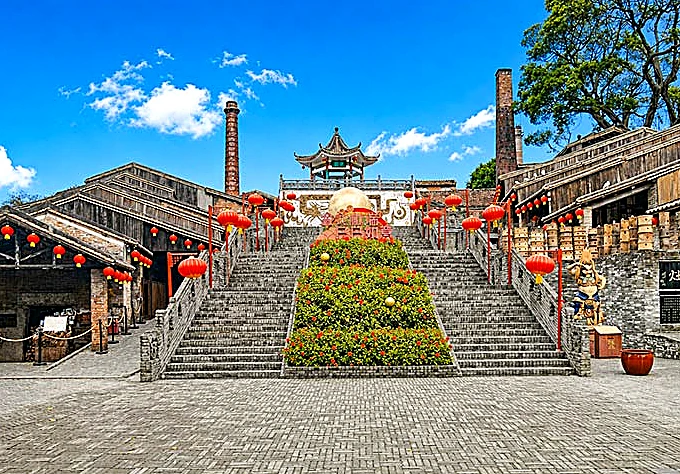
Contemplating Guangzhou’s Dafo Temple as a whole, ancient architecture researchers and culture-savvy travelers all marvel at the wondrous synthesis between rigorous Ming-Duchy court standards and the unconstrained, ethereal grace of traditional Lingnan temple arts. The complex space is established upon an absolutely symmetrical central divine axis, creating the classic “front hall rear pavilion” layout characteristic of grand ancient southern sanctuaries. Amidst bustling Yuexiu District with hurried paces, every transition from temple gates through brick courtyards, enclosing corridors, to worship halls opens mental depths where solemn tranquility completely pushes aside external worldly clamor.
The majestic centerpiece reigning upon the main axis is the Mahavira Hall, featuring massive scale and rising proudly into open space. Large timber load-bearing structural frames alongside colossal glazed tile roofs exude magnificent imperial prestige. Stepping inside the silent inner hall redolent of sandalwood, viewers’ eyes are instantly drawn to the Shakyamuni, Amitabha, and Bhaisajyaguru Buddha triad seated solemnly at the center. Crafted elaborately from solid brass during the Kangxi reign of the Qing Dynasty, the three giant statues stand enduringly across time, possessing benevolent, fulfilled expressions and soft flowing robes resembling silk clouds. Advanced ancient bronze-casting craftsmanship of high-Qing master artisans transformed dozens of tons of metal into living manifestations of pure lands, solemn yet radiating peaceful auras encompassing the entire main hall.
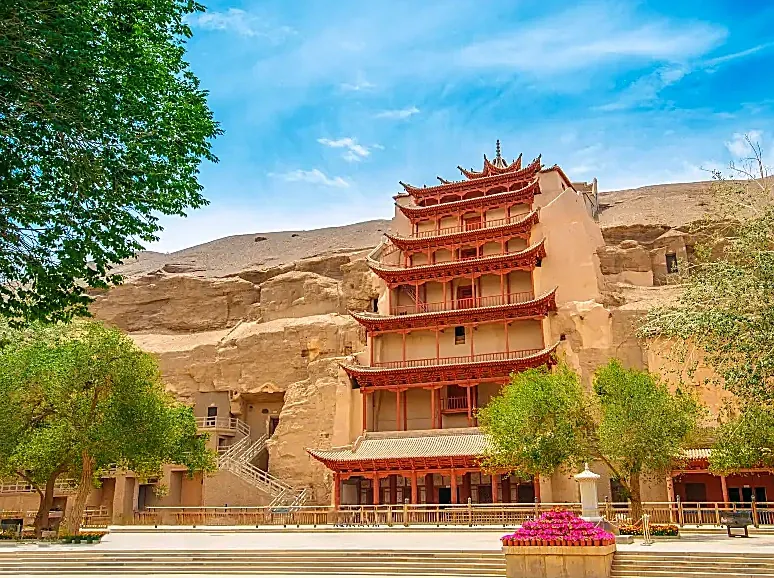
Another unique interior architectural wonder is the massive octagonal rotating scripture repository (Zhuanlun Zang). This is a supreme carpentry masterpiece featuring a large central wooden axis running through its core, allowing the entire scripture structure to revolve around itself per Buddhist doctrines of endless reincarnation. Every corner of the repository is meticulously carved with cloud-water motifs, auspicious patterns, and brilliantly painted brackets. Bracket clusters supporting outward-extending roof tiers resemble miniature multi-tiered pavilions, exhibiting supreme ancient master carpentry joining wood without a single metal nail.
Accompanying ancestral heritage, the sanctuary’s current imposing scale leaves deep marks through major expansion works named Pojue Tower and Hongfa Tower. Reconstructed in Ming-Qing antique styles featuring multi-tiered stacked-roof structures, these works showcase flying-eave multi-tiered tower arts—where tiered roof eaves curve upward into skies like birds soaring amidst mountain clouds. Intricate wooden bracket clusters interweave, layering to bear loads while creating mesmerizing visual rhythms. Viewed from afar, seamless integration between antique shrines and majestic rear pavilions forges a solemn, magnificent Buddhist complex, standing as an enduring cultural symbol of ancient Lingnan.
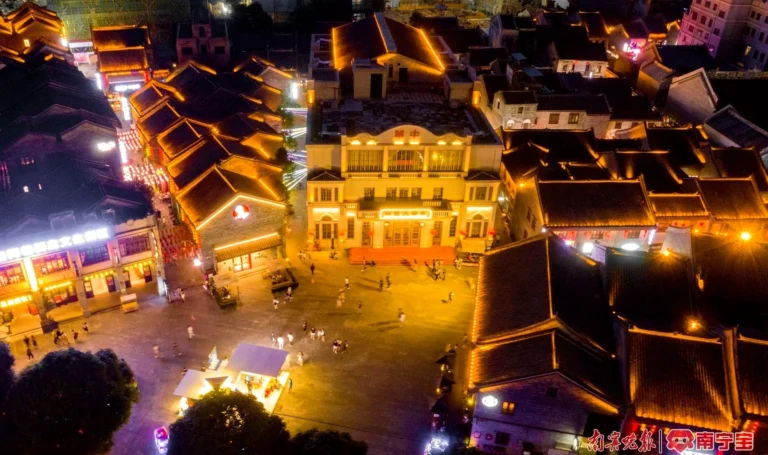
As dusk descends over the Pearl River and night embraces the bustling Lingnan metropolis, Dafo Temple sheds daytime stillness to enter a breathtaking visual metamorphosis. That transitional moment typically strikes around 7:00 PM nightly, when illumination rituals ignite simultaneously across ancient towers. From shadowy depths, tens of thousands of warm amber-gold photoelectric strips glow along tile roof contours, embracing complex bracket structures and honoring proud upturned eaves reaching toward the sky. The entire Buddhist complex resembles a lavishly gilded golden edifice radiating warm, sacred vitality, transforming into the most captivating visual climax across Guangfu’s nocturnal travel paintings.
The focus of this magical lighting show centers upon the multi-tiered Hongfa Tower featuring stacked roof tiers soaring high. Viewed from afar, majestic timber architecture combined with contemporary lighting engineering generates surreal optical illusions, instantly reminding countless travelers and art connoisseurs of the legendary Yubaba bathhouse in Hayao Miyazaki’s classic animated masterpiece *Spirited Away*. The random coincidence between traditional East Asian architectural proportions and magical golden hues transforms the ancient sanctuary into a mythical palace. Every curved eave, window lattice, and carved balcony is honored down to micro-details, forging spatial depth that is magnificent yet enchanting, detached entirely from mundane reality.
Dafo Temple’s nocturnal allure likewise rests upon profound contrasts with surrounding spatial contexts. Nestled peacefully right beside Beijing Road pedestrian street—Guangzhou’s most bustling commercial axis—the temple resembles an ancient gem embedded amidst neon light matrices and modern LED screens. Amidst bustling shopping crowds and hurried urban rhythms, the temple’s solemn golden hue acts as a cultural anchor, binding human minds back to millennial spiritual origins. Stepping through triple gates into inner courtyards instantly blocks outdoor street clamor, leaving only harmony between gentle golden light and sandalwood fragrances drifting on night winds.
Nighttime temple courtyards become meeting places for seeking inner peace and photography enthusiasts alike. Beneath glowing eaves, travelers devoutly fold hands praying for peace, casting long shadows across ancient granite-paved floors. Fragrant wisping smoke winds beneath golden light beams, blending with night dewdrops to forge illusory mists recreating majestic mountain sanctuaries amidst urban landscapes. Splendid nighttime beauty transcends technical lighting displays, serving as a silent dialogue between millennial past and modern rhythms, engraving eternal, enchanting Lingnan imprints in travelers’ memories.
Leaving Dafo Temple’s silent sanctuary redolent of sandalwood behind, travelers merely cross triple gate thresholds to instantly immerse in colorful worldly realms laden with human warmth. The ancient temple nestles beside two celebrated Lingnan culinary axes: Huifu East Road food street and the Beijing Road pedestrian commercial district. This area has long been regarded as the heart of the classic motto “Eating in Guangzhou,” preserving authentic Guangfu culinary flavors across centuries of historical ups and downs, forging a flavor map both refined and rich in native character.
Reigning supreme among gourmets is morning tea culture—the “one pot, two pieces” philosophy of savoring quality tea accompanied by two delicate dim sum baskets deeply rooted in old Guangzhou lifestyles. Right along Beijing Road steps from the temple gates, the flagship store of century-old restaurant Tao Tao Ju stands as a living culinary witness since the late Qing Dynasty. Steaming bamboo baskets open a world of supreme delicacies, highlighted by bamboo charcoal golden lava buns bursting with sweet, rich salted egg yolk filling. Nearby are crystal shrimp dumplings featuring translucent wrappers revealing pink prawns wrapped in crunchy bamboo shoot dice. Tao Tao Ju also captivates diners with crispy roast goose featuring amber skin and herbal rich fat paired with boat congee.
Equally renowned within meters of the temple is Dian Dou De teahouse rising proudly beside Tupufang, an antique tea space preserving Manchu architectural splendor featuring colored glass and mahogany carvings. Here, handmade Cantonese dim sum reaches supreme standards, allowing visitors to leisurely sip Tieguanyin or premium Pu-erh tea before savoring crispy fried shrimp rice noodle rolls wrapped in soft wrappers.
Yinji’s rice noodle roll branch on Huifu East Road highlights native culinary flavors, famed for preserving traditional cloth-stretched steaming methods. Rice batter ground from stone mills is spread across stretched cloth over boiling water. Instantly, thin, chewy rice sheets are scraped onto tables, rolling around savory beef or crunchy shrimp, drizzled with heirloom soy sauce fragrant with sesame oil.
Venturing deeper into alleys enclosing Dafo Temple, diners wander through a maze of street snacks. Cantonese beef offal pots simmer in rich herbal broths, while crispy fried stinky tofu and tangerine peel milk tea beckon. Crispy pigeon roasted with paper-thin skin and five-spice meat makes classic snacks. Blending traditional traits are Southeast Asian accents from Dadutou Ha with rich shrimp, alongside stinky tofu stalls, weaving a diverse, vibrant culinary picture enduring across time.
Situated within bustling Yuexiu District, accessing Guangzhou Dafo Temple is exceptionally convenient thanks to the millennial city’s advanced public transit network. The most ideal, fastest route for travelers is utilizing Guangzhou’s metro network, boarding Line 1 or Line 2 and alighting at Gongyuanqian Station, following Exit D to merge into street life before a 5-to-8-minute stroll reaching antique temple gates. Additionally, those selecting Metro Line 6 easily alight at Beijinglu Station, located a short walk across colorful commercial complexes.
Free admission year-round allows global visitors to worship and stroll anytime. Visitors should avoid buying incense from street hawkers outside fences, as administration provides complimentary pure incense at courtyard bronze burners. Sincere devotion at Buddha’s doors measures through serene minds and pure incense rather than extravagant offerings.
Dawn and dusk transitions are most magical. Pojo Tower illumination lights daily from 7:00 PM to 10:00 PM, transforming wooden towers into illusory palaces. Arriving around 6:30 PM allows serene temple strolls, worship before Khang Hy bronze statues, and selecting quiet viewing spots for golden roof lighting. Avoid flash photography inside inner halls, whispering and walking quietly across wooden sills.
Surrounding culinary exploration near pedestrian Beijing Road involves crowds at Tao Tao Ju or Dian Dou De. Advance table reservations via local apps or early dining avoid long queues.
Preparation for southern pilgrimages requires Chinese visas, e-wallets, and offline maps. To experience Dafo Temple’s historical depth alongside modern metropolises smoothly, join the Guangzhou – Shenzhen 4D3N Tour for unforgettable memories.