In the heart of vibrant Guangzhou, where modern economic currents surge without pause, Beijing Road Pedestrian Street stands tall as a living testament to the enduring vitality of Lingnan civilization. A rare distinction in global urban planning history is that Guangzhou’s traditional central axis has never shifted from these exact coordinates for more than 2,200 years. From its earliest walled beginnings to its rise as a bustling international trading port, this ground has continually served as the political, military, and cultural heart of the entire Lingnan region—gathering layers of historical sediment across the rise and fall of northern feudal dynasties and southern regional regimes alike.
Tracing history back to 214 BC—the thirty-third year of Qin Shi Huang—after pacifying the south, Nanhai Commandery Commissioner Ren Xiao chose this auspicious site to raise ramparts and build walls, giving birth to Ren Xiao City, the founding milestone of Guangzhou’s urban history. Entering the early Western Han Dynasty, when Zhao Tuo established himself as king of Nanyue, he chose this vital stretch of land as his capital, expanding and fortifying the stronghold as Panyu City, later known to posterity as Zhao Tuo City. That pivotal geopolitical decision laid a sturdy foundation for the royal core, turning today’s Beijing Road area into a supreme seat of authority and launching over two millennia of accumulated heritage across Nanyue, Tang, Southern Han, Song, Yuan, Ming, and Qing eras.
The most compelling physical evidence of this thousand-year timeline emerged during a landmark archaeological excavation in 2002 carried out during upgrades to the pedestrian street. Beneath modern paving stones, archaeologists uncovered the “Millennium Ancient Road Site” with an extraordinary stratigraphic sequence. Underground here, eleven ancient road surfaces from five dynasties—Tang, Southern Han, Song, Ming, and Qing—are stacked one above another like a stone chronicle preserved across centuries of change. In particular, foundation traces of the Song-era “Twin Towers” built to strict imperial palace standards further affirm its role as a solemn royal gateway where imperial edicts and diplomatic ceremonies once passed in steady procession.
Alongside the rise and fall of dynasties, the name of this vital thoroughfare changed four major times, faithfully reflecting the historical context of each era. Under the Song Dynasty, because of its imposing twin city gates, locals affectionately knew the spot as “Shuangmen Di” (“Twin Gates”). During the Ming and Qing dynasties, as feudal administration tightened, the avenue was laid out as “Chengxuan Straight Street,” forming a straight axis leading directly to the Chengxuan Provincial Administration Commission—a symbol of central imperial governance projected across the southern coast.
Entering the turbulent modern era, the street continued to carry deep historical imprints. During the Republic of China period, to honor early revolutionary leader Hu Hanmin—a key founding statesman of the new order—the road was named “Hanmin Road,” later renamed “Yonghan Road” to signify enduring permanence. At the height of twentieth-century social movements, renaming waves formally established the name “Beijing Road,” expressing a deep orientation toward the northern capital. Across more than two millennia of shifting names and historical tides, the avenue has endured unbroken, preserving the soul of an ancient capital woven into ceaseless modern prosperity.
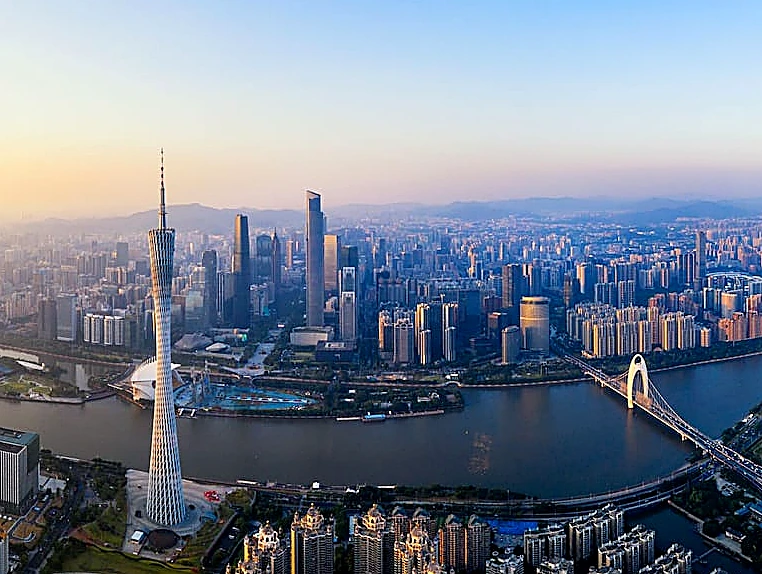
Viewed through traditional geomancy and historical geography, Beijing Road Pedestrian Street occupies what ancients hailed as the “center of all centers” within walled Guangzhou. Its setting fulfills an ideal “mountain-backed, water-flanked, dragon-vein converging” configuration rare in southern China. To the north, auspicious terrain sweeping down from gentle Yuexiu Mountain forms a bedrock anchor behind the avenue. To the south, sightlines open toward the surging Pearl River carrying centuries of silt. In traditional East Asian geomancy, mountains govern population and water governs wealth; sitting right between majestic hills and a generous river turned this site into a prime commercial hub attracting talent from afar and gathering imperial vitality across more than two thousand years.
Looking deeper into the original landscape structure, the West Lake Road area intersecting today’s Beijing Road was once a celebrated waterside spot known as “West Lake” in ancient Guangzhou. During the golden age of feudal dynasties, this was not a grid of dense buildings or flat asphalt, but a calm natural lake fringed with weeping willows that served as a microclimate regulator for the administrative core. Tucked within that tranquil lakeside setting is the “Nine Star Stones” site—dating from the Song and Yuan dynasties and surviving today. Nine dramatic rocks shaped to evoke stars in Taoist astronomy once graced royal gardens of the Southern Han rulers and served as a premier literary gathering spot for zither music, poetry critique, and moonlit water reflections, lending rich cultural depth amid bustling urban life.
Spatial planning along the avenue also inherited classic traits of Lingnan water-town geography, where waterways and urban fabric intertwine closely. Beijing Road’s overland trade route never developed in isolation; it linked organically with ancient water transport via famed Tianzi Wharf along the Pearl River. Tianzi Wharf long served as the “First Official Pier,” welcoming imperial envoys, international merchant vessels, and salt-and-silk convoys coming ashore to transfer goods directly into the city core along Beijing Road. This “land-and-water linked, court-in-front and market-behind” structure created a self-sustaining cycle of gathering vitality and generating prosperity, keeping commercial lifelines unbroken across changing regimes.
The historic and cultural preservation zone of Beijing Road spans a strictly protected 22.17 hectares, shaping an iconic urban spine stretching more than 1,500 meters through the historic heart of Yangcheng (Guangzhou). This heritage axis begins in the north along Guangwei Road and the northern boundary of the thousand-year-old Nanyue Kingdom Palace site, running southward until reaching breezy Yanjiang Middle Road beside the Pearl River. Within this expansive footprint, the core pedestrian street covers roughly 1.252 kilometers with a generous 16-meter cross-section, creating a spacious walkway where high-level archaeological preservation and lively commerce blend seamlessly.
The architectural soul crowning the street is its network of Lingnan arcade shophouses (qilou) weathered across decades. These commercial buildings set their ground floors back to create continuous covered colonnades—a smart microclimate solution suited to sudden tropical downpours and intense southern sun. Sturdy columns and European Renaissance-inspired arches harmonize with traditional Lingnan relief motifs over light gray granite-plaster facades. Building elevations are restored under a “make old look like new while honoring historical authenticity” ethos, preserving cornices, wooden grilles, and historic family shop signs without losing contemporary vitality.
Right at the center of the street, an open-air archaeological corridor is protected beneath multi-layered transparent tempered glass, withstanding all weather while offering a one-of-a-kind multi-dimensional view. Strollers walk seemingly above a millennium of cultural strata, viewing the “Five-Dynasty Ancient Road” where paving bricks from the Tang, Song, Yuan, Ming, and Qing dynasties stack in chronological order, alongside massive stone foundation traces of a Song-era city gate. Bringing together 87 immovable cultural heritage sites and 93 historic buildings turns the street into a living open-air museum where the past of a great southern port city lives right beneath visitors’ feet.
Investment scale and spatial vision along Beijing Road are also evident in how modern underground transit pairs with relaxed ground-level pedestrian space. Subway entrances feed directly into the street, dispersing large crowds smoothly without burdening the heritage surface above. The corridor is also extending deeper toward the waterfront to connect with Haizhu Square, gradually completing a high-end ecosystem of retail, cultural exhibitions, and leisure that anchors a hundred-billion-RMB Lingnan cultural commercial hub of global caliber.
As sunset glow settles beside the Pearl River, the rhythm of Beijing Road Pedestrian Street does not wind down; instead, it transforms dramatically into a radiant visual spectacle where boundaries between ancient heritage and modern city life dissolve completely. Beneath the Lingnan night sky, the kilometer-long avenue glows in a sea of multicolored light. Illumination from stylish shopfronts and neon signs mingles with architectural floodlights across weathered green-brick walls, reflecting silhouettes of strollers passing open-air archaeological layers. At night, the street becomes a grand open-air stage where every visitor feels like a time traveler in southern China’s liveliest metropolis.
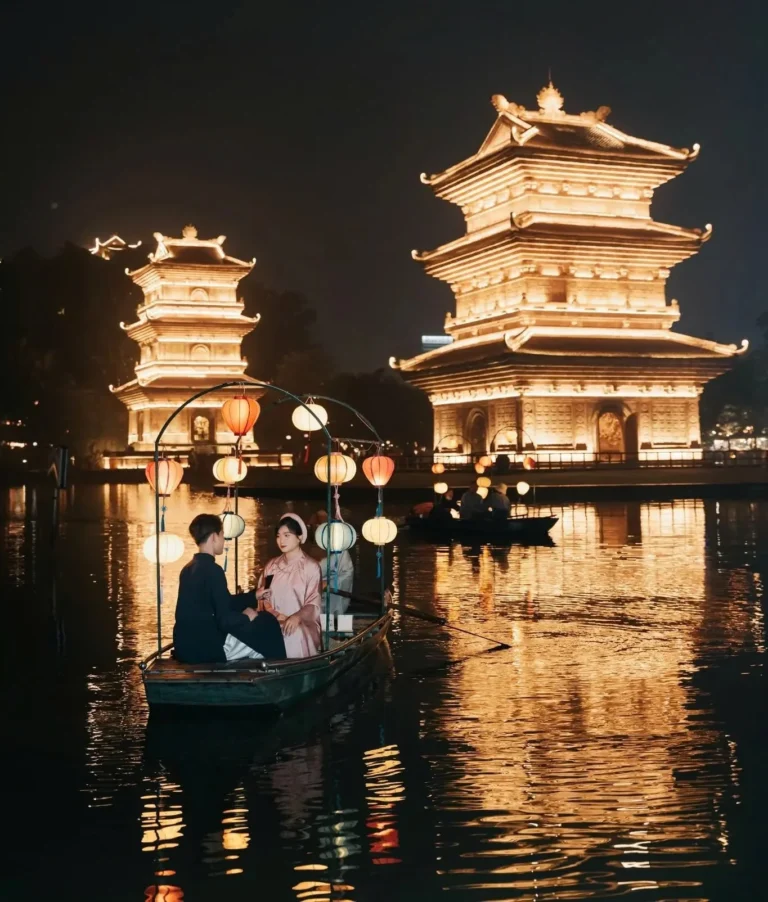
The most dramatic and captivating focal point of Beijing Road’s night illumination is the Dafosi Temple standing majestically along the western side of the district. Founded during the Southern Han Dynasty as one of the sacred “Twenty-Eight Temples” guarding the Lingnan frontier, it weathered cycles of rise and fall before Prince Shang Kexi of Pingnan undertook a major reconstruction during the Kangxi reign of the Qing Dynasty. When the entire timber complex lights up together, its multi-tiered main hall—with layered eaves, sweeping flying corners, and intricate dougong brackets—shines like a palace suspended in midair. Warm golden light wraps wooden frames, rafters, and ancient pillars, creating an enchanting scene often compared to mythical pavilions in Spirited Away and drawing crowds to admire and photograph it every night.
Beneath the arches of Sino-European arcade buildings, contemporary light art blends smoothly with everyday street flavor. “Guochao” (national-trend) motifs weave into multimedia light projections, where giant 3D visual displays cast soaring dragons and phoenixes, blue-and-white porcelain patterns, and ancient Guangzhou legends across modern facades. That energy resonates with fragrant street food steaming from longtime stalls: savory beef offal stewed with radish, sweet almond dessert soup, springy fresh-shrimp wonton noodles, and traditional curry fish balls—composing a lively symphony of southern taste and urban emotion.
Nighttime momentum continues southward beyond the core pedestrian street, forming a leisurely promenade linking straight to historic Haizhu Square and Pearl River night-cruise piers. Along this route, urban lighting guides visitors from serene temple eaves through bustling tech-lit shopping arcades and out toward breezy riverbanks. This skillful blending of millennium-old heritage, generational cuisine, and modern visual art makes Beijing Road by night a singular multi-sensory experience capturing Guangzhou’s enduring splendor.
An old saying proclaims, “Eat in Guangzhou,” yet to touch the refined essence of Cantonese cuisine, food lovers across generations continually return to the crossroads of flavor and memory along Beijing Road. Far more than a bustling marketplace, the area holds living intangible culinary heritage, highlighted by local “Old Canton” food maps and lists of thirty must-visit heritage eateries. The spirit of Cantonese cuisine—foremost among China’s Four Great Culinary Traditions—shines through refined ingredient selection, intricate technique, respect for natural freshness, and seasonal balance of yin and yang.
Speaking of the century-old culinary culture along this historic street, the flagship Tao Tao Ju teahouse stands as a living witness to “tan cha” (morning tea)—a tradition woven into Lingnan life. Stepping through its ornate Manchurian-carved doors transports diners into old-capital elegance to enjoy “one pot of tea and two dim sum dishes,” sipping rich black tea beside steaming bamboo baskets. Nearby, Guangzhou Restaurant—celebrated as a classic palace of Cantonese gastronomy—preserves time-honored roasting mastery. Amber-skinned roast goose, glossy honey char siu fragrant with rose-liquor aroma, and delicate dim sum showcase the artistry of master Cantonese chefs.
Beyond grand restaurants, the soul of everyday Old Canton cuisine shines in modest family-run shops along side streets. Foremost is Yinji Changfen, which elevates street snacks into handcrafted artistry by steaming rice rolls on traditional silk cloths. Translucent, jade-smooth rice sheets wrap crisp fresh shrimp or tender marinated beef, drizzled generously with a secret sweet-savory soy sauce. Alongside it stands Dian Dou De, renowned for traditional shrimp dumplings pleated like delicate fans with clear wrappers that showcase sweet ocean shrimp, paired with rich crab-roe siu mai.
Tucked along historic West Lake Road preserving sweet old-street flavors, the sign of Nam Sin Buffalo Milk Dessert Shop draws a steady stream of visitors. This famed shop is a haven for desserts made from rich Shunde buffalo milk—yielding double-skin milk pudding (shuangpinai) with a silky, custard-rich texture that melts on the tongue. On chilly days, a hot bowl of ginger milk curd—magically setting right at the table as fiery aged ginger juice meets hot milk—awakens the senses with sweet, warming comfort.
After dusk, deep alleys branching off the main avenue fill with rustic aromas from longtime charcoal kitchens. The crackle of clay-pot rice (baozifan) over glowing charcoal mingles with fragrant rice, glossy cured sausage, and a crisp golden crust at the bottom of the pot. Beside it, pots of beef offal simmered with radish bubble with herbal fragrance, while silky congee simmered with bone broth and fresh seafood weaves a warm, authentic portrait of historic Guangzhou street life.
Reaching this millennium-old avenue is simple with a basic grasp of Guangzhou’s modern subway network woven beneath the city. To join the lively flow along Beijing Road, taking the Guangzhou Metro is easiest: ride Line 1 or Line 2 to Gongyuanqian Station and exit via Exit D to enter the bustling northern section, or take Line 6 to Beijing Lu Station and exit via Exit B to step right onto the main commercial stretch. The outdoor pedestrian street is open free of charge around the clock, though shops, department stores, and fashion boutiques along both sides typically open around 10:00 AM and wind down near 10:00 PM.
One of the most memorable sights visitors hope to catch is Dafosi Temple lighting up at night. This historic temple—with roots going back to the Southern Han Dynasty—usually illuminates its multi-tiered timber halls with thousands of warm golden lights from roughly 7:00 PM to 9:30 PM each evening, creating a scene straight out of a fantasy novel. While exploring, pay special attention to the outdoor Millennium Ancient Road archaeological glass display. Although the thick transparent glass showcasing road layers from the Tang, Song, Yuan, Ming, and Qing dynasties offers a dramatic view, it can become quite slippery on damp, drizzly Lingnan days—so wear slip-resistant shoes and watch your step.
Sampling classic Cantonese cuisine along Beijing Road is a rewarding culinary journey, though a little planning helps avoid crowds and pitfalls. Century-old “Time-Honored Brand” institutions like Tao Tao Ju and Guangzhou Restaurant often draw long queues during morning tea hours and traditional holidays. A seasoned tip is to pull a queue number online early or arrive before 8:30 AM to enjoy Tieguanyin tea alongside shrimp dumplings and char siu buns at an unhurried pace. Also, when shopping for specialties like Huangshanghuang cured sausages, herbal teas, or carved jade, visit official certified shops rather than street hawkers to avoid overpriced mixed crafts.
For a smooth trip from the very start, ensure your passport has over six months of validity, complete your China tourist visa in advance, and have entry/exit forms ready. In a highly cashless society, linking an international credit card to Alipay or WeChat Pay before departure is essential for paying meals, transit, and shopping where cash is rarely used. Having an eSIM or international roaming data plan active will also keep maps and messaging connected effortlessly. With these practical details in place, you can savor centuries of history blended with modern energy in central Guangzhou. If you want to explore these rich cultural layers on a well-structured, comfortable schedule, consider a 4-Day 3-Night Guangzhou–Shenzhen Tour to experience the vibrant pulse of southern China.