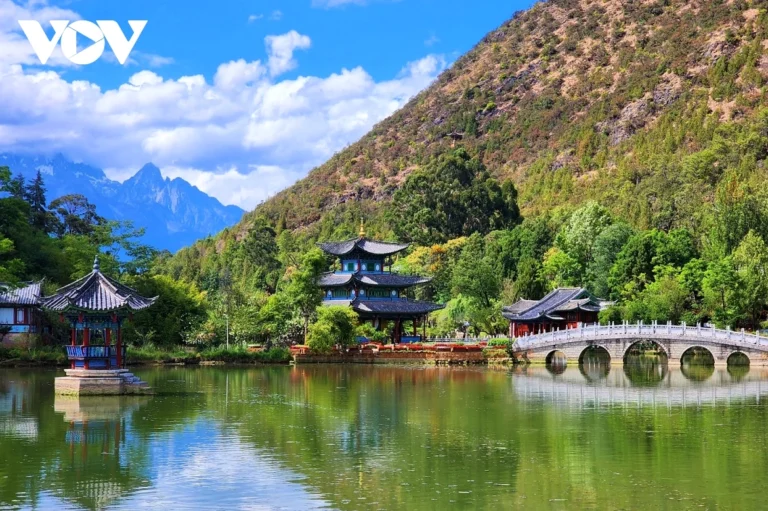
Nestled quietly at the foot of majestic Elephant Hill north of Lijiang Old Town, Black Dragon Pool Park has long been regarded as the vital spring nourishing the entire canal network of this millennium-old cultural land. Its origins trace back to pure underground water gushing from limestone fissures and gathering into a crystal-clear, mirror-calm pool that locals once poetically called Jade Spring. Turning back the pages of ancient southwestern gazetteers, formal construction of man-made structures in this natural setting began in the second year of the Qianlong reign under the Qing Dynasty—1737 AD. That era marked tighter direct administration and cultural consolidation across borderland Tusi territories, laying foundations for deep blending between northern imperial architecture and indigenous Naxi woodcarving artistry.
The spiritual anchor and founding nucleus of the entire complex is the Dragon God Shrine of Jade Spring, built by local officials and residents in 1737 to honor the deity protecting water sources and peace throughout the valley. The shrine’s revered efficacy and the ethereal beauty of the jade spring soon reached Beijing, drawing special imperial attention from Qing emperors to this distant frontier. Across the dynasty’s history, the shrine received the imperial title “Dragon God” twice. Those solemn royal bestowals elevated the shrine’s official standing within state-recognized deities and placed Black Dragon Pool among China’s most celebrated springs of the era.
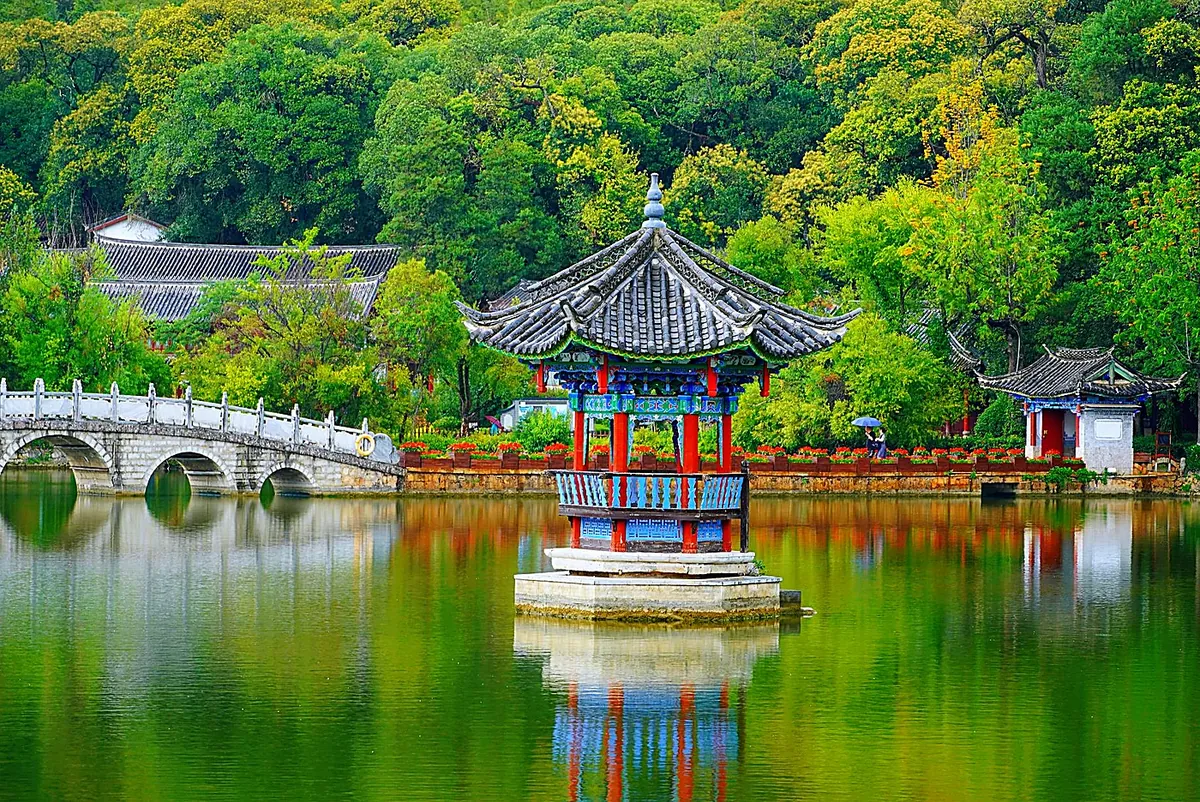
The passage of time added further cultural layers across shifting political eras. More than a century later, during the late Qing under Emperor Guangxu, Black Dragon Pool underwent another notable transformation. In the second year of Guangxu (1876), two iconic structures—the Ancient Opera Stage and Deyue Pavilion (“Moon-Capturing Pavilion”)—were built and completed. Standing gracefully amidst blue water and connected to shore by curving stone bridges, Deyue Pavilion became a favored spot for Lijiang scholars to compose poetry and admire the scenery. Alongside it, the Xueshan Studio on the eastern bank of Deyue—with roots dating back to 1737—formed a secluded, refined retreat where literati admired Jade Dragon Snow Mountain’s reflection on the lake while sharing tea and chess.
Through the upheavals of world wars and sweeping twentieth-century social changes, Black Dragon Pool retained the refined character of its heyday. Beyond preserving original buildings, the park welcomed and safeguarded rare historic structures from the Ming and Qing dynasties relocated here for conservation in later decades. Because it gathers such a dense concentration of openwork woodcarving, intricate dougong bracket joinery, and sweeping upturned eaves in traditional style, scholars have honored the scenic area as an open-air museum of Ming–Qing architecture in Lijiang. Its historical depth and heritage integrity made Black Dragon Pool an inseparable core element of the UNESCO-recognized Lijiang Old Town World Heritage site, before earning 4A National Tourist Scenic Area status in 2009—affirming the enduring vitality of a centuries-old cultural icon.
Standing at over 2,400 meters above sea level on the northwestern Yunnan plateau, Lijiang’s Black Dragon Pool Park occupies a rare geographic coordinate among classical East Asian gardens. Sitting directly beside the northern edge of Lijiang Old Town, the landscape rests firmly along the western slope of Elephant Hill—a hill shaped like a kneeling elephant acting as a northern guardian Xuanwu screen. In traditional geomancy, this terrain fulfills prime criteria of an auspicious energy-gathering sanctuary, where vitality flowing down dragon veins from northern snow peaks is sheltered and held by Elephant Hill, creating a basin where pure energy settles. The organic bond between sturdy granite rock and abundant groundwater acts as a natural geomantic shield while moderating the microclimate across Dayan Valley for centuries.
The core lifeblood shaping the site’s name and spirit is its remarkable subterranean hydrology emerging from bedrock. Right at Elephant Hill’s base, regional karst geology forms deep underground caverns where two icy, crystal-clear springs surge continuously through stone crevices year-round. Snowmelt filtered through tens of thousands of geological strata collects into a deep, expansive pool spanning roughly 40,000 square meters. The water is clear enough to reveal pebbles and swaying aquatic plants below, gleaming emerald-green like a giant piece of jade—which is why ancients affectionately called it Jade Spring. Beyond scenic beauty, this pool serves as a vital waterworks heart, feeding three branches of the Jade River that wind through cobbled lanes and timber verandas across Lijiang Old Town.
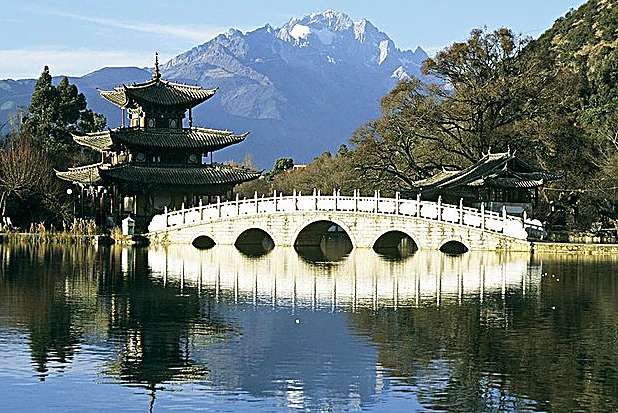
Scenery here reaches a peak of visual artistry through reflections that ancients captured in a timeless poetic couplet: “Dragon Pool inverts all thirteen peaks; jade waters stretch more than half a li.” On calm mornings as mist lifts or on windless evenings, the lake acts like a dead-still mirror capturing the full grandeur of Jade Dragon Snow Mountain’s thirteen year-round snow-capped peaks against clear highland skies. Vivid contrast between pure white snow high above, dark green weeping willows along the banks, and deep jade water below creates a poetic landscape rarely matched anywhere in Southwest China.
Landscape planning at Black Dragon Pool is also a classic model of shakkei (“borrowed scenery”)—framing distant sky and mountains inside a compact garden. Rather than imposing heavy man-made structures, ancient planners followed natural foothill hollows, arranging softly curving stone embankments, gentle earthen banks, weeping willows, and old cypresses. The park opens northward to frame direct views of Jade Dragon Snow Mountain, forging an invisible yet tight visual link between still water below and towering snow above. Blending cool spring water from Elephant Hill with ancient snow reflections on the surface yields a complete geomantic whole that sets Black Dragon Pool apart along Yunnan’s frontier.
Historic architecture in Black Dragon Pool Park reads like an exemplary landscape blueprint where four major southwestern building traditions converge: Han, Bai, Tibetan, and Naxi. Rather than following rigid northern palace symmetry, layout adapts fluidly to Jade Spring’s water contours and sightlines toward the snow peaks. At the entrance stands Wenming Archway, a traditional four-pillar, three-bay gate carved with clouds, flames, dragons, phoenixes, and auspicious birds—marking the transition from bustling town streets into a serene woodland garden.
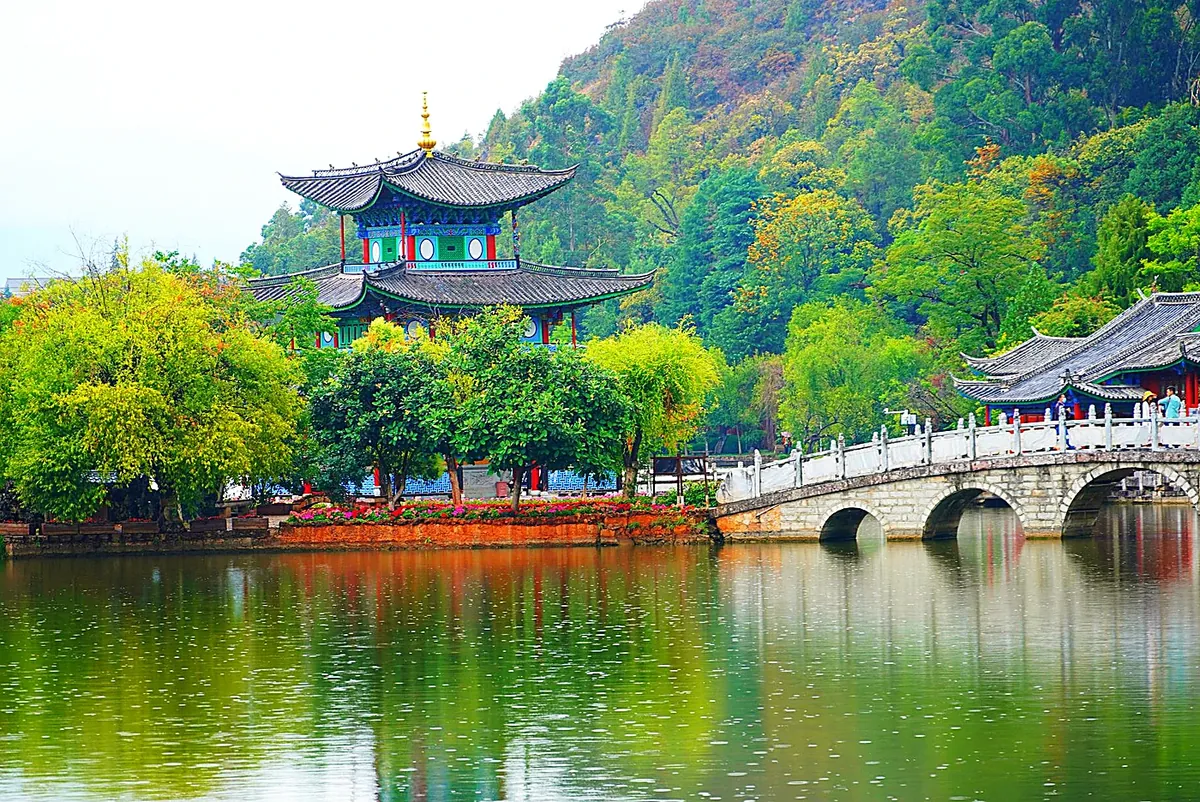
Moving out onto the lake, the graceful white stone Suocui Bridge arches across jade water toward Deyue Pavilion. This three-story pavilion standing amidst the pool features layered eaves curving lightly on all four sides, casting reflections across calm water alongside distant Jade Dragon peaks. Beside it sits the Ancient Opera Stage, a colorful traditional timber theater once alive with mysterious Naxi Dongjing court music during spring ceremonies. Anchored in a prime hillside spot stands the Dragon God Shrine of Jade Spring, built in the Qing Qianlong era in formal temple style complete with imperial plaques and inscriptions—testifying to central court recognition of Lijiang’s local water-god devotion.
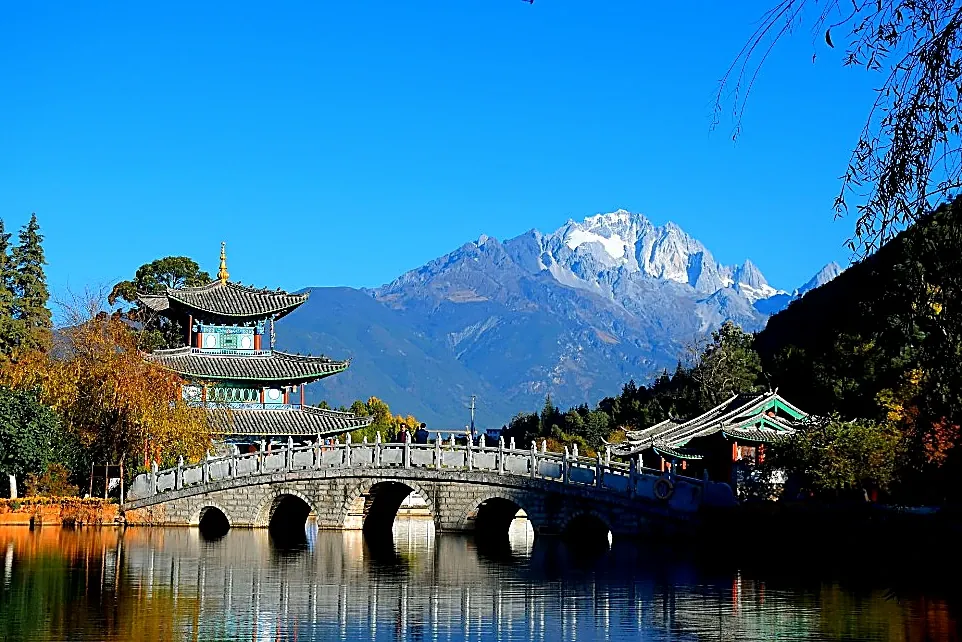
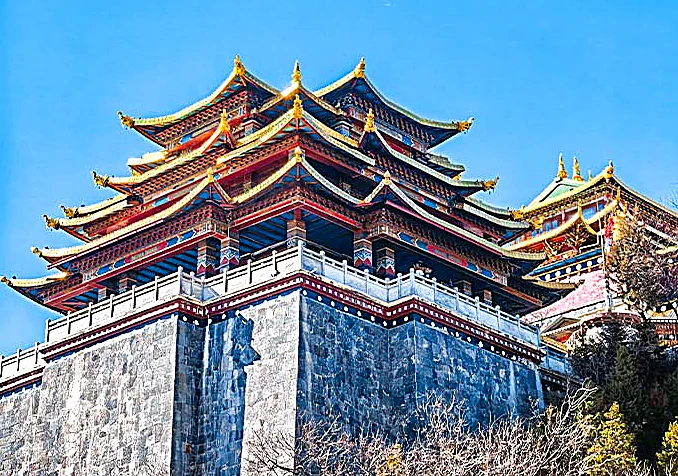
The most dazzling timber masterpiece in the entire complex is the Five Phoenix Pavilion, originally part of the mountain gate at celebrated Fu Guo Temple below Baisha Mountain and relocated intact to Black Dragon Pool in the late twentieth century for preservation. Standing nearly twenty meters tall, this soaring pavilion features three tiers of rafters and dougong brackets with twenty wide-spreading roof corners—creating a striking visual effect like five colorful phoenixes spreading their wings against the blue sky. Even more remarkably, its entire load-bearing frame is joined using intricate hardwood mortise-and-tenon joints without a single iron nail, showcasing deep ancient wood mechanics and master carpentry.
Beside the graceful Xueshan Studio shaded by old trees, the garden also sets aside dedicated space for the Lijiang Dongba Culture Museum. Systematically arranged as a heritage stronghold, the museum houses thousands of precious original artifacts, including ancient manuscripts written in Dongba pictographs—the world’s only living purely pictographic script still in active use. Together with ritual implements, ceremonial vessels, wooden masks, and antique Dongba thangka scrolls, it transcends ordinary sightseeing to become a living encyclopedia of Naxi anthropology and civilization beside the snow mountains.
As late afternoon sun slips behind ranges of snow-capped peaks, Lijiang Valley enters its most magical transition of the day. Unlike dazzling neon metropolises or resorts relying on flashy laser shows, Black Dragon Pool Park at dusk embraces a quiet, natural lighting aesthetic. Warm amber sunset light slants across Elephant Hill, gilding Jade Dragon’s thirteen snow-clad peaks to the north before shifting into the soft indigo-violet twilight characteristic of the Yunnan–Guizhou plateau. Jade Spring pool becomes a calm antique mirror gathering wide skies and layered light and shadow across unruffled green water.
Nighttime at Black Dragon Pool offers a striking, enchanting contrast to neighboring Lijiang Old Town. Just a short walk from busy Sifang Street—lively with taverns and Naxi reed pipes—Black Dragon Pool returns visitors to ethereal quiet. There are no commercial water shows or noisy concerts here; instead, the “live scene” is the resonance between vast nature and centuries-old architecture. Garden lighting is deliberately restrained, using subtle warm light tucked beneath stone balustrades and curved eaves to highlight traditional forms without overpowering the quiet mountain night.
Once darkness settles fully, Deyue Pavilion out on the lake appears like a waterside palace suspended between reality and dream. Its three-story glazed-tile structure with gracefully curved eaves reflects across clear water in near-symmetrical beauty. White marble arches of Suocui Bridge mirror in the deep pool alongside round glints of moonlight on water, bringing to life old poetic verses celebrating water, wind, and moon. Deep forest shadows along Elephant Hill embrace the shoreline, framing a quiet sanctuary apart from the outside world.
Strolling along the bank in cool highland night air, visitors sense the refined evening-wandering spirit of Ming–Qing literati. Occasionally, floating from Deyue Pavilion or lakeside willows, come the plaintive, ethereal notes of a traditional Naxi ensemble played by local elders. Pipa and ancient sugudu lutes blend with the gentle murmur of Jade Spring flowing endlessly, creating a peaceful harmony that awakens the senses. Night light at Black Dragon Pool is not a display of technology, but a poetic pause where heritage, Eastern sensibility, and Lijiang’s timeless landscape find balance.
Stepping out from the calm of Black Dragon Pool, Lijiang’s cultural story continues through distinctive indigenous Naxi cuisine. Local food reflects cold highland terrain, rich vegetation beneath Jade Dragon Snow Mountain, and generations of food preservation. In winding lanes between the park and old town, family kitchens steam with aromatic dishes distilling pure spring water and mountain harvests.
Topping the culinary scene around Black Dragon Pool are warming hotpots that bring families together in crisp highland air. Salt-cured pork rib hotpot with wild mushrooms is a beloved family specialty: pork ribs cured in coarse salt and air-dried through cold winter months are slow-simmered with prized wild fungi such as matsutake and golden boletes to release a clean, deeply savory broth. Equally famous is steaming black-goat hotpot made from free-range highland goats, braised tender with mealy mountain potatoes and wild mushrooms. Diners also seek out small street shops for tangy pickled-beef hotpot in Ama Niu style or stone-pot steamed chicken in Dianchuan style, where highland chicken cooks rapidly under pressurized steam from natural stone vessels to lock in pure sweetness and trace minerals.
Alongside slow-simmered stews is indigenous wood-fire grilling, exemplified by famous Dongba grilled fish. Freshwater fish raised in snowmelt waters are marinated with special dried chili, Sichuan pepper, and secret mountain herbs, then grilled over hot charcoal until skin turns crisp and flesh stays moist, finished with crushed roasted peanuts and green scallions. Equally rich is Naxi roasted pork belly, cut thick, seasoned boldly, and roasted over charcoal until fat renders and skin crackles golden with smoky aroma. Meals feel even livelier with crispy fried pork ribs served with fresh mint leaves—a spontaneous yet refined pairing of rich fried pork with cool, lightly peppery mountain herbs.
Wandering slowly through flagstone lanes around Black Dragon Pool, century-old street-food culture comes alive through chickpea jelly (liangfen). This classic Naxi snack made from protein-rich local beans can be eaten cold with soy sauce, fragrant vinegar, and bright red chili oil, or pan-seared on a cast-iron griddle until golden and crisp outside while staying soft and chewy inside. Rounding out the walk are charcoal-puffed rice-cake slices brushed with spicy bean sauce, ash-roasted potatoes, and rustic stir-fried minced pork with Yunnan pickled greens and bell peppers. Before ending your stroll, a freshly baked rose pastry with flaky layers enclosing fragrant fresh rose petals preserves the sweet, lingering charm of ancient Lijiang.
Resting peacefully at the foot of Elephant Hill, Black Dragon Pool Park is located at No. 1 Minzhu Road in Gucheng District, Lijiang City. From the core of Dayan Old Town to the park gate is only about one kilometer north—an ideal distance for an unhurried walk beside clear water. Visitors can follow babbling Jade River channels, crossing mossy stone bridges and trailing willows in about fifteen minutes to step naturally into this serene sanctuary. For quicker access or traveling with older companions, Lijiang city buses and taxis drop off right outside the grounds, while outer self-driving parking lots are spaciously laid out for all arrival options.
Regarding admission and formalities, the scenic area welcomes visitors from early morning mist until sunset fades behind the snow peaks. While the park itself is open to the public for strolling, visitors are generally required to present a valid Lijiang Old Town maintenance fee receipt at entry checkpoints—so remember to carry your original passport and ID when passing through. The best time of day to visit Deyue Pavilion or Suocui Bridge is right at dawn. As early sunlight crosses crisp highland air, Black Dragon Pool lies dead calm like a silver mirror, reflecting the full majesty of Jade Dragon Snow Mountain before afternoon breezes or bustling crowds stir the water.
Standing above 2,400 meters on the plateau, climate around the pool feels spring-like year-round yet brings sharp day–night temperature swings. Dress in layers to adapt easily to sudden temperature shifts, and pack sunglasses, sunscreen, and a wide-brimmed hat against strong ultraviolet rays on the Yunnan plateau. For extra exercise and a sweeping vantage point, a stone trail behind Five Phoenix Pavilion climbs up to the Elephant Hill viewing pavilion—offering panoramic views of Dayan Old Town’s thousands of overlapping tiled roofs framed by nature and centuries-old heritage. Portable oxygen canisters and local Rhodiola herbal supplements are also handy for first-time visitors adjusting to thinner southwestern air.
Exploring Lijiang’s natural grandeur and Dongba culture feels even more rewarding within a thoughtfully planned multi-stop route. To take in Black Dragon Pool alongside dramatic landscapes across mysterious Yunnan, consider a hands-on itinerary such as a Dali–Lijiang–Shangri-La–Kunming tour for an unhurried, memorable journey.