Seven Star Crags (七星公园) resembles a gigantic geological and cultural museum of Guilin, where every single ancient limestone stratum bears the accumulated imprints of over a millennium of dynastic vicissitudes. The cultural origins of this scenic wonder were established during the Sui Dynasty (581–618). In the Kaihuang era (581–600), the Seven Star Cave was first discovered amidst wilderness and drifting clouds, leading to the appearance of modest Buddhist thatched hermitages built against the cliffs of Putuo Mountain (普陀山), leaving behind the earliest pioneering stelae inscriptions still preserved at the cave entrance. Entering the Tang Dynasty (618–907), the pinnacle of cultural governance under the Kaiyuan era (713–741) transformed Seven Star Cave into the premier scenic retreat in the Lingnan region. Li Bo, the talented Prefect of Guizhou, personally scaled mountains and forded rivers to comprehensively survey the geographic terrain, establish hiking trails, and officially name numerous scenic spots. It was also during this golden age that the majestic calligraphy masterpiece “Xiaoyao Pavilion” by master Yan Zhenqing and the Early Tang relief Buddha statues were carved directly into the cliff walls, immortalizing the spirited grandeur of the High Tang into the rock and stone.
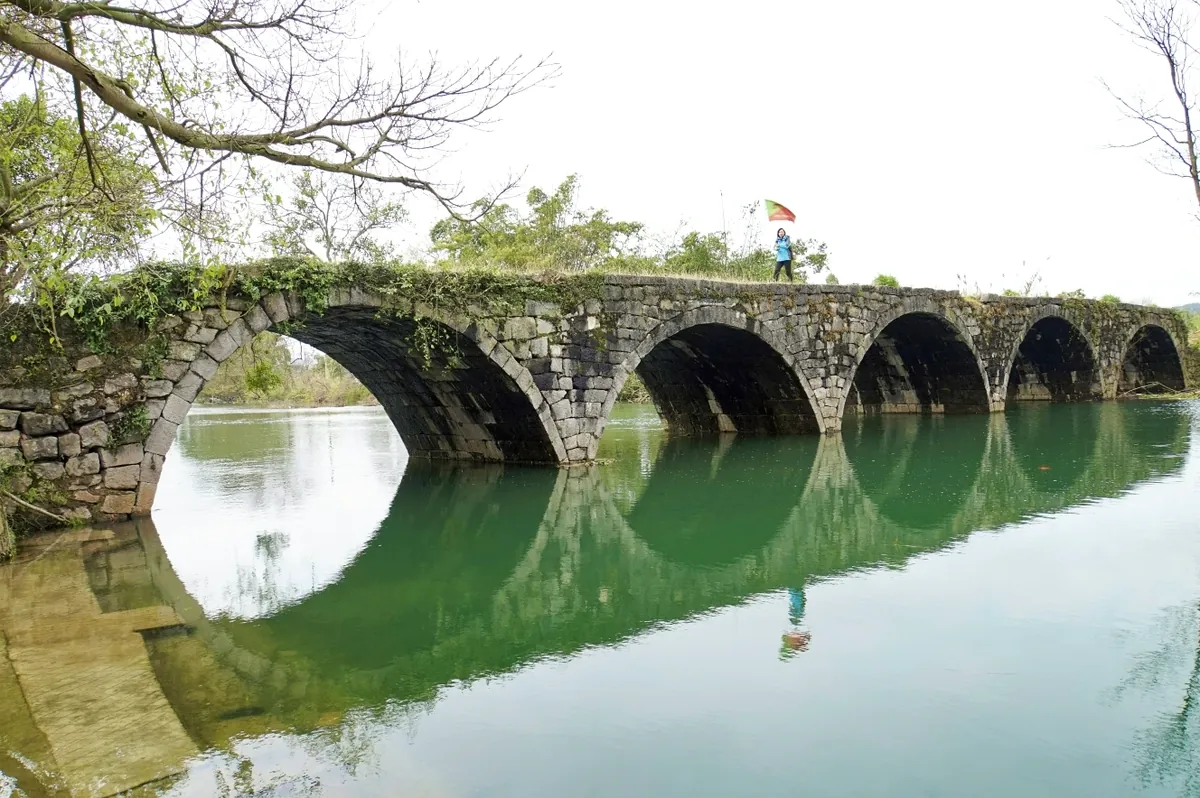
The poetic current continued to flow through the Song Dynasty (960–1279), marking a major turning point in the seventh year of Qiandao (1171). The scholar and Administrator of Jingjiang, Fan Chengda, upon taking office in this region, dedicated himself to fieldwork and authored the classic geographical treatise “Gui Hai Yu Heng Zhi”, while also overseeing the planning and restoration of the masterpiece Flower Bridge and personally inscribing the immortal “Bihui Ming” poem onto the cliff face. By the Ming Dynasty (1368–1644), from the Hongwu to the Wanli eras, the eastern cluster of mountains fell under the direct jurisdiction of the Jingjiang Prince’s Mansion. Camel Hill, standing proudly like a camel resting on a grassy meadow, became the secret archery training ground for the imperial relatives of the vassal prince. The elegant traces left by the free-flowing brush of scholar Zhang Xiandi and the serenity of Yinyuan Hermitage also gradually took shape, weaving a profound cultural visage in the heart of the southern imperial court.
The vicissitudes of times did not stop at scenic escapism but were also deeply imbued with unyielding integrity through the fierce turning points of modern history. In the third year of Shunzhi (1646) during the early Qing Dynasty, the Anti-Qing and Ming Restoration movement erupted fiercely across southern China. Ming general Xiao Zhen turned the perilous cliffs around Putuo Mountain into an impregnable military defense line, valiantly halting the assault waves of the Eight Banner cavalry, leaving behind for posterity a martyr’s tomb blazing with loyalty alongside stirring memorial stelae. Nearly three centuries later, amidst the fires of the Pacific War and the Second Sino-Japanese War (1937–1945), the natural cave network transformed into a reinforced air-raid shelter and an underground field hospital for the Kuomintang engineering corps; today, the limestone cliffs still preserve hastily carved inscriptions recording the dates of dodging bombs and bullets, vividly reflecting a turbulent era of smoke and warfare.
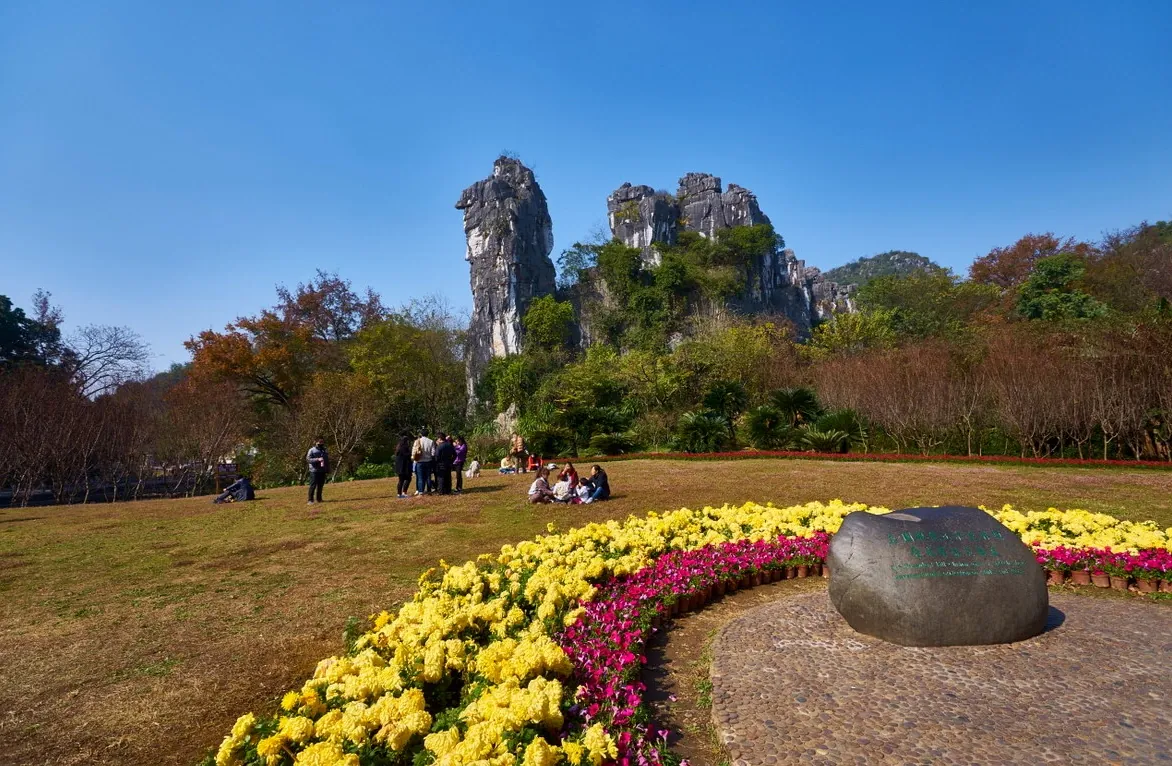
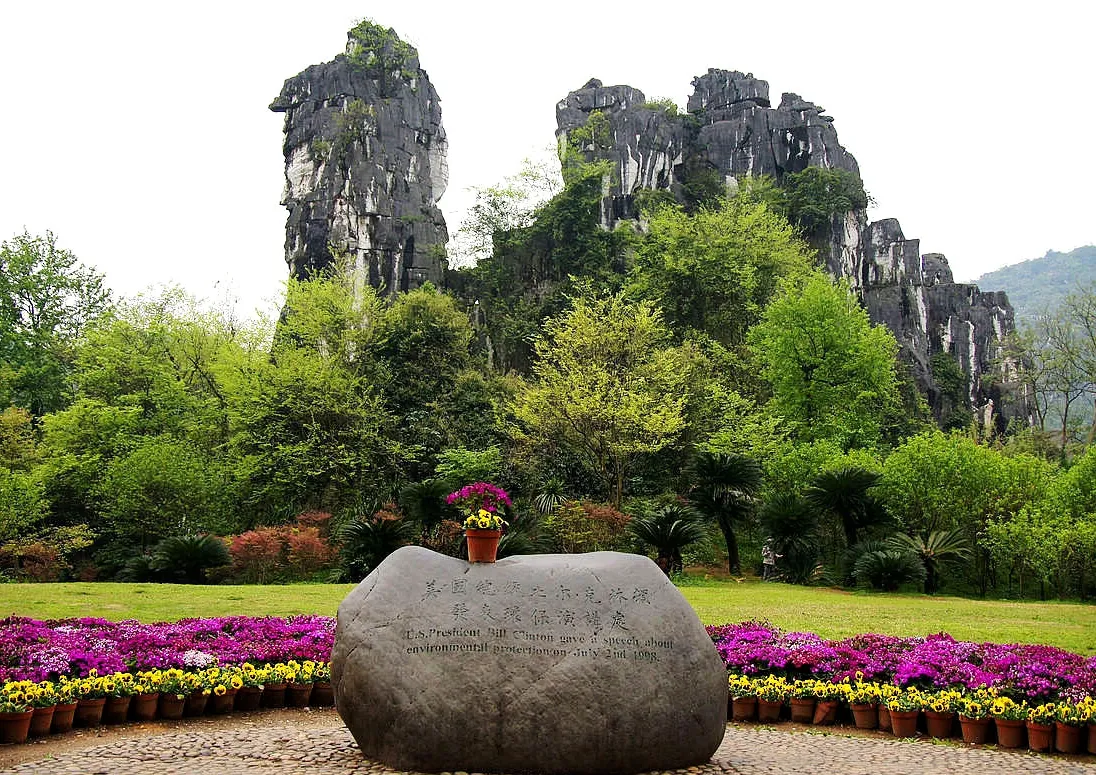
Entering the modern era, Seven Star Crags not only preserves historical traces but has also risen to become a symbol of diplomatic connection and humanity’s message of peace. In July 1998, during his official state visit, US President Bill Clinton chose the expansive lawn stretching right at the foot of Camel Hill to deliver a globally strategic speech on ecological environmental protection. That milestone gave birth to the name “Clinton Lawn”, bringing the millennium-old scenic space into the mainstream of contemporary international events.
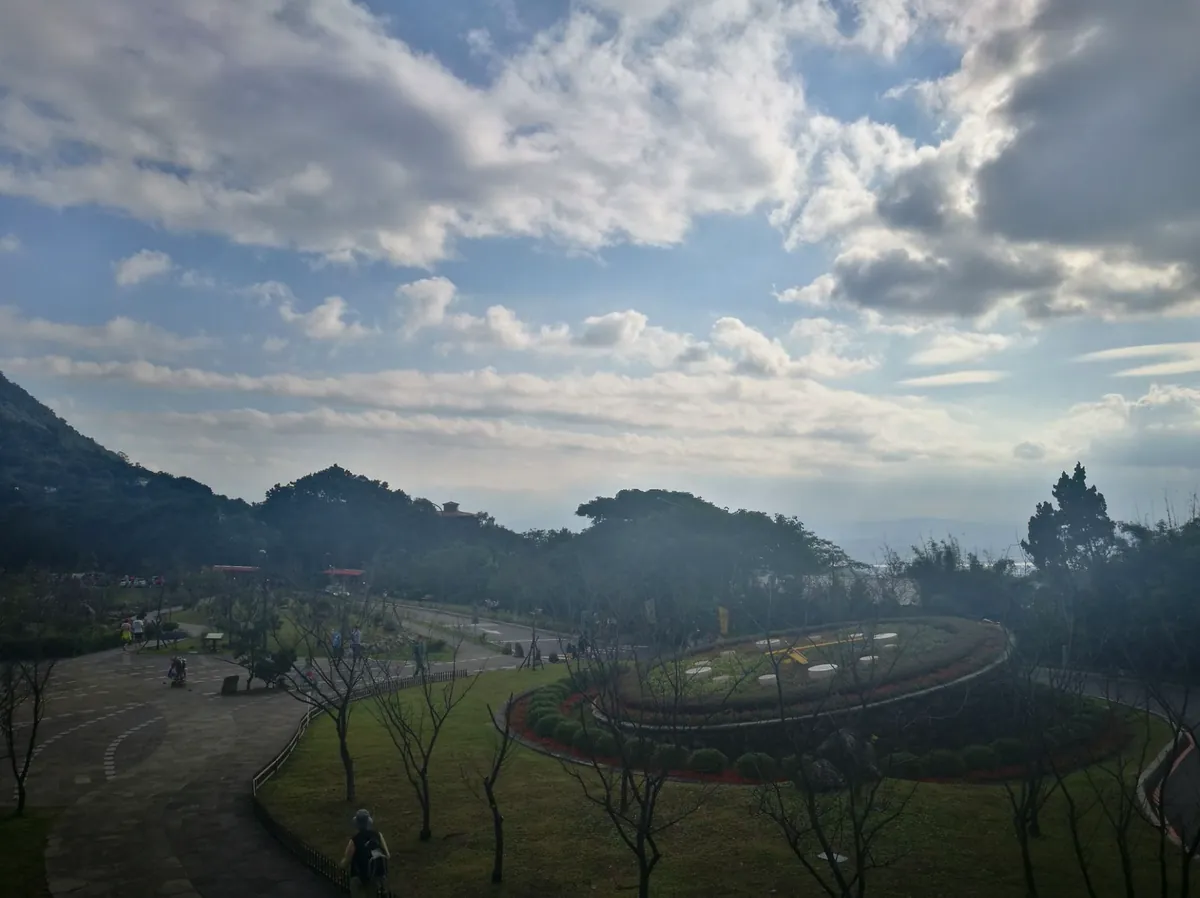
Today’s Seven Star Crags unfolds like a living outdoor chronicle, where millennial imprints blend flawlessly with modern ecological landscapes. From a panoramic view, the park appears tranquil with smoothly paved internal pathways winding gracefully amidst lush green lawns. A distinctive visual highlight is the gigantic circular floral clock reigning gracefully on the right side of the frame, creating a symbol for measuring time between heaven and earth. Scattered along the pathways, trees shedding their leaves stretch out bare branches to create a somber depth, contrasting impressively with the undulating green mountains in the distance under a hazy, cloud-draped sky.
Gracefully situated on the eastern bank of the tranquil Li River in the Qixing District, the Seven Star Mountain (Qixing Mountain) complex enjoys a rare and magnificent natural feng shui layout characteristic of Guilin’s karst landscape. Encircling the base of these limestone peaks is the winding Xiaoqing River, accompanied by a network of natural ponds that act like a soft silk ribbon, locking in the sacred energy of the land. From the perspective of traditional feng shui, this terrain creates a “gathering water, accumulating blessings” configuration, where water veins converge to embrace the sturdy mountain core, harmonizing the yin-like stillness of the clear water with the yang-like stoicism of ancient limestone, generating an abundant flow of vital energy (qi) that protects the entire scenic area.
From a geological perspective, the spectacular landscape of Seven Star Mountain is a masterpiece of tropical karstification spanning hundreds of millions of years. The entire foundation of the area is linked to the Rongxian limestone formation, which originated in the Late Devonian period, approximately 360 to 380 million years ago. Through the immense tectonic upheavals of the Earth’s crust—most notably the Yanshan and Himalayan orogenic cycles—these ancient carbonate sedimentary layers were compressed, fractured, and uplifted from the seabed. Under the relentless chemical erosion of rainwater dissolving carbonic acid, the massive limestone blocks were gradually carved and dissolved along natural fracture lines, leaving behind seven towering limestone peaks that rise independently above the fertile alluvial plain.
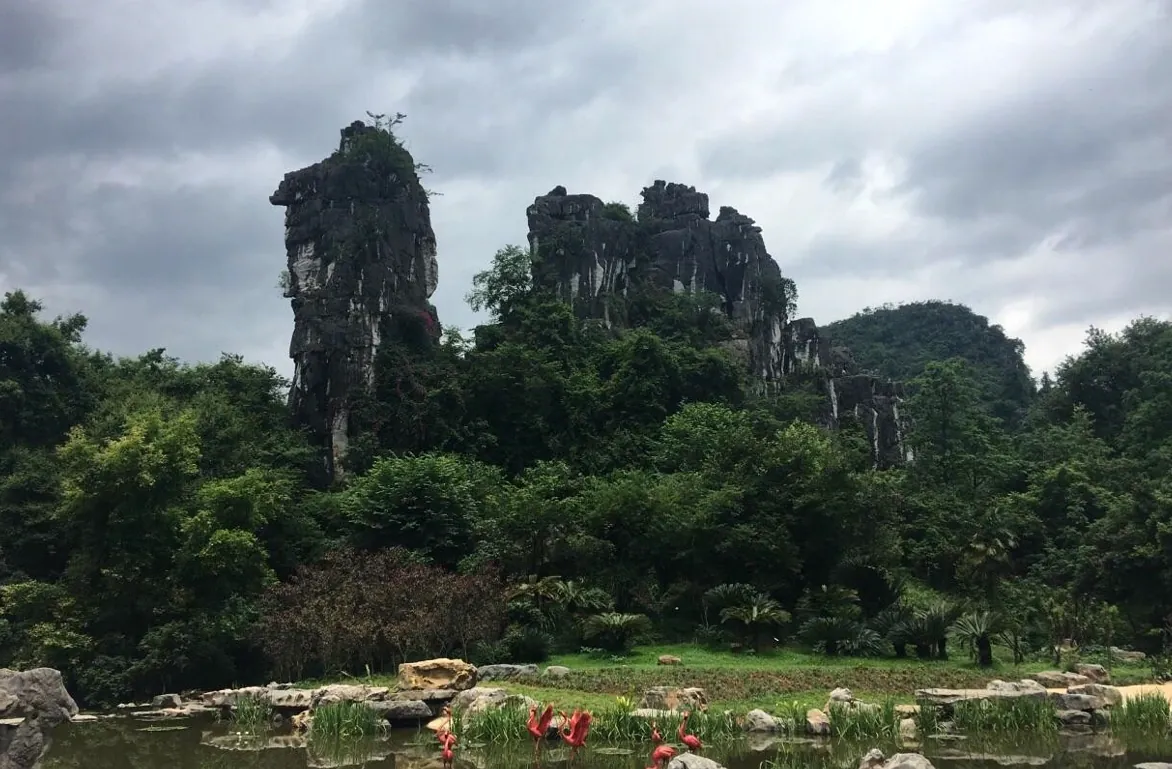
What has captivated generations of scholars and poets is nature’s miraculous arrangement, as the distribution of these seven peaks precisely mimics the astronomical pattern of the Big Dipper constellation. The complex is divided into two main topographical clusters that complement each other perfectly. To the north, the four peaks of the Putuo Mountain block—Tianchu, Tianshu, Tianji, and Tianquan—rise to form the sturdy “ladle” of the Big Dipper. Continuing to the south is the chain of three peaks belonging to the Crescent Mountain (Yueya Shan) block—Yuheng, Kaiyang, and Yaoguang—which curve gently like the elegant “handle” reaching toward the sky, creating a profound spiritual resonance between celestial phenomena and earthly landforms.
Right at the central lawn, spreading out at the foot of the limestone peaks shaded by lush greenery, a majestic ash-gray landscape stone is placed solemnly amidst a space filled with vibrant purple and yellow flowers. The flat surface of the stone is inscribed in both Chinese and English, marking the historical moment when former U.S. President Bill Clinton stopped here to share a message on global environmental protection, serving as a vivid testament to the connection between pristine nature and contemporary ecological consciousness.
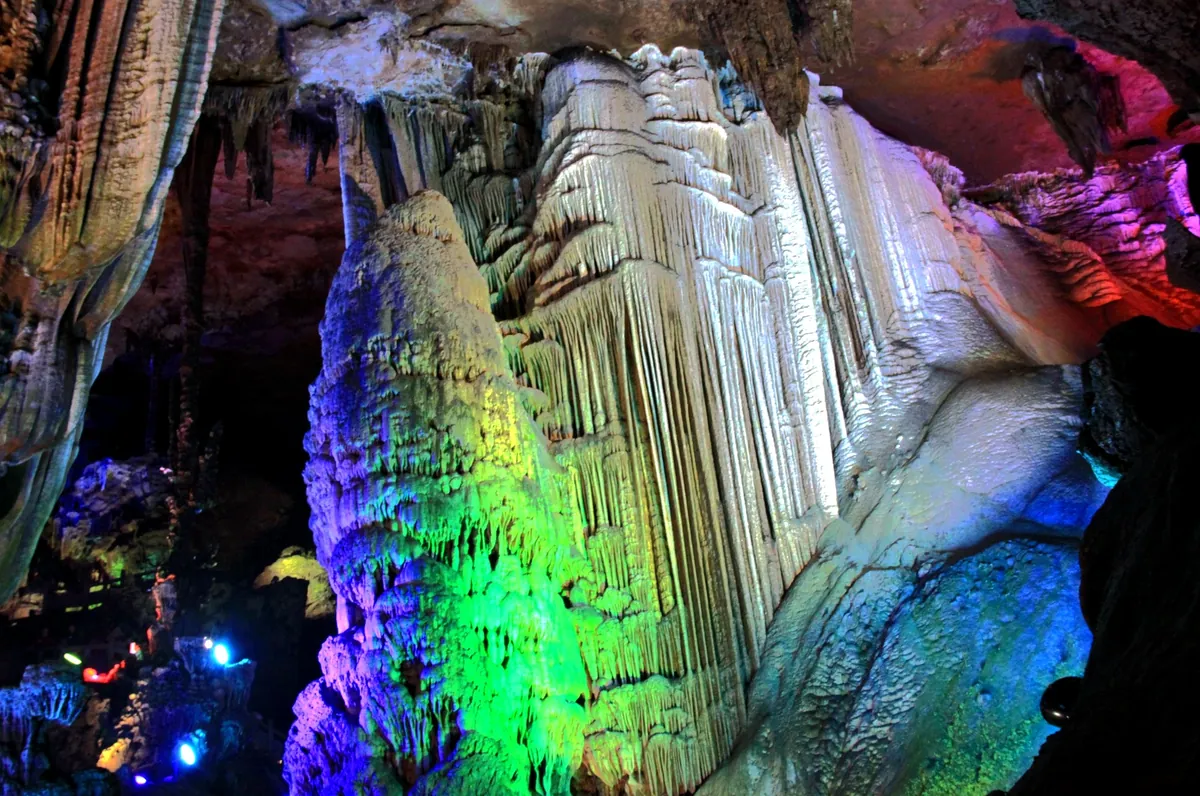
Hidden deep within the Putuo Mountain block is the Seven Star Cave system, a pristine remnant of an ancient underground river from the Pleistocene epoch, dating back hundreds of thousands of years. The cave interior spans three vertical levels, reflecting the stages of falling groundwater levels as the Guilin plain continuously uplifted. The middle level of the cave is currently a spectacular 814-meter-long tour route, which maintains an ideal year-round temperature of approximately 20°C. Here, the process of pure calcium carbonate precipitation through slow-dripping water has created an entire forest of stalagmites, stone columns, and stalactites in myriad shapes, completing a unique landscape painting that exists both above ground and in the deep subterranean realm.
Spanning an expansive area of 134.7 to 137.4 hectares (approximately 2,061 acres), Seven Star Mountain positions itself as one of the largest urban landscape parks in Guilin. The core factor contributing to the invaluable ecological value of this complex is its natural forest coverage rate, which reaches 84%, turning the entire space into a giant green lung that embraces the million-year-old karst tower system. The spatial planning here is not merely a rustic embellishment, but an exemplary dialogue between natural mountain-water landscapes and architectural works bearing the imprints of imperial dynasties, creating a rhythmic transition between tranquil scenery and the pulse of contemporary urban life.
The most famous and ancient architectural symbol of the complex is the Flower Bridge (Huaqiao), which spans the Xiaoqing River and dates back to the Southern Song Dynasty during the Jiaxi era (1237–1240). Following major large-scale renovations during the Ming Dynasty under the Jiajing Emperor and technical refurbishments in 1965, the bridge now stands proudly with a sturdy 11-arch structure carved from blue-green limestone. The upper level of the bridge is designed in the “Corridor Bridge” style with a breezy roof covered in elegant green glazed tiles. When the water level rises, the reflection of the stone arches on the calm water creates a magical visual phenomenon that scholars and poets have praised as “Four bright moons playing with lotus flowers,” also known by the beautiful name “Flower Bridge Red Snow.”
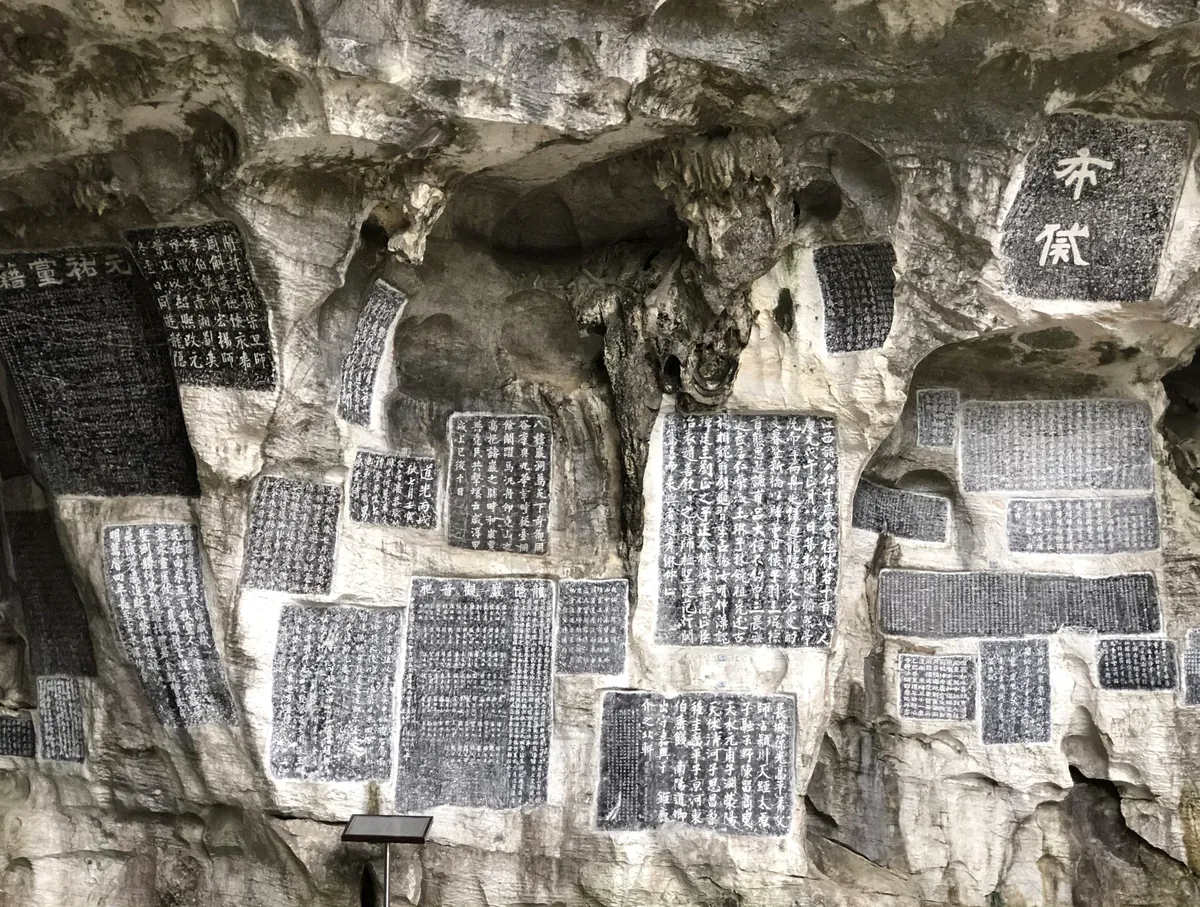
Venturing deep into the cultural landscape, the Guihai Stele Forest Museum stands impressively at the foot of Longyin Rock, serving as a massive repository of stone inscriptions in the Lingnan region. This site preserves a collection of 210 to over 500 cliff-side stone inscriptions spanning the Tang, Song, Yuan, Ming, and Qing dynasties. Historians focus their research on the “Yuanyou Party Tablet,” an invaluable stone record listing the high-ranking officials purged during the fierce political conflicts of the Northern Song Dynasty. The authentic, ancient carvings on the natural limestone cliffs not only reflect the pinnacle of calligraphic art but also preserve precise, thousand-year-old insights into politics, diplomacy, and local customs.
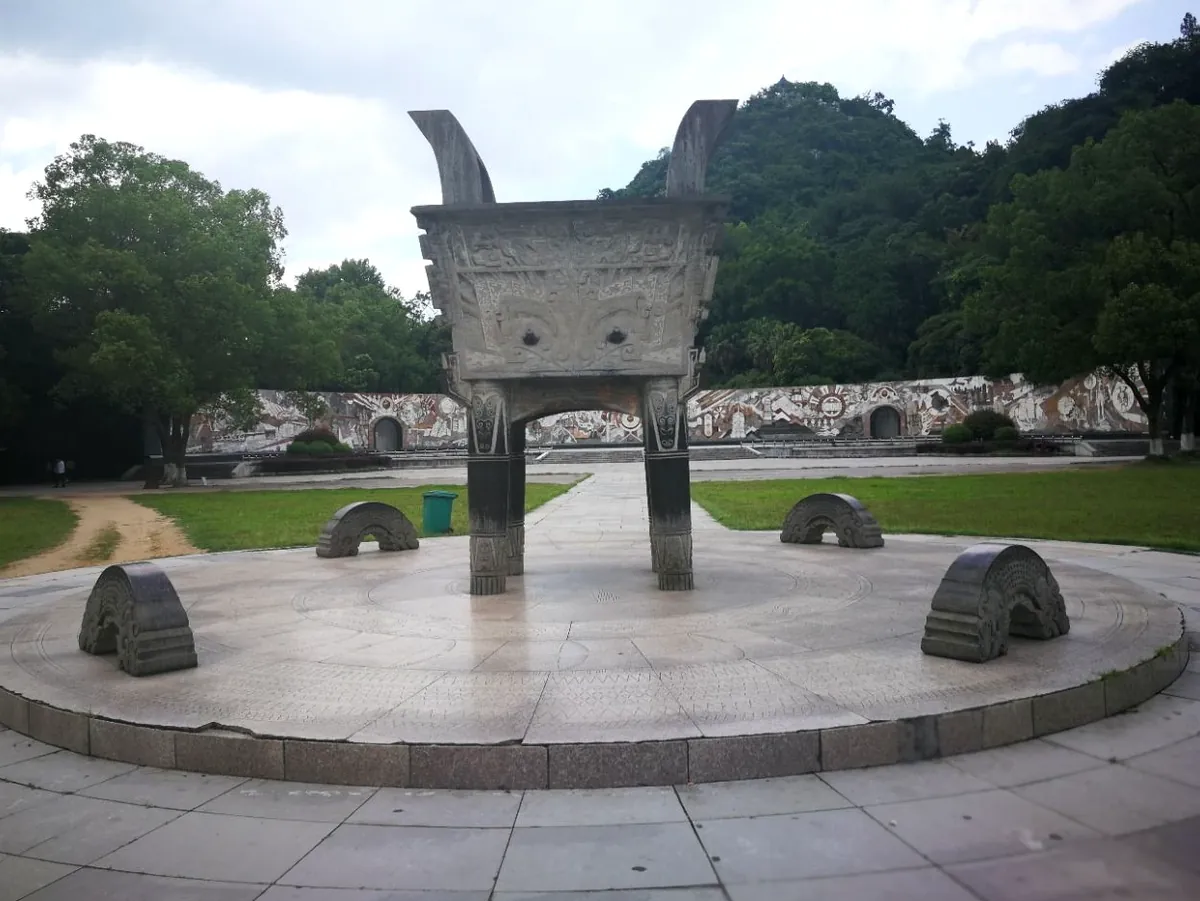
The grandeur of modern planning is affirmed by the “Light of China” relief square. This is a monumental granite sculpture project, 106 meters long and 5 meters high, crystallized from over 100 exquisite stone carvings. The massive stone wall recreates the 5,000-year-old source of brilliant Chinese civilization, detailing the Four Great Inventions and major intellectual achievements. Adjacent to this, the natural karst landscape showcases magnificent formations, such as Camel Hill, which vividly mimics the shape of a two-humped camel standing tall amidst the grass. Furthermore, the Seven Star Cave system features ceilings reaching up to 27 meters in height and a maximum width of 49 meters, creating a fascinating underground exploration journey.
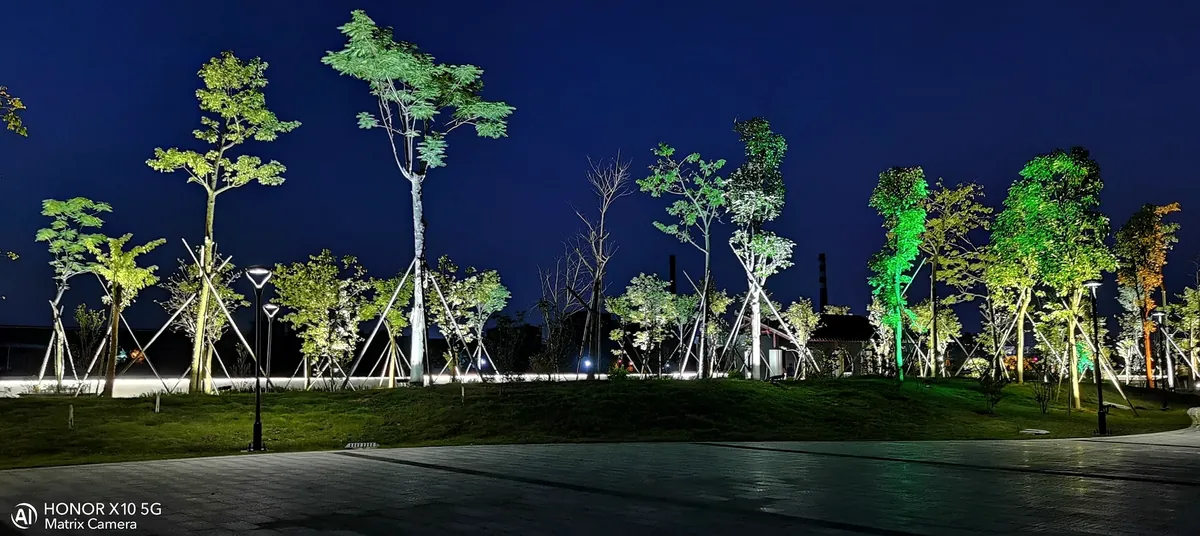
As night falls, the Seven Star Mountain space undergoes a spectacular transformation through modern lighting art, highlighting every detail of the landscape and flora. Lush ancient trees are bathed in sharp beams of light, blending pure white, ethereal green, and warm amber tones. Along the neatly paved walkways in the foreground, slender street lamps distribute light evenly, illuminating the verdant greenery, while the faint silhouettes of park infrastructure recede into the background. This combination of light brings a profound depth, infusing a contemporary breath into the heart of this heritage site.
The meticulous and synchronized investment in every auxiliary component—from viewing corridors and ecological stone embankments to internal walking paths—has turned the entire Seven Star Mountain area into a perfect open-air landscape museum. Each architectural structure here does not detach from nature but leans into the geological folds, creating a spatial entity that is both solemn and serene, brimming with cultural vitality that has endured through the ages.
As the sunset fades behind the undulating karst ranges, Seven Star Mountain sheds its daytime tranquility to don a magnificent cloak woven with contemporary light and shadow art. The centerpiece of this splendid night scene originates from the Flower Bridge spanning the crystal-clear Shuiyue River. Under the direction of lighting design experts, the eleven ancient arches of the historic bridge are awakened by a multi-colored artistic lighting system, reflecting perfectly onto the mirror-like water. This scene vividly recreates the famous “Flower Bridge Red Reflection” visual masterpiece—where the arched bridge, resembling a vibrant five-colored rainbow, stretches across the night, blending with a light, drifting mist to create an ethereal space between reality and dreams.
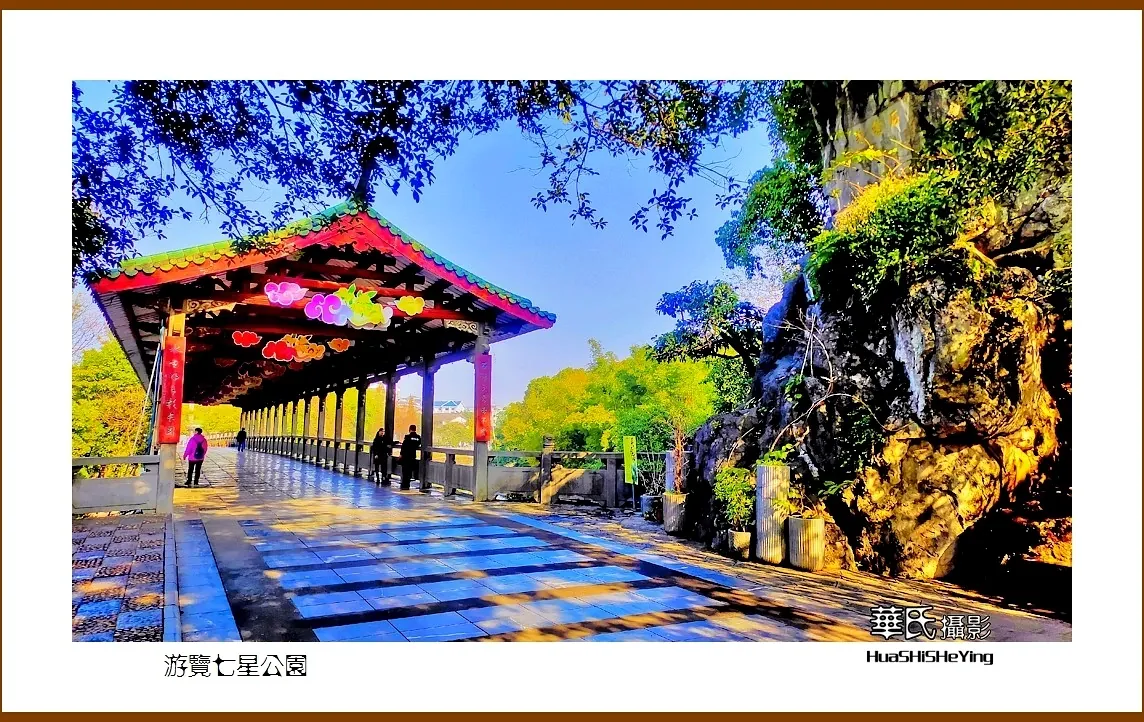
Standing out in this space are rows of wooden corridors, deeply imbued with the style of traditional Oriental garden architecture, winding softly along the foot of the mountain. Along the curved tiled roofs of the corridors, a series of lanterns shaped like auspicious clouds emit a gentle, multi-colored light, illuminating the quiet path below. Right next to the sturdy corridors, the towering karst limestone cliffs are draped in lush tropical vegetation, standing proudly against the clear sky, creating a spectacular symphony between human artistry and the unparalleled grandeur of Guilin’s landscape.
Delving deep into the limestone massif, Qixing Crags opens up a magnificent underground labyrinth where heritage preservation science closely blends with cutting-edge visual presentation technology. To preserve the stalactite structures crystallized over tens of thousands of years alongside the sensitive karst micro-ecosystem, the lighting system here applies low-temperature biological lighting technology combined with Augmented Reality (AR). Thermal radiation is minimized to the utmost, completely preventing the risk of artificial weathering and the growth of harmful moss and mold. Under the sharp and precise cold light, each magical stalactite and stalagmite column brilliantly refracts like thousands of transparent crystals, while AR technology realistically recreates the legend of the descent of the seven constellations right on the cave vault, transforming the geological exploration into a surreal visual journey.
The nightlife rhythm at the Qixing Mountain complex is increasingly elevated with the orientation of sustainable night economy development, harmoniously connecting tranquil experiences with the bustling pulse of urban prosperity. As night falls, the Tianxiang Observatory atop Mount Putuo becomes the ideal coordinates to admire the twinkling starry sky and take in the panoramic view of the brilliantly lit Li River valley. At the foot of the mountain, along the banks of the serene Xiaoji River, the night food space filled with the fragrance of osmanthus flowers awakens travelers’ taste buds with warm cups of osmanthus tea, sweet osmanthus cakes, and rustic local delicacies. Notably, Qixing Mountain also plays a strategic connecting link directly to the famous Two Rivers and Four Lakes night cruise route and the grand real-scene show “Impressions of Liu Sanjie” directed by Zhang Yimou on the Li River. This seamless continuity creates a continuous chain of light art and cultural performance experiences, deeply portraying the soul of a magical Guilin as night falls.
After footsteps enjoying the wonders of green mountains and clear waters of Qixing Mountain, the journey to understand the depth of Guilin’s cultural dimension leads connoisseurs into the famous local culinary space, where the harmony of yin and yang philosophy of the millennium-old Lingnan region converges. The iconic dish that plays the soul in daily life here is Guilin Rice Noodles (桂林米粉 – Guilin Mifen), a rustic gift that reaches the pinnacle of sophistication in traditional culinary techniques. The core value shaping the reputation of the bowl of noodles lies entirely in the secret Lushui (卤水) broth. This smooth, cockroach-brown sauce is meticulously simmered for many hours from fresh pork and beef bones along with more than twenty premium traditional Chinese herbs such as cloves, Amomum cardamomum, Amomum villosum, cinnamon bark, and Guilin’s specialty Luo Han Guo. Every drop of sauce condenses the sweet and lingering aftertaste of herbs blended tightly with the rich fat of bone marrow, creating a passionate layer of aroma spreading through every ancient alley.
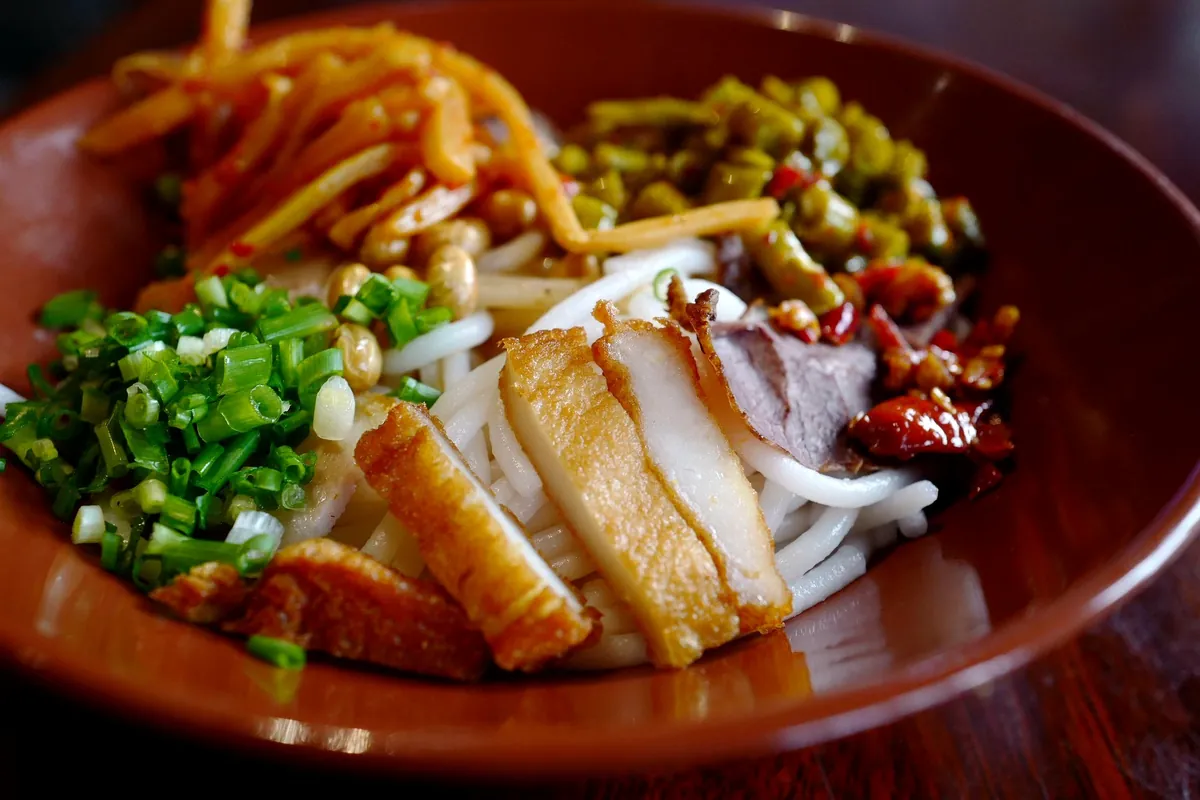
Locals around the Qixing Park area maintain a very standard and unique rice noodle tasting ritual. First, diners choose the round, smooth, and chewy rice noodle strands (Lutai Fen), and the chef briskly adds a few slices of “Guoshao” (锅烧) – pork belly boiled then deep-fried using a family technique making the skin blister and crispy while the meat inside remains tender and juicy – interspersed with slices of tender braised beef. After a ladle of concentrated Lushui sauce is evenly poured over the noodles, diners will manually add classic side dishes including long-fermented spicy and sour bamboo shoots (酸笋), chopped culantro, and a spoonful of Guilin’s famous chili paste with its characteristic numbing spice flavor. The bowl of noodles must be thoroughly mixed and eaten dry first to fully experience the delightful contrast between the smoothness of the rice flour strands and the crispy crunch of the Guoshao piece. When the bowl is almost empty, food connoisseurs will leisurely walk to the large thermos placed in the shop, ladle a spoonful of piping hot, sweet bone broth to rinse the bowl, closing the meal with warmth and comfort spreading throughout the body. Long-standing family-traditional brands like Dongli Rice Noodles (胜利米粉) or Minggui Rice Noodles are always the invariable stop for foodies when visiting Qixing.
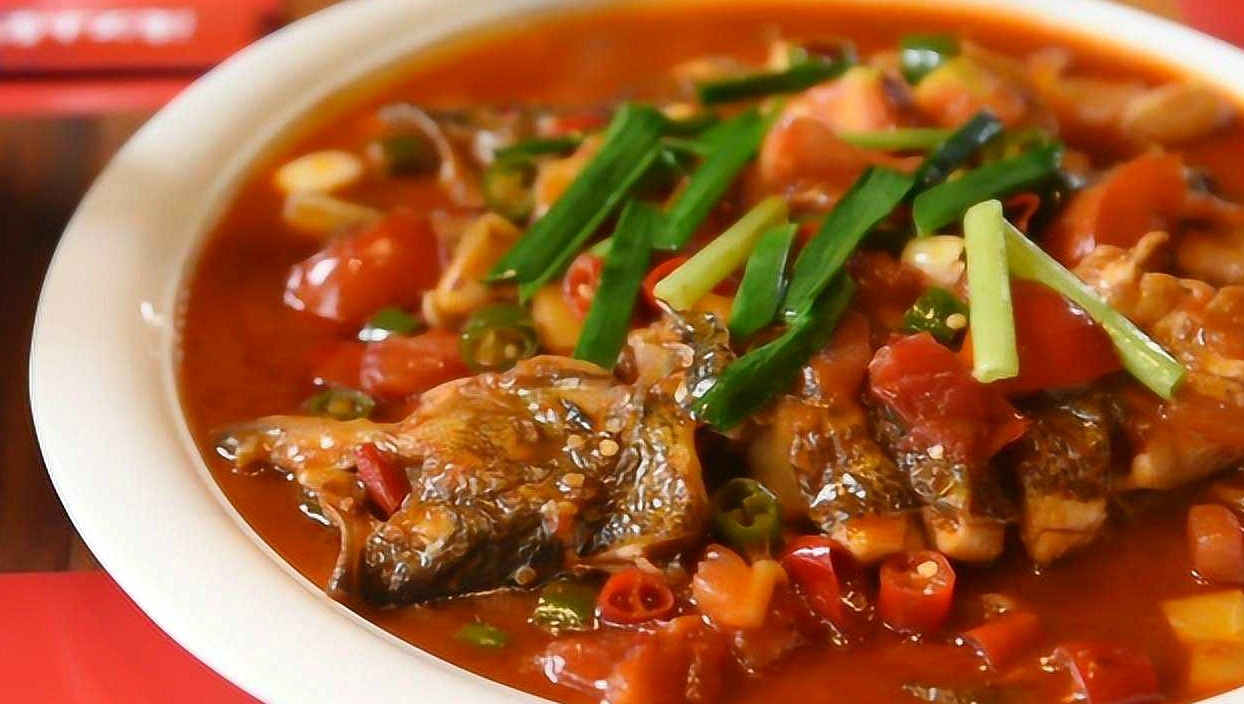
Besides rice noodles, the abundant produce from the meandering Li River near Qixing Mountain also gave birth to the renowned Yangshuo Beer Fish (阳朔啤酒鱼 – Pijiu Yu) across the landscape. Fresh carps just caught from the crystal-clear riverbed are kept with scales intact, dropped into an iron wok with high heat to deep-fry until the scales stand up, crispy and porous like snowflakes. Next, the fish is simmered on low heat with the region’s famous Liquan Beer (漓泉啤酒), blending with ripe red tomatoes and sliced local green peppers. The mildly bitter malty flavor of Liquan Beer quickly evaporates under high heat, neutralizing the natural fishy odor and penetrating deeply into the snowy-white fish flesh, creating a rich sweet-and-sour thick sauce imbued with five flavors. Harmonizing with the beer fish is the Li River Stuffed River Snails (漓江田螺酿 – Li Jiang Tian Luo Niang), a testament to the masterly craftsmanship of Guilin’s “stuffed dish” art. Plump Li River snails are removed, minced with lean pork shoulder, shiitake mushrooms, and young mint leaves, then stuffed back into the snail shells and braised thick with fragrant osmanthus wine and savory chili paste, delivering a delightfully crunchy sensation blending with a unique refreshing coolness.
The journey to immerse oneself in local flavors reaches its pinnacle when travelers raise a cup of Gongcheng Oil Tea (恭城油茶 – Youcha), an intangible cultural culinary heritage reflecting the lifestyle of mountain communities. This invigorating and health-boosting beverage is prepared directly in a small cast-iron skillet: carefully selected aged tea leaves are stir-fried until charred along with old ginger and crushed garlic, then pounded to a pulp right at the bottom of the pan using a specialized wooden pestle to fully extract the pungent, aromatic essence. The dark, simmering tea broth is strained into a rustic earthenware bowl, sprinkled with a handful of crispy puffed white rice, golden roasted peanuts, and mini deep-fried dough sticks (quẩy). The fleeting bitter taste on the tip of the tongue instantly gives way to a lingering sweet, warm, and rich aftertaste, resembling a deep, harmonious note within the diverse culinary landscape of the renowned Seven Star Scenic Area.
To effortlessly reach the millenia-old breathtaking natural landscapes of Seven Star Mountain, international travelers can easily access it via the highly developed CRH high-speed rail network. From the city center, the scenic area is just about 4.5 km from Guilin Railway Station (桂林站) and about 8 km from Guilin North Railway Station (桂林北站) by taxi or city bus, seamlessly connecting with high-speed trains from Guangzhou with a travel time of just 2 hours and 15 minutes, or from Shenzhen in about 3 hours. For travelers embarking on an overland cross-border journey from Vietnam, the vital route starts from the Huu Nghi International Border Gate (Lang Son) following the G72 expressway via Nanning to Guilin with a smooth total journey of about 7 hours; alternatively, you can choose to depart from the Mong Cai International Border Gate (Quang Ninh) to Dongxing city, combining the S60/G75 expressway and the Dongxing – Nanning – Guilin high-speed rail system to optimize travel time.
Regarding legal and immigration procedures, international flyers traveling directly to Guilin can take advantage of the flexible 144-hour transit visa-free policy at Guilin Liangjiang International Airport (airport code KWL). Alongside this, the most optimal and popular option for group tours is the Tourist Group Visa (旅游团体签证) with streamlined procedures requiring only a valid passport scan, saving waiting time and offering very reasonable costs ranging from 15 to 25 USD per member.
To fully appreciate the essence of the complex within an ideal timeframe of 2.5 to 3 hours without physical fatigue, experienced travel experts often set up a scientific one-way itinerary: picking up guests from the West Gate (the solemn main entrance), strolling across the mossy Flower Bridge (Cầu Hoa Kiều), stepping into the magnificent 814-meter-long Qixingyan Karst Cave, stopping to admire the calligraphy heritage at the Guihai Stele Forest, and taking in the majestic sandstone formation of Camel Hill standing proudly beside Clinton Lawn before exiting the park through the South Gate to completely avoid shuttle bus congestion on the main road. The golden hours to capture the soul of the landscape in summer are around 07:30 – 09:30 AM or after 15:30 PM to avoid the harsh sunlight; while in winter, it is best to start from 09:00 – 11:30 AM when the lingering mist gradually clears to give way to brilliant sunshine. Photography enthusiasts cannot miss the southern bank of the Moon River to frame the backlit Flower Bridge reflecting its ancient shadow onto the crystal-clear water, or angle 45 degrees towards Camel Hill from the lush green lawn glowing brightly under the late afternoon sunset.
Due to the microclimate inside Qixingyan Cave where relative humidity frequently exceeds 90%, the paved limestone slabs are always damp and slippery; travelers should strictly avoid high heels or hard-soled shoes and instead equip themselves with sneakers providing good traction. When walking at the foot of Putuo Mountain shaded by ancient forests, visitors must be especially cautious of the semi-wild monkey population; maintain a minimum distance of 2 meters, do not tease them, and strictly avoid holding transparent plastic bags containing food or drinks, as their mischievous nature can easily lead to sudden snatching behavior. Furthermore, to guard against sophisticated “0-dong shopping trap” scams outside the relic area, travelers must maintain a high level of vigilance against ploys luring them into jade and Pi Yao workshops with staged acts such as “the chairman’s son” or “overseas Vietnamese compatriots claiming kinship” to clear inventory with fake discounts of up to 90%, as well as traditional Chinese medicine foot soak pulse-reading tricks exaggerating ailments. Wisely choosing pure sightseeing itineraries (No Shopping – 纯玩团) that strictly comply with Article 35 of the Tourism Law of the People’s Republic of China will serve as an impenetrable shield to fully protect your sightseeing experience.
Fully enjoying the magnificent natural scenery and thousand-year cultural depth of this land will be even more elevated when set within a seamless, professional, and deeply experiential journey. Travelers can easily turn their dream trip into reality by joining the Changsha – Fenghuang Ancient Town – Zhangjiajie – Qixingshan 6D5N tour to etch unforgettable memories of ancient Chinese landscapes.