Winding gracefully amid undulating limestone karst peaks on China’s southern frontier, the Yulong River (Chinese: 遇龙河 – Yulong He) has been celebrated for millennia as the largest and most abundant tributary along the left bank of the majestic Li River. Stretching 43.5 kilometers along its main channel with a catchment area spanning 158.47 square kilometers, this watercourse is far more than a natural drainage artery; it is a living witness cradling a thousand years of rise and fall across Chinese dynasties. In the primordial Qin and Han eras, the river bore the name Anlong River (安龙河 / 伕龙河), evoking a rugged lower reach tied to the arduous labor of boatmen poling vessels through treacherous rapids. Entering the Han Dynasty, an enchanting legend took root in local folklore—telling of an enlightened Taoist master whose spiritual power moved a celestial dragon to descend and dwell within a secluded bend of the river, bringing favorable winds and timely rains to villagers far and wide. By the prosperous Ming Dynasty, as classical scholarship and geomancy shaped rural planning, the old character implying toil was officially replaced with “Yu” (遇 – “to encounter”), giving birth to the eternal name Yulong River—signifying an auspicious land where mortals are blessed to encounter a descending sacred dragon.
The geopolitical and commercial imprint of the Yulong River was etched deeply into history beginning in the Qin Dynasty (221–206 BCE). After unifying the six warring states, Emperor Qin Shi Huang ordered General Shi Lu to carve through mountains and excavate the celebrated Lingqu Canal, linking the Xiang River system of the Yangtze basin with the Li River of the Pearl River system to open supply routes into Lingnan. Closely connected to the Li River, the Yulong basin swiftly became a bustling corridor for transporting military provisions, staging vessels, and circulating regional goods. During the golden ages of the Tang (618–907) and Song (960–1279) dynasties, recognizing the river’s gentle gradient interspersed with shallow shoals and submerged limestone ledges, riverside residents crafted sturdy rafts lashed together from mature local bamboo poles. Lightweight, flat-bottomed, and requiring minimal draft, bamboo rafts conquered every river obstacle while turning the Yulong River into a lively commercial waterway carrying grain, textiles, and forest products across Lingnan townships.
Infrastructure and classical masonry along the Yulong River reached their artistic zenith during the Song, Ming, and Qing dynasties through a collection of arch stone bridges that still stand intact today. Oldest among them is Xianxian Bridge (also handed down as Xiangui Bridge), erected in the fifth year of Zhenghe under Emperor Huizong of Song (1115) and holding the record as the oldest surviving single-arch stone bridge in all of Guangxi. The unmatched marvel of this thousand-year-old monument lies in its dry-stone masonry technique: thousands of dressed stone blocks interlock with millimeter precision without steel reinforcement, bound solely by traditional slaked-lime mortar blended with viscous sap extracted from wild mountain yams—an organic binder resilient enough to withstand centuries of flash floods. Following in that architectural lineage, Yulong Bridge—completed in the tenth year of Yongle in the Ming Dynasty (1412)—and Phoenix Bridge—built in the sixth year of Chenghua (1470)—continue casting graceful reflections across the water as vital village links completing a timeless pastoral landscape.
Entering the modern era, having weathered wartime turmoil and national reconstruction, the Yulong River was fortunate to escape heavy industrialization thanks to its secluded karst valley geography. Beginning in 2000, Yangshuo County authorities approved a comprehensive master plan designating the entire watershed as a scenic conservation zone dedicated to sustainable ecotourism. To rescue the river from noise pollution and exhaust fumes from motorized vessels, a sweeping reform carried out between 2008 and 2012 banned all fuel-powered boats completely from the waterway. Restored to its pristine state with 100% handcrafted bamboo rafts propelled solely by human pole, drifting down the Yulong River and gliding over stone weirs has become a living cultural heritage experience—inviting travelers to listen to bamboo poles dipping into crystal water, admire mossy stone bridges, and touch an unbroken current of thousand-year history.
Nestled inside the celebrated karst valley of Yangshuo County bordering Guilin in the Guangxi Zhuang Autonomous Region, the Yulong River commands a geomantic setting rarely matched in Eastern landscape philosophy. Its watershed is encircled by dramatic conical and tower limestone karst formations, where thousands of sharp peaks rise like calligraphy brushes toward azure skies in a classic “crouching tiger, hidden dragon” embrace. Rather than surging violently like major rivers, the Yulong winds gently like a jade silk ribbon threading through valley folds, mirroring ancient limestone pinnacles on its glass-still surface. Millions of years of limestone erosion have endowed the basin with a lush semi-aquatic ecosystem where mineral-rich soils merge with fertile alluvium to nurture endless emerald valleys.
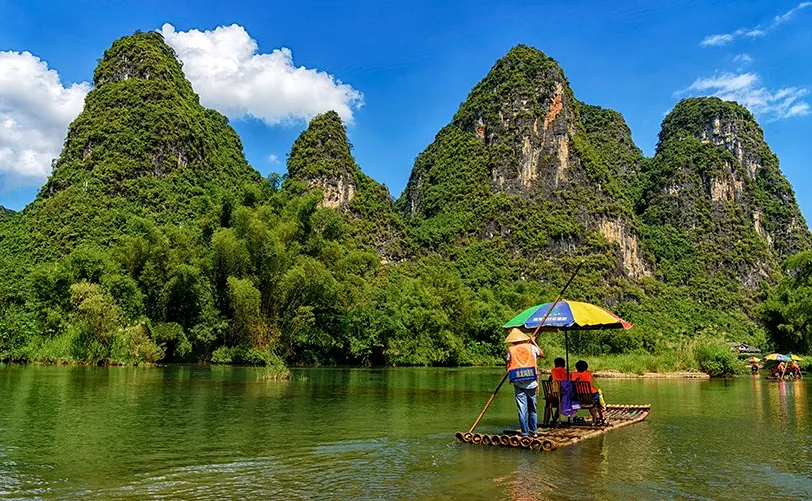
The natural scenery along both banks of the Yulong River represents a seamless harmony between untamed nature and traditional southern agrarian life. At the foot of towering dark-gray cliffs, gentle tiered rice paddies trace the water’s edge, framing quiet farming hamlets. The river runs so crystal-clear that visitors can see straight to the riverbed, where lush ribbons of aquatic eelgrass sway rhythmically beneath tranquil emerald currents. Punctuating this serene flow is a network of historic stone weirs built generations ago from heavy gray flagstones to regulate irrigation water—creating delightful low cascades where each bamboo raft dips smoothly over the lip amid splashes of white foam that punctuate the tranquil symphony of mountain and river.
The waterway is divided into distinct scenic rafting routes tailored to the character of each river stretch and its surrounding heritage. The Upper Reaches route—departing ancient Jinlong Bridge downstream to Jiuxian Village over roughly ninety minutes—immerses travelers in the most secluded, untouched portion of the basin, featuring frequent stone weirs, brisker currents, and tranquil corridors shaded by giant arching bamboo groves. Continuing downstream, the Middle Reaches route links Jiuxian Pier to Xianxian Pier in about one hour, unveiling prosperous thousand-year-old villages whose gray-brick homes and yin-yang tiled roofs shimmer in morning sunlight.
The lower section of the Yulong River delivers the scenic highlight of the entire valley along the Lower Reaches route from Shuiyudi Pier to Wanjing over roughly fifty to sixty minutes. Here the riverbed widens and currents turn glass-smooth and transparent like liquid jade, showcasing vivid contrasts between lush underwater greenery and distant ranks of karst peaks—an ideal canvas for unforgettable photography. For travelers wishing to linger immersed in Lingnan’s fairytale landscape, the full-length Golden Route—spanning four to five unhurried hours from Jinlong Bridge all the way to Shuangliu Bridge—captures every shift in river character, from bubbling upper-reach cascades to broad, mirror-still lower waters.
Along the winding bends of the Yulong River, traditional settlements embody centuries of indigenous “backed by mountains, facing water” geomantic wisdom. Exemplifying this vernacular heritage is Jiuxian Ancient Village (旧县村), a classic residential ensemble reflecting Lingnan culture of the Ming and Qing dynasties. Prominent clan residences follow symmetrical three-courtyard and four-courtyard layouts uniting interiors with nature around central skywells. Architectural refinement shines through elegant ash-gray brick walls, mist-catching yin-yang tiled roofs, and massive ironwood pillars—with lintels, upturned eaves, and thresholds intricately carved with auspicious motifs, birds and blossoms, and folk reliefs forming a living museum of highland craftsmanship.
Complementing these historic villages is an iconic network of arched stone bridges spanning the river, defining the classic visual signature of Yangshuo‘s karst landscape. Standing as masterpieces of ancient civil engineering, these dry-stone arches rely on neither driven pilings nor synthetic mortar; instead, precisely dressed wedge-shaped stones lock together so gravitational load and abutment thrust counterbalance each other, converting weight into structural stability. Having endured centuries of surging mountain floods, these semicircular stone arches still carry rural foot traffic while casting circular reflections in calm waters that merge human ingenuity seamlessly with untamed nature.
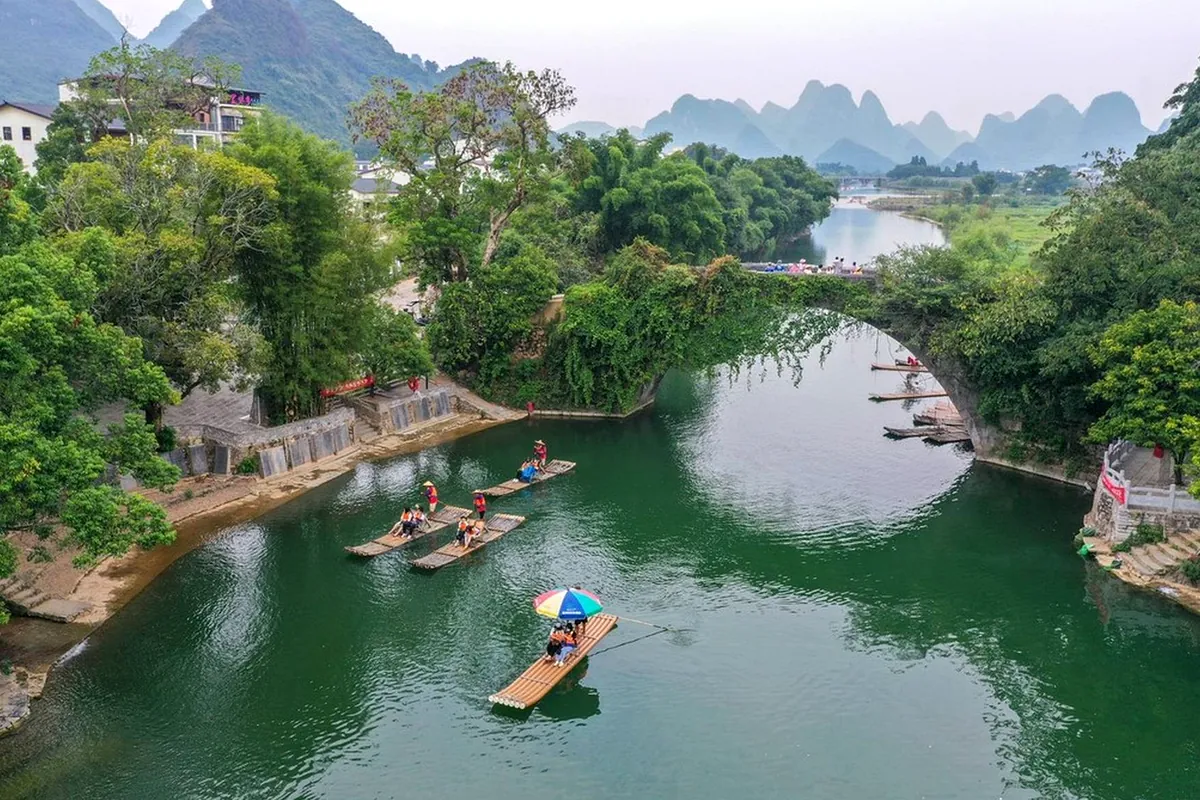
Entering the modern era of ecological conservation, riverside infrastructure along the Yulong River has been upgraded through thoughtful, sustainable investment. The entire sightseeing raft fleet has undergone smart engineering refinement: traditional natural bamboo poles are reinforced internally with buoyant composite tubes molded to replicate authentic bamboo nodes, eliminating waterlogged rot while ensuring rock-solid buoyancy and safety without diminishing rustic charm. Passenger terminals at Jinlong Bridge and Shuiyudi Pier feature solar-paneled public facilities, while visitor shuttles between piers operate via zero-emission electric eco-carts that preserve crisp, clean air throughout the karst valley.
This balance between natural preservation and high-caliber investment is equally visible in smart visitor services and world-class eco-luxury resorts. Bamboo rafting operations run smoothly through digital integration, from timed crowd management via WeChat Mini Programs to automated turnstiles equipped with AI facial recognition that eliminate paper tickets and peak-season bottlenecks. Along the river buffer zone stand architectural landmarks such as Alila Yangshuo—artfully converted from a 1960s sugar mill blending industrial nostalgia with local karst stone—and the serene courtyard sanctuary of Banyan Tree Yangshuo, demonstrating how honoring local heritage elevates hospitality to pinnacle refinement.
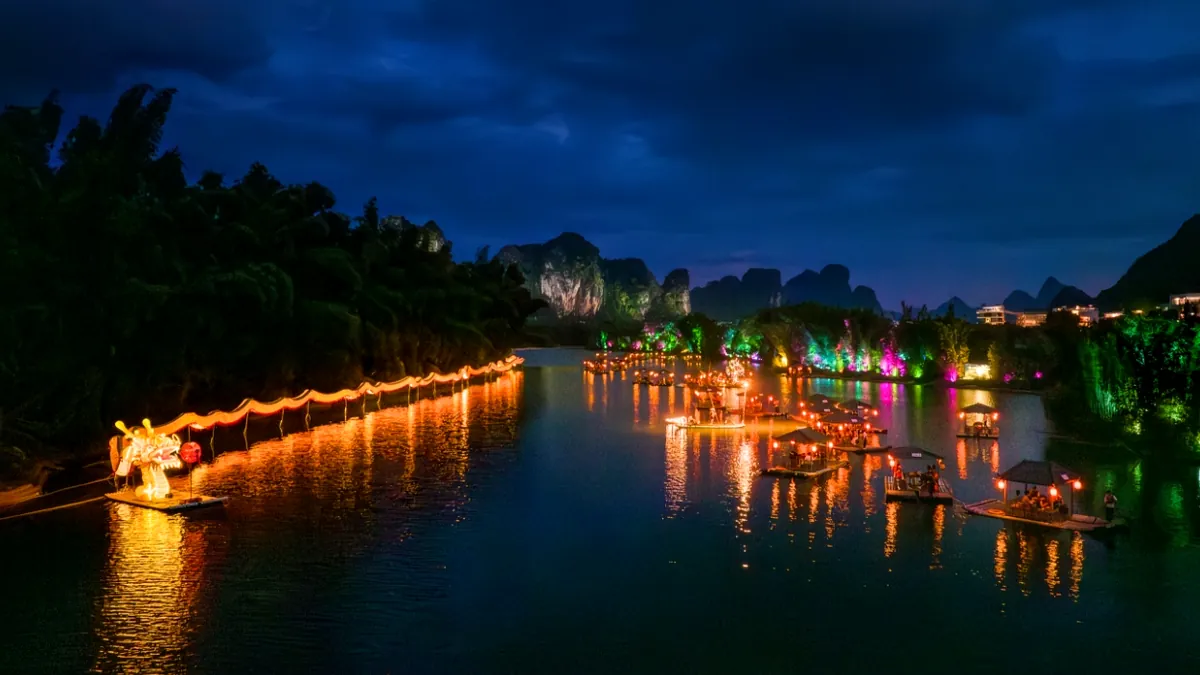
As sunset fades across the Yulong valley, the golden warmth of autumn months from September through November yields to drifting veils of indigo mist. In sharp contrast to daytime slow-travel rafting along emerald waters, nightfall transforms the Yulong basin into a tranquil, meditative sanctuary. Firmly rejecting glaring neon signs and noisy urban clamor, lighting across the valley embraces minimalist restraint—using soft warm-amber uplighting calibrated just enough to trace the monumental silhouettes of million-year-old karst peaks in harmony with the quiet rhythm of Yangshuo’s waters.
This poetic dialogue between stillness and spectacle shines vividly in the connection between the serene Yulong River and Yangshuo’s acclaimed nocturnal arts scene. Just a short distance toward the Li River lies the open-air stage of the legendary live performance Impression Liu Sanjie. Directed by acclaimed filmmaker Zhang Yimou alongside Wang Chaoge and Fan Yue, this monumental production turns two kilometers of natural river surface and twelve towering karst peaks into one of the largest live stages on Earth. Cutting-edge digital lighting and natural river mist transform traditional bamboo rafts, cormorant fishermen, and flowing crimson silk ribbons worn by Zhuang maidens into luminous brushstrokes celebrating centuries-old folk ballads of the legendary songstress Liu Sanjie.
After immersing yourself in that dazzling visual spectacle along the Li River, returning to secluded luxury retreats nestled along the Yulong River feels like entering a tranquil sanctuary. Designed in the spirit of traditional northern Guangxi villages, weathered tiled roofs and fragrant osmanthus trellises glow softly beneath golden silk lanterns reflecting across calm waters and framing historic stone arches like Fuli and Yulong Bridges after dark. Layered low-glare illumination honors classical architecture while minimizing light pollution, leaving starry skies sparkling clearly above the limestone canyon.
Rounding out a serene evening is savoring authentic regional dishes on a wooden riverside veranda. Guests enjoy signature Yangshuo Beer Fish simmered in clay pots with freshly caught river fish, local draft beer, bell peppers, and ripe tomatoes, alongside plump stuffed river snails seasoned with wild mountain mint and lemongrass. Sipping warm osmanthus tea with a lingering sweet finish while listening to evening crickets and the distant dip of a wooden oar leaves a lasting sense of peace that washes away every worldly care.
Along both banks of the Yulong River, Yangshuo’s culinary heritage reflects both the bounty of a fertile alluvial valley and Lingnan gastronomy infused with aromatic Zhuang mountain herbs. Every bamboo raft journey down these crystal waters leads naturally to the dish hailed as the soul of local cuisine: Yangshuo Beer Fish (阳朔啤酒鱼). Unlike conventional seafood preparations, fresh carp netted straight from the Yulong River is left unscaled—cleaned internally and plunged immediately into a sizzling cast-iron wok of camellia-seed oil until its scales turn shatteringly crisp. Chefs then pour local craft beer directly into the bubbling pan alongside juicy tomatoes, fiery red chilies, whole garlic cloves, and artisanal soy sauce. Fragrant malt steam and bright tomato acidity eliminate any hint of muddiness, keeping the flesh sweet and tender beneath crispy scales drenched in rich, spicy crimson sauce.
Stepping into family-run eateries shaded by ancient bamboo groves in Jiuxian Village or near Jinlong Pier, travelers cannot miss authentic Guilin Rice Noodles (桂林米粉)—a culinary lineage tracing back to the Qin Dynasty when northern troops marched south to excavate the Lingqu Canal. The secret of a great bowl lies not in elaborate toppings, but in the house-secret herbal braising master stock (lushui) guarded across generations. Fresh pork marrow bones are simmered for twelve hours with over twenty Chinese herbs and spices—including star anise, cassia bark, black cardamom, amomum fruit, and licorice—to yield a dark-amber elixir of deep umami sweetness. Plump, chewy round rice noodles are blanched quickly, ladled with rich concentrated gravy, and topped with thin slices of ruby-rimmed char siu pork, crunchy roasted peanuts, spicy pickled bamboo shoots, and crisp scallions for an unforgettable balance of refreshment and warmth.
Highland cooking across the Yulong valley is equally celebrated for Bamboo Tube Chicken (竹筒鸡) and Clay-Wrapped Beggar’s Chicken (叫花鸡). Free-range hill chickens foraging along limestone slopes develop firm, flavorful meat seasoned with wild mountain herbs and crushed prickly ash according to Zhuang tradition. For Bamboo Tube Chicken, bite-sized pieces are tucked inside freshly cut sections of young mountain bamboo and roasted directly over wood embers, infusing the succulent meat with sweet bamboo sap. Beggar’s Chicken takes artisanal care further: a whole seasoned bird is wrapped tightly in fragrant lotus leaves gathered from Yulong lagoons, encased in a thick shell of river clay, and buried in glowing embers—cracking open the baked clay shell to release an intoxicating cloud of lotus aroma and pure, juicy chicken.
Completing the local flavor map is the wholesome sweetness of traditional pastries crafted from Yangshuo’s harvests. Deep-green mugwort rice cakes (Aiye Baba) are kneaded from upland glutinous rice flour blended with wild cliffside mugwort leaves around a filling of crushed peanuts, black sesame, and cane brown sugar, steamed in wooden baskets to release a soothing herbal fragrance. Alongside them sits translucent water-chestnut jelly cake, cool and springy, showcasing the crisp natural sweetness of water chestnuts cultivated in riverine alluvial soils—embodying the classical Chinese philosophy that food and medicine share a single nourishing root.
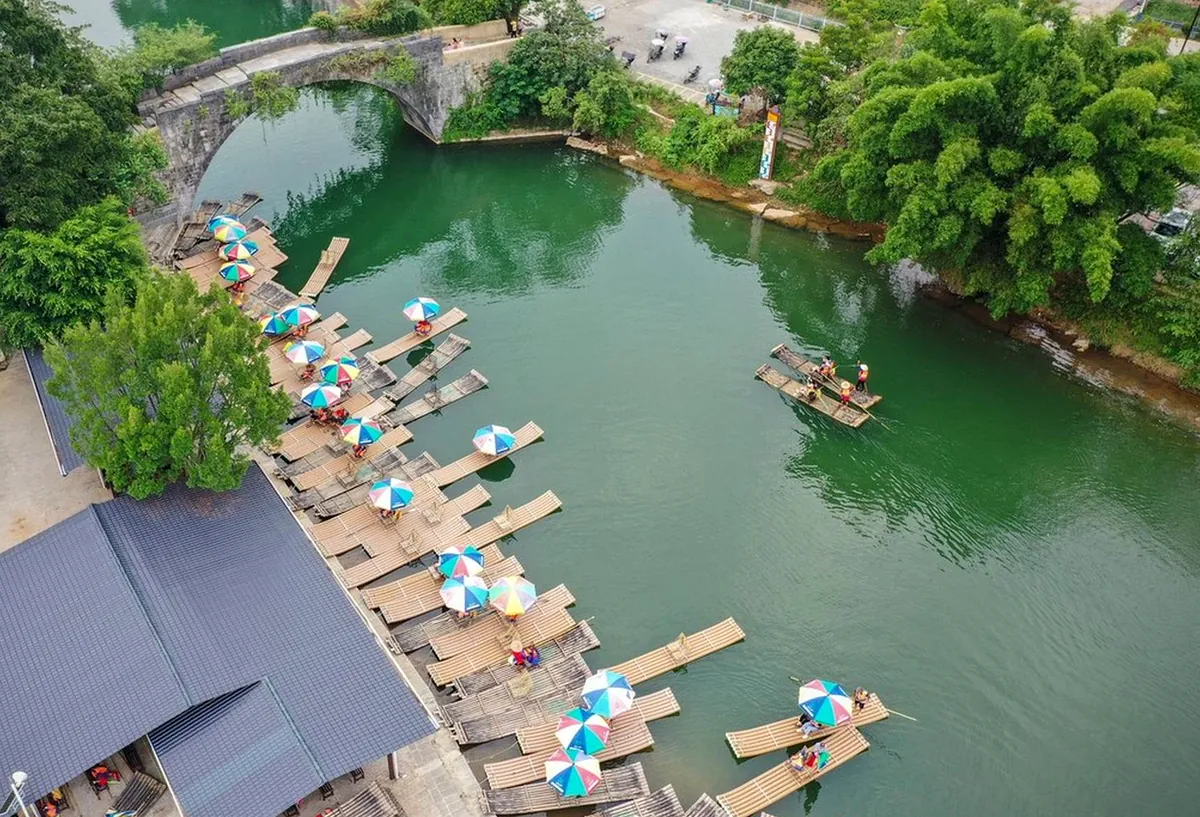
Gliding gently down the Yulong River feels like drifting through a living ink-wash painting, yet experiencing it at its finest benefits from practical insights into seasonal rhythms and waterway safety. Yangshuo enjoys four distinct seasons, with the finest windows for bamboo rafting arriving in spring from March to May and autumn from September to November. Spring wraps the valley in ethereal enchantment as gossamer mist drifts around million-year-old karst peaks above golden carpets of blooming rapeseed lining both banks. Autumn brings crisp sapphire skies and golden sunlight piercing crystal waters straight down to swaying riverweeds, framed by golden rice paddies fragrant with harvest.
Yulong River piers operate under strict inland waterway safety rules designed to protect both natural tranquility and passenger safety. Unlike motorized tour boats on the Li River, every craft here is built from resilient mature bamboo poles and propelled entirely by hand using long bamboo poles wielded by skilled local rafters. Under strict safety regulations, each raft carries a maximum of two passengers plus one oarsman to maintain perfect stability, and wearing life jackets is mandatory throughout the journey. Because rafts glide freely over low stone irrigation weirs—producing thrilling splashes of water at each drop—securing phones, cameras, and electronics inside waterproof pouches before boarding is essential.
To protect your travel experience and avoid commercial tourist traps, remain alert against suspiciously cheap day tours linked to disguised shopping stops. The smartest, most relaxing choice is selecting transparent, non-commercial itineraries that preserve full sightseeing time on the river. Official bamboo rafting tariffs are digitally standardized and posted publicly on electronic boards at major piers including Jinlong Bridge, Jiuxian, and Shuiyudi. Purchase tickets exclusively at official scenic-area counters or through reputable travel operators, declining unauthorized touts outside pier gates who may shorten routes or demand arbitrary surcharges.
Traveling from Vietnam to Guilin’s karst valley is faster and smoother than ever thanks to seamless regional transit links. Overland travelers can cross through Huu Nghi Quan International Border Gate in Lang Son using a Border Travel Permit or passport with a valid Chinese visa into Pingxiang in Guangxi, continuing via expressways or intercity coaches to Nanning. Air travelers flying into Nanning Wuxu International Airport connect directly with China’s modern high-speed rail (HSR) network—gliding comfortably through the rolling hills of Liangguang in just over two hours straight to Guilin or Yangshuo Station, ready to step into the fairytale waters of the Yulong River.
Drifting slowly beneath ancient stone arch bridges to the gentle murmur of water and birdsong in riverside bamboo groves creates an enduring memory for every admirer of East Asian culture. To ensure a seamless journey from border formalities to unhurried rafting along emerald waters, partnering with a thoughtfully curated itinerary is a worthwhile investment—explore our high-quality all-inclusive China tour packages to savor majestic landscapes without worrying about complex travel logistics.