Unlike ancient centuries-old buildings tied to the brilliant heritage of imperial dynasties, Pipa Yuan Hot Pot Restaurant—bearing the Chinese name 枇杷园食为天火锅—stands as an extraordinary emblem of modern experiential economic thinking in the metropolis of Chongqing. Established in 2010, it marks a profound modern transformation in rural ecological structures and local cultural services. Rather than drawing upon ancient dynastic myths, Pipa Yuan flourished directly from New Rural Reconstruction policies, turning a wild hillside fruit orchard at the foot of the Nanshan range into one of the largest wild-setting culinary complexes in the entire Ba-Shu region.
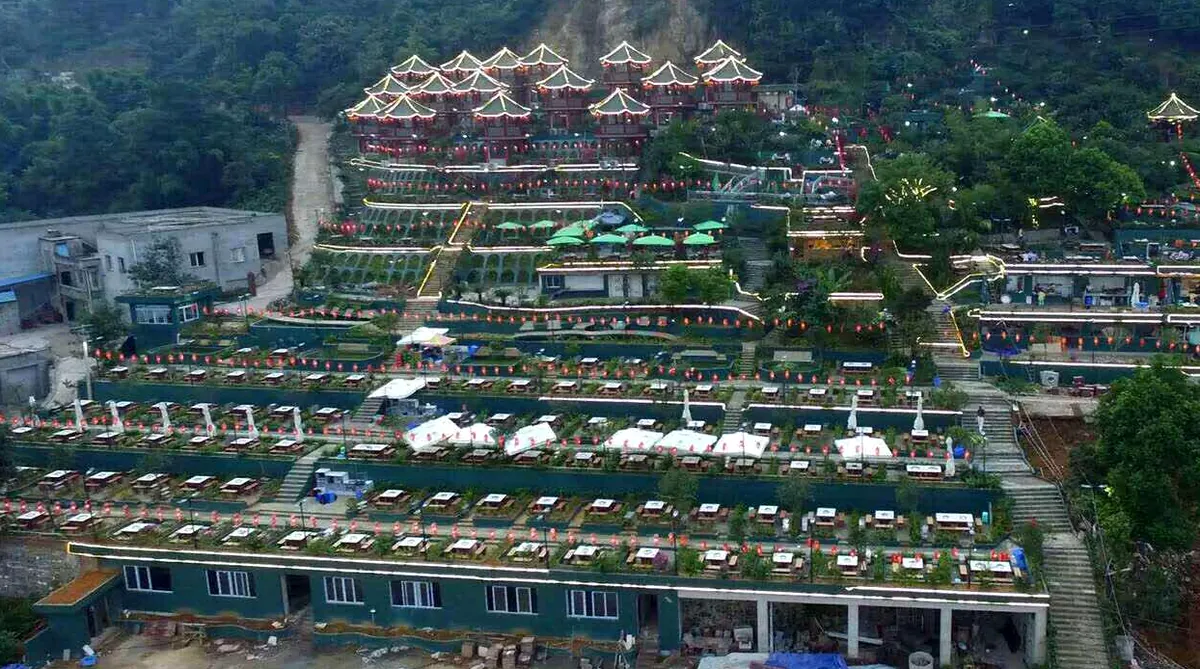
The entire ecological tourist area unfolds with the majestic splendor of a bustling ancient market quarter artfully planted in the heart of a lush green valley. Black-tiled roofs curve gracefully with soaring upturned eaves, built in stepped terraces following the steep slope of the hillside to celebrate the exquisite refinement of traditional Chinese woodwork. Slate staircases and wooden balustrade corridors connect harmoniously across elevations, guiding visitors toward spacious outdoor courtyards bathed in natural sunlight. Here, hundreds of rustic wooden dining tables are arranged neatly beneath the shady canopy of sprawling loquat (pipa) trees, opening up sweeping panoramic views across the breathtaking natural landscape.
Before its spectacular structural transformation, this fertile land consisted primarily of specialized loquat orchards—a sweet, refreshing fruit native to the hills of the Southwest. In the early 2010s, local farmers and culinary artisans joined hands in a bold undertaking: blending the fiery hot pot culture of ancient Yangtze River boatmen into a refined pastoral landscape. The name “Shiwei Tian” is drawn from the classical dictum “The people regard food as heaven” (Min yi shi wei tian) from the monumental Records of the Grand Historian, asserting the supreme status of gastronomy in human life while expressing the aspiration to elevate a humble working-class dish into an elite dining art amid the vast wilderness.
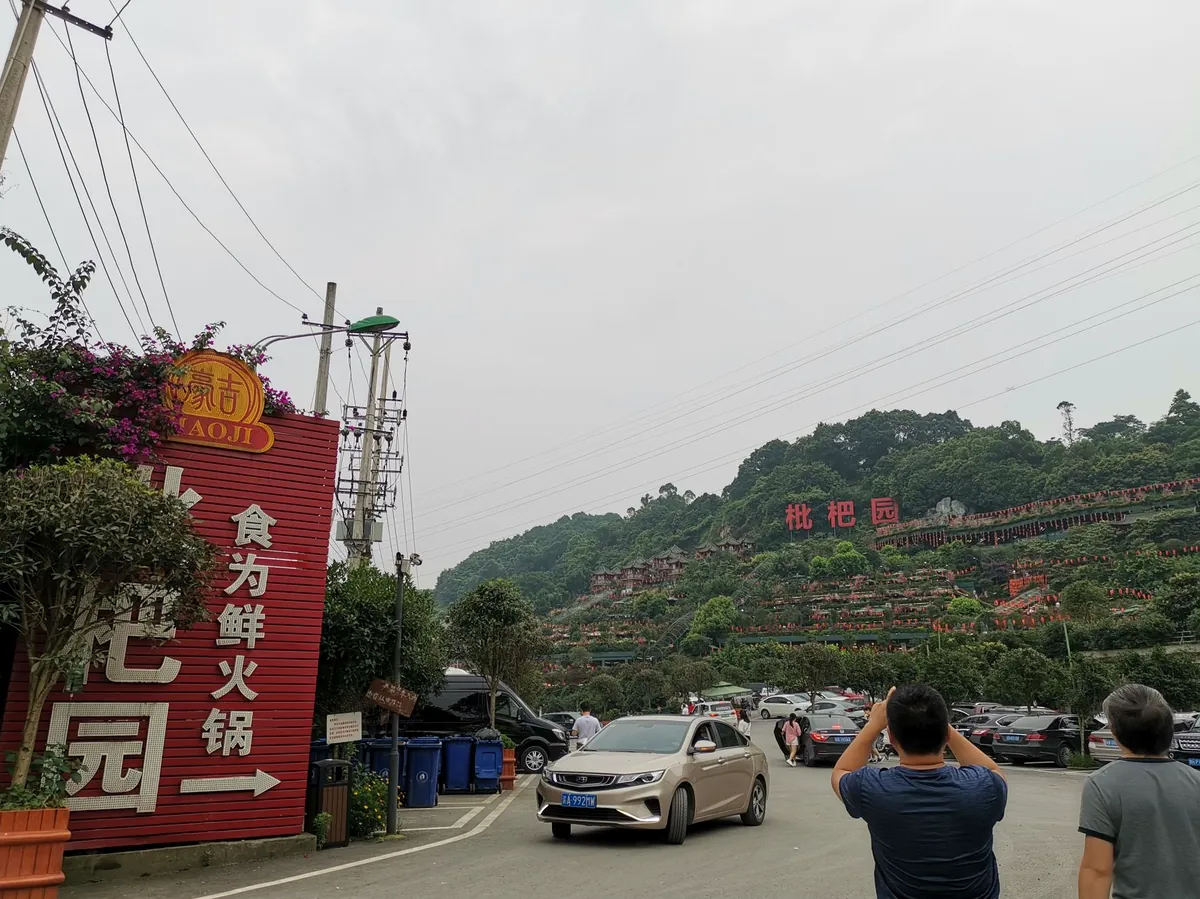
From a few modest shelters initially erected beneath ancient, gnarled loquat trees, the project has fully harnessed Chongqing’s steep, multi-tiered hillside topography to create a one-of-a-kind terraced layout. Continuous growth over the years marks a fundamental evolution from a purely agricultural farming model into a high-end entertainment, resort, and cultural exploration complex. It not only captures the industrious, creative spirit of contemporary urban residents, but also serves as a living testament to the revolution in Chongqing’s culinary culture, propelling traditional Sichuan peppercorn hot pot to brilliant new heights against the backdrop of a singular ecological landscape.
Nestled within the majestic Nanshan range in Nan’an District, Pipa Yuan Hot Pot Restaurant occupies an exceptionally auspicious geomantic site in the Ba-Shu region. Since ancient times, the Nanshan range has been regarded as a green screen sheltering the southern shores of the Yangtze River, converging the spiritual vitality of Chongqing’s mountains. Here, winding mountain ridges and valley mists mingling with morning dew form a protective belt of prevailing winds—blocking harsh gales while trapping abundant vital energy. Ancients defined this area as terrain where waters gather and winds are stored, where hilly topography transcends mere scenery to embody the traditional Five Elements feng shui philosophy of classical East Asia.
What leaves diners utterly astonished is how the restaurant claims an entire gently sloping yet steep hillside, once an expansive ancestral loquat orchard spanning generations. Rather than leveling the ground to erect cold concrete blocks, local artisans respected the natural terraced structure of the mountainside. The rugged, precipitous slope—normally a harsh challenge in Chongqing’s eight-dimensional vertical metropolis—became its most precious architectural asset. Every slope, retaining wall, and uneven patch of earth was meticulously measured to position dining tables cascading smoothly from foothill to summit, forming a multilayered terraced architectural fabric reminiscent of an ancient agricultural marvel fused with modern gastronomy.
The ancient loquat orchard serves as the green lungs and soul of the entire landscape. The loquat tree—an evergreen bearing traditional symbolism of auspiciousness and longevity in Chinese culture—stretches broad canopies that cast cool shade across slate-paved walkways. During the flowering and fruiting season, golden clusters of heavy fruit glow amidst drifting mist, releasing the clean fragrance of blossoms and fruit intermingled with the signature spicy aroma of boiling chili oil vats below. Wooden gazebos, winding paths clinging to cliff edges, and natural stone staircases are designed to weave beneath tree crowns, preserving every mature tree without felling or harming the hill’s native ecosystem.
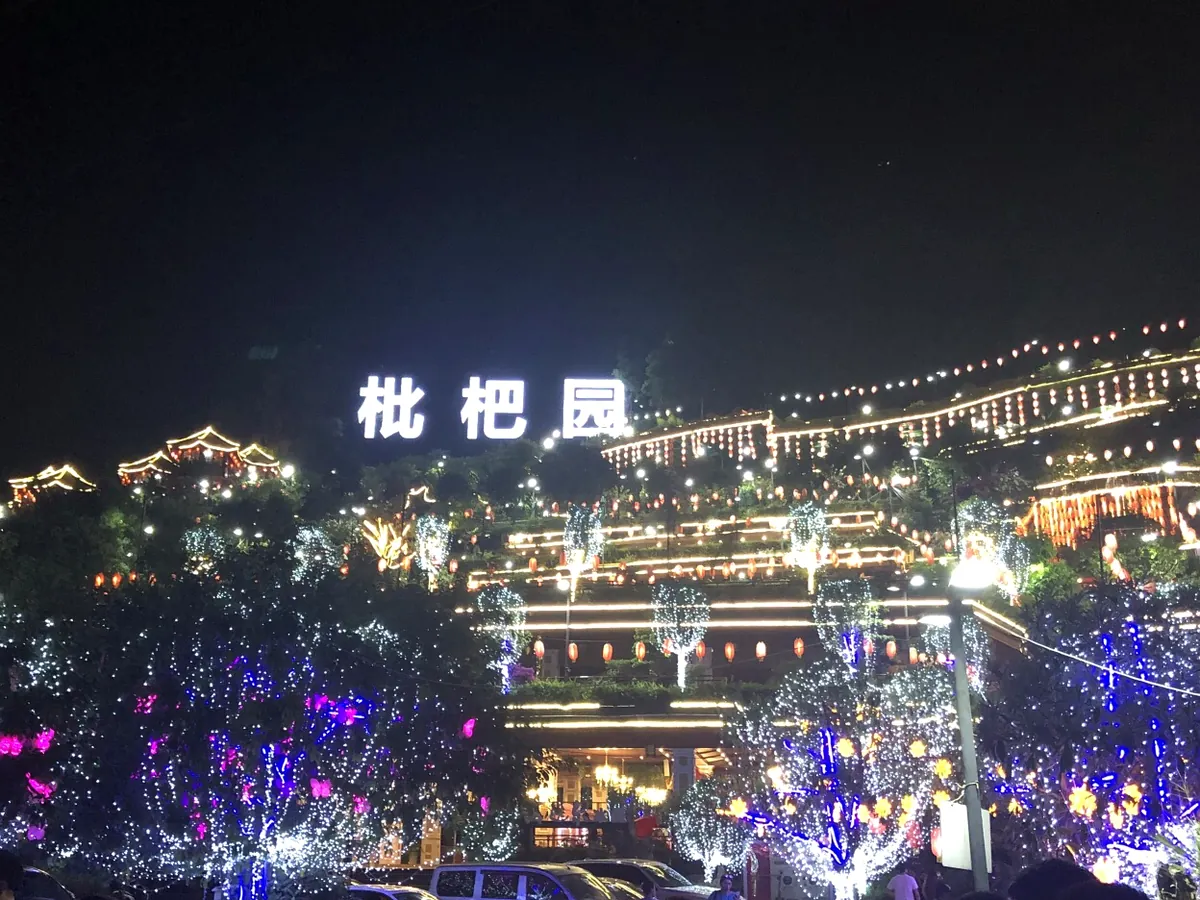
As dusk settles over the summit of Nanshan, the entire hill transforms into a breathtaking lighting artwork set within expansive nature. Thousands of wooden steps and steep paths are brightly illuminated by traditional red lanterns and LED strips tracing the hillside like a fiery Milky Way winding through the dark wilderness. The completely open landscape lets diners enjoy hot pot while sweeping their gaze across the tranquil Nanshan forests, breathing in the pure, crisp air of the woods while feeling the sheer grandeur of Chongqing’s multi-tiered topography where humanity and nature unite in a supreme architectural dance.
Admiring Pipa Yuan from the foot of Nanshan, connoisseurs cannot help but marvel at a masterpiece applying adaptive architecture to commercial gastronomy on an unprecedented scale. Instead of bulldozing the natural hillside to build lifeless concrete boxes, local architects relied entirely on the original slope of the Ba-Shu mountain range, creating an incomparable multi-tiered dining complex. This sprawling compound rejects conventional enclosed air-conditioned dining rooms in favor of opened visual boundaries, allowing hundreds of dining tables to weave gracefully beneath the lush green canopies of countless ancient loquat trees.
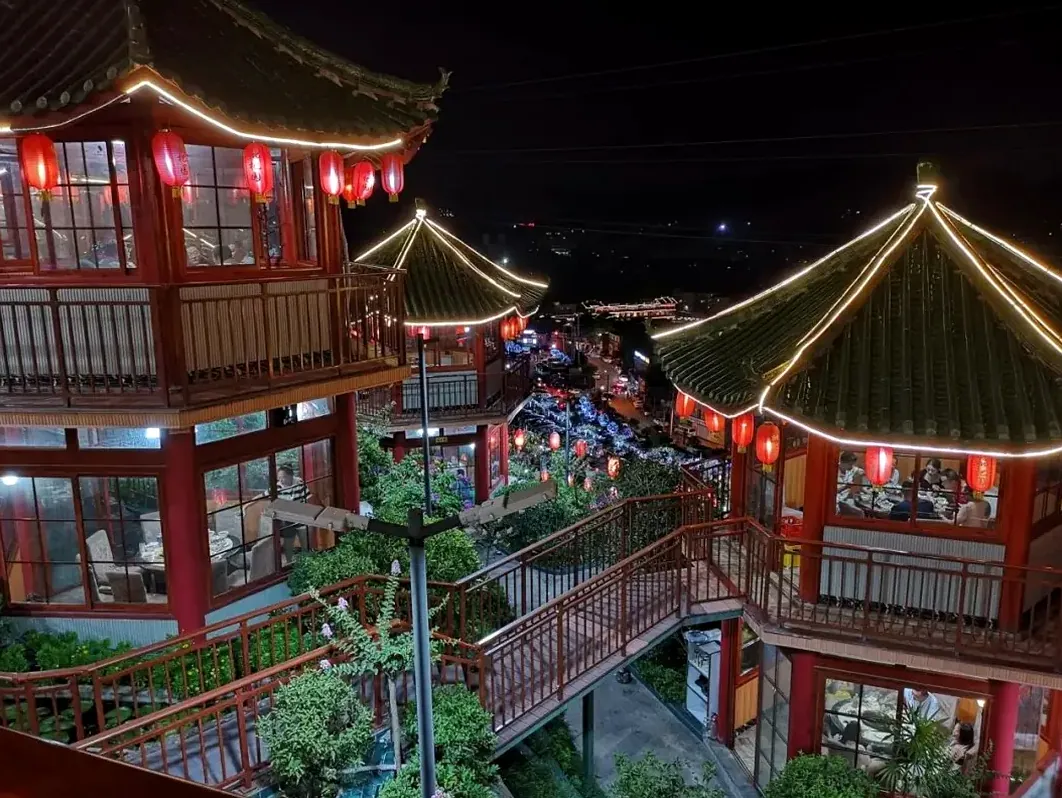
From an expansive aerial perspective after dark, Pipa Yuan unfolds like a magnificent ancient palace materializing amidst misty wilderness. Majestic multi-story buildings featuring signature upturned Oriental roofs are vividly outlined by thousands of refined modern LED strips harmonizing with the warm, glowing aura of countless crimson lanterns. Winding plank walkways and rustic wooden corridors cling precariously to cliff edges, weaving an arresting aerial transit network that feels like an ink-wash painting of an ornate ancient city suspended mid-air.
Outdoor dining tables are arranged in terraced seating configurations spreading gently across dozens of different vertical elevations on the hillside. Each tier of tables is ingeniously designed not to obstruct the sightlines of the tier behind, while fully harnessing cooling microclimates and natural mountain breezes to dispel the heat rising from hundreds of spicy hot pot cauldrons. Diners enjoy their feasts in pristine air where the gentle scent of loquat blossoms and forest tree sap blends exquisitely with the numbing, spicy pungency of Sichuan peppercorns and red chilis, delivering an expansive sensory resonance across taste and smell.
The scale of investment and operational logistics at Pipa Yuan represents a staggering logistical feat in the global dining industry. Spanning across the hillside with nearly one thousand dining tables serving simultaneously, the restaurant routinely welcomes from 3,000 to over 10,000 diners daily at peak capacity. To sustain this massive machinery, the garden’s owners designed an underground service ramp network, specialized electric ingredient transport carts, and prep supply stations distributed evenly across all elevations. The central kitchen operates on precise industrial assembly-line standards, ensuring tons of beef tallow, bone broth, and hundreds of thousands of plates of fresh tripe and tendon are rushed lightning-fast to cliffside dining tables in a flash.
Alongside modern terraced structures, Pipa Yuan’s visual soul fully inherits the essence of traditional southwestern Chinese stilt house architecture (Diaojiaolou). Sturdy wooden load-bearing pillars plunge deep into the stone slope, supporting natural wood observation decks projecting boldly into open space, creating the sensation of floating midway up the mountain. As night deepens, boiling steam mingles with blazing lantern light reflecting across curving wooden bridges, transforming the entire complex into a luminous headland that asserts the pinnacle status of a world-class culinary cultural landmark.
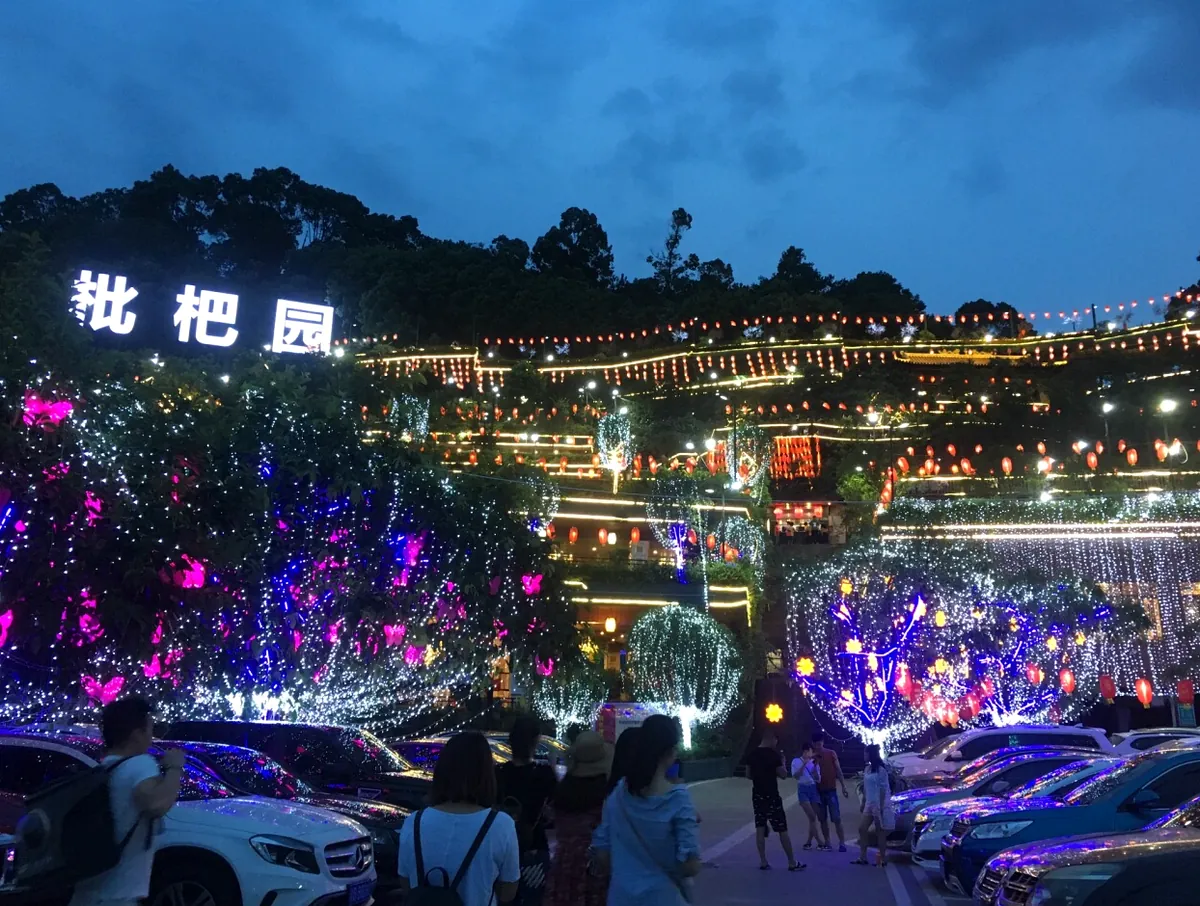
When dusk fades behind the layered folds of the Nanshan range, night falling over Chongqing turns Pipa Yuan from a peaceful ecological garden into the glittering guise of a miniature city of light. The magical synergy between steep hillside terrain and lighting design transforms the entire hill into a colossal live-action stage. Looking up from the foothills, boundaries blur between a conventional restaurant and a festive architectural monument, where the breath of ancient Ba-Shu urban life merges smoothly with the vibrant, powerful pulse of a modern metropolis that never sleeps.
From the expansive front courtyard and spacious parking apron, visitors are immediately captivated by Pipa Yuan’s enchanting evening tableau. Ancient trees and lush loquat groves across the hillside are draped in sophisticated LED strips casting multi-colored ethereal glows alongside thousands of traditional red lanterns suspended along every stone stairway. These warm, vibrant lights pierce the dark mountain shadows while reflecting across bustling vehicle traffic, herrading a magnificent banquet high in the clouds.
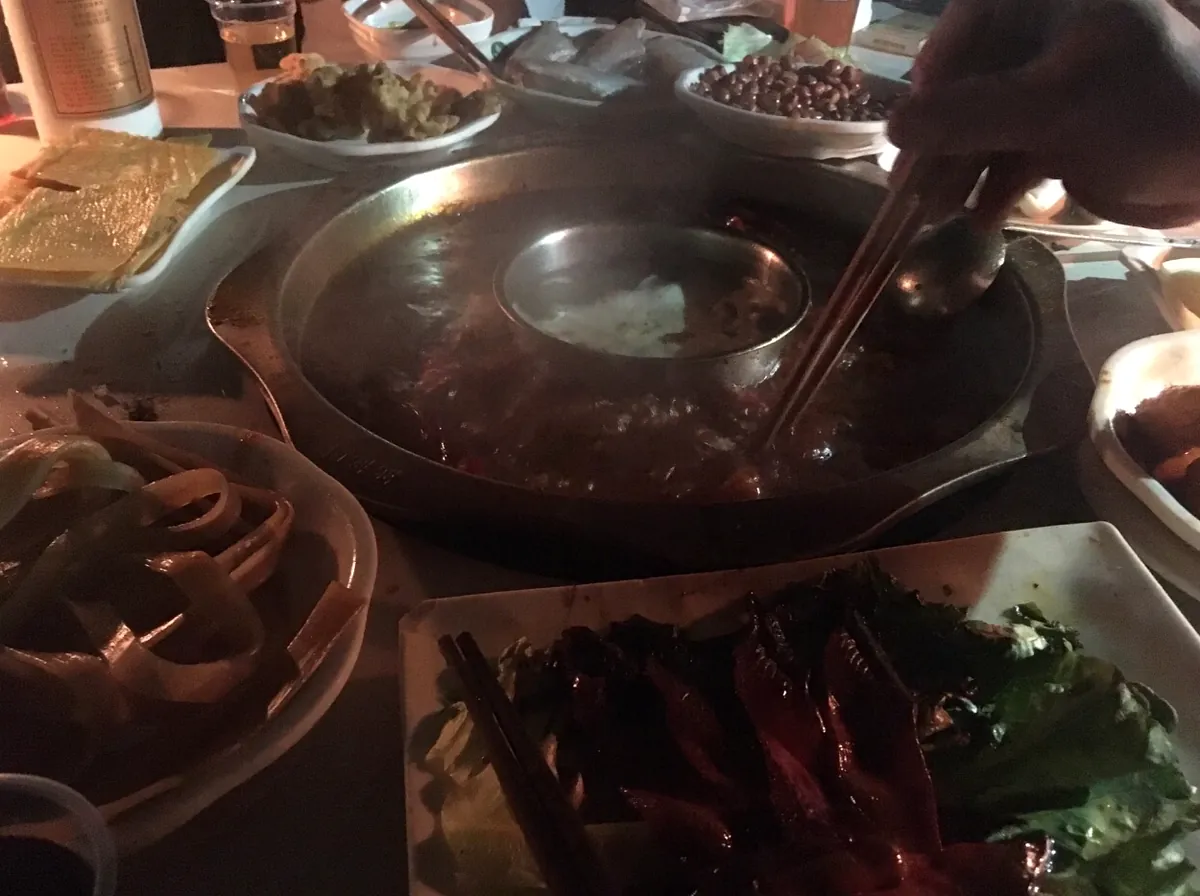
The golden hour defining visual aesthetics at Pipa Yuan unfolds between 6:30 PM and 8:00 PM nightly. When master switches are flipped, thousands of red lanterns ignite in unison, turning the sloping hillside into a cascading river of visual lava flowing across terraces. Steaming clouds rising from hundreds of boiling Nine-Grid hot pots mingle with the mountain mist, creating a hazy illusion reminiscent of magnificent cinematic periods. This marks the most precious visual touchpoint, making any visitor feel as though they have stepped into a resplendent earthly version of fairy-tale pavilions.
Accompanying this grand feast of light is the vibrant intangible cultural heritage of the Ba-Shu region brought to life through live-action performances. Amid bubbling beef tallow and the numbing, spicy aroma of Shizhu red chilis and Jiangjin Sichuan peppercorns, traditional percussion rings out rhythmically as Sichuan Opera Face-Changing (Bianlian) artists dart swiftly among dining tables. Interwoven with these acts are graceful demonstrations of Long-Spout Tea Pouring (Changzui Hu), where masters wield teapots with long spouts winding like flying dragons, accompanied by cheers and joyful toasts from diners—recreating the chivalrous, free-spirited camaraderie of ancient Yangtze River boatmen.
As night deepens, Pipa Yuan’s nocturnal symphony grows even more contemplative and spellbinding. Lighting across Nanshan illuminates the entire southern corner of the Yangtze River, elevating the restaurant beyond a mere dining stop into a peerless leisure icon. Standing on any hilltop balcony, sweeping your gaze across glittering lights echoing the vibrant pulse of thousands of synchronized souls, travelers truly grasp why Chongqing is celebrated as the hot pot capital and the city of sleepless nights.
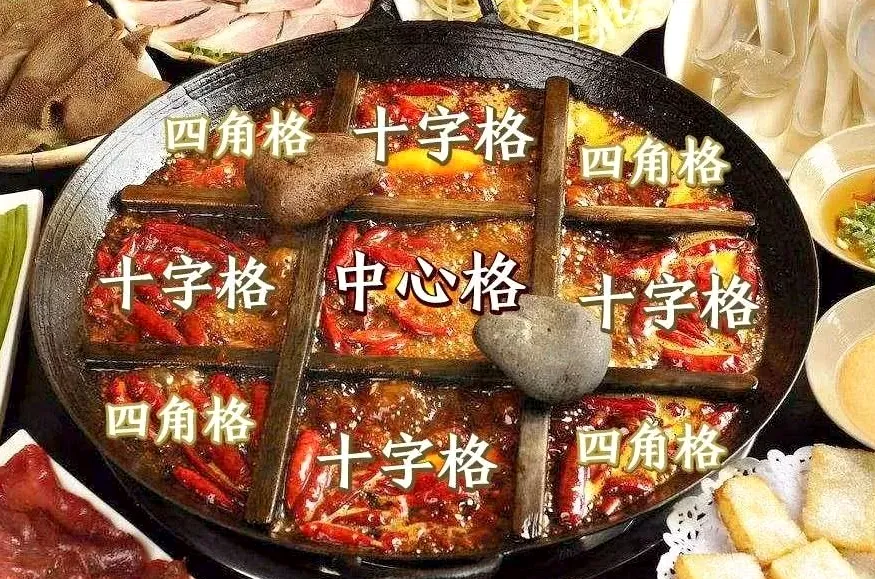
Culinary heritage at Pipa Yuan Shiwei Tian not only inherits the bold flavors of the Ba-Shu region, but also resurrects a life philosophy born along the river docks of the Jialing and Yangtze Rivers during the transition from the late Qing Dynasty to early Republic. At that time, dockworkers hauling goods at Chaotianmen Pier gathered around iron woks filled with beef tallow, Sichuan peppercorns, and red chilis, using crossed tin boards to divide the pot into nine separate compartments. The unique Nine-Grid hot pot structure (Jiugongge) was born then, allowing each person to keep their own section without mixing food, and has now been elevated by culinary artisans at Pipa Yuan into a premier tasting standard based on sophisticated thermal zoning.
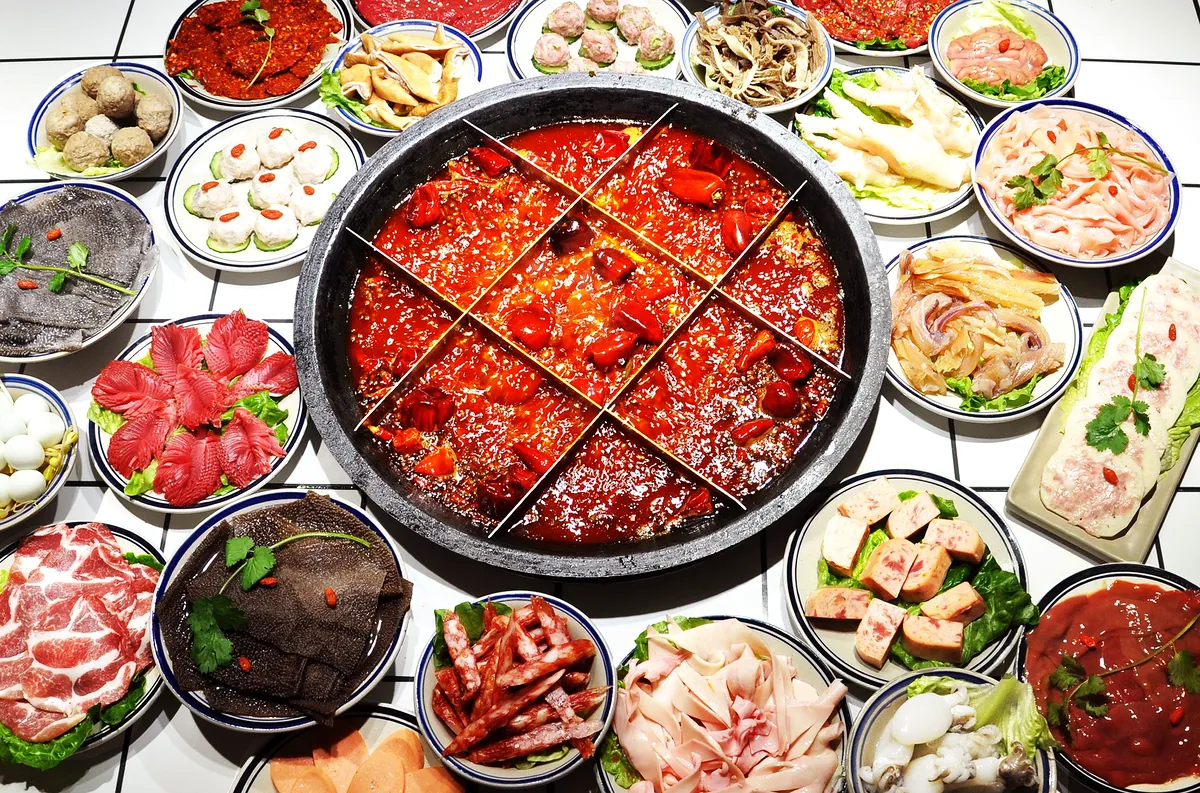
The core principle of the Nine-Grid hot pot lies in uneven heat transfer across its nine separate sections. The absolute center—exposed to the most intense flame—is the heart grid with rolling boiling temperatures, ideal for quick-dipping techniques designed to preserve crisp tenderness. Four intersecting sub-grids surrounding the center maintain medium heat with gentle simmering bubbles, providing an ideal space for poaching marinated meats that require even cooking times. The four corner grids farthest away retain the lowest, simmering heat, dedicated to braising collagen-rich ingredients that require deep absorption of herbal spices. The soul of this hot pot is pure beef tallow (niuyou) cooked elaborately with famous Shizhu red chilis, Maozhou red Sichuan peppercorns, fennel seeds, cassia bark, black cardamom, and Yongchuan fermented black beans, yielding a rich crimson soup base radiating an intoxicating aroma the moment heat hits.
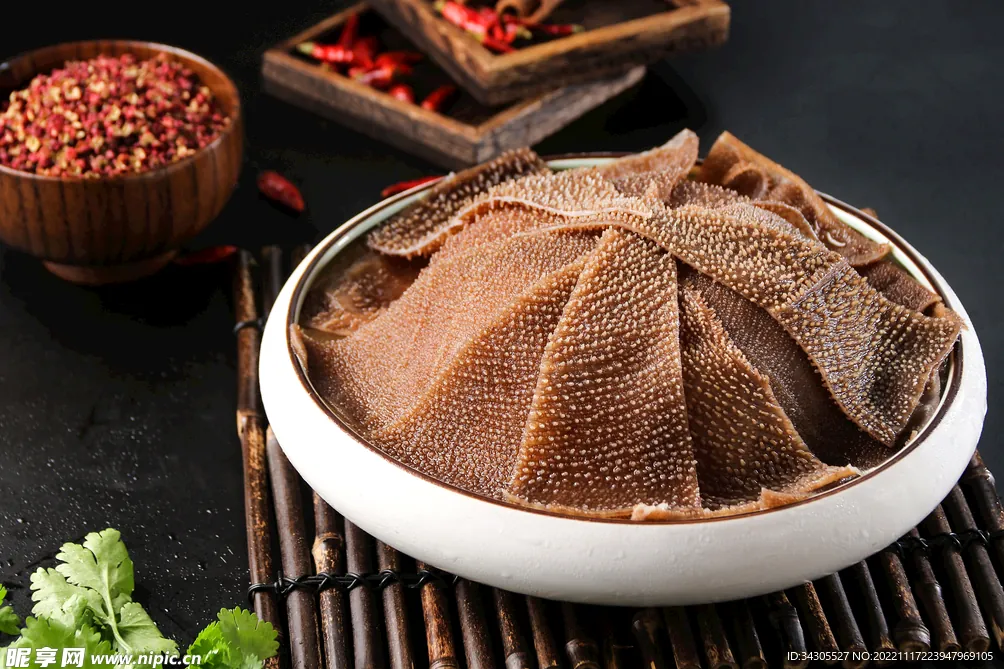
Reigning supreme atop the culinary pantheon here is Hairy Beef Tripe (Maodu), the forest-combfed rumen of freshly slaughtered cattle featuring natural dark flesh spikes. Enjoying Maodu demands absolute precision following the folk culinary axiom “seven dips up, eight downs” (qi shang ba xia)—swishing it up and down right in the heart grid for precisely fifteen seconds. Upon lifting, the meat spikes tighten into a crisp, bouncy texture, absorbing the spicy, numbing fat while keeping its clean, sweet flavor intact. Accompanying the tripe are thick cuts of fresh duck blood, smooth and free of air bubbles; dropping them into medium-heat grids transforms them into tender jelly blocks infused with chili oil that remain juicy inside, melting instantly on the tongue like silk.
Completing this flavor harmony is Fresh Chili Marinated Beef, a Chongqing specialty where tender slices of beef tenderloin are hand-pounded to loosen muscle fibers, then buried under coarse chili powder, freshly pounded local chilis, and native peppercorns. Even when submerged in boiling beef tallow across surrounding grids for minutes, the spicy chili coat clings tightly to each slice, keeping the inner beef tender and wonderfully sweet without drying out. To balance the blistering heat of chilis and peppercorns, local diners mix a traditional dipping sauce consisting solely of pure sesame oil blended with abundant freshly minced garlic and chopped scallions. Cooling sesame oil forms a protective coating over the throat and stomach lining while instantly soothing the burning sensation, celebrating the exquisite five-flavor harmony of the Ba-Shu earth in every bold bite.
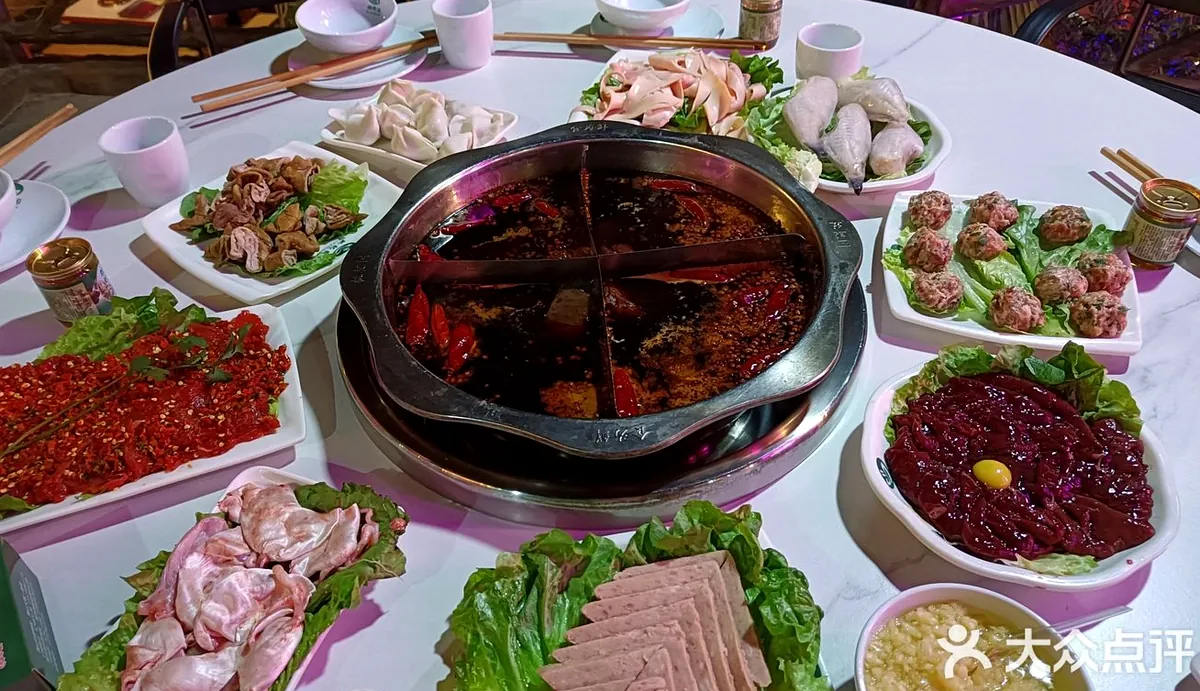
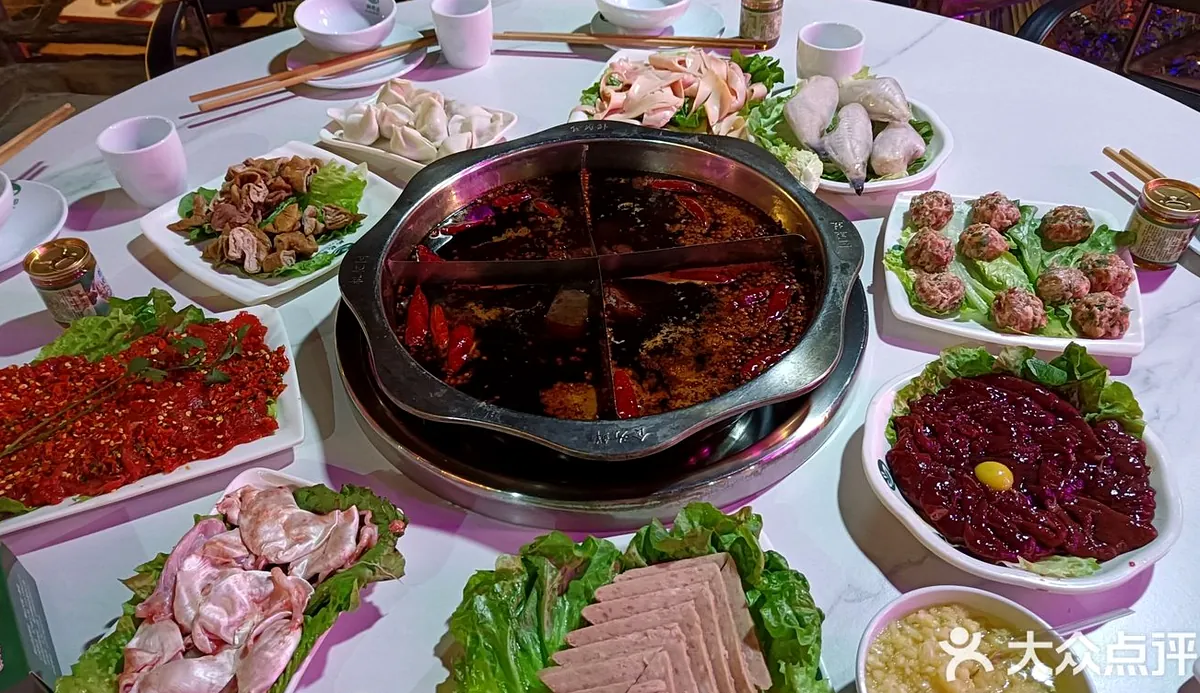
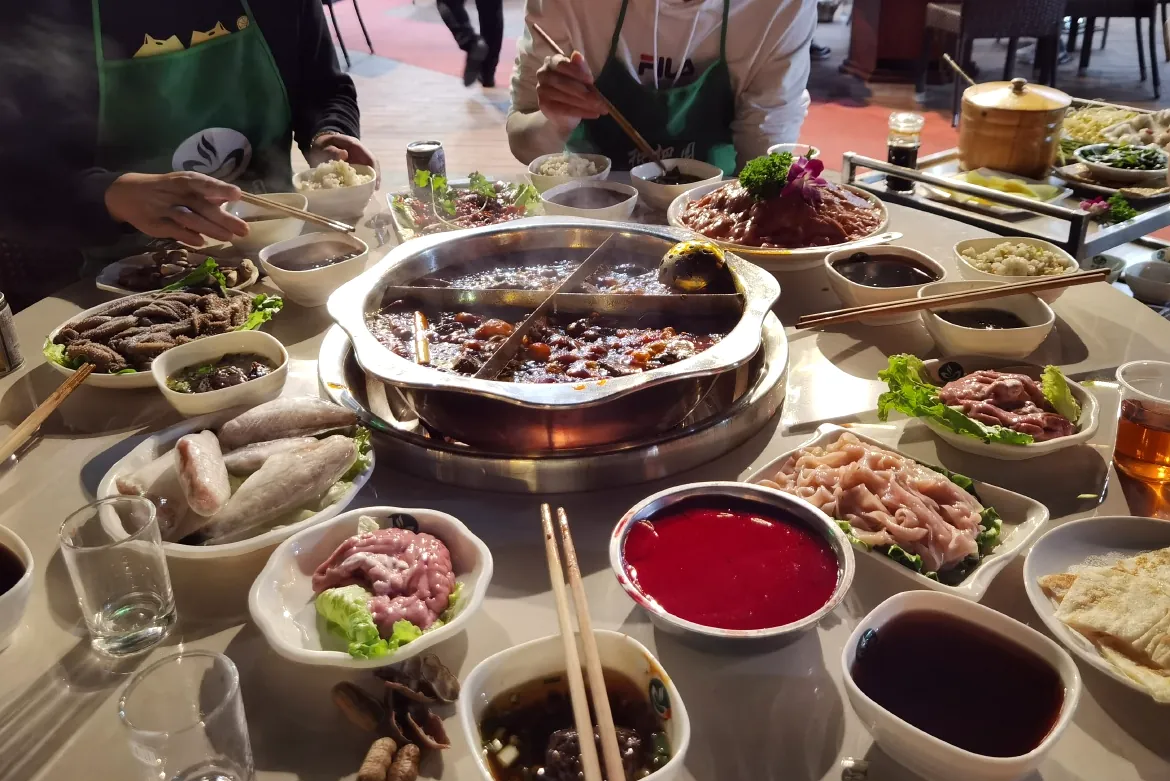
Seated midway up the Nanshan hillside, diners are greeted by a lavish Ba-Shu feast arrayed around partitioned metal hot pot cauldrons venting clouds of steam. The focal point of the table is a broth glowing red with Sichuan chilis and famous peppercorns boiling vigorously beside a mellow, nourishing white bone-marrow compartment. Encircling the copper pot are countless ceramic plates layered with premium fresh ingredients: thin crimson strips of fresh beef, plum-patterned tripe, sliced fresh liver, glossy hand-pounded meat pellets, contrasted against the pristine white of soft tofu and fresh green mountain greens foraged that very day.
Pipa Yuan Hot Pot Restaurant maintains a bustling pace running almost continuously round the clock, opening from 9:00 AM until midnight or the early hours of the morning to welcome travelers from afar. Despite its record-breaking scale featuring hundreds of tables spread across the hillside, booking tables at least twenty-four hours in advance via the local Dianping app remains essential to avoid waiting hours among the crowds. The ideal time to begin the feast is around 5:30 PM, when sunset gradually descends over the misty valley and thousands of red lanterns ignite simultaneously, turning the ancient orchard into a magical waterfall of light.
Perched remotely on the steep slopes of the Nanshan scenic area in Nan’an District, reaching Pipa Yuan via public transit such as subways or buses is virtually impossible for international travelers. Winding mountain roads require visitors to take traditional taxis or ride-hailing apps via Didi Chuxing originating from downtown Yuzhong Peninsula. The journey along winding mountain passes drops passengers right at the reception gate at the foot of the hill; from here, reaching the dining area requires walking up hundreds of steep stone steps, making comfortable running shoes or flat-soled non-slip footwear indispensable.
For international visitors, exploring the foggy metropolis of Chongqing and experiencing culinary culture at Pipa Yuan is made accessible thanks to the 144-hour visa-free transit policy at Jiangbei International Airport. However, language barriers at a purely local dining establishment featuring digital menus exclusively in simplified Chinese characters and cashless payments through domestic e-wallets can create initial surprises. Understanding local culinary customs not only helps diners easily select appropriate spice levels to match their palates, but also supports smooth navigation across complex hilltop zones.
To enjoy breathtaking spicy flavors amidst lush green mountains without worrying about table reservations or transit hurdles, choosing to join a professionally designed all-inclusive China tour package unlocks the door to entering one of the Middle Kingdom’s most magnificent hot pot paradises smoothly and memorably.