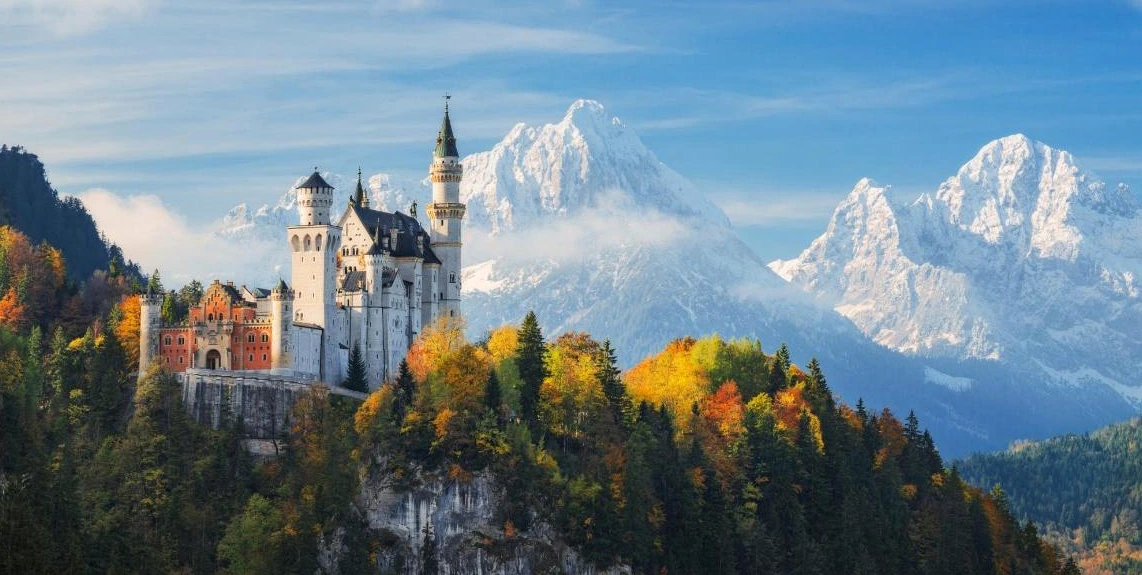
Nestled amidst the majestic scenery of the Bavarian Alps, where cloud-veiled limestone peaks of the Allgäu embrace endless emerald valleys, Neuschwanstein Castle emerges like a mirage straight out of a medieval epic. This white-stone architectural masterpiece is far more than a royal residence; it is the ultimate symbol of the romantic soul, tragic grandeur, and profound inner turmoil of King Ludwig II—the legendary monarch of the illustrious House of Wittelsbach who ruled the Kingdom of Bavaria from 1864 to 1886. Ascending the throne at just eighteen years old, confronted by the overwhelming rise of the Prussian Empire and the gradual erosion of Bavaria’s independent political power following the Austro-Prussian War, Ludwig II chose to retreat from pragmatic statecraft and immerse himself in a dreamworld of Germanic mythology and his boundless passion for the grand operas of composer Richard Wagner.
The genesis of the monument stemmed from a longing to recreate an authentic knight’s fortress, an isolated sanctuary far removed from the mundane world. In September 1868, rather than turning to traditional academic architects, the king commissioned theatrical set designer Christian Jank to draft the initial sketches brimming with dramatic flair and romantic poetry. Under the technical direction and coordination of court architect Eduard Riedel, the sacred foundation stone ceremony officially took place on September 5, 1869, upon the ruins of two ancient fortresses: Vorderhohenschwangau and Hinterhohenschwangau. Throughout its arduous years of construction, the edifice originally bore the modest title “Neue Burg Hohenschwangau” (New Hohenschwangau Castle), echoing the king’s idyllic childhood memories at his father Maximilian II’s Hohenschwangau Castle, before being posthumously renamed “Neuschwanstein” (meaning New Swan Stone) in honor of the Schwanenritter legend and the noble figure of Lohengrin, the Swan Knight.
Yet the fate of this monumental work is bound to one of the most enigmatic tragedies in European royal history. Despite pouring his heart, royal fortune, and decades of meticulous oversight into every carved detail, King Ludwig II resided in his fortress for only a fleeting span of time. In June 1886, the king was deposed by a council of ministers on grounds of mental instability and escorted away from his beloved sanctuary of Neuschwanstein. Just three days later, on June 13, 1886, the body of the solitary monarch was discovered alongside his psychiatrist, Bernhard von Gudden, in the frigid waters of Lake Starnberg—a mysterious death that remains unanswered to this day. This harrowing turn of events brought the entire construction project to an abrupt halt, leaving several ambitious features permanently unfinished, including the soaring Bergfried main keep and the imposing chapel.
History’s irony continued just six weeks after Ludwig II’s death, when the Bavarian authorities were compelled to throw open the gates of a fortress built for absolute seclusion, charging public admission to pay off the colossal construction debts left behind by the king. From the forsaken fantasy of a tragic monarch, Neuschwanstein has risen to become one of the world’s most celebrated cultural landmarks, drawing over 1.3 million pilgrims of beauty each year. The surreal splendor of this stronghold served as the timeless inspiration for Walt Disney’s iconic castle in the animated classic Sleeping Beauty, and its enduring heritage value was officially recognized by UNESCO as a World Heritage Site in July of this year as part of the magnificent ensemble of the Palaces of King Ludwig II of Bavaria.
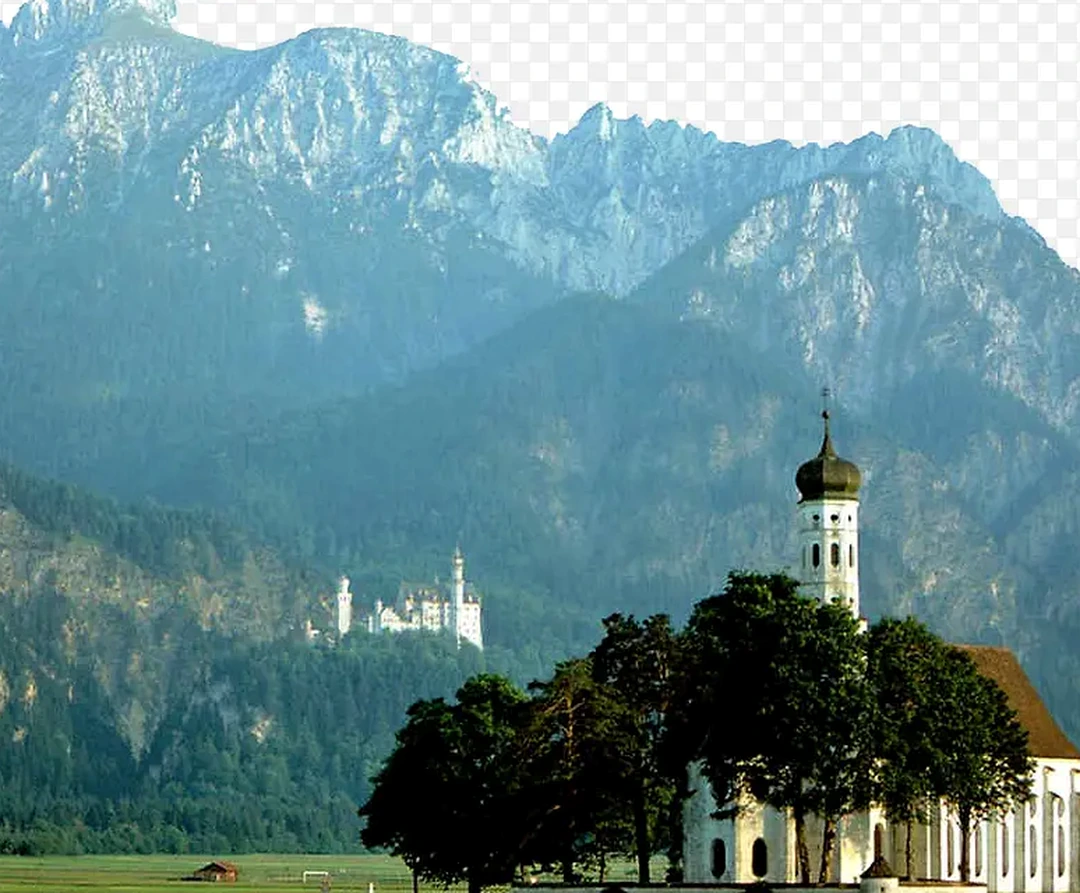
Standing proudly atop a rugged mountain ridge at an elevation of 965 meters above sea level, Neuschwanstein Castle occupies the exact footprint of the two ruined medieval strongholds of Vorder- and Hinterschwangau in the historic region of Hohenschwangau, Ostallgäu district, in southern Bavaria. Beyond the mere presence of an opulent stone edifice, it stands as a resolute declaration of triumph over nature’s most formidable terrain. Directly beneath its colossal limestone pedestal yawns the deep Pöllatschlucht gorge, where the timeless Pöllat stream roars and churns, carving a natural boundary that severs the castle from earthly clamor. Geographically, anchoring its back against the mighty Alps while poised precariously mid-sky grants the fortress an unmatched “crouching dragon” stance—shielded discreetly from prying eyes yet commanding a sweeping panorama across the fertile plains stretching endlessly below.
To bring King Ludwig II’s extraordinary architectural vision to life, skilled engineers and masons undertook an unprecedented feat of topographical surgery upon the sheer, jagged crag. Massive blocks of monolithic limestone from the two predecessor fortresses were blasted away and leveled to a depth of up to eight meters to carve out a solid foundation plateau atop the narrow, elongated spur. Hauling hundreds of thousands of tons of marble-like stone from nearby Oberammergau, soft sandstone from Nürtingen, and vast quantities of hydraulic cement up to nearly a thousand meters in harsh alpine weather demanded cutting-edge mechanical engineering of the era, including mobile steam cranes and specialized single-track railways. The foundations were anchored directly into the bedrock via early reinforced concrete blocks, achieving an engineering marvel that both rests organically upon and locks the structure tightly into the backbone of the mountain range.
Transcending the rigid, imposing symmetry of classicism once fashionable at the Palace of Versailles, Neuschwanstein was conceived in faithful adherence to the Picturesque movement—a school celebrating untamed natural beauty and organic architecture. The overall layout bends and undulates rhythmically along the natural contours of the ridge, dissolving into the surrounding mountain-and-water landscape rather than flattening it to project raw power. To the west lies the jade-like stillness of Lake Alpsee reflecting ancient pine forests; to the north opens a sweeping vista over Lake Forggensee and rolling green meadows; while to the south, a nostalgic visual axis links directly to the golden fortress of Hohenschwangau, where the romantic monarch spent his boyhood. The harmonious convergence of abundant moisture from the surrounding lakes and rivers with the crisp mountain air of towering limestone cliffs creates a pure microclimate, transforming the site into an ethereal, secluded oasis utterly detached from the upheavals of the outside world.
The crowning achievement of Neuschwanstein’s spatial planning lies in its art of visual staging (Inszenierung), turning the entire architectural complex and natural setting into a magnificent open-air stage worthy of Richard Wagner’s poetic dramas. Every soaring spire, crenellated wall, and glazed bay window was angled with mathematical precision to produce breathtaking visual effects from afar—none more legendary than the perspective from Marienbrücke (Mary’s Bridge) spanning the Pöllat Gorge. Suspended ninety meters above the foaming waterfall below, the slender iron bridge serves as an unrivaled royal box seat. Viewed from this vantage point, Neuschwanstein rises not as an inanimate mass of masonry, but like a crystalline formation thrusting straight out of the sheer cliffside, soaring proudly amidst the Allgäu mists and affirming the seamless union of human engineering and the eternal majesty of the Bavarian mountains.
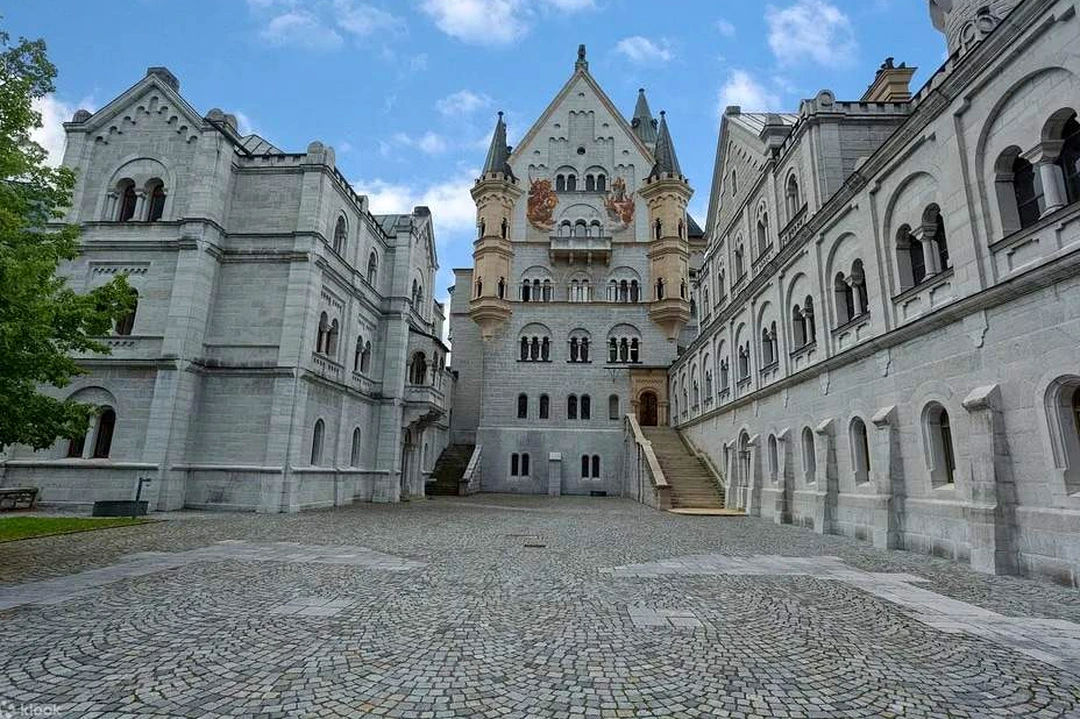
From afar, Neuschwanstein Castle appears as a surreal vision stepped out of medieval chivalric epics, yet from an architectural standpoint, it represents the quintessential pinnacle of Historicism, articulated through a Neoromantic vocabulary intricately woven with Neo-Gothic styling and opulent Byzantine courtly splendor. Art-obsessed King Ludwig II never intended to replicate an authentic feudal defensive stronghold; instead, alongside stage designer Christian Jank and architect Eduard Riedel, he distilled the most radiant aesthetic traditions to erect a monument of spiritual symbolism. Behind its tapering watchtowers, stout crenellated ramparts, and exquisitely carved friezes lies an ambitious spatial structure that defied every contemporary construction limit atop the treacherous crags of the Ammergau Alps.
The sheer physical scale of the fortress is staggering, with a total building volume approaching roughly 300,000 cubic meters. To support this colossal edifice perched high on a precipitous cliff, engineers of the day constructed a load-bearing core of millions of high-strength fired bricks, subsequently clad entirely in pristine white limestone quarried from nearby deposits. At key structural focal points such as the reception hall, vaulted corridors, and royal pedestals, renowned Untersberg marble from the Salzburg region was painstakingly dressed into imposing colonnades boasting a refined, golden-gray sheen. The castle’s main tower was originally conceived to reach 90 meters in height to dominate the entire Pöllat Gorge, though it was ultimately completed at a proud height of around 65 meters—just enough to preserve absolute harmony between human creation and untamed nature.
The pinnacle of interior craftsmanship converges inside the Throne Room (Thronsaal), a two-story sanctuary modeled after the imperial Hagia Sophia and grand Byzantine basilicas. The space radiates supreme majesty with an intricate mosaic floor depicting the flora and fauna of Eden, paired with murals portraying Christ alongside the Twelve Apostles and six canonized kings. Even more astonishing is the hidden structural engineering behind it: to support a resplendent gold-leaf hemispherical dome without a single obstructing central pillar, the architects discreetly integrated an advanced load-bearing steel frame deep within the brick walls. Equally extraordinary is the oak woodcarving in the king’s bedchamber, where Bavaria’s finest master woodcarvers labored tirelessly for over four years to chisel intricate Gothic tracery illustrating the tragic romance of Tristan and Isolde.
Neuschwanstein’s most wondrous and dramatic contrast lies in the seamless marriage between its ethereal, nostalgic exterior and some of the most advanced technical infrastructure in 19th-century Europe. During construction, steam engines and mechanical cable-driven cranes were deployed to hoist tens of thousands of tons of material up the steep mountain pass. Inside the castle, an infrastructure network far ahead of its time was cleverly concealed: a central boiler system circulated warm air throughout rooms large and small, while fresh spring water tapped high in the mountains was piped under pressure across every floor, supplying continuous hot and cold running water to both kitchens and lavatories. Toilets featured modern pneumatic automatic flushing mechanisms alongside an electric bell network enabling instant communication between the monarch’s chambers and his attendants. Together, these innovations prove that Neuschwanstein was no mere solitary daydream, but a brilliant synthesis where romantic art achieved total resonance with the cutting-edge mechanical engineering of a new era.
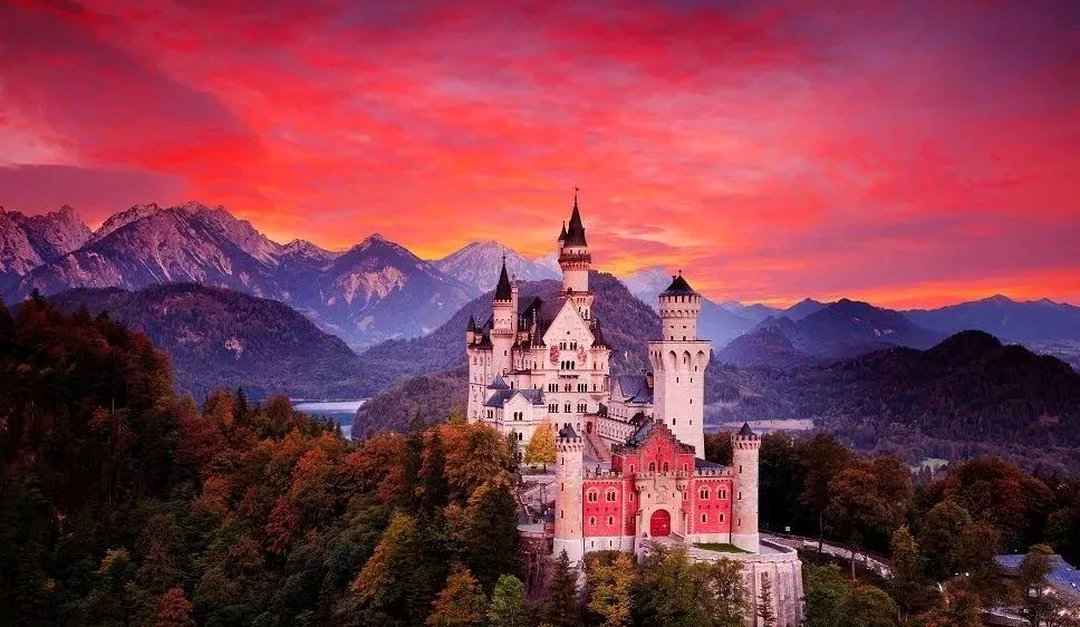
As the sun dips behind the Ammergau Alps, a magical optical spectacle of nature begins to drape the rocky peak of Tegelberg. This is the moment of Alpenglühen—the signature alpine alpenglow—awakening the entire visual soul of Neuschwanstein. Under the oblique rays of dusk, the pale gray limestone slabs quarried from Alter Schrofen undergo a breathtaking transformation into warm ochre tones before blushing into a dreamy rose pink. The interplay between this rich warmth and the deep, fathomless green of the pine forests blanketing the Pöllatschlucht gorge turns the fortress into a mythical sculpture floating mid-air, resembling a colossal stage backdrop poised for the opening act of a tragic heroic saga.
To King Ludwig II, Neuschwanstein was never built to host ostentatious court ceremonies or tedious diplomatic receptions. The historic upheaval of 1871, when the Kingdom of Bavaria was forced to cede sovereignty and join the German Empire under the hegemony of Prussia’s Hohenzollern dynasty, dealt a devastating blow to the proud psyche of the young monarch. Profoundly disillusioned by the reality of his diminished authority, Ludwig II fled into a world of myth and legend, transforming the untamed crag into a sacred hermitage (Einsiedelei). Here, conventional daily rhythms were completely inverted: the king slept through the noisy daylight hours and awakened only as deep night descended. In the stillness of the Bavarian darkness, Neuschwanstein became a true three-dimensional opera stage—where every stone, vault, and corridor drew direct inspiration from the immortal epics of Richard Wagner, from the Grail legend of Parsifal to the tragic love story of Tristan and Isolde.
The centerpiece of auditory and visual artistry within the castle is the Singers’ Hall (Sängersaal), the grandest chamber in the palace, occupying the entire fourth floor of the main building. Modeled after the legendary Wartburg Castle, this hall features an intricately carved coffered wooden ceiling engineered with precision as a massive acoustic soundboard, creating sublime acoustics for intimate chamber concerts. Although Ludwig II never hosted a single public grand concert here during his lifetime, the Sängersaal was kept perpetually poised for an imagined performance. Beneath the shimmering glow of more than six hundred beeswax candles and massive gilded Byzantine chandeliers, murals depicting the medieval minstrel contests seemed to stir to life, flickering in the night breeze drifting through stone-arched windows and transporting the observer into a realm of pure reverie.
As deep night blankets the Hohenschwangau valley, Neuschwanstein’s interplay with light reaches the sublime heights of a solitary apparition. Viewed from Queen Mary’s Bridge (Marienbrücke) spanning the abyss of the Pöllat Gorge, the fortress stands silhouetted against the pitch-black sky like a mysteriously luminescent quartz crystal. The ceaseless roar of the waterfall echoing from the chasm below mingles with the whistle of wind through pointed turrets to compose an endless natural symphony—at once untamed and tinged with melancholy. Neuschwanstein by night belongs not to the bustle of urban life, but to the lingering resonance of supreme romantic emotion—where architecture, music, and natural light fuse into one, realizing the eternal escapist longing of Germany’s most tragic king.
Tucked peacefully at the foot of the majestic Ammergebirge mountains, the culinary landscape surrounding the two fairytale villages of Schwangau and Hohenschwangau offers far more than simple sustenance for weary travelers; it is a proud symphony of regional flavor. Nurtured over centuries beneath the protective shadow of the House of Wittelsbach, local dining culture distills a remarkable harmony between the hearty, rustic pastoral traditions of the Allgäu highlands and the refined elegance that once captivated the imagination of romantic King Ludwig II. It is a culinary world where every pat of butter, wedge of cheese, and cut of game carries the pristine breath of snow-kissed Alpine pastures.
Speaking of the soul of Allgäu cuisine, one cannot overlook Kässpatzen—the celebrated handmade egg noodle specialty that has enchanted generations of wayfarers. Fresh dough is scraped swiftly from a wooden board straight into boiling water, lifted out the moment the noodles turn tender, and immediately tossed with a rich blend of aged Allgäu mountain cheeses, Bergkäse and Alpkäse. Crafted from the pure milk of cattle grazing freely on wildflower-strewn high alpine slopes all summer long, the mature cheese melts into a velvety, stretchy blanket coating every chewy strand. Served piping hot and crowned generously with crispy butter-fried onions, the dish fills the air with the unmistakable, rich aroma of southwestern Bavaria’s mountain forests.
While cheese and dairy embody the generosity of lush alpine meadows, Wildgerichte—traditional game dishes—stand as a living tribute to royal courtly heritage. The dense Ammergebirge forests encircling Neuschwanstein long served as the exclusive royal hunting preserves of Bavarian monarchs. Today, the art of preparing wild game is faithfully upheld by local chefs. Red deer, roe deer, or chamois meat is meticulously marinated with juniper berries, rosemary, and wild peppercorns before being slow-braised in red wine until velvety tender. The deep, subtly wild sweetness of the venison pairs exquisitely with the tart brightness of Preiselbeeren (lingonberry compote) and hearty Semmelknödel bread dumplings, delivering a truly regal gastronomic experience.
No feast beneath the ramparts of Neuschwanstein would be complete without the sweet desserts once cherished at the royal court. The iconic Kaiserschmarrn—a favorite indulgence of both Habsburg and Wittelsbach nobility—is made from fluffy pancake batter pan-fried to golden perfection in cast iron, torn into rustic bite-sized pieces, dusted with powdered sugar as white as snow atop Mount Säuling, and served alongside fragrant apple compote. Every autumn, historic village ovens also waft the warm scent of cinnamon from traditional Zwetschgendatschi, where juicy purple plums are arranged neatly atop a thin yeast-dough base and baked until the fruit releases a tantalizing, sweet-tart glaze.

To round out this captivating sensory journey, Allgäu craft beer serves as the ideal bridge linking past and present. Seated beside century-old oak windows inside historic inns such as Hotel Müller or Schlosshotel Lisl—establishments that once welcomed bustling royal retinues—raising a glass of creamy-headed Weizen wheat beer, deeply malted Dunkelbier, or golden Hellbier glinting like sunset light off Neuschwanstein’s pale stone walls allows travelers to savor the quiet poetry of a culinary heritage tempered through centuries of history.
Journeying to the ethereal realm of Neuschwanstein amidst the Allgäu peaks requires thoughtful preparation around timing and seasonal rhythms, as King Ludwig II’s fairytale palace operates under strict schedules designed both to welcome visitors and safeguard its heritage. The annual operating calendar is clearly divided into two distinct seasons: the summer season runs from March 23 through October 15 with gates open from 09:00 AM to 06:00 PM, while the winter season from October 16 through March 22 shortens visiting hours to 10:00 AM through 04:00 PM. The entire monument closes completely on four major holidays: December 24, 25, and 31, and January 1. Keeping these dates in mind is essential so travelers never miss their chance to step into a medieval dream—whether Mount Tegelberg is blanketed in pristine snow or golden sunlight shimmers across the crystal waters of Lake Alpsee.
One crucial tip for every traveler is the castle’s strictly enforced ticketing system: tickets are never sold directly at the castle gates atop the cliff. Visitors must purchase tickets at the Ticket Center Hohenschwangau located prominently at the foot of the mountain—or, ideally, reserve them well in advance online to lock in a specific entry slot. Every ticket is tied to a fixed admission time and includes a strictly guided tour led either by a multilingual audio guide or a professional local guide. This standardized system not only preserves a hushed, reverent atmosphere inside the royal chambers, but also carefully regulates foot traffic to protect the load-bearing structure of the century-old landmark.
Transport connections to Neuschwanstein reflect the hallmark order and convenience of German infrastructure. Travelers arriving by private car can follow the scenic B17 highway through the historic town of Füssen into the village of Schwangau, where well-organized paid parking lots sit around the lakes at the base of the hill. For those favoring public transit, the smoothest route is taking a direct regional train from Munich Central Station (München Hauptbahnhof) to Füssen Station, followed by a short hop on bus line 73 or 78 to the Hohenschwangau / Neuschwanstein stop. There, the landscape unfolds with traditional timber-framed Bavarian houses nestled beneath towering limestone cliffs.
From the base of the hill up to the castle lies a scenic thirty- to forty-minute walk along trails shaded by beech trees and fragrant pines—an ideal choice for early risers eager to breathe crisp mountain air and beat the midday crowds. Those seeking a nostalgic touch worthy of 19th-century Bavarian nobility can ride up the winding incline in two-horse carriages, or board a dedicated shuttle bus up to the viewing area near Marienbrücke. Suspended nearly a hundred meters above the Pöllat Gorge, this dramatic footbridge offers the single most breathtaking panoramic vantage point, though it may occasionally close during icy winter weather or high winds for visitor safety.
Photography at Neuschwanstein depends deeply on the sun’s arc across the Alps. In the crisp morning hours, early sunlight illuminates the eastern and southern facades head-on, rendering the soaring white towers with razor-sharp clarity. Conversely, as late afternoon fades into dusk, looking toward the western facade from the valley captures the enchanting optical spectacle of Alpenglühen, when sunset hues bathe the snow-dusted peaks in rose and cast an ethereal glow across the stone walls—evoking the enduring melancholy of Bavaria’s romantic king.
To ensure your journey to Germany’s fairytale heartland unfolds effortlessly without the stress of coordinating complex logistics or securing timed entry tickets months ahead, traveling with an experienced tour operator is always the ideal choice. Feel free to explore and select from our all-inclusive European tour packages to enjoy seamless service—from dedicated transportation to attentive care at every stop across Europe’s most enchanting destinations.