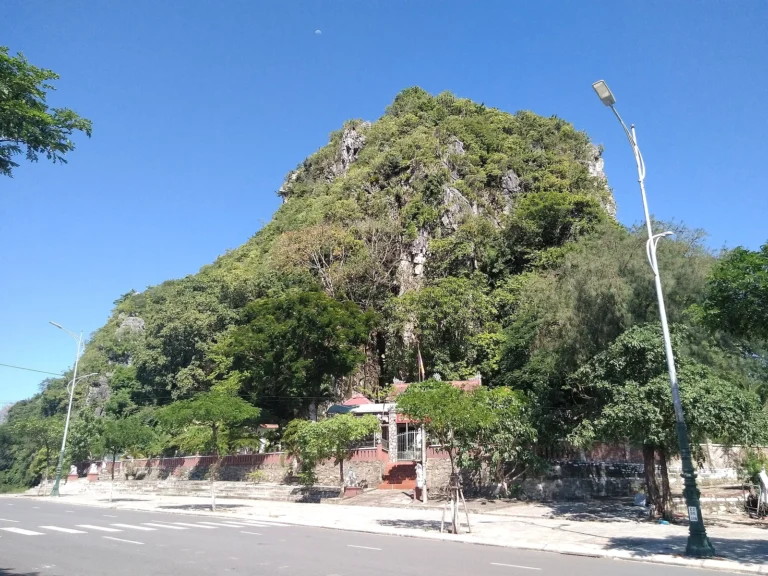
Rising majestically more than a thousand meters above sea level, the historic architectural complex recorded in French colonial archives as “Village Français” (French Village) commands a one-of-a-kind geographical position in the upper highlands of the Ba Na mountain range, now part of Hoa Vang District, Da Nang City. From a geological and topographical perspective, this massif forms part of Mount Chua within the Northern Truong Son mountain system, soaring like a monumental natural rampart that intercepts breezes from the East Sea and captures the converging climatic currents between Northern and Southern Vietnam. The terrain embodies classic feng shui harmony: backed by the imposing peak of Mount Chua and facing out toward the vast expanse of Da Nang Bay and the Son Tra Peninsula. The interplay between rugged primary forest terrain and sweeping panoramic vistas creates an auspicious, ethereal sanctuary where mountain clouds swirl year-round, turning this summit into a unique temperate microclimate in the heart of sunny, wind-swept tropical Quang land.
Tracing history back through Vietnam’s feudal dynasties—from the Le Dynasty through the Nguyen Lords to the independent Nguyen Dynasty—this highland region was recorded in the imperial gazetteer Dai Nam Nhat Thong Chi under the solemn name “Mount Chua.” In those days, it was a remote, untamed wilderness of dense sacred forests and rugged terrain, rarely trodden by Kinh lowlanders and inhabited primarily by indigenous ethnic minorities such as the Co Tu people. According to linguists and folk toponymists, the name “Ba Na” (or “Ba Nang”) derives from an indigenous language or a phonetic evolution from ancient Cham, reflecting the imprint of prehistoric communities who once lived at the foot of the mountain. It was not until the early twentieth century, as France’s first colonial exploitation program entered a comprehensive phase, that this pristine landscape underwent a fateful transformation—evolving from untouched wilderness into an elite hill station above the clouds (station d’altitude).
The origins of the complex are closely tied to a strategic directive issued by Governor-General of Indochina Paul Doumer in 1901, though the man who laid the first foundations shaping its architectural footprint was French Navy Captain Albert Debay. Commissioned by the colonial administration to survey the region, Debay trekked across treacherous mountain trails to discover the Ba Na plateau, whose year-round cool climate evoked Europe’s temperate mountain ranges such as the Alps and the Pyrenees. Between 1912 and 1925, under the direction of French architects and engineers, a network of trails, villas, hotels, and sanatoriums rose across the peaks, establishing a “Little France” atop the Truong Son range. Gothic, Romanesque, and Renaissance architectural styles were deliberately employed to recreate a nostalgic French cultural enclave in the midst of the tropics.
From the perspective of modern travel journalists and heritage conservation authorities, the geological and architectural significance of the French Village extends far beyond man-made scenic appeal; it represents a valuable layer of historical sediment. The site preserves evocative remnants telling the story of a turbulent era of cultural intersection, while simultaneously safeguarding a rich primary forest ecosystem teeming with flora and fauna endemic to the Truong Son range. Having weathered the vicissitudes of war and time, the area has been restored and repositioned as a living testament to early twentieth-century urban planning and resort architecture. Researching and preserving the authentic character of this landmark not only restores true value to a heritage space, but also celebrates the enduring beauty of an unrivaled vantage point where dramatic nature meets human cultural legacy.

Perched high atop majestic Mount Chua at an elevation of nearly 1,500 meters above sea level, the “French Village” unfolds like a miniature medieval European tableau, where the untamed wilderness of the Truong Son range blends seamlessly with architectural heritage imbued with early twentieth-century French character. Veiled in mist for much of the year, this architectural ensemble is far more than a historic mountain retreat—it is an extraordinary landscape masterpiece in which every street corner, tiled roof, and arched window tells a story of refined human craftsmanship harmonizing with rugged highland terrain.
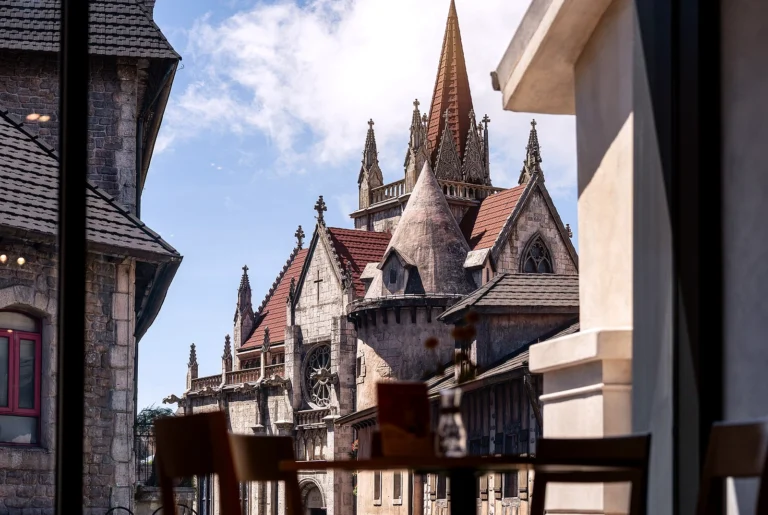
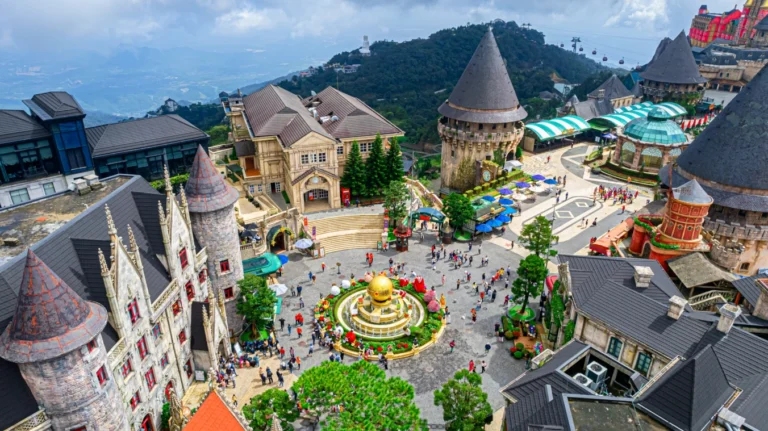
Strolling along moss-covered cobblestone lanes, visitors are captivated by the sculptural artistry and classic urban planning of old France. The complex showcases a dramatic fusion of timeless architectural movements: soaring Gothic spires reaching toward the sky, the quiet gravitas of Romanesque thick stone walls, and the romantic symmetry of Renaissance design. Every chateau, from the Mercure Danang French Village Bana Hills hotel to the cluster of heritage-style villas, features gracefully curved archways, dormer windows evocative of the French countryside, and intricate bas-relief detailing. The distinctive “mountain-backed, sea-facing” topography and naturally undulating slopes create dynamic terraced elevations, preventing visual monotony and allowing the buildings to emerge organically through drifting wisps of cloud.
To capture this grand yet nostalgic beauty at its finest, professional photographers and travel writers consistently point to several iconic vantage points. First is the central square anchored by St. Denis Church, which commands a sweeping frontal view of the main chateau cluster with its stately architectural lines; shooting from a low upward angle frames the scene with the dramatic sweep of a historical feature film. Second are the balconies of the classic villas overlooking the primary forest valley, opening out onto boundless mountain vistas. The optimal windows for photography are sunrise (from 5:30 to 6:30 AM) and sunset (from 5:00 to 6:00 PM), when golden rays slant through morning mist or bathe ancient stone walls in warm crimson hues—creating a magical, “million-dollar” natural light that no artificial studio can replicate.
Stepping onto the summit of Ba Na and immersing yourself in the atmosphere of the “French Village” feels like an extraordinary journey across time, where the boundary between colonial past and modern rhythm dissolves. The first overwhelming sensation is the sudden shift in space and climate: leaving behind the tropical heat of Central Vietnam, just a few minutes aboard a world-record-setting cable car transports you into a mist-draped European village. Church bells echo across the primeval forest, while steep Gothic pitched roofs, moss-grown stone walls, and sweeping arched windows come alive beneath drifting fog, stirring an emotion at once unfamiliar and deeply evocative.
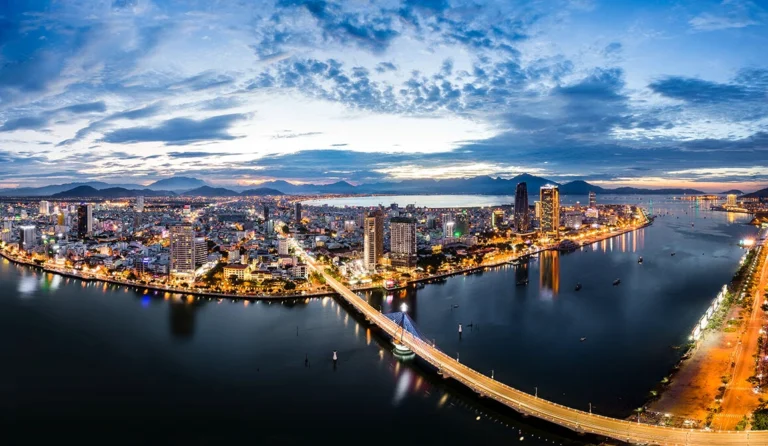
Exploring the summit goes well beyond admiring architecture, offering rewarding active and spiritual experiences. Travelers can begin the morning with a gentle hike along rolling hillside trails, breathing in the crisp, pure air of the Truong Son primary forest. For those seeking tranquility, the spiritual complex—featuring the solemn Linh Ung Pagoda veiled in mountain clouds, the serene statue of Shakyamuni Buddha, and peaceful meditation grounds—offers moments of profound stillness. Gazing outward from the summit, the entire panorama of Da Nang Bay, sweeping ribbons of white-sand coastline, and the poetic Han River stretches into view, forming a breathtaking natural tableau that leaves visitors deeply moved by the harmony of mountains and sea.
Vibrant local culture is also thoughtfully woven into leisure and culinary experiences. Visitors can wander leisurely down historic stone-paved streets, listen to the lilting melodies of street accordionists, or pause at a cozy square-side cafe to sip a fragrant hot cup of tea in the crisp highland chill. Dining here is equally rich, uniting refined French gastronomy—from flaky, golden croissants to full-bodied Mediterranean-style wines—with hearty highland specialties of the Ba Na mountains prepared by local hosts. Together, these moments transform the “French Village” from a mere visual photo stop into a living tapestry of memories, satisfying a traveler’s curiosity while offering quiet sanctuaries of peace for the soul.
Exploring this European-inspired architectural sanctuary atop Ba Na is far smoother and more rewarding when travelers come prepared with practical insights. In terms of operating hours, the French Village welcomes visitors from early morning until late afternoon in accordance with the general schedule of the Sun World Ba Na Hills complex—typically opening around 7:00 AM and concluding sightseeing activities around 5:00 PM daily to ensure safe descent via the cable car system.
Regarding admission costs, entry to the French Village is included in the standard cable car ticket for Ba Na Hills. This pass covers round-trip cable car rides as well as access to the French Village architecture, the Golden Bridge, and numerous signature landscaped zones, whereas dining, arcade entertainment, and specialty museums within the complex carry separate posted rates at the ticket counters.
To reach the foot of Ba Na Mountain from central Da Nang, travelers can choose from several transport options tailored to their preferences, including private charter cars, dedicated shuttle buses, ride-hailing services, or self-riding motorbikes along the Ba Na–Suoi Mo highway route. The road is wide, smoothly paved, and winds past lush green tree lines, making for a pleasant ride for independent road-trip enthusiasts.
Additionally, because the complex sits more than a thousand meters above sea level and neighbors sacred religious sites, visitors should dress neatly, respectfully, and modestly when entering temples and pagodas. Moreover, as mountain weather shifts rapidly—often bringing mist and brisk temperatures by afternoon—packing a light jacket, a compact umbrella, and comfortable walking shoes is essential for staying warm and navigating the historic cobblestone streets with ease.
The best time of year to visit the French Village is during the dry season, when clear skies and brilliant golden sunlight illuminate the pointed tiled roofs and gray stone facades, creating a grand European-style panorama. Conversely, travelers drawn to dreamy, atmospheric beauty can visit during the misty season to experience the quiet, timeless charm of a heritage enclave nestled high in the clouds.
To enjoy a seamless getaway and experience the full splendor of the French Village without worrying about transport logistics, ticket bookings, or itinerary planning, travelers can opt for VDS Travel’s premium all-inclusive Da Nang tour packages. Every itinerary is thoughtfully timed for photo stops at peak scenic light, accompanied by knowledgeable local guides and top-tier hotel and dining standards.