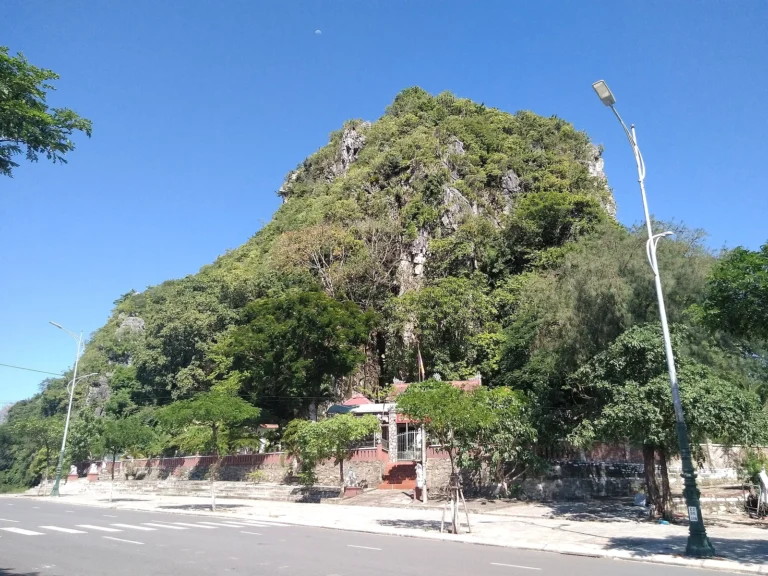
Standing proudly and resiliently amidst the majestic Trường Sơn mountain range, Mount Bà Nà emerges as a unique coordinate, a heroic frontier fortress guarding the land of Quảng Nam and Đà Nẵng for ages. Boasting an average altitude of nearly 1,487 meters above sea level, this mountain is not merely a geographical high point but a historical witness, a convergence place for the spiritual energy of the earth and sky in the Quảng region. Viewed from an overall geomantic perspective, Bà Nà is a natural grand acupoint with a formation of surrounding mountains paying homage, backing against the rolling Trường Sơn range and facing the vast East Sea. This rugged yet magnificent terrain has created a one-of-a-kind microclimate, where all four seasons converge in a single day and wispy clouds embrace steep mountain slopes and murmuring forest streams year-round.
Regarding its name’s origin and historical progression, the name Bà Nà has long floated in the dust of time amid indigenous legends and court historical records. According to cultural researchers and folk memory, the name Bà Nà may stem from the indigenous K’Ho people’s designation for high mountains, or from French explorers who, upon setting foot here and finding the mountain overflowing with wild bananas (named “bananier” in French), called it Mount Bà Nà. From the perspective of official historical records, since the era of the Nguyễn lords reclaiming land and establishing settlements, this mountain has been documented in ancient geographical gazetteers such as *Đại Nam nhất thống chí* (Comprehensive Gazetteer of Đại Nam) and *Phủ biên tạp lục* (Miscellaneous Records of the Border Prefecture) by Lê Quý Đôn as a remote, majestic, and mysterious wilderness. Through the vicissitudes of time, the land at the foot and along the slopes of Mount Bà Nà also preserves invaluable archaeological cultural strata, ranging from ancient relics of the Sa Huỳnh culture to the ritual and religious spaces of the ancient Champa kingdom, closely linked to the tranquil Cham towers on both banks of the Thu Bồn and Hàn rivers.
The historical journey of Bà Nà grows even more profound when associated with the footprints of enlightened eminent monks and the Buddhist spiritual system. Deep within the tranquil wilderness, this place once served as a foundational sanctuary of the Lâm Tế Chánh Tông (Linji) sect, where Zen Master Thích Mật Khế and numerous other eminent monks chose to enter seclusion and practice in order to blend into the pure, silent realm. Furthermore, this sacred mountain served as an endless source of inspiration for celebrities, literati, and Nguyễn dynasty officials during their imperial tours and governorships of the Quảng region. They left behind countless literary works and poems praising the magnificent landscape, the majesty of the rolling clouds, and the transcendent, ethereal beauty of Bà Nà’s fairyland.
Entering the early 20th century, under the strategic vision of French Indochina Governor-General Paul Doumer, an expedition led by engineer Debay parted the misty veil to plan Bà Nà into a high-end European-style resort. Although the antique villas, luxurious restaurants, and paths of that era were largely destroyed in the fires of war between 1945 and 1975 and eroded by time, the heritage and geological values of Bà Nà Hills today remain deeply cherished by management agencies and the press. It has blossomed into a unique heritage tourism icon, where a heroic past and a prosperous present intertwine, continuing to write the legendary story of a sacred mountain in the heart of Vietnam’s heritage.
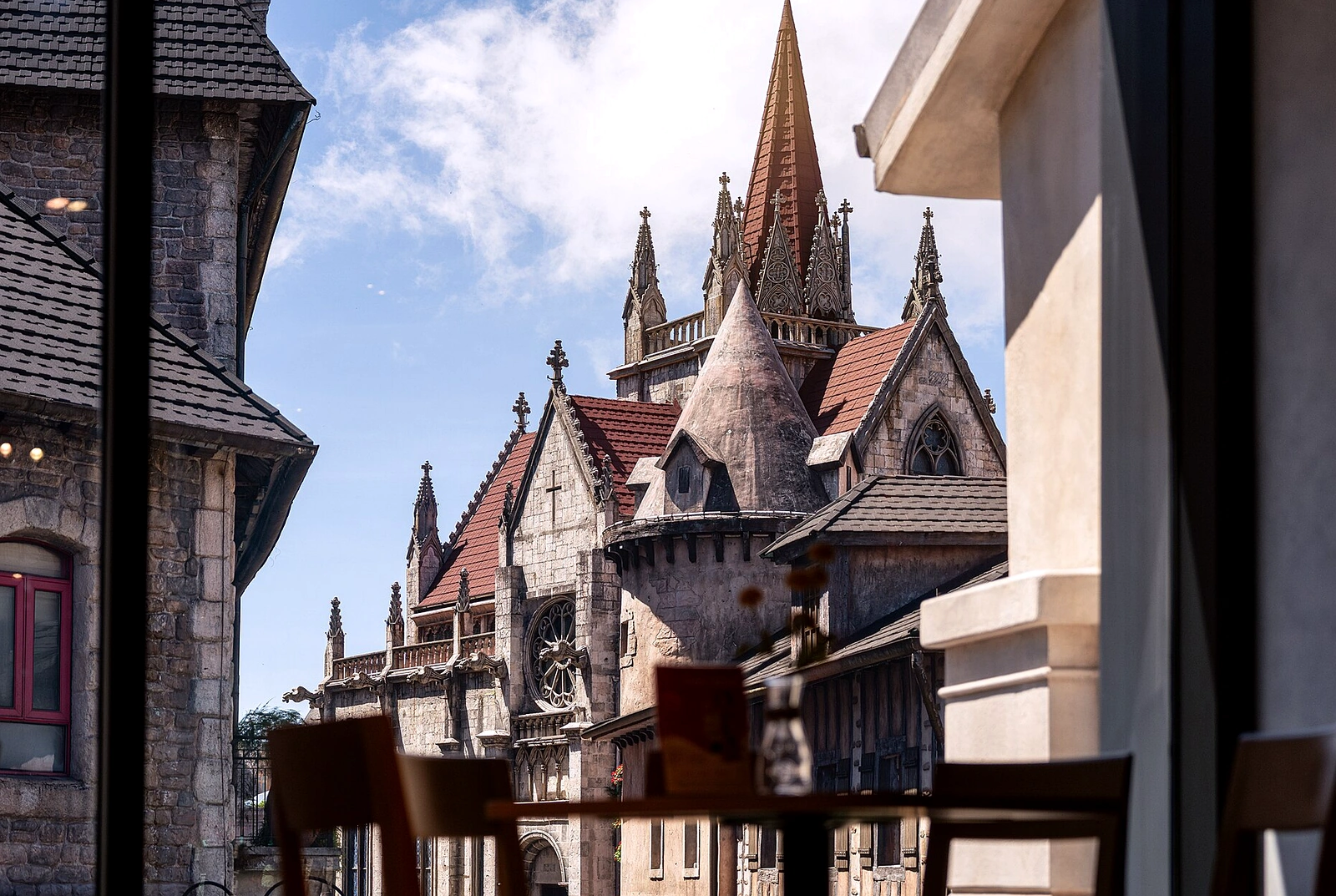
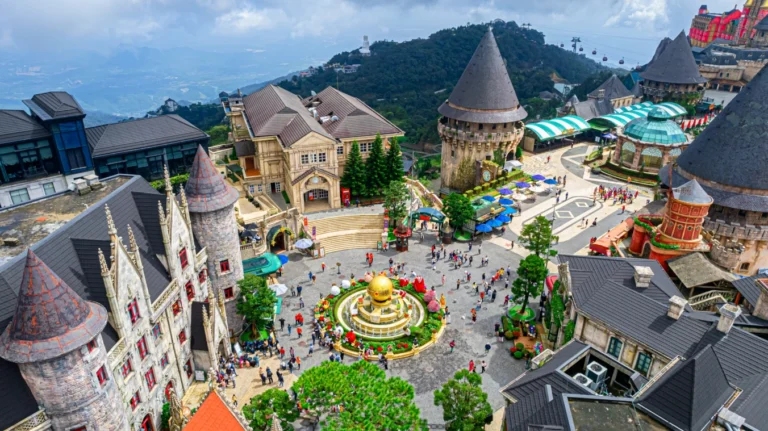
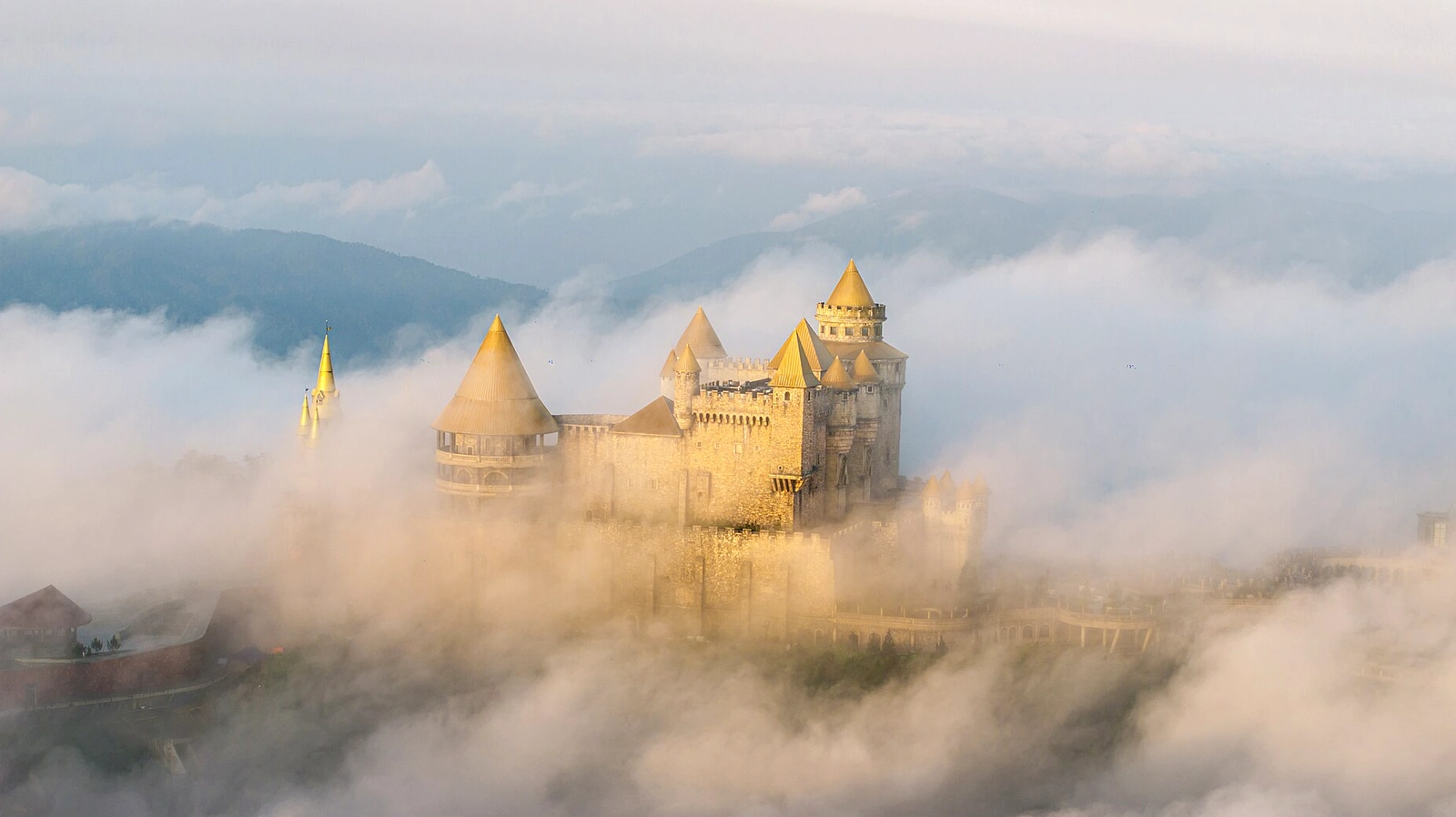
Stepping foot upon the peak of Bà Nà, visitors feel as though they are wandering into an ethereal fairyland where the boundary between earth and sky seems to dissolve. Possessing a unique terrain soaring nearly 1,487 meters above sea level, this place is graciously endowed by nature with a remarkably unique climate of four seasons in a single day, perfectly combined with the skillful hands of humans to forge a one-of-a-kind landscape masterpiece. Stretching across the mountaintop is an architectural complex steeped in classic European imprints, evoking a tranquil yet lavish and magnificent 19th-century French village amidst deep green wilderness.
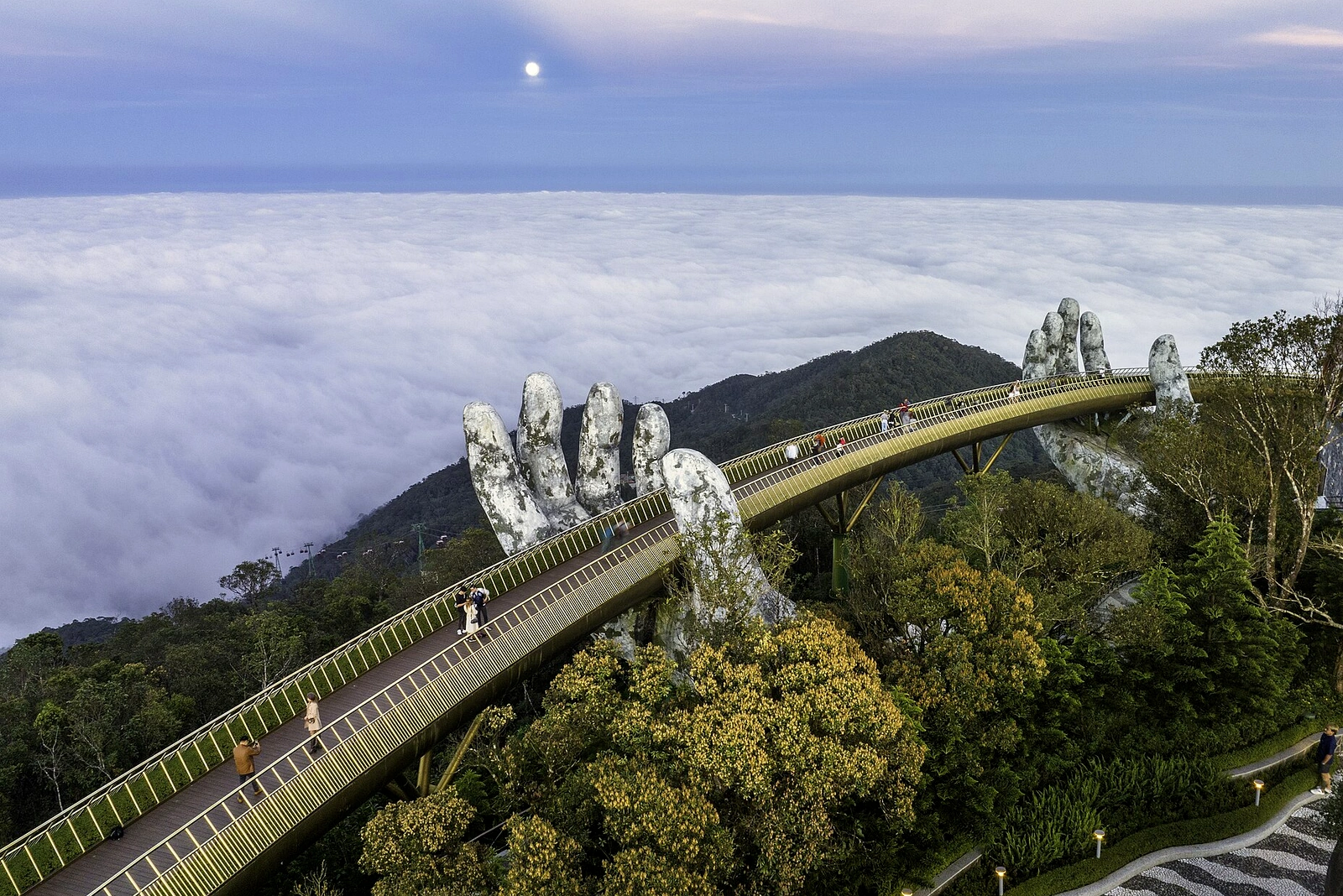
Every architectural line here represents a delicate symphony between sculpture and pinnacle construction engineering. The system of ancient castles and churches with characteristic steeply sloped tile roofs, rustic stone walls meticulously chiseled in every detail, and softly curved arched windows all exude timeless beauty. Interspersed among this Gothic architectural space are vibrant flower beds tended with meticulous care, creating a flawless fusion of European nostalgia and the wild, magnificent beauty of the Quảng mountain forests. Standing out amidst this space is the Golden Bridge with its globally iconic design, where two mossy giant hands emerge from the mountain core, cradling a brilliant golden silk ribbon winding through billowing clouds.
To fully capture the most breathtaking moments in this fairyland, professional photographers and international travel press frequently prioritize shooting at two classic vantage points. The first is the viewpoint at the Golden Bridge railing looking out toward the vast primordial valley; the ideal time is at dawn (from 6:00 to 7:30 AM) when the first rays of sunlight pierce through thick fog, casting illumination upon the giant hands to create an ethereal, mystical, and epic scene. The second camera angle, dubbed the “million-view coordinate,” is located at the central square of the French Village, home to pointed spires stretching proudly into the deep blue sky.
The sunset moment (from 5:00 PM to 6:00 PM) at this angle delivers an overwhelming sensation as the evening glow bathes ancient stone walls in brilliant gold, transforming the entire architectural complex into a living oil painting. The combination of cloud-swept mountain winds, magnificent architecture, and natural lighting turns every frame at Bà Nà into a precious artwork, captivating any traveler passionate about travel and photography.

Stepping foot onto Bà Nà Hills today, visitors not only touch the heroic pages of Quảng’s history but also enter an overwhelmingly vivid and stunning experiential world. The journey to conquer the nearly 1,487-meter peak begins right from cable car cabins suspended amidst the clouds, carrying travelers across roaring white waterfalls and deep green primordial jungles of the majestic Trường Sơn range. Viewed from above, the entire city of Đà Nẵng, the Hàn River winding like a soft silk ribbon, and the white-sandy central coastline gradually shrink into view, delivering an indescribably free and expansive sensation.
Upon stepping out at the transit station, the characteristic chilly bite of the highlands immediately awakens all senses, dispelling the sweltering heat of the lowland city. Amidst this misty, wispy atmosphere, the tranquil spiritual life here emerges with vivid intensity. Visitors can leisurely stroll along moss-covered stone steps, making their way to Linh Ung Pagoda with its majestic statue of Shakyamuni Buddha facing the open sea, or quietly worship in peaceful meditative spaces. The echoing temple bells blending with the rustling mountain winds create a soul-cleansing sound, enabling anyone who arrives to feel deep inner peace and cast away all worldly troubles and cares.
Alongside its spiritual depth and magnificent natural landscape, Bà Nà retains visitors through distinctive and refined culinary cultural experiences. Strolling through the ancient French village spaces with their magnificent Gothic architecture, visitors feel as though they are wandering into a miniature corner of Europe in the heart of heritage. Enticing aromas waft from traditional culinary stalls where diners can savor renowned specialties of the Quảng Nam – Đà Nẵng region, such as Mỳ Quảng rich with hometown flavors, refreshing two-ended pork wrapped in rice paper (*bánh tráng cuốn thịt heo*), or sip warming wine inside centuries-old wine cellars. The flawless blend of local culinary flavors rich with the soil of Quảng and refined Asian-European dining styles elevates every emotion of the diner.
Departing Bà Nà Hills as sunset begins to redden the western mountain ridges, what lingers with each visitor is not merely stunning check-in photos or bustling recreational experiences, but an unforgettable, reflective emotion. It is a sense of awe before natural wonders and human craftsmanship, a vibration before a vibrant cultural space that flows enduringly through time. Bà Nà is truly a precious destination where past and present meld, where humans rediscover a sacred connection with nature and themselves.
To ensure the journey to explore the Bà Nà Historical-Scenic Complex unfolds smoothly and completely, travelers should equip themselves with practical insights regarding timing, transportation, and necessary regulations. Regarding the ideal time to visit during the year, the dry season from March to August annually is considered the most perfect period. At this time, the weather atop Bà Nà is exceptionally clear with brilliant golden sunlight, highly favorable for admiring the magnificent natural panorama and participating in outdoor activities. Conversely, the rainy season from September to February of the following year brings a misty, magical atmosphere, well-suited for those seeking tranquility and nostalgic spiritual spaces.
The resort opens to welcome guests daily throughout the week, starting around 7:00 AM and concluding cable car operations at 7:00 PM, allowing visitors flexible sightseeing itineraries. Regarding listed ticket prices, pricing policies are generally clearly differentiated between out-of-province visitors and locals (with preferential policies for residents holding Đà Nẵng household registration), including round-trip cable car tickets and access to most scenic and architectural attractions. Specifically, the spiritual zone and mountain temples completely charge no admission fees.
The optimal travel route from downtown Đà Nẵng to the foot of Mount Bà Nà spans about 30km, taking roughly 45 to 50 minutes of travel. Visitors can choose to follow Hoàng Văn Thụ – Nguyễn Văn Linh street, continue across Hòa Cầm overpass to enter National Highway 1A, and then turn onto the Bà Nà – Suối Mơ road (ĐT602) to head straight to the resort gate. Popular and safe vehicles include personal cars, taxis, all-inclusive shuttle vans, or motorbikes for those passionate about adventuring along winding mountain-slope roads.
Additionally, because Bà Nà is a complex combining religious spaces, beliefs, and high mountain terrain featuring numerous stone staircases, visitors should note to choose polite, modest, and tasteful attire when entering sacred spaces such as shrines and monastic institutes. Sneakers or flat-soled shoes with good traction are mandatory footwear to protect feet and make traversing steep mountain slopes safe, comfortable, and meaningful.
To enjoy a seamless vacation and fully appreciate the beauty of Bà Nà Hills without worrying about arranging transportation, booking attraction tickets, or managing travel itineraries, travelers can choose premium all-inclusive Đà Nẵng tour packages from VDS Travel. Each tour is meticulously designed to optimize check-in timing when the scenery is at its most radiant, accompanied by a team of guides deeply knowledgeable in local culture and backed by top-tier hotel and culinary service standards.