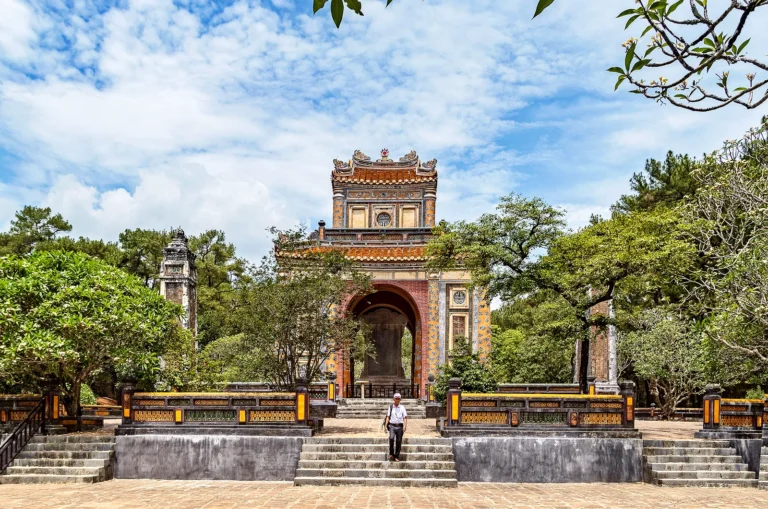
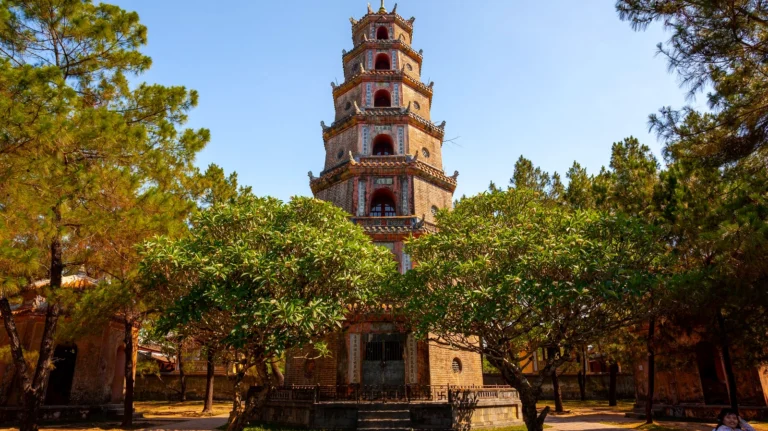
Nestled quietly amidst the picturesque mountain scenery of Huong Tho Commune, Huong Tra Town, Hieu Mausoleum—more widely known to posterity as the Tomb of Minh Mang—is far more than a mere royal burial site; it is an artistic masterpiece born from the profound philosophical vision of the Nguyen Dynasty’s second emperor. Situated on Cam Ke Mountain, where the spiritual energies of Hue’s earth and sky converge, the tomb was the result of meticulous topographical surveys conducted personally by Emperor Minh Mang starting in 1826. It was not until 1840, at the height of his reign when the monarch felt the need for an eternal resting place commensurate with the nation’s stature, that construction officially began. Following the emperor’s passing in 1841, his successor, Emperor Thieu Tri, honored his father’s wishes and dedicated himself to completing the complex in 1843, transforming it into an enduring symbol of orthodox Confucian ideology and the spirit of “civil governance” of Vietnam’s last feudal dynasty.
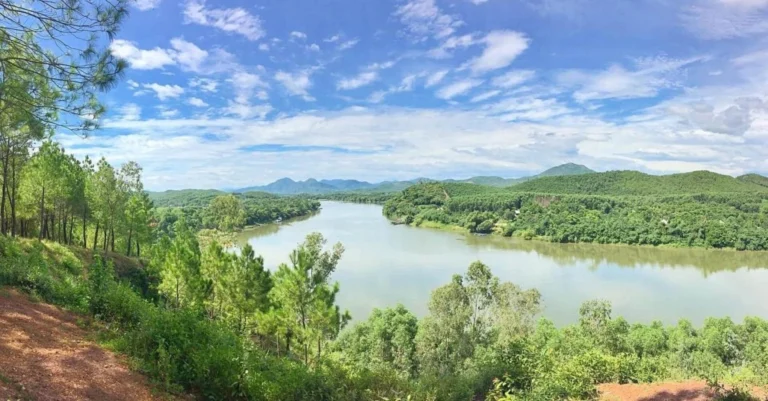
The beauty of Hieu Mausoleum is defined by the absolute harmony between human craftsmanship and the natural layout of the land. Its “mountain-backed, water-facing” (tựa sơn hướng thủy) geomantic setting was hailed by contemporary feng shui masters as one of the most auspicious locations within the entire Nguyen royal tomb system. In front of the mausoleum, majestic Kim Phung Mountain serves as a natural protective screen, while the Perfume River winds gracefully like a crimson silk ribbon embracing the complex, forming a steadfast “Dragon Flanking, Tiger Crouching” (Long chầu Hổ phục) configuration. A 700-meter-long sacred axis runs straight along the central path, stretching from the Great Red Gate (Dai Hong Mon) all the way to the foot of La Thanh Hill, dividing the entire complex into two perfectly symmetrical halves. This balance is not merely an architectural solution, but a physical manifestation of the Confucian worldview, where order, discipline, and harmony between humanity and nature reign supreme.
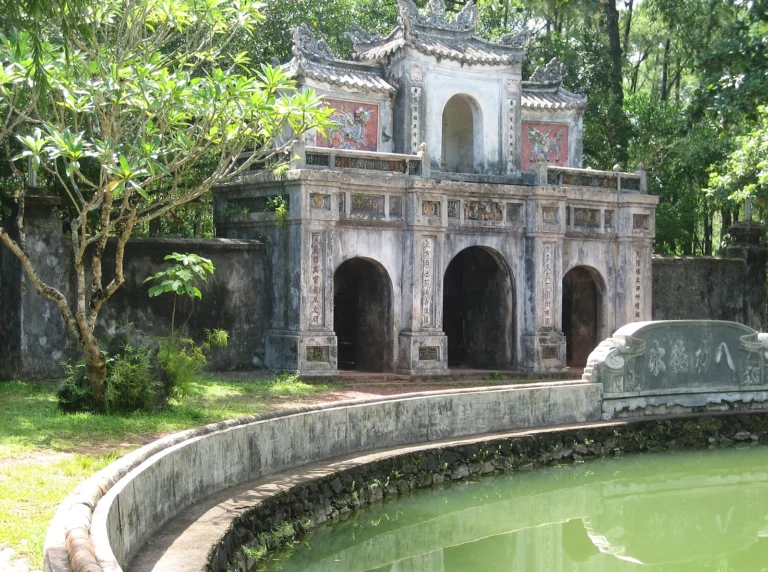
The significance of Hieu Mausoleum also lies in the historical imprints tied to remarkable figures and legends. Dai Hong Mon—the main entrance gate to the tomb—stands as a testament to absolute solemnity, having been opened only once in history to allow Emperor Minh Mang’s funeral procession to pass through before being sealed forever, preserving the tranquil sanctity of the eternal realm. Inside, the Stele Pavilion (Bi Dinh), housing the “Thanh Duc Than Cong” stele personally composed by Emperor Thieu Tri, is not only a masterpiece of Han-Nom calligraphy but also an invaluable historical document recording Emperor Minh Mang’s administrative reforms and statecraft philosophy. Intricately carved parallel couplets in wood and stone adorning structures such as Minh Lau (Pavilion of Light)—a pavilion perched atop a high hill symbolizing the workings of the cosmos—turn Hieu Mausoleum into a living cultural museum.
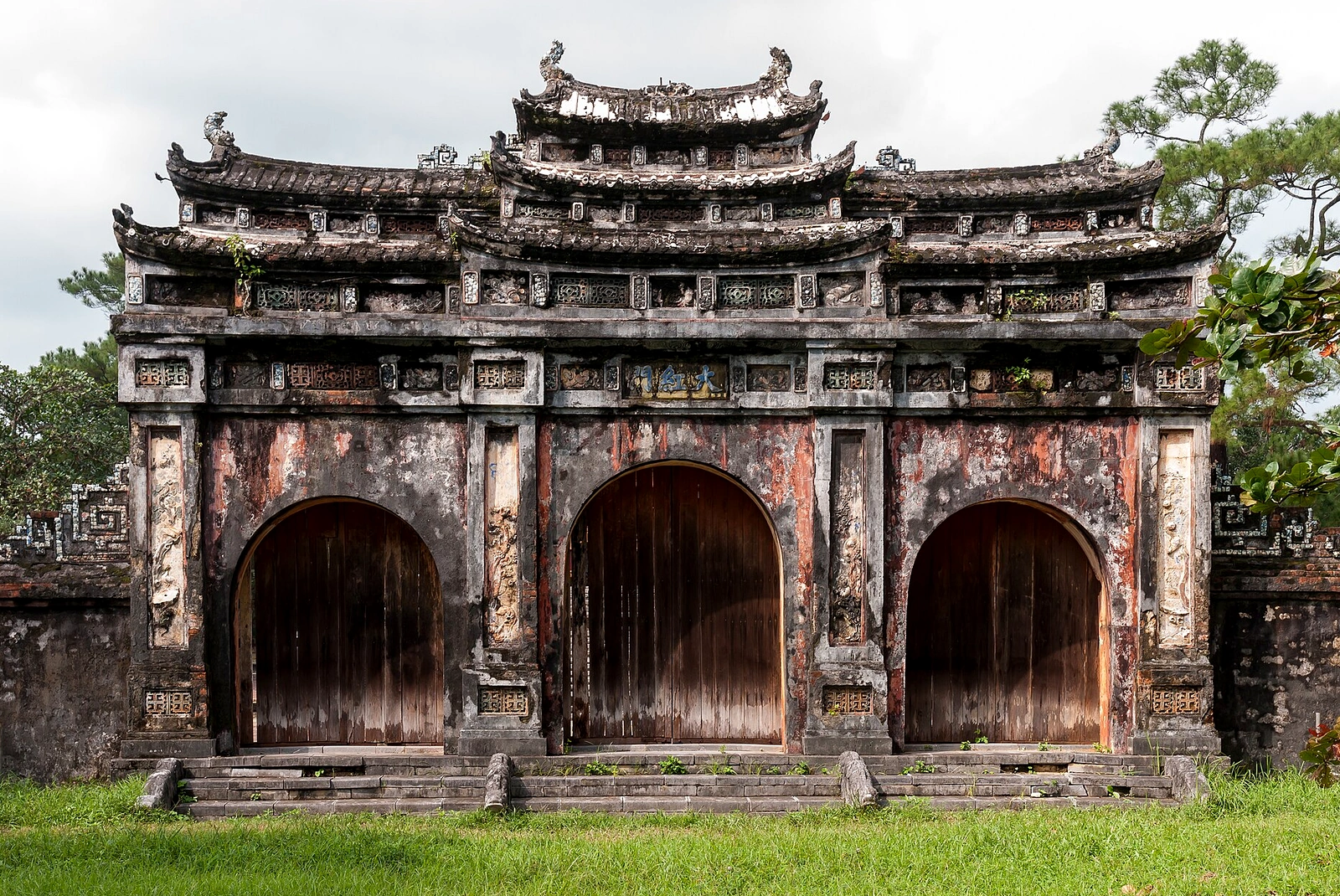
Owing to its extraordinary architectural, geological, and cultural values, Hieu Mausoleum was inscribed by UNESCO as a World Cultural Heritage site in 1993 as part of the Complex of Hue Monuments. To researchers and travelers alike, Hieu Mausoleum is not just a geographical coordinate on Vietnam’s heritage map, but a “manifesto” carved in stone proclaiming the vision of a monarch who brought Vietnam to territorial and administrative unification. The enduring survival of Hieu Mausoleum through the vicissitudes of history stands as an eloquent affirmation of the resilient vitality of national cultural heritage, where every stone and every branch tells the story of a golden era in the nation’s past.
Stepping into Hieu Mausoleum, visitors are not merely strolling through a historical monument; they are wandering into a seamless symphony composed by human hands and the breath of nature. Unlike the austere, brooding solemnity of many other royal tombs, the Tomb of Minh Mang embodies absolute equilibrium, where Confucian philosophy is given tangible form through exquisite architectural lines that blend effortlessly into the idyllic mountain-and-river landscape of the former imperial capital.
The very first feature that leaves every visitor in awe is the 700-meter-long sacred axis running along the central thoroughfare, bisecting the complex into two mirror-image halves. This is more than a walkway; it is a spiritual journey guiding the human soul from the earthly realm into the dimension of eternity. Flanking both sides of the path, ancient pine trees lean in to cast cool shade, combining with a network of lakes and stone bridges to create a living ink-wash painting. The “mountain-backed, water-facing” terrain, anchored by Kim Phung Mountain in front and embraced by the meandering Perfume River, creates a rare “Dragon Flanking, Tiger Crouching” geomantic posture that makes the entire monument feel like an inseparable part of the Cam Ke mountains and forests.
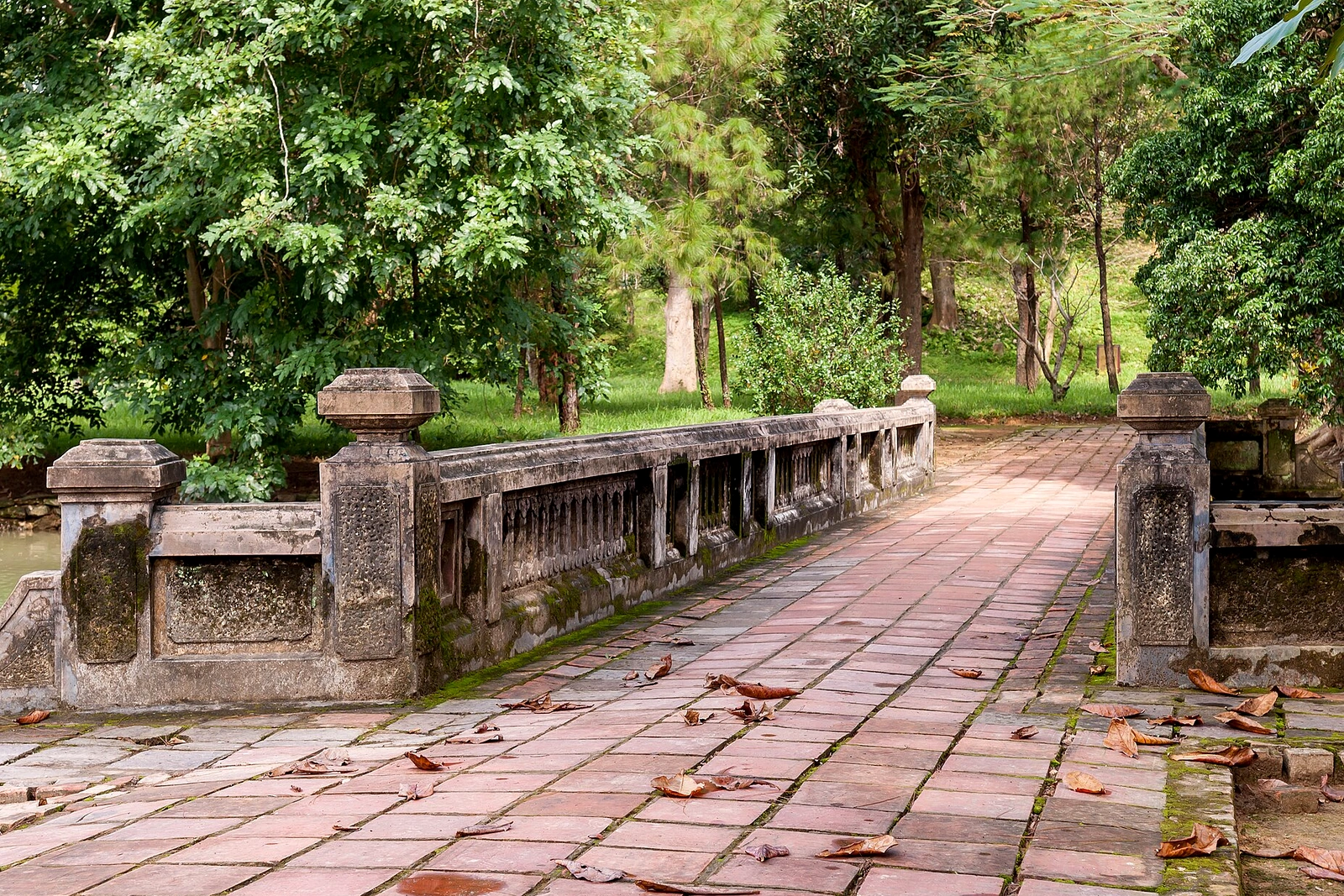
The architecture of Hieu Mausoleum represents a refined synthesis of stone and wood carving artistry. Dai Hong Mon, with its imposing portals opened only once in history, retains an air of quiet gravitas that defies the passage of time. Venturing deeper inside, Minh Lau—the pavilion rising on a high mound—represents the pinnacle of architectural philosophy. Designed in a square layout symbolizing the operation of the universe, Minh Lau serves not only as a resting pavilion for the monarch’s spirit but also as an ideal vantage point overlooking the panoramic splendor of the entire mausoleum. Intricate carvings of dragons and phoenixes, stylized motifs on spirit screens, and meticulously chiseled stone Han-Nom couplets all bear witness to the supreme aesthetic mastery of Nguyen Dynasty artisans.
To capture “million-view” photographs at Hieu Mausoleum, professional photographers typically favor two classic camera angles. The first is from the front of New Moon Lake (Ho Tan Nguyet) looking straight toward Minh Lau. The most magical time for this shot is at dawn, when the first rays of morning sunlight pierce through the thin mist, reflecting the pavilion’s silhouette onto the glassy water to create an ethereal, deeply poetic scene. At this hour, soft golden light accentuates the vermilion lacquer and gilded details on the wooden pillars, creating a striking contrast against the lush greenery.
The second classic angle is from the elevated terrace of the Stele Pavilion (Bi Dinh) looking down along the sacred axis. This vantage point allows you to capture the flawless symmetry of the architectural ensemble in a single frame. Sunset is when the light turns most contemplative and profound, as the day’s final rays stretch across the stone staircases, casting dramatic plays of light and shadow. Here, the grandeur of the surrounding forests merges with the timeless patina of heritage, yielding photographs that are not only visually captivating but also rich in cultural and historical depth. With its harmonious blend of monumental architecture and natural scenery, Hieu Mausoleum is truly an unmissable destination for anyone seeking to reconnect with the roots of Vietnamese culture.
Passing through the portals of Dai Hong Mon, visitors do not simply tour a historical relic—they embark on a mesmerizing journey back in time. The experience at Hieu Mausoleum begins with a sense of awe before the arrow-straight sacred axis, where every footstep across moss-covered flagstones evokes a profound stillness, completely detached from the bustle of the outside world. The initial impression upon standing within this space is one of human smallness in the face of monumental architectural scale, paired paradoxically with a deep inner peace as you breathe in the mountain air of Cam Ke. Strolling past twin rows of stone civil and military mandarins and admiring their finely chiseled details, visitors can palpably feel the royal authority and rigorous Confucian ethos that Emperor Minh Mang imbued into every inch of the grounds.
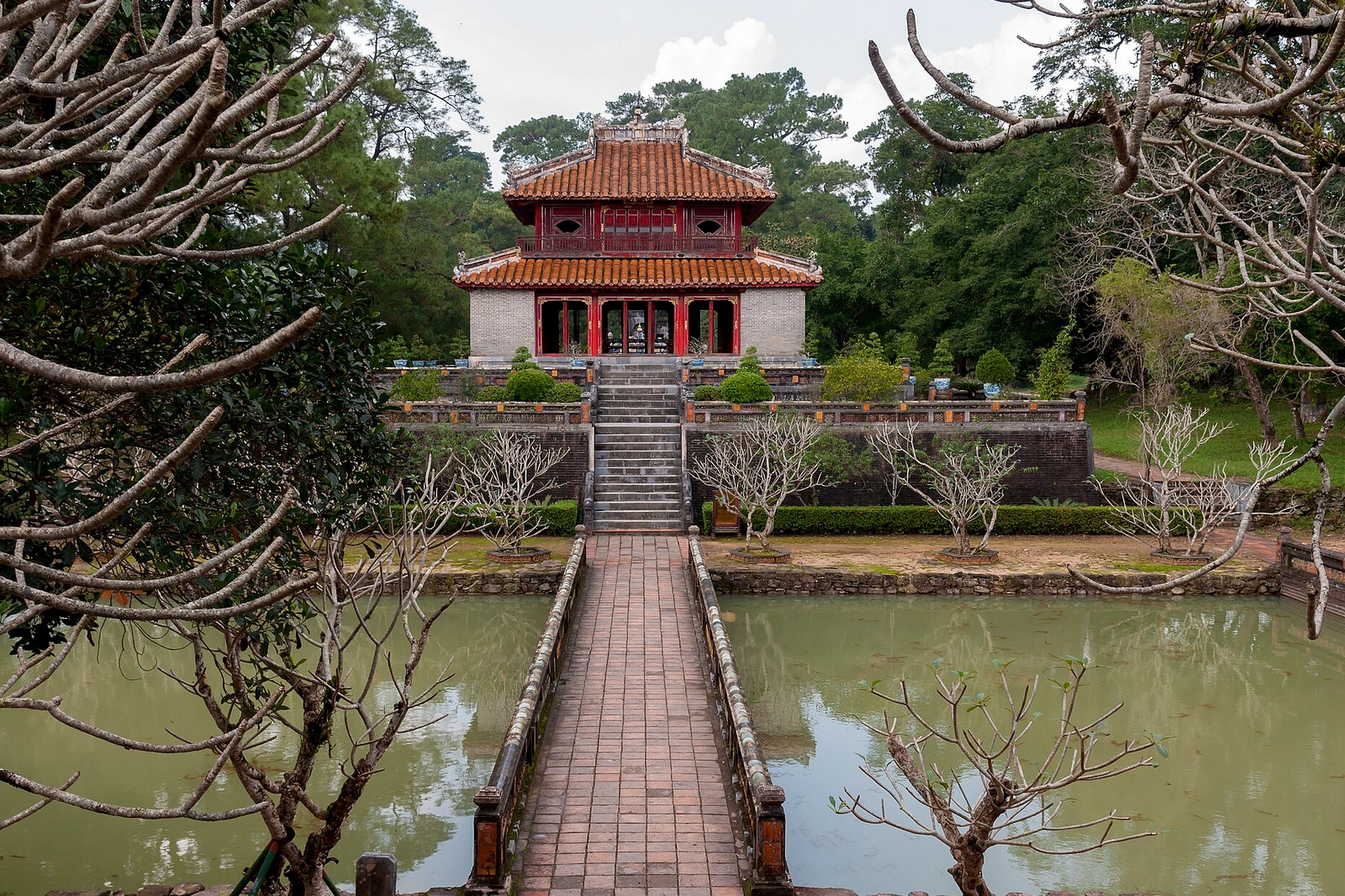
One of the most rewarding experiences is quiet contemplation around Minh Lau and New Moon Lake. When late afternoon sunlight casts long shadows across the crescent-shaped waters, the atmosphere grows so enchanted and hushed that you can hear leaves fluttering down or the wind sighing through the ancient pine canopies. Many visitors choose to sit quietly on the stone steps, reflecting on the cosmological philosophy the ancients so artfully wove into the architecture. It is a moment of stillness in which the soul is cleansed by the tranquility of heritage, where past and present intersect on a deeply resonant note. For those eager to explore further, climbing the staircases leading up to the higher hills for a bird’s-eye view of the mausoleum is a rewarding endeavor. From above, the entire complex unfolds like a traditional landscape painting exhibiting absolute harmony between human design and pristine nature, with Kim Phung Mountain standing guard ahead and the Perfume River winding like a soft silk sash cradling the eternal slumber of the monarch.
A journey to Hieu Mausoleum would be incomplete without immersing yourself in vibrant local cultural experiences. After exiting the tomb grounds, many travelers opt for a boat ride along the Perfume River to fully appreciate the “Dragon Flanking, Tiger Crouching” geomantic setting from the water. The gentle splash of oars, accompanied by traditional Hue folk chants (hò Huế) drifting from afar, creates a cultural ambiance quintessential to the ancient capital. In particular, the area surrounding Huong Tho Commune is a haven for food lovers. Following your visit, stopping at local garden houses to savor renowned specialties such as lotus-wrapped steamed rice (cơm sen), steamed rice cakes with shrimp paste (bánh lá chả tôm), or sipping a delicate cup of royal herbal tea makes for an unforgettable experience. The subtle sweetness of lotus and the rich flavors of rustic dishes elevated with imperial culinary traditions, enjoyed amidst cool, leafy gardens, forge a seamless link between cultural heritage and the everyday life of Hue’s residents.
The initial sense of awe when confronting the majesty of Hieu Mausoleum gradually transforms into deep empathy as visitors engage firsthand with local cultural values. This is more than a sightseeing excursion; it is a pilgrimage back to cultural roots, where every tangible encounter becomes a treasured fragment of memory. Hieu Mausoleum is not merely the resting place of a king—it has become a living space where history continues to tell its own stories through every bough, blade of grass, and the warm hospitality of the local people.
To make your exploration of Hieu Mausoleum seamless and meaningful, it is helpful to prepare practical details regarding itineraries and heritage etiquette. The Tomb of Minh Mang is open to visitors every day of the week, including public holidays and weekends. Visiting hours typically run from early morning until late afternoon, allowing ample time to admire the monument’s beauty at a leisurely pace without feeling rushed. Regarding admission fees, the site applies ticket rates regulated by the Hue Monuments Conservation Center. Visitors should check the latest ticket prices at the ticket booth right outside the entrance or through the managing authority’s official channels, and note that fee exemptions or discounts generally apply to children, senior citizens, and eligible priority groups under state regulations.
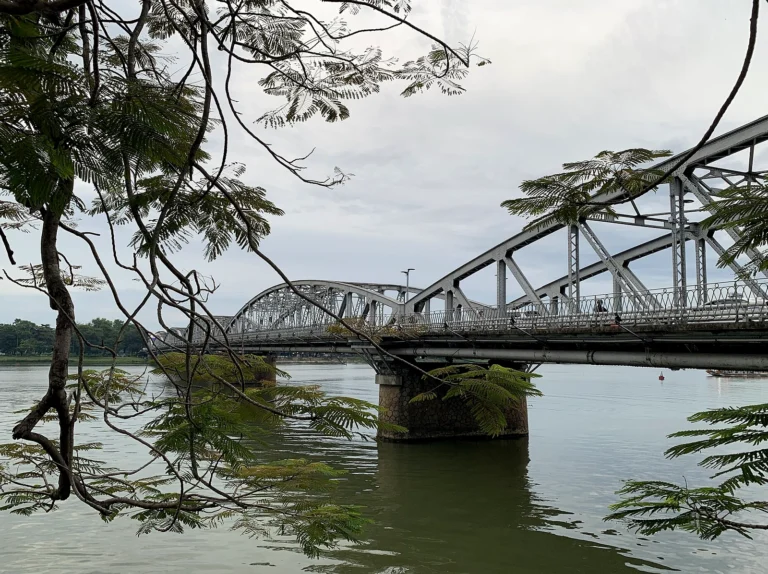
As for transportation from Hue city center, travelers have flexible options including motorbikes, private cars, or taxis. The most scenic and convenient route follows Bui Thi Xuan Street or Huyen Tran Cong Chua Street, hugging the poetic Perfume River all the way to Huong Tho Commune. If you enjoy feeling close to nature, riding a motorbike is a wonderful choice, making it easy to pull over for photos along tree-lined country roads. Alternatively, dragon boat cruises on the Perfume River offer a deeply poetic way to reach the monument, docking near the mausoleum grounds and recreating the historic water journeys once taken by Nguyen emperors.
The ideal time to visit Hieu Mausoleum is during the spring months, when Hue enjoys cool, pleasant weather and the surrounding natural scenery bursts into lush, vibrant greenery. Avoiding days of heavy rain or peak summer heat will make your visit far more comfortable, especially since exploring the expansive grounds involves walking along stone pathways and climbing numerous staircases. Because Hieu Mausoleum is a sacred spiritual site and the eternal resting place of a monarch, visitors should pay special attention to dress code. Opt for polite, modest attire and avoid overly short or revealing outfits to show respect for this traditional cultural space. Additionally, given the terrain’s many stone steps and wide grounds, a pair of comfortable, sturdy walking shoes will be an indispensable companion, helping you move effortlessly and protecting your feet throughout your visit.
Finally, please maintain respectful conduct by refraining from touching artifacts, avoiding graffiti or defacement of architectural structures, and helping keep the grounds clean. Abiding by these guidelines not only preserves the authentic beauty of the heritage site but also fosters sustainable cultural tourism, ensuring Hieu Mausoleum remains a cherished point of pride for every traveler visiting the ancient capital.
To enjoy a seamless getaway and take in the full splendor of the Tomb of Minh Mang without worrying about arranging transportation, booking admission tickets, or planning itineraries, travelers can choose VDS Travel’s premium all-inclusive Hue tour packages. Every itinerary is thoughtfully timed so you can capture photos when the scenery is at its most radiant, accompanied by knowledgeable local guides deeply versed in regional culture alongside top-tier hotel and dining standards.