Reclining alongside the romantic Perfume River (Hương Giang), Thien Mu Pagoda—also known as Linh Mu Pagoda—is far more than a conventional Buddhist sanctuary; it is a living historical monument uniting the spiritual essence and political philosophy of the Nguyen dynasty. Perched atop Ha Khe Hill in Kim Long Ward, Hue City, this ancient temple commands one of the most auspicious locations within the former imperial capital’s heritage landscape. From a feng shui perspective, Thien Mu Pagoda is likened to a sacred “observatory” achieving ideal harmony in its “backed by the mountain, facing the water” orientation: in front flows the winding Perfume River hugging the base of the hill, while behind stretches a tranquil expanse of forested hills, forming a classic “crouching dragon, lying tiger” terrain where the spiritual energy of ancient Thuan Hoa converges.
The historical origins of the pagoda are intertwined with the southward expansion of Lord Tien Nguyen Hoang. According to records in the Dai Nam Nhat Thong Chi, in the year Tan Mao (1601), when Lord Nguyen Hoang arrived to govern the southern frontier, he heard local accounts of the spiritual energy surrounding Ha Khe Hill. Legend tells of an elderly woman dressed in a red tunic and green trousers who appeared atop the hill at night, prophesying that a true ruler would come to erect a pagoda to gather spiritual vitality and strengthen the nation’s dragon vein. Believing in this auspicious omen, Lord Nguyen Hoang ordered the construction of a temple crowning the hill and named it Thien Mu—evoking the appearance of the “Heavenly Lady” (Bà Mụ nhà trời). This milestone not only anchored Buddhism within the political life of the Nguyen lords, but also laid the foundation for a cultural symbol that has endured across centuries.
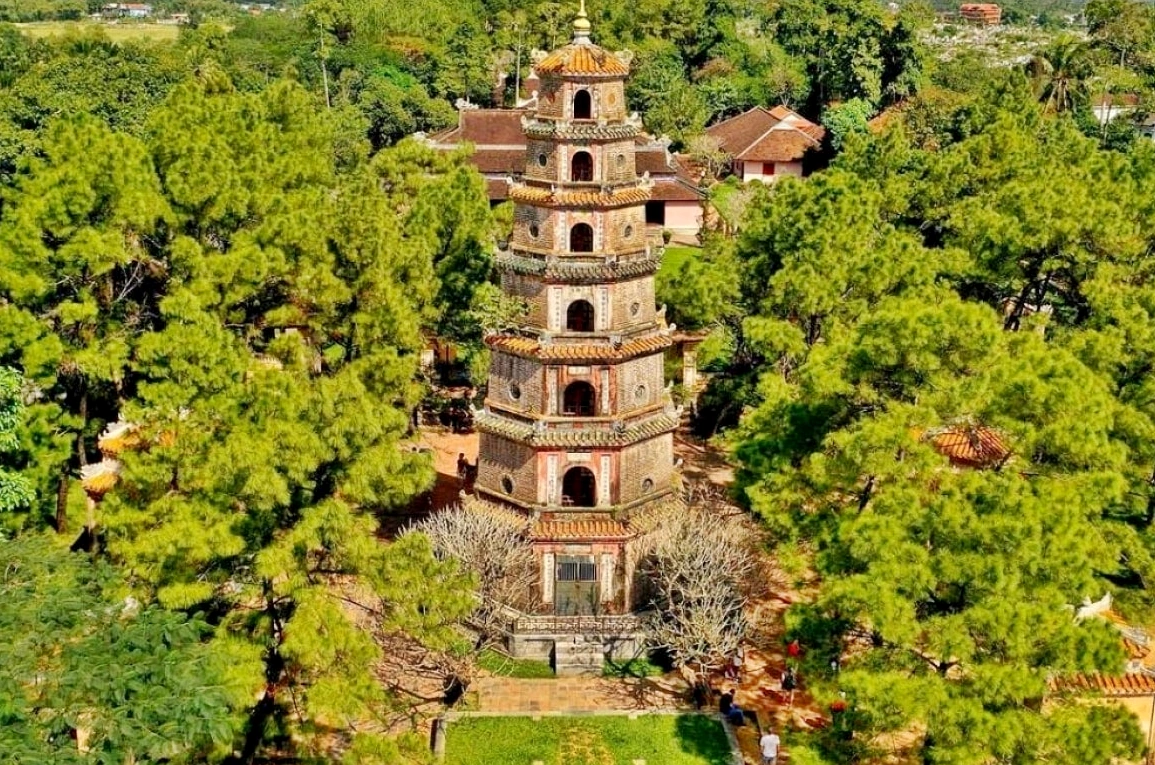
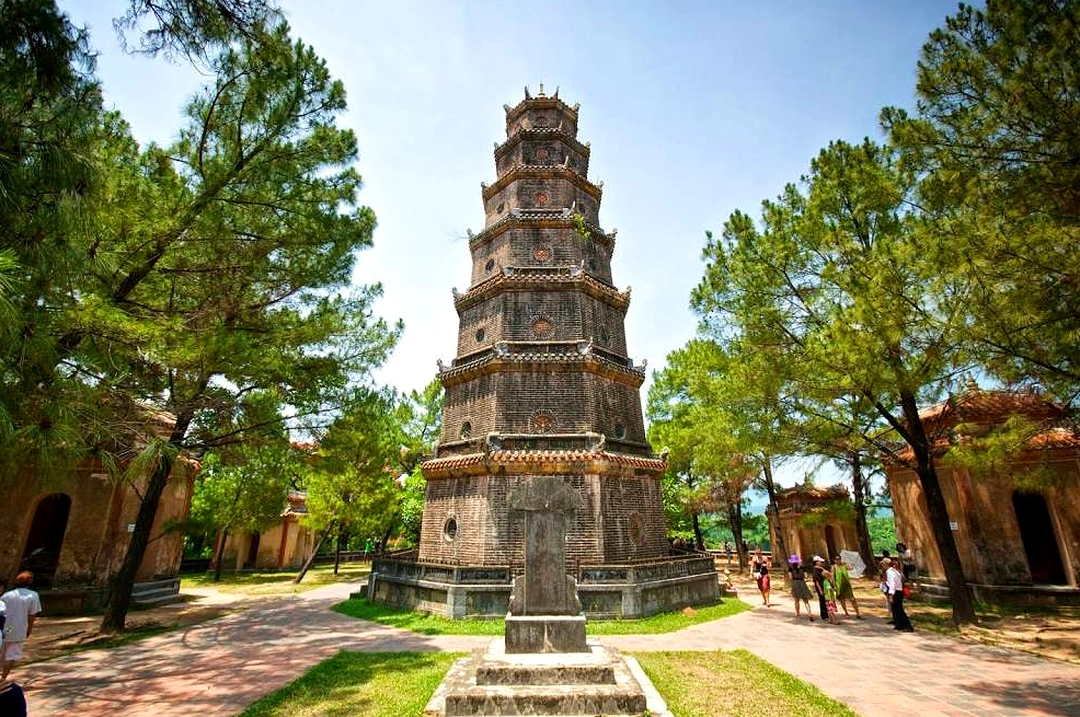
For more than four centuries, Thien Mu Pagoda has borne witness to the sweeping historical tides from the Nguyen lords through the Nguyen dynasty, with each era leaving behind distinctive architectural marks and priceless relics. In 1665, Lord Nguyen Phuc Tan commissioned major renovations that cemented the temple’s stature within the realm. By 1710, Lord Nguyen Phuc Chu ordered the casting of a monumental bronze bell weighing over two tons, inscribed with a text composed in his own hand reaffirming the bond between the Dharma and sovereign authority. Most notably, in 1844, Emperor Thieu Tri—a monarch celebrated for his poetic sensibility and devotion—commissioned the seven-tiered Phuoc Duyen Tower while bestowing the title “Linh Mu” upon the pagoda with prayers for national peace, prosperity, and harmonious weather. Today, the silhouette of Phuoc Duyen Tower rising into the sky and reflecting across the Perfume River stands as an iconic visual emblem etched into the hearts of Vietnamese people and international travelers alike.
The significance of Thien Mu Pagoda lies not only in its grand architectural structures or treasured antiques—such as the stone stele borne upon a giant marble turtle and Later Le-style altar statues—but also in its synthesis of Confucian and Buddhist philosophies in statecraft. Designated a Special National Monument in 2013, Thien Mu Pagoda is recognized as an inseparable pillar of the Complex of Hue Monuments. It serves both as a destination for travelers tracing cultural roots and as living testimony to a storied land where history, geomancy, and spirituality converge in serene, majestic beauty at the heart of a World Heritage city.
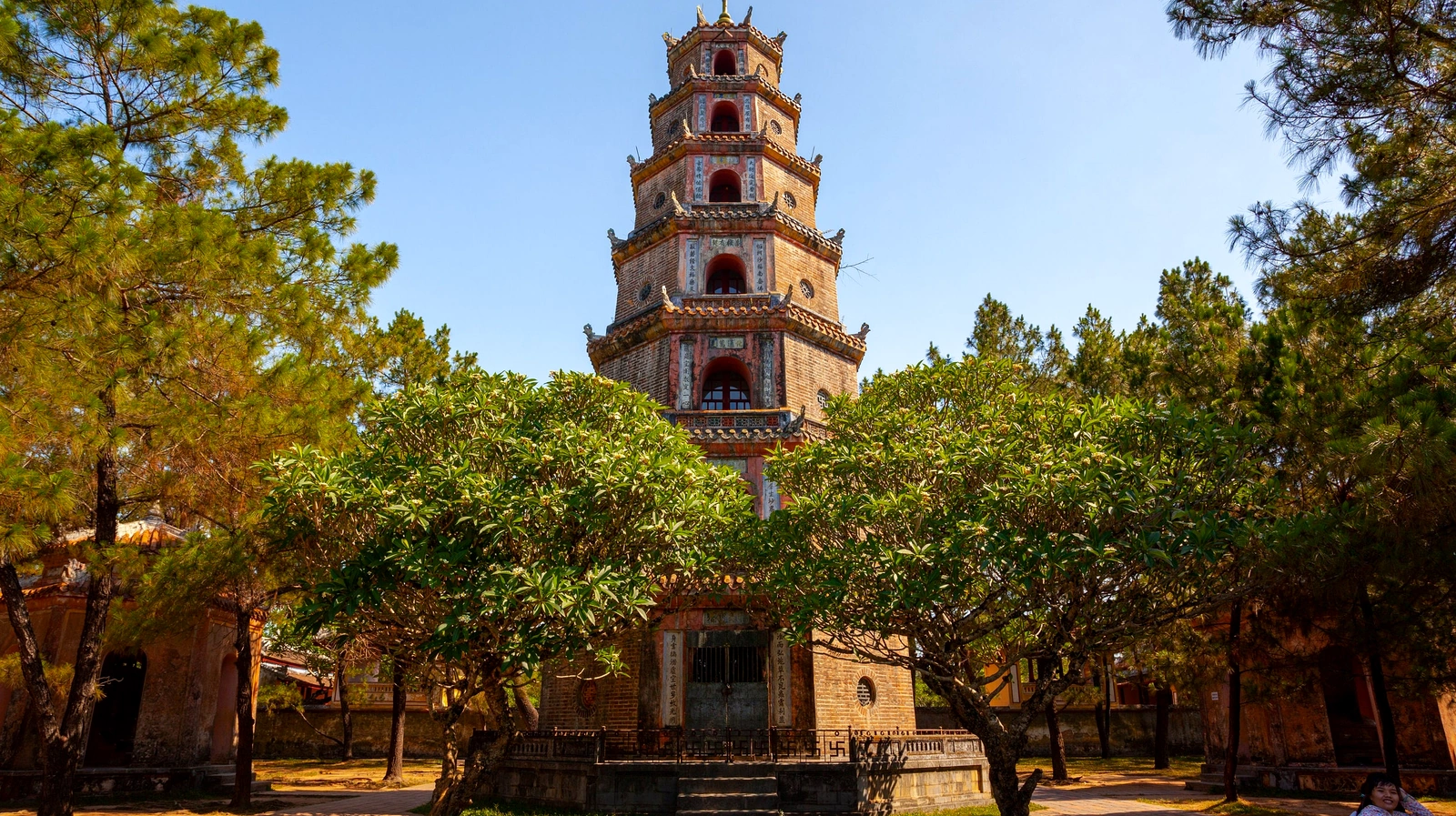
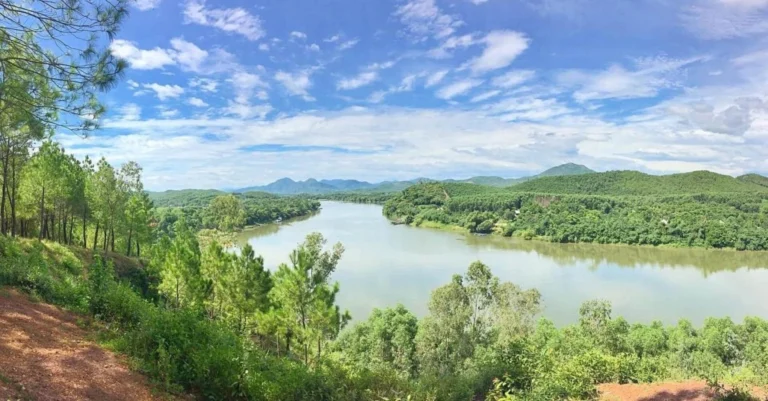
Thien Mu Pagoda is not merely a place of worship, but an architectural masterpiece that harmonizes effortlessly with the natural splendor of the Hue countryside. Upon arriving, visitors are immediately captivated by its commanding “backed by the mountain, facing the water” setting. Seated atop Ha Khe Hill, where the Perfume River curves gracefully like a ribbon of silk around the hillside, the temple forms a living ink-wash painting in which heaven, earth, and the human spirit meet in quiet equilibrium.
The foremost architectural highlight—and the pagoda’s unmistakable emblem—is Phuoc Duyen Tower. With an octagonal, seven-tiered form soaring 21 meters against the azure sky, the tower stands like a spiritual pillar anchoring the vital energy of the former imperial capital. Each tier is intricately detailed, showcasing the refined craftsmanship of Nguyen-era artisans. Stepping deeper into the grounds, visitors encounter profound stillness, where leaning ancient pines cast cool shade over brick-paved pathways leading toward the sanctuaries. Sculptural artistry shines throughout the complex, from solemn Dharma Protector statues (Hộ Pháp) and expressive Eighteen Arhat figures (Thập Bát La Hán) to delicate woodcarvings radiating the timeless grace of the Later Le and early Nguyen eras.
To capture memorable, frame-worthy photographs at this historic sanctuary, photographers typically highlight three prime vantage points. The first is from the foot of the hill, angling your camera upward from the surface of the Perfume River toward Phuoc Duyen Tower. This angle frames the full vertical silhouette of the tower against the sky, with traditional dragon boats drifting across the water in the foreground for a poetic composition. The second spot is the stele pavilion housing the massive turtle-borne stone stele, where sunlight slanting through wooden doorways casts dramatic rays across intricate stone reliefs. The third angle is the expansive courtyard in front of Dai Hung Main Hall, offering a wide panorama uniting ancient trees with moss-draped yin-yang tiled roofs.
When it comes to lighting, sunset is widely regarded as the golden hour by photographers. As the sun dips behind distant mountain ridges, warm late-afternoon light bathes the temple in a soft golden glow, casting long shadows across weathered brick walls and deepening the sanctuary’s serene, sacred atmosphere. At this hour, the resonant chime of the temple bell drifting through the dusk invites every visitor to pause in quiet reflection. For those who prefer crisp morning clarity, dawn is equally rewarding—early rays piercing thin mist over the Perfume River drape Phuoc Duyen Tower in shimmering gold. From every angle, Thien Mu Pagoda endures as an open-air architectural museum where every brick and pine bough tells a captivating story.
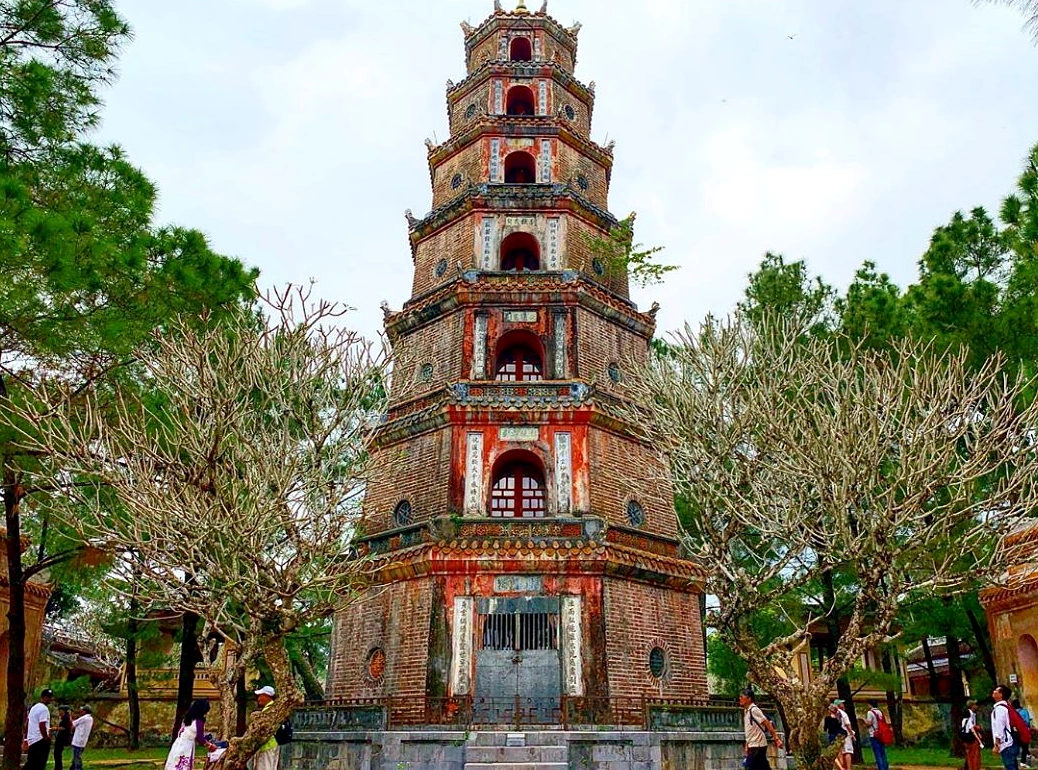
Visiting Thien Mu Pagoda is far more than a routine sightseeing stop—it is a journey into the unhurried heartbeat of Hue. The experience begins when approaching the landmark via the scenic Perfume River. Rather than arriving solely by road, many travelers choose to board a traditional dragon boat at Toa Kham Wharf, gliding peacefully across emerald waters. From afar, Phuoc Duyen Tower rises proudly against the sky, mirrored in the river like a graceful brushstroke. Seated aboard the boat, listening to the rhythmic dip of oars as the pagoda emerges amid ancient pines creates an immediate sense of calm that leaves everyday hurry behind.
Ascending the stone steps toward the temple entrance brings a palpable shift in atmosphere. Noise gives way to quietude, broken only by lingering echoes of the temple bell and faint wisps of incense carried on the breeze. Climbing up toward Phuoc Duyen Tower rewards an unhurried pace, allowing you to appreciate the refined geometry of its octagonal tiers up close. Looking out from the hill across the river, the Perfume River winds like a soft silk ribbon embracing Hue—a breathtaking vista where natural beauty and historic architecture unite in timeless stillness.
Inside the temple sanctuaries, quiet moments of devotion bring deep inner calm. Beneath soft candlelight, finely sculpted Dharma Protectors and Eighteen Arhats inspire solemn reverence. Visitors often pause to light an incense stick, offer a silent prayer for peace, or simply rest along the shaded veranda listening to the wind whisper through old pine groves. This harmony of sacred space and centuries-old artistry leaves the mind refreshed and serene.
After nourishing the eyes and spirit, no visit to Thien Mu Pagoda is complete without sampling local street food right at the foot of the hill. Riverside stalls serve authentic Hue delicacies ranging from translucent tapioca dumplings (bánh bột lọc) and steamed rice cakes (bánh nậm) to steaming bowls of silken tofu in ginger syrup (đậu hũ non nước đường gừng). The clean sweetness of rock sugar, warming kick of fresh ginger, and velvety texture of the tofu create an unforgettable treat. Sitting on low wooden stools savoring local snacks while watching passersby and boats drifting down the Perfume River captures the gentle warmth of Hue life—blending noble spiritual heritage with simple everyday charm.
Thien Mu Pagoda is not only a Special National Monument, but also an essential spiritual and cultural landmark in the ancient capital of Hue. To make your visit smooth, respectful, and rewarding, keep a few practical details in mind.
Regarding opening hours, Thien Mu Pagoda welcomes visitors every day of the week from early morning until late afternoon, giving travelers ample time to stroll at leisure, admire its historic architecture, and soak in the tranquil riverside setting. A welcome bonus for travelers is that admission to Thien Mu Pagoda is completely free of charge—no entrance ticket is required, making the sanctuary accessible to pilgrims, families, and cultural explorers alike.
Reaching Thien Mu Pagoda from central Hue is simple and offers two memorable options. For overland convenience and scenic views, ride a motorbike or take a private car along Kim Long Road—a leafy avenue lined with traditional Hue garden houses leading directly to the temple gate. Alternatively, boarding a dragon boat along the Perfume River to dock right at the foot of Ha Khe Hill offers a relaxing voyage and an iconic riverside perspective of the pagoda.
In terms of the best season to visit, while Hue holds distinct charm year-round, January through April is generally considered ideal. During these months, mild temperatures and dry weather make climbing stone steps and exploring the spacious grounds especially pleasant. For maximum tranquility, visit early in the morning when mist lingers over the Perfume River, or at dusk when sunset paints Phuoc Duyen Tower in warm crimson-gold hues.
Because Thien Mu Pagoda is an active, revered Buddhist sanctuary, visitors should observe a respectful dress code. Wear modest, neat clothing and avoid shorts, sleeveless tops, or overly short skirts when entering worship halls. Additionally, since the complex sits atop a hill with numerous stone steps, flat shoes or comfortable sneakers are recommended for safe, effortless walking. Finally, maintain quiet decorum, speak softly, and refrain from touching historic artifacts or statues so that this irreplaceable heritage remains preserved for generations to come.
To enjoy a seamless getaway and experience the full beauty of Thien Mu Pagoda without worrying about arranging transportation, booking tickets, or planning itineraries, travelers can choose premium all-inclusive Hue tour packages from VDS Travel. Each tour is thoughtfully timed for peak scenic lighting, accompanied by expert guides deeply versed in local culture and top-tier hotel and dining service standards.