Tucked beneath dazzling neon signs and the brisk footsteps of Seoul’s premier modern shopping paradise, few realize that Myeongdong originally embodied the spirit of a quiet enclave steeped in Confucian philosophy. Rewinding to the early Joseon Dynasty—which spanned over five centuries from 1392 to 1910—this neighborhood bore the refined name Myeongryebang (명례방 – “District of Bright Propriety”). At the heart of old Hanyang, Myeongryebang remained entirely untouched by mercantile bustle, serving instead as a peaceful residential quarter. It was the familiar home of impoverished Confucian scholars poring over classical texts alongside lower-ranking royal court officials. Clustered traditional tiled roofs and the gentle cadence of poetry recited behind earthen walls wove together an atmosphere of scholarly elegance, reflecting the moral discipline and austere lifestyle of the literati beneath the foothills of Namsan Mountain.
The relentless wheel of history shifted dramatically during the Japanese colonial period on the Korean Peninsula from 1910 to 1945. Seeking to transform Hanseong (renamed Keijo at the time) into a Western-style colonial urban hub, authorities stripped away the traditional name Myeongryebang and designated the area Meijimachi (明治町). Occupying a vital strategic crossroads, Meijimachi was swiftly cleared of its old Confucian character to become the city’s busiest financial and commercial center. Colonial financial institutions, banks, and large-scale trading houses built in red-brick Baroque and Neoclassical styles rose side by side. Main thoroughfares were paved and widened to welcome waves of foreign merchants and local industrialists, closing the chapter on an isolated residential ward and laying the early foundations of a future commercial powerhouse.
It was not until 1946—one year after the liberation of the peninsula—that the name Myeongdong (明洞) was officially restored and adopted as an assertion of cultural sovereignty, retaining the character “Myeong” (“Bright”) as a deliberate thread linking back to historic Myeongryebang. Yet Myeongdong’s deepest humanistic spirit blossomed most vividly during the painful postwar reconstruction era of the 1950s and 1960s. Emerging from the ashes of the Korean War, Myeongdong remarkably became a spiritual oasis and creative cradle nurturing postwar writers, artists, and intellectuals. Classical music cafes and modest teahouses tucked inside winding alleys turned into vibrant cultural salons, where poets, critics, translators, and painters gathered over strong black coffee to wrestle with the turbulence of the era and the human condition.
Amid the drifting cigarette smoke of Myeongdong’s teahouses during those years, the footsteps of pioneering writer Yi Sang (Lee Sang – 李箱) etched themselves permanently into collective memory as an immortal cultural icon. Living, conversing, and drawing creative inspiration from these very streets, his razor-sharp prose and avant-garde vision birthed revolutionary works of modernism in Korean literature. The intimate confines of Myeongdong’s tearooms served far more than casual respite—they functioned as incubators for groundbreaking artistic ideas expressing the profound existential solitude of intellectuals in a Seoul striving to reclaim its national identity.
Entering the 1970s and 1980s, Myeongdong’s pulse transformed once again alongside the rapid takeoff of South Korea’s Miracle on the Han River economy. Bespoke tailoring ateliers, spontaneous street-fashion runways, and dense rows of bank headquarters propelled Myeongdong to the pinnacle of glamour, cementing its reputation as the nation’s fashion capital. Parallel to the rise of consumer culture, Myeongdong also etched its name into history as an indomitable spiritual bastion during South Korea’s democratization movement throughout the 1980s. Rising proudly atop a hill overlooking the shopping avenues, Gothic-style Myeongdong Cathedral became a sacred sanctuary sheltering pro-democracy demonstrators, where students, workers, and activists found refuge and raised their voices for freedom. This extraordinary interplay of commercial evolution, literary depth, and democratic courage forged Myeongdong’s layered, enduring soul across every tide of history.
Viewed through the classical geomantic principles (Pungsu-jiri) that shaped Joseon-era Hanyang, modern-day Myeongdong occupies an auspicious, dynamic terrain where the natural energy of Mokmyeoksan (present-day Namsan Mountain) slopes gently downward toward Cheonggyecheon Stream. Before donning its glittering mantle as a commercial paradise, the original topography consisted of rolling lowlands interspersed with gentle knolls, nourished by clear rivulets winding through rocky crevices northward toward the stream. According to traditional Korean human geography, resting firmly against Namsan at the rear while opening toward wealth-gathering waters in front endowed this land with abundant vital energy—symbolizing the accumulation of prosperity, population, and enduring vitality.
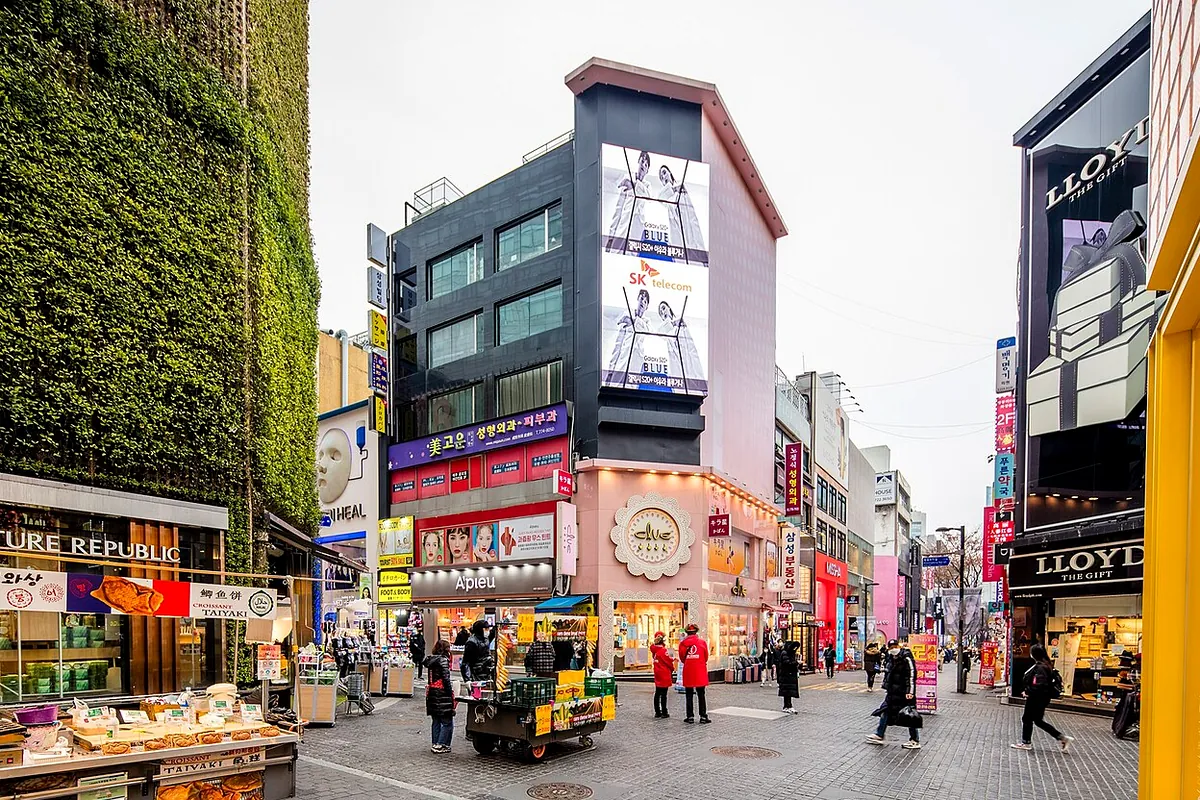
Across centuries of urban evolution, that primal natural landscape gradually matured into an intricate, multi-tiered spatial grid positioning Myeongdong as a strategic hinge in central Seoul. In terms of contemporary human geography, the district sits at a rare intersection of heritage and modernity: to the south rises evergreen Namsan crowned by N Seoul Tower; to the north borders Euljiro financial boulevard, home to major conglomerates and the most powerful banking institutions in the Land of Kimchi; while immediately to the west lies Namdaemun Market, a centuries-old traditional marketplace. Wedged between a modern financial core and historic commercial trading grounds, Myeongdong serves as a supreme retail crossroads where consumer energy never pauses.
Myeongdong’s sophisticated spatial planning also shines in the seamless integration between its open-air streetscape and subterranean world, creating a self-contained, weatherproof retail ecosystem. Above ground, main avenues and interlocking grid alleys follow the gentle slope of the historic hillside, guiding pedestrians effortlessly from broad boulevards into vibrant fashion lanes. Anchoring this commercial quadrilateral are two vital transit gateways: Myeongdong Station on Subway Line 4 to the south and Euljiro 1-ga Station on Subway Line 2 to the north—acting together as a massive pedestrian funnel circulating hundreds of thousands of shoppers daily from every corner of the capital.
Notably, to overcome the extremes of Korea’s temperate climate—from biting northeastern winter winds to drenching summer monsoons—urban planners engineered the Myeongdong Underground Shopping Center stretching over 300 meters in length. Far more than a pedestrian underpass, this subterranean artery connects the two key subway hubs seamlessly beneath street level. Hundreds of compact shops offering accessories, apparel, and souvenirs line the corridor, keeping retail energy thriving even when snow blankets the streets overhead. This harmonious balance of natural hill contours, Namsan’s green backdrop, and modern underground infrastructure preserves Myeongdong’s status at the pinnacle of contemporary retail urbanism.
From an urban planning and architectural heritage standpoint, Myeongdong presents a polyphonic streetscape where early modern historical strata interweave tightly with the Korean Peninsula’s most vibrant commercial pulse. Its spine is anchored by Myeongdong-gil Avenue and an organically connected grid of side lanes. To optimize the shopping experience and safeguard massive daily foot traffic, municipal authorities enforce strict spatial management: the main thoroughfare and adjoining alleys are physically closed to motor vehicles and converted into a dedicated pedestrian zone daily from 10:00 AM to 10:00 PM. Prohibiting vehicular traffic during peak hours liberates the streetscape into a lively open-air marketplace where boundaries between sidewalk and roadway dissolve beneath millions of footsteps.
Myeongdong’s architectural allure lies in the dramatic juxtaposition between early twentieth-century Western Neoclassical landmarks and towering contemporary retail complexes. Along the district’s outer edge stand solid stone monuments of Korea’s modern era, exemplified by the original Bank of Korea building (now the Bank of Korea Money Museum) with its stately Greco-Roman columns and Renaissance symmetry. Yet just a few intersections away, the eye is dazzled by monumental retail complexes such as Shinsegae Department Store and Lotte Young Plaza—multi-level skyscrapers whose exterior walls double as giant digital media facades radiating dynamic light shows across the luxury retail landscape.
Presiding over a quiet knoll on the eastern edge of the district, Myeongdong Cathedral—completed in 1898—rises as a pure Gothic Revival masterpiece of red and gray brick, serving as a spiritual anchor contrasting sharply with the commercial whirlwind below. Built on a Latin cross floor plan with a 45-meter bell tower, pointed arches, and intricate stained-glass windows, this historic cathedral stands not only as the birthplace of Korean Catholicism, but also as a timeless architectural treasure. Its serene presence inside a hyper-energetic shopping metropolis creates a unique “spiritual oasis” where pedestrians can step instantaneously from bustling retail energy into poetic, contemplative stillness.

The sheer scale of investment in Myeongdong is reflected in its intensive subterranean development and land values ranking among the highest per square meter anywhere in the world. Beneath major thoroughfares stretches a network of underground shopping arcades linked directly to key subway hubs, forming an intelligent multi-level transit web that relieves surface congestion. Together, cutting-edge glass-fronted multinational flagship stores, mobile street-food carts arrayed along stone pavers, and century-old brick heritage buildings elevate Myeongdong beyond a mere marketplace into an enchanting open-air museum of urban architecture.
As sunset fades behind the silhouette of Namsan Mountain, Myeongdong undergoes a dazzling metamorphosis into its most luminous nocturnal incarnation. Its very name—”Bright Village”—reads like an accurate prophecy fulfilled every evening. Myeongdong-gil and its network of side streets erupt with visual energy as colossal digital LED screens wrapping flagship cosmetics emporiums and fashion towers ignite in unison, casting kaleidoscopic reflections across polished paving stones. Kinetic architectural lighting keeps the entire district in constant motion, transforming the neighborhood into a world-class contemporary visual stage where consumer culture and public light art merge seamlessly.
Punctuating this high-tech matrix of light are iconic cultural venues showcasing Korea’s celebrated nonverbal performing arts. Foremost among them is the Myeongdong Nanta Theatre, home to the world-famous percussion comedy show blending slapstick theater with traditional Samulnori rhythms. Without uttering a single word of dialogue, performers wield kitchen knives, wooden cutting boards, cast-iron woks, and roaring flames to generate infectious beats paired with acrobatic choreography and dazzling stage lighting. Transforming everyday kitchen tools into a thrilling theatrical spectacle, Nanta captivates millions of international visitors annually as an indispensable pillar of Myeongdong’s nightlife.
Matching the energy of the stage is the evening arrival of hundreds of street food carts, unfolding like a choreographed parade of color down the center of the pedestrian boulevard. Beneath glowing neon strips strung along mobile canopies, fragrant steam rises carrying aromas of classic Korean street snacks and inventive modern creations. Visitors encounter bubbling pans of fiery gochugaru-red tteokbokki rice cakes, skewers of eomuk fish cakes simmering in sweet radish broth, and golden, savory gyeran-bbang egg bread. Street chefs work swiftly over roaring torches searing garlic-butter lobster tails or melting cheese over grilled dduk-galbi meat patties—creating a feast for both eyes and palate in the crisp evening air.
Myeongdong’s nocturnal symphony pulses late into the night, defining an immersive urban lifestyle. Upbeat K-pop tracks spilling from flagship stores mingle with acoustic guitars and powerful vocals from street buskers performing at lively intersections. Pedestrians drift along with the crowd, savoring glass-glazed tanghulu fruit skewers while admiring interactive digital displays on towering glass facades—forming a quintessential East Asian nightscape brimming with vitality, cosmopolitan glamour, and the enduring warmth of street-food culture.
Behind its glamorous glass towers and bustling fashion flagships, Myeongdong also guards the soul of one of Seoul’s premier culinary destinations, harmoniously uniting international dining standards with authentic Korean street flavors. Shaped by decades of modern history, its food scene flows along two irresistible currents: multi-generational family kitchens preserving classic Korean recipes, and dazzling evening street stalls constantly innovating to delight palates from around the globe.
At the pinnacle of Myeongdong’s heritage kitchens stands Myeongdong Gyoza, a legendary eatery continuously honored in the Michelin Bib Gourmand guide for many consecutive years. The heart of its menu is its celebrated Kalguksu knife-cut noodle soup, featuring hand-kneaded noodles immersed in rich chicken broth simmered for hours and topped with fragrant stir-fried minced pork and delicate, silky wontons. Equally iconic are its steamed Mandu dumplings, whose gossamer-thin wrappers encase juicy minced pork and fresh chives. The signature touch defining Myeongdong Gyoza for over half a century is its proprietary garlic kimchi—an intensely fiery, freshly fermented kimchi packed with chili powder and crushed garlic that delivers an unforgettable burst of flavor alongside the comforting, savory noodle broth.
Culinary depth leads gourmets onward to Myeongdong Katsu, a beloved institution founded in 1983. Tucked modestly down a historic alley, this restaurant embodies Japanese-Korean culinary exchange during Korea’s economic renaissance, renowned for traditional pork aging paired with precision panko frying that yields a crisp golden crust sealing in thick, juicy meat. Meanwhile, royal wellness cuisine shines at time-honored ginseng chicken soup houses such as Baekje Samgyetang, where young spring chickens stuffed with Korean ginseng, astragalus root, jujubes, chestnuts, and glutinous rice are slow-simmered in earthen stone pots to extract pure restorative nourishment rooted in traditional yin-yang principles.
When dusk falls, Myeongdong’s culinary landscape shifts to an entirely different rhythm as hundreds of illuminated street-food carts line the main pedestrian avenue. Unlike the rustic simplicity of traditional markets, Myeongdong street food offers a theatrical sensory performance. Diners watch torches sear garlic-butter lobster topped with bubbling melted cheese, filling entire blocks with rich aroma. Beside them sit warm, fluffy gyeran-bbang egg breads chasing away winter chill, and steaming Busan odeng stalls brimming with skewered fish cakes steeped in delicate radish-and-kelp broth. Glistening sugar-glazed tanghulu fruit skewers add sweet sparkle to the night—turning every bite into a living story of Korean culinary evolution.
To immerse yourself effortlessly in Myeongdong’s vibrant energy, understanding Seoul’s urban transit network is essential. Located at the heart of Jung-gu District, the neighborhood connects seamlessly to one of Asia’s most efficient subway systems. The most direct route is Seoul Subway Line 4 to Myeongdong Station, where Exits 5, 6, 7, and 8 lead straight onto the illuminated main commercial artery. Alternatively, Euljiro 1-ga Station on Line 2 serves as a strategic northern gateway opening directly toward the Shinsegae and Lotte department store complexes. For travelers arriving from Incheon International Airport, Airport Limousine Buses 6001 and 6015 offer direct, stress-free service—taking roughly 65 to 75 minutes along wide expressways to drop passengers right outside major Myeongdong hotels without hauling heavy luggage through subway stairs.
Myeongdong wakes around 10:00 AM and maintains high energy until roughly 10:00 PM nightly, when the final street-food stalls pack away their steaming carts. Savvy fashion and beauty shoppers should align visits with major nationwide shopping festivals—most notably the annual Korea Grand Sale in January and February, offering sweeping winter discounts across major retail groups, and Seoul Festa in May celebrating spring and summer culture. During these events, flagship brands slash prices by 30% to 70% while offering generous limited-edition gift sets, turning the district into a true shopper’s paradise.
One of the most rewarding perks for international shoppers in Myeongdong is South Korea’s transparent, streamlined VAT refund system. On single receipts of 30,000 KRW or more at participating Tax Free stores, travelers simply present a valid original passport to claim tax deductions. Instant Tax Refund at the register is widely available across major cosmetics chains and department stores, deducting VAT directly at checkout. For receipts not refunded on the spot, automated self-service tax refund kiosks located along main streets and inside major hotel lobbies scan passports and receipts to dispense immediate cash or credit card refunds—eliminating long airport queues prior to departure.
Although Seoul ranks among the world’s safest metropolises, tens of thousands of visitors converging on Myeongdong each evening call for sensible awareness of personal belongings—especially around crowded street-food stalls and packed cosmetics stores. To protect your consumer interests, prioritize flagship brand stores and reputable department stores displaying clear, transparent price tags, and always retain itemized receipts. Steering clear of bargain-basement tour operators that pressure travelers into unverified agricultural or health-supplement shops ensures a relaxed, dignified journey celebrating the generous spirit of modern East Asia.
Discovering the full richness of Myeongdong’s shopping culture and historical depth becomes all the more effortless and rewarding when accompanied by knowledgeable local guides on an all-inclusive South Korea tour package thoughtfully curated so every moment of exploration is seamless and memorable.