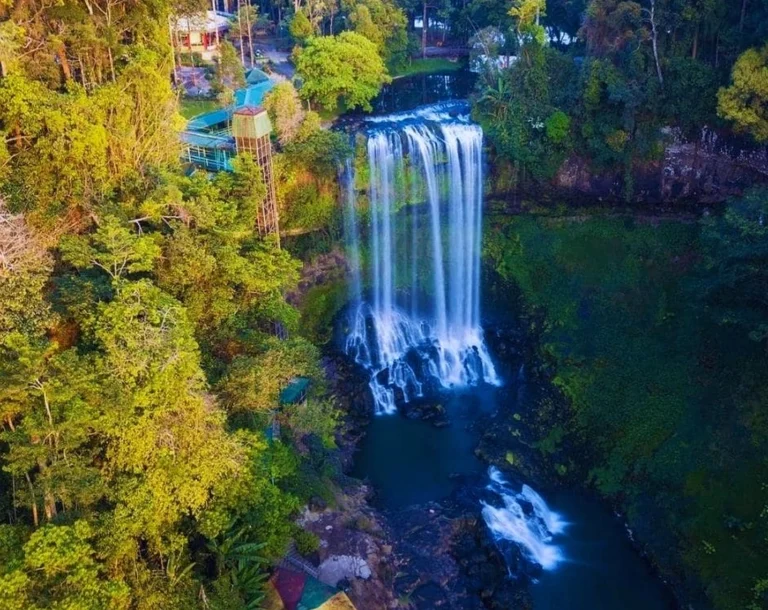
Nestled amidst the majestic primeval forests of the Southern Central Highlands, Pongour Waterfall (also commanding respect under the name Seven-Tier Waterfall) marks its presence at coordinates 11°42’45″N 108°17’15″E, within Tan Thanh Commune, Duc Trong District, Lam Dong Province. From the perspective of human geography and classical feng shui, this scenic landmark commands an extraordinarily auspicious terrain embodying the symbolic principle of “backed by mountains and facing water.” It serves as a vital convergence point of energy within the Da Nhim River hydrological system, receiving abundant currents cascading down from the Di Linh Plateau. Naturally stacked layers of basalt rock wind gracefully across seven stepped tiers, creating a magnificent hydraulic architecture evocative of the “Water Dragon Descending the Mountain”—a subtle harmony between millions of years of tectonic energy and the solemn spiritual aura of old-growth mountain forests. Unlike moss-covered imperial temples or mausoleums bearing the stamp of central dynastic power, Pongour’s historical and cultural value endures in the annals of indigenous consciousness as “intangible cultural heritage intertwined with natural landscape.” In the ancestral memory of the K’Ho people, the waterfall is bound to the poignant legend of female chieftain Kanai—a remarkable leader who pioneered the land, tamed wild beasts, and safeguarded the peace of her village. Tradition holds that when darkness fell upon the mortal realm and the heroine passed into the beyond, four loyal rhinoceroses remained silently by her side, standing vigil over her body. From that sacred realm, tears of grief transformed into a rushing cascade, flowing day and night over dark basalt steps like the flowing tresses of the legendary chieftainess. Over the passage of time, though devoid of stone stelae or feudal royal edicts due to its secluded location deep within the sacred K’Ho wilderness, Pongour nevertheless left an indelible mark on modern history. In the early twentieth century, the waterfall’s untamed beauty captured the attention of French explorers venturing across the highlands, notably Paul Doumer. The pinnacle of its scenic acclaim came in 1960, when former Emperor Bao Dai officially bestowed upon Pongour the title “Nam Thien De Nhat Thac” (The Foremost Waterfall of the Southern Sky). This recognition not only affirmed the landmark’s unrivaled standing among Vietnamese people of that era, but also stands as testament to the timeless allure of a natural wonder set deep in the wilderness. Viewed through the lens of modern conservation science, Pongour’s value far surpasses that of an ordinary sightseeing stop. On April 27, 2000, the Ministry of Culture, Sports and Tourism officially designated it a National Scenic Relic under Decision No. 920/QD-BVHTTDL. To this day, Pongour preserves a rare, intact original basalt geological structure in Vietnam, untouched by the harsh concrete intrusions of urban civilization. This pristine authenticity has turned the site into an invaluable open-air laboratory, drawing geologists, cultural anthropologists, and travelers passionate about tracing heritage to its roots, listening to the echoes of time harmonize with the grand epic of the Central Highlands.
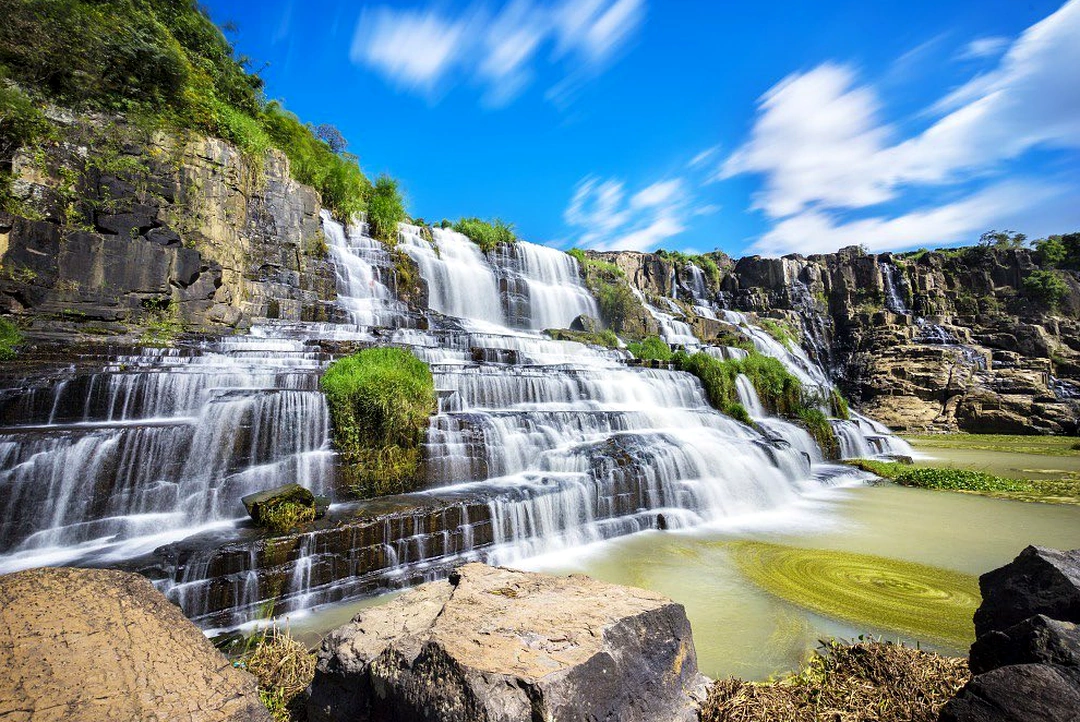
If the Lam Dong Plateau were likened to a colossal ink-wash painting, Pongour Waterfall would be the most breathtaking and enchanting brushstroke bestowed by nature. Free from the monotony of waterfalls plunging straight down from sheer heights, Pongour is a masterpiece of geological architecture featuring naturally layered basalt formations that create a one-of-a-kind terraced structure. Stretching across seven expansive stone tiers, the waters of the Da Nhim do not crash down violently; instead, they glide gracefully over smooth rock slabs like a ribbon of white silk draped across the deep forest, producing rhythms of sound at once epic and contemplative—much like a grand symphony of the Central Highlands.
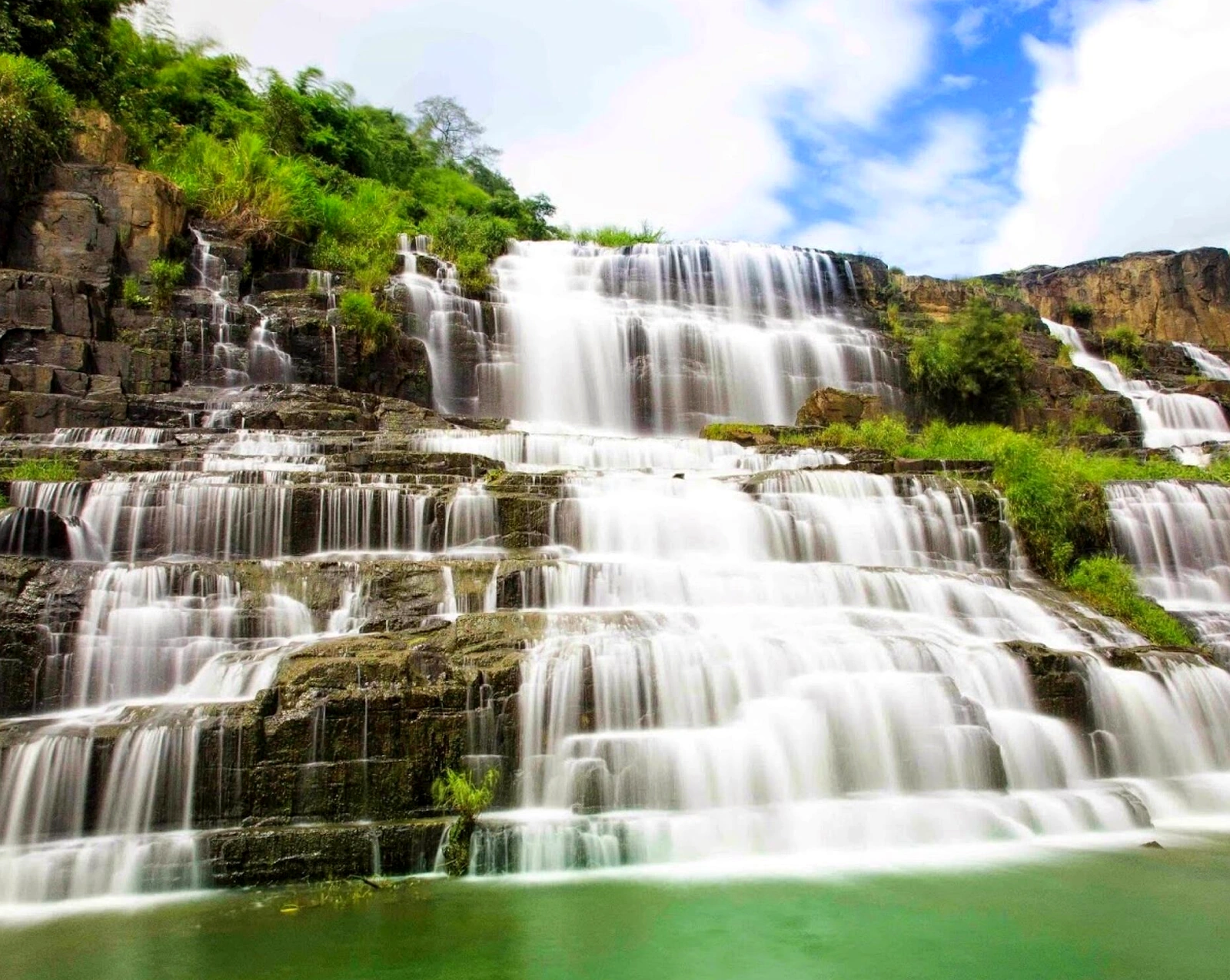
In terms of natural architecture, Pongour possesses a rare “Water Dragon Descending the Mountain” terrain. The basalt tiers here are far from inert slabs of rock; they were intricately arranged across millions of years of geological formation. Hexagonal and pentagonal stone columns stack upon one another to form giant staircases, shattering the descending current into thousands of fine droplets and shrouding the entire gorge in an ethereal mist. This terraced structure turns Pongour into a master architect in its own right, where each stone ledge serves as a stage and each stream as a dancer, uniting in seamless balance between the unyielding strength of stone and the fluidity of water.
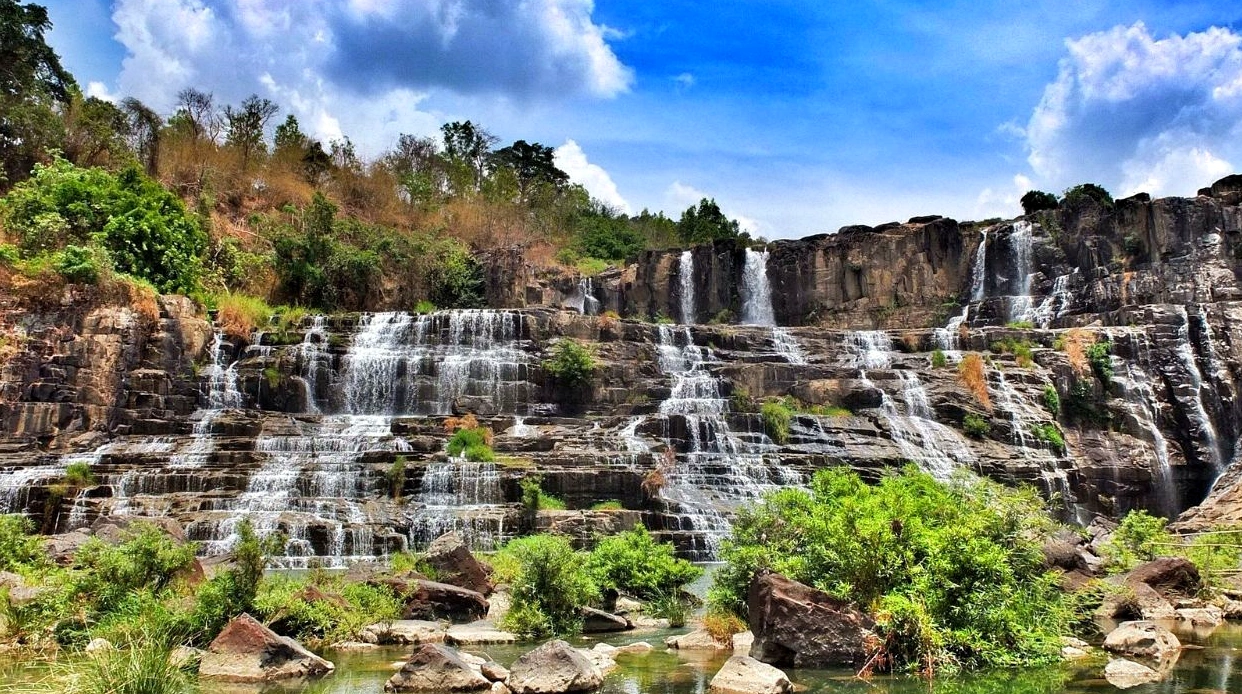
To capture the full splendor of the “Foremost Waterfall of the Southern Sky,” professional photographers favor two classic vantage points. The first sits directly opposite the main cascade. From here, a wide-angle lens takes in the entire sweep of all seven tiers, framing a symmetrical composition between foaming white water and dark basalt cliffs. The ideal moment for this angle is at dawn, when early morning sunbeams filter through the forest canopy, conjuring a magical “waterfall rainbow” right at the base of the falls. The soft light at this hour preserves crisp detail in every rivulet without blown-out highlights, accentuating the pristine, serene majesty of the heritage site.
The second vantage point lies downstream, where the water settles into a tranquil pool after descending all seven tiers. This is the sought-after “million-dollar view” beloved by travelers, particularly at sunset. As the sun dips behind stands of ancient pines, the light shifts to warm golden-amber hues, reflecting off the mirror-still surface of the lake. The contrast between sunset gold and the deep emerald of old-growth forest creates a poetic tableau that leaves anyone standing before the lens feeling humbled amidst grand nature. Moreover, employing a long-exposure technique from this spot smooths the rushing water into liquid silk, lending an air of mystery and refinement to the frame.
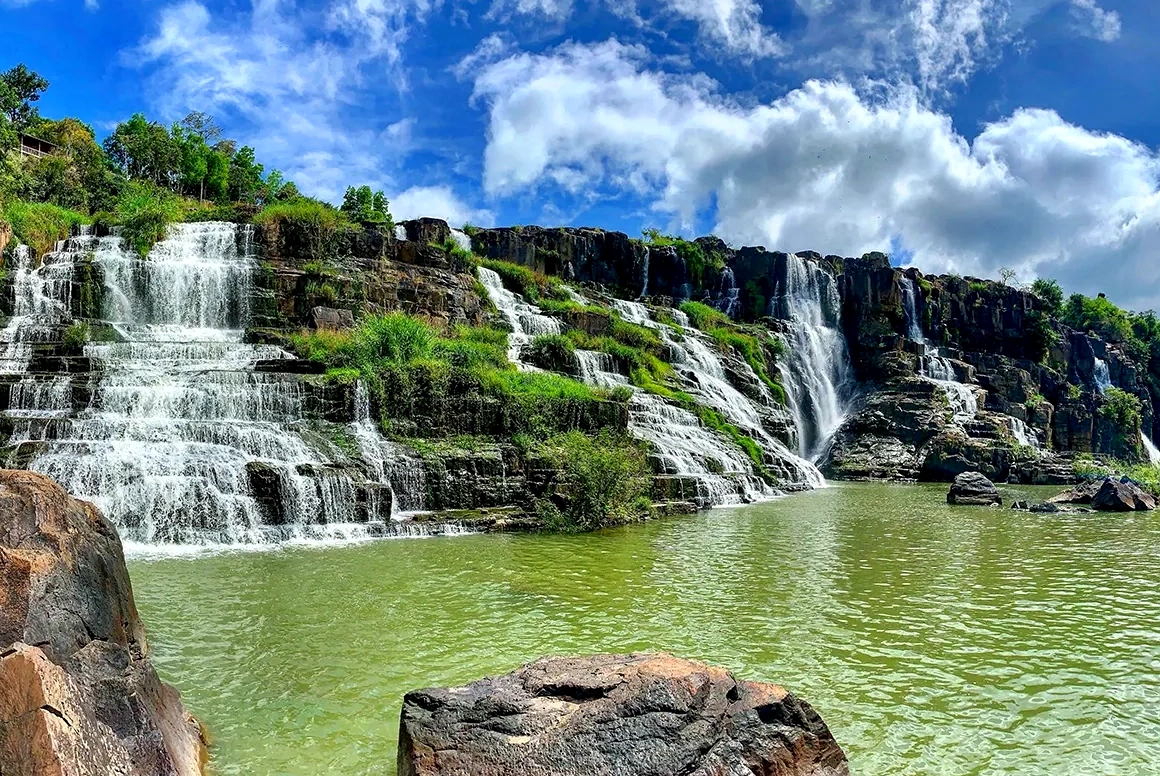
Whether you are a researcher seeking the intersection of geology and culture, or a traveler in search of once-in-a-lifetime photographs, Pongour knows how to captivate every visitor with beauty that shifts throughout the day. Every perspective here is more than a mere photograph; it is a communion between the human soul and the pulse of Mother Earth. Visit Pongour on a clear, sunny day, when rising mist dances with shafts of light, to fully breathe in the spirit of a natural heritage enduring across time.
Upon arriving at Pongour Waterfall, the very first sensation greeting visitors is not merely the signature crisp chill of the Lam Dong Plateau, but a breathless sense of awe before a monumental natural wonder. Gazing down from above, the Da Nhim River surges across seven stately tiers of layered basalt, sending up clouds of white spray like thousands of silver ribbons draped over the wilderness. The roar of rushing water intertwines with mountain winds to compose an untamed symphony, awakening every sense and transporting visitors into a realm wholly removed from the bustle and clamor of daily urban life.
Exploring this site firsthand calls for the steady stride of an investigator paired with the reverence of a pilgrim. To reach the foot of the falls, visitors follow a winding trail beneath the canopy of an old-growth primeval forest. Stepping down moss-covered stone steps while breathing in pure air scented with pine resin and damp earth fosters a profound connection with nature. Occasionally, small boats glide gently across the calm downstream pool, offering an intimate, poetic close-up of the millions-of-years-old geological formations where mysterious black basalt crags cradle cool, crystal waters.
Beyond its scenery, the spiritual atmosphere here offers moments of rare stillness. Standing before the cascade hailed as the Foremost Waterfall of the Southern Sky, reflecting on the origins of female chieftain Kanai through stories passed down by the indigenous K’Ho people, one’s mind naturally grows calm. Many visitors choose to pause quietly beside the cliff face, closing their eyes to feel the subtle energy of the deep forest coursing through them, or offering heartfelt incense in tribute to the ancestors who pioneered and safeguarded this sacred land.
Capping off a journey into nature, vibrant local culinary traditions awaken the palate of every traveler. Right beside the scenic area, regional specialties rich with the flavors of the Central Highlands await guests gathered around a crackling fire. Nothing compares to savoring fragrant black pork grilled in bamboo tubes, tender bamboo-cooked sticky rice paired with pungent basil salt, or sipping warm, herbal-fermented jar wine alongside local hosts. All of these treasured experiences—from awe-inspiring landscapes to genuine indigenous hospitality—turn a visit to Pongour Waterfall into an unforgettable memory.
Continuing a field journey from downtown Da Lat to reach this sacred waterfall in Duc Trong District, travelers and researchers alike benefit from knowing key practical details regarding hours, costs, and the best routes.
For transportation and route directions from central Da Lat, you can travel by motorbike or car along National Highway 20 toward Ho Chi Minh City. Upon reaching the Xom Dat area (Tan Thanh Commune, Duc Trong District), a signpost directs you to turn right onto a winding red basalt dirt road shaded by lush trees that leads straight to the heritage site entrance. The entire journey spans roughly fifty kilometers, offering a scenic drive across highland landscapes.
The heritage site management board welcomes visitors and researchers daily from early morning until late afternoon, specifically from 7:00 AM to 5:00 PM every day of the week, including public holidays. Admission tickets are modestly priced to suit all travelers and students, ranging from roughly 20,000 VND to 30,000 VND per person, excluding parking fees for personal vehicles.
For the most rewarding visit and field observation, the ideal time of year to explore Pongour Waterfall is during the dry season (from November to April of the following year). During these months, dry weather reveals the raw, majestic geometry of the basalt tiers while gentler water flow makes observing geological formations and descending to the base far easier. Conversely, visiting during the rainy season brings thunderous, powerful torrents true to the spirit of the “Water Dragon Descending the Mountain,” though extra caution is required.
Finally, as this natural heritage site is deeply tied to the sacred legends of the K’Ho people, visitors should wear neat, respectful attire and prioritize athletic shoes or footwear with strong traction for navigating damp, slippery stone steps. At the same time, please help protect the environment and respect indigenous cultural spaces so the pristine beauty of the “Foremost Waterfall of the Southern Sky” remains preserved for generations to come.
To enjoy a seamless holiday and experience Pongour Waterfall at its finest without worrying about arranging transport, admission tickets, or itineraries, travelers can choose VDS Travel’s premium all-inclusive Lam Dong tour packages. Every itinerary is thoughtfully timed for photo stops when the scenery shines brightest, accompanied by knowledgeable guides versed in local culture and top-tier hotel and dining standards.