Tucked away amid the layered mountain peaks of historic Kozuke Province (present-day Gunma Prefecture), Kusatsu Onsen (草津温泉) carries millennia of cultural heritage rooted in sacred ancient legend. According to tradition, these geothermal waters were discovered in the 2nd century by Prince Yamato Takeru no Mikoto, the legendary hero of early Japanese mythology. While campaigning to pacify the eastern provinces on the orders of Emperor Keiko, the prince followed plumes of steam rising from a rocky valley and came upon bubbling, sulfur-scented waters gushing from the earth. Although steeped in myth, archaeological findings and historical chronicles from the Nara period (710–794) confirm that early settlers and Buddhist monks were already gathering here to bathe in the pure thermal springs, transforming the secluded valley into a sacred earthly sanctuary.
During the Muromachi period (1336–1573), as civil conflict turned the Japanese archipelago into a fiercely contested battlefield, Kusatsu Onsen entered a rugged yet illustrious chapter of its history. The hot spring town served as a natural field hospital, nursing countless wounded warriors and samurai back to health from deep sword and spear injuries. Warring States commanders recognized that Kusatsu’s extraordinarily high acidity and concentrated mineral content possessed potent antiseptic properties capable of rapidly healing wounds and dispelling infectious fevers. Bands of samurai traversed the steep passes of the volcanic Shirane range to immerse themselves in the scalding waters, restoring both body and resolve before returning to decisive campaigns that shaped the nation’s fate.
The Edo period (1603–1867) marked the turning point that elevated Kusatsu to the pinnacle of Japanese hot spring culture. In 1686, during the Jokyo era, the eminent physician and scholar Tachibana Kyuhaku published a groundbreaking medical treatise analyzing the therapeutic efficacy of Japan’s natural thermal springs. This landmark publication officially ranked Kusatsu Onsen among the “Three Great Hot Springs of Japan” (Nihon Sanmeisen – 日本三名泉), alongside Arima and Gero. Kusatsu’s reputation reached the innermost chambers of the Tokugawa Shogunate. Admiring its miraculous healing properties, successive shoguns—most notably the eighth shogun, Tokugawa Yoshimune—repeatedly dispatched special relay couriers to seal Kusatsu mineral water inside large cypress casks and haul them expeditiously across hundreds of miles of treacherous mountain roads to Edo Castle for the shogun’s personal bath.
The Meiji Restoration (1868–1912) brought Kusatsu onto the international scientific stage, lifting it beyond the realm of folk wisdom alone. A pivotal milestone arrived in 1876 when Dr. Erwin von Bälz—the distinguished German physician widely regarded as the father of modern Western medicine in Japan—visited the geothermal valley to conduct thorough field surveys. Astonished by the water’s unusually high mineral concentration and natural acidity, Dr. Bälz carried out rigorous biochemical and clinical studies before declaring to the international medical community that Kusatsu Onsen ranked among the most therapeutically potent healing spas on Earth. This global endorsement by a leading Western scientist not only helped introduce modern balneotherapy to Japan, but also permanently enshrined Kusatsu as an enduring national treasure across changing eras.
Perched roughly 1,200 meters above sea level, the town of Kusatsu occupies a distinctive highland basin along the eastern flank of Mount Kusatsu-Shirane, a towering stratovolcano in historic Kozuke Province, now Gunma Prefecture. Through the lens of East Asian geomancy (feng shui), the terrain embodies the classic ideal of “backed by mountains, overlooking a valley.” Mount Shirane—permanently blanketed in mineral ash and hardy alpine flora—stands behind the town as a protective Black Tortoise guardian, shielding it from biting winter winds sweeping off the Sea of Japan. The deep natural basin acts like a geomantic treasure bowl, gathering vital energy rising from deep underground magma chambers that have released immense geothermal heat across tens of millennia. Gently sloping southeastward, the land welcomes warm morning sunlight to burn off highland mist while maintaining a natural gradient that keeps thermal waters flowing continuously without ever stagnating.
Kusatsu Onsen’s spatial layout is a masterpiece of terrain-responsive urban design, demonstrating an intimate harmony between local builders and natural laws. The focal axis of the entire resort centers directly on the Yubatake hot spring source, where mineral water erupts in record-breaking volume. From this steaming heart, open-air channels and mineral-seasoned pine conduits branch outward like meridians, winding along natural contour lines to distribute thermal water to traditional ryokan inns. Multi-story cedar-and-gray-tile buildings sit staggered across the gentle slopes, creating a centripetal layout that is both cohesive and organic. Nestling into the hillside allows buildings to catch natural convective breezes while dispersing Kusatsu’s signature sulfur vapor across open public spaces, enveloping the historic village in an unmistakable natural mineral aroma.
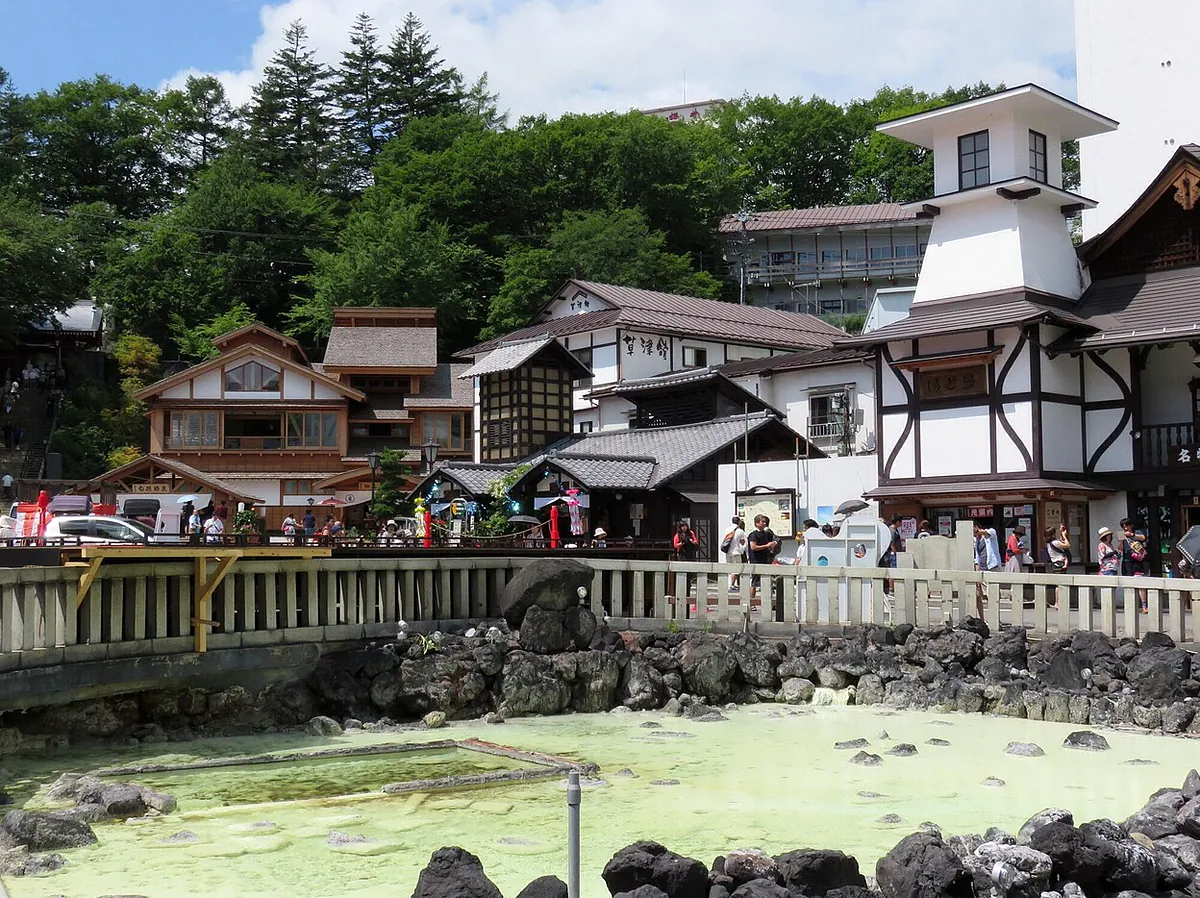
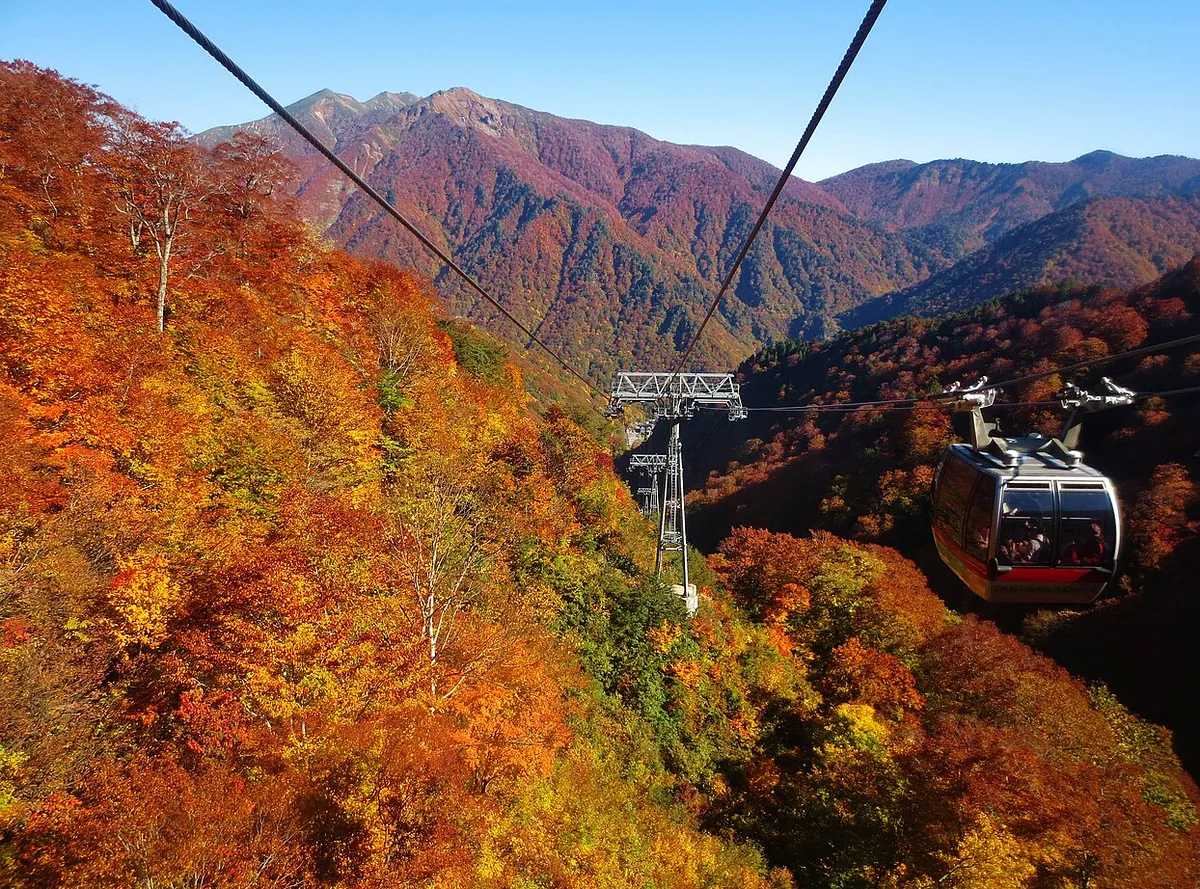
Surrounding the hot spring core is the lush temperate mixed forest of Joshin’etsu Kogen National Park, forming a vital natural bio-filter. At over a thousand meters in elevation, Kusatsu enjoys a crisp highland climate characterized by refreshing average temperatures, invigorating atmospheric pressure, and abundant negative ions ideal for natural climatotherapy. Vegetation transitions visibly across elevations: silver-barked shirakaba white birch groves mingle on the slopes with Japanese red pine, sugi cedar, and ancient mizunara oak. In spring and summer, this woodland buffer tempers humid air rising from the Kanto Plain, keeping the atmosphere crisp and pure. Come autumn, the flanks of Mount Kusatsu-Shirane ignite with crimson momiji maple leaves and golden beech foliage, forming a magnificent natural backdrop against milky-white plumes of steam drifting endlessly from the valley floor.
When winter arrives, Kusatsu transforms into an enchanting snow-country wonderland steeped in classic yukiguni atmosphere. Deep blankets of powdery snow settle atop fir canopies and steep ryokan roofs, creating a mesmerizing visual contrast between pristine frost above and piping-hot geothermal steam rising from the earth below. The union of crisp alpine air at 1,200 meters and rich mineral warmth from underground gives rise to a rare therapeutic microclimate. Gentle breezes carry mineral-laden mist laced with the resinous scent of virgin pine forest, turning Kusatsu into a secluded sanctuary where body, mind, and spirit are purified amid spirit-infused Japanese mountain scenery.
The architectural soul of Kusatsu Onsen lies in its singular centripetal layout, where every gently sloping stone-paved lane in this Gunma highland town naturally converges upon Yubatake—literally the “Hot Water Field.” Functioning as the beating heart regulating the entire spa town’s rhythm, Yubatake is an extraordinary open-air hydraulic engineering marvel designed to cool scalding spring water straight from the earth before piping it to local inns. Dozens of thick-hewn pine and cedar wooden chutes arranged in sweeping stepped tiers form a dramatic cascading matrix. As strongly acidic, mineral-rich water surges steaming day and night down the wooden troughs, skilled artisans periodically harvest crystallized sulfur mineral deposits clinging to the timber—a prized natural bath mineral revered as yu-no-hana (“hot water flowers”). The crisp geometric symmetry of the wooden conduits contrasts harmoniously with jagged volcanic boulders framing the basin, creating a vista that is at once technically ingenious and deeply mystical.
Encircling this steaming central basin is an impressive ensemble of traditional ryokan architecture preserving the nostalgic transition between the romantic Taisho era and the Showa period. Multi-story wooden inns rise sturdily on massive timber frames joined through intricate traditional mortise-and-tenon carpentry without a single iron nail—allowing structures to flex resiliently against harsh highland weather and corrosive sulfur vapors. Glazed charcoal-gray and jet-black ceramic tile roofs sweep gracefully over engawa wooden verandas that dissolve the boundary between indoors and outdoors. Sliding open delicate washi-paper shoji screens reveals serene interiors floored with fragrant igusa rush tatami mats, ink-painted fusuma sliding doors, and tokonoma alcoves displaying seasonal blossoms—inviting guests into profound stillness as mist curls up from the central plaza outside.
Tucked among cozy family-run inns and historic hotels are meticulously tended Japanese Zen gardens inspired by wabi-sabi philosophy. Miniature tsuboniwa courtyard gardens nestled inside lightwells and quiet corners artfully combine moss-draped boulders, raked white gravel karesansui ripples, rhythmic bamboo tsukubai water basins, and yukimi-doro snow-viewing stone lanterns crowned in winter white. These serene garden pockets not only bring shade and fresh airflow to private baths crafted from fragrant hinoki cypress, but also guide visitors’ minds into a meditative state before stepping into Kusatsu’s famously piping-hot waters.
Extending westward beyond the Yubatake core opens Sainokawara Valley, where the compact historic town transitions seamlessly into untamed volcanic wilderness. Following gravel-strewn Sainokawara-dori past rustic two-story pitched-roof inns leads directly into a geothermal park where natural hot springs flow openly across reddish-brown, mineral-stained basalt rock beds. Crowning the far end of this scenic corridor is Sainokawara Rotenburo, a monumental open-air bath spanning hundreds of square meters encircled by dense pine-forested hills. Here, human architecture steps aside almost entirely for nature—leaving only simple raw-timber shelters along the water’s edge so hundreds of bathers can soak simultaneously beneath open skies, watching clouds drift across Mount Kusatsu-Shirane in an unbounded outdoor sanctuary.
As dusk settles over the Gunma mountains, Kusatsu Onsen sheds its quiet daytime demeanor and drapes itself in a dazzling, ethereal veil of light. At the center of the nocturnal spectacle stands Yubatake, where artistic illumination designed by world-renowned lighting designer Motoko Ishii comes alive. Under her masterful choreography, beams shift smoothly from misty emerald green to warm amber, shining straight through billowing plumes of steam rising from spring water emerging naturally at 65°C. Swirling clouds of sulfur-scented vapor catch the glowing light to conjure an otherworldly dreamscape that blurs the boundary between waking reality and ancient Japanese folklore.
Right beside Yubatake’s steaming cascades stands Netsunoyu, a historic bathhouse keeping Kusatsu’s living cultural soul alive through the celebrated Yumomi performance. Originating in the Edo period, Yumomi is far more than a folk dance—it is an ingenious indigenous hydro-engineering technique developed to cool scalding mineral water down to a comfortable bathing temperature without adding a single drop of cold water, thereby preserving its potent mineral concentration undiluted. Inside a warm Taisho-style timber hall, local performers clad in traditional dark-blue kasuri-patterned yukata cinched with crimson sashes plunge 1.8-meter pine paddles into the steaming bath in unison. Rhythmic slaps of wood against water send white mineral foam splashing across the pool in time with the haunting, centuries-old Kusatsu Bushi folk chant—vividly capturing ancestral resilience and reverence before nature’s raw power.
Stepping out from Netsunoyu’s echoing song, visitors are drawn into the serene yet poetic nightlife unfolding along the historic stone lanes circling the plaza. The crisp mountain chill seems to melt away amid the cheerful clack-clack of thousands of wooden geta clogs striking stone pavement as guests stroll the night streets dressed in colorful yukata robes. Rows of washi paper lanterns cast a warm amber glow across centuries-old wooden ryokan facades. Along street corners, traditional stalls send up fragrant clouds of steam from bamboo baskets filled with brown-sugar onsen manju buns stuffed with sweet red bean paste, alongside creamy, soft-yolked onsen tamago eggs slow-cooked in mineral spring water—anchoring travelers in the comforting warmth of highland hospitality.
Later into the night, Kusatsu’s beauty grows even more contemplative when viewed from the stone stairway ascending to historic Kousen-ji Temple, perched gracefully on a low hill overlooking Yubatake. Standing within the quiet temple precinct beneath towering ancient pines—gazing past flickering candles and moss-covered stone lanterns—visitors take in a sweeping panorama of the hot spring valley slumbering beneath a luminous halo of steam. Murmuring spring currents mingling with warm mist rising into the crisp night air compose an endless symphony of nature and humanity, leaving travelers with a lasting impression of a sanctuary that has healed body and soul across centuries.
Exploring a thousand-year-old spa town like Kusatsu Onsen offers profound insight into the mountain gastronomy of Joshu. Nurtured by Gunma’s highland climate and year-round geothermal heat, local cuisine embodies a philosophy of holistic nourishment where subterranean warmth meets regional harvests to create dishes of understated perfection. Strolling along steam-veiled stone slopes around Yubatake Square, travelers are captivated not only by the rich mineral air, but also by the sweet aroma rising from traditional bamboo steamers—opening the door to a singular culinary heritage.
The enduring culinary icon inseparable from Kusatsu’s bathing tradition is Onsen Manju, the beloved hot spring steamed bun etched into the memories of generations of visitors. Its signature charm lies in pairing wheat dough enriched with Okinawan brown sugar—yielding a soft, amber-hued bun—with silky, hand-simmered azuki red bean paste that melts effortlessly on the tongue. Rather than relying on electric steamers, time-honored confectioners such as Matsuchiya harness natural geothermal steam rising directly from local mineral vents to cook each batch. Pure mineral vapor gently infuses the dough, locking in moisture and imparting a subtle, nutty sweetness. Holding a piping-hot manju in the brisk highland air and biting into its tender shell and rich sweet core reveals at once why this humble treat has become the soul of every evening stroll through town.
At the heart of formal kaiseki banquets served inside historic ryokan inns reigns premier Joshu Wagyu beef. Blessed with pristine meltwater from the Tanigawa mountain range and lush highland pastures, Gunma Prefecture provides ideal conditions for raising Japanese Black cattle to exacting standards. Every cut of Joshu Wagyu displays intricate snow-white marbling—a hallmark of superior grade. Seared over geothermal-heated volcanic stone plates or dipped briefly into a simmering sukiyaki pot of sweet-savory soy broth, paper-thin slices melt instantaneously, releasing deep umami and a rich, buttery aroma. Paired with prized local Shimonita green onions, Joshu Wagyu delivers a sublime culinary crescendo where pastoral tradition meets courtly refinement.
Alongside regal Wagyu, Kusatsu cuisine preserves the clean flavors of deep mountain forests through the classic pairing of maitake mushrooms and handmade buckwheat soba noodles. Foraged from Gunma’s old-growth woodlands, wild maitake (“dancing mushrooms”) are prized for their thick petals, crisp-tender snap, and bold herbal aroma. Skilled chefs coat clusters in gossamer-light tempura batter and fry them in bubbling sesame oil until golden and shattering crisp while locking in juicy woodland flavor. This aromatic mushroom tempura is traditionally served beside chilled zaru soba—pure buckwheat noodles kneaded with sweet spring water from Mount Shirane. Cool, savory tsuyu dipping sauce, springy buckwheat noodles, and crisp tempura compose a refreshing harmony that resets the palate and restores balance after soaking in Kusatsu’s intensely acidic mineral waters.
Kusatsu Onsen’s culinary culture weaves together geothermal warmth and crisp highland air. Free of ostentation, every heirloom specialty—from steam-kissed onsen manju and velvety Joshu beef to refreshing buckwheat soba—expresses sincere hospitality and a philosophy of eating in harmony with nature, turning every meal into a complete ritual of physical and spiritual renewal.
Departing the dazzling energy of Tokyo, the journey to Kusatsu Onsen unfolds across a dramatic transition from the broad Kanto Plain into the rugged mountain ranges of Gunma Prefecture. The fastest and most scenic rail route begins aboard the Joetsu Shinkansen or Hokuriku Shinkansen from Tokyo Station to Takasaki Station. At this key junction, travelers transfer to the local JR Agatsuma Line, winding gracefully through the pine-clad curves of the Agatsuma Gorge to Naganohara-Kusatsuguchi Station. A final 25-minute ride aboard a dedicated JR Bus Kanto coach climbs gently into the heart of town, bringing total travel time to roughly three hours. For travelers preferring to avoid platform transfers with luggage, direct highway express buses from Busta Shinjuku offer a relaxed alternative, crossing the scenic hills of Joshinetsu in about four hours.
While Yubatake Square steams and glows beneath warm lanterns 24 hours a day, renowned public bathhouses such as Sainokawara Rotenburo and Otakinoyu generally welcome guests from 7:00 AM until 9:00 PM. Kusatsu’s thermal water is famous for its extraordinarily strong natural acidity—ranging between pH 1.7 and 2.1—giving it powerful antibacterial and purifying properties that also require mindful care. Before entering the bath, always remove rings, necklaces, and any precious metal or silver jewelry to prevent chemical reactions that can permanently tarnish them. To absorb the water’s therapeutic benefits safely, limit each soak to 10 to 15 minutes; visitors with sensitive skin should rinse gently with warm fresh water at the shower stations afterward to protect the skin’s natural moisture barrier.
Bathing etiquette in Kusatsu is a meditative lesson in purity and communal respect refined over generations. Bathers must undress completely and wash thoroughly at seated shower stations before stepping into the hot spring pool; swimsuits and any clothing are strictly prohibited in communal baths. A small modesty towel may be folded neatly atop your head to help regulate blood pressure or placed on dry stones beside the pool, but must never touch the clean mineral water. In keeping with traditional Japanese bathhouse norms, visitors with large tattoos are advised to cover them with skin-toned waterproof adhesive patches or book a traditional ryokan offering private family baths (kashikiri onsen) for complete freedom and relaxation.
Kusatsu Onsen has preserved its timeless charm largely untouched by over-commercialization, thanks to generations of family-owned ryokan inns stewarding the town’s heritage. Free from tourist traps or high-pressure shopping detours, the town maintains an atmosphere of complete safety and serenity—where visitors can slip into a lightweight yukata, clatter along misty stone slopes in wooden geta clogs, and savor freshly steamed onsen manju straight from the basket. To experience Japan’s premier hot spring treasure smoothly and appreciate every cultural nuance without worrying about language barriers or transit schedules, joining a professionally curated all-inclusive tour package ensures an effortless, deeply restorative highland escape.