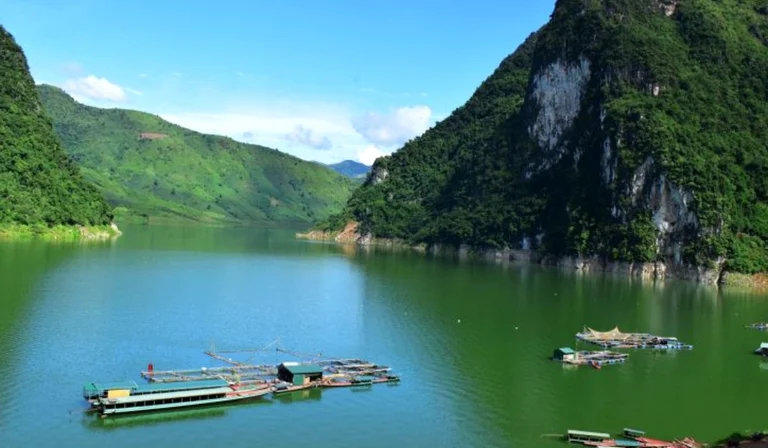
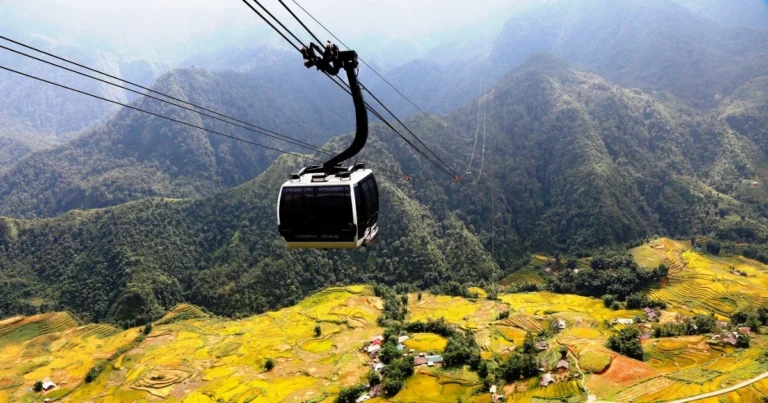
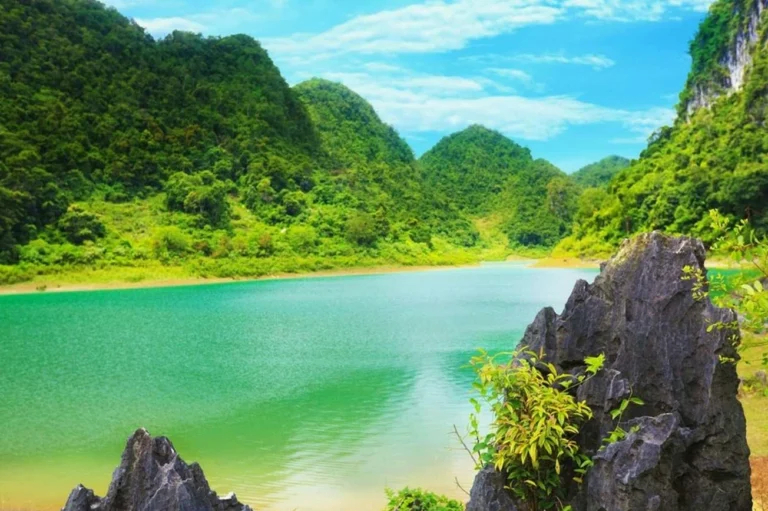
Nestled amidst the majestic Northwest great forests, Hoa Binh Lake emerges as a watercolor wonder crafted by nature and shaped by human hands and intellect, stretching across auspicious geographical coordinates within Hoa Binh city and the districts of Cao Phong, Tan Lac, Mai Chau, and Da Bac. From a feng shui perspective, this is a space converging the vital energies of heaven and earth, where the turbulent Da River flows through overlapping limestone mountain ranges, creating a rugged, grandiose, and wildly pristine valley system. The perfect combination of a vast water surface area of approximately 8,000 hectares, a winding length of over 230 kilometers, and hundreds of large and small islands undulating amidst jade-green waters has bestowed upon this land a unique visage—simultaneously majestic and rugged like the highlands, yet dreamy and magical like a lake archipelago.
The historical origins of this landmark are tied to the evolutionary process of human survival spaces dating back tens of thousands of years. Today’s lake bed area is precisely the upper Da River valley—the renowned cradle of the “Hoa Binh Culture” dating from 12,000 to 8,000 years ago, honored by international archaeologists as one of the shining milestones of human prehistory. Through the feudal dynasties of Ly, Tran, Le, and Nguyen, this land belonging to Quy Hoa lo and then Hung Hoa garrison served as a battlefield and strategic commercial bottleneck, governed through a system of heroic ancient Muong chieftains belonging to the Deo, Xa, and Dinh clans. Under the reign of King Minh Mang in 1831, this land imbued with deep indigenous imprints was renamed Ho Bi prefecture, before officially being designated as Hoa Binh province in 1886 during the reign of King Dong Khanh.
The imprint of time on this land is further etched through heroic historical pages and legend-steeped folklore systems. These include the valor of ancient Muong chieftains who submitted to the Hoa Lu court during Emperor Dinh Tien Hoang’s era in the mission of unifying the country and consolidating the borderlands. There are also the epic echoes of the 19th century when the Can Vuong movement erupted, marking the footsteps of leader Doc Ngu (Nguyen Van Giap) and Lanh Thanh alongside insurgent armies establishing bases along the Da River basin, utilizing the magnificent cave system of Hoa Binh’s mountains as fortified ramparts resisting French colonialism. In the 20th century, this place continued to write a new legend as tens of thousands of brilliant Soviet experts and resilient Vietnamese workers day and night held their ground, blocking the ferocious Da River to erect the century-old hydroelectric project, officially giving birth to the name “Hoa Binh Lake” on the historic milestone of November 6, 1994.
Today, from the perspective of heritage tourism and scientific research, Hoa Binh Lake is not purely an artificial reservoir serving economic development, but concurrently an invaluable pristine ecological-cultural museum. The deep waters of the lake bed silently preserve hundreds of archaeological sites from the Late Paleolithic and Early Mesolithic periods, alongside dozens of unique Muong cultural spaces with melodies of Mo Muong and gongs resounding across the great forests. The exquisite blend of tectonic geological values, global archaeological heritage, and indigenous cultural identity has transformed Hoa Binh Lake into a premier heritage travel coordinate where prehistoric and modern pasts intertwine, inviting kindred souls to explore and worship.

Hoa Binh Lake appears as a hydrological wonder perfectly combining human ingenuity and nature’s magnificent creations. Dubbed the “Ha Long Bay on the mountains,” the lake’s water surface spanning up to 8,000 hectares is as calm as a giant jade-green mirror, reflecting the boundless sky and overlapping embrace of mountain ranges. The terrain here exhibits characteristics of million-year-old karst topography, creating hundreds of large and small islands undulating amidst clear blue waters, with each island serving as a natural museum preserving lush pristine vegetation and mossy vertical cliffs telling tales of millennia of history.
Reigning at the head of that grandiose space is the Hoa Binh Hydropower Plant—a 20th-century industrial architectural masterpiece. Massive reinforced concrete blocks forged from the sweat, intellect, and blood of tens of thousands of Vietnamese workers and Soviet experts stand majestic against the sky. The spillway during flood season resembles a giant white silk ribbon cascading from the heavens, creating a heroic harmony of roaring waters echoing across the Northwest mountains. Winding roads hugging the mountainside leading to the summit of Uncle Ho’s monument hill or the main observation point form harmonious architectural accents where humans stand amidst boundless clouds to fully perceive the harmony between a heroic past and a peaceful present.
To fully preserve the magnificent beauty of this masterpiece, photographers and travel journalists frequently share two unmissable “million-view” framing angles. The first angle is located at the summit of Thung Khe pass or high points in Da Bac district overlooking the entire lake panorama at dawn. From around 5:00 to 6:00 AM, when wispy morning mist still lingers on the water, early morning sunrays piercing through cloud cover create magical optical effects, illuminating undulating rock islands like vivid ink-wash strokes against a brilliant pink-orange sky.
The second ideal check-in angle is situated right at the main dam area or aboard cruises drifting across the lake during sunset (around 5:00 PM to 6:00 PM). At this moment, Hoa Binh Lake’s surface transitions into the subdued colors of twilight, reflecting the blazing red sun gradually sinking behind the Northwest mountain range. Dugout canoes of the Muong people gliding gently by create ripples, combining with the imposing silhouettes of hydroelectric turbine towers in the background to deliver frames that are both epic in character and heart-wrenchingly poetic.

As motorboats cleave through the deep blue waters of Hoa Binh Lake, travelers step into a world completely detached from urban noise and bustle. The calm lake surface acts as a giant mirror reflecting the boundless sky, embracing overlapping limestone mountain ranges shimmering within mystical mist. The initial overwhelming sensation is the breathtaking grandeur of nature, where sky, rivers, mountains, and heroic history blend as one. Viewed from afar on a boat, lush green islets rising from the lake evoke associations with an “inland Ha Long Bay” amid the wild and mystical Northwest great forests.
Practical exploration here would be incomplete without exhilarating active experiences. Travelers can test their endurance climbing peaks surrounding the lake bed such as Thung Nai peak or mountains in Da Bac district. Steps overcoming challenging terrain are handsomely rewarded when gazing from high above at the panoramic view of Hoa Binh Lake winding softly like a silver silk ribbon across peaceful villages. Welcoming brilliant dawns over the water or witnessing sunsets painting the entire space gold are meditative moments touching the deepest emotions of any nature lover.
Alongside stunning natural landscapes, vibrant indigenous cultural spaces in lakeside villages such as Muong Bien, Co To island, or Ngoi village offer profound spiritual and cultural experiences. Visitors can worship at the sacred Ba Chua Thac Bo temple perched precariously on a mountainside, listening to legends of devotion and divine protection for those earning their livelihoods on waterways. Gongs resounding across mountains, graceful Xoe dances by Thai and Muong maidens beside flickering fires, and traditional stilt houses nestled beneath ancient tree canopies create an irresistible allure, capturing travelers’ footsteps.
The experiential journey at Hoa Binh Lake is also an exciting gastronomic adventure featuring renowned local cuisine. Sitting beside a cozy Muong meal, visitors savor fragrant grilled Da River fish rich in natural sweetness, bitter bamboo shoots dipped in sesame salt rich with forest flavors, sticky upland glutinous rice cooked from golden grains of the valley, and sips of pungent leaf-fermented Ruou Can. All these flavors harmonize with the hospitality and warmth of local ethnic minorities, leaving enduring echoes in every traveler’s heart about a land rich in historical imprints and vibrant contemporary culture.
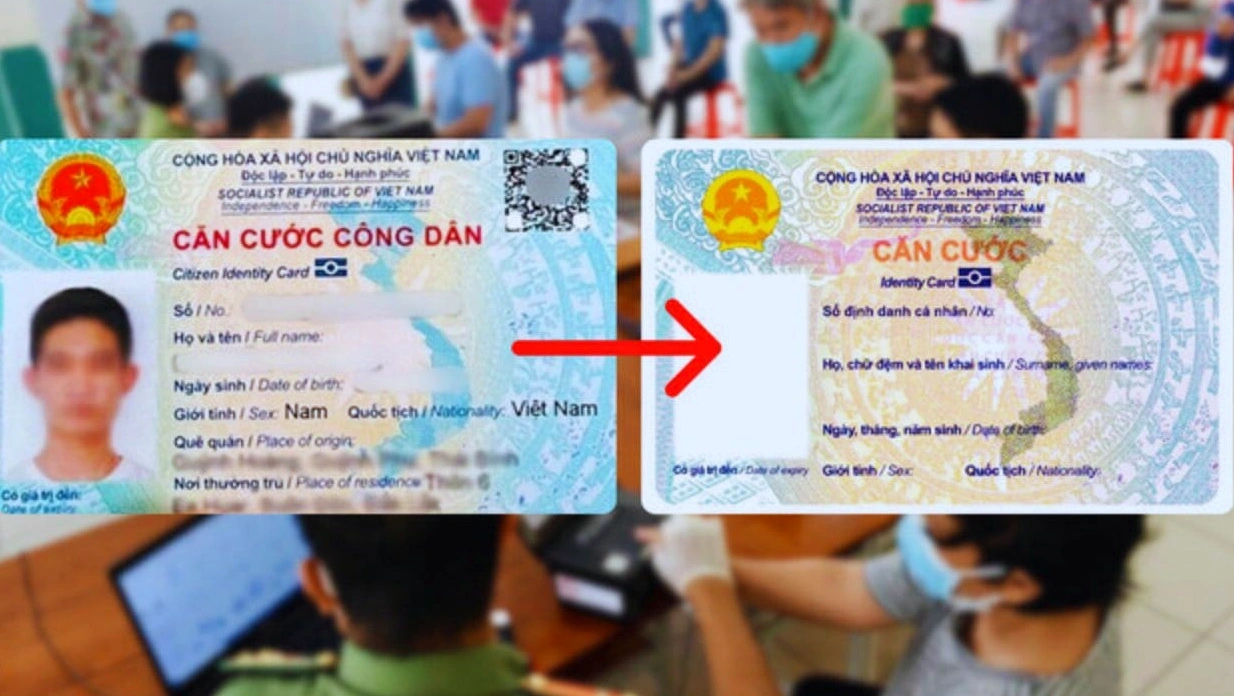
Hoa Binh Lake stands as one of the most appealing ecotourism and spiritual-cultural destinations in the Northwest, offering visitors full immersion into majestic nature and long-standing historical spaces. To ensure a smooth journey exploring the lake bed, equipping oneself with practical information on timing, costs, transportation, and behavioral guidelines is essential.
Regarding ideal visiting times, travelers can embark on Hoa Binh Lake exploration during any season of the year, but the finest period spans from October of the previous year to April of the following year. At this time, weather is dry, temperatures are cool, and the lake surface is as calm as a mirror, highly favorable for boat travel, island tours, and cave exploration. Particularly during the high-water season, the poetic and picturesque landscape becomes even more magical and grandiose.
The lake bed area and lakeside attractions open freely to visitors every day of the week, typically from 7:00 AM to 5:00 PM to ensure waterway safety. Regarding costs, general sightseeing of Hoa Binh Lake’s landscape is entirely free. However, visitors will incur incidental service fees such as renting lake tour boats (varying by passenger count and route itineraries), admission tickets for specific community tourist sites, temples, or caves per local management board listings.
The optimal travel route from Hanoi center involves taking the Thang Long Boulevard or National Highway 6 through Hoa Binh province, covering a total distance of approximately 70 to 90 km (taking about 2 hours). Travelers can choose personal transport (cars, motorbikes) for itinerary flexibility, or board Hanoi – Hoa Binh interprovincial buses from major stations like My Dinh or Giap Bat. Upon arriving in Hoa Binh city, travelers proceed to the inland waterway port to board boats for lake exploration.
When visiting Hoa Binh Lake, particularly when touring temples, sacred spaces, or traditional Muong villages, visitors should select polite, modest attire, prioritizing neat, sweat-absorbent clothing and high-traction athletic shoes to facilitate mountain climbing and cave exploration. Additionally, strict adherence to waterway safety regulations—such as wearing life jackets while boating—maintaining public hygiene, protecting natural scenery, and respecting indigenous ethnic customs is imperative.

To enjoy a complete vacation and fully admire the beauty of Hoa Binh Lake without worrying about arranging transport, booking admission tickets, or travel itineraries, visitors can choose premium all-inclusive Hoa Binh package tours by VDS Travel. Each tour is optimally designed for check-in timings when scenery is at its most vibrant, accompanied by a team of guides thoroughly knowledgeable in local culture and top-tier hotel and culinary service standards.