Rising out of the vast waters off the eastern coast of Jeju Special Self-Governing Province, Republic of Korea (济州特别自治道, 대한민국), Seongsan Ilchulbong (城山日出峰 — Sunrise Peak) stands like a colossal basalt crown carved into the coastal sky. The origins of this geological masterpiece trace back to the Late Pleistocene epoch, roughly 5,000 to 10,000 years ago, when a violent phreatomagmatic eruption erupted beneath a shallow seabed. Superheated magma collided explosively with freezing seawater, triggering a chain of steam blasts that shattered basaltic rock into clouds of fine ash, which settled across thousands of sedimentary layers to sculpt an extraordinary volcanic tuff cone. Weathered across millennia by wind and ocean storms, the formation has endured unbowed, crystallizing into a monumental natural amphitheater rising from the sea.
Tracing history back to the Three Kingdoms period and the independent Kingdom of Tamna (which existed from pre-Christian times through the 15th century), this sacred headland left an indelible imprint on generations of local fishermen and islanders. The ancient people of Tamna regarded the sea-jutting peak as an altar bridging earth and heaven, where monarchs performed solemn rituals honoring sky and ocean deities to pray for safe maritime voyages. Its broad, open crater rim and sweeping command of the eastern horizon also served as a natural astronomical observatory, enabling ancient sages to track solar and lunar cycles and forecast ocean weather. During the Goryeo Dynasty (918–1392)—particularly following Jeju’s administrative incorporation in 1105 under King Sukjong—the royal court swiftly recognized the strategic chokepoint of this headland, establishing a vital coastal outpost to repel Wokou (Japanese pirates) raiding the southern seas.
The peak’s iconic name took permanent shape during the Joseon Dynasty (1392–1910). Under the illustrious reign of King Sejong the Great (1418–1450), royal geographers and officials noted how the sheer crater walls and 99 jagged rock pinnacles resembled an impregnable fortress sculpted by nature—giving rise to the name “Seongsan” (Fortress Mountain), officially recorded in royal geographical gazetteers. During the same era, the kingdom’s military communications network extended to the volcanic island with the construction of the Seongsan Bongsudae beacon station atop the summit. Whenever storms brewed or foreign warships approached the coast, daytime smoke plumes and nighttime signal fires blazed from Seongsan Bongsudae, relaying urgent warnings along Jeju’s coastal chain of beacons all the way to the capital of Hanyang.
Yet Sunrise Peak witnessed not only the glory of dawn, but also the grim scars of modern conflict. During the Japanese colonial era (1910–1945), in the desperate closing years of World War II, Jeju Island was fortified as a last-ditch coastal defense line by Imperial Japanese forces. Using the forced labor of local residents, the Japanese military carved 24 military caves deep into the sheer basalt cliffs right at the water’s edge. These subterranean tunnels were designed to conceal Shinyo explosive suicide boats intended to ram Allied warships. Today, those 24 dark cavern mouths cut into the volcanic rock remain intact as somber monuments bearing witness to the brutality of war.
Scarcely had the smoke of World War II cleared when the peak became a silent witness to one of the bloodiest tragedies in the modern history of South Korea: the Jeju April 3 Incident (1948–1954). Amid ideological turmoil and brutal violence, the lush grassy slopes and sea-facing cliffs of Seongsan witnessed the bloodshed and tears of countless innocent civilians. Rising above its sorrowful past, the peak gradually reclaimed its place as a geological and scenic treasure of unmatched global value. In the modern era, this natural marvel has earned humanity’s highest honors: inscribed as a UNESCO World Natural Heritage site in 2007, inducted into the Global Geoparks Network in 2010, and voted by millions worldwide onto the New 7 Wonders of Nature list—completing its transformation from a bloodstained fortress into an eternal sanctuary of peace and pristine beauty.
Viewed through the traditional geomancy of coastal Jeju islanders, Seongsan Ilchulbong stands in an auspicious position at the island’s easternmost tip, acting as a natural observatory welcoming the very first rays of solar vitality rising out of the boundless ocean. Geologically, this distinctive tuff cone originally emerged as an isolated hydrovolcanic island offshore. Over thousands of years of wave erosion paired with natural sediment deposition, a sandbar tombolo gradually linked the massive rock formation to the mainland of Jeju Island, transforming it into a proud peninsula jutting boldly into the sea. Encircling the peninsula’s perimeter are vertical basalt cliffs resembling an impregnable rampart, confronting the white-capped swells of the Pacific day and night in an unshakable geomantic stance guarding the maritime dragon vein of eastern Jeju.
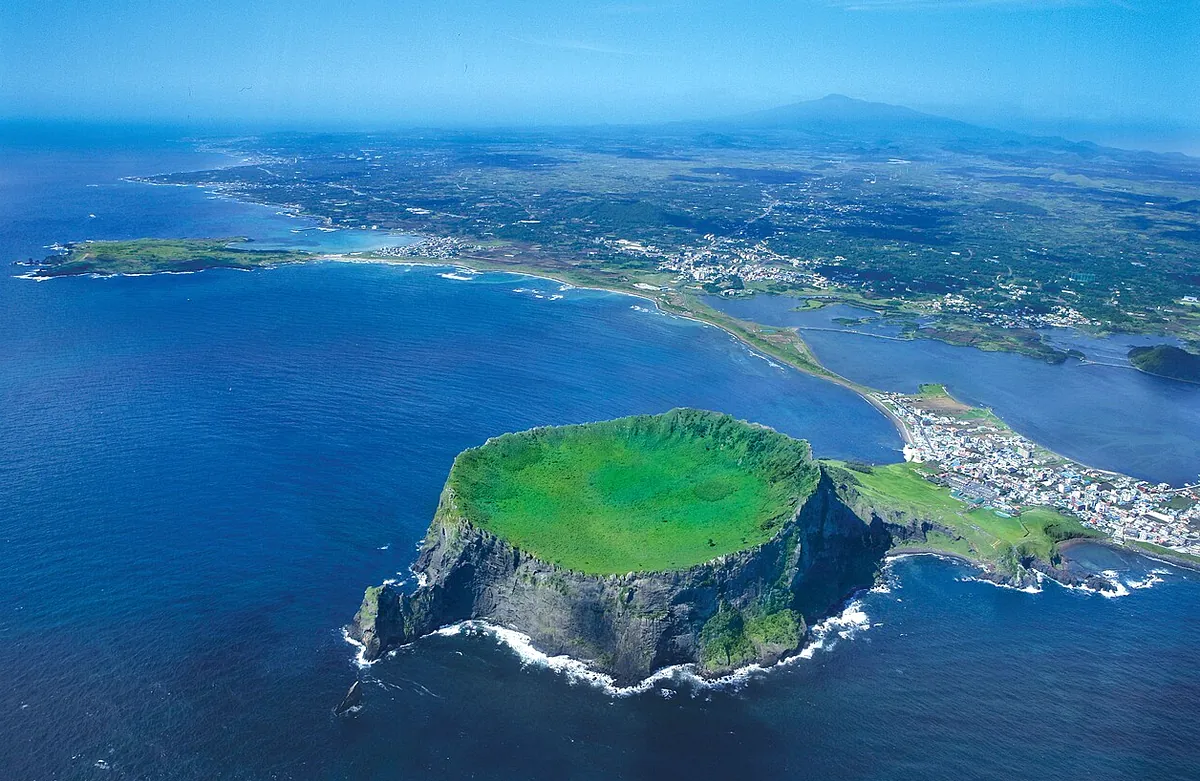
The topography of Seongsan Ilchulbong achieves the rare textbook perfection of a tuff cone born from explosive phreatomagmatic eruptions when molten magma met frigid seawater. Its broad, bowl-shaped summit crater resembles a giant emerald basin ringed by ninety-nine sharp basalt pinnacles thrusting straight into the azure sky. These jagged rock spires give the mountain the unmistakable silhouette of an ancient coastal citadel—the very inspiration behind its Sino-Korean name, Seongsan Ilchulbong (Fortress Mountain Sunrise Peak). The sheltered, sunken crater floor fosters a distinct micro-ecosystem where lush grassland thrives in vivid contrast to the rugged, layered pyroclastic cliffs plunging into the surf along its outer flanks.
Within Jeju’s broader coastal landscape, the peak serves as the visual centerpiece of the windswept Eastern Coastal Highway. This scenic corridor links a string of celebrated landmarks, beginning at the gentle white sands of Hamdeok Seoubong Beach, gazing across the channel toward Udo Island—shaped like a reclining cow resting peacefully amid the waves—before converging dramatically at the monolithic cone of Seongsan and tapering southward toward the windswept meadows and quiet coastal promontory of Seopjikoji. This coastal corridor not only showcases the dramatic evolution of volcanic landforms across successive eruptions, but forms a harmonious ecological ribbon uniting sky, sea, and traditional island architecture.
Above all, the geological and geomantic grandeur of Seongsan Ilchulbong shines brightest along the heritage footpath of the Jeju Olle Trail—Route 1, a 15-kilometer walk starting in Siheung through peaceful rural lanes before culminating triumphantly at Gwangchigi Beach. Gwangchigi’s shoreline is widely hailed by geographers and travelers alike as the single finest vantage point, where moss-draped volcanic lava flats emerge at low tide. When the sea turns mirror-calm, the entire imposing silhouette of Seongsan Ilchulbong’s natural fortress reflects flawlessly upon the crystal-clear water, creating a sublime tableau where sacred mountain energy meets timeless natural beauty.
Seen from above or from vessels cruising off eastern Jeju, Seongsan Ilchulbong rises like a colossal basalt fortress presiding defiantly over open ocean swells. Sculpted by shallow-water hydrovolcanic eruptions, the crater bowl spans roughly 80,000 square meters. Sunken like an ancient open-air amphitheater, the crater is ringed by 99 razor-sharp rock spires pointing toward the turquoise sky like the ceremonial crown of a sovereign sea deity. The deep basin floor stays carpeted year-round in lush greenery, where silver grass, reeds, and temperate coastal flora root deeply into mineral-rich volcanic ash, enduring salty ocean gales across all four seasons.
To balance strict World Natural Heritage conservation with access for millions of visitors, the summit trail is thoughtfully engineered as a single closed-loop staircase spanning roughly one kilometer. Built from porous native black basalt blocks paired seamlessly with salt-resistant natural timber boardwalks, the steep path climbs at an average gradient of around 30 degrees along the sheer tuff wall, requiring 50 to 60 minutes for a complete round-trip ascent and descent. Stone steps wind past hardy coastal shrubs, maples, agaves, and ancient ferns clinging to damp rock crevices, opening onto scenic overlooks tucked discreetly behind natural cliff ledges jutting over the abyss.
Beyond its sheer geomorphological beauty, the rugged coastline preserves poignant reminders of modern wartime history. Hidden right at the base of the vertical cliffs along the waterline lies a network of 24 man-made caverns hollowed into solid basalt. Conscripted local laborers were forced by the Imperial Japanese military to excavate these secret bunkers during the closing stages of World War II to shelter ambush craft and explosive suicide boats against aanticipated Allied amphibious landings. Today, these dark, moss-covered archways echoing with crashing surf stand as sobering historical witnesses adding reflective depth to the sunlit majesty of Sunrise Peak.
Contrasting with the somber stillness of those wartime caves, the gentle coastal plain at the western foot of the peak hosts the vibrant Haenyeo Cultural Village, a living heart of Jeju’s maritime heritage. Here, live coastal demonstrations and a cultural interpretive center invite visitors into the authentic daily world of Jeju’s legendary women divers. Travelers can watch Haenyeo mothers and grandmothers in traditional diving gear plunge effortlessly into frigid waters without breathing apparatus, surfacing with freshly harvested abalone, sea snails, and sea cucumbers. Adjacent to the heritage cove stands a modern geological interpretive center utilizing augmented reality to visualize the explosive magma-seawater eruptions of millennia past—turning a scenic hike into an unforgettable encyclopedic encounter with nature and human resilience.
When night settles over eastern Jeju, Seongsan Ilchulbong stands like a monumental stone sentinel guarding the ocean gate, quietly absorbing deep swells where the Sea of Japan meets the East China Sea. After dark, the foot of the volcano settles into dramatic contrast between the velvety shadow of the primeval tuff cone and the shimmering Milky Way arching over the waves. Far out on the horizon, fleets of night squid-fishing boats illuminate the sea with glowing fishing lamps (Eohwa), turning the distant water into a constellation of floating light. Here, nocturnal illumination stems not from artificial laser shows, but from the timeless harmony between centuries-old island livelihoods and the cosmos above.
The most sacred moment transforming Sunrise Peak into a supreme visual sanctuary arrives at dawn, when first light pierces the indigo veil of night. Since dynastic times, the spectacle of the sun rising out of the ocean horizon to bathe ancient tuff cliffs in rose-gold light has been celebrated by scholars as “Seongsan Ilchul” (Sunrise at Fortress Mountain)—ranked first among the “Yeongju Sipgyeong” (Ten Scenic Wonders of Jeju). As morning rays sweep across the vast crater rim crowned by ninety-nine jagged spires, the grassy basin ignites with a luminous golden halo. Nature’s optical symphony dissolves every boundary between deep sea, sky, and ancient fortress walls in the pure vitality of daybreak.
Right beneath those millennia-old sedimentary cliffs, where gentle waves lap against a sheltered cove, an extraordinary living cultural performance unfolds in the morning light: the daily harvest of the Haenyeo (women divers). Inscribed on UNESCO’s Representative List of the Intangible Cultural Heritage of Humanity, the freediving mastery and maritime way of life of Jeju’s women form the living soul of Seongsan. Beneath shimmering emerald water reflecting early sunlight, resilient women in dark wetsuits—carrying buoyant tewak floats and woven mangsak nets—wade steadily into the open sea without oxygen tanks.
Each deep dive onto rocky reefs to gather abalone, sea cucumbers, and wild seaweed becomes an instinctive, proud display of human endurance. The moment these Haenyeo mothers and elders break the surface and emit the haunting “Sumbisori” whistle—a distinctive high-pitched exhalation echoing like a sea flute off basalt cliffs—resonates as an anthem to human grit against the vastness of the ocean. Held daily along the volcanic cove below the peak, these authentic demonstrations remain unscripted and raw, preserving the true spirit of a living heritage. Together, the natural light show of Yeongju’s foremost scenic wonder and the heroic maritime culture of Jeju’s daughters make Seongsan Ilchulbong an enduring cultural crossroads where every beam of light carries tens of thousands of years of story.
Experiencing the true soul of Sunrise Peak extends beyond the first rays of dawn over its volcanic crater into a deeply rooted culinary heritage shaped by centuries of oceanic isolation. Confronted for millennia by salt-laden gales and rugged basalt soil, communities around Seongsan Ilchulbong forged a distinctive gastronomic philosophy: honoring the pure essence of local ingredients with minimal seasoning, elevated to perfection through peak freshness and time-honored recipes passed down across generations.
Reigning supreme on the local table is Jeonbok-juk (abalone porridge), a pure delicacy harvested from the rocky reefs beneath the volcanic headland. Unlike ordinary seafood porridges, Seongsan’s Jeonbok-juk boasts a signature emerald-green hue and deeply savory richness derived from fresh abalone viscera (geut) carefully pounded, sautéed in fragrant pure sesame oil, and slow-simmered with premium white rice. Tender, crisp-chewy slices of wild abalone infused with the clean brininess of the Kuroshio Current meld into velvety steaming porridge, awakening every sense after an early-morning climb to greet the sunrise.
Stepping inland toward the gentle pastures flanking the mountain slopes, diners encounter Jeju’s famed charcoal-grilled black pork, Heuk Dwaeji Gui. Raised outdoors across mineral-rich volcanic foothills, native Jeju black pigs develop remarkably firm meat, thick skin, and crisp, clean-tasting fat that never feels heavy. As thick slabs of pork belly hit glowing hardwood charcoal grates, enticing sizzles and smoky aromas fill the air. The essential finishing touch elevating Heuk Dwaeji Gui is a bubbling metal ramekin of Meljeot (traditional fermented anchovy sauce) warmed directly on the grill with sliced garlic, red chilies, and a splash of local liquor—dipping charred, juicy pork into this savory elixir creates an unforgettable explosion of rustic coastal flavor.
Another culinary classic born from Jeju’s volcanic character is Haemul-ttukbaegi, seafood stew served in a traditional black stone pot. Hand-carved from heat-retaining volcanic stone, the cauldron arrives at the table bubbling fiercely like a miniature volcano. Inside brims a vibrant medley of sweet blue crab, tender cuttlefish, shrimp, clams, and fresh abalone brought ashore that very morning by Haenyeo divers. Simmered in a savory broth enriched with fermented soybean paste and fiery chili powder, its deep, clean sweetness instantly chases away the damp chill of Northeast Asian sea winds.
Completing a coastal feast in the shadow of Seongsan is the wholesome, earthy sweetness of Omegi-tteok. Born in an era when wet-rice paddies were scarce on Jeju’s basalt terrain, islanders crafted chewy glutinous millet dough infused with aromatic mugwort, wrapped around a rich, velvety red bean paste filling. Rolled in boiled whole red beans, toasted sesame seeds, or coarsely crushed chestnuts, a bite of Omegi-tteok paired with a warm cup of buckwheat tea as twilight settles over the bay offers a heartfelt taste of the humility, resilience, and hospitality of ancestors who built their lives beside ancient volcanic reefs.
Reaching the stone fortress of Seongsan Ilchulbong from Jeju International Airport (CJU) is effortless thanks to an efficient public transit network. Most convenient and economical are Express Bus routes 111 and 121, departing regularly from the airport arrivals terminal and crossing Jeju’s eastern plains in roughly 1 hour and 20 minutes for an affordable fare of around 3,000 KRW. For travelers who prefer driving independently, following Beonyeong-ro highway past swaying silver-grass meadows and volcanic cinder cones (Oreum) trims travel time to just 55 to 65 minutes. Approaching eastern Seogwipo, the massive crown-like silhouette of the tuff cone rises dramatically against the blue sky, heralding arrival at a rare geological wonder.
One of the greatest advantages when planning a visit to this natural World Heritage site is the special administrative status of Jeju Special Self-Governing Province. Jeju grants visa-free entry for up to 30 days to citizens of numerous countries—including travelers from Vietnam—provided they arrive via direct international flights or direct international transit into Jeju without entering mainland South Korea. However, travelers must observe this legal boundary strictly: visa-free privileges apply exclusively within Jeju Island, and visitors without a valid South Korean visa must never attempt to board ferries or domestic flights to the mainland, as doing so incurs severe immigration penalties and deportation.
Conquering the 182-meter volcanic crater rim calls for thoughtful preparation in both stamina and gear. Steep wooden stairways clinging to the basalt slopes often hold morning dew and salty sea mist, making high-traction athletic shoes or dedicated hiking footwear essential to prevent slips. Because Seongsan Ilchulbong juts directly into the open ocean, its summit experiences brisk, gusty sea winds year-round—a quality windproof jacket and light scarf are indispensable for staying warm while awaiting daybreak. Packing a compact pair of binoculars also unlocks remarkable detail, letting you trace layered pyroclastic strata along sheer sea cliffs or scan across emerald waters toward Udo (Cow Island).
To ensure your journey leaves only pure, unhurried memories, discerning travelers should steer clear of heavily discounted “zero-dollar” package tours. Such distorted itineraries often slash precious sightseeing time to herd visitors through closed-door shopping centers selling ginseng, lingzhi mushrooms, or red pine needle oil—reducing a world-class natural wonder to a rushed photo stop. Experiencing Seongsan Ilchulbong properly requires at least 2.5 to 3 unhurried hours to ascend the crater rim, pause to listen to waves crashing against volcanic ledges, and stroll down to the cove below to witness live Haenyeo freediving demonstrations. To enjoy seamless logistics without language barriers or hidden shopping detours, experienced travelers often choose a thoughtfully curated, discovery-focused all-inclusive South Korea tour package where authentic local rhythms and natural wonders always take center stage.