Cap Tien Temple is a special national historical site located in Van Don district. With a long-standing history, it is one of the main sightseeing routes in Van Don. Visiting Cap Tien Temple, travelers can admire the scenic beauty and learn about the local culture, beliefs, and history. This article will introduce you to the unique highlights and interesting legends of Cap Tien Temple.
Read more: Top 9 Most Sacred Temples and Pagodas in Quang Ninh
Location and Origin of the Name of Cap Tien Temple
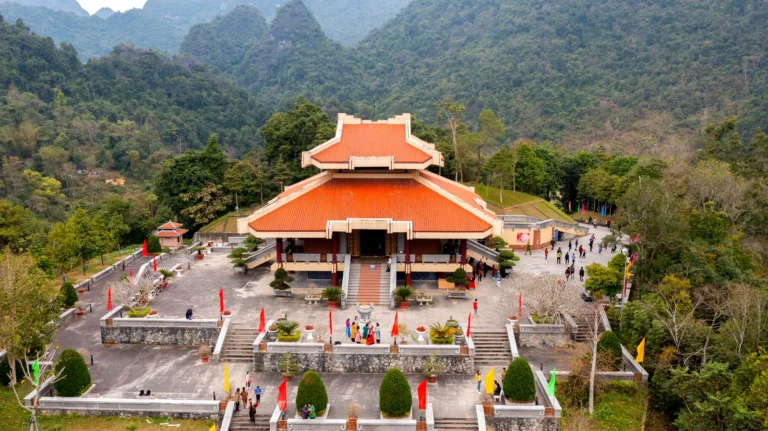
Cap Tien Temple, also known as Co Be Cua Suot Temple, is one of the temples belonging to the Cua Ong Temple relic complex, recognized as a Historical Relic in 1989. It is located right at the gateway of Van Don District in Dong Xa Commune, about 2km from Cua Ong Temple. The temple boasts a prime location with its back leaning against the fairy mountain and its face turning towards the sea of Bai Tu Long Bay, creating a peaceful, poetic, and sacred atmosphere. Today, the temple is a famous spiritual and cultural tourism destination in Van Don district, attracting many visitors to sightsee and pray.
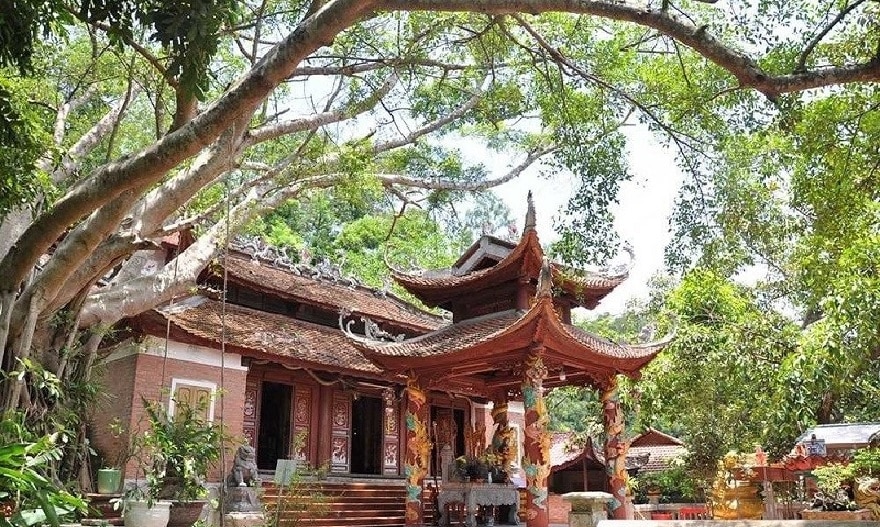
Cap Tien Temple
The temple is named Cap Tien (Fairy Pair) because legend has it that in the past, this was a land of picturesque mountains and rivers with poetic and quiet scenery. Two immortals frequently came down here to play chess and enjoy the scenery, attended by two fairy maidens. While the two immortals played chess, the two fairies often went to the foot of the mountain to play, bathe, and fetch water up the mountain to boil for the immortals’ tea. The spot where the fairies fetched water is a very small freshwater well that never dries up. The place where the fairies stood to draw water later became hollow, still bearing the prints of their footprints. The well water they used is called the “Fairy Well” because even when the tide comes in and turns salty, the well water becomes fresh again once the tide recedes. For this reason, local place names are associated with the word “fairy” (tien), such as Tien Mountain, Tien Bay, Cap Tien Village, etc. Legend also holds that Cap Tien Temple worships the daughter of Hung Nhuong Vuong Tran Quoc Tan – the naval commander who guarded the Cua Suot region, hence it is also called Co Be Cua Suot Temple.
In addition, during the Nguyen dynasty, there was a mandarin official in charge of the waterways in this area who performed many helpful deeds for the people. He also took the initiative to contribute efforts and wealth, and mobilized the people to restore and renovate the temple. To remember his virtues, after his passing, the people also worshipped him at the temple, which is why Cap Tien Temple is also known as Quan Chanh Temple.
Accreditations and Titles of Cap Tien Temple
- In 1989: Cap Tien Temple together with the Cua Ong Temple relic complex was awarded the Historical Relic certificate by the Ministry of Culture and Information (now the Ministry of Culture, Sports and Tourism).
- On August 18, 2006, the People’s Committee of Quang Ninh Province ranked Cap Tien Temple as an Architectural Art and Scenic Relic.
- On December 25, 2017, along with the Cua Ong Temple Relic (Cam Pha City), Cap Tien Temple was designated as a Special National Relic by decision of the Prime Minister.
Architecture of Cap Tien Temple
The road leading to Cap Tien Temple is designed with 2 lanes and paved solidly with concrete. Along the way, visitors can experience the charming landscape here, with towering cliffs on one side and the blue sea dotted with undulating islands on the other.
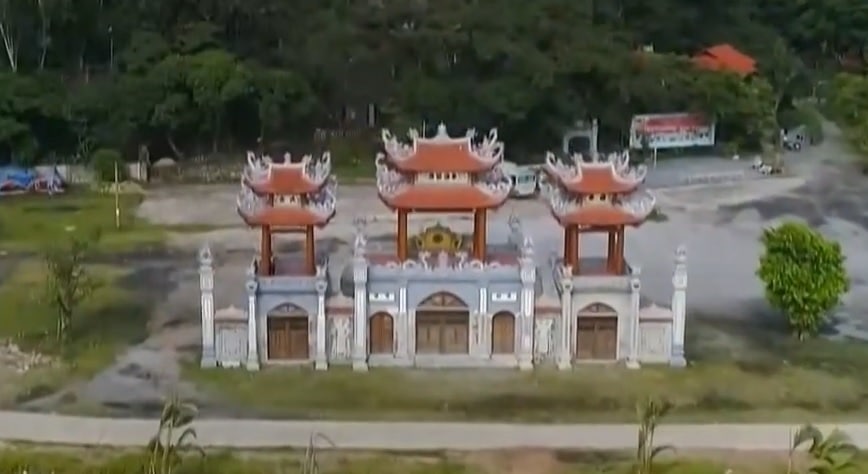
Cap Tien Temple Three-Arch Gate
The initial impressions of Cap Tien Temple for many visitors are a temple hidden beneath ancient tree canopies, a curved bridge, and a majestic three-arch gate defying the waves of the open sea. Regarding the scenery of Cap Tien Temple, folklore has captured its beauty in verse:
“As dusk falls upon Cap Tien wharf
The dragon boat moors to draw water from the fairy well”
Cap Tien Temple was originally built a long time ago. During the Tran Dynasty, its spiritual development shifted slightly compared to earlier periods, and it experienced its strongest growth during the Nguyen Dynasty. The temple was rebuilt in 1996 and assigned by the provincial People’s Committee to the management of Van Don district, directly under the communal People’s Committee. In 2006, the temple underwent a complete restoration into three main structures: the front ceremonial hall (tien duong), the central sanctuary (chung tu), and the rear sanctuary (hau cung), covering a total area of 360 m2.
Over time, the old temple suffered significant damage. It was rebuilt in 1996 and meticulously restored in 2006 to become spacious and airy while retaining the fundamental architectural features of a traditional structure. Today, the temple complex consists of three main structures: the Main Temple, Son Trang Cave, and the Fairy Well (Gieng Tien).
1. Main Temple
Facing Northeast, the temple is designed in the shape of the Chinese character “Dinh” (T-shape), consisting of a front ceremonial hall and a rear sanctuary with a total area of 102m2. The roof truss architecture of the front hall follows the “chong ruong con nhi” style, with door pillars made of Tau wood. Horizontal lacquered boards (hoanh phi) and parallel couplets (cau doi) are hung across the trusses and pillars. A square ceremonial pavilion (phuong dinh) stands in the courtyard, featuring a double-tiered, eight-roof structure covered with scale-like tiles and leaf-shaped ridge tiles. Inside the pavilion sits a large bronze communal incense burner.
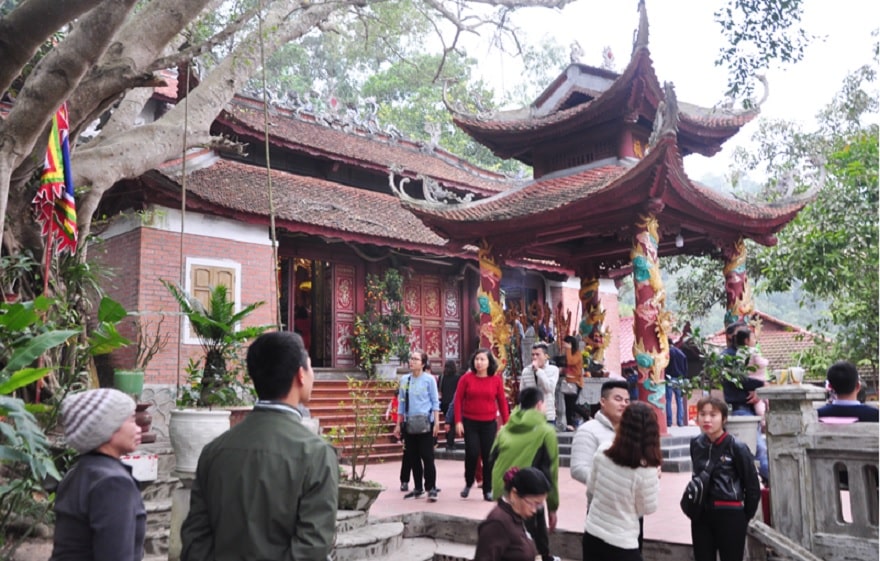
Cap Tien Main Temple area
- The first bay of the main hall enshrines the young princess of Cửa Suốt, holding the religious title “Tien Co Cua Suot”.
- The second bay enshrines Dong Hai Dai Vuong (The Great King of the East Sea), with the right side dedicated to the Five Supreme Lords (Ngu Vi Ton Ong) and the Four Palaces Mandarins (Tu Phu Quan Hoang), and the left side dedicated to Mother Goddess Chau Ba.
- The inner sanctum (cung cam) enshrines the Holy Mother of the Three Realms (Tam Toa Thanh Mau).
2. Son Trang Cave

Son Trang Cave
Located facing the Northeast within the cave, the worship statues are harmoniously arranged throughout the rear sanctuary space, including Mother Goddess of the Upper Mountains (Mau De Nhi Thuong Ngan), the two Royal Ladies, and the 12 Son Trang Maidens. The cave is divided into two sections like the temple’s architecture: the flat outer area is used for rituals, while the inner area features sculpted rock formations and statues. Above the partition wall between the ritual area and the cave sanctuary hangs a scroll-shaped horizontal board inscribed with four Chinese characters meaning “Cong Dong Son Trang”. Statues are placed throughout the rear sanctuary within the cave, including Mother Goddess De Nhi Thuong Ngan, the two Royal Ladies, the 12 Son Trang Maidens, and two statues of the Young Princes (Cau) on either side. In the center of the cave hangs a scroll-styled horizontal board inscribed with four characters “Nu Dong Son Trang”. To honor the merits of the female general associated with the temple, people composed the following parallel couplets:
“Thích thị vệ cung kim tự miếu
Sinh vị nữ quốc tử vi thần”
The couplet translates to: In life, she served as a female general; in death, she became a divine deity saving sentient beings, worshipped at the ancient Cap Tien temple.
3. Fairy Well (Giếng Tiên)
This is a freshwater well located right on the seashore. A special feature of the Fairy Well is that when the tide rises and submerges the well in saltwater, the water immediately turns fresh again. The well never dries up year-round, which is why locals and fishermen deeply cherish it.
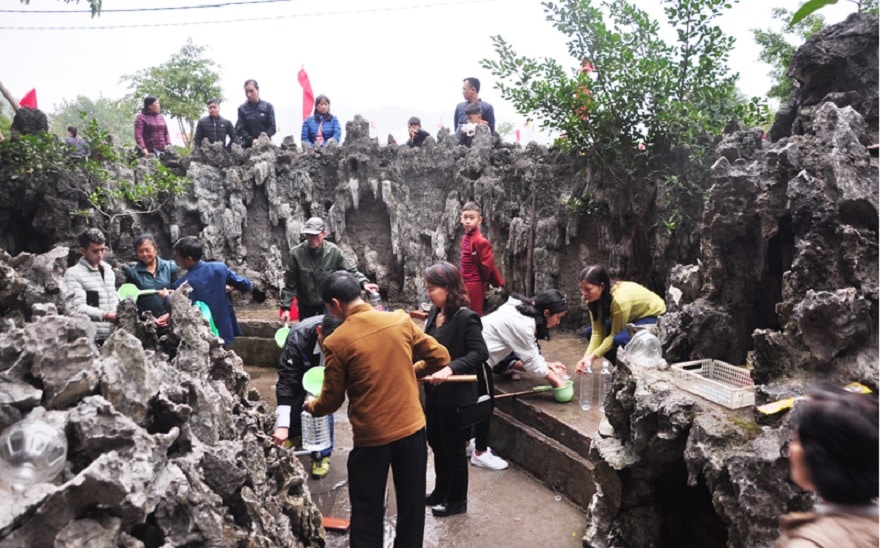
Fairy Well area
According to Mr. Pham Thang Loi, deputy head of the Cap Tien Temple management board, the Fairy Well provides warm water in the winter and cool water in the summer. The drier the weather, the cooler the water becomes. Although the hill above the temple is barren without large trees, it inexplicably possesses an endless source of fresh water.
Cap Tien Temple is not only a scenic heritage site but also holds immense historical significance. It is a place that preserves and maintains the nation’s long-standing cultural traditions. The temple is also a prominent stop on the Van Don tourism itinerary, integrated into the district’s distinctive tourism network, attracting a large number of visitors from all over the country.