Nestled quietly at the foot of Mount Kinugasa in Kita Ward, northern Kyoto, the famed Golden Pavilion of Kinkaku-ji—written in kanji as 金閣寺—has long stood as a proud emblem of Japanese aesthetics and spiritual depth. Though the world knows this sanctuary by the dazzling gold shimmer reflected across the Mirror Pond, its official monastic name is Rokuon-ji (鹿苑寺, Deer Garden Temple). The history of this ancient temple is far more than the story of a single religious monument; it is a multi-layered chronicle capturing the convergence of supreme power, the zenith of medieval artistry, and the cyclical nature of creation and destruction that seems to shadow absolute beauty.
Tracing history back to the fourteenth century, the precursor to this sacred precinct was not a Zen Buddhist temple at all, but a lavish mountain villa called Kitayama-dai owned by Saionji Kintsune, one of the most powerful court nobles of his era. As the Saionji clan’s fortunes waned, the estate caught the eye of Ashikaga Yoshimitsu, the third shogun of the Muromachi shogunate—an extraordinary leader who unified the Northern and Southern Courts and elevated shogunal authority to its highest peak. In 1397, Yoshimitsu formally acquired the entire estate, redesigning and expanding it into a magnificent palace complex that served as both a seat of political power and the birthplace of the brilliant Kitayama Culture—a golden age witnessing the seamless fusion of aristocratic court refinement in Kyoto with the disciplined, bold spirit of the samurai class.
Under Yoshimitsu’s patronage, the three-story gold-leafed reliquary pavilion was erected amidst picturesque mountains and water, serving not only for Buddhist veneration but also for receiving foreign envoys, poets, and scholars. However, this golden era tied to secular authority drew to a close upon the great shogun’s death in 1408. Honoring Yoshimitsu’s final wishes, his son Ashikaga Yoshimochi converted the entire villa complex into a solemn Zen monastery belonging to the Rinzai school. The name Rokuon-ji was formally bestowed at this time, derived from the late shogun’s posthumous Buddhist title, Rokuon-in-den, while evoking Deer Park (Sarnath)—the sacred site where the Historical Buddha first turned the Wheel of Dharma.
Enduring centuries of upheaval—resiliently surviving the fierce conflicts of the Warring States period and the devastating fires of the Ōnin War—this priceless heritage unexpectedly faced its most tragic ordeal in the twentieth century. At dawn on July 2, 1950, all of Japan was shocked by news that the original three-story Golden Pavilion—a National Treasure standing for over five and a half centuries—had been completely reduced to ashes. The arsonist was none other than Hayashi Yōken, a 21-year-old novice monk tormented by depression and a fanatical obsession with the pavilion’s absolute beauty. This devastating fire not only destroyed an ancient architectural masterpiece but also sparked profound philosophical reflection on desire and destruction, directly inspiring literary giant Yukio Mishima to pen his immortal novel The Temple of the Golden Pavilion.
Yet from those desolate ashes, the undying spirit of traditional Japanese craftsmanship brought about a miraculous rebirth. An exact reconstruction faithful to original Muromachi-period blueprints was completed in 1955, followed by a major restoration in 1987. During this historic refurbishment, master artisans coated the upper two tiers of the pavilion with approximately 20 kilograms of pure gold leaf, beaten to a remarkable thinness of just 0.1 micrometers using traditional lacquerware methods and renowned Kanazawa hand-gilding techniques. Through this extraordinary conservation effort, Kinkaku-ji’s transcendent splendor was restored in full. In 1994, the temple was inscribed by UNESCO on the World Heritage List as an essential component of the Historic Monuments of Ancient Kyoto, enduring as an eternal witness to history’s vicissitudes and the miraculous resilience of human civilization.
Situated along the gentle slopes of Kyoto’s Kitayama district, Kinkaku-ji channels the full flow of auspicious energy according to traditional Japanese geomancy. At the height of Muromachi shogunal power, Shogun Ashikaga Yoshimitsu selected this favored parcel to build his Kitayama-den retreat, utilizing Mount Kinugasa behind it as a protective rear anchor. The master layout strictly honors the principle of backing onto mountains while facing water, transforming gentle hillsides into natural screens that shield the tranquil Zen sanctuary from the worldly clamor of ancient Heian-kyō. This distinctive topography not only elevates the stately, ethereal presence of the reliquary hall but also makes full use of shakkei (“borrowed scenery”), deftly incorporating the rolling forested ridges of Kitayama as an expansive backdrop that dissolves the boundary between human architecture and untamed nature.
At the center regulating the entire spatial composition and vital energy of the sanctuary is Kyōko-chi—literally the Mirror Pond—an expansive artificial lake stretching directly before the gleaming three-story pavilion. Acting as a colossal mirror capturing natural light, the crystal-clear water produces the mesmerizing optical phenomenon known as Sakasa-Kinkaku—the inverted reflection of the Golden Pavilion shimmering beneath the surface. The stillness of the water softens the visual weight of the gilded edifice while creating multi-layered spiritual depth between reality and illusion. Whenever a passing breeze ripples the surface, the reflected pagoda shatters into thousands of glittering fragments before gradually coalescing whole once more—a poignant visual meditation on impermanence and stillness in Buddhist aesthetics.
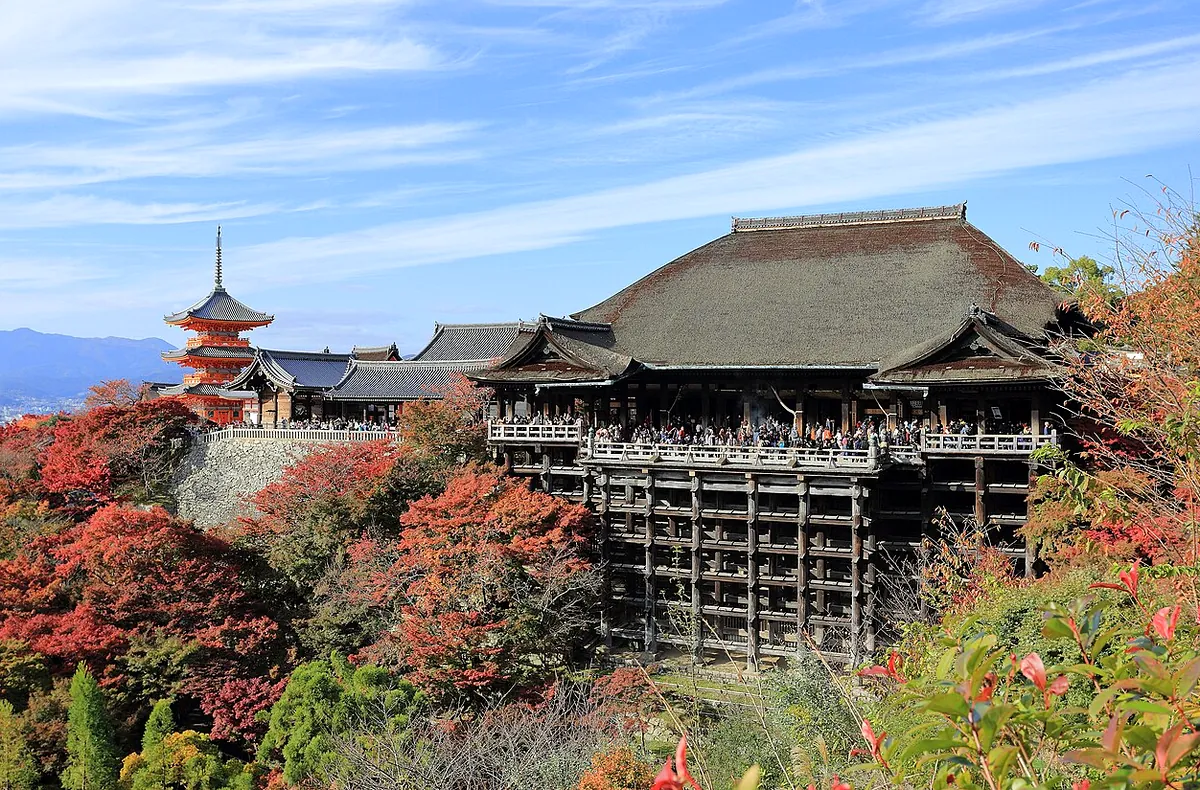
Surrounding the pond is a classic Pure Land-style strolling garden representing the zenith of Muromachi-era landscape design. This school deliberately recreates Amida Buddha’s Western Paradise on earth through the curated arrangement of stones, sculpted trees, and water. Dotting the expanse of Kyōko-chi are rock islets shaped like turtles and cranes—traditional symbols of longevity and immortality—alongside the larger Ashihara-jima Island, symbolizing the mythical origins of Japan. The monumental boulders forming these islets were rare tributes presented to Shogun Yoshimitsu by regional feudal lords, most notably the jagged Hosokawa-seki stone, positioned carefully at convective angles to guide water currents and concentrate spiritual energy throughout the grounds.
The botanical ecosystem at Kinkaku-ji is meticulously curated to complement a Zen ethos that is at once minimalist and opulent. Centuries-old red and black pines are pruned by master gardeners into sinuous dragon forms leaning gracefully toward the water’s edge to shelter moss-covered stones. The landscape transforms subtly with all four seasons: pale pink cherry blossoms drifting across the pond in spring, lush emerald moss glistening with morning dew in summer, fiery crimson momiji maple leaves contrasting against regal gold in autumn, and pure white snow blanketing the curved roofs when winter arrives. Every turn and white-gravel pathway winding around the Kitayama slopes is choreographed as an emotional sequence leading into a timeless realm of nature and stillness.
Standing proudly along the edge of Kyōko-chi Mirror Pond, the three-story Kinkaku Pavilion rises like a gilded mirage suspended on the threshold between earthly reality and the Pure Land. Far more than an isolated religious structure, it serves as the ultimate aesthetic manifesto of Kitayama Culture under Shogun Ashikaga Yoshimitsu. What continually astonishes architectural scholars worldwide is its bold eclecticism: seamlessly uniting three distinct historical architectural styles along a single vertical axis. Each story shifts not only in structural form but also carries its own philosophical and political dimension, creating a flawless, harmonious whole set against the breathtaking scenery of the ancient capital.
The ground floor, named Hōsui-in (Chamber of Dharma Waters), is built in the Shinden-zukuri palace style characteristic of Heian-period court nobility. Rather than displaying opulent gold, the first tier celebrates natural simplicity through unpainted cypress pillars, crisp white plaster walls, and an open structure featuring broad verandas extending right over the water. Hinged wooden lattice shutters (shitomi-do) allow the interior to merge seamlessly with Kyōko-chi Pond, making morning mist and gentle ripples an integral part of the room. Once used for refined receptions and poetry gatherings, this level enshrines statues of Shakyamuni Buddha alongside an effigy of Shogun Yoshimitsu—an enduring symbol of imperial aristocracy deeply rooted in Japanese culture.
Ascending to the second floor, the architectural rhythm shifts decisively to the Buke-zukuri (warrior residence) style in a chamber named Chō-on-dō (Grotto of the Sound of Waves). Representing the residential aesthetic of the samurai class that rose to prominence during the Kamakura period, it embodies martial fortitude, discipline, and military authority ascending to govern the nation. The exterior walls of Chō-on-dō are completely sheathed in gleaming pure gold leaf, creating a dramatic contrast with the understated ground level below. Behind gilded sliding doors sit statues of Kannon Bodhisattva flanked by the Four Heavenly Kings. Gilding this floor not only proclaimed the shogunate’s unmatched wealth, but also symbolized martial spirit bowing in reverence before Buddhist compassion.
Crowning the pinnacle is Kyūkyō-chō (Cupola of the Ultimate), a sanctuary designed purely in the Chinese Zen temple style (Zenshū-butsuden) introduced during the Song and Yuan dynasties. Distinct from the two lower levels, Kyūkyō-chō features graceful bell-shaped arched windows (katō-mado), crisp square proportions, and an atmosphere of absolute tranquility dedicated to seated meditation. Both the exterior and interior of the third tier are richly gilded from floor to ceiling, evoking the Western Pure Land and the supreme realization of Buddhist enlightenment. Perched majestically atop the steep shingled roof is a bronze phoenix (Hō-ō) plated in pure gold, spreading its wings proudly toward all four directions as an eternal guardian watching over the realm and the passage of time.
Preserving this radiant beauty against wind and weather demands extraordinary craftsmanship and exacting conservation standards. During the landmark 1987 restoration, the entire exterior structure from the second to third stories was stripped and recoated with five layers of traditional Urushi lacquer extracted from natural tree sap, serving as both adhesive and timeless armor against moisture and decay. Master goldsmiths from Kanazawa applied a total of 20 kilograms of pure gold leaf across the exterior surfaces. Rolled to roughly twice the historical thickness—reaching about 0.1 micrometers—this gold leaf reflects sunlight with a deep, warm luminosity that no modern industrial process can replicate. The union of tens of thousands of hand-applied gold leaves with nail-free traditional wood joinery makes Kinkaku-ji a priceless architectural treasure where earthly power and spiritual aspiration merge into an eternal halo in the heart of Kyoto.
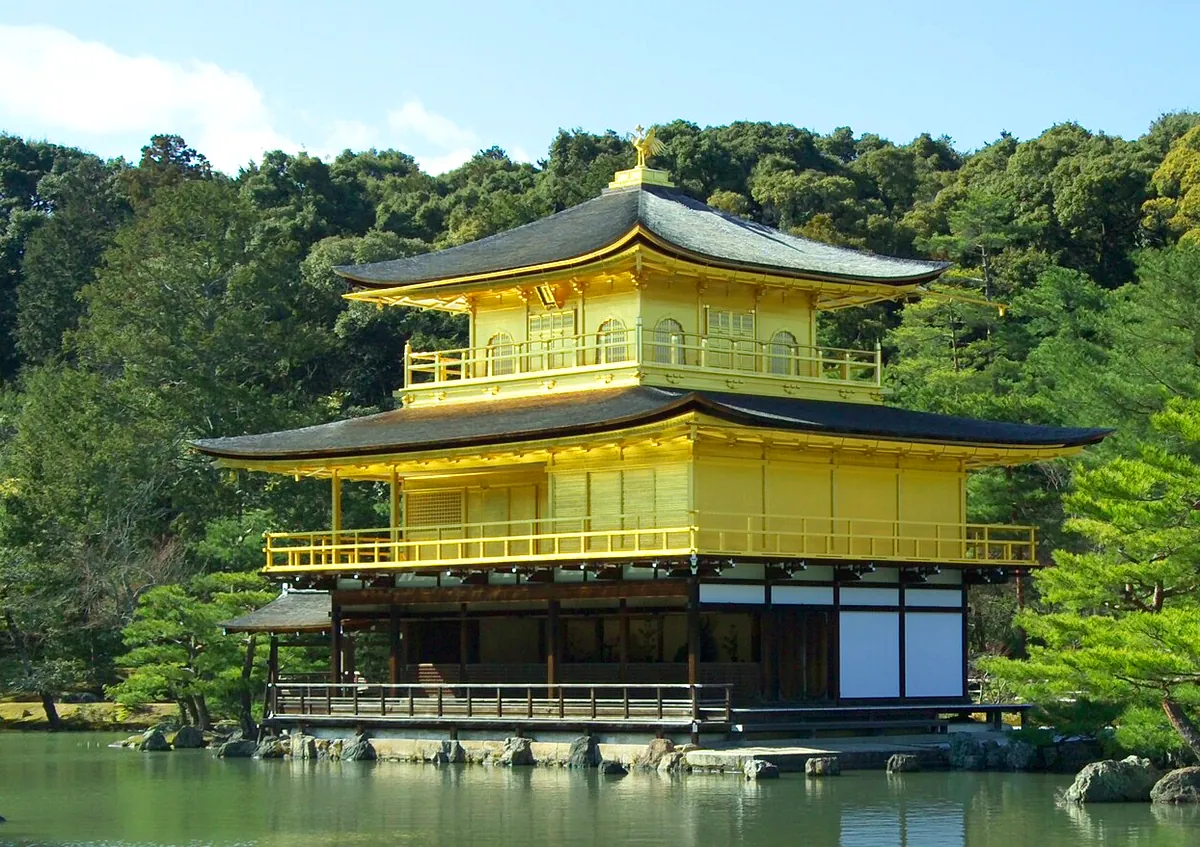
Unlike commercialized entertainment complexes or major attractions that rely on 3D projection mapping to draw crowds, Kinkaku-ji steadfastly preserves its authenticity as a solemn Zen training monastery. Affiliated with the prestigious Shōkoku-ji branch of the Rinzai school, this historic temple never stages loud evening spectacles or installs high-powered nighttime floodlights. Heritage administrators and resident monks firmly reject artificial lighting effects within the sacred precinct to safeguard monastic dignity and the absolute stillness of the heritage forest around Mount Kinugasa. As soon as the heavy timber gates close at 5:00 PM following final admission at 4:30 PM, Kinkaku-ji retreats into serene darkness, returning the grounds to rustling mountain winds and the measured chimes of monastic bells.
Even without the artificial glare of modern nightlife, Kinkaku-ji stages an unmatched “natural performance” woven by the shifting light of sky and sun. Lighting artistry here is defined by the day’s golden hours: early morning right when the temple gates open at 9:00 AM, or late afternoon between 3:30 PM and 4:30 PM. During these windows, low-angled sunlight strikes directly across the pure gold leaf sheathing the upper two stories of the reliquary—Chō-on-dō in warrior Buke-zukuri style and Kyūkyō-chō in Zen temple architecture. Sunlight ignites a brilliant spectrum that transforms the entire pavilion into a luminous jewel box, reflected in full across the tranquil 6,000-square-meter expanse of Kyōko-chi Mirror Pond.
This enchanting visual resonance is further elevated by Muromachi-period garden artistry. Clusters of prized stones gifted to Shogun Ashikaga Yoshimitsu by feudal daimyō, paired with Ashihara-jima Island modeled after the Japanese archipelago, act as focal points amidst the clear water. Under the slanting rays of late afternoon sun, ancient pines cast elongated shadows while gentle ripples shimmer like scattered flakes of gold—creating a breathtaking contrast between earthly golden brilliance and the ephemeral, illusory nature of its reflection below. It is a living embodiment of yūgen—profound, subtle grace—in classical Japanese culture, where supreme beauty touches silent awakening in a way no modern stagecraft could ever reproduce.
Once dusk settles completely and Kinkaku-ji withdraws into nocturnal solitude, travelers eager to experience evening culture in northern Kyoto can stroll south toward the historic Nishijin district nearby. Far removed from the neon bustle of big-city nightlife, evening life here unfolds quietly through warm golden light glowing behind wooden kōshi lattice windows of traditional machiya townhouses. Beneath silk chōchin lanterns swaying gently in hillside breezes, the rhythmic clatter of wooden shuttles from centuries-old Nishijin-ori brocade weaving workshops still echoes softly down flagstone alleys—a nostalgic, refined, and contemplative evening cadence that serves as the perfect epilogue to beholding Rokuon-ji bathed in sunset gold.
Beneath the tranquil shade of northern Kyoto’s pine forests, a pilgrimage to Kinkaku-ji extends beyond gazing at golden splendor reflected in Kyōko-chi Pond into a deeply contemplative culinary journey. For centuries, dining around northern Kyoto has been intertwined with the Zen traditions of the Muromachi period, where gastronomy sought not the lavish extravagance of imperial banquets, but a return to pure simplicity through pristine local seasonal ingredients.
The pinnacle of this serene culinary philosophy is Shōjin Ryōri, traditional Zen Buddhist vegetarian cuisine rooted in monastic precepts. Strictly upholding compassion and non-violence toward all living beings, Shōjin Ryōri excludes all meat and fish as well as the five pungent roots—such as garlic, onions, and scallions—believed to excite the senses. Instead, skilled chefs elevate Kyoto’s seasonal harvest into culinary art using silky tofu, toasted sesame seeds, sun-dried shiitake mushrooms, and prized heirloom Kyō-yasai vegetables. A classic Shōjin-zen meal follows the principles of five cooking methods, five colors, and five flavors—harmonizing sour, spicy, salty, sweet, and bitter notes to awaken every sense while keeping the mind calm and centered.
To experience traditional Zen cuisine at its finest, travelers often take a leisurely ten-minute walk from the Golden Pavilion’s gates to the quiet grounds of Daitoku-ji Temple, where the celebrated teahouse restaurant Izusen sits tucked peacefully amid greenery. Preserving authentic recipes across generations, Izusen serves guests using vermilion lacquerware bowls known as Teppatsu, modeled after monks’ alms bowls. Nested neatly one inside another, the bowls open to reveal a miniature portrait of all four seasons—from tender pumpkin simmered in fragrant dashi and glossy rolled yuba tofu skin to delicate white miso soup accented with grated daikon radish.
Alongside Shōjin Ryōri, Yudōfu—simmered tofu in pure spring water—stands as an inseparable culinary pillar of the ancient capital. Kyoto’s legendary tofu quality stems from the ancient subterranean aquifer flowing beneath the Kyoto basin, prized for its ideal softness and pure mineral balance. Blocks of silky kinugoshi tofu are gently simmered in a clay earthenware pot lined with northern kombu kelp to release natural umami sweetness. Using a bamboo ladle, diners lift piping-hot cubes of tofu and dip them lightly into dashi soy sauce brightened with citrusy ponzu, freshly grated ginger, and thinly sliced scallions—savoring a melt-in-your-mouth texture and pure soybean richness.
Concluding a serene visit, travelers frequently pause at rustic wooden teahouses nestled near Kinkaku-ji’s exit to experience refined Kyōgashi confectionery. Miniature wagashi sweets sculpted like delicate jewels shift motifs with the changing seasons—a shy cherry blossom in spring, a crimson maple leaf in autumn, or a fragile snowflake in early winter. The gentle sweetness of hand-cooked azuki red bean paste and fine wasanbon sugar pairs exquisitely with a bowl of freshly whisked matcha. Using a bamboo chasen whisk, the tea master whips stone-ground Uji matcha into a velvety jade froth whose initial pleasant astringency gives way to a lingering, sweet finish—leaving travelers with the pure, lasting impression of a thousand-year-old Buddhist sanctuary.
To experience the transcendent beauty of Rokuon-ji without being swept into bustling crowds, thoughtful timing and itinerary planning are essential. The temple gates open daily from 9:00 AM to 5:00 PM year-round, regardless of winter snow or summer sun. The finest moments to hear wind chimes and admire golden reflections dancing across the pond are right at opening in the morning—when early mist still clings to centuries-old bonsai pines—or late afternoon as setting sunbeams paint the clouds crimson and bathe the 24-karat gold leaf in warm twilight radiance. Visiting during these shoulder hours avoids visual and auditory crowding from large tour groups, preserving quiet space to commune with unique Kitayama architecture.
Getting to Kinkaku-ji is straightforward via Kyoto’s well-organized transit network, though knowing the right routes helps ensure a smooth ride. Departing from Kyoto Station—the city’s central transit hub—the most popular and scenic option is boarding Kyoto City Bus routes 205 or 101 for a leisurely 40-to-45-minute ride along historic avenues. Single rides cost a flat 230 JPY; however, travelers planning to visit nearby landmarks such as Ryōan-ji’s famous rock garden or Nijō Castle will find the 1,100 JPY Subway & Bus One-Day Pass far more economical and flexible. For greater privacy and speed, a taxi heading north along Nishiōji-dōri reaches the temple gate in 25 to 30 minutes, with standard fares ranging from 3,000 to 4,500 JPY depending on traffic.
Stepping across the temple threshold, visitors should remember that Kinkaku-ji is first and foremost an active, revered Zen monastery affiliated with Shōkoku-ji of the Rinzai school, rather than merely a tourist attraction. Heritage authorities enforce strict conservation rules to protect this National Treasure: drones and unmanned aerial vehicles are strictly prohibited across the entire airspace to prevent collisions with the delicate gold leaf of the Reliquary Hall; smoking is banned throughout every corner of the gardens; and visitors must never touch traditional Urushi lacquered woodwork or step beyond the iconic Kinkaku-ji-gaki bamboo fences. Loud noise or blocking narrow garden pathways for photos runs counter to the contemplative spirit surrounding Kyōko-chi Mirror Pond.
In the travel market, discerning visitors should also evaluate itineraries carefully to avoid cut-rate tours that diminish the experience. Bargain packages often slash time at the Golden Pavilion to under thirty rushed minutes of quick snapshots before herding travelers into commissioned duty-free shops to subsidize tour costs. To truly appreciate wabi-sabi aesthetics and the remarkable architectural synthesis of Shinden-zukuri, Buke-zukuri, and Zenshū-butsuden styles, choosing a curated, non-commercial “No-Shopping” cultural itinerary is essential. A genuinely enriching visit allocates at least two unhurried hours inside the gardens—allowing time to savor frothy matcha at Sekkatei Teahouse and absorb the timeless philosophy of impermanence left by past masters.
When every detail is thoughtfully arranged—from navigating bus routes and observing monastic etiquette to choosing an unhurried, culturally respectful itinerary—an encounter with the Golden Pavilion transcends ordinary sightseeing to become an uplifting moment for the soul. To experience the ancient capital with ease and depth, travelers can explore an all-inclusive Japan tour package carefully curated to honor enduring heritage and the timeless beauty of Japan.