Amidst the majestic Central Highlands jungle, where the legendary Serepok River splits into roaring currents rushing over ancient basalt rapids, lies an extraordinary destination steeped in time and myth: Buon Don. From a historical-geographical perspective, this land is not tucked inside the bustling urban core of Buon Ma Thuot, but rather sits as an independent outlying subregion in the lower reaches of the Serepok River, possessing a geopolitical and cultural space of cross-border significance. The terrain of Buon Don is a masterpiece bestowed by nature, where the mother river divides into two branches embracing a lush, crescent-shaped alluvial strip, creating a rare “converging dragons” feng shui formation known in the native M’nong and Ede dialects as Buon Dret, or Buon Don—meaning “Island Village.” This unique geological structure transformed the area into a sturdy natural fortress, as well as a strategic stopover along a vital trade corridor connecting the highlands with neighboring Indochinese nations for centuries.
Looking back through historical records, Buon Don once stood beyond the reach of the central imperial administration of Dai Viet throughout the Early Le, Revival Le, and Tay Son dynasties, existing as an untamed autonomous region ruled by powerful indigenous chieftains. It was not until the first half of the 19th century, under the Nguyen Dynasty (from the reigns of Minh Mang to Tu Duc), that the name Buon Don officially entered the chronicles via military maps and imperial vermilion records. The turning point that shaped the heroic historical standing of this land is tied to the year 1861—a landmark milestone under Emperor Tu Duc—when the legendary chieftain Khun Yu Nop (later honored by the royal court and locals as Y Thu Kon, the “Elephant King”) decided to relocate his village from the northern bank to establish a settlement on Don Islet. That pivotal geopolitical event did not merely give birth to a sustainable cultural settlement; it simultaneously laid the foundation for Buon Don to rise as the premier capital for taming wild elephants and trading forest products and ivory across all of Indochina.
Through the lens of modern heritage preservation and academic research, management agencies and the press unanimously regard Buon Don not simply as an ordinary eco-tourism destination, but as a living museum of geology, biology, and cultural anthropology. This place preserves intact the authentic values of the M’nong and Ede Bih ethnic cultures, from the one-of-a-kind art of hunting and taming wild elephants to traditional longhouse architecture nestled beneath the shade of ancient trees. The beauty of Buon Don is a sublime harmony between the fierce untamed wilderness of the great forest, the solemn depth of epic folklore, and the richness of a glorious chronicle nurtured by the silt of the Serepok River. Through countless shifts of time, Buon Don still stands proud as a singular landmark of the sacred soul of the Central Highlands’ mountains and rivers, beckoning wanderers passionate about discovering ancestral heritage.

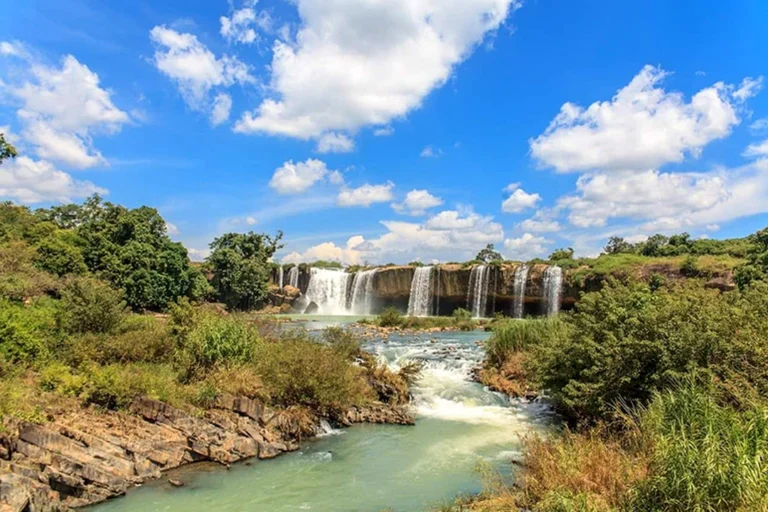
Buon Don emerges as a masterpiece of nature and human hands, where the legendary Serepok River winds around to embrace the verdant islet. The topography here is remarkably unique, formed from a crescent-shaped alluvial land strip divided and surrounded by two river branches flowing year-round. Millennia of silver waters have nourished lush vegetation and ancient banyan groves spreading their shady canopies, painting a picturesque landscape of rivers and mountains imbued with the untamed spirit of the Central Highlands. This majestic natural scenery does not merely captivate visitors with the grandeur of its waterways; it also harbors a profound spiritual and cultural realm intertwined with the slow, peaceful rhythm of indigenous ethnic life.
Beyond natural wonders, the architectural value of Buon Don is a wonderful fusion of rustic sculptural art and flexible adaptation to a riverine terrain. The most prominent hallmark is the system of traditional stilt houses belonging to the Ede and M’nong people, boasting impressive lengths that symbolize the prosperity of ancient chieftain clans. Sturdy, glossy black ca chit ironwood pillars, resilient through countless rainy and sunny seasons, combine with thickly thatched palm-leaf roofs to create a stately yet welcoming silhouette. In particular, the carvings on rafters and staircases—depicting mother’s breasts, crescent moons, bird and animal motifs, or stylized ivory tusks—reflect a refined aesthetic sensibility and rich spiritual life. The suspension bridges spanning the turbulent Serepok River, swaying gently in the forest breeze, stand as a testament to marvelous ingenuity in downstream transport architecture, linking village life with the vast wilderness.
To capture the most priceless moments in this legendary land, professional photographers and travel journalists often share insider tips on cinematic vantage points. The first million-view photo spot is the Buon Don suspension bridge area at dawn. As the first rays of morning sunlight pierce through the thin mist hovering over the Serepok River, brilliant golden light illuminates the time-worn wooden bridge spans and the churning whitewater below, creating an ethereal backdrop that is both wild and poetic. An elevated camera angle overlooking the entire Don Islet frames the distinctive crescent-shaped landmass in its entirety.
The second ideal photography spot highly praised by experts is the riverside alluvial flats or atop elephants strolling leisurely at sunset. Between 4:30 PM and 5:30 PM, when the sun begins to dip beyond the far bank of the Serepok River, painting an entire corner of the Central Highlands sky crimson, soft golden-orange light reflects off the calm water, highlighting every architectural contour of the ancient stilt houses and the undulating silhouettes of the deep forest. Standing here to capture the lingering sunset over the legendary river, visitors will come away with frames brimming with the essence of time—both majestic and steeped in the nostalgia of an endless epic realm.

Setting foot in Buon Don today, travelers do not merely touch upon the heroic pages of a bygone wild-elephant-hunting kingdom, but also embark on a deeply rewarding and emotionally resonant hands-on journey. From the very moment you step onto the legendary suspension bridge swaying high above the churning waves of the Serepok River, a sense of awe envelops your senses. The roar of rushing water beneath your feet and the brisk mountain wind rustling through century-old banyan canopies compose a wild symphony, awakening dormant instincts for exploration buried beneath the noise of urban life.
The journey continues with footsteps conquering red basalt hills and the experience of gliding gently in a dugout canoe across the emerald waters of the storied Serepok River. Sitting aboard the lightly rocking wooden boat, gazing at lush green islets and primeval vegetation lining both banks, you truly feel the magnificence nature has bestowed upon this land. Pausing at the highest vantage point of the heritage site to cast your eyes over the panoramic view of villages nestled beneath the forest canopy, a profound sense of peace and wonder at the grandeur of the Central Highlands swells in your chest.
Not stopping at scenic beauty, the spiritual atmosphere here also offers moments of deep reflection. Visitors can pay respects at the mausoleum of Elephant King Khun Yu Nop, lighting a stick of incense in gratitude to the legendary forefather, and listen to village elders recount ancient tales beside a flickering fire as gong music resonates through the great forest. These time-honored stories breathe life into every gust of wind and every grain of wood, transforming inanimate artifacts into treasured historical relics that touch the deepest recesses of every distant traveler’s soul.
Capping off an exploration of Buon Don are renowned local culinary experiences that leave diners lingering with fondness. Gathering around a jar of rich ruou can (stem wine), savoring fragrant sticky rice cooked in bamboo tubes (com lam) dipped in wild lemon-basil salt, golden honey-glazed grilled chicken infused with the flavor of sun and wind, or fresh, sweet specialties from the Serepok River makes all fatigue melt away. Amidst the vibrant cultural space of gongs, culinary flavors blend with the genuine, warm hospitality of the M’nong and Ede people to leave an unforgettable mark—making Buon Don not just a place to visit, but a beloved rendezvous for souls who cherish culture and history.

To ensure your journey exploring the legendary land of Buon Don goes smoothly and fulfilling, having practical information on opening hours, ticket prices, transportation, and cultural etiquette is essential. Buon Don warmly welcomes visitors from near and far to discover the unique indigenous history and culture of the Central Highlands’ ethnic communities along the flowing Serepok River.
Regarding operating hours, tourist sites and historical landmarks in Buon Don generally open daily from 7:30 AM to around 5:00 PM. This standard timeframe allows visitors to leisurely enjoy outdoor activities, tour ancient stilt houses, and explore the gong cultural space. The most ideal time of year to visit Buon Don is from November to April of the following year, when the Central Coast and Central Highlands enter the dry season with minimal rain and brilliant golden sunshine—perfect for travel, photography, and nature exploration.
In terms of costs, admission tickets to community tourism sites in Buon Don are generally quite affordable, ranging from 30,000 to 50,000 VND depending on the specific area you choose to visit (such as the Serepok Islet Tourist Area or the Elephant King Mausoleum). Meanwhile, several natural riverside trails and traditional village spaces can be explored freely without an entrance fee. However, if you wish to experience specialized services such as renting traditional attire, sampling local cuisine, or hiring an indigenous tour guide, clearly listed price schedules are available at the ticket counter of each area.
The most convenient route from Buon Ma Thuot city center to Buon Don follows Provincial Road 1 (the extended Nguyen Tat Thanh Street). The journey covers roughly 40 km to the northwest and takes about 45 to 60 minutes by car or motorbike. Today, this road is smooth and well-paved, flanked by endless green cashew and rubber plantations. Motorbikes are favored by younger travelers for the freedom to take in the scenery, while cars or dedicated route buses are safe options for families or larger groups.
Finally, when visiting Buon Don, travelers should choose neat, comfortable clothing and prioritize sneakers or flat shoes, as sightseeing involves plenty of walking across suspension bridges, red dirt paths, and natural rock gardens. At the same time, please dress modestly and respectfully when entering sacred spaces such as communal stilt houses and the mausoleums of historical chieftains to show reverence for the traditional customs and beliefs of the local ethnic communities.

To enjoy a seamless getaway and take in the full splendor of Buon Don without worrying about arranging transportation, booking entrance tickets, or planning itineraries, travelers can choose VDS Travel’s premium all-inclusive Buon Ma Thuot tour packages. Every itinerary is thoughtfully designed to optimize photo opportunities when the scenery is at its most radiant, accompanied by knowledgeable guides well-versed in local culture alongside top-tier hotel and dining standards.