Standing majestically along the Right Bank of the Seine, the Louvre Palace complex rises like a living chronicle carved in stone, bearing witness to more than eight centuries of the rise and fall of French civilization. The origins of this monumental edifice trace back to 1190, when King Philip II Augustus ordered the construction of a formidable military fortress known as the Château du Louvre before departing on the Third Crusade. At the time, the fortress’s paramount mission was to establish an impregnable defensive perimeter guarding the western gateway to Paris, protecting the capital against raids by Anglo-Norman forces. In etymological records, the name “Louvre” derives from the Medieval Latin root “Lupara” or the Old Gaulish variant “loup,” evoking a wild, forested terrain along the riverbank that was once inhabited by wolves. The original fortress was a square defensive structure encircled by a deep moat fed by the waters of the Seine, with a thirty-meter-tall cylindrical keep, the Grosse Tour (Donjon), rising defiantly at its center.
Entering the 14th century, as the boundaries of Paris expanded beyond its ancient city walls, the purely military stronghold began its transformation into a sumptuous royal residence. Under the reign of King Charles V, respectfully remembered by posterity as “Charles le Sage” (Charles the Wise), the palace underwent extensive renovations overseen by the royal architect Raymond du Temple. Stark defensive ramparts were pierced with windows to welcome natural light, graceful spiral staircases were added, and a grand library housing thousands of rare ancient manuscripts was established—laying the earliest foundations for the Louvre’s role as a symbol of knowledge and culture. During the height of the Renaissance, in 1528, King Francis I decided to demolish the gloomy medieval keep to build a magnificent royal palace suited to the tastes of the era. The monarch entrusted the reconstruction to architect Pierre Lescot, who laid the groundwork for the Lescot Wing (Aile Lescot), characterized by harmonious sculptural proportions that seamlessly blended Italian classical influences with the refined elegance of French artistry.
Each succeeding dynasty regarded the Louvre as a grand canvas upon which to etch the mark of royal sovereignty. Under King Henry IV, construction was swiftly undertaken on the monumental Grande Galerie, stretching hundreds of meters along the Seine to seamlessly link the Louvre with the Tuileries Palace (Palais des Tuileries), forging a spatial axis symbolizing unified royal authority. The pinnacle of French Baroque classicism was further cemented during the reign of the Sun King, Louis XIV, through the imposing eastern Colonnade. This architectural triumph was the collective brainchild of the famed “Petit Conseil,” comprising architect Louis Le Vau, royal painter Charles Le Brun, and architectural theorist Claude Perrault. By the 19th century, even though the royal court had long since relocated to Versailles, Emperor Napoleon I and later Emperor Napoleon III continued the mission of completing the vast palace wings embracing the Cour Napoléon, shaping one of the most majestic U-shaped architectural complexes on the European continent.
Historical upheaval sealed the Louvre’s destiny in the most dramatic fashion at the outbreak of the French Revolution. The insurrection of August 10, 1792, brought an end to the monarchy and paved the way for converting the entire royal residence into a public cultural institution. Exactly one year later, on August 10, 1793, the museum officially opened its doors to the public under the name “Muséum central des arts de la République,” ushering in an era of democratized art in which royal heritage became the shared patrimony of all humanity. During the First Empire, the institution was renamed the “Musée Napoléon,” receiving thousands of masterpieces of painting and sculpture acquired through military campaigns across Europe and Egypt. A landmark contemporary transformation occurred in 1981 when President François Mitterrand launched the ambitious “Grand Louvre” project, relocating the Ministry of Finance to return the entire palace complex to the arts. The arrival of the glass Pyramid designed by architect Ieoh Ming Pei, inaugurated in 1989, serves as an exquisite bridge connecting the depth of a feudal past with its stature as a premier global sanctuary of culture.
Situated at the historic heart of Paris’s 1st Arrondissement, the Louvre Museum commands a regal setting spanning more than forty hectares along the Right Bank of the River Seine. Viewed through the lens of traditional geomancy and Western capital city planning, this gently sloping stretch of land serves as the vital focal point of the entire Seine basin, where the river curves gracefully to cradle the ancient stone embankments. This riverside alluvial plain, which served in the Middle Ages as a military outpost controlling vital waterway commerce, was transformed over the centuries into an opulent palatial complex. The combination of sturdy Lutetian limestone foundations—quarried from the subterranean bedrock of Paris—and massive stone retaining walls along the Right Bank not only shielded the complex from historic river floods, but also sculpted a resplendent facade reflected in the shimmering waters, achieving a sublime harmony between symmetrical court architecture and an expansive natural landscape.
The defining centerpiece in the spatial planning of the royal palace is the starting point of the prestigious Axe Historique (Historical Axis), proudly known to Parisians as the Voie Triomphale (Triumphal Way). Originating at the imposing bronze equestrian statue of the Sun King Louis XIV at the center of the Cour Napoléon, this grand ceremonial sightline cuts a razor-straight path straight through the heart of the architectural complex. This invisible arrow pierces the center of the transparent glass pyramid, passes through the miniature Arc de Triomphe du Carrousel, slices lengthwise across the lush greenery of the elegant Tuileries Garden, aims directly at the ancient Luxor Obelisk on the Place de la Concorde, and sweeps up the Champs-Élysées to reach the monumental Arc de Triomphe atop the Place de l’Étoile. Both micro- and macro-scale masterwork of human urban engineering, this unobstructed vista links the absolute monarchy of the Bourbon era with modern republican civic space in a seamless, endless flow of architectural energy.
The present-day palace complex is laid out in an enormous open horseshoe configuration, comprising three primary wings embracing vast open-air courtyards. The Sully Wing anchors the eastern end, enclosing the historic square Cour Carrée—once the site of King Philip Augustus’s medieval fortress—and showcasing the pure, dignified aesthetic of the French Renaissance. The Denon Wing stretches along the southern flank parallel to the Seine embankment, featuring soaring arched windows that capture shimmering reflections from the river to illuminate its vast galleries of antiquities. Opposite it on the northern side stands the stately Richelieu Wing running alongside bustling Rue de Rivoli behind neoclassical stone arcades; it once housed the headquarters of the French Ministry of Finance before being wholly returned to the museum.
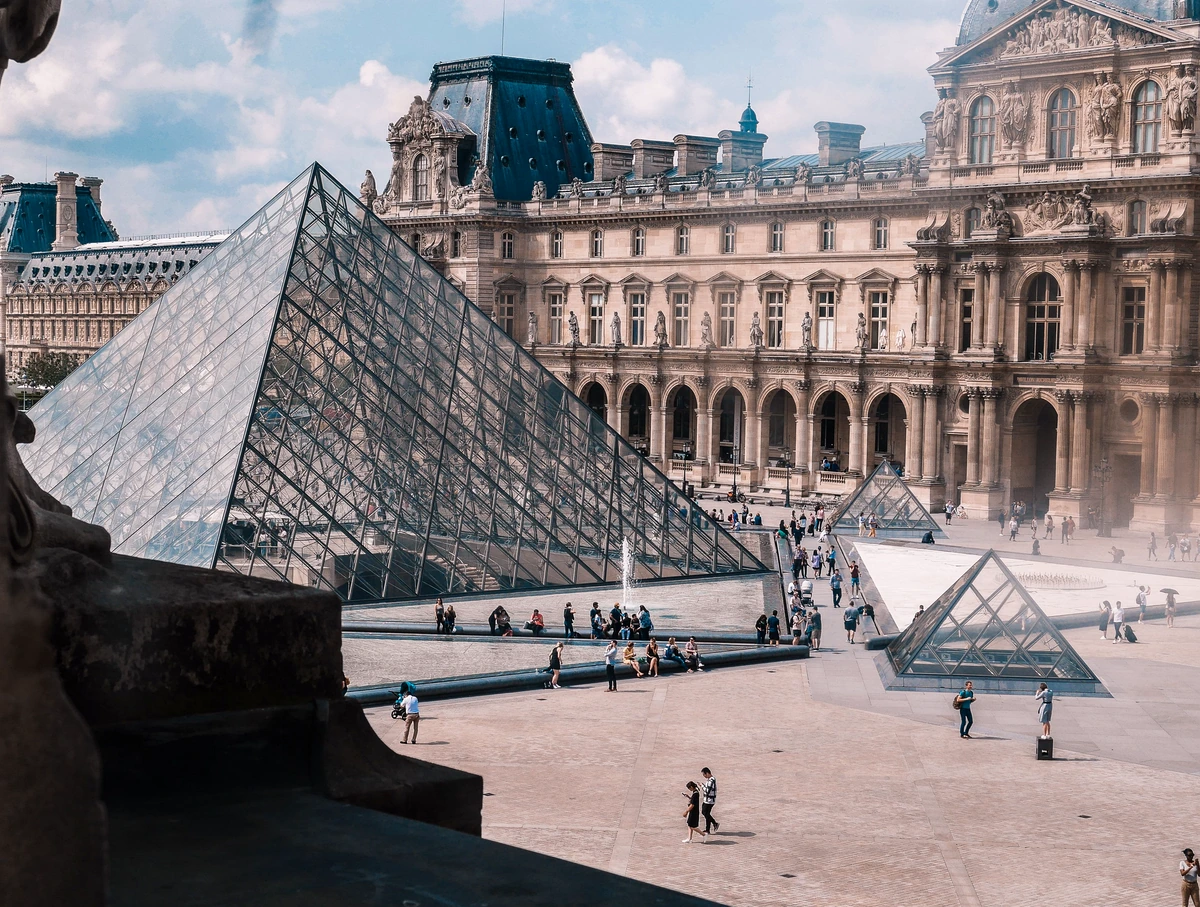
The interplay between the dense stone massing of the three palace wings and the open urban voids creates an unmistakable spatial rhythm. Interior courtyards such as the Cour Carrée and Cour Napoléon function not merely as transitional passageways, but as expansive open-air civic plazas channeling urban energy and an endless stream of art lovers. Moving from the quiet, contemplative enclosure of the sculpted stone walls of the Cour Carrée, visitors emerge into the breathtaking expanse of the Cour Napoléon—where the glass planes of the pyramid meet the sky—before flowing effortlessly into the lawns, octagonal basins, and meticulously manicured tree-lined alleys of the Tuileries Garden. This unbroken continuity from the granite river quays through royal archways to tree-shaded boulevards transforms the Louvre into a living organism where superlative engineering merges seamlessly with the fluvial topography of Paris.
If the entire city of Paris can be likened to an epic poem written in stone, the Louvre complex is its grandest ancient palimpsest, where nearly a millennium of architectural strata intertwine, overlap, and elevate one another without ever obscuring the distinct identity of each era. Descending into the subterranean archaeological excavations (fouilles du Louvre médiéval), visitors can touch the rough-hewn blocks of Lutetian limestone quarried from the ancient stone beds of the Paris Basin. Here, the formidable base of the defensive keep erected by King Philip Augustus in the late 12th century still looms in the dim light, vividly preserving the raw spirit of medieval military fortification before the site was reborn as a lavish royal palace.
Ascending to the sunlit ground level, the royal facade undergoes a dramatic metamorphosis into the radiant spirit of the Renaissance through the artistry of the Lescot Wing (Aile Lescot). Under the masterly direction of architect Pierre Lescot in collaboration with celebrated sculptor Jean Goujon, this wing established the canon of French Classicism. Its facade presents a rhythmic progression of classical orders stacked in ascending hierarchy—from grounded Doric on the ground floor, to graceful Ionic on the piano nobile, to stately Corinthian on the attic story—harmoniously paired with intricately carved mullioned windows and the signature Mansard roofs of France. This lineage of architectural grandeur reaches its zenith on the eastern facade with the Colonnade de Perrault, co-created by Claude Perrault, Louis Le Vau, and Charles Le Brun under King Louis XIV. Rising atop a solid rusticated podium, the paired Corinthian columns project the majestic, uncompromising rigor of 17th-century French Classicism, reflecting the supreme authority of absolute monarchy.
Yet the Louvre’s architectural evolution did not stop at Renaissance or Classical symmetry; it was clothed in extravagant splendor during the Second Empire. Architects Louis Visconti and Hector Lefuel infused the Richelieu and Denon wings with an exuberant Neo-Baroque flair, expressed through dense high-relief carvings, ornate curved pediments, and freestanding statues celebrating the prosperity of Napoleon III’s empire. Every wall surface, cornice, and molding is a tour de force of craftsmanship, turning both the Cour Carrée and the Cour Napoléon into monumental open-air sculpture museums where the pinnacle of French stonecraft is on full display.
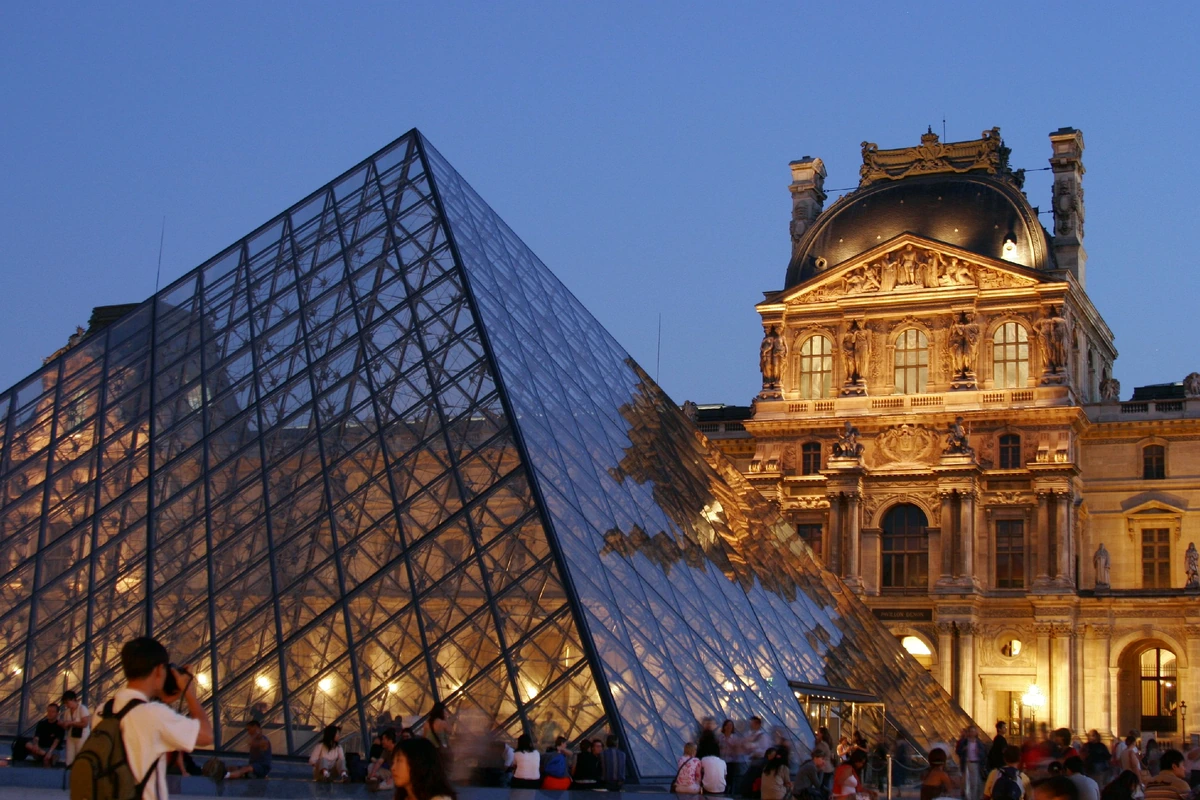
At the heart of this venerable royal complex, the 1989 arrival of the glass Pyramid (Pyramide de verre), conceived by legendary architect Ieoh Ming Pei, struck like a bold touch of the future landing squarely within the past. Standing 21.64 meters high with a square base measuring 35.42 meters on each side, the structure is a triumph of geometric precision and pioneering engineering. Rather than using standard architectural glass, which inevitably carries a greenish tint from iron impurities, Pei partnered with glass manufacturer Saint-Gobain to painstakingly develop an ultra-clear, extra-white “diamond” tempered glass. Held together by an intricate structural web of stainless steel, lightweight aluminum alloys, and tensioned cables inspired by maritime rigging, the pyramid is an exact assembly of 603 diamond-shaped and 70 triangular glass panes. This crystalline geometry diffuses dazzling natural daylight by day and gleams like a multi-faceted jewel by night.
Far more than a visual icon, Pei’s creation is a masterstroke of spatial urban planning. The pyramid serves as the museum’s main portal, gently drawing visitors down into the spacious subterranean concourse of the Hall Napoléon and Carrousel du Louvre. From this central underground hub, wide passageways efficiently distribute crowds across the three main museum wings—Sully, Denon, and Richelieu—gracefully solving the logistical challenge of welcoming millions of annual visitors without disturbing the historic palatial fabric above. The dialogue between modern daylight streaming through crystal-clear glass and thousand-year-old stone walls turns an architectural visit to the Louvre into an unforgettable journey across time.
As dusk settles over the Seine and Paris shifts into deep twilight blue, the Louvre Palace sheds its solemn daytime demeanor to enter an enchanting visual symphony of architectural lighting. Its comprehensive illumination master plan (Plan Lumière) was meticulously engineered to awaken a thousand years of heritage without harming the delicate Lutetian limestone—the prized shell-bearing sedimentary stone quarried beneath Paris since Roman times that built the fortress walls of Philip Augustus and the grand palaces of Francis I and Louis XIV. Once night falls, thousands of high-efficiency, energy-saving luminaires cast a warm golden glow across every molding, Corinthian capital, arched window, and statue honoring France’s illustrious figures, reviving the supreme majesty of a storied dynasty in the heart of the City of Light.
The focal point of the Louvre after dark is the visual stage of the Cour Napoléon, where I. M. Pei’s glass Pyramid transforms into a radiant, luminescent marvel. Composed of 673 seamlessly fitted diamond and triangular panes, this modern structure sheds its metallic framework to become a glowing crystal jewel radiating light from within. Soft illumination filters through the transparent prism and reflects across the surrounding tranquil water basins, creating a shimmering double reflection beneath the night sky of Île-de-France. Here, the dialogue between the grounded permanence of Renaissance royal stonework and the ethereal weightlessness of modern glass achieves the height of aesthetic beauty. Below ground, the Inverted Pyramid (Pyramide Inversée) hangs suspended like a crystalline stalactite, capturing indirect daylight and scattering soft spectral hues across the Carrousel du Louvre, transforming the subterranean concourse into a futuristic cathedral of art.
To experience the museum at its most contemplative, the regular evening openings (nocturnes) held every Wednesday and Friday—extending until 9:45 PM—are a true privilege for devoted art lovers. As the bustling daytime crowds disperse toward the Rue de Rivoli and the quays of the Seine, the Louvre reclaims the hushed, reverent stillness proper to its vast galleries. Within the dimmed ambiance of the grand halls, layered directional lighting focuses full visual intensity on each priceless masterpiece. Inside the expansive Salle des États, Leonardo da Vinci’s “La Joconde” (Mona Lisa) appears in serene solitude behind her protective glass. Free from pressing crowds, Lisa Gherardini’s enigmatic smile feels all the more alive and mesmerizing, meeting the viewer’s gaze through subtle layers of mystical sfumato under precisely calibrated optical lighting.
Experiencing the Louvre by night also leads visitors up grand stone staircases to altars of classical antiquity. Standing at the foot of the Daru Staircase in the quiet of late evening, the marble statue of “La Victoire de Samothrace” (Winged Victory of Samothrace) towers above as though having just alighted from the ancient Aegean Sea. Precisely angled theatrical lighting casts dramatic shadows across the wind-whipped folds of drapery clinging to her body and her proudly outstretched wings, infusing this 2nd-century BC Hellenistic masterpiece with tragic grandeur and commanding power. Viewing art at night in the Louvre is far more than sightseeing; it is an authentic cultural pilgrimage where time stands still amid footsteps echoing across polished oak floors and quiet gasps of awe before humanity’s eternal beauty.
A journey through the artistic treasures of the Louvre would be incomplete without an encounter with the French art of living and French gastronomy (art de vivre), cultivated over centuries right at the heart of the 1st Arrondissement in the City of Light. This royal palace complex and its surrounding historic streets house not only painting masterpieces, but also the cradle of both classical royal court cuisine and quintessential Parisian bistro culture. The refinement of the French palate traces back to lavish banquets under Francis I and Louis XIV, where the art of the table was elevated to a rigorous aesthetic code; over time, those culinary traditions filtered into everyday civic life, shaping a celebrated gastronomic map stretching from the Right Bank of the Seine to the serene Tuileries Garden.
Right inside the Louvre itself, the most iconic stop is Café Marly, poised elegantly beneath the vaulted arcades of the Richelieu Wing. Seated amid opulent Napoleon III-style interiors adorned with gilded moldings, guests can gaze through tall French windows overlooking the Cour Napoléon and the geometric splendor of I. M. Pei’s glass Pyramid. Listening to the gentle clink of a silver spoon against porcelain while sipping a rich espresso or fragrant apéritif as sunset bathes the ancient Lutetian limestone walls in gold, travelers experience an unforgettable fusion of painting, architecture, and culinary artistry.
Menus at distinguished restaurants and historic eateries surrounding the Louvre proudly celebrate classic savory dishes of the national culinary canon. A feast often begins with French onion soup (soupe à l’oignon gratinée), a culinary legacy born in the historic Les Halles market that once stood adjacent to the royal palace. Sweet onions are slowly caramelized in unsalted butter until deep amber and velvety, simmered in a rich herb-infused beef broth, and crowned with a crisp baguette slice smothered under bubbling, golden-brown melted Comté or Gruyère cheese. Following this comforting opener comes the celebrated bœuf bourguignon, a testament to French culinary patience, in which select cuts of beef are braised slowly for hours in Burgundy red wine alongside fresh mushrooms, carrots, and lardons, yielding layers of deep flavor that melt effortlessly on the palate.
Alongside formal savory fare, the world of pastry (pâtisserie) and baked goods (viennoiserie) around the Louvre forms an enchanting museum of aromas and colors in its own right. Few can resist the allure of the classic Saint-Honoré cake, an aristocratic dessert created by a master pastry chef on neighboring Rue Saint-Honoré and named after the patron saint of Parisian bakers. This confection pairs a crisp puff pastry base (feuilletage) ringed with glossy caramel-dipped choux puffs and crowned at the center with airy, cloud-like chiboust cream. Together with glossy chocolate éclairs, vividly hued macarons crisp on the outside and chewy within, and croissants fragrant with premier Normandy butter from heritage bakeries, every stroll around the palace becomes a sweet sensory indulgence.
Crowning this culinary symphony after touring the Louvre is a freshly baked, piping-hot Grand Marnier soufflé—a technical tour de force demanding absolute precision from the pastry chef. Served the moment it emerges from the oven, it rises proudly above its porcelain ramekin with a cloud-soft interior infused with the intoxicating aroma of fine orange liqueur. Dining around the Louvre is thus far more than refueling after hours of walking the galleries; it is a refined cultural ritual in which every dish, cup of tea, or glass of wine serves as an invisible bridge connecting travelers deeply to the soul and thousand-year heritage of France.
Stepping into one of the largest artistic labyrinths on Earth calls for careful practical planning so your visit unfolds smoothly amid cultural pilgrims from every corner of the globe. The Louvre opens its doors at 9:00 AM and closes at 6:00 PM daily, except on Tuesdays, when the entire royal complex closes for curatorial work and collection maintenance. For visitors captivated by the tranquil beauty of classical art, the late-night openings (nocturnes) on Wednesdays and Fridays until 9:45 PM offer an invaluable experience. Beneath the glass pyramid glowing with warm golden light, the night falling over Paris outside contrasts with the serene calm within, allowing you to admire the immortal smile of the Mona Lisa or the proud silhouette of the Winged Victory of Samothrace without the distraction of noisy daytime crowds.
To make the most of your time and avoid waiting for hours in the Cour Napoléon, visitors should book timed-entry tickets online in advance through the museum’s official portal. Standard admission grants access to all permanent collection wings, including the magnificent galleries of Egyptian antiquities, Greek classics, and Islamic art. In terms of transportation, the Paris Métro is the fastest and most convenient option. Simply take Métro Line 1 or Line 7 and disembark at the Palais Royal – Musée du Louvre station. Rather than heading up to street level to join the long outdoor queues beneath the glass Pyramid, the smartest underground route leads directly through the Carrousel du Louvre shopping gallery straight to the security checkpoints at the Hall Napoléon within minutes. Additionally, the Passage Richelieu entrance facing Rue de Rivoli serves as a dedicated access point for museum members and pre-booked guided groups, significantly cutting down entry times.
Spaces housing humanity’s priceless treasures demand strict, respectful conduct from every visitor. Flash photography is strictly prohibited throughout all exhibition galleries, as the intense heat and light radiation emitted by artificial flashes can accelerate pigment degradation on canvas surfaces, directly threatening the longevity of oil masterpieces spanning from the Renaissance to Romanticism. Keeping conversations to a quiet murmur, refraining from touching marble pedestals or artworks, and following designated visitor routes are essential etiquette to preserve the museum’s dignified atmosphere. At the same time, the Louvre upholds world-class accessibility standards through comprehensive infrastructure for visitors with reduced mobility (PMR), including discreetly integrated vertical lifts, complimentary wheelchairs available at information desks, and modern handheld audio guides ensuring every guest can experience humanity’s shared artistic heritage equally and completely.
With more than 73,000 square meters of exhibition space stretching across tens of thousands of footsteps, wearing comfortable walking shoes and embracing an unhurried pace will turn your artistic pilgrimage at the Louvre Palace into an unforgettable memory of a lifetime. Travelers wishing to pair their exploration of the Louvre with other iconic cultural and architectural wonders across the European continent can explore all-inclusive European tour packages for a seamlessly organized journey filled with unforgettable moments.