The historical current of Zurich, Switzerland (recorded in classical Chinese texts as 苏黎世) carries an astonishing cultural depth, spanning millennia from primitive Celtic tribes to the dazzling global financial metropolis it is today. Turning back the ancient pages preserved in historic libraries, Zurich’s roots can be traced to the first millennium BCE, when the area consisted of prosperous Celtic settlements. Then, the wheel of time turned in 15 BCE, when the mighty Roman Empire conquered the lands north of the Alps, establishing a strategic outpost and setting up a customs station named “Turicum.” Over centuries of phonetic evolution within medieval High German, this original Latin name gradually transformed into the familiar “Zurich” or “Zürich” of today, carrying the resonance of a vital commercial crossroads since antiquity.
The tides of history shaped Zurich through successive dynastic milestones and dramatic political upheavals. Having spent the first through fifth centuries under Roman administration as a customs and postal post, the settlement gradually emerged from the shadow of antiquity into the Middle Ages through decisive turning points. In 1218, Zurich received a destiny-altering privilege when it was officially granted the status of an “Imperial Free City” (Reichsfreiheit), conferring substantial administrative autonomy upon the community under the direct protection of the Emperor. Beyond that, the strategic stature and allure of this lakeside city were powerfully affirmed in 1351, when Zurich formally joined the fledgling Swiss Confederation, becoming its fifth member canton and serving as an irreplaceable economic and political anchor within the alpine alliance.
Speaking of Zurich’s spiritual and political depth, one cannot overlook the towering historical figures who left an indelible mark here. Charlemagne, the great Emperor of the Franks, laid the earliest foundations reinforcing the religious and political standing of the Fraumünster abbey, turning it into a regional center of spiritual authority. Centuries later, the flames of the Protestant Reformation raging across Europe found one of their primary epicenters in Zurich under the brilliant leadership of reformer Huldrych Zwingli. From 1519 onward, when Zwingli assumed the role of People’s Priest at the Grossmünster cathedral, Zurich rose to become a staunch bastion of Protestantism, shaping the intellectual and cultural identity of a vast region. By the 19th century, as the wave of industrialization surged forward, master architect Gottfried Semper emerged as a visionary builder, reshaping and defining the city’s classical skyline through landmark architectural works of enduring heritage.
Zurich’s remarkable transformation from a feudal medieval town into a modern metropolis reached its peak in the 19th century, when the railway network officially opened, linking Zurich with the rest of Europe. This milestone breathed dynamic life into the city, igniting rapid breakthroughs in textiles, mechanical engineering, and above all, the meteoric rise of modern banking. From the early days of its financial system to the towering banking institutions of today, Zurich has cemented its unshakable stature as Switzerland’s foremost commercial and cultural hub, rising to become one of the world’s premier financial capitals where a golden past and a prosperous present blend seamlessly.
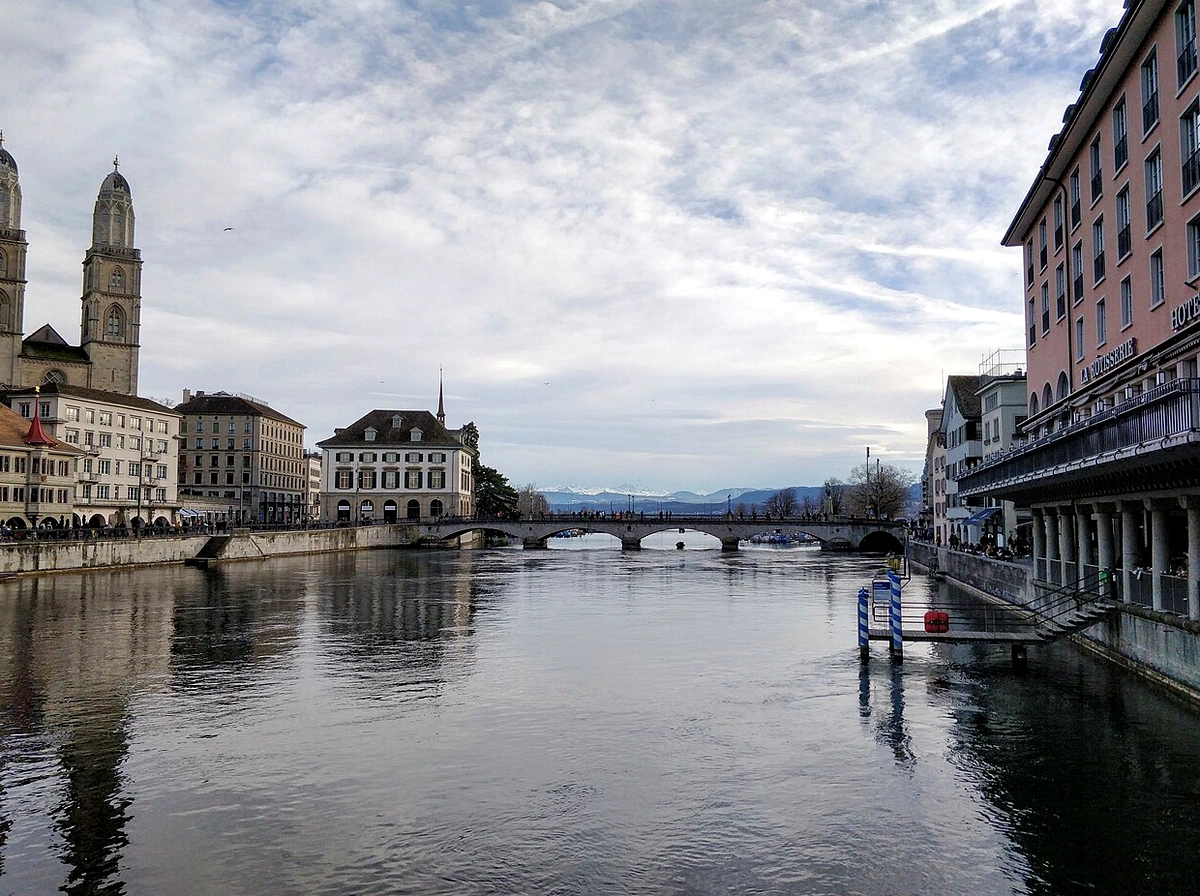
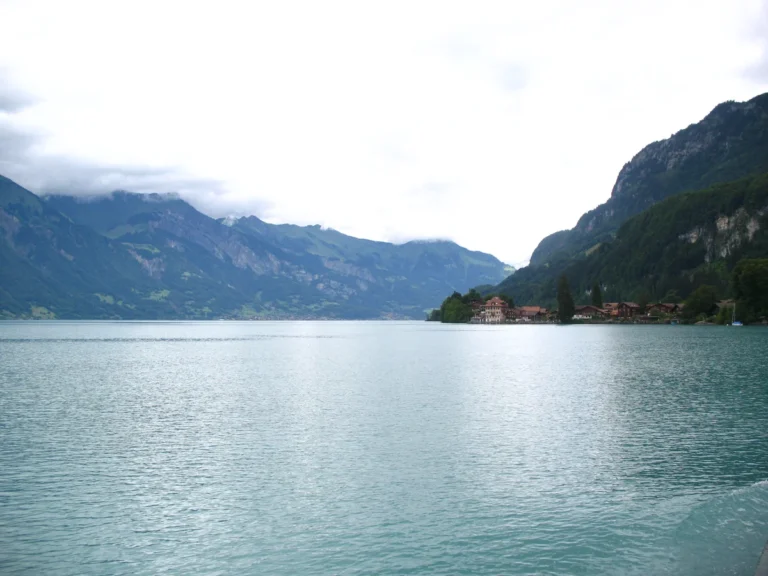
From the perspective of a cultural historian and human geographer, examining Zurich, Switzerland (苏黎世) cannot be separated from its exceptionally auspicious natural topography, where nature sculpted an ideal living environment uniting water portals, vital arteries, and protective shelter. Positioned right at the northwestern tip of Lake Zurich, where the Limmat River begins its journey cutting through the heart of the city before merging with its major tributary, the Sihl, in the central district, Zurich possesses the classic terrain of premier commercial and strategic cities. Through the lens of modern geological science, the local geomorphology bears the unmistakable imprint of the Quaternary Ice Age: as the great Linth Glacier retreated, it left behind a complex system of moraine formations—most notably the historic Lindenhof hill and adjacent ridges—creating a natural vantage point both defensible against outside threats and commanding a sweeping view over the commercial basin.
The city’s average elevation sits at roughly 408 meters above sea level, encircled by the foothills along the northern edge of the majestic Alps, highlighted by the Uetliberg peak rising to 869 meters. The interplay between the expansive aquatic ecosystem of Lake Zurich and the dynamic hydrological axis of the Limmat River naturally establishes a powerful ventilation corridor across the entire urban fabric. During warm summer months, moisture rising from the lake moderates the microclimate, bringing cool, refreshing energy to public spaces; conversely, in winter, the basin topography combined with cold air masses frequently produces temperature inversions and delicate morning mists, draping the historic architecture in an ethereal, poetic Central European veil.
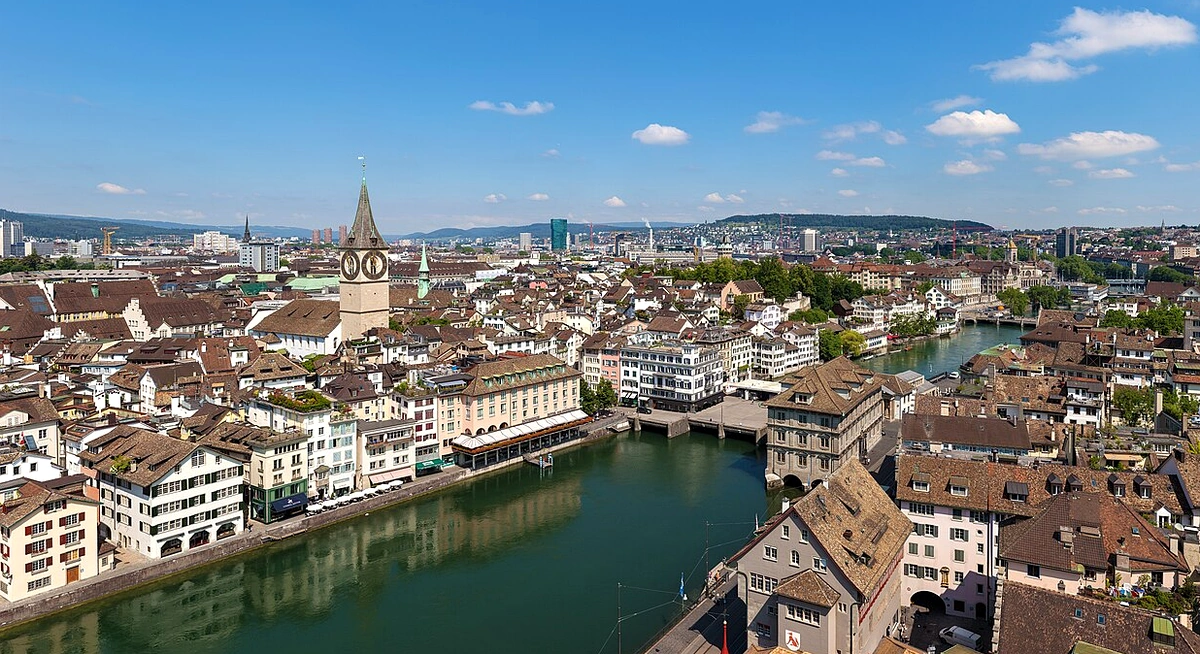
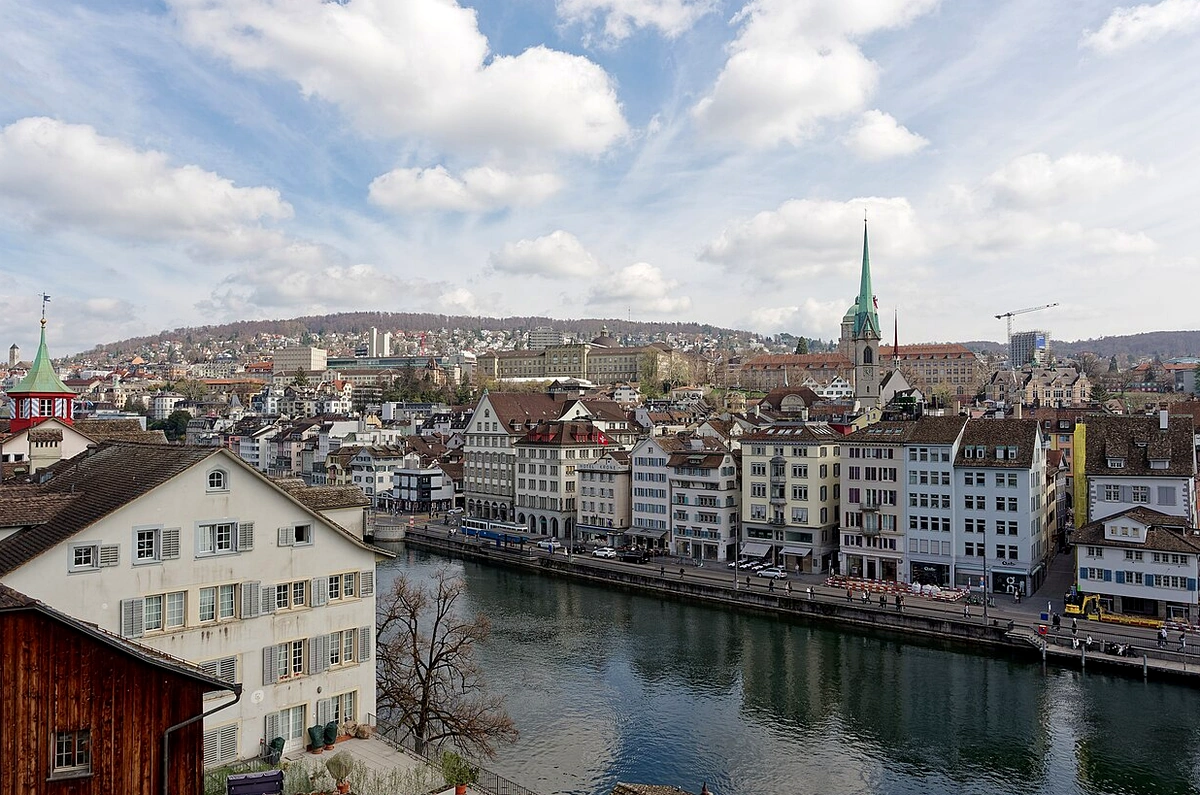
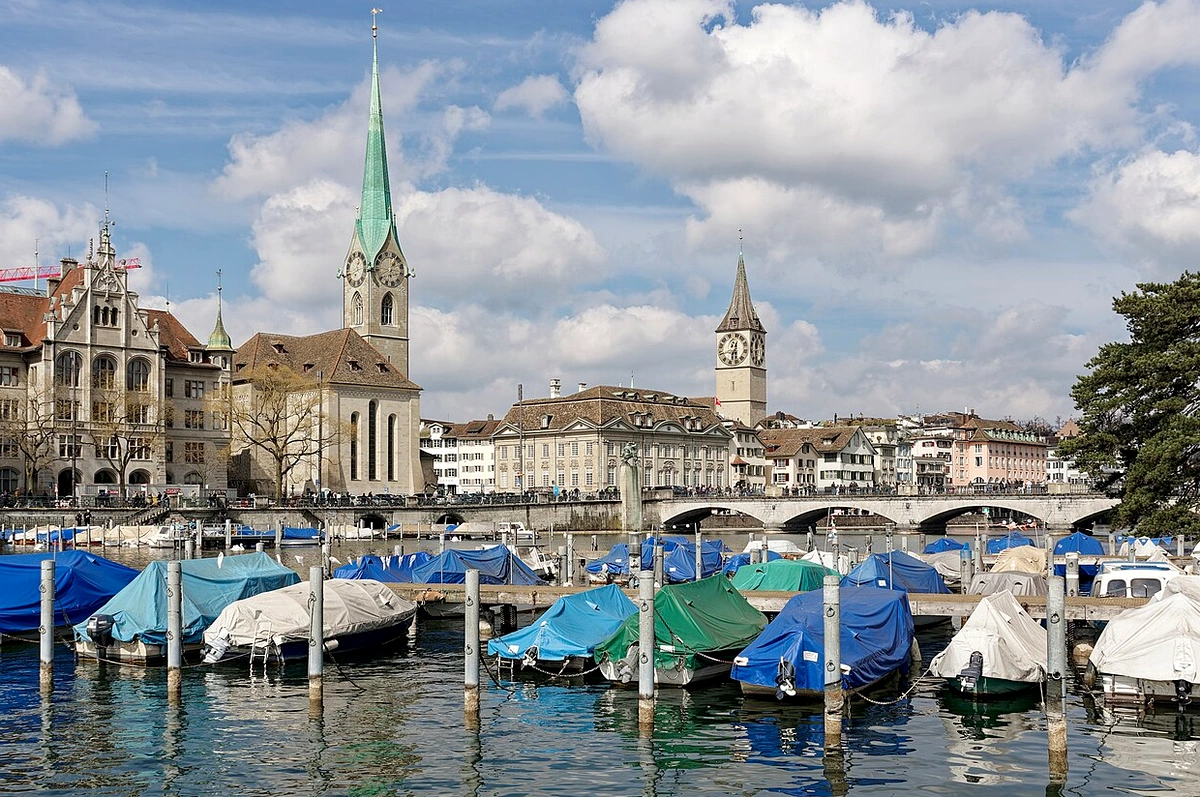
The spatial engineering and settlement siting practiced by Zurich’s early inhabitants stand as living proof of a spatial philosophy harmonizing military defense with commercial port economics: following the contours of water, commanding vital trade bottlenecks, and maximizing natural terrain. Seen from above, the Limmat River axis served not only as a waterway artery but also as a natural boundary dividing the poles of power within the medieval city. On the eastern bank, the imposing twin towers of the Grossmünster rise boldly as an emblem of the supreme authority of the Church and monastic orders; directly opposite on the western bank, the slender spire of the Fraumünster represents the secular and aristocratic influence of feudal nobility and wealthy merchants. Facing one another across the tranquil waters from opposite riverbanks, these two monumental churches anchor the entire city skyline with artistic symmetry, vividly reflecting the tension yet balanced order of medieval European society.
Over centuries of organic growth, Zurich’s landscape planning has transcended pure defensive strategy to become a living architectural museum of spatial adaptation. Every cobblestone alley winding up moraine slopes, every row of historic houses hugging the water’s edge, and every ancient stone bridge spanning the Limmat testifies to the foresight of generations of urban planners. Rather than seeking to subdue nature, they adapted to the contours of the land—harnessing waterways to cultivate prosperity and utilizing high ground as natural bulwarks. This refined synthesis of ancient glacial geology, dynamic hydrology, and strategic spatial planning has forged a Zurich that is not only geographically resilient, but also endowed with an unmistakable landscape identity—at once contemplative and dignified, yet open and modern in the very heart of the Old Continent.
Strolling along the winding Limmat River as it embraces the heart of Zurich, visitors feel as though they have stepped into a living architectural museum, where the finest visual artistry of the Old Continent blends seamlessly with Swiss spatial mastery. The urban fabric here is no mere patchwork of historical eras, but an organic whole cultivated over centuries. Zurich’s traditional architecture demonstrates a profound mastery of materials, skillfully uniting abundant Alpine stone—such as durable sandstone and solid granite—with sturdy timber framing. This combination not only ensures resilience against harsh mountain weather, but also imparts a rustic yet stately aesthetic that endures through the ages.
The most commanding focal point in this spatial tableau is the trio of historic churches defining the city skyline. Standing guard on one bank of the river is the Grossmünster, a monument embodying the spirit of Romanesque architecture dating back to 1100. Descending into its original 11th-century crypt, the echoes of history seem to seep through the cool stone walls. Over the centuries, its iconic twin towers were renovated in the Gothic style in the 15th century, endured a devastating fire in the 18th century, and were reborn with Neo-Gothic spires soaring into the Central European sky. Directly across the water, balancing the Grossmünster, stands the Fraumünster, a religious landmark with deep roots tracing back to 853. It captivates travelers with its slender, distinctively green Gothic spire. Inside, 14th-century Gothic vaulted ceilings retain their solemn grandeur, yet what truly takes one’s breath away are the monumental stained-glass windows crafted by modern art master Marc Chagall in 1970, alongside the exquisite rose window by Augusto Giacometti, creating a wondrous dialogue between light, color, and sacred space.
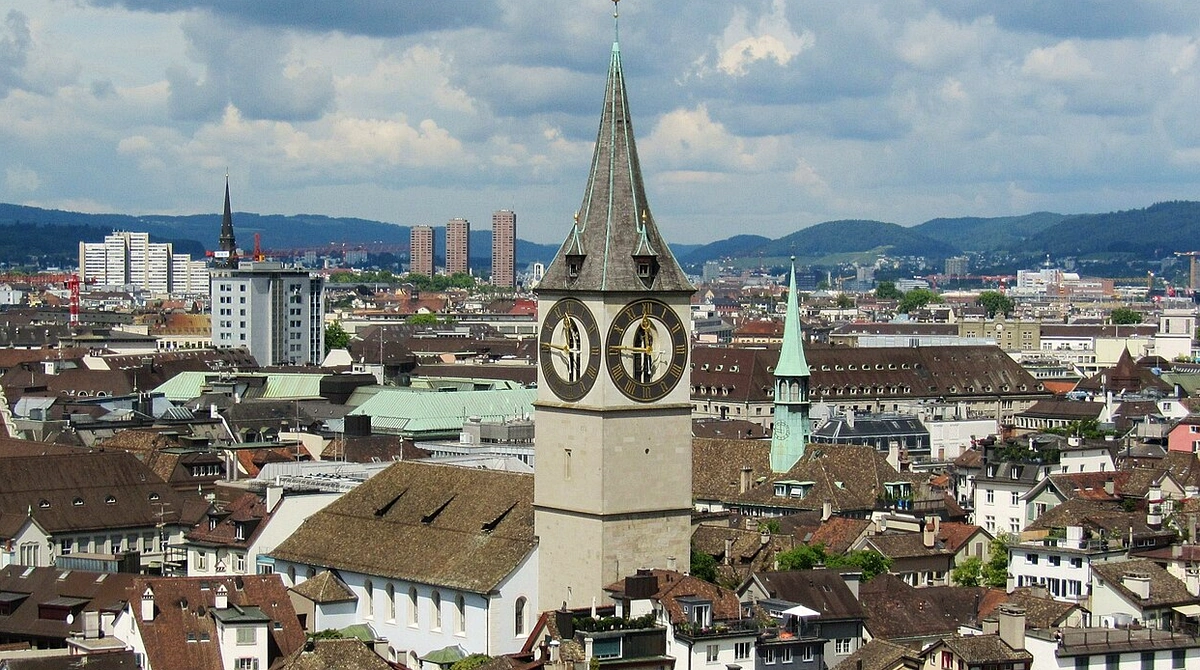
Completing this sacred architectural triad is St. Peter’s Church, a historical witness originally founded in the 9th century. Beyond its spiritual significance, St. Peter is a point of engineering pride for Zurich, boasting the largest church clock face in Europe with a diameter of 8.64 meters. At the base of its tower, engineers and archaeologists can still trace the remarkably refined stone masonry of the 9th-century Carolingian dynasty. The coexistence of architectural layers spanning from the Frankish Empire through the Renaissance to contemporary urban design makes Zurich a multidimensional city, where every brick, sandstone block, and decorative motif whispers stories of a civilization that honors its past while reaching boldly toward the future.
When night descends upon the land of renowned timepieces, Zurich (苏黎世) does not drift into quiet slumber; instead, it transforms into an enchanting realm of visual art. The city’s lighting design is guided by a philosophy that respects nocturnal darkness, minimizing light pollution while accentuating every detail of its historic architecture and creating an ethereal interplay with the water. Strolling along both banks of the Limmat at twilight, visitors feel as though they are wandering through an open-air museum, where warm-toned LED illumination is subtly positioned to embrace medieval guild houses (Zunfthäuser) and moss-draped stone bridges. Rather than glaring harshly, the soft golden glow highlights the crisp ridges of stepped gables and hand-carved stonework along the embankments before shimmering across the gently flowing Limmat, turning the river into a giant mirror reflecting both the night sky and the city’s storied past.
Yet Zurich’s nightlife and cultural scene extend far beyond illuminated facades; they burst to life through time-honored folk festivals steeped in local heritage. Foremost among them is the spring festival Sechseläuten, celebrated annually on the third Monday of April. On this day, the entire city steps back into the Middle Ages as members of traditional guilds (Zünfte) don splendid historical costumes and parade through the streets amid lively brass bands, drumming, and the cheers of tens of thousands of spectators. The dramatic, eagerly awaited climax of Sechseläuten unfolds at Sechseläutenplatz, where a giant snowman effigy named the Böögg—symbolizing winter—is mounted atop a pyre with its head packed with fireworks. Once the flames ignite and engulf the Böögg, the exact time it takes for the fireworks in its head to explode is traditionally used to forecast the weather for the coming summer—a beloved folk custom blending community spirit with hopeful anticipation of fair skies and bountiful harvests.
In vibrant contrast to spring’s stately pageantry comes the exuberant, carefree energy of summer with the one-of-a-kind river swim known as Limmatschwimmen. When late-summer warmth blankets the city, thousands of locals and visitors gather along the riverbanks, trading formal business attire for swimwear to plunge directly into the crystal-clear, refreshing waters of the Limmat. Accompanied by festive music drifting from both shores, crowds float safely downstream with the brisk current, swimming right through the heart of the city from the Kornhausbrücke bridge to the Letten riverside bathing complex. More than just a refreshing recreational event, Limmatschwimmen is living proof of Zurich’s world-leading water purity, celebrating an intimate bond between urban community life and nature beside the lake.
Alongside these grand festivals, Zurich’s evening arts and dining culture flourishes across historic vaulted wine cellars, impromptu contemporary music performances on the steps of the Grossmünster, and colorful artisan night markets. This seamless weave of centuries-old architectural heritage, nature-conscious lighting design, and enduring festive spirit makes Zurich a living cultural organism where every street corner and bridge span tells stories that stand the test of time.
The local culinary map of Zurich (苏黎世) embodies the quintessential spirit of German-speaking Switzerland, where traditional cooking techniques and regal refinement unite to form a distinctive gastronomic tradition. Behind its sleek modern exterior and brisk financial tempo, Zurich’s culinary world cherishes classic heritage, anchored by rich cream sauces, prime cuts of meat, and abundant Alpine dairy products. Every dish is more than a feast for the palate—it is a living museum preserving cultural memories forged across centuries of lakeside development.
At the pinnacle of Zurich’s culinary artistry stands Zürcher Geschnetzeltes, or Zurich-style sliced veal. As the undisputed pride of the region, this signature dish is prepared using choice cuts of tender veal sliced into thin strips or delicate ribbons. What elevates the dish to sublime heights is its velvety sauce, crafted with freshly foraged forest mushrooms, fine white wine, rich reduced stock, and pure heavy cream. Following strict local tradition, it is always served alongside crispy golden Rösti—traditional Swiss pan-fried potato cakes. Crisp and golden on the outside yet tender inside, the Rösti absorbs the rich, wine-infused creamy veal sauce to create an unforgettable symphony of flavor capable of winning over even the most discerning palates.
Beyond grand banquets in historic dining rooms, Zurich’s street food culture holds irresistible rustic charm through beloved staples such as grilled Bratwurst served with crusty Swiss bread, or the hearty autumn feast known as Züri-Metzgete. What lends Zurich’s gastronomy its extraordinary cultural depth is its enduring bond with medieval guild house restaurants. Centuries ago, powerful merchant and craft guilds constructed grand guild halls for assemblies and diplomatic banquets.
Today, these architectural landmarks have been transformed into premier traditional restaurants, most notably the weavers’ guild house Zunfthaus zur Waag and the wine merchants’ guild house Zunfthaus zur Meisen. Dining within these storied walls feels like stepping into another era, surrounded by intricately carved timber ceilings, shimmering stained-glass windows, and centuries-old frescoes. Eating in Zurich is therefore far more than tasting fine cuisine—it is a journey back to the golden age of medieval guild alliances, where history, artistry, and culinary heritage merge seamlessly in timeless local traditions.
To round out an exploration of this pristine yet historic lakeside metropolis known as 苏黎世 (Zurich), equipping yourself with practical, reliable travel tips is the golden key to a smooth and rewarding trip. To make the most of every moment in Switzerland’s largest financial hub, knowing the exact opening hours of its iconic landmarks is essential. Standing majestically beside the Limmat River, the religious landmark Grossmünster welcomes visitors Monday through Saturday from 10:00 AM to 6:00 PM during summer, where a small admission fee of around 5 Swiss francs grants access to climb the tower for panoramic views over the city. Just across the Münsterbrücke bridge, the Fraumünster church opens daily from 10:00 AM to 5:00 PM; note that photography and filming are strictly prohibited inside the sanctuary housing Marc Chagall’s priceless stained-glass masterpieces in order to preserve them.
Reaching this global financial center is effortless from the moment you land at Zurich Airport (ZRH). Rather than navigating complicated transfers, Switzerland’s state-of-the-art public transit system offers frequent S-Bahn commuter trains and direct express services that whisk travelers to Zurich Main Station (Zürich HB) in just 10 to 13 minutes. To maximize savings and convenience throughout your stay in the city, purchasing a Zürich Card is indispensable, granting unlimited travel across all public transit—including trams, buses, trains, and lake boats.
Drawing from the insights of cultural researchers and seasoned travel specialists, an ideal full-day itinerary begins in the morning along prestigious Bahnhofstrasse and Paradeplatz—the financial heartbeat of the nation. Midday is the perfect time to stroll over to the Fraumünster and climb historic Lindenhof hill—once the site of a Roman fortress—before stopping at a traditional Old Town restaurant to savor Zürcher Geschnetzeltes paired with crispy Rösti. The afternoon opens up academic and spiritual landmarks with a visit to the Grossmünster, followed by the renowned campuses of the University of Zurich and ETH Zurich (Swiss Federal Institute of Technology), where Albert Einstein once studied and taught. As dusk settles, riding the mountain railway up to Uetliberg rewards you with breathtaking sunset panoramas across shimmering Lake Zurich and the majestic Alps.
Alongside itinerary and transit planning, keeping a few practical tips in mind will ensure a seamless experience. When entering historic churches and sacred spaces, modest, respectful attire is required. Because Zurich sits at the foot of the Alps, weather conditions can shift rapidly, making a windproof jacket and compact umbrella essential items in your daypack. Furthermore, Switzerland’s economy operates almost entirely cashless, with credit card acceptance approaching 100%, ensuring fast, transparent, and secure transactions everywhere from luxury boutiques to transit ticket machines.
To turn your European dream into reality and experience the architectural and cultural treasures of the land of watches firsthand, explore our detailed itinerary for the 12D11N Germany – Austria – Italy – Switzerland – France tour and get ready for an unforgettable journey.