Allianz Arena Munich stands at a strategic geographical coordinate in the northern suburb of Fröttmaning, north of Munich’s city center in the state of Bavaria, Germany, at an elevation of approximately 517 meters above sea level. The terrain here forms part of the flat Bavarian plateau stretching along the Isar River basin, creating an expansive open setting distinctly separated from Munich’s historic urban core. Selecting Fröttmaning as the foundation for a monumental sports complex at the dawn of the twenty-first century not only solved an urban planning challenge, but also established a vital transit corridor linking the historic center with the A9 national autobahn and Franz Josef Strauss International Airport. Once characterized by open agricultural fields and a reclaimed landfill, the surrounding landscape has been transformed into a modern urban space where the stadium rises like a colossal sculptural form hugging the southern German skyline.
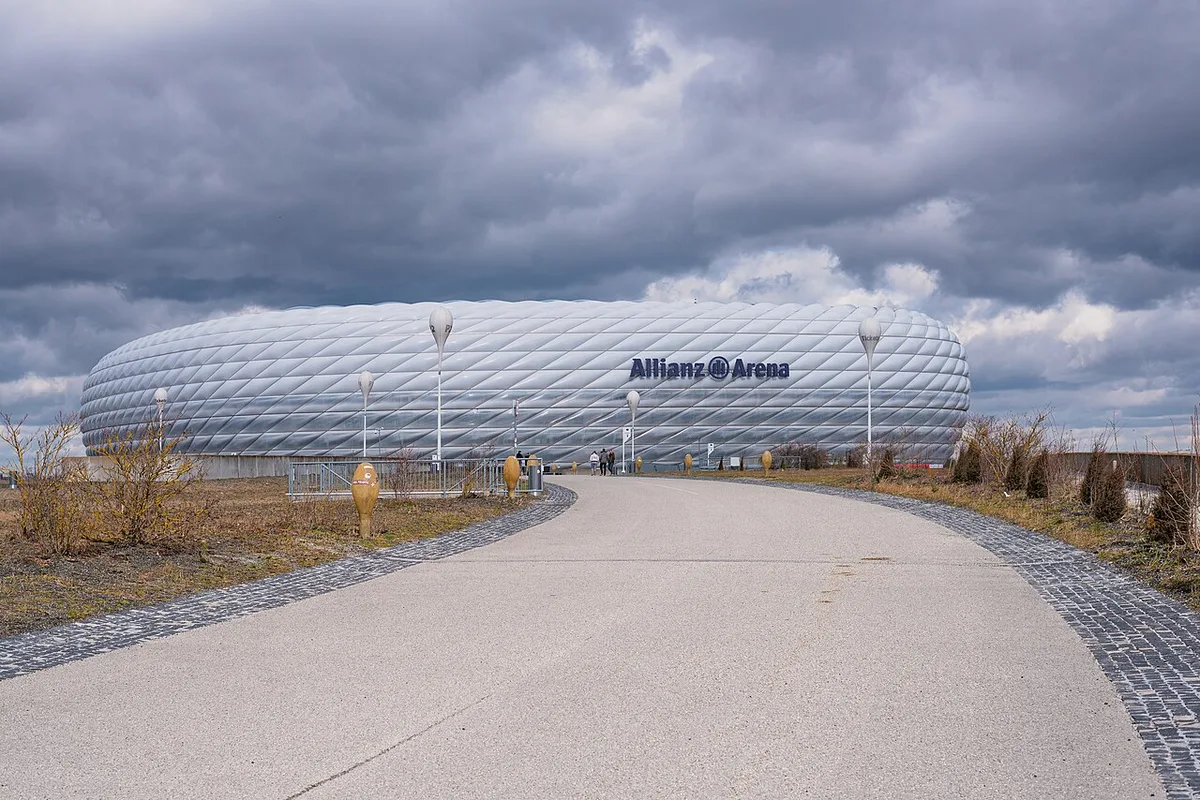
The historical genesis of Allianz Arena is closely intertwined with profound structural shifts in Munich football and the drive to modernize national sports infrastructure ahead of the 2006 FIFA World Cup. Prior to its construction, the city’s major clubs—Bayern Munich and TSV 1860 Munich—shared the legendary Munich Olympic Stadium, a tent-roof architectural masterpiece designed by Günter Behnisch for the 1972 Summer Olympics. Over time, however, the Olympic Stadium increasingly revealed limitations against modern football standards, particularly the vast distance separating spectators from the pitch due to its athletics track, alongside a canopy roof inadequate for shielding fans from harsh Bavarian winter weather. A historic referendum took place in October 2001, in which an overwhelming majority of Munich voters approved building a brand-new football-specific stadium, opening a pivotal chapter for a contemporary architectural icon.
The architectural design of Allianz Arena was entrusted to the world-renowned Swiss firm Herzog & de Meuron, who proposed a revolutionary concept in both materiality and form. Construction officially began in autumn 2002 and concluded in spring 2005, backed by substantial capital investment from both tenant clubs and financial partners. The structure’s groundbreaking engineering centerpiece lies in its exterior facade composed of 2,874 aerodynamic ETFE foil air cushions—measuring a mere 0.2 millimeters thick yet boasting extraordinary mechanical strength, self-cleaning properties under rainfall, and superior fire resistance. Beyond creating the distinctive silhouette of a giant air-filled cushion or luminous vessel, this membrane envelope integrates advanced lighting technology capable of shifting colors dynamically, turning the entire architectural volume into a massive optical screen mirroring events unfolding inside.
Over more than two decades of existence, Allianz Arena has witnessed and hosted defining moments in German football as well as European cultural and social life. The stadium officially inaugurated on May 30, 2005, with a friendly match between TSV 1860 Munich and 1. FC Nürnberg, followed the next day by Bayern Munich facing the German national team. Its first global milestone arrived with the opening match of the 2006 FIFA World Cup between host Germany and Costa Rica, where millions of viewers worldwide first beheld the facade glowing brilliant red for Bayern Munich matches, pure white when hosting the German national side, or signature blue when TSV 1860 Munich took the pitch during the years the club co-owned a stake in the venue.
Shifts in financial ownership also left a decisive mark on the venue’s operational history. During a period of severe financial strain for TSV 1860 Munich, Bayern Munich purchased its crosstown rival’s remaining shares in 2006, officially assuming sole ownership of the stadium. That move relieved its longtime rival of heavy debt burdens while cementing the unrivaled stature of Germany’s most storied club inside its own fortress. Since then, Bayern Munich’s vibrant red has reigned supreme across the ETFE membrane facade on match weekends, transforming the arena into an impregnable stronghold and a symbol of Bavarian sporting supremacy across the Old Continent.
In terms of national symbolism and cultural influence, Allianz Arena transcends the role of an ordinary sports venue to stand as an emblem of technical innovation, precision engineering, and contemporary German minimalist aesthetics. It redefined stadium design benchmarks worldwide, proving that architecture need not remain a static mass of reinforced concrete, but can operate as a living organism communicating intuitively with its surroundings through light and motion. Blockbuster UEFA Champions League nights, historic showpieces such as the 2012 Final between Bayern Munich and Chelsea, and UEFA Euro 2024 fixtures have all solidified this landmark’s legendary status in the collective memory of millions of football fans across the globe.
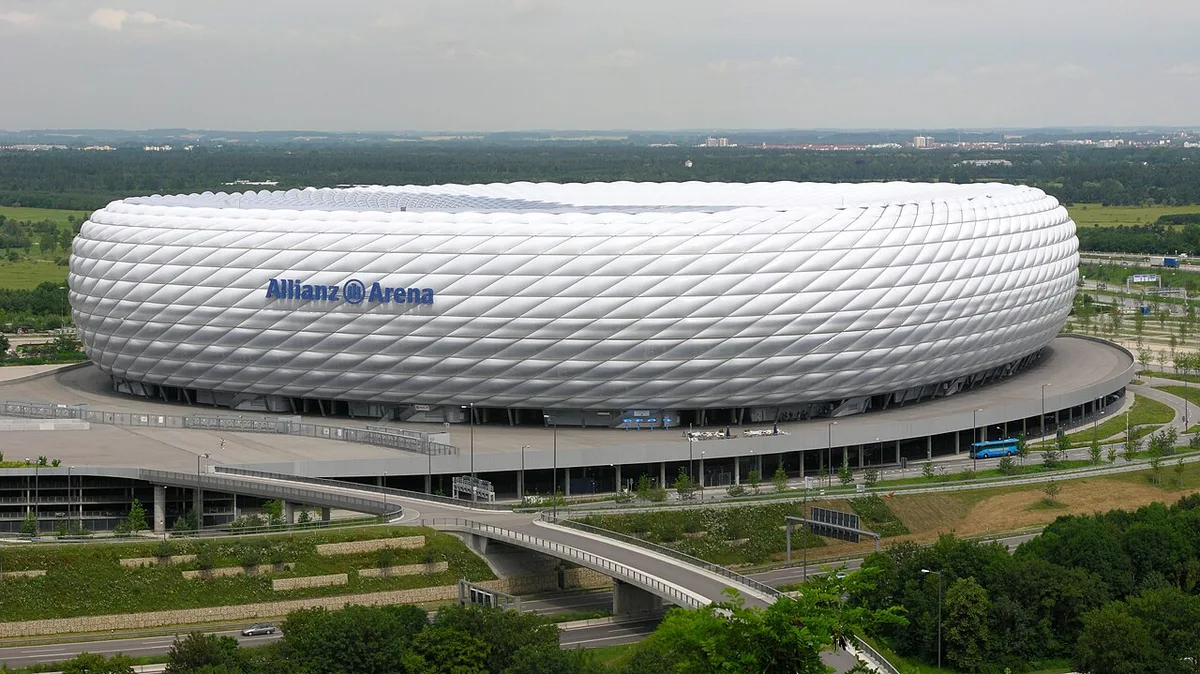
Viewed through the lens of international cultural tourism, Allianz Arena has evolved from a purely functional arena into a premier urban tourism magnet in southern Germany. Every year, millions of visitors from every continent flock here not only to tour the players’ dressing rooms, the famous players’ tunnel, and the FC Bayern Museum, but also to admire the engineering marvel of one of the world’s most distinctive architectural membrane shells. The seamless fusion of visionary urban planning, cutting-edge structural engineering, and illustrious sporting heritage guarantees Allianz Arena Munich’s singular standing—affirming it as vivid proof of the synergy between culture, architectural art, and sports economics in the age of globalization.
Allianz Arena Munich, begun in 2002 and officially inaugurated in May 2005, marked a revolutionary milestone in global sports architecture and contemporary urban planning in Bavaria, Germany. Positioned in Fröttmaning at Munich’s northern edge and designed by acclaimed Swiss architectural practice Herzog & de Meuron, the venue embodies a seamless union of advanced structural engineering and monumental urban sculpture. Commissioned to succeed the iconic Munich Olympic Stadium after its historic service since the 1970s, the project met rising demand for a modern football-only arena fulfilling UEFA’s strictest criteria for international fixtures. Its spatial conception emerged from a fiercely contested international design competition in which the architects triumphed over formidable rivals with a bold proposition: transforming a colossal sports stadium into a living architectural entity whose appearance shifts continuously with time and the events taking place within.
In master spatial planning, Allianz Arena occupies an expansive plot on Munich’s northern alluvial plain, where level topography enables sweeping long-distance sightlines toward an iconic sculptural volume. Covering hundreds of thousands of square meters across the wider complex, the stadium and its supporting infrastructure integrate multi-level access networks, Europe’s largest underground multi-story parking structures, and broad public plazas built to welcome vast crowds. The stadium’s zoning unfolds in tightly orchestrated concentric rings, beginning with a FIFA-standard pitch equipped with subterranean drainage and hydronic heating pipes, encircled by steep four-tier grandstands engineered for unobstructed sightlines from every seat. Surrounding buffer zones house spacious concourses, retail amenities, club heritage galleries, VIP hospitality suites, restaurants, and international media facilities—all laid out coherently to optimize pedestrian flow and prevent bottlenecks during sell-out events.
Allianz Arena Munich ranks among Europe’s highest-capacity venues, opening with roughly 66,000 seats and expanding through subsequent structural upgrades to surpass 75,000 seats for domestic and international fixtures. Spectators arriving at the venue experience a scientifically planned transit and pedestrian network, with Fröttmaning U-Bahn station located a short walk away via elevated bridges and broad esplanades designed to disperse tens of thousands of fans within minutes. Rising approximately fifty meters from ground level to its highest roof ridge, the stadium commands an imposing geometric presence that nevertheless feels weightless thanks to its translucent, feather-light outer shell. Wrapping this vast spatial volume are thousands of cushions crafted from high-performance ETFE (Ethylene Tetrafluoroethylene) fluoropolymer foil—a revolutionary alternative to traditional glass prized for ultra-lightweight strength, rainfall self-cleaning properties, and resilience against southern Germany’s demanding weather extremes.
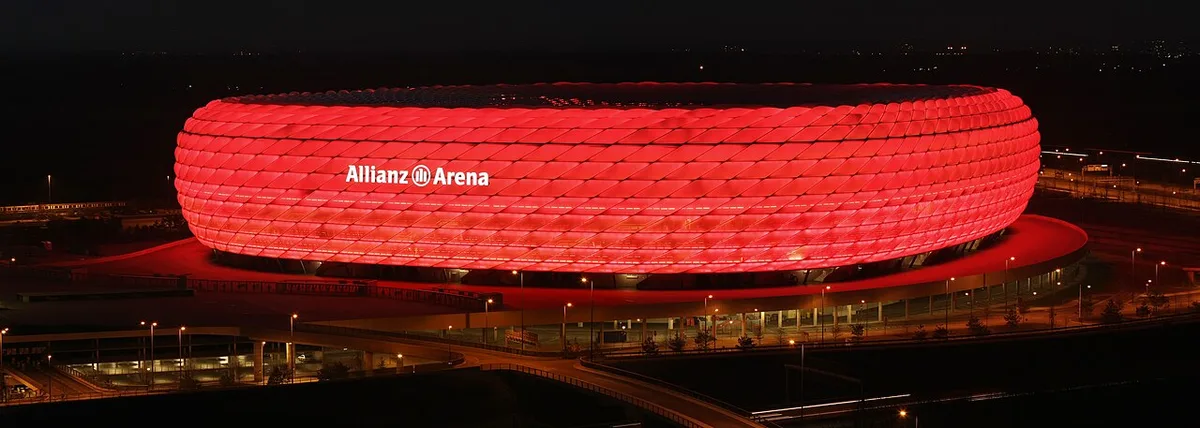
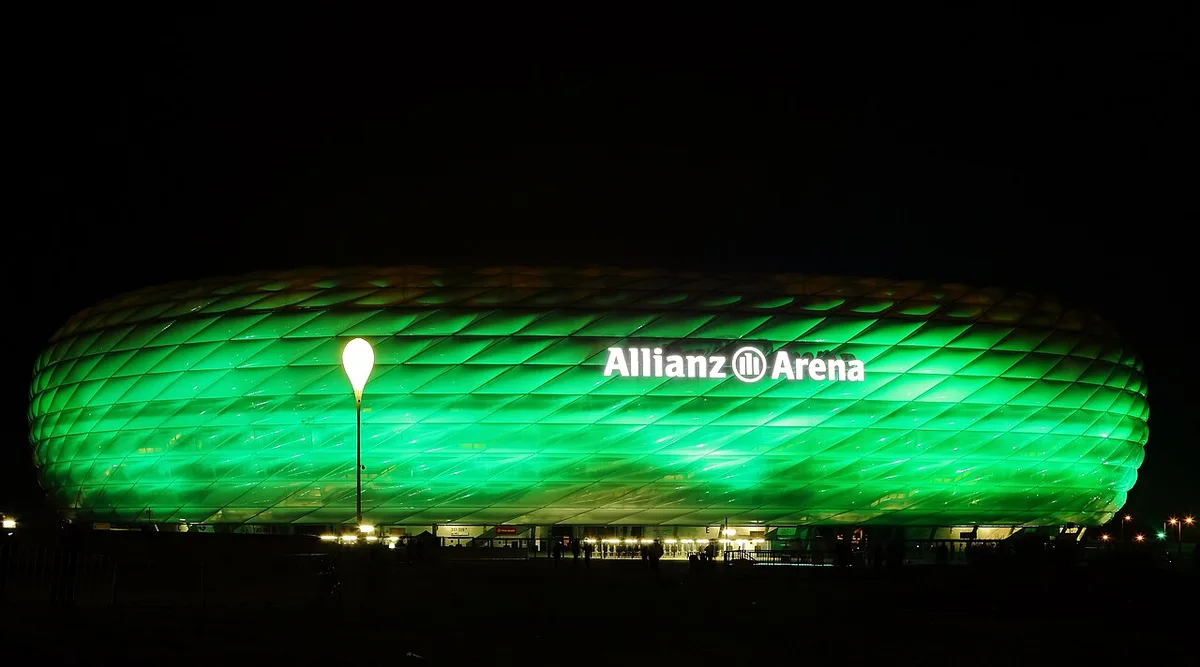
Construction engineering and material execution at Allianz Arena exemplify the zenith of civil engineering and structural steelwork at the turn of the twenty-first century. The stadium’s primary load-bearing skeleton comprises thousands of tons of high-tensile structural steel precision-fabricated off-site before assembly via heavy cranes. A tensioned-membrane roof integrated with spatial steel trusses shelters every tier from rain and snow without interior support columns, guaranteeing clear sightlines from every seat in the house. Technologically, its signature innovation lies in the color-changing LED illumination system embedded behind the ETFE panels. Through digital lighting control, the entire diamond-patterned exterior transforms seamlessly between vibrant red for Bayern Munich home matches, crisp white for German national team fixtures, or blue and special palettes for civic and non-sporting events—creating a dramatic visual beacon visible from dozens of kilometers away along autobahns approaching Munich.
Integrating the venue into Munich’s transit network and natural landscape also required intricate, high-investment infrastructure planning. Adjacent to the stadium sits Europe’s largest multi-story parking facility, accommodating nearly 10,000 cars and hundreds of coaches with dedicated highway slip roads designed to minimize traffic spillover into neighboring residential districts. Architects and planners further prioritized environmental sustainability by installing rainwater harvesting and recycling systems to irrigate the pitch alongside energy-efficient lighting and climate controls across hospitality zones. Broad granite-paved esplanades encircling the base serve not only as crowd-dispersal concourses, but also as open civic plazas hosting cultural gatherings that keep the precinct vibrant year-round beyond major matchdays.
Ultimately, this landmark established a new paradigm in large-scale public architecture, where contemporary sculptural expression merges with advanced material science and forward-looking urban planning. Its triumph resides not merely in vast seating capacity or the visual drama of its ETFE air-cushion facade, but equally in how intuitively the building interacts with people—from effortless transit circulation to the multidimensional sensory experience of stepping inside its sweeping bowl. After nearly two decades of operation, the stadium remains one of the greatest masterpieces of sports architecture ever built, standing as proof of human ingenuity in conquering structural, material, and urban spatial challenges.
Allianz Arena Munich rises in the northern reaches of Munich, Bavaria, in the Federal Republic of Germany, marking a revolutionary landmark in twenty-first-century sports architecture. Conceived by renowned Swiss architects Herzog & de Meuron, the building moves well beyond the utilitarian bounds of a football arena to stand as a global urban sculpture. Begun in 2002 and inaugurated in 2005, it embodies pioneering design philosophy in which advanced structural engineering intersects deeply with visual theory and modern sculptural form. Bringing this vision to reality demanded profound mastery of material science, structural mechanics, and public spatial psychology, resulting in a civic gathering place infused with unmistakable Bavarian identity.
Examining the overall structure, its defining breakthrough is an outer envelope composed of 2,874 diamond-shaped ETFE air cushions, making it the largest membrane-clad building on the planet. Measuring less than two-tenths of a millimeter thick, these translucent fluoropolymer foils possess extraordinary tensile durability, severe-weather resistance, and rainfall self-cleaning properties engineered into their surface finish. Utilizing ETFE not only dramatically reduced deadweight loads across the roof and facade, but also created an ideal daylight diffuser by day and a monumental illuminated canvas by night. Dynamic chromatic shifts across this shell via digital LED lighting completely transformed the surrounding urban nightscape, fostering an ongoing dialogue between static architectural form and kinetic light.
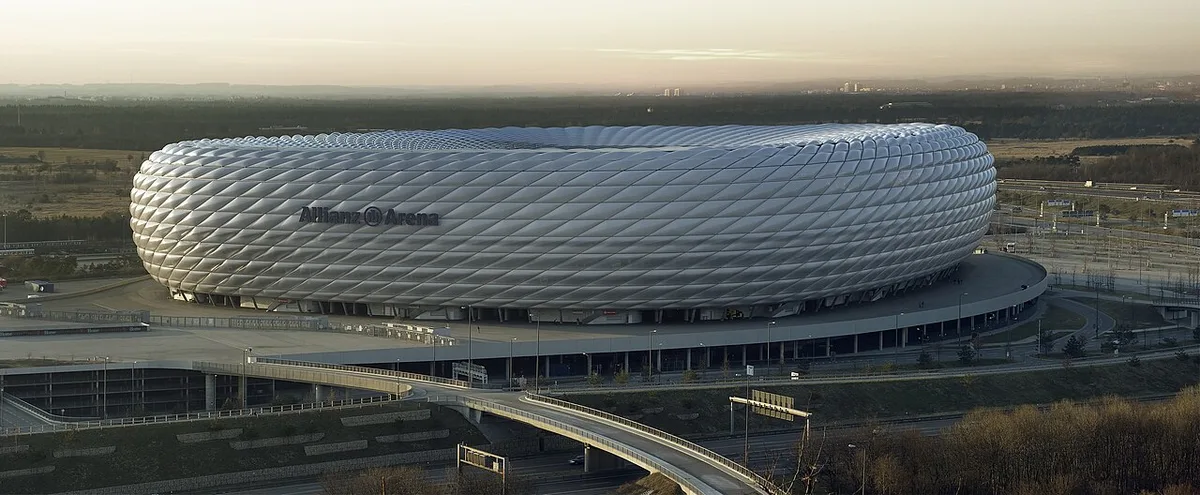
Inside, the stadium bowl is organized into steeply raked seating tiers calculated with mathematical precision to optimize sightlines toward the pitch from every angle. Lower, middle, and upper tiers are cleanly delineated by generous concourses served by escalators and prestressed reinforced-concrete stairwells. Its compact elliptical footprint not only satisfies stringent international sporting criteria, but also generates distinct acoustic resonance: the roar of tens of thousands of supporters rebounds and amplifies continuously off the overhanging roof canopy, producing an electric atmosphere unmatched in European stadium design. Every geometric and engineering choice reflects human-centered design philosophy placing the spectator’s visual and acoustic experience front and center.
The color-shifting illumination of the ETFE shell carries deep cultural and symbolic resonance for supporters and Munich’s civic community alike. When the home club takes the field, brilliant red blankets the entire facade, proclaiming traditional club colors and Bavarian pride. Conversely, during international fixtures or when the German national team plays, the exterior shifts to pure white, symbolizing neutrality, sporting nobility, and national unity. On special occasions or in solidarity with global social initiatives, the facade displays multicolor patterns and intricate light displays—turning the arena into a colossal urban visual canvas reflecting the pulse and cultural movements of the contemporary world.
Beneath the luminous outer shell and shaded grandstands lies a complex subterranean infrastructure housing athlete facilities, press conference auditoriums, technical plant rooms, and premium hospitality suites. The players’ dressing rooms are crafted as serene inner sanctuaries designed for peak pre-match focus and post-match reflection. Interior finishes—natural timber, tempered glass, and brushed stainless steel—are thoughtfully curated to balance refined elegance with rigorous functional durability. Pitch maintenance integrates underground heating, vacuum drainage, and supplemental grow-light rigs mimicking the solar spectrum to keep the turf in peak biological condition regardless of harsh southern German winters.
Appreciating the heritage depth of this landmark calls for viewing it through twenty-first-century civic architecture, where iconic structures no longer serve a single isolated function but anchor regional urban identity. Allianz Arena Munich has transcended the role of sports venue to become a monumental light sculpture and spatial landmark along the vital highway corridor connecting Germany with Central Europe. Its synthesis of modernist minimalist form and cutting-edge material science reshaped how people experience monumental scale. The stadium stands enduringly as evidence of how structural engineering ascends to high art when guided by a singular creative vision, leaving a lasting legacy in human architectural culture.
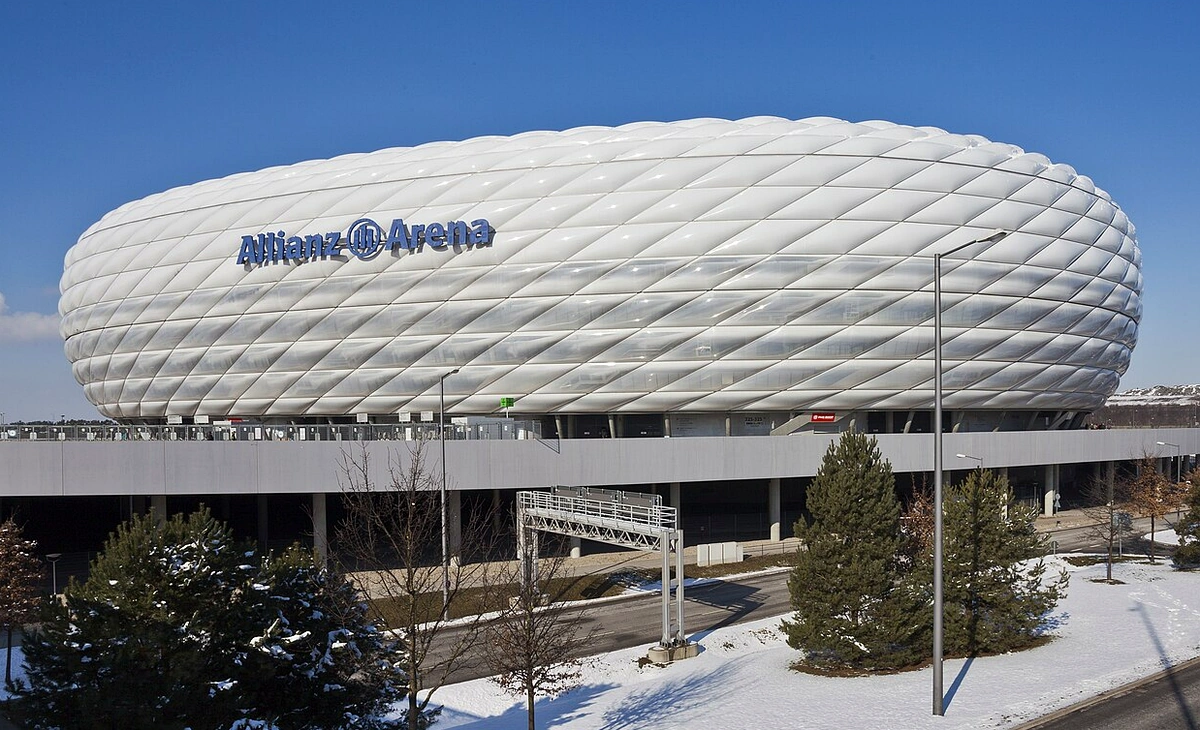
Allianz Arena Munich rises across the northern plains of Bavaria’s capital as a timeless architectural presence where local daily rhythms blend seamlessly with the contemporary pulse of one of the world’s greatest sporting venues. As the first rays of dawn pierce thin morning mist drifting off the fast-flowing Isar River nearby, the landscape around the arena awakens in quiet majesty. At this early hour, its outer shell of nearly three thousand translucent ETFE (ethylene tetrafluoroethylene) cushions has yet to switch on artificial lighting; instead, it reflects natural morning light in pure ivory-white tones, evoking a colossal iceberg or giant seashell resting amid expansive meadowlands. Local residents from neighboring communities such as Fröttmaning frequently choose this tranquil dawn window for morning exercise along dew-kissed jogging paths and manicured lawns ringing the stadium perimeter. Amateur runners, road cyclists, and elderly morning walkers compose a peaceful daily tableau reflecting Munich residents’ close bond with nature and open public spaces. Behind the scenes, technical staff and groundspeople are already hard at work inspecting climate systems, preparing pristine turf surfaces for training sessions, and overseeing comprehensive security across the vast complex. Morning calm soon gives way to brisk daytime energy as the sun climbs higher and visitors from around the globe begin arriving via Europe’s premier public transit network onto the stadium’s central esplanade.
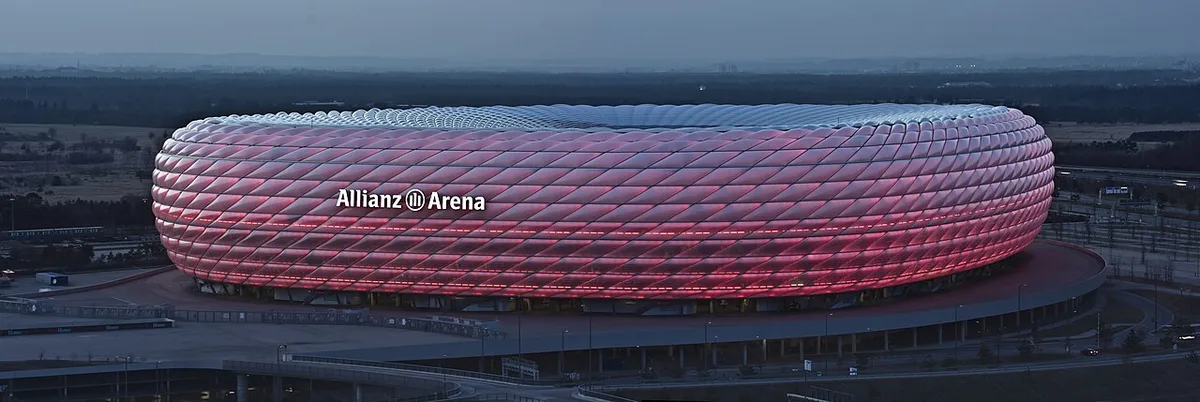
By midday, the grounds around Allianz Arena transform into a vibrant hub where FC Bayern Munich’s storied football heritage intersects with commerce, education, and entertainment. Concourses, the club museum, and official megastores welcome steady streams of architecture scholars, design students, and passionate supporters from every continent. Aromas of traditional Bavarian pretzels mingle with freshly brewed coffee drifting from outdoor cafes, where patrons animatedly debate match tactics, World Cup lore, and the legends who have graced this turf. Multilingual tour guides lead groups deep inside the venue through the players’ tunnel, minimalist yet commanding dressing rooms, and pitchside technical dugouts that have witnessed countless triumphs. Under bright daylight, the ETFE membrane proves its engineering brilliance by diffusing natural sunlight evenly into interior spaces while shedding dust whenever rain falls. Contemporary art showcases and pop-up exhibitions frequently animate the broad concrete esplanades around the stadium’s base, offering an open cultural forum where street artists and young designers display sculptures and installations exploring the interplay among humanity, technology, and sport in the digital age.
As sunset paints the western German horizon, the scenery surrounding Allianz Arena shifts into an entirely different aesthetic mood—radiant and evocative. Warm amber-gold evening light washes across the ETFE cushions, creating a smooth chromatic gradient from soft blush pink to deep amber that accentuates the building’s sweeping curves just before nightfall. At this magic hour, the most prized panoramic viewpoints emerge, drawing professional photographers and travelers chasing the ultimate urban light. The finest vantage point sits atop nearby Fröttmaning Hill, an elevated green mound from which onlookers can capture the stadium’s giant UFO-like silhouette poised beside curving autobahns streaking with headlights. From above, the arena looks like a futuristic vessel, a colossal astronomical observatory, or a glowing light sculpture set down in Munich’s northern suburbs. Once darkness falls completely, thousands of interior LED fixtures ignite, turning the entire stadium into an optical lighthouse visible from tens of kilometers away aboard flights descending into Munich Airport. Depending on the event inside or civic celebrations, the arena glows fiery red for Bayern Munich home matches, crisp white or blue for special occasions, or vibrant rainbow hues during Pride weeks and community cultural festivals.
On match nights, when top-flight fixtures kick off, the atmosphere inside and around the stadium reaches a fever pitch of passion and collective emotion. Chants from tens of thousands of supporters on steep grandstands create a thunderous acoustic resonance echoing across the pitch and radiating outward through the sound-insulated facade. Across the city, local life converges in traditional beer halls and open-air public viewing zones where fans gather, raise hefty Bavarian beer steins, and follow every pass on giant screens. Experiencing matchday here goes far beyond watching ninety minutes of football—it is immersion in a modern European civic ritual akin to a secular festival. After the final whistle blows, crowds file smoothly out through exits engineered around crowd-flow science, heading toward the U-Bahn metro in remarkable order guided by local stewards and volunteers. The transition from roaring energy back to midnight stillness unfolds swiftly and seamlessly as exterior facade lights dim for the night. The final footsteps fade into darkness, leaving behind an enduring architectural icon quietly gathering energy for a new cycle beginning at dawn across storied Bavaria.
The neighborhood surrounding Allianz Arena Munich, at the northern edge of Bavaria’s capital in Germany, is not merely a twenty-first-century sporting temple famed for its color-changing ETFE facade, but also a vibrant culinary landscape showcasing the finest gastronomy of southern Germany. To appreciate the full flavor map of this district, one must look back at how Bavarian cuisine took shape from demanding soil conditions, centuries-old agricultural traditions, and ancient Germanic heritage. Dishes found around the area—from historic tavern inns tucked inside former farming villages like Fröttmaning to matchday food stalls serving tens of thousands of spectators—embody hearty generosity, practicality, and time-honored preservation crafts handed down across generations.
At the heart of regional gastronomy stands the art of pork preparation, with Schweinshaxe—crispy roasted pork knuckle—reigning supreme in local culinary tradition. Crafting Schweinshaxe at traditional kitchens near Allianz Arena demands meticulous attention to detail: selecting meaty fore-knuckles balanced with marbling, seasoning with garlic, coarse sea salt, black pepper, and rosemary, and braising gently in rich vegetable stock before roasting at high heat. The secret to achieving crackling skin that shatters crisply without turning tough—while keeping the interior meat succulent, tender, and deeply flavorful—lies in basting the rind repeatedly with dark wheat beer during the final stages of roasting. Served piping hot, it is traditionally accompanied by potato dumplings known as Knödel—an ingenious staple born from local farm harvests—alongside tangy braised sauerkraut to balance the rich, savory pork.
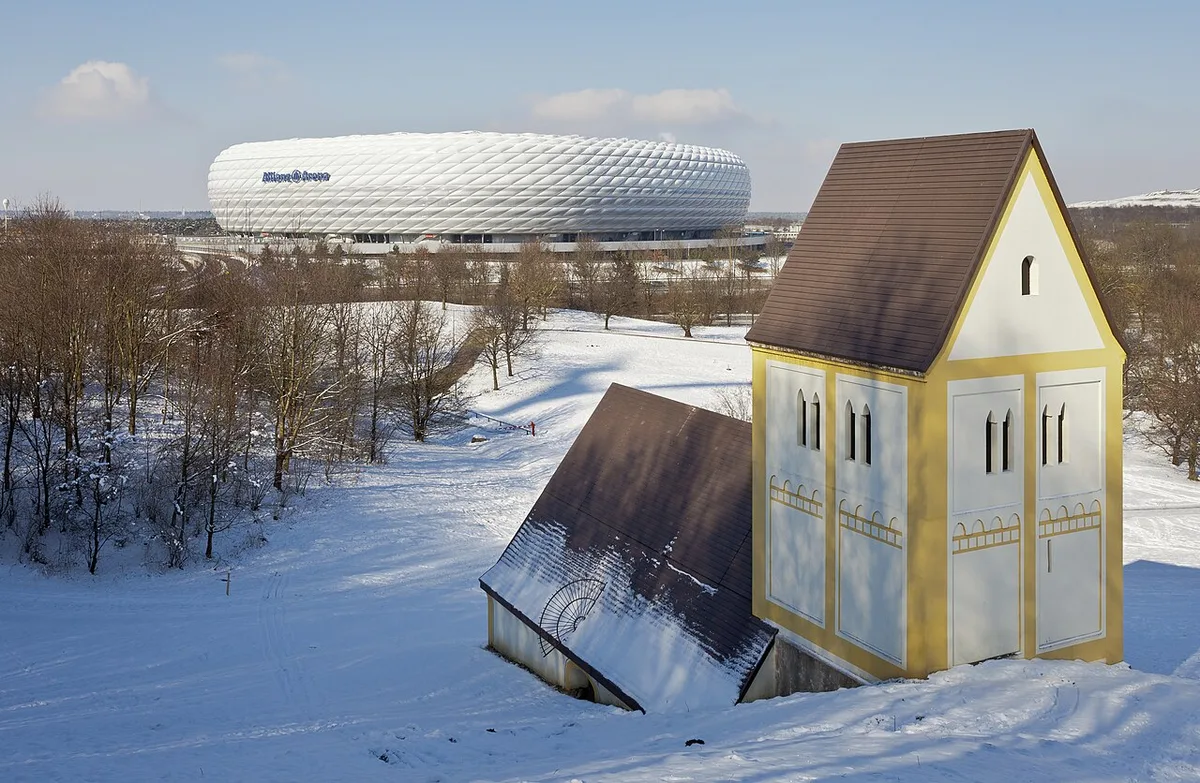
Alongside roast pork knuckle, Munich white sausage—Weißwurst—stands as an immortal culinary emblem tied to Bavarian morning rituals. Made from finely minced veal and fresh pork back bacon blended with fresh parsley, lemon zest, onions, and traditional spices, Weißwurst owes its characteristic pale ivory hue to the complete absence of nitrites or artificial preservatives. Enjoying Weißwurst follows strict, time-honored custom: traditionally served only in the morning, it must be eaten before the church bells chime noon—a rule dating back to pre-refrigeration days when fresh veal had to be prepared and consumed early in the day at peak freshness. Before serving, the sausages are gently warmed in hot water rather than boiled so their delicate natural casings never burst. Diners pair Weißwurst with coarse-salted Bavarian pretzels and sweet Bavarian mustard, traditionally peeling back the casing by hand or using the classic “zuzeln” technique rather than slicing it like ordinary sausage, turning breakfast into a uniquely interactive local ritual.
The culinary ecosystem around the stadium is also deeply shaped by craft brewing heritage safeguarded since 1516 by the Reinheitsgebot, the Bavarian Beer Purity Law. Signature pours served across the district include Helles, a crisp, golden lager with delicate hop balance, and Weißbier, an unfiltered wheat beer celebrated for natural notes of banana and clove. Local beer-drinking etiquette centers on hefty one-liter glass mugs called Maß and the ritual of clinking glasses while making sincere eye contact to honor friendship and camaraderie. During major celebrations across northern Munich, beer culture transcends simple refreshment to act as a social catalyst uniting all walks of life along long communal timber benches over cold steins, golden rotisserie chicken, and giant pretzels.
Exploring the wider urban fabric extending from Allianz Arena toward nearby Schwabing and Munich’s historic Altstadt-Lehel old town reveals a harmonious blend of heritage and modernity. Along tree-lined boulevards and cobblestone lanes, centuries-old traditional inns known as Wirtshäuser stand alongside contemporary restaurants reinterpreting regional flavors. Inside a classic Wirtshaus, dark oak paneling, the clatter of stoneware, and warm laughter foster an inviting atmosphere reflecting southern Germany’s unhurried appreciation for hospitality and family values. No menu is complete without Obatzda, a velvety Bavarian cheese delicacy whipped from ripe Camembert, butter, finely diced onions, sweet paprika, and a splash of wheat beer—creating a rich, spiced orange spread ideal for slathering onto crusty bread alongside afternoon pints.
Regional dessert craftsmanship equally reflects Alpine harvests and rustic mountain traditions. Warm Apfelstrudel—paper-thin layers of flaky pastry wrapped around tart-sweet apples, raisins, cinnamon, and butter-toasted breadcrumbs served with vanilla sauce or whipped cream—provides a classic finale to a hearty Bavarian meal. Meanwhile, traditional yeast-dough specialties such as Dampfnudeln—pillowy steamed sweet dumplings served with warm vanilla custard or tangy plum compote—showcase generations of Bavarian home-baking ingenuity using simple wheat and dairy staples. Over the decades, even as neighborhoods around Allianz Arena have modernized and welcomed global visitors, its culinary heritage has steadfastly preserved its authentic soul, acting as a living museum of history, custom, and the art of good living beneath the Alps.
Situated on the northern outskirts of Munich in Bavaria, Federal Republic of Germany, Allianz Arena is not only an iconic architectural monument of world football, but also a bustling micro-metropolis welcoming millions of cultural explorers and sports fans annually. Planning a seamless visit to this ETFE-clad marvel begins with understanding seasonal weather patterns, Munich’s integrated public transit system, and local security and cultural etiquette. Climatically, Munich experiences a temperate continental climate with pronounced seasonal swings requiring thoughtful packing and itinerary planning. Spring, from March through May, brings blossoming landscapes alongside lingering early-season chill, while summer from June through August delivers warm days occasionally topping 30°C—ideal for exploring the stadium’s exterior grounds. Autumn arrives in September with golden Bavarian foliage before giving way to crisp, frosty winters from December through February, when temperatures regularly dip below freezing and snow blankets the stadium’s inflated outer cushions.
Transit connections linking central Munich with Allianz Arena operate with hallmark European precision. The U-Bahn underground railway—specifically line U6 heading north to Fröttmaning station—serves as the primary lifeline for visitors. From Fröttmaning station, a dedicated pedestrian esplanade stretching roughly 600 meters leads directly to the main plaza before the stadium gates. Public buses also provide flexible alternatives during peak periods or major international tournaments. For travelers prioritizing door-to-door convenience, taxis and ride-hailing apps are readily available from Marienplatz or Franz Josef Strauss International Airport, though fares and travel times increase substantially on major matchdays due to strict police traffic cordons and road diversions. Purchasing integrated transit passes such as an MVV Day Ticket or Group Day Ticket offers the most economical and convenient way to ride across Munich’s entire public transport network.
The best time of day to photograph Allianz Arena’s striking architecture revolves around its color-changing ETFE facade illumination. Late afternoon into dusk is truly magical, as integrated LED panels ignite in vibrant red for Bayern Munich fixtures—or white and blue depending on scheduled events—while residual twilight still glows in the sky. Natural dusk light combined with luminous architectural engineering creates an unforgettable visual spectacle reflecting Herzog & de Meuron’s contemporary design vision. To avoid peak crowds and explore the interior bowl, FC Bayern Museum, and players’ tunnel at a relaxed pace, visitors should book morning tour slots on non-matchday weekdays.
Packing appropriate attire requires balancing seasonal weather with extensive walking around the complex. Because open concourses and broad exterior plazas experience brisk breezes even during summer months, carrying a lightweight windbreaker or sweater is always smart. In winter, an insulated coat, slip-resistant walking shoes, a knit hat, and warm gloves are essential protection against southern Germany’s biting cold. When joining stadium tours or attending matches, opt for comfortable clothing and supportive sneakers, as exploring the grounds and climbing steep grandstand steps can involve hours on your feet.
Respecting security protocols and local etiquette is paramount for every international guest visiting the arena. Stadium management enforces strict electronic screening at all entry gates, prohibiting hazardous items, pyrotechnics, weapons, glass bottles, and professional cameras with detachable lenses unless accredited with official media passes. Bag sizes permitted inside are strictly capped under European stadium security rules, and larger backpacks or luggage must be checked at automated storage lockers outside the main gates prior to ticket inspection. Good etiquette also includes keeping concourses clean, refraining from smoking in prohibited indoor zones, and following instructions from stewards and local volunteers.
Managing museum tickets and match passes requires early planning due to tremendous global demand from football supporters. Tickets for the FC Bayern Museum and behind-the-scenes arena tours should be booked in advance via the official online portal to secure preferred time slots and avoid sell-outs during peak travel seasons. For top-flight Bundesliga clashes or European cup nights, purchasing tickets through unauthorized resellers carries high risks of invalid passes or heavily inflated prices. Visitors should also note that ticketing relies on digital barcodes, mobile QR codes, or smartcards, and guests may be asked to present matching photo identification at automated security turnstiles to guarantee transparency and safety for everyone inside.
To experience this journey to the fullest alongside a local guide, explore our 9D8N Germany – Austria – Hungary – Czech Republic Tour with a thoughtfully curated itinerary.