Stepping back into the turbulent years of the 13th century, when Europe was still steeped in the slow shifts of medieval feudalism, a small fishing settlement began to take shape along the lower Amstel River—in what would one day become the vibrant heart of the land of tulips. Around 1270, by the river mouth where the tides of the Zuiderzee churned day and night, the area’s earliest inhabitants teamed up with local lords—most notably the powerful noble house of Amstel, prominently represented by Gijsbrecht III van Amstel—to embark on a fateful engineering project that would transform the local human geography. Together, they built a sturdy water-retaining dam to block gales and saltwater surges from pushing deep inland, protecting their livelihoods and early reclaimed plots. From those humble beginnings, the name Amsterdam was born, taken directly from that historic dam on the Amstel—still affectionately called De Dam by locals—setting the stage for a wild marshland to rise into one of Northern Europe’s busiest commercial ports.
Across centuries of historical accumulation, the face of this central square has witnessed sweeping transformations across dynasties and eras. In the 17th century, during the golden age of Dutch maritime trade when vessels of the East India Company sailed across the seven seas, famed cartographer Barlaeus described Dam Square as the “throat of land and sea”—where the vitality, economic lifeblood, and political authority of the entire realm converged. Far more than an open urban plaza, this space served as a grand stage for profound shifts in power. When the Netherlands’ fate became intertwined with conquests and upheavals across the European continent under the French Empire, the classical medieval town hall here was repurposed into a new symbol of royalty, as King Louis Bonaparte—brother of Emperor Napoleon Bonaparte and then King of Holland—chose it as his royal palace, infusing the historic setting with architectural and political currents from continental Europe.
Yet beneath the splendor of royal residences and the brisk pulse of a modern city, Dam Square has never forgotten the scars that harsh history etched into its cobblestones. The deepest and most painful wound in community memory occurred on May 7, 1945. At the time, World War II in Europe seemed to have ended with Nazi Germany’s unconditional surrender, and thousands of Amsterdam residents poured joyfully into the square to celebrate liberation in an outpouring of emotion. Amid that fragile turning point, bursts of gunfire from remaining German defensive posts suddenly raked the unarmed crowd, claiming the lives of many innocent civilians in a place that had just begun to feel the light of peace.
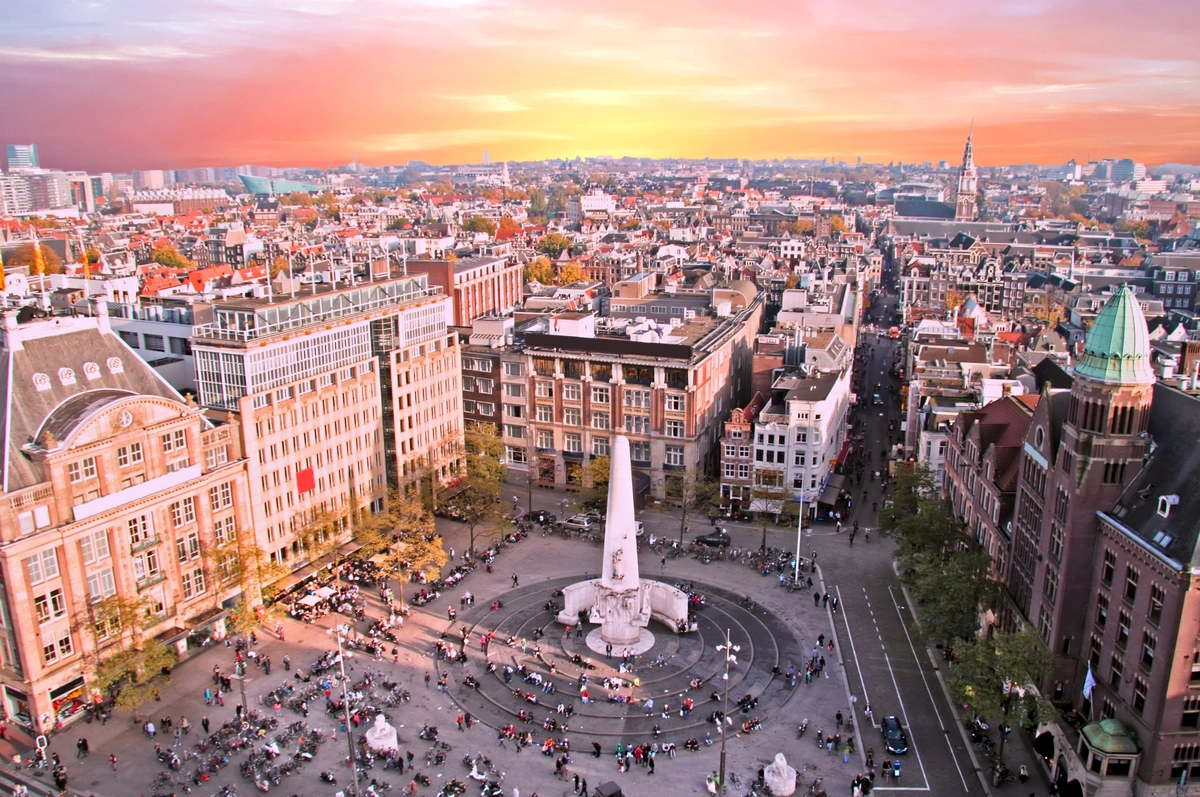
To honor those heavy losses and commemorate the resilience of the Dutch people through the fires of war, a monument of special spiritual and historical significance was unveiled at the center of the square in 1956 to a design by gifted architect J.J.P. Oud: the National Monument, with its towering white travertine limestone wall rising into the Amsterdam sky. Carved into those cool yet sacred stone slabs are inscriptions recording the grief of war while honoring the indomitable spirit and ardent longing for freedom of those who gave their lives for their homeland. Today, walking across the wide expanse of Dam Square, visitors do more than watch lively crowds from around the world—they touch a living chronicle where every inch of ground and every corner whispers stories of a community that tamed the sea, stood firm through historical storms, and kept its national soul intact across the ages.
Viewed through the lens of landscape anthropology and Western urban planning paired with Eastern feng shui correlations, Dam Square appears as a geographical marvel shaped by Dutch determination and strategic foresight. In terms of natural topography, this entire historic site sits on a low-lying downstream delta plain roughly two meters below average sea level. Since time immemorial, it has formed a landscape of interlocking waterways and surrounding basins, where the gentle yet forceful Amstel River flows steadily from south to north through the city before pouring into the broad IJ bay right along the northern edge of the square—making this spot the vital trade and water-management gateway of the Low Countries.
That very geology posed a life-or-death challenge to pre-modern urban builders. The ground beneath Dam Square and its surroundings was not solid bedrock, but deep soft clay and thick layers of mud accumulated over centuries. To overcome natural subsidence and turn a waterlogged marsh into a sturdy seat of power, the Dutch pioneered one of architecture’s greatest foundation techniques: wooden foundation piling, known as heipalen. With extraordinary patience, tens of thousands of large pine and oak trunks were driven deep through soft mud until reaching firm sand strata far below the ancient seabed. These inverted forests of timber quietly bore the weight of the grand structures ringing the square, forming a durable foundation system that has endured centuries of wind and time.
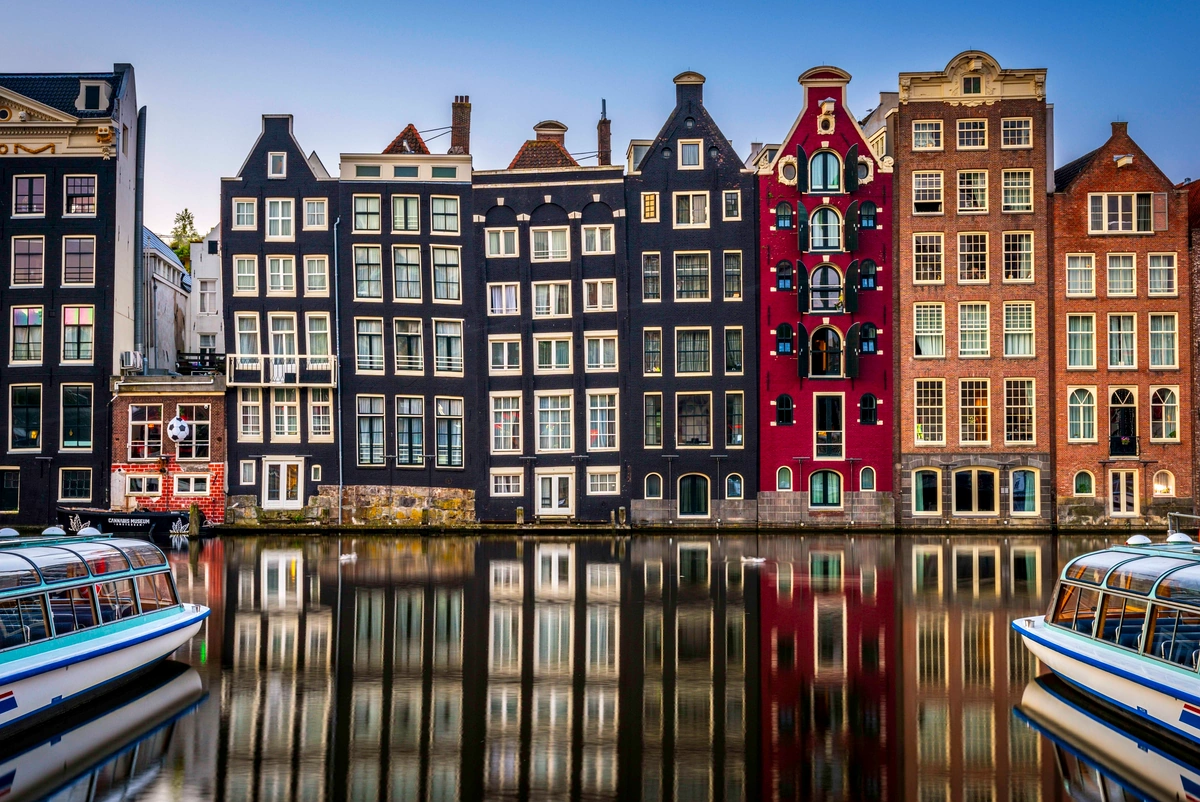
Beneath that complex geology lies an irregular polygonal plan governed by a tightly reasoned spatial philosophy that balances civic and religious authority alongside commercial vitality, characteristic of medieval and early-modern Europe. Looking across the square as a whole, a clear division of power is tightly linked through a central visual axis. Standing prominently on the west side is the Royal Palace of Amsterdam—supreme symbol of secular authority and administrative governance. Facing it across the east side is the New Church (Nieuwe Kerk), representing the community’s religious soul and spiritual life. Meanwhile, the north and south sides open like extensions of commercial capital flows, where merchants, markets, and boats once converged.
This refined spatial arrangement created a lasting civic magnet: royal authority anchoring one side, sacred tradition balancing the other, and at the center a bustling public commons and market heart. Dam Square thus rises above an ordinary open plaza to become a living museum of mastering nature—where people did not yield to difficult terrain, but used technical knowledge, urban planning, and strategic vision to turn a low-lying basin below sea level into the beating heart of a global maritime trading empire.
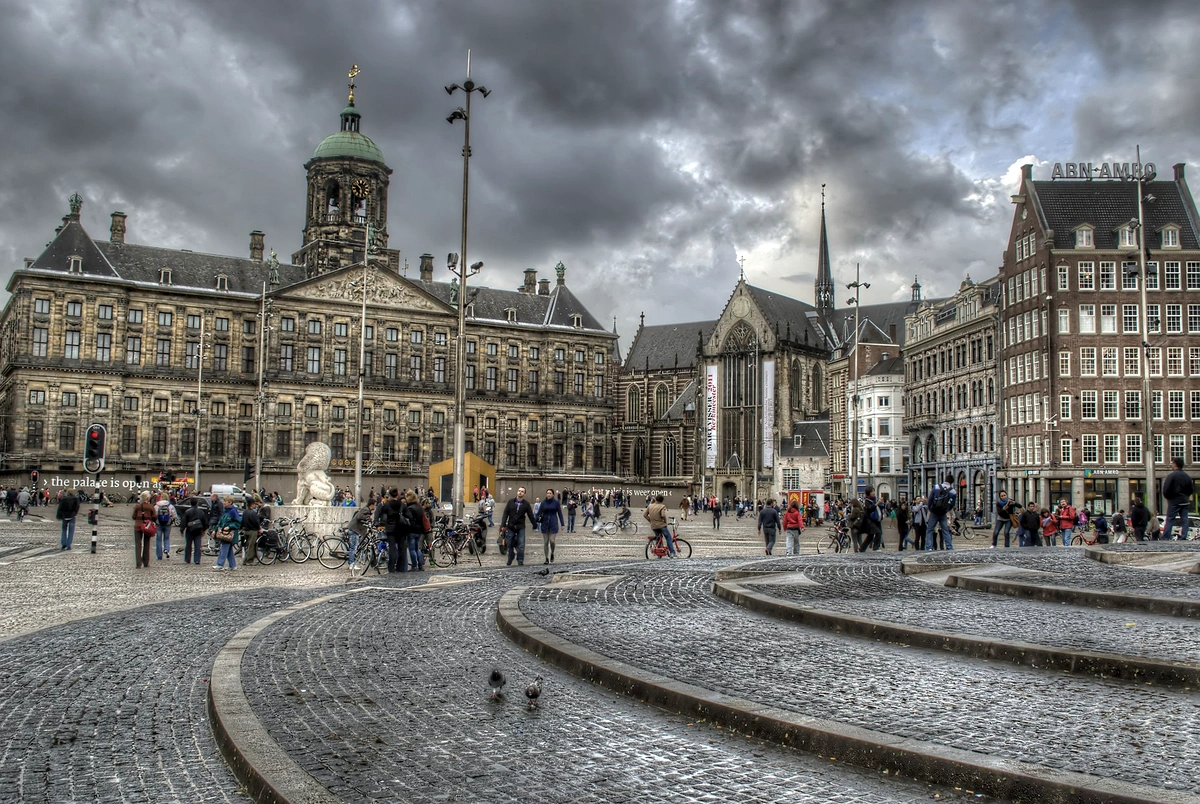
Stepping into the captivating space of Dam Square in Amsterdam, visitors are immediately struck by a distinctive architectural harmony where Dutch classicism, regal Gothic forms, and contemporary sculpture come together seamlessly. Shaped across centuries of history, this spatial layout is far more than a simple open square—it is a living architectural museum preserving golden-era hallmarks of the Dutch Golden Age. Each building around the square carries its own story and artistic idiom, creating a grand ensemble with refined cultural depth rare anywhere in the world.
At the heart—and the most authoritative focal point—of this ensemble is the former town hall, now the Royal Palace of Amsterdam (Koninklijk Paleis Amsterdam), an architectural masterpiece begun in 1648 under master architect Jacob van Campen. Seen from afar, the building projects dignified calm thanks to Bentheimer sandstone imported directly from Germany, lending a tone that feels at once historic and enduring. To support the immense weight of an imperial-scale building on muddy ground beside the Amstel, 17th-century engineers drove 13,659 sturdy wooden piles deep into the earth—a remarkable technical feat for its era. The facade follows strict Palladian proportions, while the sculpted pediments—carved under master sculptor Artus Quellinus—depict mythological motifs and Amsterdam’s maritime prosperity.
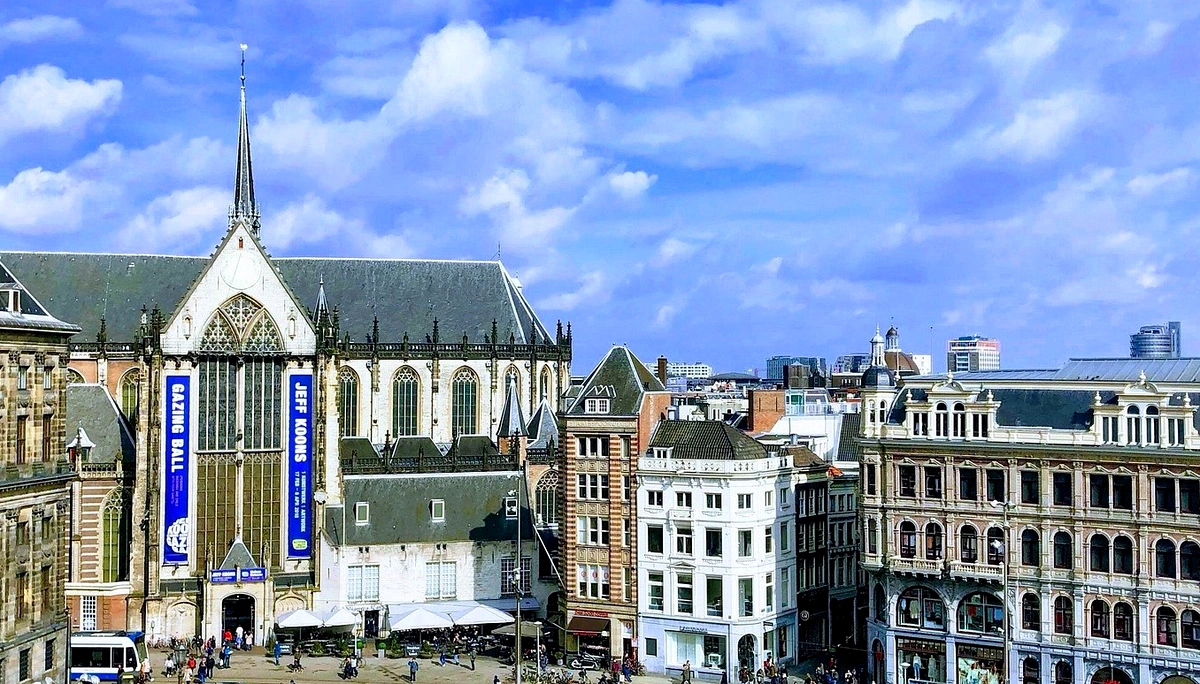
Counterbalancing the regal presence of the Royal Palace is the Nieuwe Kerk (New Church), a religious landmark marked by late Gothic architecture with construction beginning in 1408. Built on a Latin cross plan typical of major European churches, it impresses with soaring flying buttresses and a luminous interior lit through stained-glass windows. Inside, visitors admire finely carved Renaissance choir stalls that have witnessed numerous Dutch royal coronations. The interplay of pointed Gothic arches and Renaissance ornamentation makes Nieuwe Kerk a vivid witness to major artistic transitions in European history.
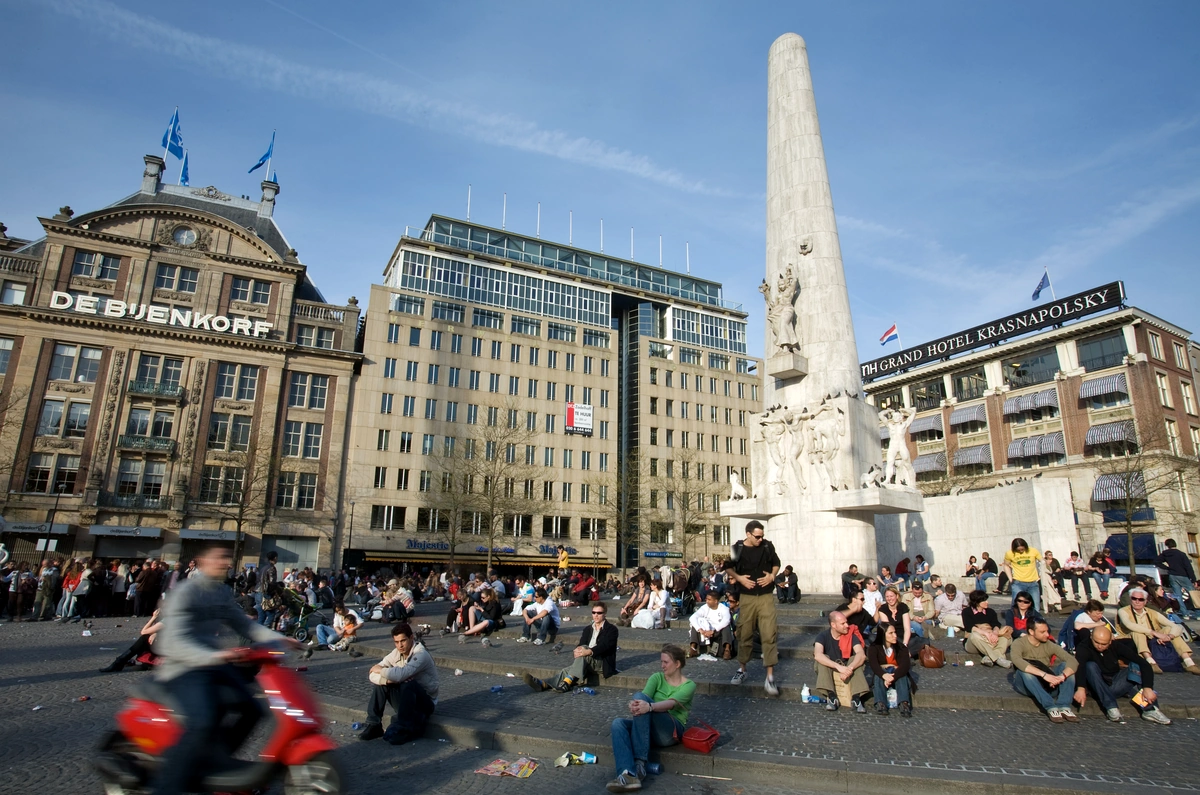
Completing the multi-layered composition of Dam Square is the National Monument, a contemporary sculptural memorial erected in tribute to victims of World War II. Rising 22 meters high, the pure white travertine limestone obelisk is structured with solemn precision. Its facade features expressive reliefs by sculptors Jacobus Jonk and John Rädecker symbolizing the sorrow of war, hopes for peace, and Dutch wartime resistance. Inside the monument’s structure are urns containing soil gathered from eleven Dutch provinces and overseas territories, along with earth from war graves—making it a sacred emblem of national solidarity and gratitude toward the past.
As night falls over Amsterdam and rush-hour bicycle streams give way to evening city lights, Dam Square transforms into an expansive open-air stage where contemporary art, architectural lighting, and nightlife come together. Unlike the busier, more crowded feel of daytime, dusk brings a quieter yet lively mood in which historical layers are highlighted through refined lighting and world-class street performances. This shift is more than switching on streetlights; it is a careful feat of visual design and heritage conservation, where lighting engineers and urban designers balance modern illumination with the protection of centuries-old stone structures.
A clear example of refined lighting here is how LED fixtures are positioned across the Royal Palace facade. To avoid harming the precious sandstone that has weathered centuries of Dutch history, designers use warm color temperatures between 2700K and 3000K, casting a soft, dignified golden glow. Carefully angled beams trace classical columns and carved reliefs so the sandstone radiates a warm, welcoming presence. Nearby, the National Monument is lit with a complementary approach: ground-recessed uplights project crisp white light upward along the towering form against the night sky, establishing a steady spiritual and visual anchor across the square.
Wandering through Dam Square’s evening street-art scene, visitors are quickly drawn into a lively cultural current of skilled street performers. It regularly draws living-statue artists in intricate costumes who stand motionless like Renaissance sculptures before suddenly moving to interact with passersby. The soundscape shifts as well, blending energetic fire-spinning acts in the dark with warm melodies from string quartets playing beneath historic eaves. Violin notes mingling with lively chatter from nearby cafes create an animated urban scene where the line between performer and audience fades, turning anyone crossing the square into part of the moment.
Still, the pinnacle of cultural and communal ritual at Dam Square comes with major annual occasions that unite tens of thousands in shared civic pride. Every April 27, the square turns bright orange for King’s Day (Koningsdag), becoming part of one of Europe’s biggest street-culture and music celebrations for King Willem-Alexander’s birthday. Hundreds of thousands gather in festive attire to sing, dance, and celebrate. Conversely, at 8:00 PM on May 4, Dam Square falls into a moving stillness for National Remembrance Day (Nationale Dodenherdenking). Here the central ceremony honoring war victims takes place with the King and Queen laying wreaths at the National Monument. As bells ring out from surrounding historic churches and the entire square observes two minutes of absolute silence, the atmosphere reaches a peak of historical depth and solemn reflection that leaves a lasting impression on every visitor witnessing it.
Beyond the grand architecture and historic pulse of Dam Square in Amsterdam, exploring the heart of the Dutch capital is incomplete without its local food map—where centuries of traditional craft live on through signature flavors. Amid historic stalls and long-standing eateries around the square, street food tells a lively story of how the Dutch draw from sea and land to shape a proud culinary heritage. Among these flavors, the first and most iconic taste is Hollandse Nieuwe (soused herring), a proud specialty of this low-lying country.
The story of Hollandse Nieuwe is tied to the ocean’s rhythm and traditional curing craft passed down through generations. From late May into early June each year, Dutch fishermen eagerly await the season’s first herring catch, when the fish reach peak richness from feeding in cold northern waters. Soon after landing, the fish are lightly cured using time-honored methods that preserve fresh flavor, remove fishiness, and leave the flesh tender and silky. Enjoying Hollandse Nieuwe at traditional stalls near Dam Square is a distinctive local custom: aficionados hold the fish by the tail, tilt their head back, and eat it in a bite—often paired with finely chopped raw onion and crisp pickled gherkin. The contrast of briny sea notes, rich melting texture, and bright onion bite elevates a simple staple into a cherished part of Dutch food culture.
Moving from savory coastal notes to sweet flavors in historic cafes around the square, visitors are drawn in by the warm aroma of cinnamon and melted butter from classic stroopwafels. Originating in nearby Gouda in a past century, this treat shows artisanal resourcefulness: two thin, crisp waffle layers baked on patterned irons sandwich a rich caramel syrup made from brown sugar, butter, and cinnamon. The classic way to enjoy a stroopwafel pairs naturally with afternoon tea or coffee. Placing a freshly baked waffle atop a steaming mug lets rising heat soften the caramel filling while warming the crisp shell into a pliable, sweet treat against chilly northern breezes.
Rounding out central Amsterdam’s food scene is bitterballen, a staple savory snack at gatherings in traditional pubs. These neat, breaded meatballs look simple yet rely on careful kitchen craft. The filling is made from rich, long-simmered beef stock blended with butter, flour, and shredded beef into a velvety roux. Once shaped and coated in flour, egg white, and crisp breadcrumbs, they are fried until golden-brown and crunchy. Diners bite gently through the crisp crust into steaming, savory beef filling inside, then dip in spicy yellow mustard to balance the richness. More than a companion to cold beer, bitterballen symbolizes warmth and conviviality in Amsterdam’s traditional dining culture.
Standing prominently at a vital crossroads of the city, Dam Square is open to the public and visitors 24 hours a day, seven days a week, allowing anyone to experience the historic space early or late. However, if your goal is to tour the grand interior of the Royal Palace of Amsterdam, note that public visiting hours typically run from 10:00 AM to 5:00 PM daily, and booking tickets two to four weeks ahead via the official website is advisable to avoid sold-out slots. Likewise, the nearby Nieuwe Kerk opens according to rotating exhibitions, so checking its schedule beforehand is recommended.
Reaching the square from across Amsterdam is easy thanks to a well-connected public transit network. You can take the metro to Centraal Station or Nieuwmarkt Station and walk about five to ten minutes through historic streets to the square. If you enjoy watching city life pass by from a window, tram lines 2, 4, 11, 12, 13, 14, and 17 stop right at Dam, placing you steps from the center. The best window for on-site observation is between 7:30 AM and 9:00 AM, when soft morning sunlight illuminates historic facades in a calmer atmosphere before peak crowds arrive—ideal for taking in architectural details before heading toward the Nine Streets (De Negen Straatjes) along the canals or the historic Oude Kerk.
Alongside rewarding cultural moments, practical clothing and everyday city awareness help keep your trip smooth through shifting weather and busy crowds. Because the city sits near the coast, brisk winds and sudden showers are common, so keeping a quality windproof, waterproof jacket in your daypack is smart. Bustling hubs can also draw pickpockets or street distractions—such as people feigning directions—so staying alert, wearing a backpack in front, and keeping valuables secure is essential. First-time pedestrians should also pay close attention to dedicated bicycle lanes, where cyclists travel fast and hold clear right-of-way under local rules; staying mindful and obeying traffic signals keeps everyone safe. For a seamless, well-organized journey from start to finish, you can explore our all-inclusive tour packages to experience European culture without worrying about logistics.