Tracing time back to the turbulent transitional years of feudal Japan, the historical formation of the Dotonbori Food and Entertainment District in Osaka (大阪道顿堀) did not originate from the electronic beeps of neon lights or the enticing aromas of modern takoyaki stalls, but rather from the strategic vision and sweat and tears of financial pioneers of the Keichō era (lasting from 1596 to 1615). In the seventeenth year of Keichō, corresponding to 1612, a wealthy merchant and brilliant engineer of the Osaka region named Yasui Dōton (安井道頓), under the patronage and policy direction of warlord Toyotomi Hideyori, decided to invest his own fortune alongside mobilizing a vast workforce to execute a daring hydraulic engineering project: excavating and digging a vital canal connecting the Toyokobori-gawa river in the east to the Nishiyokobori-gawa river in the west, with the objective of optimizing the city’s increasingly bustling water transport network.
Yet the wheel of Japanese history turned toward a bloody chapter just before Yasui Dōton’s ambition could be fully realized, when the great Siege of Osaka (Ōsaka no Jin) broke out and claimed the life of the talented engineer on the battlefield. Not stopping there, his unfinished endeavor was continued and completed by his cousin, Yasui Dōboku, in the first year of Genna, corresponding to 1615, marking a golden milestone for urban infrastructure at the time. To honor the immense contributions and sacrifice of Yasui Dōton in creating this vital waterway, the Tokugawa Shogunate subsequently officially issued a decree naming the new canal “Dotonbori,” permanently binding his name to the cultural and commercial flow of the Kansai region.
The turning point that shaped Dotonbori’s cultural and entertainment identity began when the imperial court and Shogunate administration specially designated the southern bank of the canal to become the official theater entertainment district, operating under the moniker “Shibaimachi” (芝居町). From here, a unique traditional arts and cultural space rose powerfully; entering the mid-Edo period, this area gathered a series of sacred shrines for Japan’s pinnacle theatrical arts including Nakaza, Kakuza, Naniwaza, Bentenza, and Asahiza, historically honored under the renowned name “Dotonbori Giza” (道頓堀五座), representing five celebrated Kabuki and Ningyō Jōruri (traditional puppet theater) grand halls famous near and far.
Along the shifting currents of time, this land endured the harshest trials of modern history, epitomized by the devastating catastrophe of the Osaka air raids in the twentieth year of Shōwa, corresponding to 1945, which incinerated most traditional architectural structures and plunged the area into desolation. However, with the resilient will and indomitable recovery spirit characteristic of Osaka’s people, Dotonbori swiftly executed a grand post-war reconstruction, completely shedding the ashes of war to transform into an open-air super commercial district that harmonizes iconic global giant neon billboards with one of the most diverse street food cultures on the planet.
Stepping into the spatial boundaries of the Dotonbori Food and Entertainment District, preserved in ancient records under the Chinese character name 大阪道顿堀, travelers cannot fail to marvel at an urban planning masterpiece crystallized from nature and human intellect. Regarding feng shui topography and geographical layout, Dotonbori occupies a prime location on the fertile alluvial plain situated west of the Uemachi Plateau (Uemachi 台地), within the flat Osaka basin yet interwoven with an intricate hydrological network that favored both water and land trade from the earliest dawn of Japan’s feudal era. In the overarching picture of historical ancient Osaka, majestic Osaka Castle stood guarding the northern tip of the Uemachi Plateau, honored by period feng shui masters as the convergence point of the dragon vein—the focal point gathering vital energy across the entire Settsu realm. Following this natural flow, the Dotonbori canal was excavated to cut across the low-lying western depression of the plateau, forging a classic feng shui structure that traditional geographers term the “jade belt encircling the waist” or “water embracing” ( thủy bão), turning this place into a renowned commercial and wealth-gathering hub whose vital energy never runs dry.
Delving deeper into the philosophy of flow planning, this artificial canal was designed along an East-West axis, with waters flowing westward to empty straight into the Kizugawa River and merge into the expansive Osaka Bay, strictly adhering to traditional feng shui principles regarding winding water that slows down to gather wealth (thủy nghi khúc chiết, hoãn lưu tụ tài)—meaning water must meander and flow slowly to retain blessing and fortune for local residents. Selecting a location for such a large-scale project required a sharp strategic vision, and Edo-period designers applied the nodal economy concept by placing Dotonbori right at the southern boundary of the castle town (jokamachi) of Osaka Castle. This genius placement yielded a dual effect: cleverly dodging excessive interference and control from the central political apparatus while remaining adjacent to the residential quarter of the Minamigumi merchant class alongside the Namba Midosuji arterial avenue, creating one of the most bustling commercial buffer zones in the Land of the Rising Sun. The space along the canal banks was planned into narrow yet deep linear plots, forging a unique visual corridor termed by specialists as the landscape axis connecting streetscapes to canals and stretching to the opposite bank—the earliest evidence of mixed-use planning in ancient urban development history.
The construction and excavation engineering process of Dotonbori under the hands of visionary merchant Yasui Doton and his cousin Yasui Doboku in the early 17th century also holds wondrous tales of period hydraulic engineering. Amidst a waterlogged marshland, dredging, stone revetments, and shaping the water flow required advanced technical solutions to prevent flooding from Osaka Bay tides while maintaining stable water levels for bustling merchant vessels. Through many historical upheavals, Dotonbori’s characteristic topography and landscape structure retain their original soul, where traditional wooden merchant houses (machiya) of yesteryear have transformed into vibrant modern neon-lit architectural blocks, yet fully preserve the spirit of water-facing facades. That canal is not merely a water transport route or drainage project; it has become the soulful axis of the entire district, shaping the water-oriented lifestyle of Osaka’s people, where popular food culture and kabuki entertainment blossomed to co-create a living urban heritage transcending time in contemporary Japan.
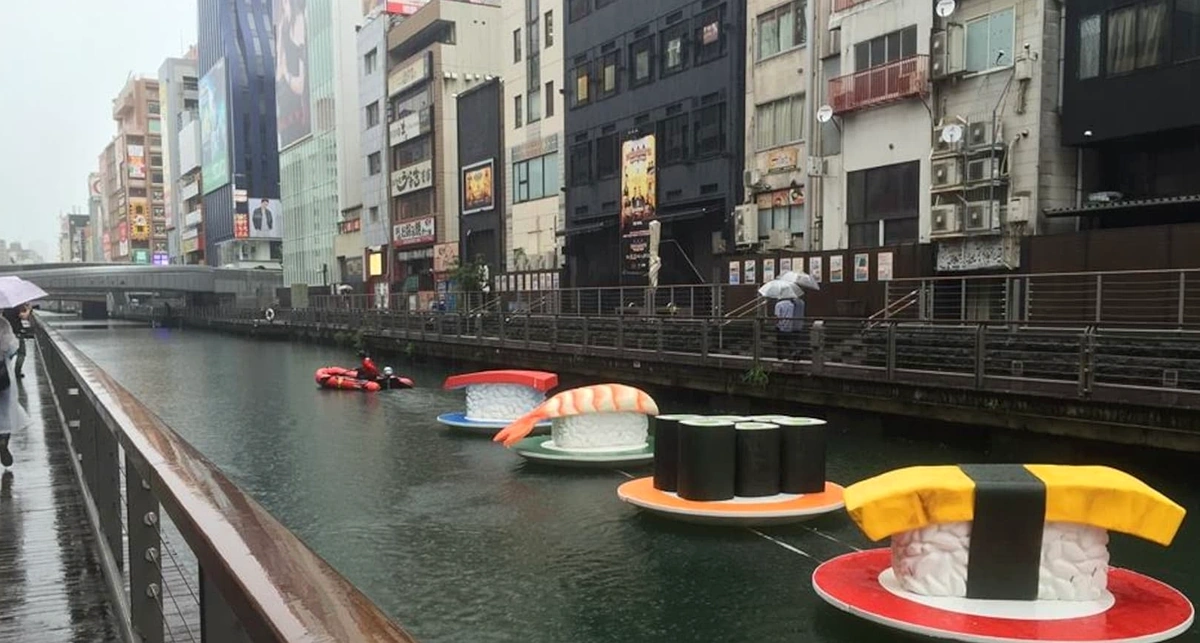
Through the perspective of a cultural history researcher and urban surveyor, the architectural space within the Dotonbori Food and Entertainment District (大阪道顿堀) opens a striking cross-section where traditional Japanese cultural layers quietly intertwine with the relentless motion of modern commerce. Setting foot in this place, the first thing captivating the vision of any traveler or researcher is the striking yet harmonious contrast between traditional residential structures bearing the marks of time and commercial buildings of metropolitan scale. Strolling along the Dotonbori canal, observing surviving or faithfully reconstructed ancient townhouses, one easily recognizes the imprint of the machiya architectural typology—traditional merchant townhouses that shaped Japanese urban facades since the feudal era.
Early machiya structures here strictly adhered to a spatial model figuratively dubbed “the eel’s bed” (うなぎの寝床 – unagi no nedoko). This structural style featured narrow frontages to optimize taxation—which relied on street frontage width—yet possessed immense depth extending inward. Interior spaces were cleverly divided into multiple layers, serving both commercial business in front and family living quarters and storage warehouses in the rear. The load-bearing structural system of these houses relied entirely on traditional woodworking art, utilizing pillar and beam frameworks connected by complex mortise-and-tenon joinery (榫卯) entirely without metal nails. This pinnacle carpentry technique not only yielded exceptional durability, but also provided superb earthquake resistance, allowing structures to flexibly sway with the tremors constantly occurring in the Land of the Cherry Blossoms. Above the living quarters, flat tile roofs (hiragawara) were meticulously tiled, combined with insect-cage windows (mushikomimado) providing natural lighting and ventilation for the subdued interior spaces below.
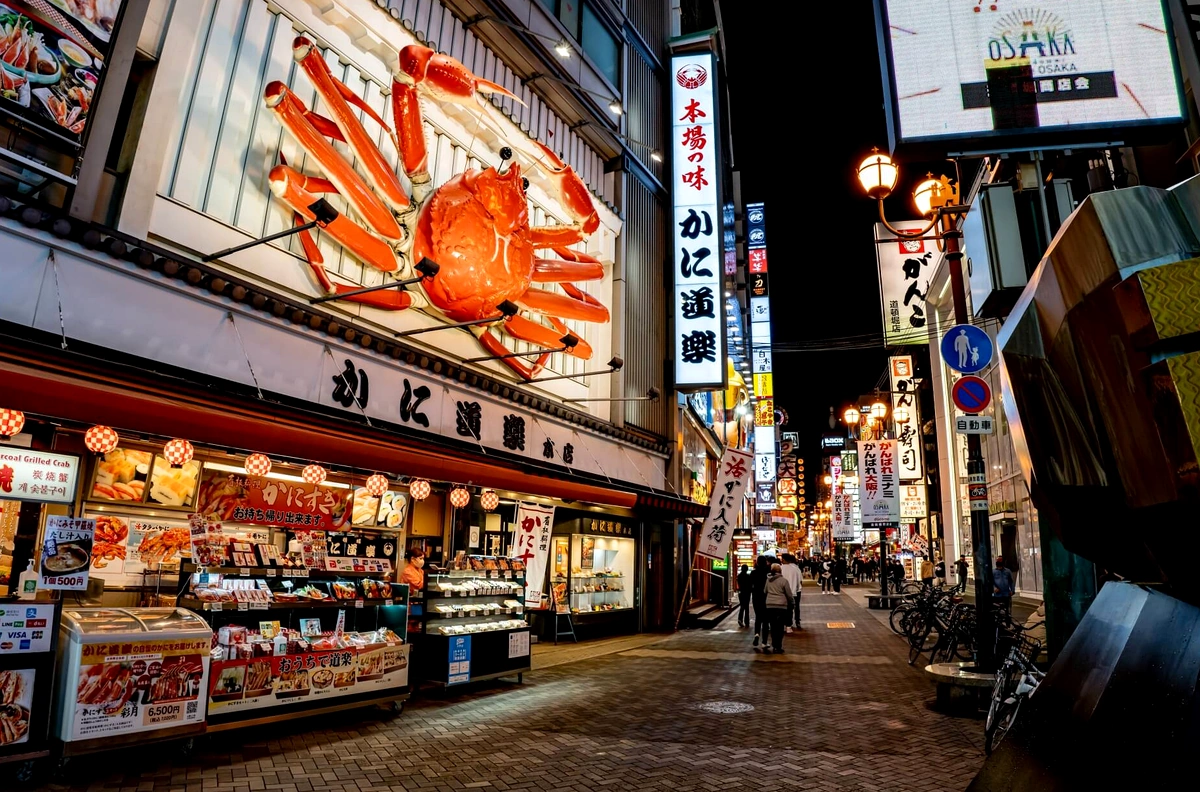
In contrast to the subdued, refined beauty of traditional machiya houses, Dotonbori’s modern spatial structure is a sanctuary of advanced engineering and explosive visual expression. As time pushed the metropolis into the era of industrialization and global commerce, large-scale structures such as the Ebisubashi building and the once-famed Dotonbori Gokuraku Shōtengai (道頓堀極樂商店街) entertainment complex sprouted, completely redefining the area’s spatial facade. Contemporary architects applied prestressed concrete combined with large-span steel framing, enabling expansive column-free ground floors to optimize crowds flocking in for dining and entertainment.
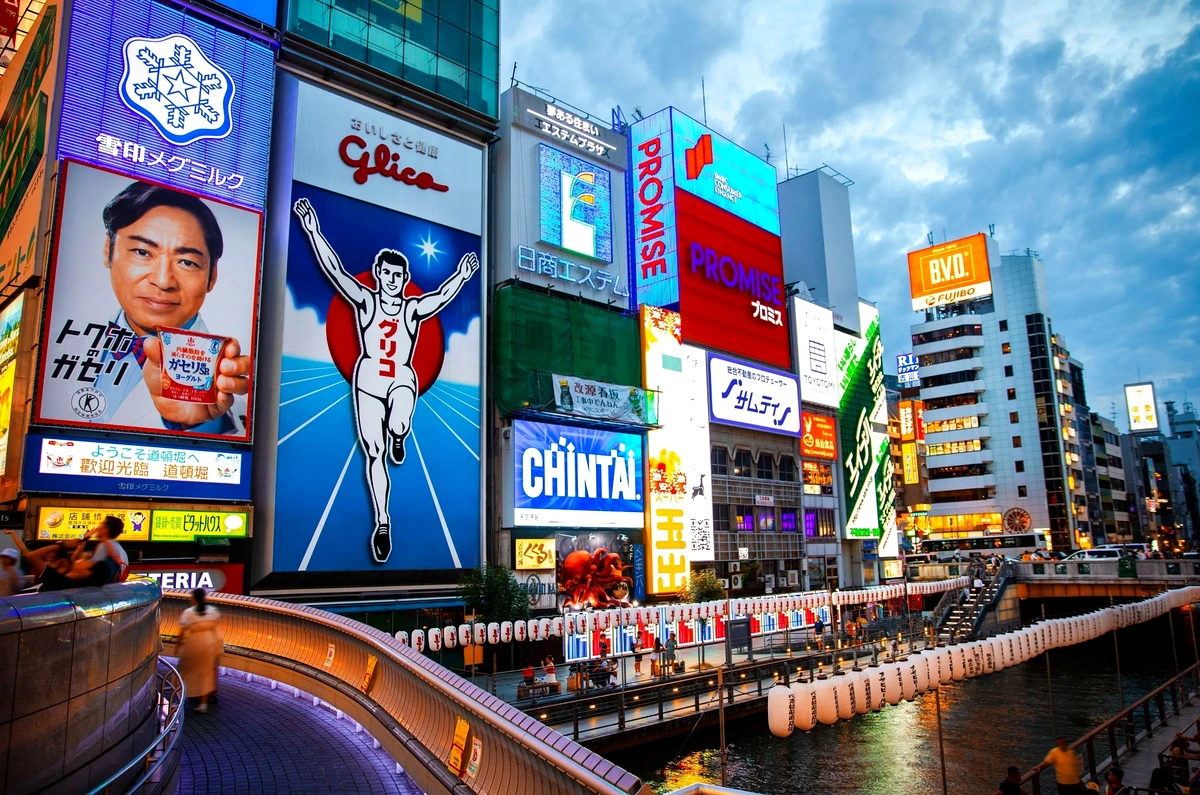
What cemented Dotonbori’s unique encyclopedic value is its mechanical kinetic signage system and globally iconic facade art. Classic landmarks such as the giant eagle billboard, the octopus evoking takoyaki craftsmanship, and the stereoscopic coiling dragon of the renowned Kinryu Ramen (金龍ラーメン) brand are far from casual wall ornaments. They are colossal industrial sculptures assembled from independent steel trusses securely anchored separately from the buildings’ main load-bearing structures. Through reaction anchor systems driven deep into foundations or column nodes, engineers calculated these kinetic architectural blocks to withstand severe gale-force winds sweeping across the Dotonbori riverbed while ensuring absolute safety for crowds below. The bold fusion of modern materials like weathering steel, tempered glass, high-grade acrylic plastics, and high-intensity LED lighting sculpted a cyberpunk-infused space, turning Dotonbori into a living museum of the evolution of Japanese urban architecture across eras.
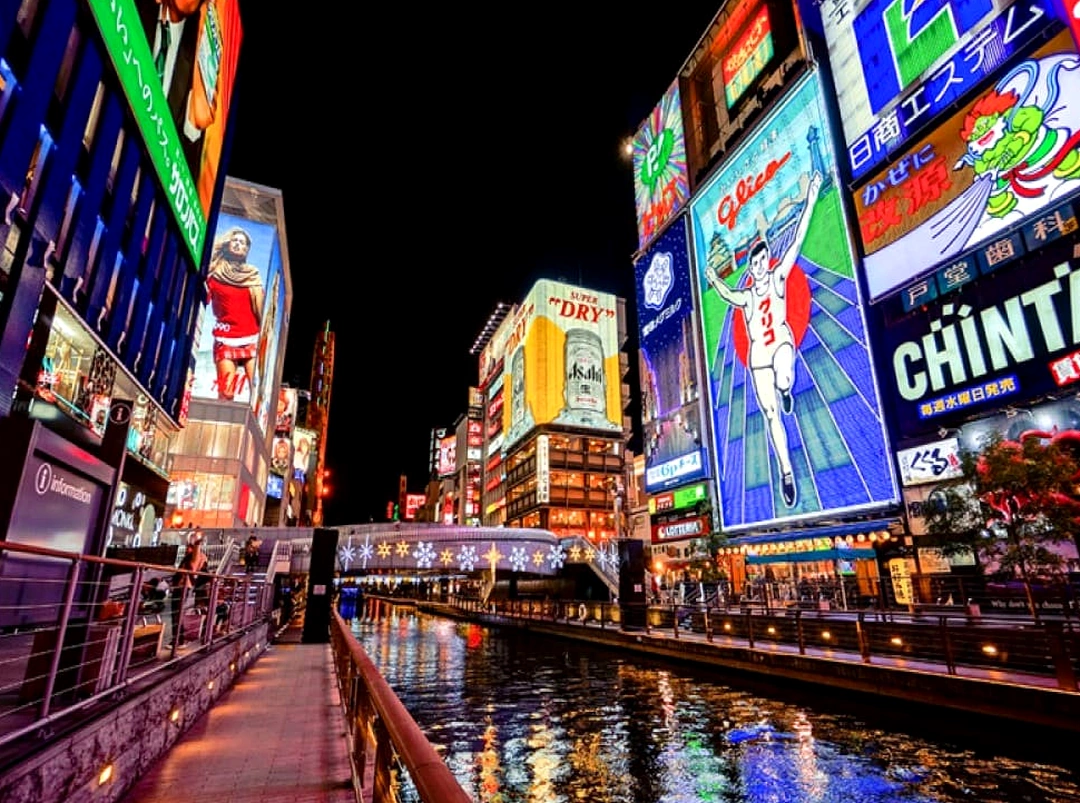
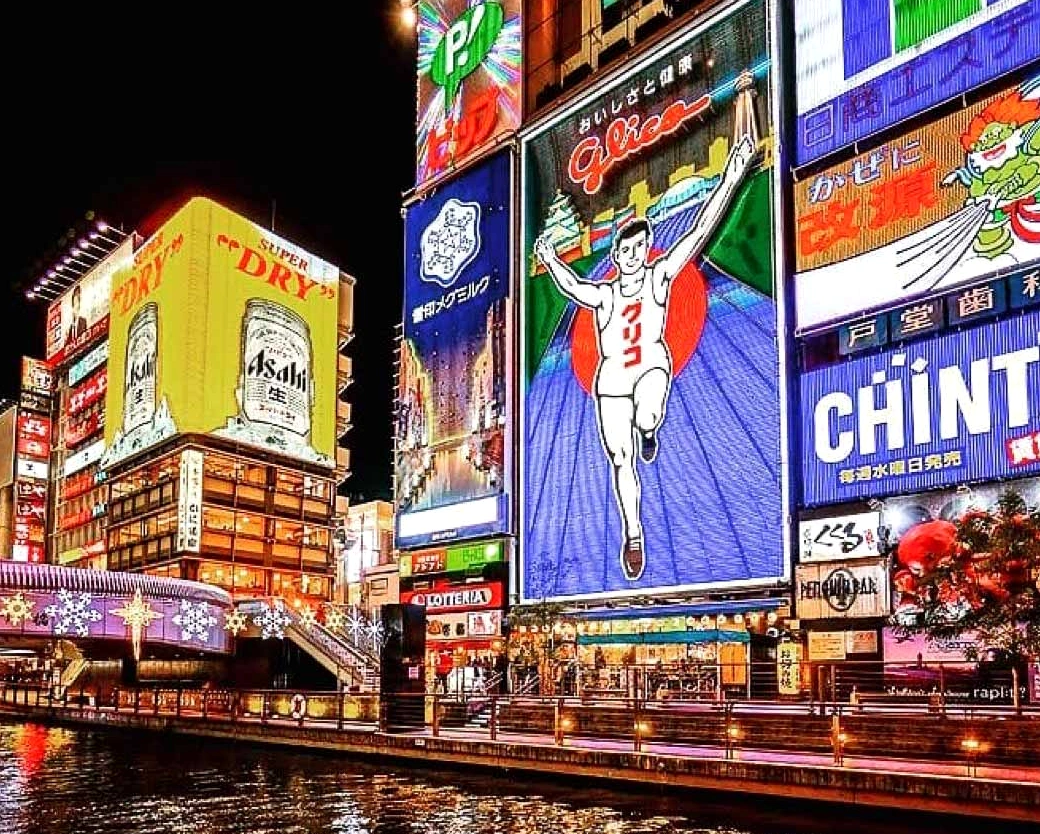
When night falls, Dotonbori sheds its daytime rustic coat to metamorphose into a visual arts masterpiece, rising as a global pioneer in nocturnal urban lighting and live-action landscape performance art. Nightlife here is not merely the bustle of flashing neon billboards, but a fusion calculated through both science and the artistic soul of Osaka’s people. The epicenter of this luminous space is the legendary “Glico Running Man” icon standing impressively beside Ebisubashi Bridge, a structure that has undergone six spectacular evolutionary generations alongside the district’s history. The current sixth version is a technological marvel featuring a colossal LED screen 20 meters tall and 10.3 meters wide, composed of over 70,000 ultra-bright LEDs. Far beyond a static image, this screen narrates a vibrant visual story where the outstanding athlete strides powerfully across global wonders and famous landmarks, captivating the admiring gaze of tens of thousands of visitors standing spellbound below.
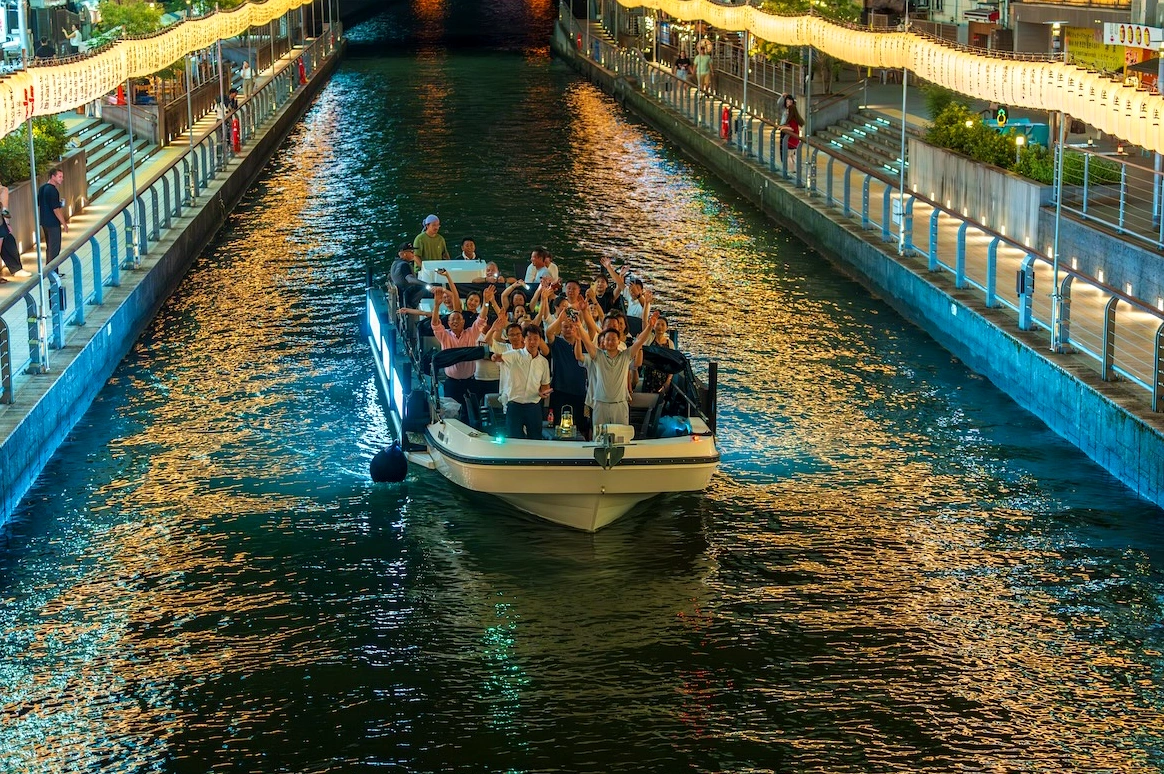
The magic of lighting art here is multiplied by the flow of the Dotonbori canal, where urban engineers meticulously calculated every lighting angle and reflection ratio of the water surface. This precision transforms dark waters into a colossal mirror, producing a detail-perfect symmetrical reflection between giant glowing stereoscopic billboards on both banks and their shimmering reflections below. The water surface becomes an illusionary stage where light refracts into colorful silk ribbons undulating with every tiny ripple, embracing the nocturnal entertainment space and delivering an awe-inspiring, mystical feeling to any visitor stepping ashore. This elaborate investment transformed every stroll around the canal into an outdoor contemporary art viewing, where the boundary between reality and virtual space dissolves seamlessly.
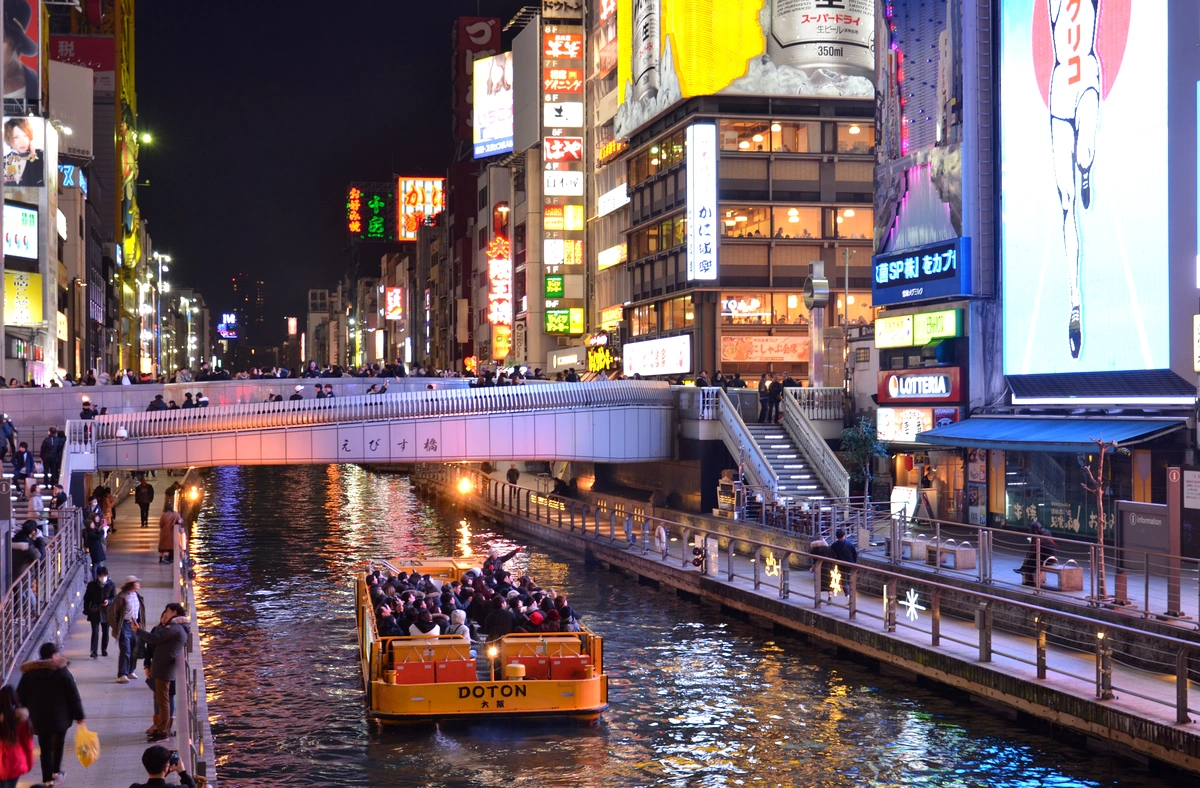
To fully grasp Dotonbori’s pulse from another vantage point, travelers often choose to board “Tombori River Cruise” boats, embarking on a water journey crossing nine historic bridges spanning the canal, including familiar names like Nihonbashi and Taizaemonbashi. This experience extends beyond viewing urban architecture from water level into a unique cultural exchange space. Aboard these boats, local tour guides with the characteristic humor of the Kansai region liven up the atmosphere through improvised monologues, charmingly joking in the laughter-filled Osaka dialect, helping travelers deeply understand the district’s uninhibited, open personality. Joyful laughter mingling with boat motor sounds and bustling noises from both banks creates a signature auditory experience found nowhere else on earth.
The area surrounding Ebisubashi Bridge serves as the epicenter of pop culture and youth generation, converging currents of contemporary Japanese subculture. Here, nightlife is not only quiet observation, but erupts in community activities, epitomized by periodic “Dotonbori Bon Odori” traditional dance festivals. Beneath the brilliant lights of towering high-rises, locals and international visitors in colorful yuktas immerse themselves in traditional dance circles, creating a miraculous fusion between a glorious past and a dynamic present. Every element—from pinnacle lighting tech, water-reflecting architectural spaces, laughter-filled cruise boats, to vibrant community festivals—weaves together a flawless Dotonbori night picture, immortalized in the hearts of distant travelers.
Hugging the winding canal network bearing deep market town imprints, Dotonbori has long been honored with the title “Tenka no Daidokoro”—meaning “Kitchen of the Realm,” a laudatory epithet expressing not only the abundance of food converging here, but also proving the district’s preeminent standing on the culinary culture map of Japan. To fully understand the dietary spirit of Kansai people, where uninhibited freedom blends with sophisticated culinary arts passed down across generations, stepping into this dining paradise is akin to a pilgrimage back to authentic roots, where every street corner conceals a family recipe, a handicraft honed over decades. The symbol of prosperity and rich tradition is Kani Doraku (道頓堀本店), a renowned establishment founded in the thirty-second year of Showa, corresponding to 1962, specializing in premium seafood transported directly same-day from northern Japan’s cold waters, such as king crab, snow crab, and hairy crab. Dining here is not merely eating, but a multi-sensory artistic journey where guests enjoy all refined variations of crustacean dishes: sweet raw sashimi preserving ocean flavors, charcoal-grilled crab legs fragrant with savory fats, crispy tempura encased in golden batter, and crab sushi rich with new-crop rice flavor. Reigning right on the street facade, the restaurant’s classic mascot is a giant mechanical crab spanning several meters with agile waving claws, beckoning travelers from afar into an atmosphere of absolute respect for natural produce.
Leaving the luxurious crab dining rooms, Dotonbori’s rhythm sweeps us into the rustic yet vibrant current of takoyaki culture, street food that transcended local boundaries to become mass culinary symbols across Japan. This ancient street is the cradle and historical starting point bringing bite-sized octopus balls to national prominence, carrying the rustic yet sophisticated food soul of Osaka. The secret behind renowned takoyaki at long-standing eateries like Honke Ootako lies in master craftsmanship, where chefs utilize thick cast-iron pans tempered over years, heated over high flames to quickly crisp the outer shell while keeping the interior batter soft and creamy. The core filling is a precise combination of firm, sweet octopus chunks, pickled red ginger, crunchy tempura scraps for texture, and freshly chopped green onions, topped with savory Worcestershire sauce, rich mayonnaise, and delicate katsuobushi bonito flakes dancing gracefully in steam rising from freshly baked balls. Savoring hot takoyaki in chilly weather beside the Dotonbori canal is an unforgettable tactile and flavor experience, where the crispy shell melts into the sweet, chewy deep-sea seafood.
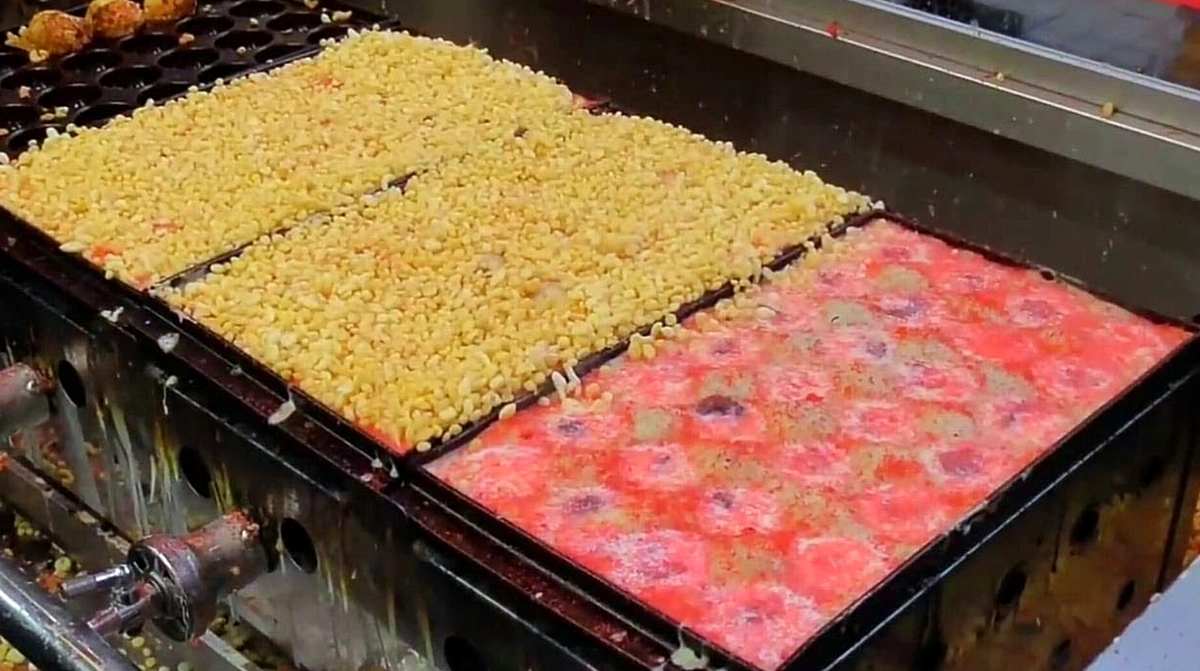
Alongside iconic octopus balls, the culinary picture here is adorned with flavorful ramen bowls reflecting the uninhibited, generous personality of Kansai people. Typifying this school is Kinryu Ramen, famous for its Osaka port-style pork bone soy sauce ramen, where broth is meticulously simmered for hours from pork bones, chicken bones, fresh vegetables, and fine kombu kelp, creating a translucent amber soup with a deep, clean, sweet aftertaste. The unique branding touch lies not only in rich broth coating chewy golden noodles, but also in nostalgic dining spaces featuring tatami seating rows right beside the street, allowing diners to slurp hot noodles while watching bustling crowds pass by. Most notably, hospitality culture here preserves traditional warmth through a self-service condiment bar with spicy pickled chives and homemade kimchi, supplied completely free and unlimited so every diner can adjust their noodle soup to personal preference. Combining enduring family recipes with bustling community atmosphere turns Dotonbori into a living entity where history, culture, and culinary arts blend into one, leaving lingering aftertastes in every traveler’s soul.
Concluding the journey soaring with Dotonbori’s vibrant rhythms, the final section of this cultural encyclopedia travel guide equips visitors with subtle, accurate field directions to realize the voyage. Field surveys and insights from deep travel guides show that public spaces along streets and Tombori River Walk pedestrian paths remain open to travelers 24 hours a day without time limits. However, the golden time to fully enjoy the mystical lighting picture is from 5:00 PM to 10:00 PM, when millions of giant neon billboards ignite simultaneously, turning the canal water into a silk ribbon reflecting magical urban colors. To access this bustling heart most conveniently, Osaka’s public transport system serves as an arterial network with modern subways including Osaka Metro Midosuji, Sennichibashi, and Nagahoritsurumiryokuchi lines, dropping passengers directly at Namba or Shinsaibashi stations, from which a leisurely five-minute stroll leads straight to legendary Ebisubashi Bridge. Additionally, when commuting via Nankai Electric Railway from the airport or surrounding regions, travelers can alight straight at Namba Station, or choose Kintetsu and Hanshin lines to stop right at the threshold of Osaka Namba district, opening seamless experiential spaces right upon exiting station doors.
Thorough preparation for routes and timing is the golden key unlocking fulfilling experiences amidst bustling crowds in this commercial district. When travelers wish to enjoy culinary highlights at renowned historic restaurants, the strict rule is booking tables 14 to 30 days in advance via official restaurant websites or premier booking platforms in the cherry blossom nation like Tabelog and OMAKASE. A standard itinerary recommended by cultural researchers starts from Namba subway station, heading straight up to Ebisubashi Bridge to snap classic photos with the Glico athlete billboard, continuing with a leisurely stroll along the Tombori River Walk winding by the canal, before turning deep into the nostalgic maze of Dotonbori shopping street and quiet Hozenji Yokocho alley. When mingling with crowds reaching hundreds of thousands daily, wearing comfortable walking shoes is a prerequisite to protect health for tireless exploration. Particularly, local culture requires strictly adhering to the rule of not eating while walking; instead, street snacks must be enjoyed near purchasing stalls alongside a self-conscious habit of carrying personal trash bags to preserve public cleanliness. Simultaneously, respecting vendors’ privacy by asking permission before photographing shops, coupled with the absolute ban on piloting drones in airspace along the Dotonbori canal, ensures your exploration journey unfolds civilly, memorably, and nostalgically. To actualize unique local culture experiences and enjoy every brilliant moment in this capital of lights without organizational worries, explore details via all-inclusive tour packages designed specially by cultural research experts.