Nestled beneath the ancient canopy of the Phang Dua primeval forest in Muong Phang Commune, Dien Bien District, Dien Bien Province—hundreds of kilometers northwest of Hanoi—the Dien Bien Phu Campaign Command Headquarters stands as a sacred symbol of Vietnamese military intellect. Within the capital’s historical memory and archival heritage, Muong Phang holds a singular place, connected by an invisible yet unbreakable bond to central command leadership in Hanoi. More than a mere historical stopover, this site was the birthplace of pivotal decisions that altered the course of the Indochina War, bearing witness to the extraordinary strategic vision of the General Command. The feng shui and topography of the Muong Phang Headquarters reflect the mastery of concealed military art—harmonizing with nature while remaining formidable and secure. Surrounded by rugged mountain ranges, deep valleys, and dense old-growth forest canopies that shielded it from both aerial and ground observation, its “mountain-backed, water-facing” position tucked deep within the Muong Thanh basin yet completely isolated from enemy encirclement created a natural defensive screen. From this vantage point, commanders could monitor the entire Dien Bien Phu basin while maintaining secret communication routes radiating in all directions, ensuring absolute security for the supreme command staff throughout the fiery months of war. The name Muong Phang originates from the ancient Tai language, echoing the spirit of the mountains and forests and the centuries-old settlement traditions of northwestern ethnic communities: “Muong” denotes a vast populated valley or territory, while “Phang” evokes distinctive terrain features and ancient tree species closely woven into local life. From this humble, rustic place name, history chose Muong Phang as the launchpad for one of the twentieth century’s greatest military feats. The monument’s historic timeframe spans from January 31, 1954, to May 15, 1954—the decisive period marking the strategic shift from “Strike Fast, Win Fast” to “Fight Steadily, Advance Steadily,” a vital turning point that saved the entire campaign. The site is forever linked to legendary commanders who stand as living milestones of national history: General Vo Nguyen Giap—Commander-in-Chief and Secretary of the Front Party Committee, who made the boldest and most difficult military decision of his life inside this dugout shelter—and Major General Hoang Van Thai, Chief of Staff, who served faithfully alongside tens of thousands of officers, soldiers, and civilian laborers holding the line beneath the forest canopy. Every winding trail, A-frame bunker, and staff or communications hut is steeped in the sweat and iron resolve of the Vietnamese people. In the eyes of contemporary media and heritage authorities, Muong Phang has become a Special National Monument—a living museum of military archaeology and landscape geology. Its heritage value lies not only in its preserved physical remnants of trenches and command huts, but also in its strictly protected primeval forest ecosystem standing as a verdant witness of the era. The untamed, majestic beauty of Muong Phang’s mountains and forests, fused with its heroic history, has transformed this site into a sacred pilgrimage destination drawing tens of thousands of domestic and international visitors each year to understand and honor the roots of Vietnam’s victory.

Tucked deep inside an ancient primeval forest in Muong Phang Commune, Dien Bien Province, the Dien Bien Phu Campaign Command Headquarters stands as a masterpiece blending ingenious military strategy with majestic natural scenery. Across the passage of history, the site has preserved its rugged yet deeply concealed “mountain-backed, water-facing” terrain, sheltered beneath the dense, sprawling canopies of the northwestern wilderness. The landscape surrounding the headquarters forms a breathtaking natural tapestry of rich flora, where centuries-old trees stretch their branches across the sky to create a seamless natural camouflage unmatched by any artificial fortification. Beneath the forest canopy, winding trails paved with moss-covered stones and fallen leaves guide visitors into a tranquil sanctuary where time seems to stand still amid the heroic echoes of wartime.
Architecturally, the structures here were designed and arranged with utmost simplicity yet remarkable scientific precision, seamlessly integrated into the natural terrain to guarantee absolute secrecy and safety for the campaign’s nerve center. The network of trenches, dugouts, and living and working quarters of General Vo Nguyen Giap, Chief of Staff Hoang Van Thai, and command departments was carved deep into the mountainside and reinforced with packed earth and sturdy timber. Every detail of the camp’s construction bears the unmistakable hallmark of the arduous resistance era: palm-leaf roofs and simple yet solid bamboo-wattle walls blending effortlessly into the deep emerald green of the Muong Phang forest. The skillful use of natural rock crevices and rugged mountain contours for command meetings and operations exemplifies supreme military ingenuity—flexible yet enduring—turning unforgiving terrain into an impenetrable shield safeguarding the campaign’s leadership.
For photographers and the travel community, Muong Phang Headquarters is not only a sacred heritage destination, but also a location boasting “million-view” photo spots steeped in historical depth and aesthetic charm. The premier camera angle prized by photography experts is the pathway leading to General Vo Nguyen Giap’s working hut, captured from a low angle looking up through the ancient forest canopy at dawn between 6:00 AM and 7:00 AM. At this hour, the first morning sunbeams pierce through the forest’s gossamer mist, illuminating the moss-covered footpath and rustic thatched roof to compose a scene at once grand, sacred, poetic, and contemplative.
A second prized vantage point lies at the observation post overlooking the entire complex of bunkers and trenches tucked beneath the old-growth forest, best captured at sunset between 4:30 PM and 5:30 PM. Under the soft golden glow of late afternoon, the rich tones of the northwestern mountains harmonize with the rustic camp architecture to create a deeply nostalgic tableau. Capturing this moment yields not only visually striking photographs of extraordinary spatial depth, but also conveys the seamless union of heroic history and untamed natural splendor in historic Dien Bien.

Stepping into the Special National Monument of the Muong Phang Campaign Command Headquarters in the heart of Dien Bien’s primeval forest, every visitor feels an indescribable wave of emotion. Exploring this sacred ground is far more than a pilgrimage into the nation’s heroic past—it is an immersive sensory journey along historic forest trails. Initial awe gives way to solemn stillness as you step beneath towering centuries-old trees where time appears suspended, safeguarding golden memories from an era of fire and courage.
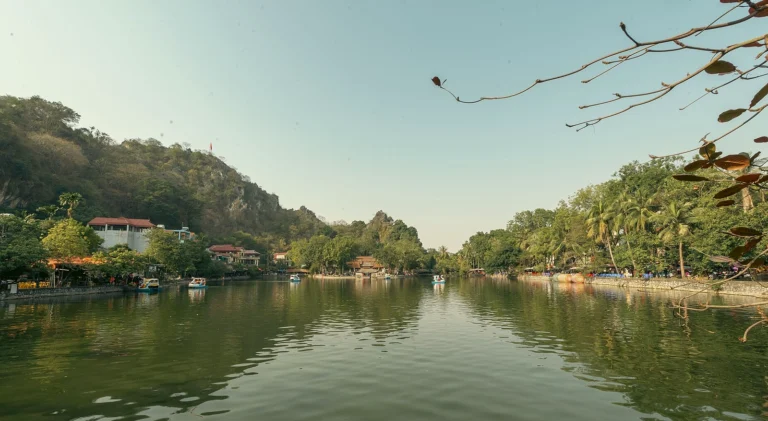
The journey begins on foot along winding paths beneath dense forest foliage, evoking the arduous marches endured by past generations. Visitors can climb to elevated vantage points within the monument grounds to pay tribute and take in sweeping panoramic views over the majestic Muong Phang valley below. Gazing out into the distance reveals an expansive natural canvas of rolling mountains cradling peaceful villages. Better yet, pairing your visit with nearby Pa Khoang Lake lets you glide by boat across emerald waters, watching clouds drift low over the surface while breathing in crisp, refreshing mountain air that melts away urban fatigue.
Deep emotional resonance also awaits in the solemn memorial spaces at the monument and memorial house dedicated to General Vo Nguyen Giap and fallen heroes. Standing amid the majesty of the mountains and the weight of history, visitors cannot help but feel profound gratitude for the immense sacrifices of earlier generations. Both inspiring and deeply personal, this experience reminds every traveler to cherish today’s peace and independence while taking pride in the unyielding willpower of Vietnam’s armed forces and people during the world-shaking Dien Bien Phu Campaign.
Rounding out the historical journey, experiencing Muong Phang’s vibrant indigenous culture and rich cuisine offers a heartwarming finale that lingers long after departure. Gathering beside a crackling hearth inside a traditional stilt house to savor celebrated northwestern Thai specialties—fragrant bamboo-tube sticky rice, smoky kitchen-hung buffalo meat seasoned with aromatic mac khen pepper, bitter bamboo shoots dipped in cham cheo sauce, and crispy grilled stream fish—reveals the genuine warmth and hospitality of local residents. Mountain flavors mingling with resonant gong music and traditional xoe circle dances paint a vivid portrait of local heritage, turning a visit to Muong Phang Headquarters into an unforgettable memory etched into the heart.

To ensure a smooth and rewarding pilgrimage to the Muong Phang Campaign Command Headquarters, keep in mind practical tips on visiting hours, routes, and site guidelines. Regarding opening hours, this Special National Monument welcomes visitors every day of the week, including weekends and major national holidays. Operating hours typically run from early morning until late afternoon, giving travelers ample flexibility to explore the primeval forest grounds and historic command bunkers at an unhurried pace.
Regarding admission fees, the Muong Phang Command Headquarters currently offers completely free entry to all domestic citizens and international visitors coming to offer incense and learn about its history. This policy ensures everyone has the opportunity to honor the immense contributions of earlier generations while keeping alive the patriotic legacy and immortal spirit of Dien Bien Phu.
The most convenient route from central Dien Bien Phu City to Muong Phang Headquarters stretches just over 40 kilometers northeast. Travelers can go by tour van, motorbike, or taxi along a scenic road winding over mountain passes and through peaceful Thai and Hmong villages framed by dramatic peaks. However, because this mountainous route features steep grades and sharp hairpin turns, those driving private vehicles should maintain confident handling and inspect their brakes and tires before departure.
When visiting this sacred historical site, guests should wear neat, polite, and modest attire suited to memorial spaces and spiritual respect. Because the monument lies deep within a primeval forest with unpaved dirt trails, stone steps, and gentle slopes, wearing athletic sneakers or hiking shoes with strong traction is essential—and packing a compact umbrella or light raincoat is wise in case of sudden highland weather shifts.
The ideal time of year to visit Muong Phang is during the dry season, lasting from November through April of the following year. During these months, dry weather and clear skies make walking between General Vo Nguyen Giap’s command bunker and staff huts beneath the ancient forest canopy effortless, while offering perfect conditions to pair your trip with a visit to picturesque Pa Khoang Lake right next door.

To enjoy a seamless getaway and take in the full beauty of the Muong Phang Campaign Command Headquarters without worrying about transportation, sightseeing arrangements, or itinerary planning, travelers can choose VDS Travel’s premium all-inclusive Hanoi tour packages. Every itinerary is thoughtfully timed to capture photo spots at their most radiant, accompanied by knowledgeable local guides and top-tier hotel and dining standards.