Nestled amidst the windswept forests of the Northern Central Highlands in Kon Tum City, Kon Tum Province—a cultural landscape rich with the heritage of ethnic minority communities—stands a one-of-a-kind religious architectural landmark: Kon Tum Cathedral, affectionately known to the world by its rustic yet majestic moniker, the Wooden Church. From an anthropological, geographic, and administrative standpoint, it is worth clarifying upfront that this architectural masterpiece sits squarely in the heart of the mountain town of Kon Tum, and not in Buon Ma Thuot as a common misconception in mainstream travel culture often suggests. Its setting bears the deep imprint of indigenous geomancy, resting along the legendary Dak Bla River—a winding ribbon of quicksilver embracing the fertile red basalt soil, where the vital energy of the majestic Truong Son range converges.
Turning back the clock to the early 20th century, construction on the church began on February 1, 1913, and was largely completed in 1918 during the reign of Emperor Duy Tan under the French protectorate. This was a turbulent historical juncture, as the colonial administration intensified its first wave of resource exploitation while expanding its reach across the highlands. Against this backdrop, as Catholic missionary work in Kon Tum entered a new chapter following harsh religious edicts under the Nguyen Dynasty, the Church chose a remarkably adaptable path of cultural harmony. Rather than imposing rigid, austere European Gothic or Romanesque models outright, missionaries from the Paris Foreign Missions Society (MEP) created a sacred space deeply infused with indigenous spirit.
The soul of the structure is inseparable from the stature and forward-thinking vision of Father Joseph Decroux (commonly known as Father Giuse), the parish priest of Kon Tum who also served as chief architect and master builder. With deep empathy for the social structures and native materials of the Bahnar and Sedang peoples, he ingeniously fused the traditional woodworking craftsmanship of lowland artisans from Binh Dinh with the communal Rong house-building techniques of the Central Highlands tribes, all harmonized with Western Romanesque proportions. This synthesis gave birth to an architectural language without a single duplicate anywhere in the world.
From the perspective of heritage conservation and material science, the Kon Tum Wooden Church is especially celebrated by researchers and cultural authorities for its superlative timber and joinery techniques. The entire load-bearing frame of the grand cathedral uses not a single iron nail, relying instead on an intricate system of mortise-and-tenon joints. Towering main pillars, each measuring over 80 centimeters in diameter, were hewn from solid trunks of Burmese rosewood (Cam Lai) and Shorea wood (Ca Chit)—some of the rarest Class I hardwoods in the Truong Son forests at the dawn of the 20th century. Paired with bas-reliefs and statues carved from monolithic timber in the distinctive style of Bahnar funerary sculptures, the edifice transcends being an ordinary Catholic church; it stands as a living museum of history, architecture, and anthropology, testifying to a miraculous encounter between religious faith and the sacred spirit of the highland mountains and rivers.
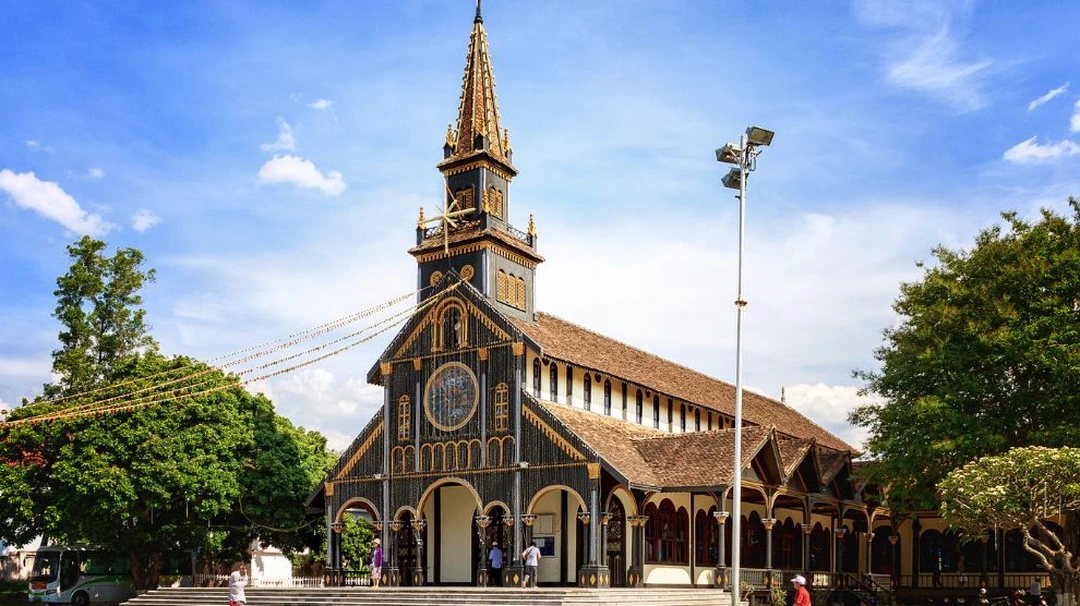
Set amid the breezy, culturally vibrant expanse of the Northern Central Highlands, Kon Tum Cathedral—or the Wooden Church—rises as an enduring symbol of East-West cultural convergence and indigenous architectural artistry. The building sits within spacious, airy grounds brimming with lush greenery and shaded by rows of ancient pine trees. Elevated and oriented toward the rising sun, the church commands a sacred, open spatial axis. At first glance, visitors are captivated by the warm, weathered patina of Ca Chit and Cam Lai timber paired with moss-draped red roof tiles that have braved more than a century of sun and rain. Overall, the structure is a seamless stylization blending the traditional communal Rong house of the Bahnar and Sedang peoples with classical Western Romanesque architecture, resulting in a monumental form that feels both awe-inspiring and remarkably welcoming.
Stepping further inside, this architectural masterpiece reveals itself even more vividly through exquisite hand-carved details and masterful timber engineering. The massive load-bearing framework—featuring rows of primary columns over 80 centimeters wide soaring upward to support the vaulted ceiling—contains not a single iron nail. Instead, master artisans of the past skillfully applied traditional mortise-and-tenon joinery, uniting the nimble craftsmanship of Central Vietnamese carpenters with the structural intuition of indigenous Rong house builders. Natural daylight filters through stained-glass windows depicting Biblical scenes, spilling across the serene interior to illuminate the organic wood grain alongside monolithic timber reliefs and statues. Rather than adhering to rigid European conventions, the decorative motifs echo the raw, soulful character of Central Highlands funerary carvings, fostering an atmosphere that is at once reverent and deeply epic.
To capture the full beauty of this architectural gem, photographers and travel journalists frequently share prized camera angles and ideal golden-hour windows. The premier photo spot is the frontal view from the expansive front courtyard, where you can frame the soaring bell tower alongside the cascading, layered curves of the tiled roofs. The ideal window for this shot is early morning, between 6:00 AM and 7:30 AM, when soft dawn sunlight slants through the trees, bathing the rustic wooden facade in a warm golden glow.
The second coveted vantage point lies along the church’s side colonnade, where long rows of massive wooden pillars create striking spatial depth and grandeur. Natural light streaming sideways through the windows in the late afternoon, roughly between 3:00 PM and 4:30 PM, produces a captivating interplay of light and shadow that accentuates every ancient wood grain and the building’s nostalgic, contemplative charm. Photographed from this angle, every frame breathes with the passage of time, preserving the true essence of a century-old architectural heritage site in the heart of Kon Tum.
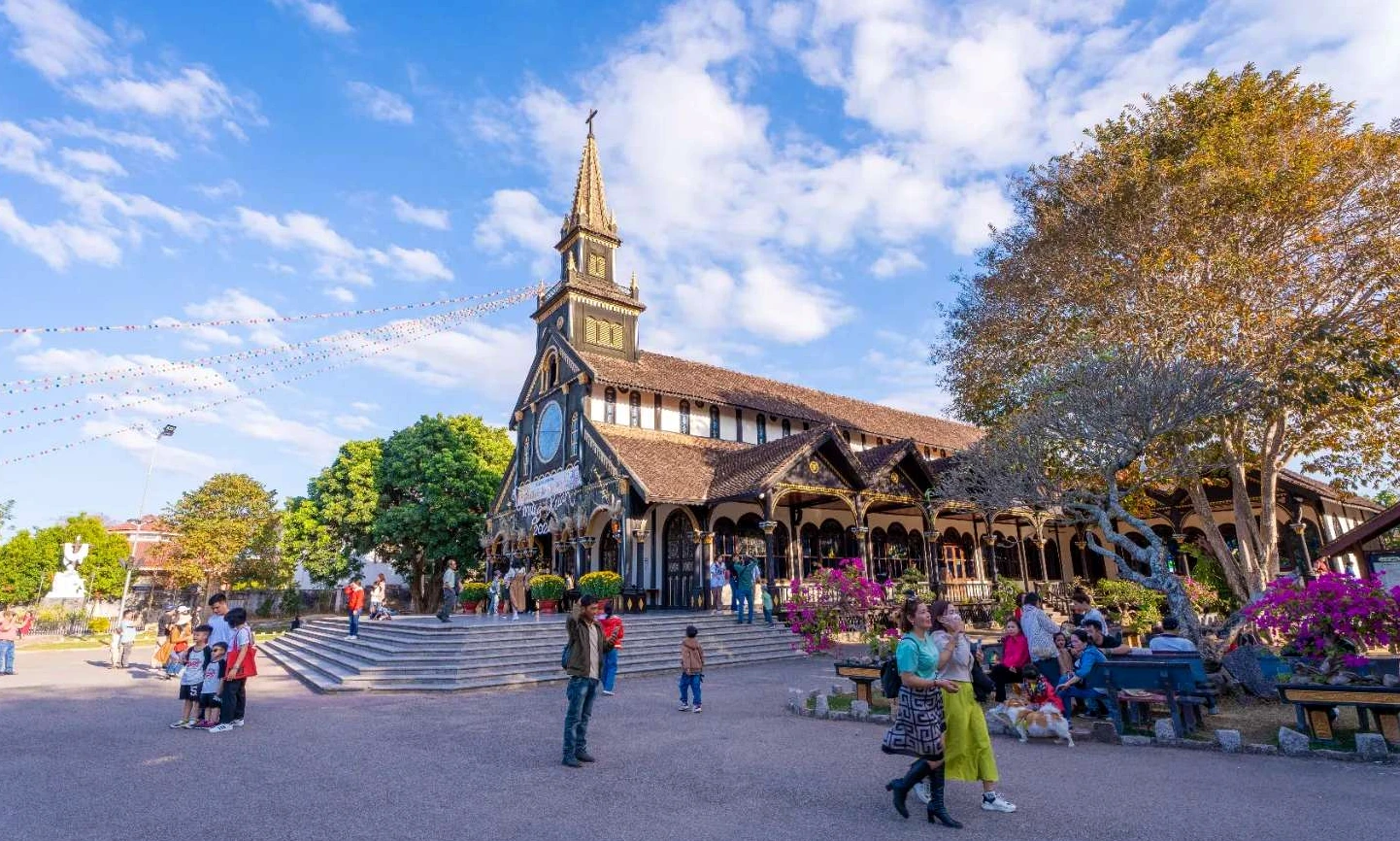
Arriving in Kon Tum City under the golden sunshine of the Northern Central Highlands, the moment the towering silhouette of Kon Tum Cathedral (the Wooden Church) comes into view, all fatigue from the long journey instantly melts away, giving way to an overwhelming sense of awe. Built starting in 1913 under Emperor Duy Tan, this historic monument stands not merely as an architectural triumph blending Western Romanesque style with traditional Rong house artistry, but also as a living cultural sanctuary pulsing with the spirit of the highlands. Standing beneath vaulted ceilings of rare Ca Chit and Cam Lai wood, inhaling the subtle fragrance of raw timber mingled with lingering incense, travelers feel as though they are touching the current of history—experiencing firsthand the remarkable fusion of southern artisans’ dexterity and the heritage of the Bahnar and Sedang peoples.
Stepping out from the quiet, reverent spiritual sanctuary inside the church, a journey through Kon Tum opens up rewarding, wide-open outdoor experiences. To take in panoramic vistas of the majestic mountains and the legendary Dak Bla River, visitors can hike up the gentle hills surrounding the city or venture to nearby highland lookouts. From above, the Northern Central Highlands landscape unfolds in serene beauty, with the river curving like a soft silk ribbon around the mountain town. Even more memorable is gliding along the Dak Bla River at sunset aboard a traditional dugout canoe or motorboat, watching the water reflect the blazing gold of dusk, listening to the highland breeze rustle through golden bamboo groves, and soaking in the unhurried, simple rhythm of riverside village life.
Beyond visual landmarks, a trip to this region is a true culinary feast boasting specialties renowned far and wide. Sitting beside a crackling charcoal brazier in the crisp highland evening chill, travelers will find it hard to forget the bold, layered flavors of Kon Tum leaf salad (goi la), featuring dozens of unique forest leaves paired with pork belly, fermented sour shrimp, and a rich, spicy fermented-rice dipping sauce. Equally unforgettable are traditional favorites such as bamboo-tube grilled chicken fragrant with wild forest pepper, sticky bamboo-cooked rice (com lam) served with fire-roasted meat and lemon-basil salt, or a warming glass of wild myrtle wine (ruou vang sim).
As a journey through the Wooden Church and the wild expanses of Kon Tum draws to a close, what lingers most deeply in every traveler’s heart is not solely awe at a timeless religious monument, but also a profound sense of tranquility. The seamless harmony of untamed nature, vibrant indigenous culture, and authentic local experiences transforms this destination into an unforgettable stop on Vietnam’s heritage travel map.
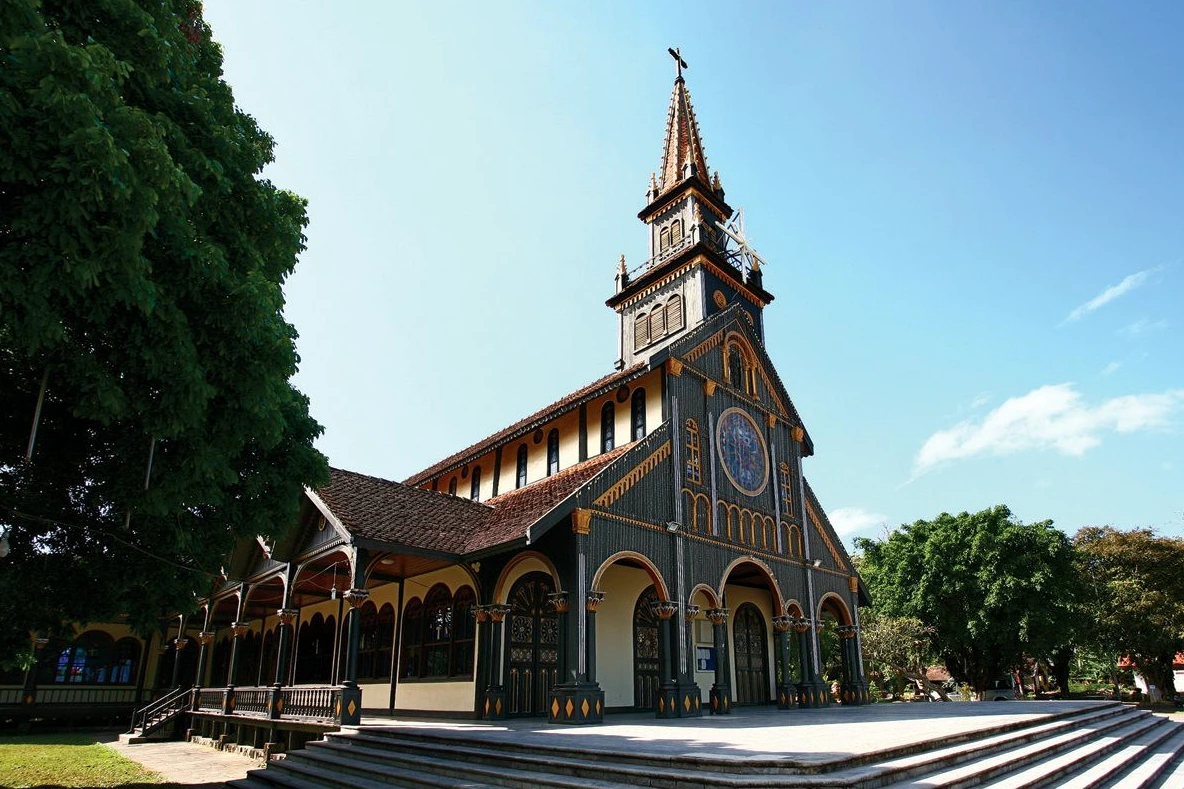
Welcome to the latest travel and pilgrimage guide to Kon Tum Cathedral—the Northern Central Highlands’ most iconic wooden architectural landmark. To ensure your visit to this century-old historic site goes smoothly and meaningfully, keep in mind a few essential practical details regarding opening hours, admission, and local etiquette.
Regarding opening hours, the church welcomes visitors seven days a week. The best window for the general public and travelers to explore the grounds and photograph the exterior architecture is from 6:00 AM to 6:00 PM. However, if you wish to attend a solemn Mass to experience the authentic religious life of the local parish community, note that weekday services typically take place at 5:00 AM and 5:00 PM, with multiple morning and afternoon Masses held on Sundays. Best of all, admission to the Kon Tum Wooden Church is completely free of charge.
Getting there is effortless thanks to its prime location right in the heart of Kon Tum City. Starting from the Central Square or the Provincial Post Office, it takes only 5 to 10 minutes by motorbike, car, or taxi. The most direct route follows Phan Dinh Phung Street or Nguyen Hue Street before turning onto Nguyen Tri Phuong Street, where the church is situated. This central position also makes it easy to pair your visit with other notable landmarks—such as the Kon Tum Bishop’s House or the Kon Klor Suspension Bridge—within a single day.
The best time of year to visit Kon Tum is from November through April, during the Central Highlands’ dry season. Skies are clear, weather is dry, and golden sunlight creates ideal conditions for photography and exploring the outdoor grounds. In particular, visiting around December rewards travelers with vibrant wild sunflowers (hoa da quy) blooming brilliantly along the roads leading into the highlands.
Finally, because this is both a sacred place of worship and a revered historical monument, visitors must observe a respectful dress code. Opt for modest, neat attire and avoid overly short or revealing clothing. Please also maintain quiet decorum inside the sanctuary, refrain from speaking loudly, and always ask permission before photographing local parishioners or religious ceremonies out of genuine respect for local culture and beliefs.
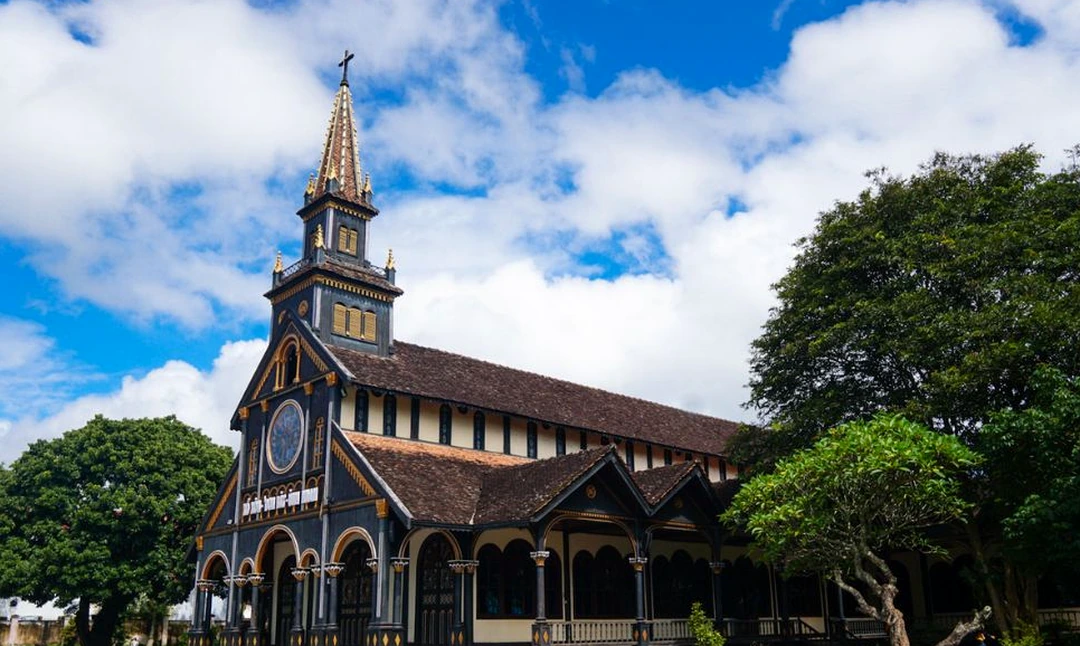
To enjoy a seamless getaway and experience the full splendor of the Kon Tum Wooden Church without worrying about transportation, sightseeing arrangements, or itinerary planning, travelers can choose VDS Travel’s premium all-inclusive Buon Ma Thuot tour packages. Each itinerary is thoughtfully timed for photo stops when the scenery shines brightest, accompanied by knowledgeable local guides well versed in regional culture alongside top-tier hotel accommodations and authentic dining standards.