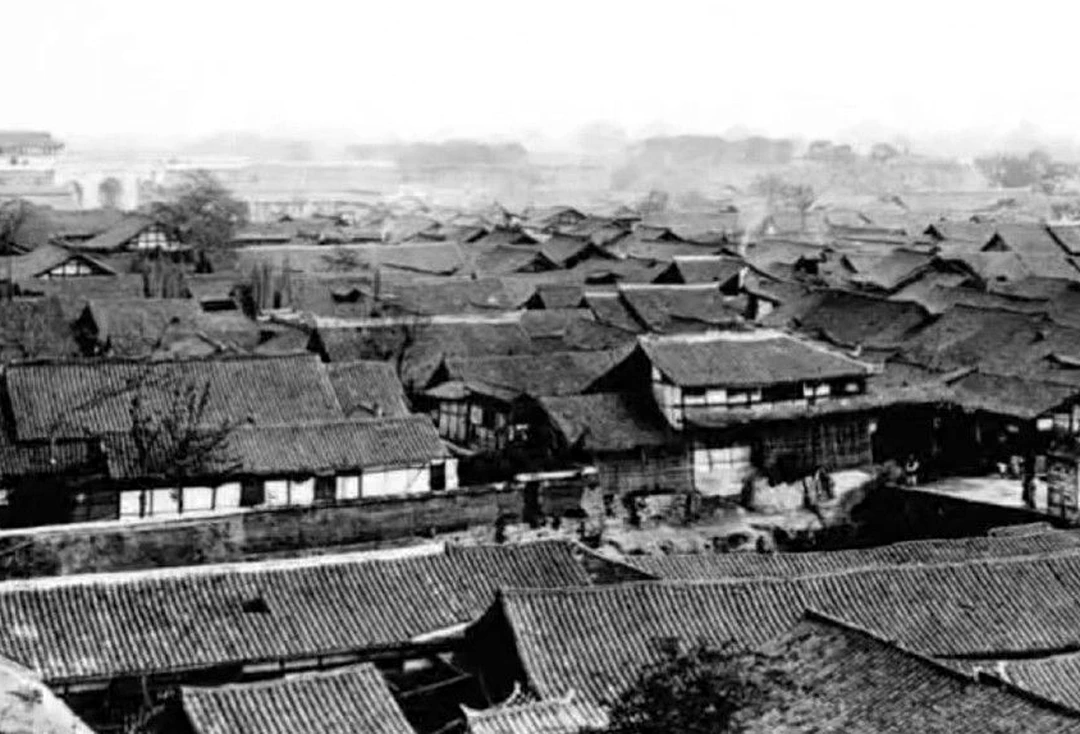
Nestled in the heart of modern Chengdu, the historic architectural complex of Kuanzhai Xiangzi (Wide and Narrow Alleys – 宽窄巷子) is far more than a mere tourist attraction; it is a living chronicle written in brick and stone that preserves the dramatic rise and fall of the ancient Shu region. The origins of this heritage site date back to the 57th year of Emperor Kangxi’s reign (1718) during the Qing Dynasty. After Sichuan Viceroy Yue Zhongqi led troops to quell unrest in Tibet, the Qing court ordered the construction of an exclusive garrison city for the Eight Banners troops right atop the ruins of ancient Shaocheng (once part of the ancient Shu capital). The birth of Mancheng—also known as Shaocheng—marked the genesis of today’s Kuanzhai Xiangzi alley network, symbolizing the strategic military presence of the Manchu Empire in Southwest China.
When originally planned, Mancheng spanned an immense area of over 500 mu (approximately 33 hectares). Behind its fortified walls lay a disciplined, strictly ordered internal street grid consisting of 42 narrow lanes known as hutongs (Manchu alleys) or zidi alleys (lanes designated for soldiers’ descendants). The architectural layout of Shaocheng deeply reflected the rigid Manchu-Han social hierarchy of the era. Most grand estates and siheyuan (courtyard houses) here were built in three-courtyard (sanjin) or four-courtyard (sijin) configurations, employing the “chuandou-style timber frame structure”—a traditional load-bearing wooden skeleton combining pillars and tie beams characteristic of southern Chinese residential architecture, yet arranged in the enclosed, formal layout typical of northern courtyard homes. This synthesis created a living environment that served both military defensive functions and a visual display of feudal aristocratic rank and authority.
The pivotal historical turning point that forever altered the fate of Shaocheng occurred in 1911. The outbreak of the Xinhai Revolution overthrew the Qing Dynasty, leading to the demolition of Mancheng’s city walls and erasing the segregation between Manchu garrison soldiers and the local Han population. Bannermen families began integrating into Chengdu’s civilian life, selling off their courtyard residences or subdividing their estates to make a living. Once a closed-off military stronghold, the district gradually transformed into a peaceful urban neighborhood where aristocratic Manchu heritage blended seamlessly with the laid-back, unhurried lifestyle of the Sichuanese people.
Through subsequent decades of urbanization and heritage preservation, those original 42 hutongs were consolidated and refined into three iconic parallel alleys, each elegantly renamed to reflect its history and physical character. Wide Alley (Kuan Xiangzi), originally Xingren Hutong during the Qing Dynasty, served as the main garrison headquarters and housed the grand mansions of high-ranking Eight Banners officers such as Zuoling and Xiaoqixiao. Narrow Alley (Zhai Xiangzi), formerly Taiping Hutong, once accommodated lower-ranking soldiers and their families, featuring tighter dimensions that evoke a quiet, introspective atmosphere. Meanwhile, Well Alley (Jing Xiangzi), originally Ruyi Hutong, was later named after an ancient brick-lined well (guzhuanjing) located in the middle of the lane—once the shared water source sustaining the entire garrison community.
Having weathered centuries of turbulent Chinese history, Kuanzhai Xiangzi stands today as a “living fossil” documenting the transition from a feudal military garrison to a vibrant cultural heritage quarter. Every gray brick wall, intricately carved wooden gate, and moss-covered stone well holds memories of a transformative era, where northern Eight Banners traditions met the soulful essence of Bashu culture to form an irreplaceable heritage enclave in the heart of Chengdu.
From an urban geography perspective, Kuanzhai Xiangzi sits at the very core of ancient Shaocheng, positioned impressively just west of Dacheng (the Greater City) within the Chengdu Basin. This placement was far from arbitrary; it strictly adhered to the rigorous principles of classical Chinese feng shui: “Ancestral temples on the left, altars of soil and grain on the right; the court in front, the market behind; and the White Tiger on the right to guard military affairs.” Situating the military quarter and northern Manchu clans in the west—the direction corresponding to the Dui trigram and the Metal element, representing the fierce power of the mythical White Tiger—was intended to fortify defenses and safeguard peace across western Sichuan. This fusion of supreme feng shui philosophy and political-military strategy turned Shaocheng into a unique architectural bastion, where every spatial detail served to protect feudal governance across generations.
Beyond macro-level feng shui, Kuanzhai Xiangzi’s spatial design showcases masterly ingenuity in adapting to the humid subtropical monsoon climate of the western Sichuan Basin, notorious for its gloomy, sun-starved winters and sweltering, high-humidity summers. To counter these natural drawbacks, ancient architects aligned the alleys along an east-west axis tilted slightly southward at a carefully calculated angle. This orientation allows the entire complex to maximize absorption of scarce solar radiation during chilly winter months. Conversely, on stifling summer days, pressure differentials between the shaded inner courtyards of the siheyuan and the sun-warmed alleyways generate strong natural airflow, creating a “corridor breeze” (guotangfeng) effect. This continuous draft sweeps away stagnant heat and humidity, keeping the neighborhood naturally cool and airy.
Another ingenious engineering highlight behind Kuanzhai Xiangzi’s enduring vitality is its sophisticated underground hydrological micro-circulation system. Built upon the principle of “streets in front, alleys behind, nourished by well water,” the district’s infrastructure harmonizes surface architecture with subterranean engineering. Beneath the bluestone paving slabs lies an intricate network of hand-carved underground drainage channels (angou), connected to wells and subterranean springs (jingquan) scattered across family courtyards. Whenever heavy basin downpours strike, the angou network immediately captures surface runoff and channels it swiftly out of the residential zone to prevent flooding. At the same time, water naturally filters through layers of clay and gravel to replenish underground aquifers, sustaining clean household water supplies and lush courtyard greenery year-round. This closed-loop hydrological cycle maintains ideal ambient humidity within the courtyards, creating a man-made ecological landscape in seamless harmony with nature.
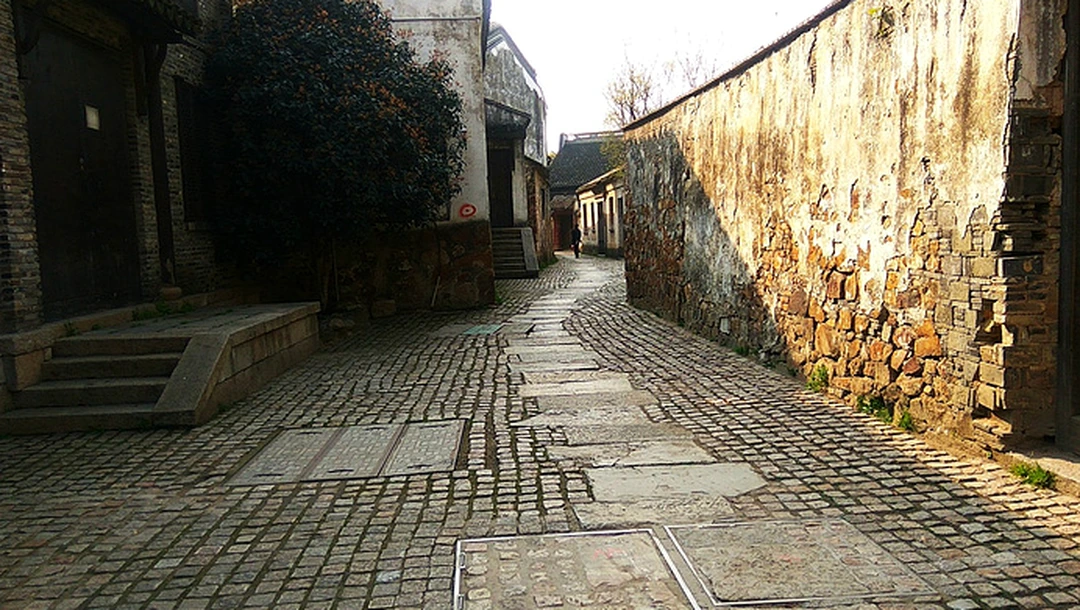
Encompassing a planned area of roughly 47.9 mu with over 25,000 square meters of actual building space, Kuanzhai Xiangzi emerges as a living architectural museum amid modern Chengdu. Its spatial layout represents a rare dialogue between disciplined Manchu military planning and the free-spirited, leisurely lifestyle of Sichuan. Built upon the foundations of ancient Shaocheng, the entire complex is anchored by three parallel east-west alleys, forming an architectural ecosystem that both reflects past social stratification and preserves contemporary everyday life.
In terms of construction techniques, the heritage buildings here exemplify the pinnacle of blending northern Siheyuan layouts with Western Sichuan folk architecture (Chuanxi Minju). The primary load-bearing skeleton utilizes the “Chuandou-style timber frame” (chuandoushi mugoujia)—an intricate mortise-and-tenon wooden joinery system assembled without a single iron nail. Wooden columns directly support the tie beams and moss-draped roofs, giving the structures exceptional weight distribution and seismic resilience against the frequent geological tremors of the Sichuan Basin. Enclosing this timber frame are traditional “bamboo-woven mud-plastered walls” (zhubian jiani qiang). Ancient artisans wove bamboo strips into a core lattice and coated both sides with a mixture of mud, straw, quicklime, and plant fibers, producing a highly breathable wall envelope that keeps interiors warm in winter and cool in summer—ideally suited to Southwest China’s damp, misty climate.
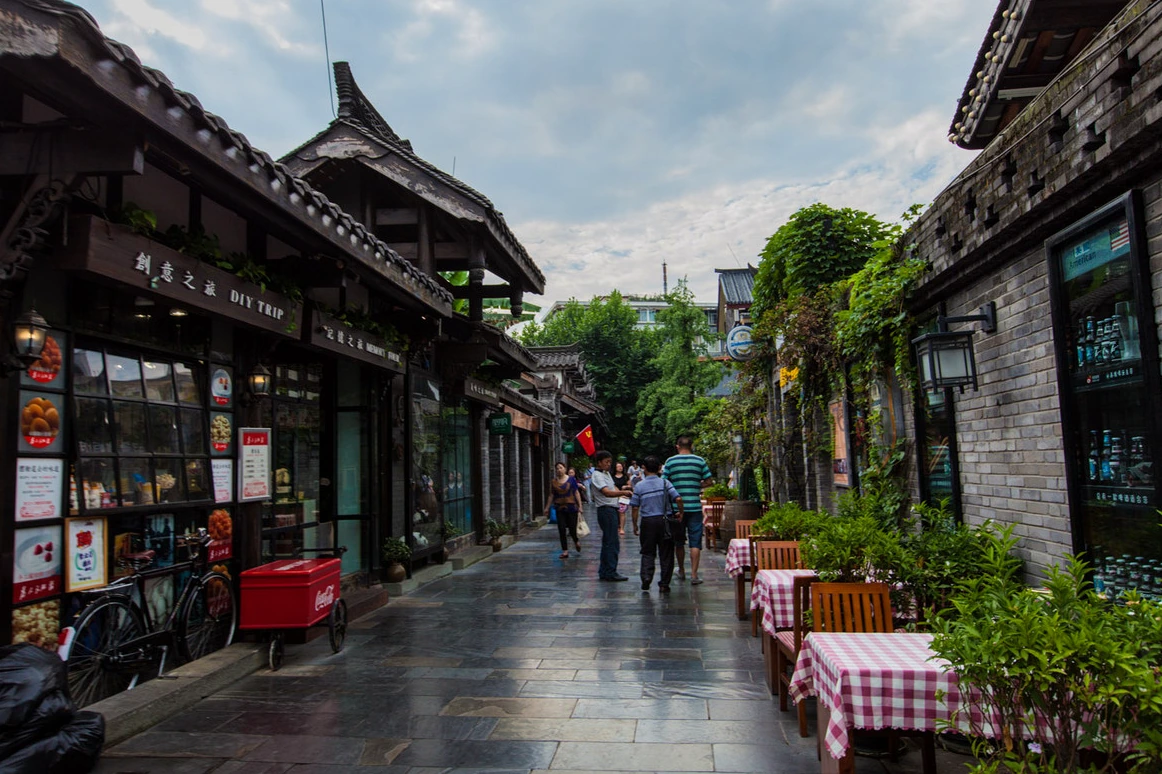
The nuanced spatial experience of Kuanzhai Xiangzi is vividly expressed through the distinct widths of its three lanes. Wide Alley (Kuan Xiangzi), spanning an open width of 6 to 7 meters, was once home to prominent Manchu aristocratic families and retains a stately air with grand courtyard compounds radiating Chengdu’s signature unhurried, leisurely pace of life. In contrast, Narrow Alley (Zhai Xiangzi) narrows to just 4 to 5 meters; formerly inhabited by wealthy merchants and intellectuals during the Republican era, its intimate proportions create deep perspective views where gray-brick Western-style villas (xiyanglou) blend gracefully with Roman arches and European floral motifs. Finally, Well Alley (Jing Xiangzi), measuring a modest 4 meters wide, serves as a lively hub of folk culture, where a long brick relief wall chronicles everyday Chengdu life across eras alongside contemporary cultural and creative art spaces.
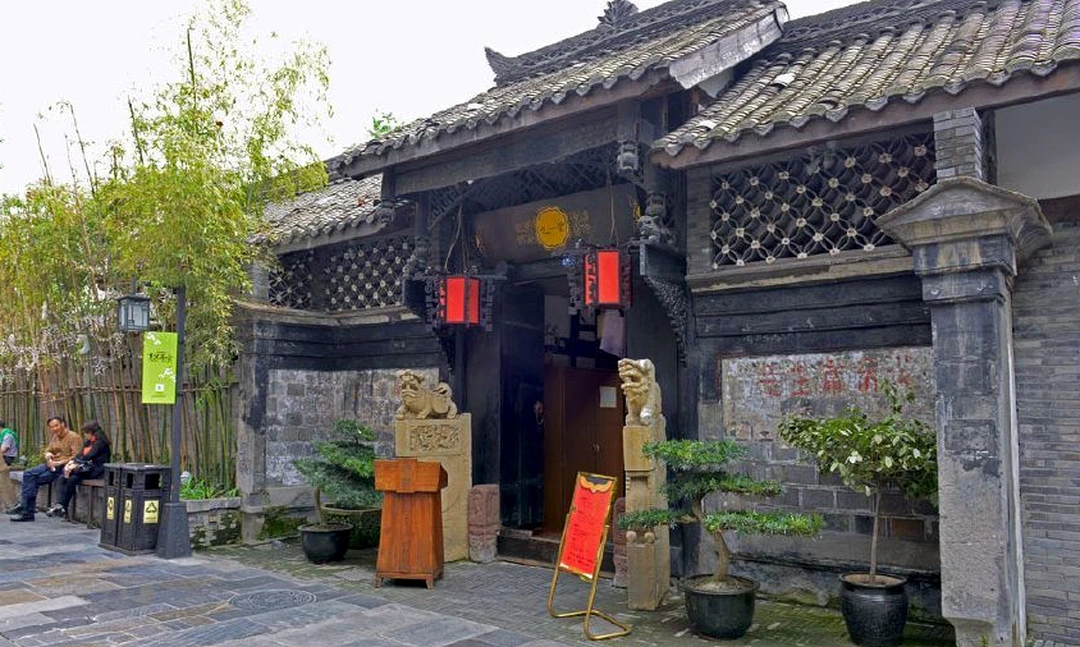
The aesthetic soul of the district rests upon the celebrated “Three Wonders of Western Sichuan” (Chuanxi Sanjue)—three pinnacles of traditional decorative craftsmanship. Foremost among them are the relief-carved gray-brick gatehouses (qingzhuan fudiao mentou). These remarkable brick sculptures illustrate a fascinating fusion of Manchu Shamanic beliefs and traditional Han Confucian aesthetics, depicting motifs of eagles, auspicious clouds, bamboo, plum blossoms, and dragon-stylized longevity characters. Equally captivating is the craftsmanship of finely sliced wooden lattice windows featuring two classic patterns: the “cracked ice pattern” (bingliewen), evoking the lofty, refined spirit of literati scholars, and the “swastika pattern” (wanziwen), symbolizing eternity, continuity, and endless good fortune. Every window lattice and brick relief serves not merely to invite light and breeze, but as a standalone work of art capturing the deep historical soul of Shu.
As dusk settles over the land of Shu, Kuanzhai Xiangzi takes on an entirely new persona, standing as a shining model of organic urban renewal paired with an immersive nighttime economy. Rather than being overwhelmed by harsh industrial floodlights, the historic architecture is elevated through the supreme lighting design philosophy of “seeing the light, not the fixture” (jianguang bujiandeng)—allowing visitors to admire dramatic illumination while keeping every light source completely hidden. Low-voltage LED strip lights in a warm color temperature range of 2200K to 2700K are discreetly tucked along eaves and ledges, gently tracing the contours of gray-brick walls (qingzhuan qiangyuan), soaring horse-head gables (matouqiang), curved roof tile channels, and ornate drip-tile eaves (wadang dishui).
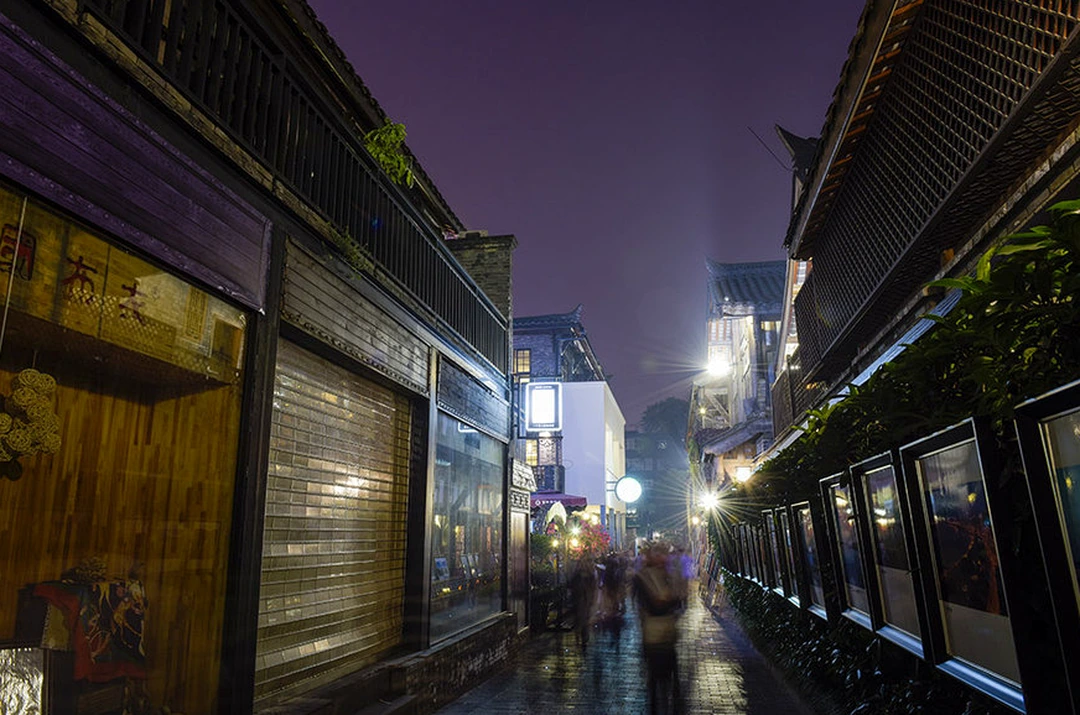
Every footstep along the centuries-worn bluestone slabs (qingshiban) becomes an enchanting visual journey after dark. Beneath visitors’ feet, recessed ground uplighting combines with digital Gobo projection technology to weave a dreamlike artistic tableau. Shadows of swaying bamboo leaves and elegant covered teacups (gaiwan) shimmer and drift softly across the ancient paving stones, bridging quiet historical nostalgia with contemporary flair. This subtle lighting artistry does more than illuminate the lanes—it evokes a poetic sense of timelessness, blurring the boundary between bygone prosperity and modern urban vibrancy.
As the evening deepens, the performing arts scene in Narrow Alley (Zhai Xiangzi) comes alive, headlined by the renowned “Shufeng Yayun” cultural show. Inside a hallowed venue dedicated to traditional Bashu performing arts, spectators are immersed in the legendary stunts of Sichuan Opera. Blink-and-you-miss-it face-changing acts (bianlian), fiery bursts of flame-spitting (tuhuo) lighting up the night, and the witty, acrobatic rolling-lamp routine (gundeng) draw continuous rounds of applause. Beyond opera, master tea artists perform long-spout copper kettle tea art (changzui tonghu chayi) like a graceful sword dance, pouring streams of boiling water into cups from afar without spilling a single drop—capturing the quintessential spirit of Chengdu tea culture.
The synergy between heritage and cutting-edge technology reaches a breathtaking milestone inside the Republican-era courtyards. Here, live performance enters a new dimension by pairing 3D holographic projection with immersive, walk-through historical theater. Rather than remaining passive spectators, guests walk directly from courtyard to courtyard, brushing past moss-covered walls to become living witnesses inside the storyline. Ethereal digital projections blend seamlessly with live performances by actors in period attire, vividly recreating historical turning points, bustling merchant life, and the refined daily rituals of old Chengdu’s scholar-gentry class in a deeply moving multisensory experience.
Visiting Kuanzhai Xiangzi invites travelers not only into an atmospheric Bashu architectural sanctuary, but also on an unforgettable journey into the heart of Sichuan cuisine—celebrated as a living museum of intangible culinary heritage. An old Chengdu proverb states, “A hundred dishes, a hundred flavors; each dish has its own character,” a culinary richness codified in the classic “Twenty-Four Flavor Profiles” (Ershisi Weixing) of Sichuan gastronomy. Strolling past Qing-era gray brick walls, the intoxicating aromas of beef tallow, Sichuan peppercorns, and dried chilies guide visitors across a kaleidoscope of tastes: from Mala (numbing and fiery spicy) and Yuxiang (fish-fragrant seasoning crafted without any fish) to Jiaoma (fresh, tingling green peppercorn) and Guaiwei (“strange flavor,” a harmonious symphony of sour, sweet, salty, bitter, spicy, and numbing). Every corner of Kuanzhai Xiangzi harbors a time-honored culinary legend perfected over centuries.
Among the many storied heritage brands (“laozihao”) standing proudly along these historic lanes, two iconic dim sum institutions representing the pinnacle of Sichuan dumpling craftsmanship are absolute must-stops. “Long Chaoshou” (Dragon Wontons) captivates discerning palates with wrappers rolled as thin and translucent as silk yet delightfully chewy, enveloping a tender, savory fresh pork filling. Its signature lies in a broth simmered for hours from pork marrow bones and whole chickens, yielding a crystal-clear soup with a deeply comforting, naturally sweet umami finish. Offering a bold contrast is “Zhong Shuijiao” (Zhong Dumplings)—exquisite all-pork dumplings without vegetable fillers, generously bathed in glossy red chili oil. The secret behind Zhong Shuijiao’s fame lies in the immaculate balance between the sweet-savory richness of rock-sugar-infused dark soy sauce, the gentle tang of aged vinegar, and a pungent punch of freshly minced garlic (“zhong suanni”), delivering an explosion of flavor from the very first bite.
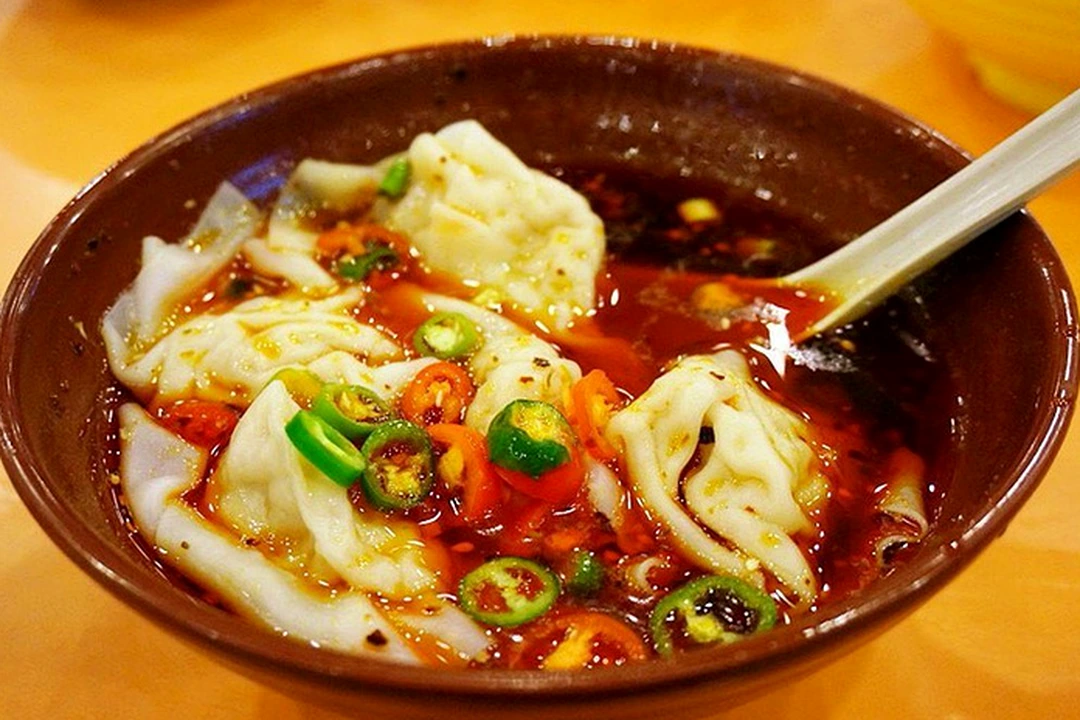
The true fiery soul of Kuanzhai Xiangzi’s food culture lies in traditional Sichuan hot pot (Lao Huoguo) and hot pot skewers (Chuan Chuan Xiang). Unlike milder hot pot styles found elsewhere, authentic Sichuan hot pot here relies on a rich base of aged beef tallow (niuyou), which locks in heat and infuses the broth with dozens of aromatic herbs, red and green Sichuan peppercorns, and premium Sichuan chilies. The base is slow-simmered over gentle heat (“wenhuo man’ao”) for hours until every layer of spice melds seamlessly. Dipping skewers of fresh beef, gizzard membranes, or duck intestines into the bubbling crimson broth takes diners on a thrilling sensory ride: the citrusy tingle of peppercorns rising to the nose, a fiery kick across the tongue, and finally a lingering, rich, savory-sweet aftertaste (“mala huigan”) that proves utterly addictive.
Alongside bold, spicy delicacies, Kuanzhai Xiangzi also preserves theatrical folk snacks, crowned by the famous glutinous rice cake “San Da Pao” (Three Cannon Shots). The unusual name of this intangible heritage treat comes from its lively preparation ritual: artisans pinch off warm balls of glutinous rice dough and hurl them forcefully onto a brass platter mounted on a wooden frame. As the dough bounces off the brass plate three times, it produces three booming “bang, bang, bang” sounds echoing cannon fire before landing neatly in a tray of fragrant roasted soybean flour. Drizzled generously with thick brown cane syrup, the snack is delightfully chewy, nutty, and subtly sweet. Savoring a plate of San Da Pao beside a cup of covered gaiwan tea in an ancient courtyard while listening to the resonant strings of a guzheng zither is the quintessential, most refined culinary ritual in Chengdu.
Exploring Kuanzhai Xiangzi smoothly requires knowing a few practical operational details to make the most of your visit. While the open-air pedestrian alleys remain accessible 24/7 for tranquil nighttime strolls, indoor venues—including family heritage museums, the Manchu Culture Museum, teahouses, and private courtyards—generally operate daily from 09:00 to 22:00. During major national public holidays, Chengdu heritage authorities frequently implement advance reservation systems and crowd-control measures to protect the historic bluestone pavements. The golden window to experience authentic “yanhuoqi”—the warm, everyday local atmosphere of Shu—is early morning between 07:30 and 09:30, when serene quiet blankets the lanes, thin wisps of mist linger over moss-covered gray roofs, and the architecture remains unobstructed by crowds. Conversely, it is best to avoid peak afternoon hours from 14:00 to 18:00 if you prefer not to navigate heavy tourist traffic.
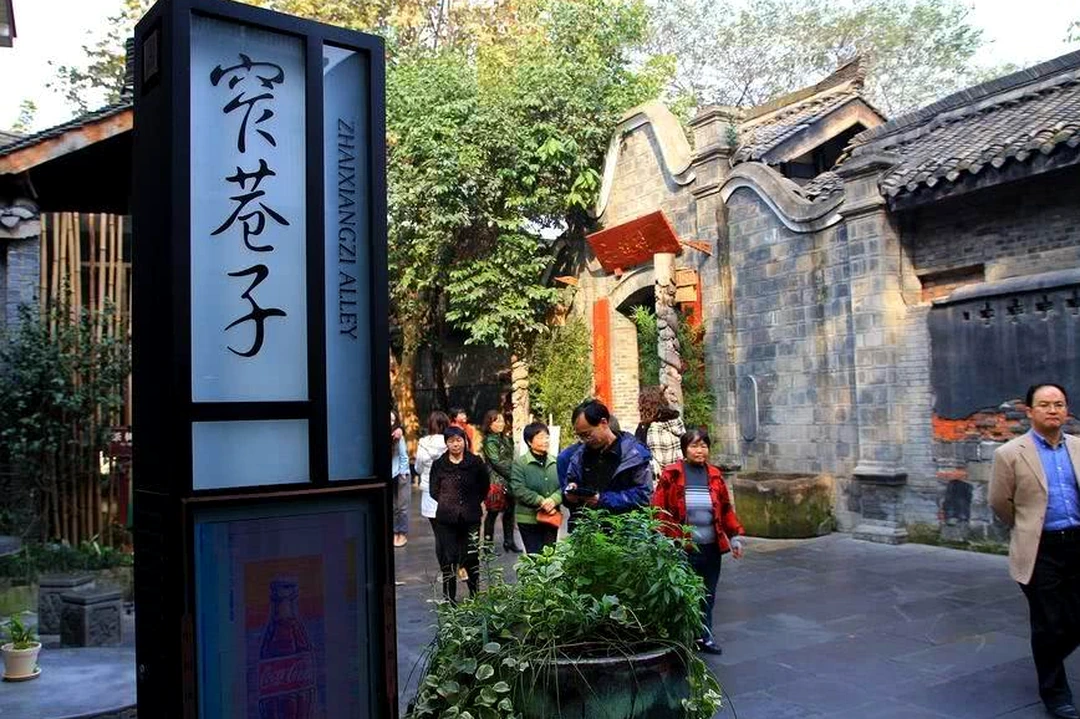
Getting there is effortless and budget-friendly thanks to Chengdu’s modern metro network. The most convenient option is taking Chengdu Metro Line 4 to Kuanzhai Xiangzi Station, or Line 2 to Tonghuimen / Zhongyi Da Sheng Yiyuan (Provincial Hospital of TCM) Station. Exiting from Gate D of Kuanzhai Xiangzi Station, a leisurely 300-meter walk brings you straight into the historic quarter. To maximize architectural perspectives and emotional pacing, cultural researchers recommend following a “golden route”: enter via the east gate of Well Alley (Jing Xiangzi), walk past the hundred-meter-long brick relief wall chronicling old Chengdu life, cross over into Narrow Alley (Zhai Xiangzi) to soak in the romantic charm of its quiet teahouses, and conclude in Wide Alley (Kuan Xiangzi)—the liveliest lane lined with grand Qing-era courtyard mansions.
To ensure a seamless visit free of common tourist pitfalls, keep a few practical insider tips in mind. Thousands of meters of alleyways are paved with centuries-old bluestone slabs (qingshiban) polished smooth by generations of footsteps, making them slippery—especially in damp weather—so wearing sneakers or flat walking shoes with reliable traction is essential. When it comes to dining and tea, be selective about front-facing stalls along the main thoroughfares, where gaiwan tea and street snacks are often steeply overpriced and mass-produced. Instead, venture deeper into hidden courtyard teahouses tucked inside quieter side passages, where traditional tea masters deliver authentic service at far more reasonable prices. Likewise, amidst mass-produced souvenirs, travelers seeking genuine intangible cultural heritage crafts—such as Shu brocade, Shu embroidery, or Chengdu lacquerware—should seek out state-certified time-honored establishments (laozihao) or workshops operated by national-level heritage artisans.
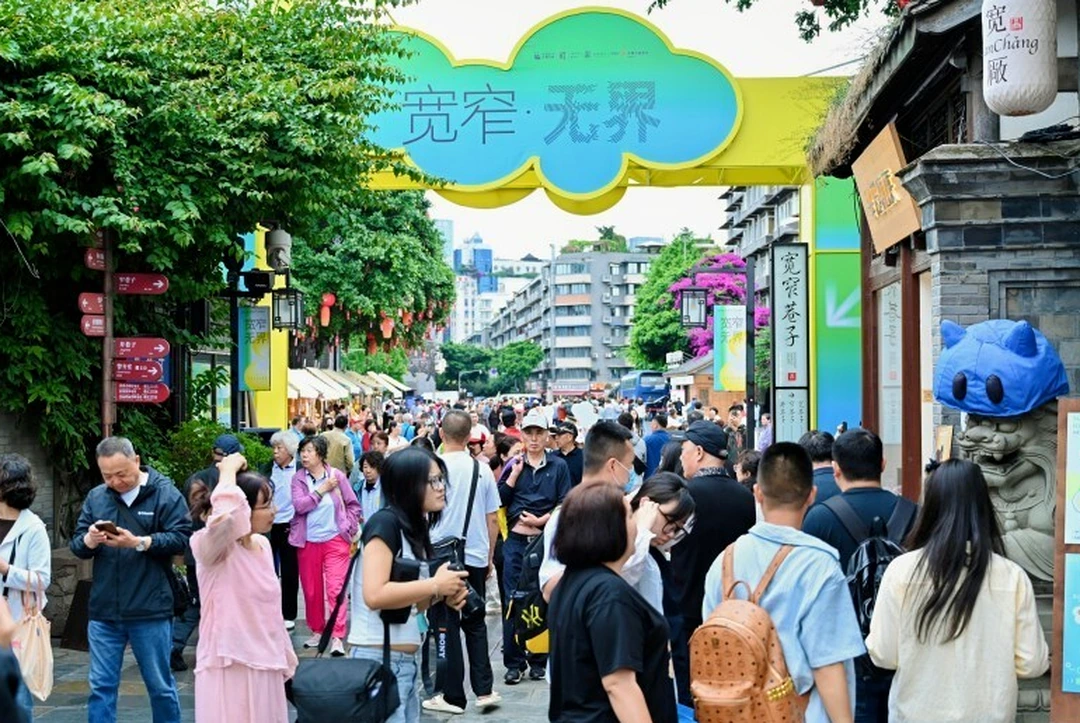
Thoughtful planning around your walking route, footwear, and cultural pacing will allow you to capture both the serene grandeur and aristocratic elegance of this 300-year-old heritage quarter in the heart of modern Chengdu. If you are planning an unforgettable journey combining Sichuan’s breathtaking natural wonders with its iconic spiritual and cultural landmarks, explore the curated itinerary of the Chengdu – Jiuzhaigou – Leshan Giant Buddha 6D5N tour for attentive service and deeply authentic local experiences.