Perched atop a towering chalk escarpment overlooking the tranquil River Thames in Berkshire, Windsor Castle stands as a living chronicle of the power and endurance of the British monarchy. It is the oldest and largest continuously inhabited and reigning royal residence on the European continent, having weathered nearly a millennium of triumphs and trials alongside the history of the United Kingdom. The fortress’s foundations were laid between roughly 1070 and 1086 under the command of William the Conqueror, England’s first Norman king. Recognizing the strategic advantage of a site located a day’s march west of central London, William chose this hilltop to construct a classic motte-and-bailey stronghold—initially consisting of a fortified earthen mound, timber palisades, and surrounding ditches designed to anchor a defensive ring suppressing rebellions following the 1066 conquest.
With the rise of the Plantagenet dynasty, timber defenses gradually gave way to enduring gray stone. Between 1165 and 1179, King Henry II ordered the dismantling of earlier structures to raise an outer stone curtain wall and lay the initial stone foundations for the Round Tower atop the central motte, transforming Windsor into an impregnable stronghold. The fortress’s military might was fiercely tested during the First Barons’ War in 1216, when a loyal royal garrison steadfastly withstood a grueling siege by rebel nobles. Yet Windsor’s most dramatic medieval transformation belonged to the reign of Edward III. Between 1350 and 1377, the chivalry-devoted monarch expended a staggering £50,000—an unprecedented sum in English medieval royal construction—to rebuild the entire Upper Ward into a magnificent palace complex under the masterful supervision of cleric and architect William of Wykeham.
Under the banner of the illustrious Tudor dynasty, Windsor entered another golden age of ecclesiastical architecture. In 1475, King Edward IV ceremonially laid the foundation stone for St George’s Chapel, the crowning achievement of the Perpendicular Gothic style. After decades of painstaking labor by master stonemasons, this sacred masterpiece was completed in 1528 during the reign of King Henry VIII. Not only does it serve as the spiritual home for the solemn ceremonies of the Order of the Garter—England’s oldest and most prestigious order of chivalry—but it also became the eternal resting place of storied historical figures, including Henry VIII himself, Queen Jane Seymour, and later the ill-fated King Charles I.
The tides of history swept the castle through its darkest chapters in the seventeenth century with the outbreak of the English Civil War. Parliamentary forces led by Oliver Cromwell seized the fortress, converting royal chambers into military barracks, munitions stores, and a prison holding King Charles I prior to his trial and execution. Following the Restoration of the monarchy, King Charles II brought exuberant continental Baroque aesthetics to Windsor throughout the 1670s. Under the skilled direction of architect Hugh May working alongside master woodcarver Grinling Gibbons, the Baroque State Apartments emerged with gilded ceilings and intricate carvings proclaiming the supreme authority of the restored crown.
In the nineteenth century, the castle’s silhouette was fundamentally reshaped once again under the House of Hanover. King George IV and architect Sir Jeffry Wyatville carried out a sweeping reconstruction between 1824 and 1830, forging the imposing Gothic Revival profile visitors admire today—most notably raising the Round Tower by 30 feet to establish an authoritative, harmonious skyline. Modern history left an indelible mark in 1917 when, amid surging anti-German sentiment during World War I, King George V issued a historic proclamation renouncing the Germanic surname Saxe-Coburg and Gotha and adopting the castle’s own name for the royal House of Windsor. The gravest contemporary trial struck on November 20, 1992, when a devastating fire gutted 115 historic rooms. Through an extraordinary five-year restoration effort costing £37 million, the project concluded triumphantly in 1997, raising Windsor from the ashes to stand proudly as an enduring national emblem.
Viewed through the lens of military geography and royal landscape planning, Windsor Castle commands a remarkably strategic position at British National Grid reference SU973770. The complex sits proudly atop a natural outcrop of Upper Cretaceous Chalk piercing through the surrounding low-lying London Clay to form a steep natural cliff along the southern bank of the River Thames. This elevated perch not only afforded sweeping tactical sightlines across the Berkshire plain and control over the vital waterway leading to London, but its porous chalk geology also provided natural subterranean drainage, safeguarding the sandstone foundations against subsidence and dampness across nearly a millennium of exposure to the elements.
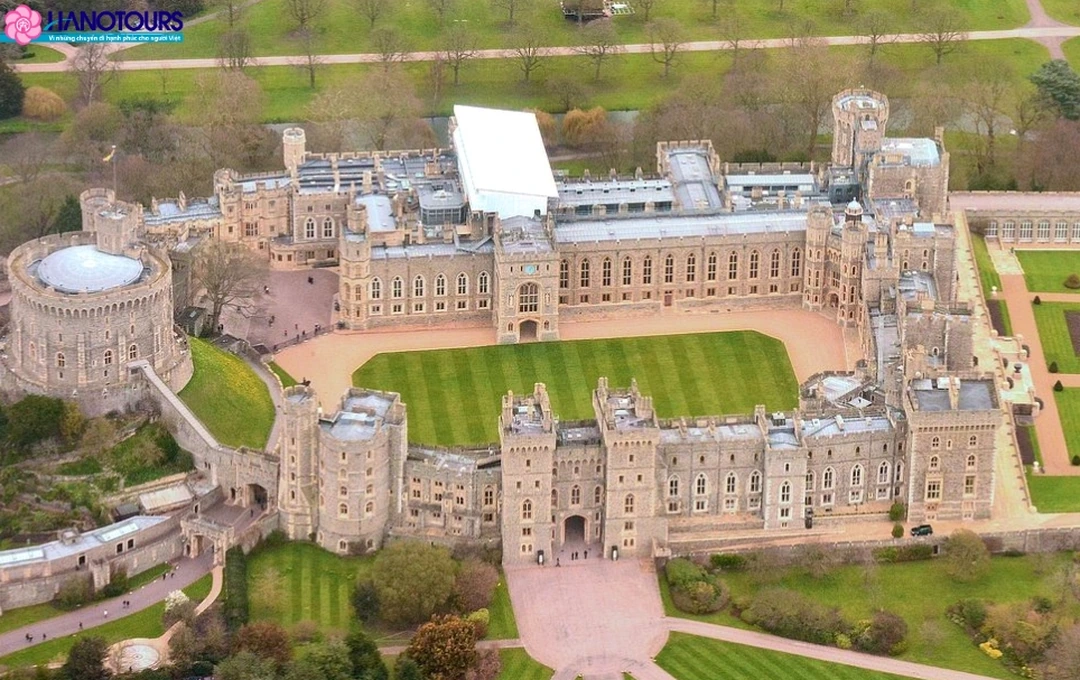
Windsor’s ground plan represents the pinnacle of medieval motte-and-bailey fortress evolution, refined over centuries into a cohesive palace complex. At the defensive core stands the Round Tower atop its ancient artificial mound, acting as a structural hinge dividing the royal domain into two distinct functional zones. To the east lies the Upper Ward, the most private and ceremonial precinct, housing the Private Apartments alongside some of Europe’s most opulent State Apartments. Conversely, the Lower Ward sloping gently to the west exudes a sacred and communal atmosphere, anchored by the Gothic splendor of St George’s Chapel—burial site of monarchs and spiritual seat of the Most Noble Order of the Garter—nestled beside the curved red-brick Horseshoe Cloister, the ornate Albert Memorial Chapel, and the quiet residences of the Military Knights of Windsor.
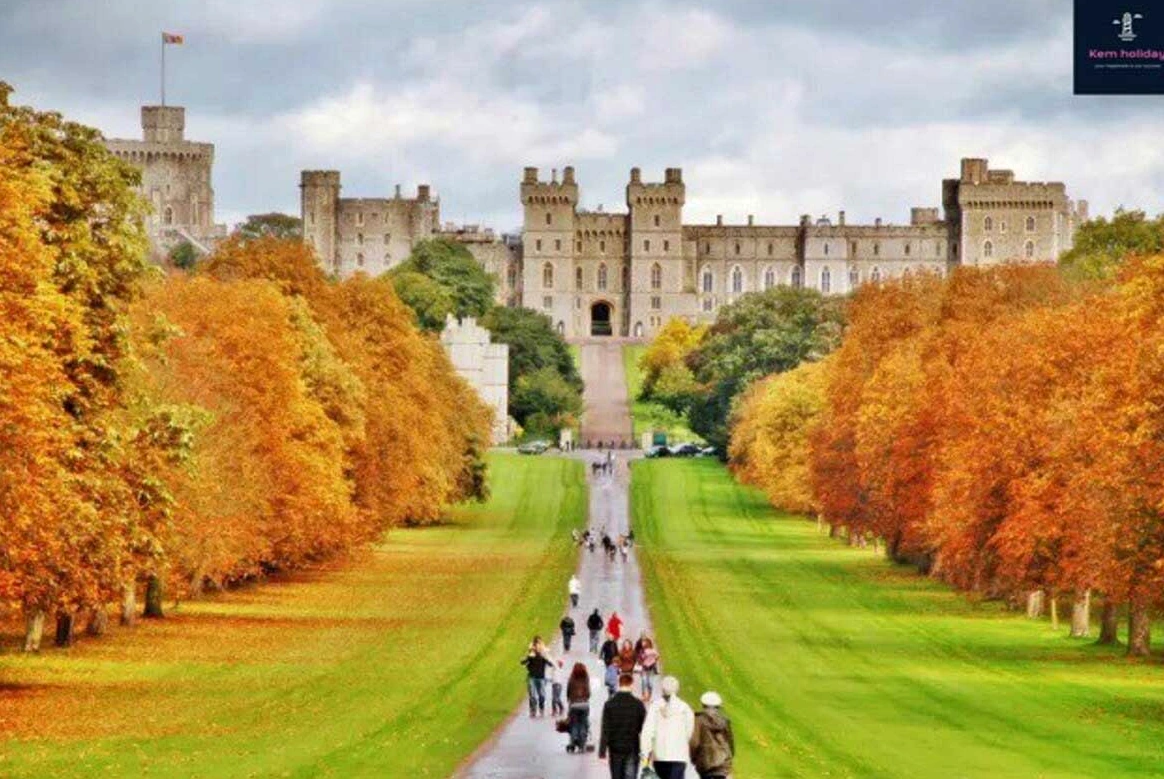
Surrounding this stone bastion stretches the vast green expanse of Windsor Great Park, spanning 4,800 acres that originated as an exclusive royal hunting forest in feudal times. Today it preserves an ancient temperate deciduous woodland ecosystem featuring hundreds of venerable native oaks (Quercus robur and Quercus petraea), many over a thousand years old, their gnarled trunks cloaked in moss and lichen like silent living witnesses to English statecraft. The seamless transition between stern gray battlements and sweeping oak glades creates a mild microclimate that shelters the fortress from biting northern winds.
Crowning this grand landscape is The Long Walk—a dead-straight, three-mile (approximately 4.8-kilometer) avenue linking the castle’s southern gate to the summit of Snow Hill. Conceived by King Charles II in 1680 under the strong influence of Baroque symmetry at the Palace of Versailles, the tree-lined boulevard was further extended and completed with double rows of trees by Queen Anne in 1710. Anchoring the far end of this regal vista stands The Copper Horse, a monumental equestrian statue depicting King George III clad as a Roman emperor atop a rocky knoll, gazing straight down the horizon toward the proud facade of the royal castle.
Covering a remarkable 13 hectares—equivalent to 32 historic Berkshire acres—Windsor Castle rises like a self-contained citadel with roughly 45,000 square meters (484,000 square feet) of floor space. Within its walls lie more than 1,000 rooms ranging from grand audience halls and gilded state reception chambers to a labyrinth of discreet aristocratic corridors. The fortress is clearly organized into three main precincts—the Upper Ward, Middle Ward, and Lower Ward—chronicling a millennium-long evolution from a Norman military outpost into the paramount residence of the British sovereign. Rather than feeling monotonous, the organic interplay of stone masonry creates a dynamic panorama in which every meter of wall bears witness to pivotal chapters of history.
Poised serenely at the heart of the Middle Ward stands the legendary Round Tower, the visual focal point of the entire complex. Despite its name, the structure actually possesses a distinctive irregular oval footprint measuring 39 meters (128 feet) across at its base, ingeniously contoured to embrace the original Norman artificial mound. Rising proudly 67 meters (220 feet) above the meandering River Thames below, the tower dominates the surrounding fertile plain. To achieve such enduring strength, master engineers combined multiple strata of fine building stone: smoothly dressed ashlar blocks and sturdy ragstone hauled painstakingly from renowned quarries at Taynton in Oxfordshire, harmonized with crisp Caen limestone imported directly from Normandy across the English Channel, imparting a somber yet commanding gray majesty.
Windsor’s monumental scale and longevity are inseparable from transformative engineering campaigns and vast royal budgets across the centuries. In the fourteenth century, King Edward III spent an astonishing £50,000—more than half the kingdom’s annual revenue at the time—to convert a military stronghold into Europe’s premier chivalric palace. In the 1820s, King George IV ushered in another brilliant renaissance by investing over £900,000 under the guidance of visionary architect Sir Jeffry Wyatville. Embracing early Industrial-era innovation, Wyatville boldly introduced cast-iron structural framing to reinforce the heavy loads of medieval timber roofs, while constructing deep subterranean brick vaults to shore up the natural chalk cliff against subsidence—achieving a classic marriage of modern mechanical engineering and timeless castle aesthetics.
If the Round Tower symbolizes military might, St George’s Chapel rising proudly in the Lower Ward represents the radiant zenith of ecclesiastical architecture, hailed as the finest masterpiece of Perpendicular Gothic design in Britain. Stepping through its imposing arched portal reveals a sanctuary seating up to 800 people, crowned by an astonishing visual centerpiece: an intricate stone fan-vaulted ceiling resembling spreading palm fronds, woven with delicate tracery ribs soaring across the nave. This is the supreme spiritual sanctuary of the Order of the Garter, the oldest and most prestigious order of chivalry in the Western world. Along the exquisitely carved oak choir stalls of the Knights, ceremonial swords, crested helms, and heraldic banners gleam beneath light streaming through vast stained-glass windows, weaving a sacred atmosphere steeped in legend and regal splendor.
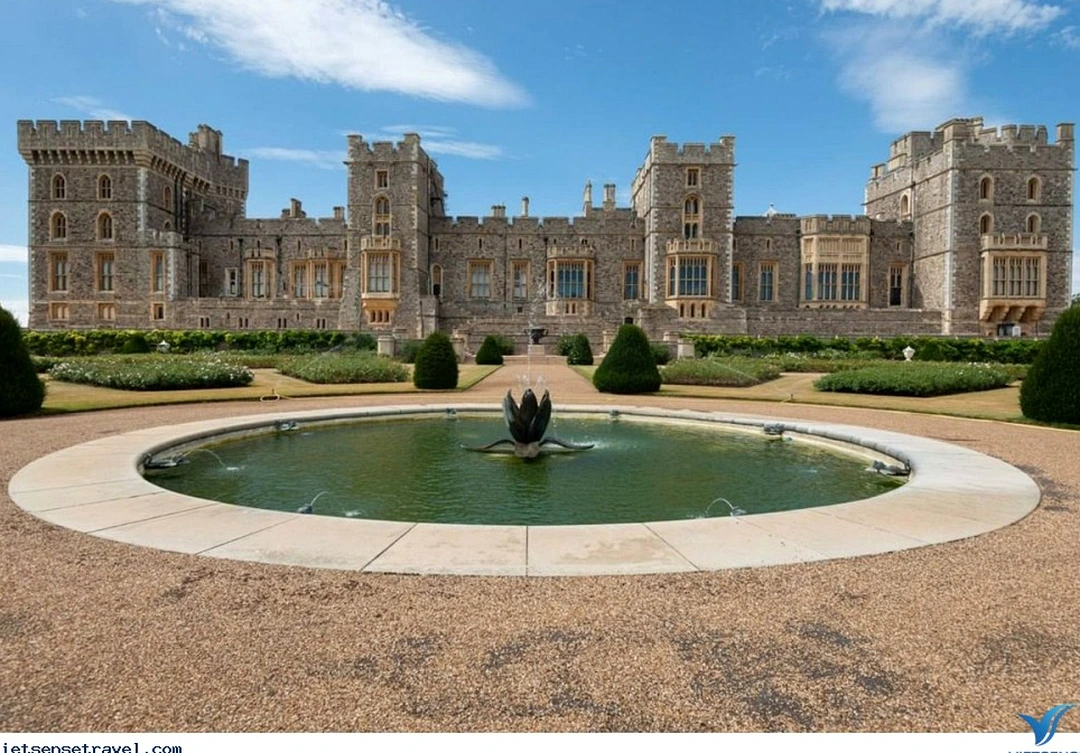
As dusk settles over the tranquil Thames Valley, the boundary between reality and legend blurs before Windsor’s imposing silhouette. The thousand-year-old architectural ensemble undergoes a dramatic nocturnal metamorphosis through precision lighting design, where illumination serves not merely for visibility but as an artistic medium honoring history. Recessed warm-spectrum LED fixtures, calibrated to exact lux levels, graze weathered sandstone blocks and medieval curtain walls. Beneath the night sky of Berkshire, the Round Tower crowning its artificial motte stands sculpted in tiered golden light, throwing into sharp relief the gravitas of a fortress that stood undefeated across dozens of reigns.
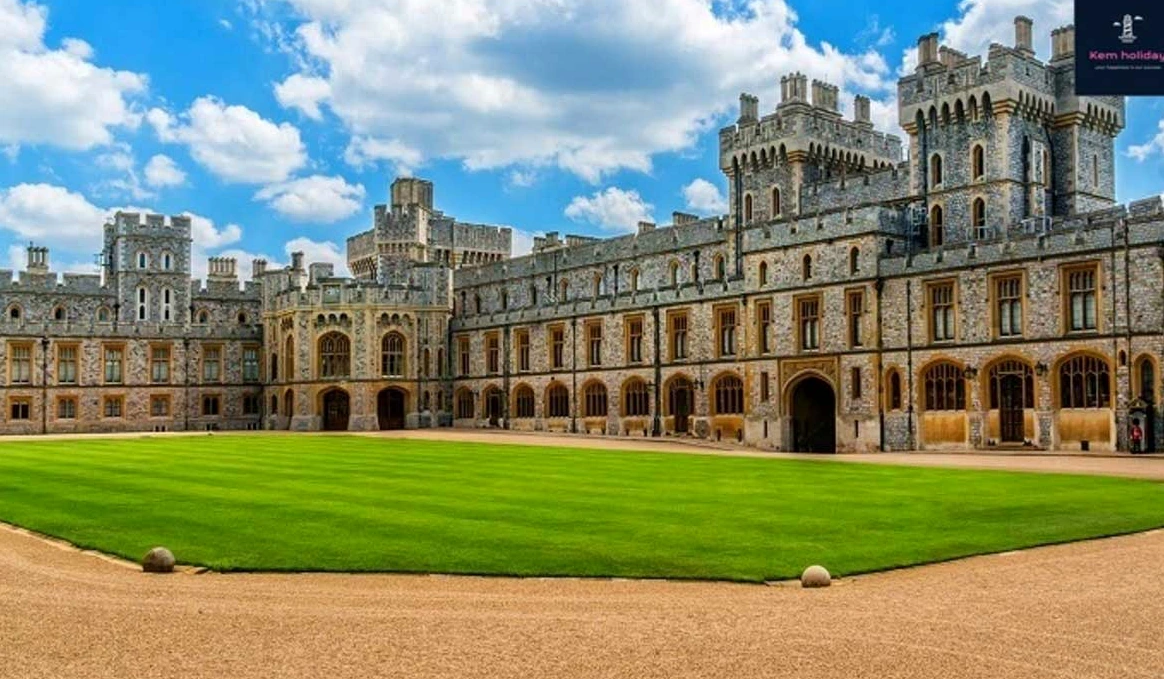
Stepping deeper into the Upper Ward, nightfall is tempered by a classical, aristocratic stillness. The Quadrangle is illuminated by cast-bronze Victorian lanterns integrating hybrid electric-and-gas technology to faithfully recreate nineteenth-century luminance. Soft amber pools of light wash over crisp gravel walkways and glint off the tall Gothic windows of the State Apartments. Here, serene quietude envelops an exclusive sanctuary where royal evening life unfolds discreetly behind heavy velvet draperies, offering an exquisite counterpoint to the rugged grandeur of the surrounding battlements.
The Lower Ward, meanwhile, becomes a natural stage for rare nocturnal pageantry steeped in England’s oldest chivalric traditions. On solemn occasions observed by the Order of the Garter—founded by King Edward III in the fourteenth century—Windsor takes on an air of mystical theater during sacred torchlit processions. Beneath flickering flames dancing across ancient flagstones, knights clad in deep-blue velvet mantles lined with white taffeta and Tudor bonnets plumed with white ostrich feathers process slowly down the stone incline from the State Apartments to St George’s Chapel. Measured footsteps keep cadence as torchlight throws leaping shadows of stone gargoyles across vaulted arches, creating a living historical tableau straight out of an epic chronicle.
Completing this nocturnal soundscape are the resonant chimes of the Curfew Tower—a formidable thirteenth-century defensive bastion anchoring the castle’s northwest corner. Across centuries of upheaval, the tower has preserved its original peal of eight massive bronze bells alongside a mechanical clockwork movement running accurately since 1689. Each evening, the curfew bell tolls across the historic riverside town, recalling the ancient lights-out decree instituted under William the Conqueror. Those deep bronze tones guide visitors toward centuries-old historic pubs tucked right beneath the castle walls, where crackling hearths and foaming pints of ale bring an evening of royal illumination and atmosphere to a satisfying close.
Tucked behind Windsor Castle’s towering stone ramparts lies The Great Kitchen, the oldest continuously operating working kitchen in the United Kingdom, serving monarchs since the fourteenth-century reign of King Edward III. Through more than six centuries of roaring hearths and major renovations under King George IV, this historic culinary hall retains its soaring vaulted timber roof and gleaming rows of copper cookware, standing witness to the evolution of British royal gastronomy. Every dish emerging from these kitchens does more than delight the palate—it celebrates the rich hunting and agricultural traditions of the Thames Valley, where each ingredient carries a story of royal terroir.
The backbone of Windsor’s palace culinary reputation is its celebrated wild game, known as Windsor Game. Harvested directly from the ancient oak woodlands and sprawling pastures of Windsor Great Park, this prized larder includes purebred red deer venison, iridescent pheasant, gray partridge, and wild mallard from natural wetlands. Alongside traditional royal hunting privileges, contemporary palace dining embraces a strict hyper-local philosophy. Crisp vegetables and tender herbs are hand-harvested from organic walled gardens and glasshouses in Home Park, while richly marbled steaks served at state banquets are sourced from pedigree Hereford and Aberdeen Angus cattle raised freely on the royal estates.
No portrait of Windsor’s culinary heritage would be complete without its iconic desserts, chief among them the nineteenth-century Royal Windsor Pudding from the reign of Queen Victoria, long treasured as an aristocratic delicacy. Distinct from modern confections, this classic pudding marries fine white breadcrumbs steeped in melted unsalted butter, whole milk, and rich egg yolks, perfumed with freshly grated lemon zest. Layered over a tart ruby bed of redcurrant jelly and crowned with a peak of toasted meringue, it delivers a sublime contrast between a crisp, lightly caramelized crust and a velvety center that melts on the tongue.
British ceremonial dining reaches its ultimate expression during State Banquets hosted inside St George’s Hall. Beneath a ceiling emblazoned with the coats of arms of Garter Knights, a monumental 50-meter mahogany-and-oak table is assembled to millimeter precision to seat 160 heads of state and distinguished international guests. The visual centerpiece of the banquet is the dazzling gilded Grand Service, comprising more than 4,000 silver-gilt pieces painstakingly crafted between 1806 and 1844 by the celebrated royal goldsmiths Rundell, Bridge & Rundell on the extravagant commission of King George IV. Soup tureens, gilded platters, marble candelabra, and wine coolers chased with classical Greek motifs catch the candlelight, turning every banquet into a living museum of sovereign majesty.
Stepping outside the solemn castle walls, the historic town of Windsor offers a warm, down-to-earth culinary tapestry in centuries-old pubs lining cobblestone lanes. Here, travelers can savor everyday British comfort food such as traditional Pie and Mash—flaky puff pastry encasing slow-braised beef served alongside creamy mashed potatoes and classic parsley liquor. On weekends, indulging in a quintessential Sunday Roast featuring tender slices of pink roast beef, crisp Yorkshire puddings drenched in rich gravy, and honey-roasted root vegetables paired with a cask-conditioned ale provides a hearty, memorable finale to exploring this royal town’s gastronomic heritage.
To ensure a seamless visit to the world’s oldest occupied royal residence, understanding Windsor Castle’s disciplined operating schedule is essential. The thousand-year-old fortress welcomes visitors Thursday through Monday, closing on Tuesdays and Wednesdays for conservation work and ceremonial royal duties. Depending on the seasons of the United Kingdom, opening hours follow a clear schedule: from March through October, doors open from 10:00 AM to 5:15 PM (last admission at 4:00 PM), while from November through February, hours adjust to 10:00 AM to 4:15 PM (last admission at 3:00 PM). All admission tickets require advance timed-entry booking through the official Royal Collection Trust (RCT) online portal. Securing the earliest 10:00 AM entry slot is the smartest strategy for experiencing the serene morning atmosphere before large tour groups gather outside the gates around midday.
Given its status as an active royal residence, airport-style security screening is strictly enforced at the Windsor Castle entrance. Large suitcases, bulky luggage, and sharp objects are strictly prohibited, and because the site provides no public left-luggage lockers, travelers should pack light before setting out. From central London, the national rail network offers straightforward connections. Trains operated by Great Western Railway or the modern Elizabeth Line depart London Paddington with a quick shuttle transfer at Slough, delivering passengers directly to Windsor & Eton Central Station in the heart of town. Another scenic rail option is taking a direct South Western Railway service from London Waterloo to Windsor & Eton Riverside, following the picturesque Thames to within a leisurely five-to-ten-minute uphill walk of the castle walls. Driving into central Windsor is strongly discouraged due to emissions zones and scarce parking; visitors traveling by car are best advised to use Park & Ride facilities along the A332 or near Junction 6 of the M4 motorway and take a shuttle bus into town.
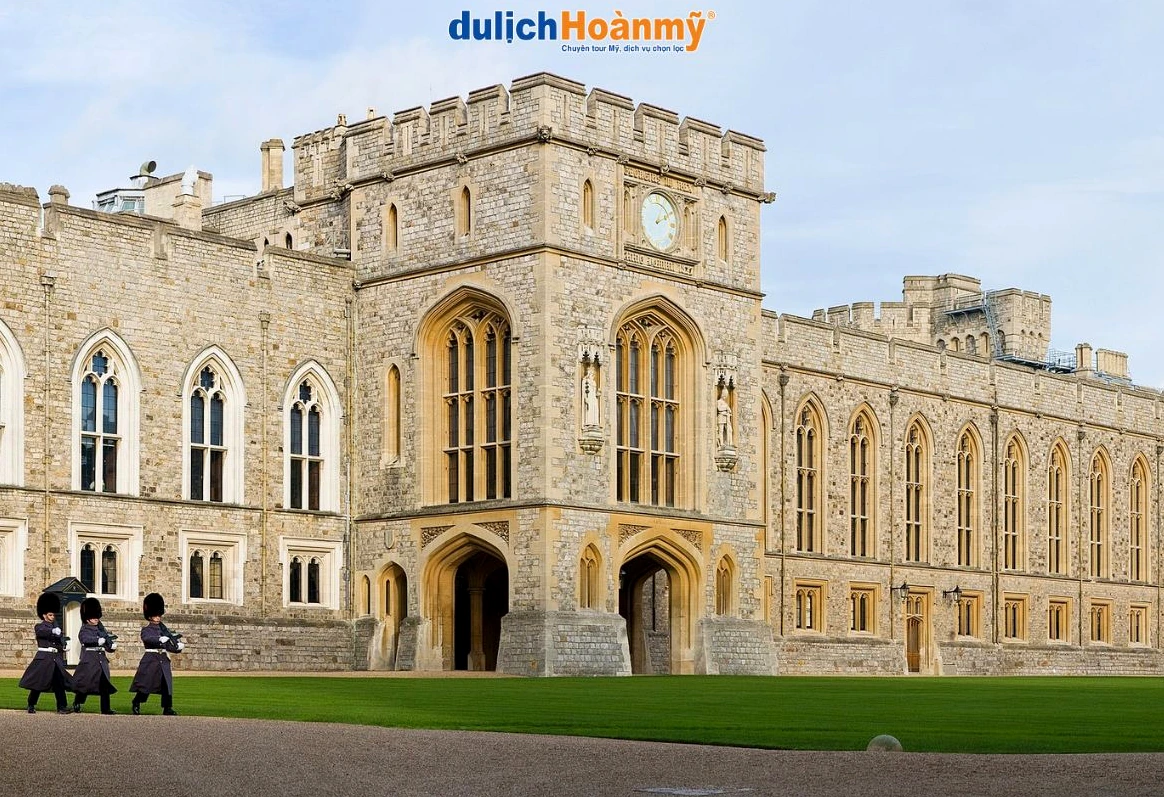
Once inside the sandstone ramparts, respectful etiquette is paramount. Inside the opulent State Apartments and sacred St George’s Chapel—final resting place of Queen Elizabeth II alongside ten British monarchs—photography and filming are strictly prohibited to protect priceless masterpieces by Van Dyck and Rubens as well as fragile historic interiors from light damage. Visitors should also dress respectfully, covering shoulders and knees when entering St George’s Chapel in keeping with its status as a working place of worship. One of the most sought-after highlights of any visit is witnessing the solemn Changing of the Guard ceremony, typically held around 11:00 AM on Mondays, Wednesdays, and Fridays subject to seasonal schedules. Rather than crowding around the narrow King Henry VIII Gate, seasoned visitors stake out a clear vantage point along the gentle incline of High Street or inside the Lower Ward near the Guardroom, enjoying unobstructed views of the Foot Guards marching in crisp formation in scarlet tunics and iconic black bearskin caps from British royal ceremonial tradition.
Exploring Windsor Fortress is far more than simple sightseeing—it is an intimate encounter with the ceremonial splendor and proud millennial heritage of Great Britain. To ensure every detail, from timed heritage tickets and rail connections to guided historical commentary, is seamlessly arranged, travelers can explore an all-inclusive England and Scotland tour package for an unforgettable, deeply enriching cultural journey.