Nestled amidst the rolling hills of Yongin City in Gyeonggi Province, the renowned entertainment complex known today as Everland—or *Aebao Amusement Park* (爱宝乐园) in Hanja—carries a creation story deeply intertwined with the monumental milestones of modern South Korean history. In the 1970s, the Korean Peninsula entered a period of rapid economic expansion celebrated as the “Miracle on the Han River” (*Hangang-ui Gijeok*) under the transformative leadership of former President Park Chung-hee. Alongside sweeping national modernization and breakneck urbanization, the suffocating pace of life in Seoul created an urgent need for a restorative sanctuary where citizens could reconnect with nature and refresh their spirits amid the relentless churn of industrialization.
Against this historical backdrop, the late founding Chairman of the Samsung Group—visionary entrepreneur Lee Byung-chull—nurtured a pioneering ambition far ahead of its time when he decided to reclaim a vast expanse of barren hills in Yongin. On April 17, 1976, the predecessor to the mega-park officially opened its gates to the public under the name “Yongin Farmland” (Korean: 용인자연농원, *Yongin Jayeon Nongwon*). In its earliest days, the grounds bore little resemblance to today’s high-tech amusement rides, functioning instead as an exemplary agro-forestry ecological complex. Tens of thousands of fruit trees were planted and rare native timber species nurtured alongside livestock barns designed to provide hands-on nature education for children while offering urban families a tranquil weekend picnic retreat after demanding workweeks.
Moving into the 1980s and early 1990s, as South Korea emerged as one of the “Four Asian Tigers,” public demand for cultural enrichment and leisure entered an entirely new era. Attuned to the changing times, Yongin Farmland steadily evolved—importing modern mechanical rides, expanding its wildlife safari enclosures, and staging vibrant seasonal flower festivals. Its most defining historical milestone arrived in March 1996: celebrating two decades of growth, the complex shed its rustic farm identity to adopt the name “Everland.” Combining the concepts of timelessness (“Ever”) and place (“Land”) alongside its Hanja ethos of a garden of heartfelt affection and boundless joy, the rebrand conveyed a deeply humanistic message dedicated to enduring smiles and happiness for every visitor.
Far from resting on domestic acclaim, Everland continually elevated its standards to stand shoulder to shoulder with the world’s premier theme parks. Its most groundbreaking engineering milestone debuted in 2008 with the unveiling of T-Express—South Korea’s first wooden roller coaster. Winding dramatically across steep valley terrain, this mechanical marvel not only claimed world records for speed, drop angle, and airtime, but also became a proud emblem of creative innovation in Korea’s entertainment industry. From a modest experimental farm on the Yongin hillsides of the last century, Everland has completed an extraordinary transformation into a living cultural landmark mirroring the rise of modern South Korea.
Situated amid the undulating hills of Yongin City in Gyeonggi Province, roughly forty to fifty kilometers southeast of central Seoul, the Everland complex occupies an unusually privileged geographical setting in contemporary theme-park design. In traditional Korean geomancy (*pungsu*) and geographical lore, Yongin has long been celebrated as a land of auspicious vitality captured by the proverb “live in Jincheon, rest in Yongin”—signifying peaceful terrain cradled by protective mountain ridges, fertile soil, and lush year-round greenery. Rather than bulldozing natural contours into a flat, monotonous plain, designers embraced the sweeping curves of the Pogok Valley, following gentle hillside gradients to sculpt a dramatic multi-tiered spatial layout that turns untamed nature into a majestic backdrop for the entire wonderland.
This natural basin, sheltered among low mountain ridges, not only fosters a mild microclimate—shielding the valley from biting northern winds in winter while welcoming warm sunbeams across the slopes in spring—but also frames breathtaking views from the park’s highest vantage points. Looking down, visitors behold a harmonious contrast between vibrant European fairytale castles and native temperate woodlands. Each spring, hillsides burst into soft pink cherry blossoms alongside dazzling beds of tulips; in summer, lush canopies of oak and pine shade every walkway; autumn transforms the entire valley into a tapestry of crimson maples and golden ginkgos before yielding to serene snow-blanketed winter landscapes. Natural terraced slopes act as soft organic boundaries between themed zones, making every transition from one lively realm to the next feel like ascending the natural steps of creation.
Although tucked deep within the green hills of the outer metropolitan area, any sense of isolation is completely dissolved by an advanced, multifaceted transit network linking the park seamlessly to the vibrant pulse of the capital region. The backbone of road access to Yongin is the arterial Yeongdong Expressway, guiding vehicles through the expansive Yongin IC interchange to connect travelers swiftly and smoothly from central Seoul districts as well as the port city of Incheon. This vital corridor acts as a continuous stream carrying domestic and international visitors straight into the bustling valley resort.
Complementing expressway access, a remarkably well-engineered radial public transit network makes reaching the park effortless from any direction. The Yongin Everline light rail glides smoothly along elevated viaducts from Giheung transfer station, winding past Yongin neighborhoods and wooded slopes before arriving at its terminal stop, Jeondae-Everland Station. Meanwhile, long-distance express buses link Seoul’s busiest financial and commercial hubs directly to the park gates: Route 5002 departs from bustling Gangnam Station, Route 5700 serves Gangbyeon Terminal and Jamsil, and Route 1500-2 provides a direct link from Sadang. This synergy of scenic mountain-and-valley terrain and seamless transportation makes Everland an ideal escape where visitors leave urban clamor behind and immerse themselves in expansive nature.
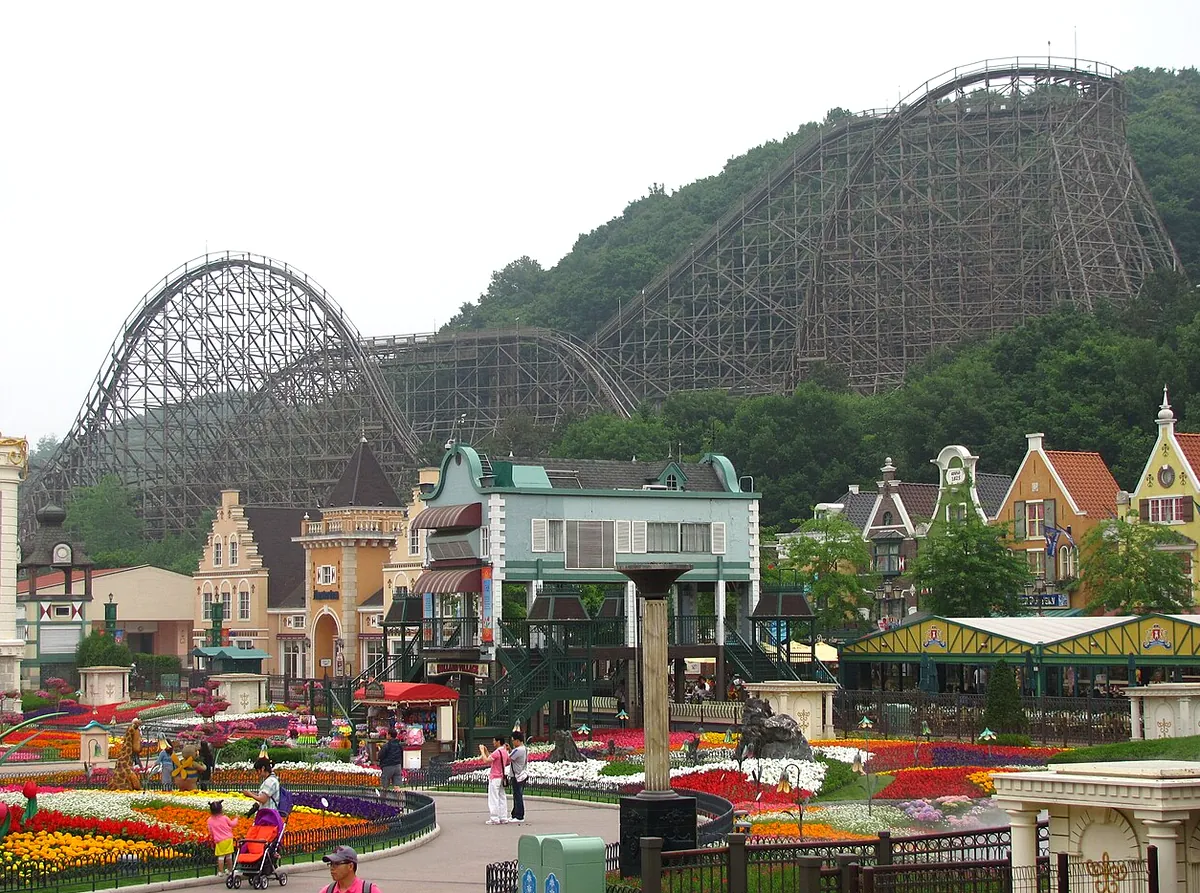
Nestled amidst Yongin’s rolling hills, Everland unfolds as a monumental architectural and entertainment complex spanning more than 100 hectares. Its physical scale reflects far more than sheer acreage—it embodies masterly spatial choreography uniting five distinct themed zones that recreate dazzling chapters of human civilization alongside majestic natural biomes. Under the meticulous care of leading landscape architects, natural hillside slopes have been sculpted into captivating visual tiers opening onto an endless journey across time and space.
Stepping through the main entrance, visitors immediately arrive at Global Fair, a grand gateway showcase of ambitious eclectic architecture. The promenade resembles a living open-air architectural museum where graceful European Renaissance facades—complete with round columns and finely molded arches—stand side by side with spires evoking mystical Indian palaces. Interwoven into this multicultural panorama are turquoise glazed roof tiles and crimson-and-gold *dougong* bracket structures reminiscent of Ming and Qing imperial palaces in Beijing. This bold synthesis creates a dazzling forecourt evoking a prosperous international trading bazaar from centuries past brought vividly to life.
Transitioning smoothly from nostalgic grandeur is American Adventure, a zone crafted to celebrate the evolution of American pop culture across historical eras. The journey opens amidst the dusty, spirited frontier of the Wild West, complete with weathered timber saloons and rustic stagecoaches recalling the rugged days of westward expansion. Yet just around a scenic bend, the atmosphere shifts abruptly into the vibrant urban pulse of the 1960s—where cheerful pastel facades, curving neon signs, and the infectious energy of early rock ‘n’ roll recapture the free-spirited vitality of American street culture.
Bordering that lively urban rhythm lies the whimsical realm of Magic Land. Inspired by the timeless fables of ancient Greek storyteller Aesop, this entire zone turns centuries-old moral tales into a tangible visual wonderland. Highlights include miniature fairytale castles with playfully curving silhouettes, giant mushroom-capped archways, and fantastical botanical gardens. Every nook, sculpted balustrade, and stone pathway awakens childhood memories, inviting travelers into a mythical realm where the line between reality and imagination dissolves.
The most iconic and romantic centerpiece of the entire park is European Adventure, opening onto the tranquil charm of the Old World. At its heart blooms the Four Seasons Garden, framed by giant rotating windmills typical of the Dutch countryside and rows of historic Flemish gabled townhouses. Designed in the classical geometric tradition of formal French gardens, expansive beds of tulips, heirloom roses, and daisies shift colors with every season, conversing harmoniously with marble fountains and stately stone colonnades.
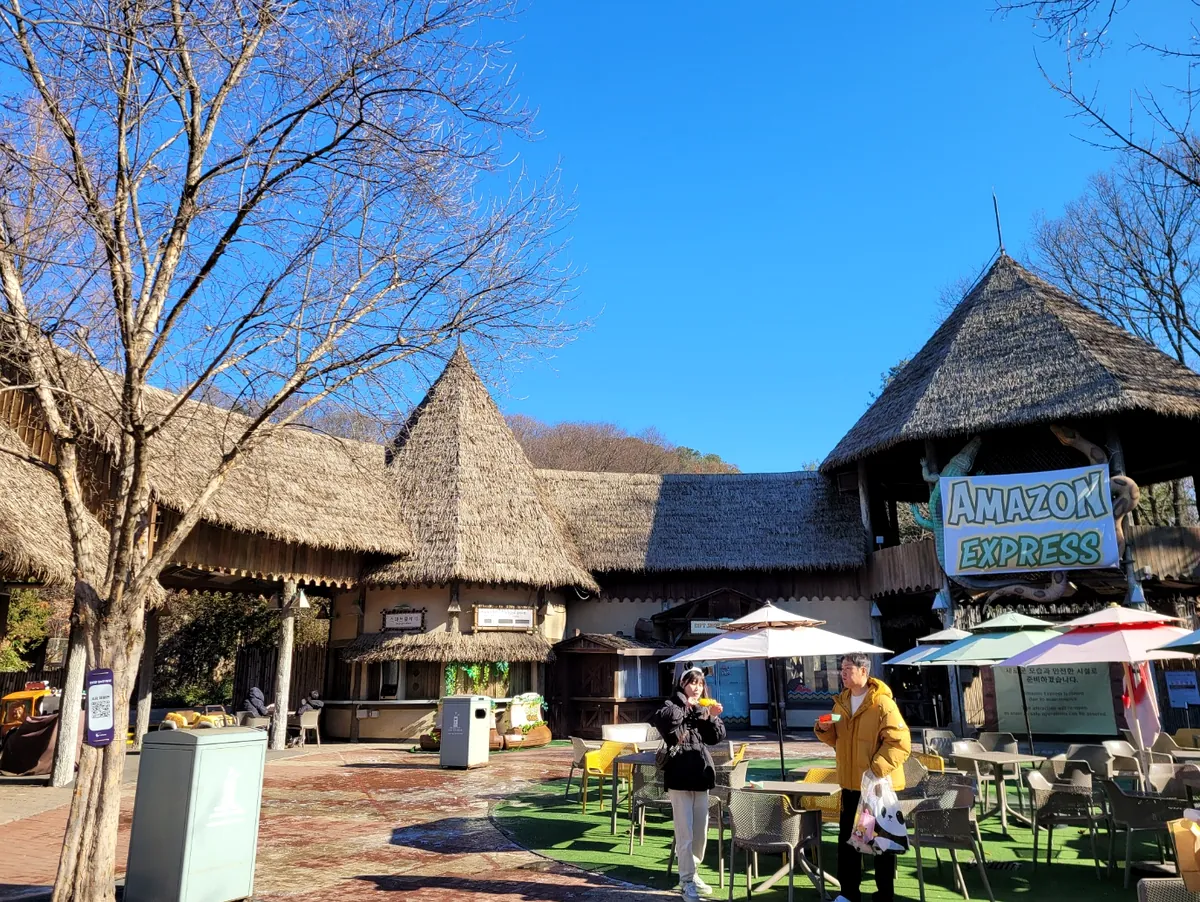
Completing Everland’s grand layout is Zootopia, an ecological marvel built on an immense scale to authentically recreate natural habitats. The landscape transitions seamlessly from humid Amazon rainforests dense with tropical foliage to sun-drenched grasslands mirroring the wild African savanna. This open-concept sanctuary provides a thriving home for more than 2,000 animals representing rare species from five continents. By replacing harsh concrete bars with natural water moats, Zootopia stands as a triumph of habitat design, underscoring the depth and humane vision behind the park’s overall architecture.
As twilight settles over Yongin’s undulating valley, Everland begins a breathtaking metamorphosis from a daytime amusement haven into a shimmering nocturnal realm of visual art. At the heart of this transformation stand European Adventure and the grand Four Seasons Garden, where Renaissance-inspired architecture awakens under multi-colored artistic illumination. Millions of advanced LED lights and three-dimensional light sculptures turn lush lawns and manicured flowerbeds into a radiant optical symphony, drawing visitors into a dreamscape straight out of classic European fairytales.
Nighttime illumination here is never static, evolving continuously in harmony with the four seasons. In spring, when the Tulip Festival blankets the valley in bloom, lighting design highlights the delicate purity of millions of petals after dark; in early summer, the Rose Festival drapes the gardens in passionate crimson splendor. When crisp autumn breezes usher in the playful mystery of Halloween, the atmosphere shifts to eerie, enchanting hues accented by spooky soundscapes and theatrical lighting across historic street corners. Come winter, the entire landscape transforms into a crystal ice kingdom as silvery-white light clusters blanket every branch and blade of grass, creating a majestic winter wonderland in the Korean night.
The park’s nocturnal energy surges further during the dazzling Moonlight Parade, as colossal floats encrusted with tens of thousands of microchip lights glide down the main avenues. Illuminated architectural floats, fairytale characters, and dancers clad in fiber-optic costumes move in sync with soaring orchestral anthems, erasing the boundary between performers and spectators. Millisecond-precise synchronization of symphonic music, kinetic motion, and dancing light turns the parade route into a glowing river brimming with vitality.
The aesthetic climax and soul of Everland’s nightlife is its large-scale multimedia live show and high-altitude fireworks finale staged above the open-air amphitheater of the Four Seasons Garden. Utilizing castle-style architectural facades as a canvas, show directors combine monumental 3D projection mapping with live flame bursts, high-pressure water screens, and razor-sharp laser beams sweeping across the night sky. Far more than a display of cutting-edge technology, the production weaves stories of courage, love, and renewal. The evening culminates in a dazzling fireworks display bursting overhead, reflecting off tranquil pools and sleeping blossoms to leave a lingering sense of wonder before visitors depart this earthly fairytale realm.
Rising far above the typical theme-park standard dominated by mass-produced fast food, Everland’s culinary map offers an authentic gastronomic exploration where traditional Korean flavors harmonize with modern Western favorites. Along the central axes of Global Fair and European Adventure, classically styled restaurants recreate the welcoming warmth of traditional family dining rooms, preserving culinary techniques passed down across generations of Korean cooks.
A classic stop for travelers seeking comforting warmth is the renowned beef short rib soup, *Galbi-tang*. Carefully selected prime beef ribs are simmered patiently for hours alongside winter white radish, whole garlic cloves, and native herbs to yield a broth as clear as amber yet deeply savory on the palate. Paired beside a steaming bowl of soup is *Bulgogi Jeongol* (marinated beef hot pot), an exemplary expression of the five-element balance in East Asian culinary philosophy. Thinly sliced beef marinated in aged soy sauce and pureed Korean pear simmers gently tableside with assorted fresh mushrooms, leeks, and sweet-potato glass noodles—creating a nourishing feast that restores energy after hours of exploration while evoking a warm family gathering in the crisp valley air.
Royal palace culinary heritage is vividly revived through Royal Tteokbokki, traditionally known as *Gungjung Tteokbokki*. Originating in royal court banquets during the height of the Joseon Dynasty—before fiery red chili powder became commonplace in palace kitchens—this dish once served as an esteemed delicacy presented to the monarch. Chewy white rice cake cylinders are stir-fried deftly in a cast-iron pan with artisanal fermented *ganjang* soy sauce, tender julienned beef, wood-ear mushrooms, colorful bell peppers, crushed pine nuts, and fragrant sesame oil. Free from the intense heat of modern *gochujang* chili paste, this authentic courtly recipe preserves regal elegance while offering a gentle, refined entry point for international visitors of all ages and backgrounds.
Alongside traditional sit-down dining, street food at Everland brings a lively, spontaneous energy to every stroll. Scattered along tree-lined promenades, the irresistible aroma of the Everland Giant Sausage sizzling over glowing charcoal effortlessly draws passersby. Celebrated for its glossy, snappy casing and juicy, richly seasoned interior, this iconic snack has become an inseparable symbol of walking through the park. Upon reaching the blooming heart of the Four Seasons Garden, the culinary journey concludes sweetly with handcrafted rolled fruit ice cream. Creamy milk base blended with fresh seasonal fruit preserves is spread and rolled deftly by artisans across sub-zero cold plates into delicate spirals, delivering a cool, refreshing finish amid gorgeous floral scenery.
Located among the gentle hills of Yongin City in Gyeonggi Province, roughly forty kilometers south of central Seoul, Everland unfolds as a sprawling recreational realm surrounded by open nature. To reach the gates from the capital, visitors can board convenient express buses departing from major hubs such as Gangnam or Myeongdong, or ride the metropolitan subway network connecting to the Everline light rail straight to Jeondae-Everland Station. The park gates typically open at 9:30 AM each morning. A golden rule for making the most of your visit is to arrive at the entrance plaza at least thirty minutes before opening time; crisp morning air lets you breathe in the fresh valley atmosphere while breezing through ticket checks ahead of the midday crowds.
Once inside the gates, the master key to navigating this vast park effortlessly is leveraging digital convenience via Everland’s official mobile app. Immediately upon scanning your admission ticket, activate the Smart Reservation feature. At a destination welcoming tens of thousands of guests daily, headline attractions—such as the breathtakingly steep wooden roller coaster T-Express or the semi-wilderness safari expedition Lost Valley—routinely log standby wait times of two to three hours. Securing timed boarding passes through the app frees up precious hours, turning tedious lines into leisurely time spent admiring themed architecture and street performances.
Beyond itinerary planning, physical readiness and smart packing play a decisive role in your comfort. Laid out across Yongin’s naturally undulating hills, Everland covers more than a hundred hectares with distinct elevation changes linking Global Fair, American Adventure, and the lower basin of European Adventure and Zootopia. Supportive, cushioned athletic shoes with reliable traction are indispensable for logging tens of thousands of steps comfortably. Dress in lightweight, breathable fabrics during warmer months, or wear versatile layers to adapt easily to noticeable temperature drops between sunny afternoons and breezy valley evenings. Packing a high-capacity portable power bank and a refillable water bottle is another simple yet invaluable detail for uninterrupted enjoyment.
On a broader level when planning your trip to South Korea, ensure electronic travel authorizations and visa documentation are finalized well in advance for smooth immigration clearance upon landing at Incheon International Airport. When comparing travel options, discerning travelers should be wary of unusually cheap package tours that slash actual park hours in order to shepherd guests into closed suburban shopping outlets—detracting severely from the joy of exploration. Prioritizing shopping-free travel standards preserves the pure cultural and recreational value of your journey. To make discovering Korea’s most captivating destinations effortless, seamless, and worry-free at every turn, joining a transparent, thoughtfully curated all-inclusive South Korea tour package is the ultimate choice for an unforgettable holiday.