Resting peacefully at the fork where the Honkawa and Motoyasu rivers divide the Hiroshima delta into fertile strips of land, today’s Nakajima-cho district in Naka Ward has weathered some of the most tumultuous chapters in Japanese history. Stretching back to the Edo period (1603–1867) under the hereditary rule of the famed Asano samurai clan governing Hiroshima Domain, this river-embraced peninsula quickly rose to become the premier overland and maritime trade artery and political hub of the Chugoku region. Moving into the Meiji Restoration and continuing up to the eve of World War II, Nakajima-cho cemented its status as Hiroshima’s urban heart—housing key prefectural government offices, bustling commercial streets, silk merchants, and a close-knit community of more than 1,300 homes and roughly 6,500 residents living harmoniously beside the gentle rhythm of river oars.
Yet that thriving old neighborhood was wiped away forever on the fateful morning of August 6, 1945—the 20th year of the Showa era. At precisely 8:15 AM, the U.S. Army Air Forces B-29 bomber Enola Gay released the first atomic bomb deployed in human history, codenamed “Little Boy,” over Hiroshima. Detonating roughly 600 meters directly above the Hiroshima Prefectural Industrial Promotion Hall—with ground zero measured over Shima Hospital just 160 meters to the southeast—the blast unleashed an incandescent fireball within seconds that drove temperatures at the hypocenter past 4,000°C, accompanied by a devastating shockwave and thermal radiation that flattened every sturdy structure within a two-kilometer radius. Vibrant Nakajima-cho vanished from the face of the earth, leaving behind a wasteland resembling hell on earth. By the end of 1945, severe burns and acute radiation sickness had claimed an estimated 140,000 innocent lives.
Rising above unimaginable grief and scars that seemed beyond healing, that devastated ground was reborn through extraordinary resolve for reconciliation. In 1949, Japan’s National Diet enacted the Hiroshima Peace Memorial City Construction Law, a landmark statute establishing the legal and philosophical foundation to rebuild the entire city as an eternal symbol of peace for all humanity. Rather than restoring dense residential blocks or rebuilding a purely commercial district, local authorities and scholars agreed to dedicate the entire Nakajima-cho peninsula to a sweeping memorial park—transforming history’s deepest wound into a timeless reminder of the sacred value of human life and compassion.
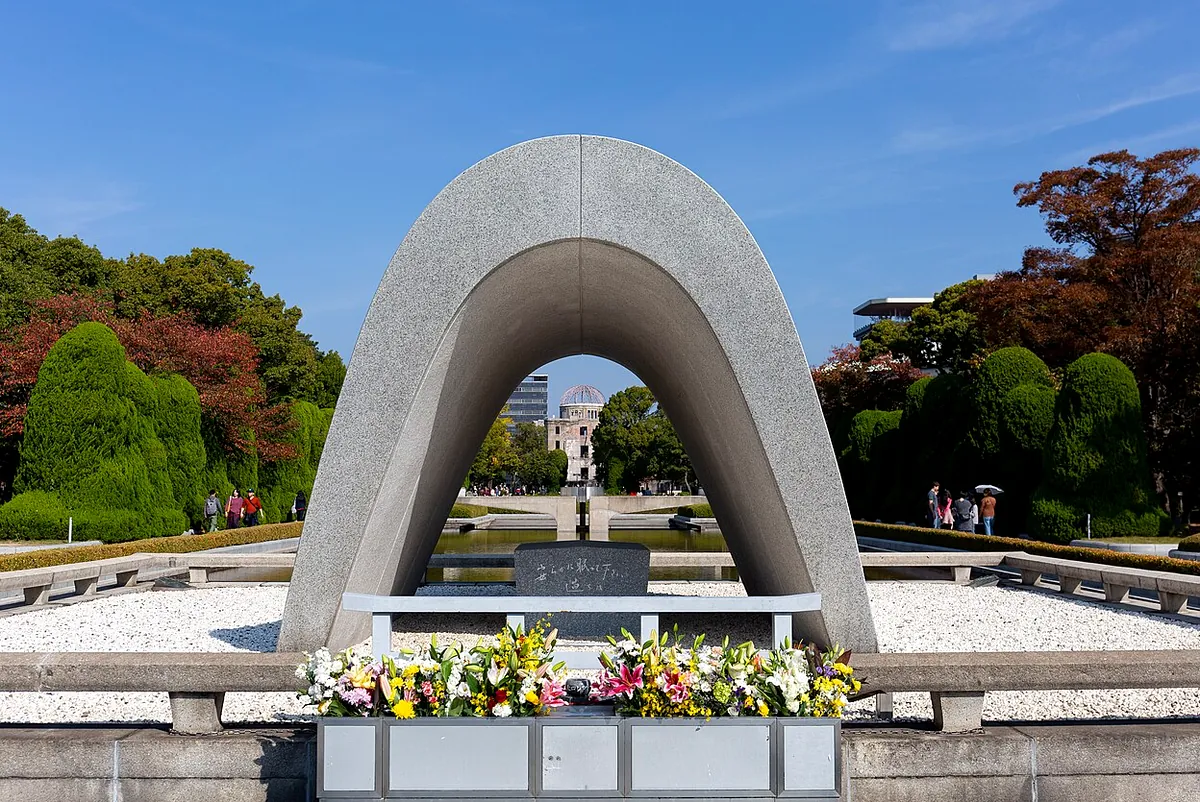
That same year, a master plan by legendary architect Kenzo Tange won first prize in a national design competition for the park. Guided by remarkable spatial vision and profound East Asian humanism, Tange established a solemn, linear memorial axis running straight through the entire complex. This visual corridor begins at the Hiroshima Peace Memorial Museum, passes the Peace Flame—burning continuously until the world is rid of nuclear weapons—looks straight through the saddle-shaped Memorial Cenotaph sheltering the registry of victims, and extends across the Motoyasu River to frame the Atomic Bomb Dome (Genbaku Dome). The bare yet defiant brick-and-steel skeleton of the former Industrial Promotion Hall, reflected in calm river waters, anchors this poignant sequence—turning Hiroshima Peace Memorial Park into a sacred open-air museum preserving the defining lesson of the century.
Situated right in the heart of Hiroshima City in Nakajima-cho, Naka Ward, Peace Memorial Park occupies a fertile triangular alluvial peninsula where two storied distributaries diverge: the Honkawa River to the west and the Motoyasu River to the east. Viewed through East Asian geomancy and landscape philosophy, this setting forms a verdant oasis embraced on both sides by flowing water. In traditional spatial wisdom, twin waterways cradling land symbolize the gathering of vital energy, purifying past trauma and nurturing enduring renewal. The tranquil currents of these two branches of the Ota River system not only form a natural boundary separating the park from bustling city streets, but also cultivate a calm, restorative atmosphere that gently soothes the deep wartime scars etched into this soil.
Prior to August 6, 1945, Nakajima-cho served as Hiroshima’s busiest commercial and cultural center, packed with thriving shops, theaters, and thousands of tightly clustered wooden homes. Thousands of degrees of heat and crushing blast pressure reduced the entire district to flat ash in an instant. During post-war urban reconstruction, rather than filling this hallowed ground with towering concrete structures, urban planners and Kenzo Tange made a historic decision: to honor that sacred emptiness. The entire twelve-hectare Nakajima peninsula was transformed into a completely open, level expanse designed to foster unobstructed clarity of both sight and spirit for everyone who enters.
Far from feeling stark, the park’s flat terrain is artfully softened by lush plantings and thoughtful spatial composition. Sweeping green lawns serve as peaceful urban sanctuaries bathed in sunlight filtering through native tree canopies. Lining walkways and river embankments are hundreds of Somei Yoshino cherry trees, ancient evergreen camphors, and resilient ginkgos swaying in the breeze. Nature transforms the park through every season: soft pink cherry blossoms in spring, cool emerald shade tempering summer heat, brilliant golden leaves in autumn, and quiet, bare branches etched against crisp winter skies. Vibrant greenery rising from ashes forms a haunting visual contrast with the skeletal ruins of the Atomic Bomb Dome standing directly across the Motoyasu River—juxtaposing enduring life against catastrophic destruction.
Water forms the backbone of the park’s microclimate and spiritual landscape. Harnessing the meandering Honkawa and Motoyasu rivers along both flanks not only brings cool, refreshing air that tempers urban heat, but also carries deep philosophical resonance of renewal and purification. During those tragic hours in 1945, scorched victims plunged into these rivers seeking desperate relief; today, calm waters mirror open skies and still trees. Each year on August 6, thousands of paper lanterns float gently down this stretch of river during the traditional Toro Nagashi ceremony, carrying prayers for peace toward Hiroshima Bay. Together, level earth, sheltering trees, and flowing water elevate Hiroshima Peace Memorial Park from a public green space into a healing landscape of universal human significance.
The park’s master plan sprang from the visionary brilliance of Kenzo Tange, the first Japanese architect awarded the prestigious Pritzker Prize. Conceived in 1949, his design seamlessly united Western Modernist clarity with the spatial depth of traditional Japanese architecture. Rather than erasing ruins beneath glittering skyscrapers, Tange turned the devastated fork of the Motoyasu and Honkawa rivers into an expansive memorial sanctuary where every major monument aligns precisely along a single symmetrical axis aimed straight at the hypocenter—creating a visual corridor both solemn and deeply cathartic.
Standing sentinel at the northern terminus of this visual axis is the Atomic Bomb Dome, universally known as the Genbaku Dome. Originally built as the Hiroshima Prefectural Commercial Exhibition Hall and completed in 1915 to designs by Czech architect Jan Letzel, the building showcased European Neoclassical elegance with a grand copper dome and sturdy brick walls. Located barely 160 meters from the hypocenter, it absorbed the vertical blast wave almost directly overhead. Interiors and upper walls were blown away in a split second, yet its resilient steel dome frame and shattered brick walls remained standing amid flattened rubble. Preserving these ruins intact for decades—and UNESCO’s 1996 inscription of the site as a World Heritage monument—established the Genbaku Dome as an immortal physical witness to the devastating power of nuclear weapons.
Anchoring the center of the park is the Memorial Cenotaph for the Atomic Bomb Victims, shaped as a graceful arched concrete vault inspired by ancient Kofun-period haniwa clay house models. This protective arch shelters a stone chest housing the registry of all known victims who perished in the bombing. Kenzo Tange’s spatial genius shines through the cenotaph’s open sightline: standing solemnly before the stone inscription to bow in remembrance, a visitor’s gaze passes straight beneath the arch to frame the burning Peace Flame and the skeletal silhouette of the Genbaku Dome beyond—forging a direct spiritual link between the ashes of the past and hopes for the future.
Directly behind the cenotaph, the Peace Flame burns atop a sculptural pedestal shaped like two open hands cradling a living flame. This monument embodies an epoch-defining vow: the sacred fire will burn day and night until the very last nuclear weapon on Earth is abolished, securing lasting peace for humankind. Reflected across a mirror-still reflecting pool, the flame creates a quiet philosophical dialogue between cleansing water and awakening fire.
Continuing northward, the Children’s Peace Monument rises high, crowned by a bronze statue of young Sadako Sasaki lifting a giant golden origami crane toward the open sky. Inspired by the true, deeply moving story of Sadako—who developed radiation-induced leukemia and folded over a thousand paper cranes with quiet hope for recovery—the monument is surrounded by glass display cases holding millions of colorful paper cranes sent from every continent, forming a living tribute of global solidarity and love.
Nearby, the Peace Bell rests beneath a concrete canopy modeled after a traditional woven hat, mirrored in a fragrant lotus pond. Cast in bronze with an embossed world map free of national borders, its striking point features a small mirror reflecting the face of whoever rings it. Each strike sends a deep, resonant chime rolling across green lawns and tree canopies, reminding every visitor of humanity’s shared responsibility to safeguard fragile global peace.
As sunset settles over the confluence of the Ota and Motoyasu rivers, Hiroshima Peace Memorial Park sheds the steady daytime rhythm of visiting groups to take on a hushed, breathtakingly sacred nocturnal presence. Unlike bustling Japanese metropolises ablaze with neon signage, evening illumination here avoids flashy water shows or commercial multicolored displays. Instead, nocturnal lighting is a subtle exercise in restraint calibrated down to exact lux levels, allowing shadow and warm golden light to converse quietly with human memory.
The focal point after dark centers on the UNESCO World Heritage Atomic Bomb Dome. Concealed floodlights tucked discreetly beneath concrete ledges and shattered brick footings cast warm upward beams at carefully calculated angles. Rather than beautifying or masking destruction, the lighting honors the stark, poignant honesty of twisted steel girders, weathered masonry, and the bare elliptical dome frame that once crowned the Hiroshima Prefectural Industrial Promotion Hall. Set in sharp relief against the dark night sky, the illuminated ruins stand like an eternal monument across time—recalling history’s deepest scar while testifying to the resilience of a city reborn from ashes.
Linked directly to the Dome along the central axis, the Peace Flame glows steadily atop its stone pedestal in the middle of a tranquil reflecting pool. Lit with the solemn pledge to burn until nuclear weapons vanish from the planet, the flame radiates warm, steadfast energy into the night. Its flickering reflection dances across glassy water in direct visual alignment with the softly lit Memorial Cenotaph beyond. This minimalist lighting composition creates an atmosphere of profound stillness, inviting evening strollers to walk slowly along granite pathways, listen to deep silence, and feel the quiet pulse of humanity’s longing for peace.
Along both stone embankments of the Motoyasu River, nightlife unfolds like a gentle solo nocturne. Dark river water becomes an expansive canvas catching shimmering reflections of the Genbaku Dome alongside soft golden lamps lining walkways shaded by weeping willows and cherry trees. During annual memorial observances, this stretch of river transforms into a deeply moving spiritual tableau during the Toro Nagashi lantern-floating ceremony, when thousands of colorful paper lanterns inscribed with prayers for peace drift gently toward Hiroshima Bay. Even on ordinary evenings, cool breezes off the Seto Inland Sea, soft water lapping against stone steps, and twinkling streetlamp reflections weave a poetic, meditative calm.
Experiencing Hiroshima after dark offers travelers a rare pause away from everyday distractions. Standing along the railing of historic T-shaped Aioi Bridge gazing toward the illuminated Dome reflected in still water, breathing crisp evening air as the distant toll of the Peace Bell echoes softly across the park, one grasps the true meaning of renewal. Nighttime here feels not bleak, but filled with quiet hope—where historically respectful lighting transforms the entire park into an open-air sanctuary of memory, guiding the spirit toward clarity and peace.
Stepping away from quiet contemplation among the monuments of Hiroshima Peace Memorial Park into nearby illuminated streets brings travelers face-to-face with a vibrant local culinary tradition. Hiroshima’s cuisine reflects far more than regional ingredients—it carries living memories of self-reliance and rebirth from ashes. During lean post-war years following the atomic bombing, scarce rations of relief wheat flour combined with whatever local vegetables could be gathered gave birth to the forerunner of Hiroshima’s iconic savory pancake. Perfected over subsequent decades, Hiroshima-style Okonomiyaki has become the ultimate culinary pride of the Chugoku region, standing in bold contrast to the batter-mixed style of neighboring Kansai.
What defines Hiroshima-style Okonomiyaki is its delicate, multi-layered cooking technique on a sizzling cast-iron teppan griddle. Skilled chefs begin by spreading a paper-thin crepe-like layer of wheat batter, piling high a generous mound of crisp shredded cabbage, topping it with fresh bean sprouts and slices of pork belly, and expertly flipping the stack so vegetable steam cooks the pork and batter naturally. Beside it, a portion of golden yakisoba or smooth udon noodles is pan-fried with savory sauce before the layered vegetable-and-pork stack is placed atop the noodles and pressed onto a freshly cracked, thin-spread egg. Finished with a generous glaze of rich, sweet-savory brown okonomiyaki sauce simmered from vegetables and fruits plus a dusting of emerald aonori seaweed flakes, it is best experienced at Okonomimura just blocks from the park—a multi-story food village housing more than twenty long-standing family stalls where diners sit around hot griddles slicing steaming bites with mini metal spatulas (hera).
Beyond hearty street food, Hiroshima is blessed with premier seafood from the Seto Inland Sea, led by world-famous Hiroshima oysters (Kaki). Backed by over four centuries of cultivation in calm, mineral-rich bays fed by the Ota River system, Hiroshima Prefecture produces more than sixty percent of Japan’s entire oyster harvest. Renowned nationwide for plump size, creamy richness, and clean natural sweetness, they can be savored chilled as raw sashimi with a squeeze of fresh lemon, smoky off charcoal grills, or as golden Kaki-fry—coated in crisp panko breadcrumbs, fried crunchy outside while remaining tender and juicy within alongside tangy tartar sauce.
Rounding out Hiroshima’s heritage flavors is delicate Momiji Manju, traditional sweet cakes molded in the shape of autumn maple leaves. Originating on nearby sacred Miyajima Island and rooted in Meiji-era lore, these bite-sized baked treats feature airy, honey-and-egg sponge cake enclosing velvety, gently sweet anko red bean paste. Along lively shopping arcades bordering the park, contemporary bakers also craft tempting fillings including earthy matcha green tea, rich cream cheese, chocolate, and smooth custard. Savoring a warm maple-leaf cake beside a steaming cup of green tea offers a soothing finale after a deeply moving day in this resilient city.
Reaching iconic Hiroshima today is seamless thanks to Japan’s world-leading rail and air infrastructure. The San’yo Shinkansen high-speed rail line serves as the primary artery linking east and west, with sleek Nozomi bullet trains gliding effortlessly through the Chugoku region. From cultural capitals like Kyoto or bustling Shin-Osaka Station, travelers reach Hiroshima Station in roughly 1 hour 20 minutes to 1 hour 40 minutes, while journeys from Tokyo take around 4 hours along the scenic coastal corridor. For visitors arriving by air, Hiroshima Airport handles domestic and international flights with frequent limousine buses reaching central Hiroshima in 45 to 50 minutes for 1,450 yen.
Once at Hiroshima Station, getting around town offers a nostalgic step back in time aboard the famous Hiroden streetcar network. More than convenient public transit, this historic tram system stands as a resilient symbol of survival—having resumed partial service just days after the 1945 bombing. From the streetcar terminal right outside the station, board Line 2 or Line 6 for a scenic 15-minute ride along tree-lined boulevards (flat fare 220 yen) straight to the Genbaku-Dome-mae stop. Stepping off the platform brings you face-to-face with the Atomic Bomb Dome beside the Motoyasu River, opening directly into the tranquil grounds of the park.
Hiroshima Peace Memorial Park remains open 24 hours a day with completely free admission, inviting quiet reflection at dawn or peaceful walks along river embankments at dusk. At the center of the complex stands the Hiroshima Peace Memorial Museum, preserving thousands of poignant artifacts, melted relics, and personal testimonies from August 6, 1945. General adult admission is set at a symbolic 200 yen; to absorb the full historical weight and human stories thoughtfully, plan to spend 2.5 to 3 unhurried hours inside.
Because the park serves as both a sacred memorial space and the final resting place of tens of thousands of victims, visitors are expected to observe respectful local etiquette. Neat, modest attire is appropriate; walk quietly, speak softly, and silence mobile phones around monuments and inside museum galleries. Littering, loud laughter, or disrespectful photo poses are strictly inappropriate out of reverence for those lost. Travelers should also remain mindful of independent sightseeing values, steering clear of high-pressure shopping detours or overpriced health-supplement pitches occasionally bundled into cut-rate tours—local eateries around the park serving Hiroshima-style okonomiyaki and Momiji Manju display clear, transparent menu pricing.
A pilgrimage to Hiroshima—a city risen from ashes into a global beacon of reconciliation—leaves an unforgettable impression of peace’s priceless value and human resilience. To reflect peacefully at these historic landmarks without worrying about transit logistics or language barriers, joining a thoughtfully paced, professional all-inclusive tour package offers an ideal way to experience Hiroshima’s depth and humanity to the fullest.