Nestled on the steep slopes of sacred Mount Otowa in eastern Kyoto, Kiyomizu-dera Temple stands towering as a monumental witness that has weathered more than a millennium of rise and fall across Japan. The origins of this sanctuary trace back to the ninth year of the Hōki era—778 AD—a pivotal moment when the Japanese imperial court was preparing to transfer its seat of power from Nara to the new capital of Heian-kyō. Historical records recount that in the spring of that year, an eminent monk of the Hossō sect from Nara named Enchin received an auspicious omen in a dream, urging him to follow a stream northward in search of a sacred, pure water source. Traversing the dense forests of Mount Otowa, Enchin encountered an ascetic hermit named Gyōei, who entrusted him with a piece of sacred timber to carve an image of the Thousand-Armed Kannon Bodhisattva and instructed him to remain and safeguard this pure spring before quietly vanishing into thin air.
However, the transformation of a secluded woodland hermitage into a grand temple complex owes its monumental patronage to the Great General Sakanoue no Tamuramaro. In the seventeenth year of the Enryaku era, this celebrated warrior of the early Heian period was hunting deer on Mount Otowa to obtain stag blood as a tonic for his pregnant wife when he chanced upon Master Enchin. With profound spiritual insight and boundless compassion, the monk revealed to the general the karmic cycle of taking life and the suffering of all sentient beings. Awakened to the truth of liberation, Sakanoue no Tamuramaro offered his deepest reverence, laid down his sword, and took refuge in Buddhism. Together with his wife, the general made a grand vow to donate his private residence and mobilize his clan’s immense wealth to construct a majestic temple complex, naming it Kiyomizu-dera (“Pure Water Temple”) in honor of the crystal-clear Otowa Waterfall while dedicating the merit of pacifying the northern frontier toward the Pure Land.
Rooted in the Yogācāra (Consciousness-Only) philosophy of the Hossō sect introduced from Tang China by the Great Master Xuanzang, Kiyomizu-dera long stood as a proud emblem of scholastic Buddhism, closely aligned with the head temple Kōfuku-ji in Nara. This deep religious and political affiliation swept the temple into bloody medieval conflicts among monastic armies, particularly fierce clashes with the warrior monks of the Tendai sect on Mount Hiei. Across the Kamakura, Muromachi, and brutal Sengoku periods, warfare and natural disasters burned the Kiyomizu-dera complex to the ground more than ten times, culminating in the catastrophic fires of the Ōnin War that reduced Kyoto to ashes and ruins.
Yet, like a phoenix rising from the ashes, Kiyomizu-dera’s enduring resilience shone forth once more during the peaceful Edo shogunate. In the tenth year of the Kan’ei era (1633), the third Tokugawa shogun, Tokugawa Iemitsu, opened the state treasury to fund an unprecedented grand reconstruction, summoning master carpenters from across the provinces to rebuild the Main Hall, wooden stage, and pagoda complex strictly according to traditional architectural canons. Preserved intact in its seventeenth-century form, this magnificent ensemble was inscribed as a UNESCO World Heritage Site in 1994—an immortal testament to the sublime harmony of spiritual devotion, supreme architectural mastery, and the indomitable spirit of Japan.
Perched precariously along the western flank of Mount Otowa within the rolling Higashiyama mountain range, Kiyomizu-dera occupies a geomantic position imbued with the most auspicious energy in ancient Kyoto. In the late eighth-century urban plan of Heian-kyō under Emperor Kanmu, the Higashiyama range represented the mighty Azure Dragon guarding the east under the Four Symbols geomantic model (Shijin-sōō). Mount Otowa, with its millennia-old murmuring pure spring, served not only as a protective screen shielding the capital but also created a classic “mountain-backed, water-facing” configuration: resting against deep, wooded cliffs while opening sweeping vistas across the Kyoto basin stretching westward, where setting sunlight transforms the valley into a tangible Pure Land on earth.
The spatial layout of Kiyomizu-dera is a masterpiece of working with natural topography, conquering the challenges of a precipitous gorge. Rather than leveling hills to create flat ground like temples on the plains, ancient builders ingeniously terraced the complex across stepped elevations hugging the mountain ridge. The focal point of this sacred landscape lies deep below in the Kinkyo-kei ravine, where the subterranean Otowa spring divides into three pure streams cascading day and night. Projecting the Main Hall directly out over the steep cliffside creates a dramatic contrast between human architectural serenity and rugged natural terrain, turning the entire temple into an unmatched panoramic observatory.
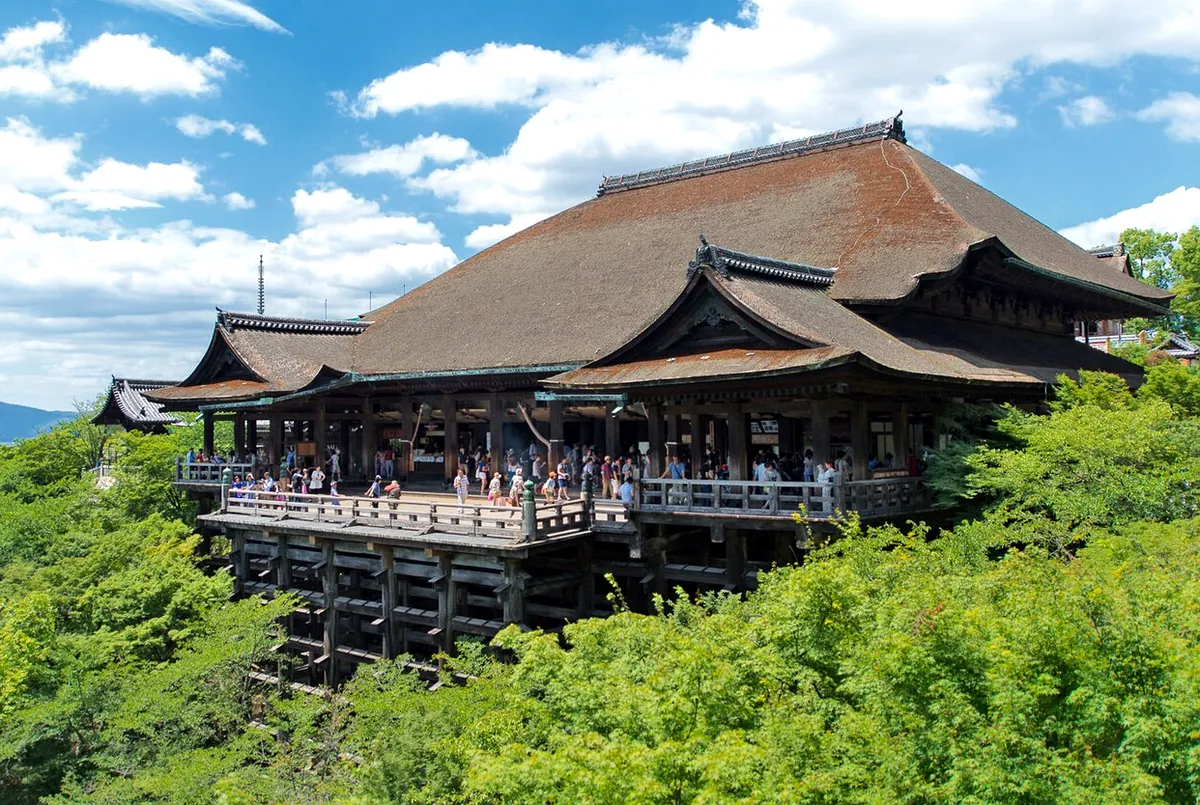
Enveloping the massive timber architecture is primeval vegetation that transforms magically through the four seasons of Japan. The valley beneath the Kiyomizu stage is carpeted with thousands of native Irohamomiji Japanese maples intermingled with prized cherry trees such as Somei Yoshino and Yamazakura. Each spring, the ravine awakens like a floating sea of blossoms, surging with pale pink clouds cradling the base of the wooden pillars. When autumn arrives, the forest shifts simultaneously into blazing crimson and burnished gold across Mount Otowa’s slopes, painting a brocade landscape (Kinshū) that has captivated poets and travelers for centuries. In winter, thick snow blankets the dark hinoki cypress-bark roofs, accentuating the quiet, contemplative beauty of Wabi-sabi aesthetics.
Rather than standing isolated as a remote spiritual island, Kiyomizu-dera is organically woven into Kyoto’s historic urban fabric through famed sloped lanes within a national preservation district for traditional architecture. Descending the gentle incline from the Niōmon Gate, travelers enter the winding stone-paved lanes of Sannenzaka (Three-Year Slope) and Ninenzaka (Two-Year Slope)—lined with intact Edo-period wooden machiya townhouses featuring tiled eaves and fluttering noren curtains. This golden scenic corridor flows seamlessly past tranquil Kodai-ji Temple, the soaring Yasaka Pagoda of Hokan-ji Temple, and stately Yasaka-jinja Shrine before merging into the atmospheric, storied streets of the Gion geisha district. This tight spatial connection makes Kiyomizu-dera the quintessential starting point distilling the pinnacle of Kyoto’s history, spirituality, and living culture.
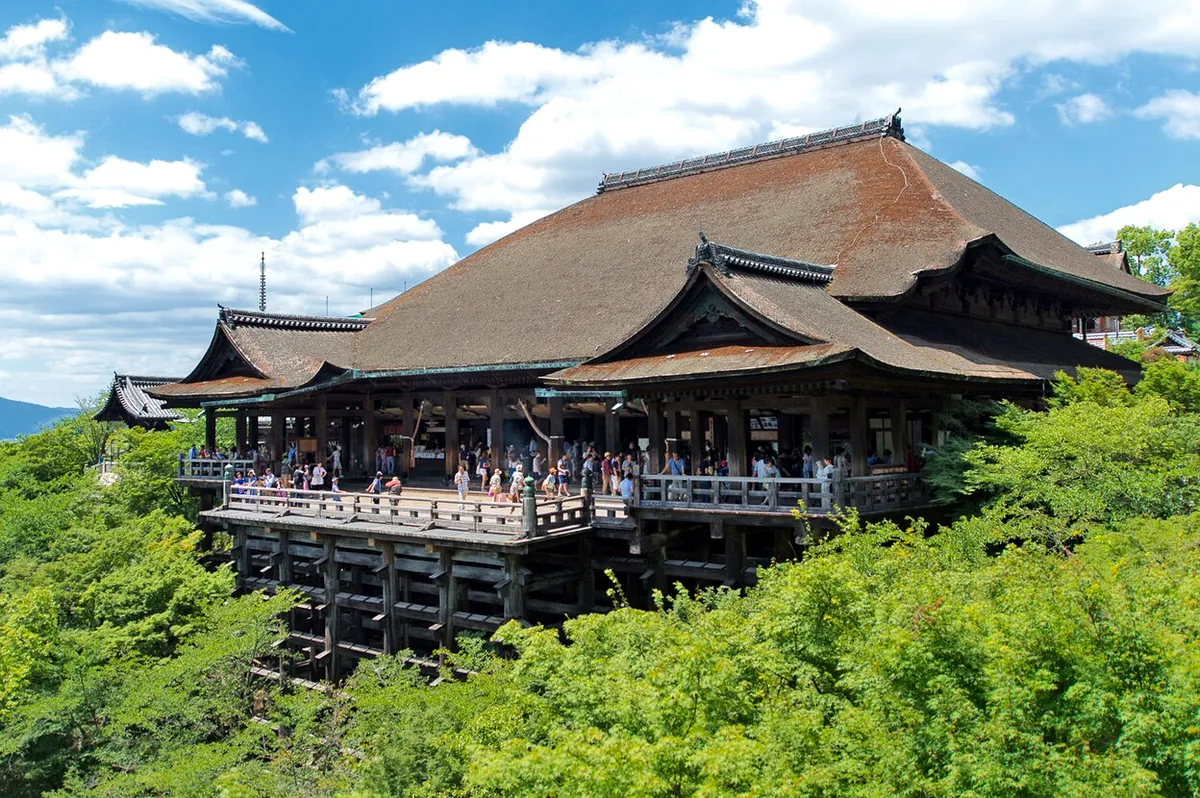
Rising dramatically against the gentle eastern slopes of the Otowa range, the architectural ensemble of Kiyomizu-dera represents the absolute pinnacle of traditional Japanese timber craftsmanship, where human ingenuity and mountainous terrain fuse as one. At the heart of this sacred complex stands the Main Hall (Hondo)—a designated National Treasure of Japan spanning nearly forty meters across its facade and over thirty meters deep. This colossal wooden structure perches boldly over the steep gorge of Kinkyo Valley, commanding sweeping views across historic Kyoto. Unlike conventional temples built on level plains, the Hondo was engineered using the celebrated Kake-zukuri (“cliff-hanging”) structural method, an extraordinary architectural solution devised to adapt to precipitous mountain sanctuaries.
The marvel of Kake-zukuri lies in its massive load-bearing lattice assembled from 139 centuries-old zelkova (keyaki) pillars. Each trunk, measuring over two meters in circumference, is anchored firmly onto bedrock foundations and rises to the height of a four-story building. What continues to astonish engineers and architectural historians worldwide is that this entire cantilevered structure uses not a single iron nail or metal fastener. Instead, master carpenters employed traditional Kigumi wood-joinery techniques, chiseling and interlocking horizontal beams and vertical braces with millimeter precision. Functioning as a natural dynamic shock absorber, the frame possesses remarkable elasticity that disperses seismic energy, allowing the Kiyomizu stage to endure hundreds of severe earthquakes and fierce typhoons across the centuries.
Extending directly from the solemn sanctuary hall is the famous Kiyomizu Stage, jutting out into open air thirteen meters above the valley floor. Surfaced with more than four hundred smooth hinoki cypress planks, this expansive terrace originally served as a sacred platform for Bugaku ritual dances and imperial gagaku court music offered to Kannon Bodhisattva. The sheer vertiginous drop of the structure entered Japanese folklore through the famous proverb “to jump off the stage at Kiyomizu,” symbolizing wholehearted courage and resolve when making a momentous life decision. Beneath a graceful hip-and-gable roof shingled with layers of brownish-gray cypress bark, the dimly lit, candle-glowing interior of the Hondo enshrines the Eleven-Faced, Thousand-Armed Kannon—the esoteric principal deity watching over the entire ancient capital.
Following a gentle stone stairway descending from the southern corridor of the Main Hall down into the shaded ravine, the sacred Otowa Waterfall reveals a serene sanctuary of pure nature and primal devotion. Fed by crystal-clear subterranean springs filtering through millennia-old rock strata of Mount Otowa, water flows through ancient stone channels before dividing into three slender streams plunging into a small basin below. These three pure currents represent three cardinal blessings of human life: longevity and health, academic and career success, and fulfillment in love. Pilgrims reverence the waters using long-handled metal ladles to purify body and spirit. Tradition holds that visitors should drink a single sip from just one of the three streams with sincere devotion—for greedily drinking from multiple streams or taking too many sips dilutes purity of heart and diminishes the prayer’s efficacy.
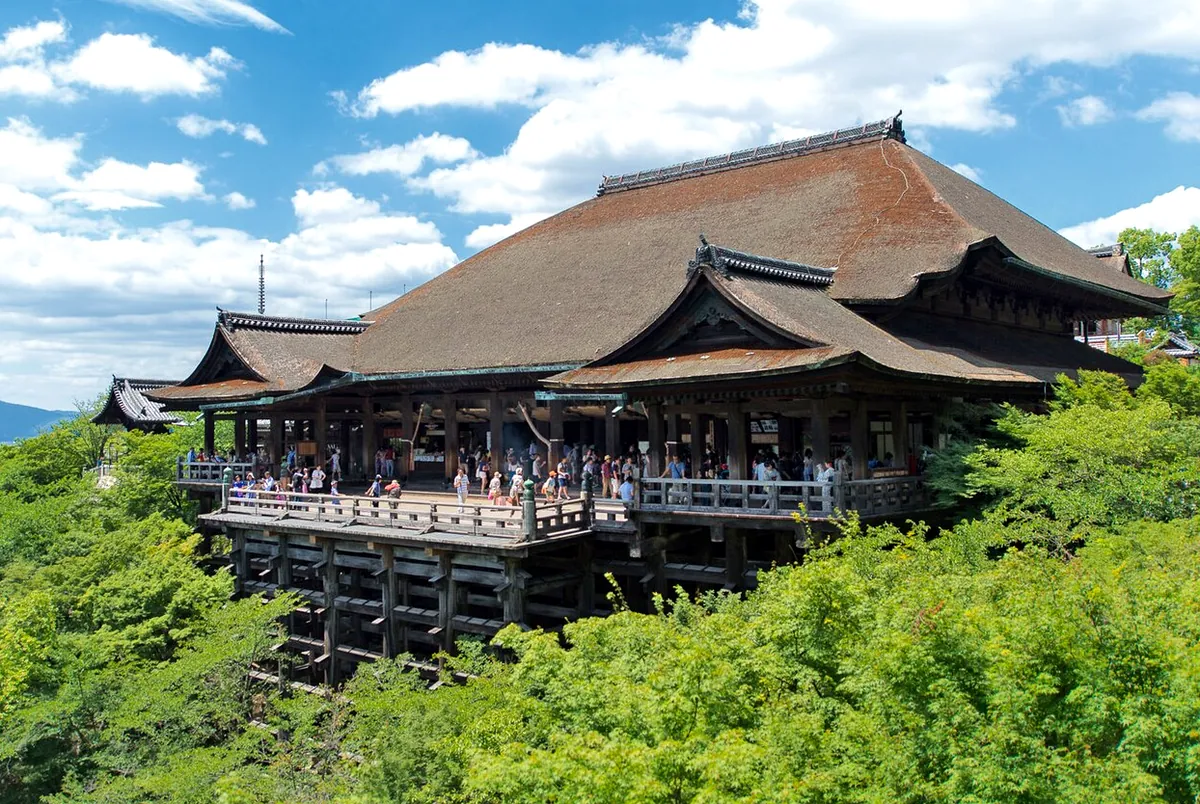
As sunset dips behind the mountains encircling the ancient capital, the slopes of Mount Otowa and the verdant hills of Higashiyama undergo a sublime transformation of space and time. Daytime pilgrimage gives way to special evening illuminations known as Yakan Tokubetsu Haikan—a celebrated visual and spiritual event held only during nature’s finest transitional moments: pristine cherry blossoms in spring and fiery autumn foliage in the crisp fall air. Amid the deep darkness of the surrounding primeval forest, high-tech architectural spotlights concealed beneath ancient canopies and Kigumi wooden foundations bathe the Main Hall and the three-story Sanjūnotō Pagoda in radiant glow. The thousand-year-old timber sanctuary suddenly shines like a colossal lotus pedestal floating above a sea of white blossoms or drifting atop layered waves of crimson momiji maple leaves, reflecting the transcendent serenity of a mountain monastery.
The most breathtaking and spiritually symbolic highlight of Kiyomizu-dera’s nocturnal illumination is a piercing beam of sapphire-blue light projected from the temple grounds across the dark night sky toward Kyoto’s western horizon. Within the Hossō Buddhist philosophy faithfully preserved at the temple for centuries, this vivid blue beam is far more than a modern laser display; it is a visual manifestation of the boundless compassion (Hi-kō) radiating from the Eleven-Faced, Thousand-Armed Kannon Bodhisattva enshrined inside the Main Hall. Acting as an invisible bridge linking the earthly realm of suffering with the peaceful Pure Land, the beam guides sentient beings through darkness. Standing on the legendary wooden balcony and tracing this ethereal ray across the night sky—intersecting the distant modern silhouette of Kyoto Tower—visitors witness a surreal visual dialogue between over twelve centuries of heritage and contemporary Japan.
The nocturnal enchantment of Kiyomizu-dera extends well beyond the vermilion Niōmon Gate, cascading like a nostalgic stream down the stepped slopes of Ninenzaka and Sannenzaka. Said to have taken shape during the Daidō era of the early ninth-century Heian period, these winding stone-paved lanes shed their daytime bustle after dark to don the quiet dignity of feudal Japan. Beneath the warm amber glow of traditional washi paper lanterns hung along historic wooden machiya houses and yarai bamboo fences, time-worn flagstones gleam with timeless allure. During the festive Higashiyama Hanatōro illumination, thousands of handcrafted ceramic lanterns paired with large-scale Ikebana floral arrangements line kilometers of pathways, transforming the preservation district beneath the temple into a living open-air museum that transports travelers into a fairy-tale world of thousand-year-old folklore.
Immersing yourself in Higashiyama’s nocturnal rhythm, you hear the rhythmic clack of wooden geta clogs echoing against stone pavement alongside wind rustling through green bamboo groves. The hush deepens the pure aroma of incense mingling with wisps of steam rising from family-run teahouses tucked along the slope. Few experiences compare to pausing for a bowl of stone-milled matcha whisked to a velvety froth, nibbling crisp cinnamon-scented yatsuhashi wafers, or savoring delicate yudofu boiled tofu steaming in sweet kombu kelp broth—culinary traditions cherished by generations of scholars and travelers. This seamless union of contemporary illumination at an ancient sanctuary and refined elegance along millennium-old streets creates a deeply moving night experience where Kyoto’s eternal soul shines brightest.
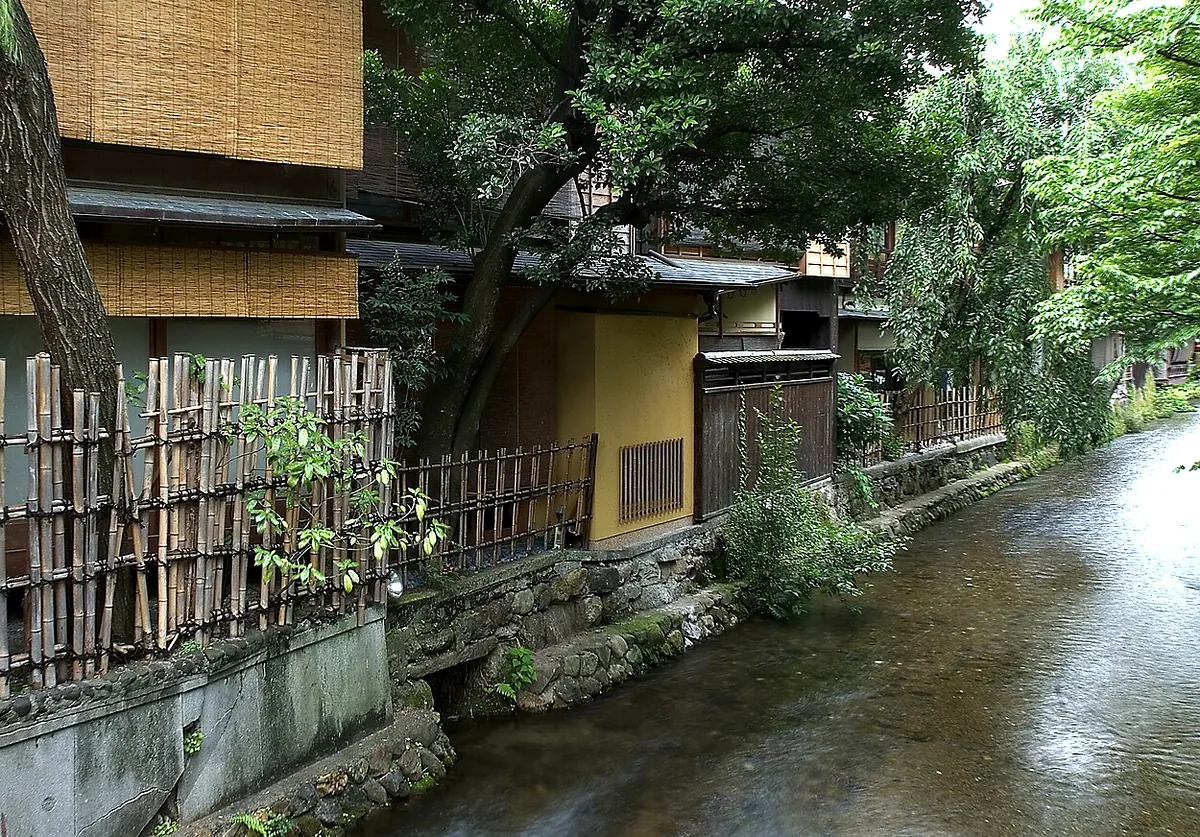
After hours of peaceful contemplation on Mount Otowa, travelers naturally drift into the misty, aromatic lanes leading down from the temple—Matsubara-dori, Sannenzaka, and Ninenzaka. The culinary landscape surrounding Kiyomizu-dera is far more than a refueling stop for hungry pilgrims; it is a living museum of Kyo-ryori, Kyoto’s refined gastronomic aesthetic perfected over centuries to nourish both body and spirit with grace and restraint.
Among the most iconic confections lining the historic wooden storefronts around Kiyomizu-dera, Yatsuhashi (“Eight Bridges”) reigns supreme. Originating in 1689 during the Genroku era of the Edo period, this sweet was created in tribute to Kengyō Yatsuhashi, the great master of the thirteen-stringed koto zither. The curved arch of the crisp baked wafer evokes both the arched soundboard of a koto and wooden footbridges spanning marshlands. Over time, the unbaked, soft version—Nama-yatsuhashi—has captivated generations of visitors. Thin, supple sheets of glutinous rice dough are folded into neat triangles infused with warm cinnamon or earthy, deep-green Uji matcha powder, enveloping a smooth filling of sweet azuki red beans simmered from prized Tamba harvests—a subtle, lingering sweetness reminiscent of old-capital hospitality.
Venturing deeper into stone-flagged alleys shaded by cypress and pine, traditional eateries around Kiyomizu-dera showcase the pinnacle of culinary simplicity through Yudofu (simmered tofu). Rooted directly in Shōjin Ryōri—the Zen Buddhist vegetarian cuisine preserved by monks for centuries—Yudofu celebrates Kyoto’s famously pure, soft groundwater. Silky, snow-white blocks of handcrafted tofu made from domestic soybeans and mineral-rich spring water are gently simmered in broth steeped from Rishiri kombu kelp. Kept just below a rolling boil so the curds stay intact, the pot releases delicate wisps of steam inside tranquil tatami-mat rooms. Lifting a piping-hot piece of tofu and dipping it lightly into delicate dashi soy sauce accented with grated daikon radish and crisp green Kujo scallions delivers pure, creamy soybean sweetness melting on the tongue—a rare moment of culinary clarity amid the earthly world.
Alongside these delicate savory traditions, the culinary map around the thousand-year-old temple shines with refined desserts crafted from Uji matcha—the birthplace of Japanese tea ceremony just south of the ancient capital. Served in historic hillside teahouses, the iconic Matcha Parfait unites Western dessert craftsmanship with traditional Japanese soul. Tall glasses are meticulously layered with bittersweet cold-whisked tea agar jelly, rich matcha-infused cream, chewy glutinous dango dumplings, and mildly sweet red bean paste, achieving an exquisite balance of sweetness and deep umami astringency.
Rounding out this gastronomic journey are modest family-run noodle shops tucked behind time-faded noren curtains. Dating back to the Meiji era, Nishin Soba preserves its original recipe: dried Pacific herring fillets slow-braised for days in sweet-savory soy sauce until tender to the bone, resting atop steaming buckwheat soba noodles submerged in fragrant katsuobushi bonito dashi broth. Every warm sip of broth and rustic buckwheat strand chases away the chill of snowy days on Kiyomizu-dera’s wooden balcony, leaving behind the quiet, lingering resonance of a culinary culture matured to timeless elegance.
To fully experience the ethereal serenity of Kiyomizu-dera Temple amid the mists of Mount Otowa, timing your visit is decisive. The vermilion Niōmon Gate opens at 6:00 AM, when morning mist still drapes the Higashiyama slopes and wind bells chime softly in the quiet dawn. This rare golden hour allows travelers to immerse themselves in pure monastic stillness, watching sunrise gild the ancient hinoki cypress-bark roofs before tour crowds fill the halls. If an early dawn departure isn’t possible, arriving roughly an hour before closing at sunset offers an equally magical alternative, as twilight paints the mountainside crimson and paper lanterns begin illuminating the descent.
Reaching this millennium-old sanctuary is seamless via Kyoto’s renowned public transit network. From Kyoto Station, visitors can board Kyoto City Bus routes 100 or 206 heading toward eastern Kyoto, disembarking at either Gojōzaka or Kiyomizu-michi stops after a fifteen-to-twenty-minute ride. From there, a ten-minute uphill stroll along charming lanes such as Chawan-zaka or Matsubara-dori unfolds a nostalgic streetscape of traditional wooden machiya houses, fragrant with freshly baked cinnamon Yatsuhashi and lined with historic Kiyomizu-yaki pottery workshops passing down centuries-old ceramic artistry.
Given the steep hillside terrain featuring mossy stone stairways and historic wooden corridors, wearing soft-soled, slip-resistant walking shoes ensures a comfortable, unhurried visit. When entering the inner sanctuary of the Main Hall (Hondo)—which enshrines the secret Heian-period Eleven-Faced, Thousand-Armed Kannon Bodhisattva—visitors are required to remove their shoes and wear socks respectfully. Sacred temple etiquette strictly prohibits photography or filming inside the central worship hall; keeping voices hushed while praying, ringing the temple bell, or offering incense preserves the tranquil spiritual atmosphere of this thousand-year-old sanctuary.
Alongside completing visa applications and digital customs declarations online prior to departure to streamline arrival at Kansai International Airport, discerning travelers increasingly favor thoughtfully paced cultural itineraries. Eliminating forced commercial shopping stops not only protects valuable time for exploring heritage monuments but also spares travelers from unnecessary hidden expenses. Discovering Japan’s timeless beauty through a refined, culturally authentic lens remains the hallmark of curated all-inclusive Japan tour packages crafted specifically for passionate travelers.