The history of Osaka Castle did not begin with samurai fortifications, but took deep root in the spiritual foundations of the ancient temple Ishiyama Hongan-ji atop the fertile Uemachi Plateau. In 1496 (the fifth year of Meio), Rennyo—the revered high priest of the Jodo Shinshu (True Pure Land) school—recognized the auspicious geomantic setting where the Yodo River meets Naniwa Bay and founded a temple complex there. Over nearly a century, a quiet hermitage grew into one of the most formidable religious fortresses of Japan’s Warring States period. Its strategic command over mountain and river forced the great warlord Oda Nobunaga into a grueling ten-year siege from 1570 to 1580, before flames consumed the temple compound and cleared the stage for a military legend to rise.
In the summer of 1583 (Tensho 11), having inherited Nobunaga’s ambition to unify Japan, the brilliant general Toyotomi Hideyoshi broke ground on grand Osaka Castle directly atop the ashes of Ishiyama Hongan-ji. Recognizing this nexus as a vital commercial hub linking ancient Kyoto with southern maritime trade routes, Hideyoshi envisioned the fortress as a bold proclamation of Toyotomi supremacy. He ordered dozens of feudal lords across the realm to quarry and haul megalithic granite boulders weighing tens of tons from distant islands in the Seto Inland Sea to raise its ramparts. The original main keep (Tenshudai) soared proudly with five exterior tiers and eight interior stories, lavishly adorned with pure gold leaf and gleaming golden Shachihoko tiger-carp roof ornaments catching the sunlight as a dazzling emblem of the golden Momoyama era.
Yet the fortunes of Japan’s samurai dynasties turned mercilessly with the tides of history. Hideyoshi’s death plunged the nation into a struggle for succession, culminating in two historic sieges known as the Siege of Osaka (Osaka no Jin) during the Winter Campaign of 1614 and the Summer Campaign of 1615. The seasoned armies of Shogun Tokugawa Ieyasu breached the Toyotomi stronghold, driving Hideyoshi’s heir Toyotomi Hideyori and his mother Yodo-dono to perish amid the flames. Determined to erase every physical trace and lingering shadow of the former regime, the second shogun, Tokugawa Hidetada, launched a massive reconstruction project in 1620 (Genna 6). The Tokugawa Shogunate buried Hideyoshi’s original foundations beneath meters of earth and stone, raising an entirely new fortress with higher, thicker battered stone walls (uchikomi-hagi) and broader, deeper moats—forging an impregnable military bastion projecting shogunal authority across western Japan.
In the second half of the 19th century, the castle’s fate was shaken once more by the upheavals of modernization. In 1868 (Keio 4), amid the turmoil of the Meiji Restoration and the Boshin Civil War, heavy artillery bombardment and raging fires destroyed most of the main keep and key watchtowers, leaving the central citadel a scorched shell. More than half a century later, in 1931, through the vision of Mayor Hajime Seki and widespread civic donations from Osaka residents, the main keep rose again. Pioneering the use of modern steel-reinforced concrete for historic reconstruction in Japan at the time, the reborn tower revived the heroic silhouette of the Toyotomi era while proving sturdy enough to survive devastating World War II air raids.
Capping half a millennium of triumph and renewal, the landmark Heisei Major Restoration took place between 1995 and 1997. This sweeping modernization reinforced subterranean seismic structures, applied advanced weatherproofing coatings, and installed modern elevators for global visitors, while meticulously restoring gold-leaf reliefs, verdigris copper-green roof tiles, and fierce tiger motifs faithful to Momoyama-period screens. Standing proudly today amid a thriving metropolis, Osaka Castle is far more than a heritage monument—it is a living epic of resilience, artistic grandeur, and enduring rebirth.
Crowning the elevated ridge of the Uemachi Plateau, Osaka Castle commands one of the most advantageous geomantic and military sites in Japanese history—once hailed as the master key controlling the entire fertile Osaka Plain. Serving as the strategic throat connecting the imperial capital of Kyoto to the Seto Inland Sea, this vantage point enabled feudal rulers to oversee overland and maritime commerce while anchoring supremacy across western Japan. Through traditional geomancy, its terrain—likened to a crouching tiger backed by high ground and encircled by flowing waterways—not only gathered auspicious vitality, but formed a nearly impregnable natural citadel.
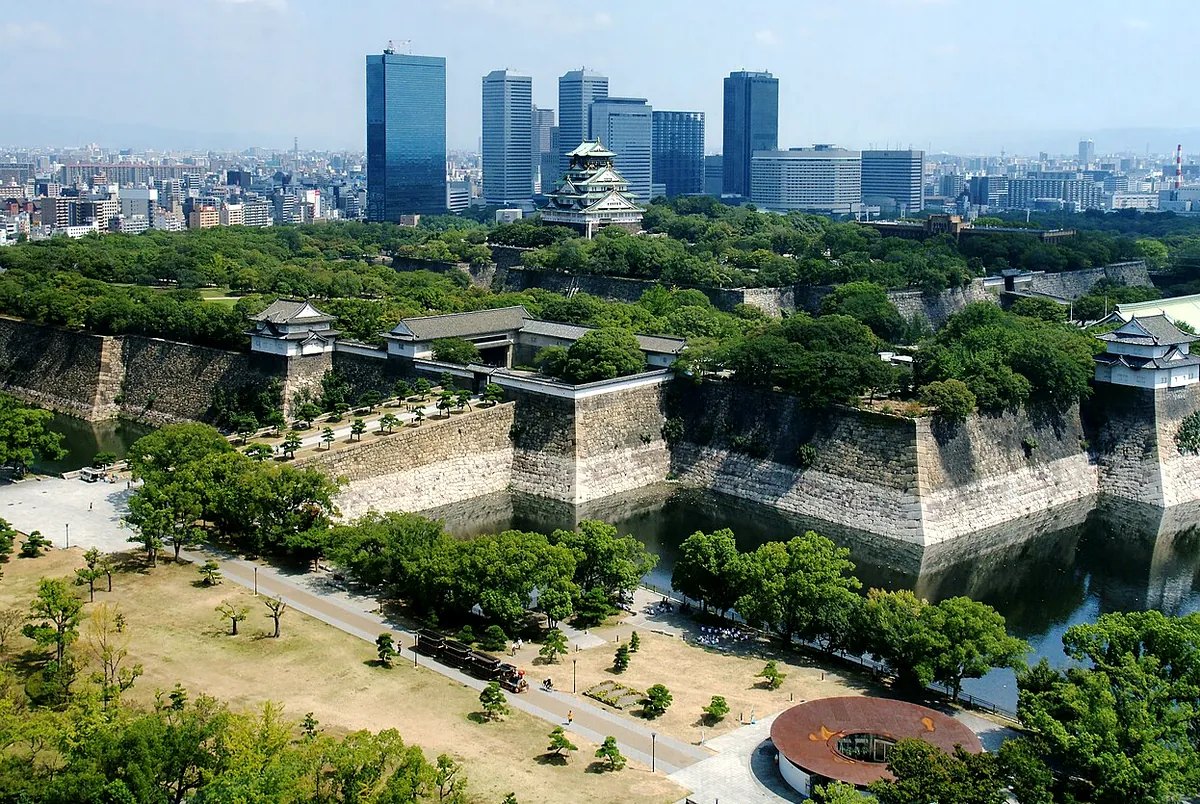
Following the natural contours of the plateau, Warring States fortress architects engineered a concentric multi-layered defense system of remarkable precision. Three fortified baileys step inward from outer perimeter to inner sanctum: Sanno-maru on the outer ring, Nino-maru in the middle ward, and Honmaru guarding the innermost core. To separate these defensive rings, builders diverted water from the neighboring Yodo and Neya rivers into vast surrounding moats stretching 70 to over 100 meters wide and averaging 5 to 8 meters deep, isolating the central citadel amid shimmering water. From afar, mirror-still moats reflecting seamless walls of massive granite blocks project both formidable military deterrence and regal poise.
Encircling those monumental stone ramparts and deep moats is the lush expanse of Osaka Castle Park, where nature stages a dazzling four-season pageant. As late winter chill fades, the celebrated Plum Grove—home to roughly 1,270 trees across dozens of cultivars—awakens in fragrant clouds of pure white, blush pink, and deep crimson. No sooner do plum petals drift away than spring bursts into full splendor as approximately 3,000 cherry trees bloom along park avenues, earning Osaka Castle Park a coveted place among Japan’s Top 100 Cherry Blossom Spots. Delicate petals flutter on spring breezes and settle in drifting carpets across the moats, uniting fleeting botanical poetry with timeless stone walls.
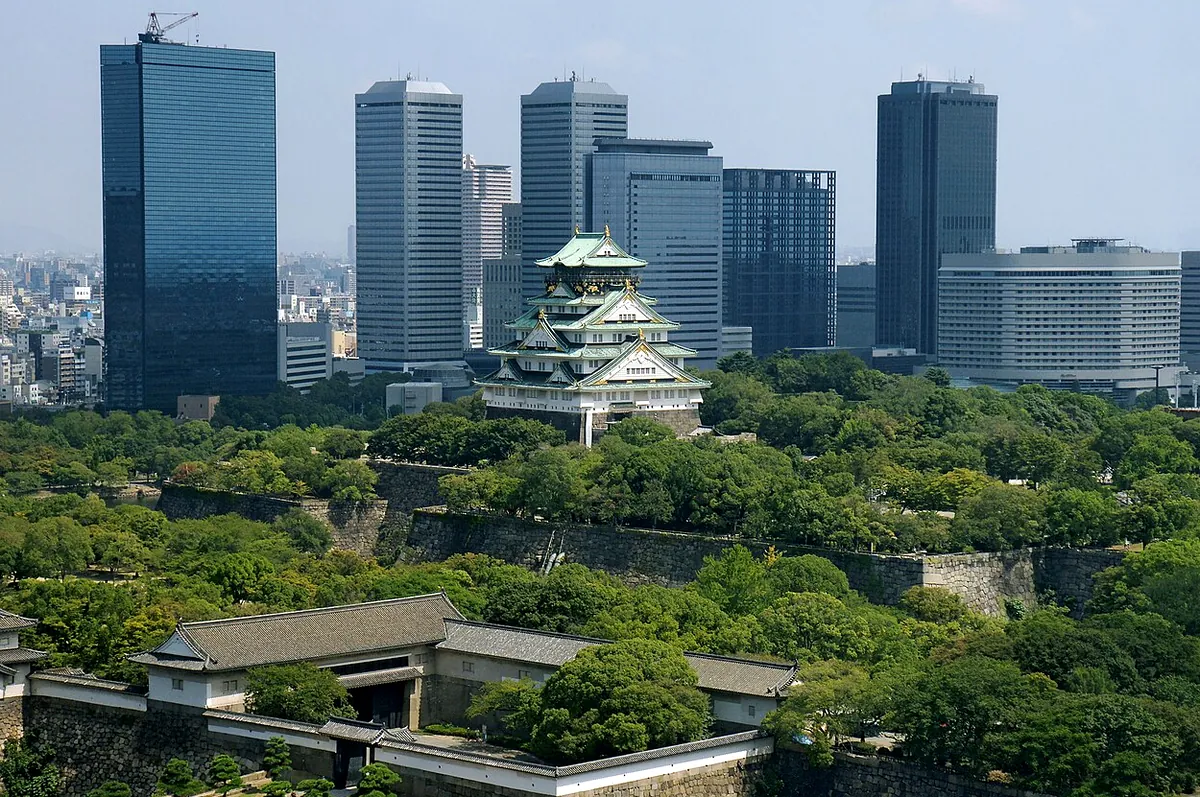
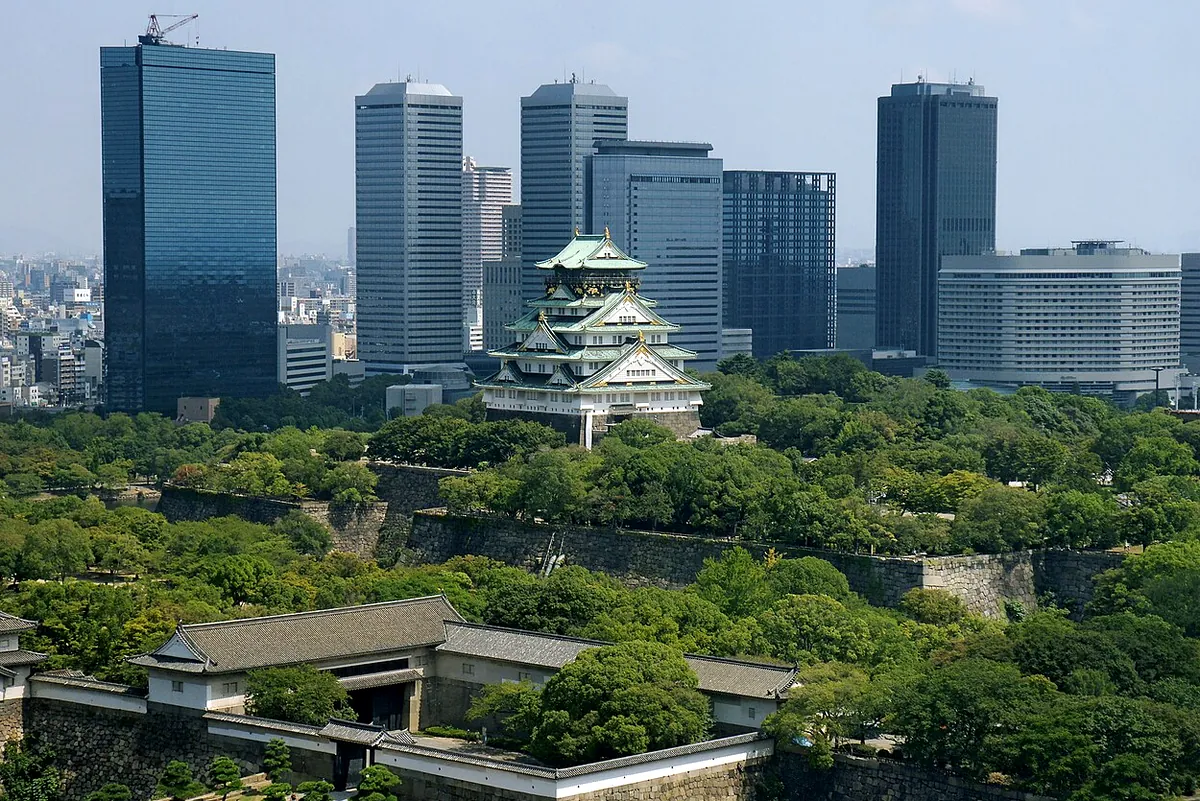
The seasonal tapestry turns once again in autumn, when crimson Japanese maples and ancient golden ginkgos blanket the castle grounds in luminous foliage. To take in the full majesty of this landscape and fortification layout, the 360-degree observation deck on the eighth floor of the main keep (Tenshukaku) offers the ultimate vantage point. Gazing past gilded Shachihoko roof finials from this windswept perch, visitors witness two eras meeting side by side: a tranquil green sanctuary of centuries-old trees mirrored in historic moats on one hand, and the gleaming glass-and-steel skyscrapers of Osaka Business Park rising directly to the east.
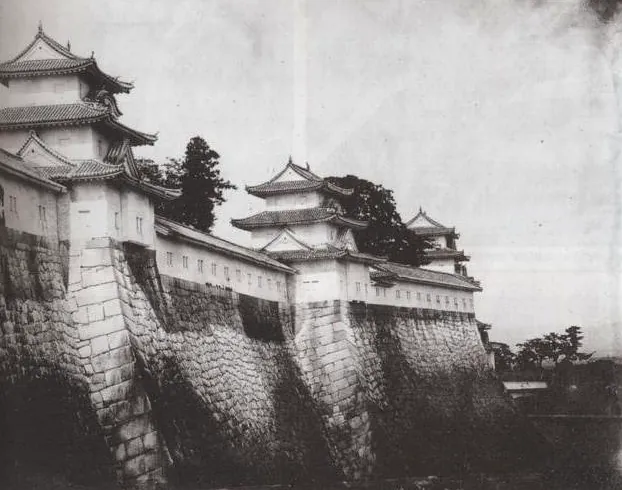
Approaching Osaka Castle from afar, the first overwhelming impression comes not only from the soaring keep, but from its colossal Ishigaki stone foundations—a triumph of early modern Japanese civil engineering. These defensive walls employ two classic dry-stone masonry methods: Nozura-zumi, stacking unhewn natural boulders with deliberate gaps for optimal drainage, and Uchikomi-hagi, dressing stone edges with precision so blocks lock tightly together without a single drop of mortar. Tens of thousands of prime granite blocks were quarried and shipped across the Seto Inland Sea by feudal lords. Remarkably, this dry-stacked masonry laid along graceful inward-curving slopes creates a flexible dynamic structure: during severe earthquakes, individual stones shift microscopically and dissipate seismic energy through friction, enabling the ramparts to endure Japan’s volatile geology for centuries.
Passing through Otemon Gate into the fortified Masugata courtyard, visitors encounter the colossal Octopus Stone—known locally as Tako-ishi. As the largest single megalith in the entire castle grounds, it weighs an estimated 108 tons and spans nearly 60 square meters across its face. Its name derives from natural dark mineral markings in the pale gray granite resembling the silhouette of an octopus. Beyond reinforcing a critical defensive gateway, Tako-ishi served as an unmistakable visual statement of supreme authority, boundless wealth, and organizational power—quarrying and transporting a hundred-ton monolith to this exact spot was a staggering engineering feat of its age.
Crowning the heart of the complex is the grand main keep, Tenshukaku, rising 58 meters into the sky. Externally, the tower displays five gracefully sweeping tiled tiers accented with gleaming gold-leaf reliefs and twin golden Shachihoko finials guarding the ridge in opulent Momoyama style. Concealed behind its historic exterior, however, are eight thoughtfully designed interior floors blending heritage preservation with modern visitor accessibility.
Floors one through seven of Tenshukaku house an engaging historical museum chronicling the castle’s dramatic rise, fall, and rebirth. Exhibits showcase thousands of treasured artifacts—from lacquered samurai armor and razor-sharp heirloom blades to painted folding screens and battle maps vividly depicting the Winter and Summer Sieges of Osaka. Classical artifacts are brought vividly to life alongside intricate miniature dioramas and augmented and virtual reality displays illustrating battlefield tactics and the turbulent saga of the Toyotomi clan.
Stepping out onto the eighth-floor observation deck rewards visitors with an open-air 360-degree panorama of vibrant Osaka, where verdant moats and ancient stonework contrast dramatically with modern towers. Today’s enduring keep reflects landmark civic and engineering milestones: the 1931 citizen-funded 1.5-million-yen reconstruction that pioneered reinforced concrete restoration, and the comprehensive 1995–1997 Heisei renovation that integrated advanced seismic dampers, protective exterior finishes, and modern visitor amenities—ensuring Osaka Castle endures as a timeless symbol of Japanese cultural vitality.
As indigo twilight settles over the Osaka Bay horizon, the historic fortress that once embodied Toyotomi Hideyoshi’s dream of unifying Japan sheds its daytime solemnity for a radiant nocturnal persona. High-powered warm-gold architectural floodlights illuminate the 55-meter Tenshukaku keep from carefully calibrated angles. Beneath golden beams, verdigris roof tiles trimmed in gold, gilded tiger reliefs, and the crowning Shachihoko finials shimmer as though lifted straight from a gilded Momoyama folding screen.
The true nocturnal magic extends far beyond the central keep to the dramatic interplay of light and shadow across ancient Ishigaki ramparts. Multi-ton granite blocks dressed and dry-stacked during the Tokugawa era stand out in crisp relief, revealing centuries of weathered texture and moss. Along the wide Sotobori and Uchibori moats encircling the hundred-hectare park, still dark waters act as a vast mirror capturing the glowing fortress. Gentle night breezes ripple across the surface, turning reflections of stately walls into shimmering ribbons of light that recall Osaka’s poetic moniker, “Mizu no Miyako”—the City of Water.
Strolling along the pathways of Osaka Castle Park after nightfall offers a deeply contemplative journey across time and space. Beneath warm Meiji-style vintage streetlamps shaded by ancient cherry and ginkgo trees, unhurried footsteps blend with the soft chorus of evening insects in the grass. Ground that once witnessed the fierce battles of the Osaka Sieges now rests in serene tranquility right in the heart of one of Asia’s most dynamic urban centers. On select evenings, large-scale interactive light-art installations transform forested castle trails into enchanted illuminated paths where symphonic music and projection art recount legends of nature spirits and heroic samurai.
From the eastern moat promenade, travelers behold one of Japan’s most striking urban vistas: the bold yet harmonious juxtaposition of feudal military heritage against the sleek towers of neighboring Osaka Business Park. Neon accents and gleaming glass curtain walls soaring into the night sky form a futuristic backdrop behind centuries-old stone ramparts. Standing along the invisible threshold between two worlds—listening to distant wind chimes mingling with the hum of city trains—visitors feel the resilient, open-hearted character of Osaka, where four hundred years of history pulse seamlessly alongside modern prosperity.
Stepping beyond the towering megalithic walls of Osaka Castle, travelers cross from military history straight into the heart of Japan’s most celebrated culinary capital. Revered during the Edo period as “Tenka no Daidokoro”—the “Nation’s Kitchen”—thanks to its status as the premier port hub for rice and coastal harvests, Osaka cultivated an unmatched culinary ethos known as “Kuidaore.” Translated roughly from Kansai dialect as “eat until you drop,” this spirited philosophy celebrates an unapologetic love for honest, extraordinary flavors perfected over centuries by prosperous merchants living around the castle moats.
Reigning supreme in Osaka’s beloved “konamon” (flour-based comfort food) tradition is Takoyaki—bite-sized octopus balls that elevate street snacking into culinary performance art. Unlike imitations elsewhere, authentic Osaka Takoyaki is spun swiftly with metal picks across scorching cast-iron griddles by skilled cooks, yielding a gossamer-thin crisp exterior encasing a molten, dashi-rich batter that melts on the tongue. Nestled inside each sphere is a tender, snappy piece of fresh octopus from the Seto Inland Sea, crowned with sweet-savory house sauce, creamy Japanese mayonnaise, and paper-thin katsuobushi bonito flakes dancing in rising steam beside the historic moat.
Right beside Takoyaki on sizzling flat iron Teppan griddles comes Okonomiyaki—Osaka’s unmistakable Kansai-style savory pancake. Born from postwar urban ingenuity, this hearty classic blends finely shredded sweet cabbage, nutty grated mountain yam (nagaimo), thin slices of pork belly, and fresh shrimp or squid directly into the batter before searing both sides golden brown. Sliced cleanly with a metal spatula, its steaming interior—glossed with rich brown sauce and dusted with fragrant green aonori seaweed—captures the generous, unpretentious spirit of generations who lived beneath Toyotomi’s ramparts.
While those griddled favorites embody lively street-food energy, Kitsune Udon stands as a refined classic born right in Osaka during the Meiji era. Served in a crystal-clear, amber-gold dashi broth simmered from deep-sea kombu kelp and dried bonito flakes for clean yet deeply resonant umami, slippery white udon noodles are crowned with a generous slab of Aburaage—deep-fried tofu pouch slow-braised for hours in sweet soy and mirin. Named in tribute to folklore linking foxes (kitsune) to Inari, the deity of rice and prosperity, this comforting bowl reflects Osaka’s subtle culinary artistry honoring pure, unadulterated ingredients.
Concluding a culinary walk beside the historic citadel, tradition meets contemporary elegance in adjacent Osaka Business Park (OBP), where tea heritage from neighboring Uji in Kyoto shines through artisanal matcha desserts. Travelers can pause for delicate handcrafted wagashi sweets or savor authentic Uji green tea soft-serve boasting deep emerald color, noble bittersweet notes, and a clean, lingering sweetness. Spanning exuberant street bites to refined tea culture, Osaka’s multi-layered gastronomy offers the quintessential way to experience the soul of this storied fortress.
Planning an unforgettable visit to Osaka Castle begins with timing your trip to Japan’s seasonal rhythm. The castle grounds reach peak splendor during two golden windows each year: spring from late March to early April, when more than 3,000 cherry trees burst into blossom around Nishinomaru Garden, and autumn (Koyo) from November to early December, when golden ginkgos and crimson maples frame the ancient moats. The main keep (Tenshukaku) opens daily from 9:00 AM to 5:00 PM with last admission at 4:30 PM, while extended evening hours are frequently offered during spring blossom festivals and Golden Week holidays.
Thanks to Japan’s punctual rail network, reaching the fortress is effortless from anywhere in the city. On the JR network, ride the Osaka Loop Line to Osakajokoen Station on the northeast side for direct access toward the main plaza, or alight at Morinomiya Station on the southeast corner for a scenic walk through wooded park trails. On the Osaka Metro, both the Tanimachi Line and Chuo Line converge at Tanimachi 4-chome Station; taking Exit 1-B or Exit 9 leads along a pleasant tree-lined avenue straight to the massive timber Otemon Gate and towering Edo-period megaliths.
Once inside the castle precinct, an unmissable experience is a 20-minute cruise aboard the gilded wooden Gozaibune boat, modeled after Toyotomi Hideyoshi’s royal pleasure barge. Gliding smoothly across the emerald waters of the inner Uchibori moat, passengers admire the 30-meter Ishigaki stone walls from an extraordinary water-level perspective, spotting carved family crests left by feudal clans on individual granite blocks. Afterward, stop by moat-side kiosks for piping-hot takoyaki or skewered green-tea dango dumplings to savor authentic Kansai street flavors.
For smooth, budget-smart sightseeing, the Osaka Amazing Pass is an invaluable companion—covering unlimited metro rides alongside complimentary admission to both Tenshukaku and the Gozaibune boat cruise. Independent travelers should also complete Visit Japan Web immigration and customs declarations prior to departure to breeze through Kansai International Airport. Above all, stay alert against heavily discounted tours relying on forced shopping stops at unverified commercial outlets; choosing reputable, transparent itineraries guarantees generous, unhurried time at cultural landmarks. To immerse yourself effortlessly in centuries of heritage without worrying about transit logistics, explore thoughtfully crafted, local-expert all-inclusive Japan tour packages.