Amidst the modern heart of Shanghai with its sweeping avenues and surging urban rhythm, the City God Temple (上海城隍庙) stands tall as an unyielding witness to time, perfectly preserving the millennium-old cultural and spiritual soul of the coastal Jiangnan region. Located right next to the ancient Yu Garden, this temple complex is not only one of the most sacred Taoist centers but also a living chronicle, marking Shanghai’s miraculous transformation from a pristine coastal fishing town into the Orient’s most prosperous metropolis.
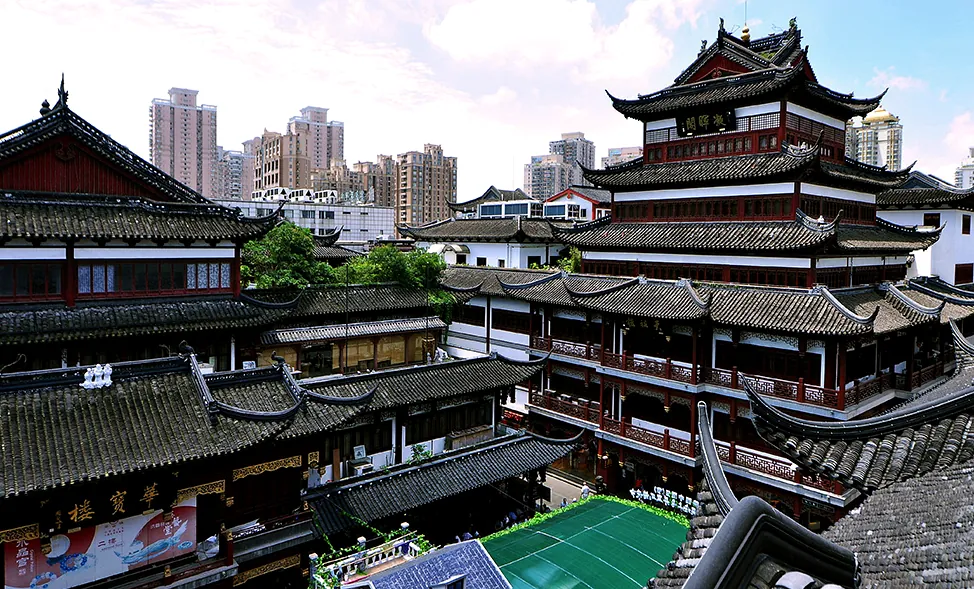
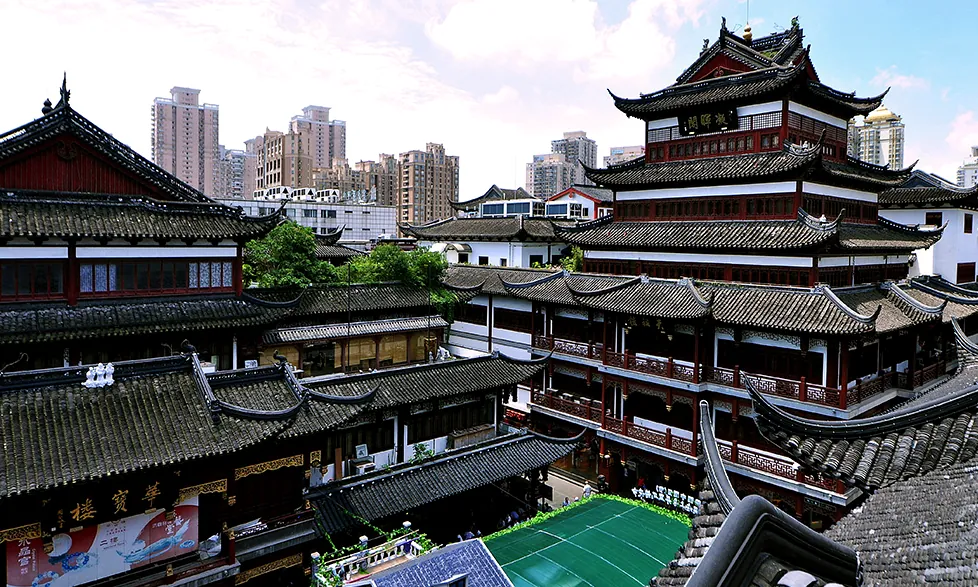
Viewed from a comprehensive perspective, the classical architectural space here emerges with an enchanting and tranquil beauty. Moss-covered glazed tile roofs, meticulously carved ridge beasts soaring gracefully with elegant curves, and crimson-and-gold lacquered precious wood truss structures combine to form a solemn complex deeply imbued with Ming and Dynasty styles. In particular, the intertwining of the tranquil traditional wooden houses of the temple grounds with the distant skyline filled with towering glass-and-steel skyscrapers portrays a spectacular visual dialogue between a millennia-old past and the utmost modern breath.
Tracing back through history, the origins of this spiritual sanctuary stem from an ancient temple named the Jinshan God Temple, dedicated to the local patron deity of waters, built in the 3rd year of Yongle (1403) under the reign of Emperor Yongle Zhu Di. By the 7th year of Yongle (1409), Zhang Shouyue, the magistrate of Shanghai at the time, recognized that a coastal administrative district expanding its borders urgently needed a guardian deity matching its development scale, and thus ordered renovations and officially requested an imperial edict to transform the site into the City God Temple. From that moment on, this sacred sanctuary shouldered the mission of protecting the populace, establishing a firm spiritual milestone for all residents within the ancient walled city of Shanghai through centuries of turbulent ups and downs.
The distinct feature that creates the cultural depth of the Shanghai City God Temple is the unique worship tradition known as “One Temple, Three City Gods” — honoring three revered deities who governed during three distinct historical periods. The City God of the front hall is Huo Guang, the Grand Commandant, an exceptional military commander of the Western Han Dynasty renowned for his service in assisting Emperor Zhao of Han and securing the nation, symbolizing ultimate righteousness and authority. Following him is Qin Yubo, a clean and upright scholar-official of the Yuan and Ming dynasties who refused official stipends to maintain his integrity, and was later posthumously bestowed the title of City God of Shanghai by Emperor Hongwu Zhu Yuanzhang to set an example of moral virtue that could reform the people’s hearts. The third City God is Chen Huachen, the Jiangnan Admiral, a valiant national hero who died a martyr at the Wusong Fortress during the Opium War under the Daoguang Emperor of the Qing Dynasty, embodying an immortal banner of patriotism and indomitable will.
Through numerous historical vicissitudes, the monument has suffered immense damage from the ravages of time and the fires of war, culminating in the fierce turbulent period lasting from 1966 to 1976. Traditional sacrificial activities were suspended, many precious statues and ritual instruments were destroyed, and the temple grounds were partitioned to serve civilian purposes and handicraft workshops. It was not until 1994 that a comprehensive restoration master plan was jointly implemented by the government and the Taoist Association. The entire main hall, inner sanctum, and auxiliary shrines were meticulously restored using traditional carpentry techniques, fully reinstating the solemn appearance of the thousand-year-old sanctuary in the heart of Shanghai’s metropolis.
Presenting itself impressively right in the historical heart of Huangpu District, the City God Temple complex occupies an exceptionally prime geographical location, which once served as the supreme administrative and cultural center of ancient Shanghai. In terms of traditional Feng Shui, ancient masters likened this terrain to a gathering place for vital energy and wind storage in the entire lower Yangtze River basin. Nestled entirely within the Old City, this area was once enclosed by sturdy feudal city walls, situated beside the surging Huangpu River and receiving abundant vital energy from the intersecting waterways of the delta plain. The arrangement of natural topography combined with the ingenious planning of predecessors turned this place into an auspicious energy nexus, symbolizing the endless prosperity of the bustling port.
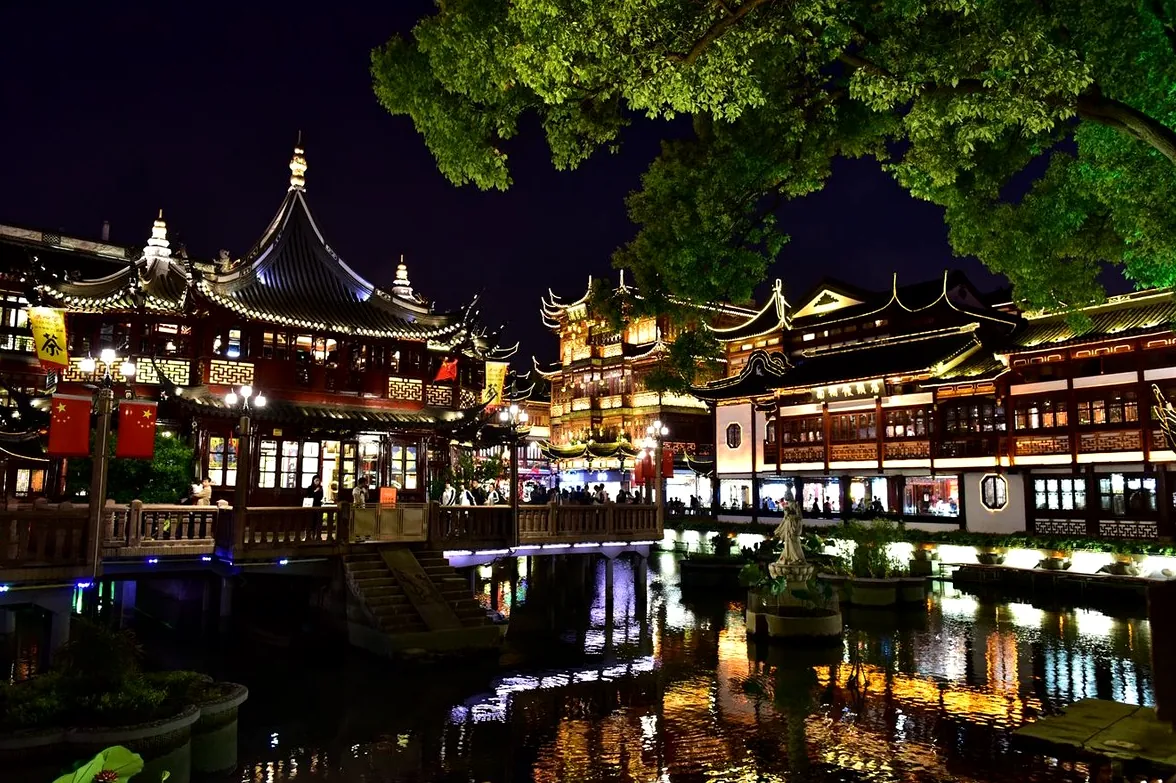
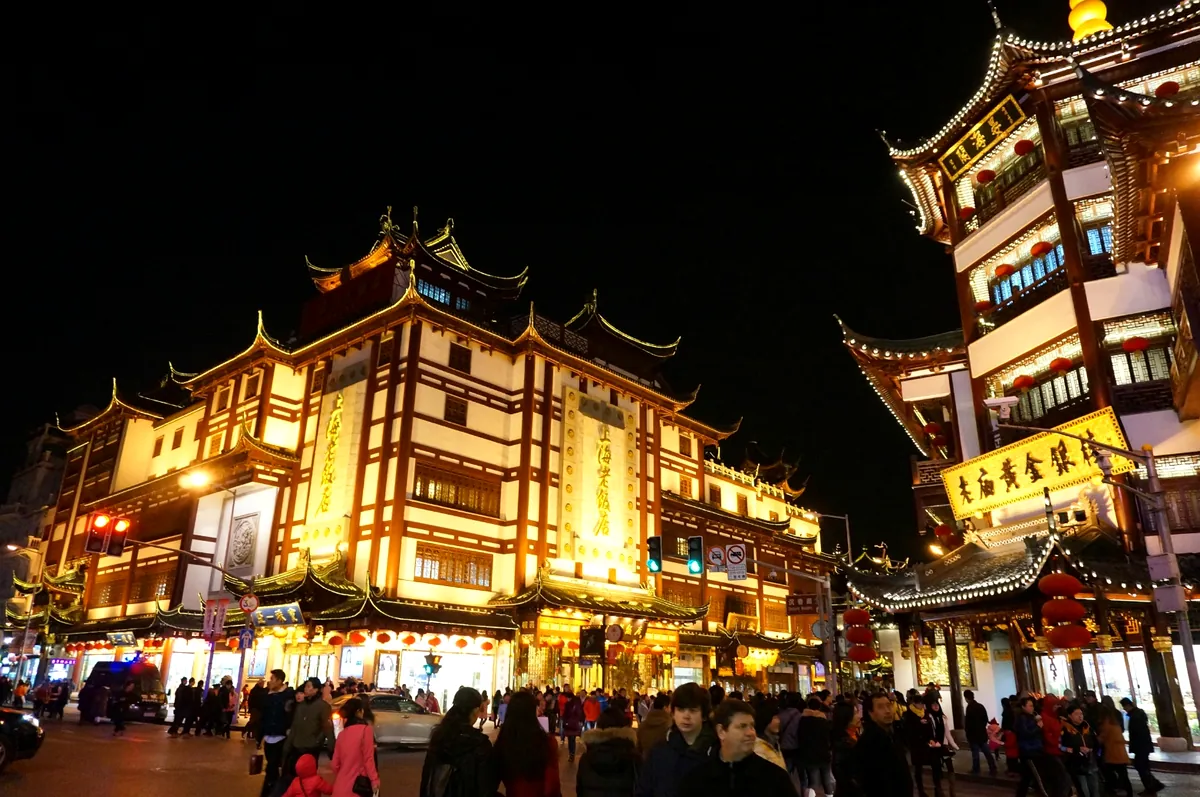
When night falls, the space bordering the solemn grounds and the adjacent Yu Garden landscape transforms into a breathtakingly magnificent visual spectacle. Traditional Chinese architectural structures with upturned eaves and soaring ridges rise against the dark sky, brightly illuminated by magnificent golden light strips reflecting down onto the mirror-like calm lake surface. Accentuating the shimmering water is the iconic nine-turn zigzag Bridge of Nine Turns, creating a winding, meditative walking route where modern lighting design beautifully honors every carved wooden grain and the centuries-old majesty of the ancient pavilions.
The spatial planning here strictly adheres to the yin-yang balance principles of Jiangnan architectural art. The religious complex of the City God Temple represents the yang element with its symmetrical, rigorous, and imposing central axis, harmoniously counterbalanced by the soft, infinitely variable yin nature of the surrounding gardens and ponds. The presence of water is not merely aesthetic; it plays a core role in regulating the microclimate, guiding pure vital energy (qi) through every shrine hall. The Nine-Turn Bridge, with its zigzagging path, serves both as a feng shui solution to prevent negative energy from traveling in a straight line and as a way to extend the visual experience, inviting visitors to immerse themselves in the serene beauty amidst an increasingly crowded metropolis.
In terms of regional connectivity and urban infrastructure, the location of the monument reflects a spectacular transition between millennial heritage and contemporary life. Despite harboring deep historical layers within its moss-covered walls, the complex boasts superior accessibility thanks to a modern transport network, most notably Metro Line 10 with a station named after the famous garden itself. This location acts as a key cultural link, forming a solid focal point connecting the golden triangle of Shanghai tourism – Suzhou – Hangzhou, allowing travelers from all over to easily gather for worship and sightseeing.
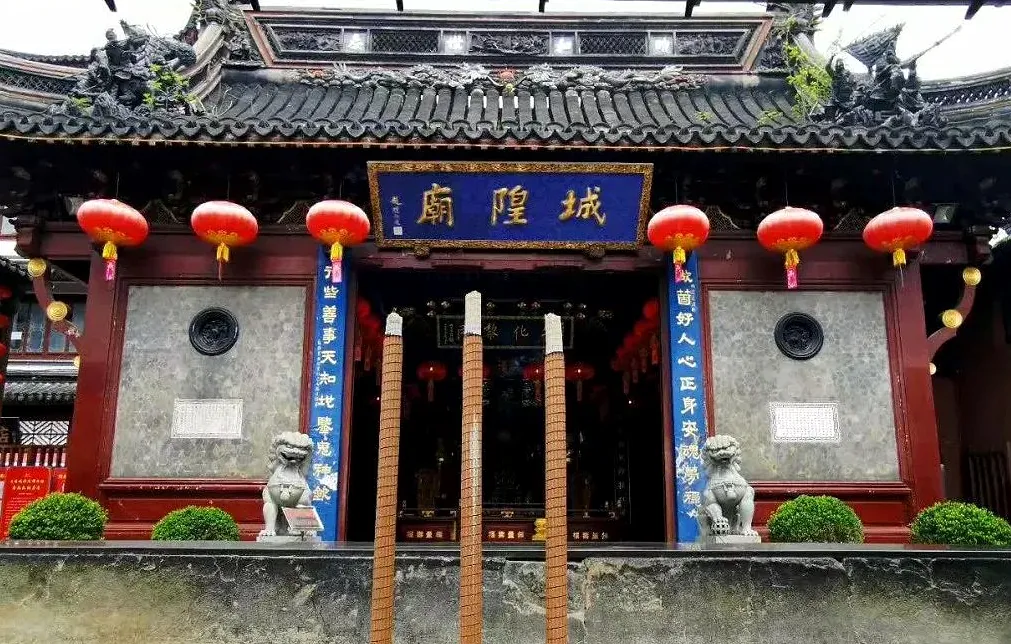
The entire area surrounding the temple is like a living open-air museum, where the flow of history from hundreds of years ago still blends seamlessly with the pulse of the modern era. The artificial landscape has been preserved almost intact, with diverse Taihu rocks, ancient trees casting shadows, and streams winding around tiered eaves, turning this land into an enduring spiritual oasis that nurtures the essence of the city through all its ups and downs.
Nestled peacefully in the heart of the magnificent Huangpu Old Town, the City God Temple of Shanghai is an excellent testament to the unique Haipai architectural school, where the solemnity and grandeur of Northern imperial standards meet the softness and fluidity of Jiangnan garden art. Unlike the monotony of purely religious structures, the space here was created based on strict Ming Dynasty feng shui principles, extending along a perfectly symmetrical north-south divine axis. The first visual impression for visitors is the moss-covered antique glazed tiles, combined with upturned swallow-tail eaves reaching proudly toward the blue sky, creating a roofline that undulates rhythmically like the waves of the Huangpu River.
Delving into the spatial structure, the entire inner temple grounds span over two thousand square meters, arranged in a “front hall, rear chamber” layout through multiple layers of courtyards and skylights to regulate the flow of energy. The heart of the complex is the Front Hall, dedicated to General Huo Guang, and the Main Hall, dedicated to the City God Qin Yubo – a Ming Dynasty official revered by the people as the guardian deity of the Shanghai port. The temple’s column-and-beam construction technique thoroughly applies a multi-layered dougong bracket system, fully interlocked with traditional wooden joinery without the use of a single iron nail. The precision in every joint not only helps the structure perfectly absorb seismic vibrations over hundreds of years but also creates vast, airy worship spaces that remain profoundly solemn under the shimmering light of red candles and incense.
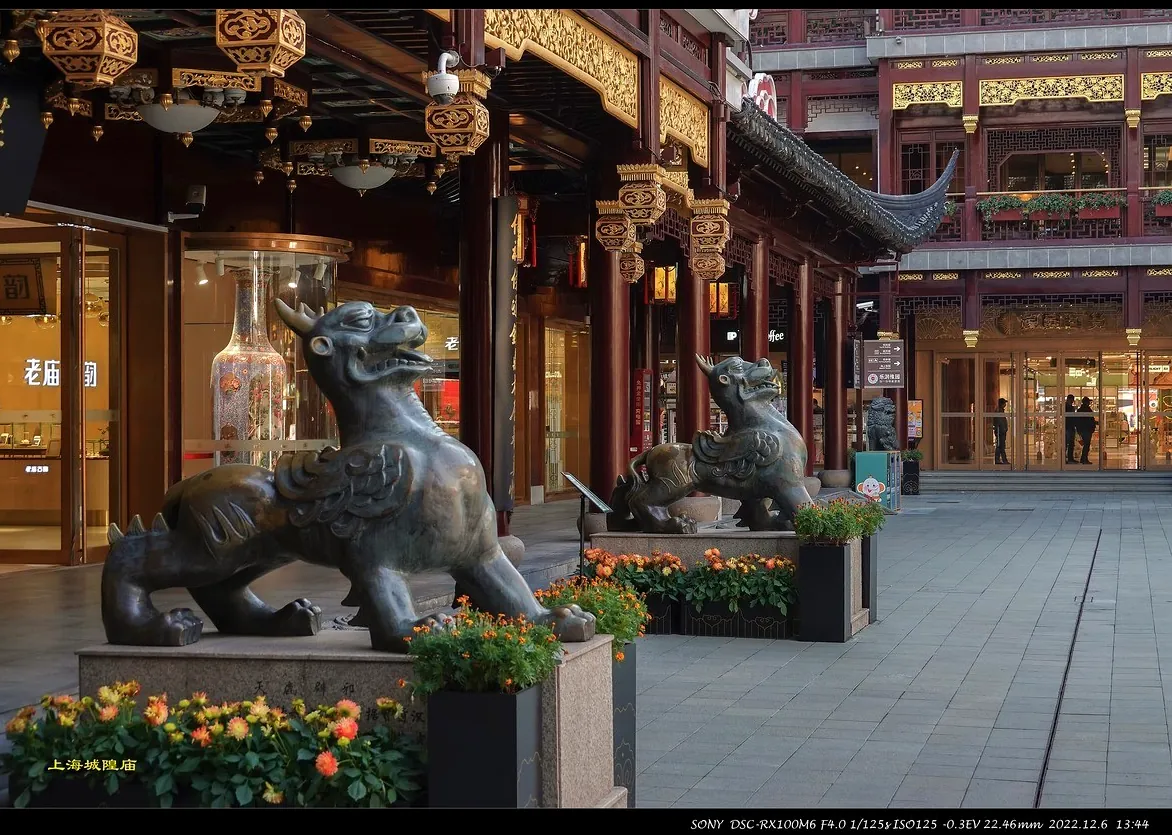
The scale of investment and actual conservation work here demonstrates a century-long cultural vision by the Shanghai municipal government and local scholars. Having endured countless fires and historical upheavals, especially during the period of requisition and severe degradation in the mid-twentieth century, the temple has undergone large-scale major renovations with funding reaching hundreds of millions of yuan. Master artisans from Suzhou and Zhejiang were invited to implement strict restoration principles, adhering to the motto of “preserving the old as it was.” The entire system of ironwood columns and cedar beams was reinforced against termites, while the antique tiles and blue slate blocks lining the courtyard were meticulously removed, numbered, and restored with millimeter-level precision compared to archival drawings from the Daoguang era of the Qing Dynasty.
The art of carving along the winding corridors and balconies surrounding the main hall is also an astonishing aesthetic marvel. On the horizontal lacquer boards, door panels, and screens made of precious wood, classic Taoist legends such as the Eight Immortals Crossing the Sea, the Seven Sages of the Bamboo Grove, or dragons playing with a pearl are exquisitely hollowed out, carved in three-dimensional relief, and then brilliantly gilded. In addition, the system of celadon-glazed ceramic decorations on the temple’s roof ridges—vividly recreating a world of immortals and auspicious beasts—was refired at the renowned Yixing kilns using exact ancient glaze formulas. The synergy between top-tier craftsmanship and scientific restoration planning has transformed the City God Temple not only into a sacred sanctuary to pray for peace, but also into a living architectural museum that preserves the pristine soul of ancient Shanghai amidst the rushing currents of modern time.
As the twilight slowly descends on the western bank of the Huangpu River, casting a deep indigo hue over the dark gray tiles of the City God Temple, this entire ancient architectural complex begins to embark on a breathtaking transformation. The meditative incense smoke of the sacred Taoist sanctuary by day gives way to a blend of magnificent lights, awakening the most prosperous nightlife in all of Shanghai. The tranquil atmosphere of the ancient temple dedicated to the Three City Gods seems to dissolve into the adjacent Yuyuan Garden commercial complex, turning the entire vast area into a dazzling “city that never sleeps,” where the boundary between reality and dream, between centuries of historical memory and modern breath, seemingly blurs beneath countless glowing lanterns.
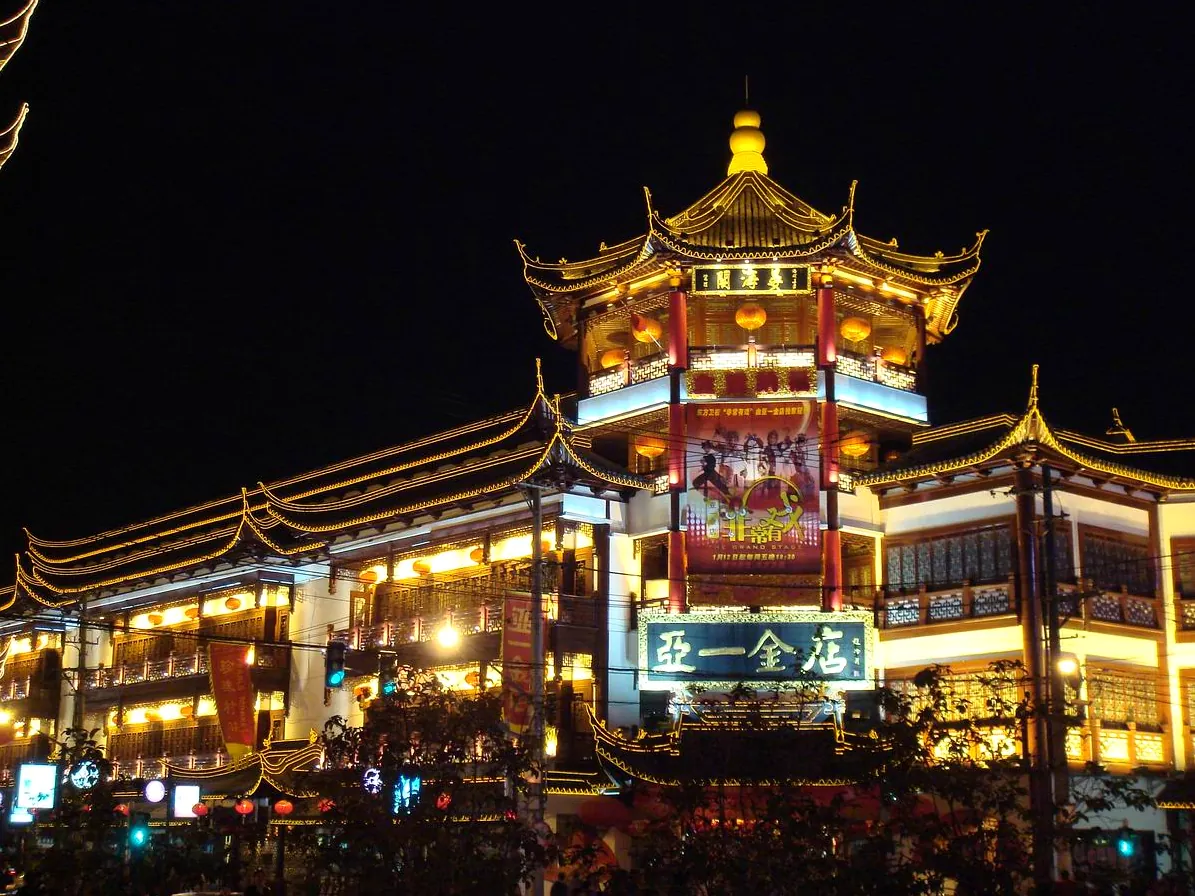
The lighting art at the City God Temple complex is not merely about illuminating an urban space, but rather a work of light sculpture that fully honors the traditional Jiangnan architecture of the Ming and Qing dynasties. Tens of thousands of LED strips with a dominant golden hue are precisely calculated to match every curve of the flying eaves and soaring arches structure, running along the roof ridges, rafters, and intricate dougong bracket systems. Viewed from above, the upturned eaves resemble the wings of a phoenix spread wide in the darkness, outlining ancient tiers of buildings floating in mid-air. The focal point of this night scene converges at the Nine-Bend Bridge, which winds across the still surface of the fish-release pond. According to ancient feng shui concepts, the zigzag structure is designed to block evil spirits that only travel in straight lines; now, in the Shanghai night, the bridge deck and the reflection of the Huxinting Teahouse shimmer on the rippling water, creating a magical visual effect akin to a majestic realm descending into the heart of the metropolis.
The most radiant and sublime highlight of the nightlife here is the lantern festival seasons—a national intangible cultural heritage with a history spanning hundreds of years. Rather than being confined to boxed-in stages, the City God Temple and the Yuyuan old quarter turn the entire open space into a giant live-action light performance stage. Through the talented hands of renowned lantern artisans from the East China region, the traditional silk-wrapped bamboo frame craftsmanship is delicately combined with 3D mapping projection technology and automated mechanics. Large-scale lantern installations depicting mythical tales from the “Classic of Mountains and Seas,” shimmering nine-tailed foxes, water-playing flood dragons, or fairies strolling through the clouds are arranged from the square in front of the temple to every bluestone-paved alleyway. Layers of light change color in rhythm with classical music, turning visitors’ night stroll into a dazzling visual adventure where every turn reveals a wondrous fairy-tale tableau.
The nightlife around the City God Temple is also a charming intertwining of audiovisual arts and vibrant civic culinary culture. As the clock strikes the hour, the crowds pouring into the ancient alleys become even busier, immersing themselves in the bustling atmosphere of family-run food stalls billowing with steam. The rich aroma of thin-skinned, juicy Nanxiang soup dumplings, the delicate sweetness of traditional pear pastry cakes, and the faint scent of Longjing tea from century-old teahouses create a uniquely Shanghainese flavor. The melodic singing of Kunqu opera and the plucking of the pipa from Suzhou Pingtan echoing from intricately carved wooden doors blend with the cheerful laughter of travelers from all directions. All of this weaves together a vibrant evening banquet scene, proving the enduring vitality of a cultural heritage that never sleeps in the past, but always knows how to brilliantly regenerate amidst every glowing lantern-lit night.
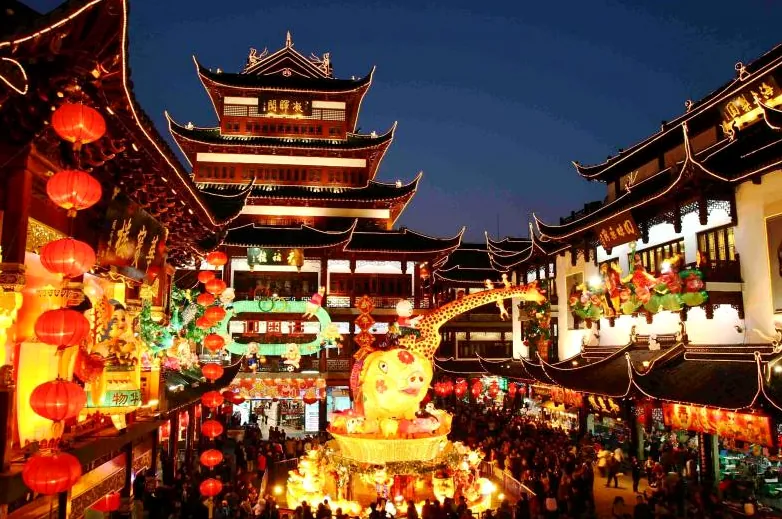
As night falls around the City God Temple complex and the Yuyuan old quarter, the entire historical space lights up in a magnificent golden dance. Traditional Chinese architectural buildings with multi-tiered upturned tile roofs are outlined with vibrant light strips, casting a warm golden glow onto the antique stone-paved pathways. Beneath the rows of shimmering red lanterns hanging along the eaves, bustling crowds slowly stroll, admiring the ornate beauty as if stepping into a painting of prosperous olden-day urban life. This magical nocturnal atmosphere serves as the perfect prelude, leading visitors into the renowned culinary paradise of the Jiangnan region.
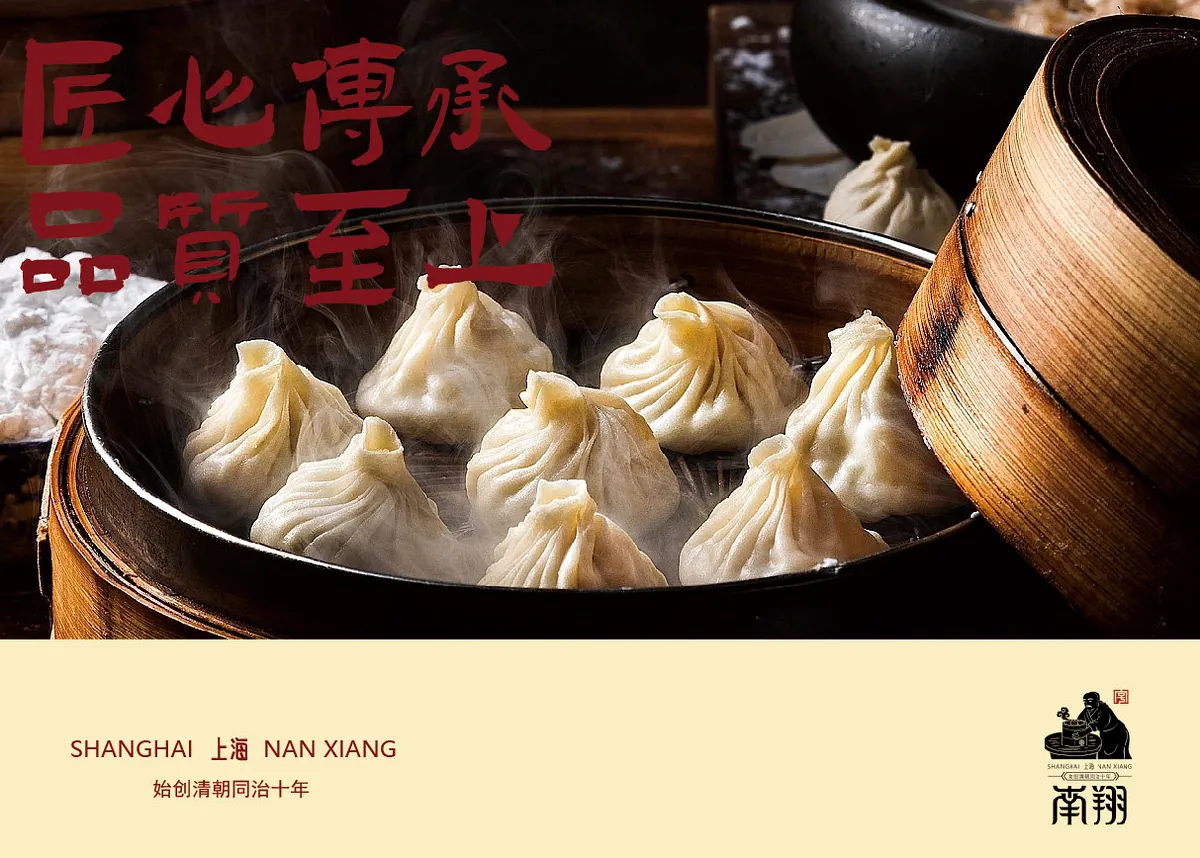
When it comes to the culinary heritage around the City God Temple, any true gourmet would rank Nanxiang Xiaolongbao as an absolute classic masterpiece. Originating during the reign of the Guangxu Emperor in the late 19th century, the first Nanxiang tea house opened beside the Zigzag Bridge, turning these tiny bamboo-steamed dumplings into an irreplaceable symbol of Shanghai’s gastronomy. Each dumpling is meticulously crafted from smooth, fine flour, rolled thin to a translucent finish yet remaining resilient enough to hold savory pork filling seasoned with ancestral spices and a rich, gelatinous bone broth. Through the nimble hands of artisans, the dough is pleated with exquisite precision—typically sixteen to eighteen uniform folds—before being steamed in bamboo baskets until piping hot. To enjoy them properly, one must follow a graceful four-step ritual: gently lift the dumpling, slowly place it onto a spoon, bite a small hole to sip the fragrant, steaming broth, and then dip it in black vinegar with shredded fresh ginger to experience a true explosion of flavor.
Beyond the xiaolongbao masterpiece, the culinary scene around the ancient temple reveals a rich world of traditional meat-filled sticky rice cakes, deeply rooted in the identity of the Jiangnan water towns. Unlike typical sweet rice cakes, locals use premium, chewy glutinous rice, pounded smooth and wrapped around a filling of savory shoulder pork marinated in soy sauce, sometimes accented with rich salted egg yolk or finely chopped fresh bamboo shoots. Each steaming, chewy cake features a soft, silky exterior that pairs perfectly with the richness of scallion oil and the savory sweetness of fresh meat, creating the unique flavor profile of the Benbang Shanghai school of cuisine. Scattered along the narrow alleys surrounding the temple, the mouth-watering aroma from pans of crispy-bottomed shengjianbao sprinkled with black sesame, crispy radish cakes, or glistening sugar-coated hawthorn skewers creates a captivating street food tapestry that has endured for centuries.
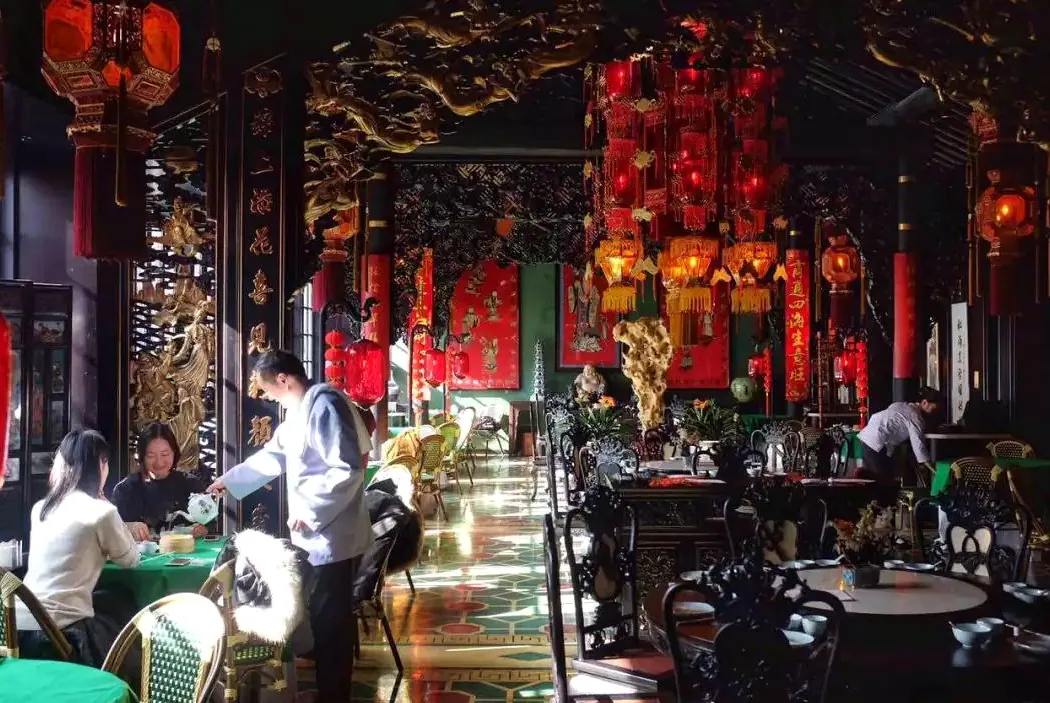
Concluding this rich culinary journey, the Lu Yu Tea House stands proudly amidst the ancient, ornate architecture, serving as an ideal stop to find tranquility and enjoy the pinnacle of tea ceremony art. Named after Lu Yu—the Tang Dynasty scholar who authored The Classic of Tea, which laid the foundation for Eastern tea culture—the tea house preserves the elegant tea-drinking style of ancient intellectuals. Sitting at a table carved with intricate patterns, listening to the melodic sounds of the pipa amidst the lingering scent of incense, guests are guided by artisans through every standard ritual of warming the pot, steeping, and pouring tea. West Lake Longjing green tea with its hint of chestnut, the fragrant Biluochun, or the rich, lingering Tieguanyin will instantly cleanse the palate, providing a perfect balance of yin and yang. Tea culture here is not merely a culinary pursuit but has sublimated into a profound philosophy of life, helping visitors fully grasp the thousand-year-old soul of prosperous Shanghai.
The journey to the sacred realm of the City God Temple in the heart of Shanghai opens up countless cultural nuances; however, to fully appreciate its subtlety and depth, travelers should equip themselves with practical knowledge about the rhythm and operations of this metropolis. Exquisitely situated in the center of Huangpu District, the temple complex and surrounding old town possess an extremely convenient public transport network. Shanghai’s world-class modern metro system takes visitors directly to Yuyuan Garden Station via Line 10 or Line 14. From Exit 1 or 3, a leisurely stroll of a few hundred meters through ancient stone-paved alleys, with the scent of incense mingling with the vibrant sounds of the city, will begin to guide the traveler’s steps.
The rhythm of time in this heritage space is clearly defined between sacred silence and bustling prosperity. The main hall of the City God Temple is generally open for worship from 8:30 AM to 4:30 PM daily. The ideal time to enter the inner sanctum is before 9:00 AM, when morning dew still clings to the glazed tiles and the crowds of pilgrims have not yet arrived. At this hour, the quiet space allows visitors to leisurely admire the Ming-era dragon and phoenix carvings, listen to the resonant bronze bells, and feel the solemnity of the place dedicated to the deity Qin Yubo. Conversely, as dusk falls, the commercial area surrounding the temple dons a brilliant, Arabian Nights-style cloak. Thousands of golden lanterns illuminate the sweeping eaves, casting reflections on the waters of the Zigzag Bridge, creating a magnificent scene that feels like a grand spectacle in the heart of the metropolis.
Immersing oneself in Shanghai’s tourism life requires quick adaptation to the modern cashless economy. Most ticket counters for the main hall, long-standing tea houses like Lu Bo Lang, or the famous Nanxiang dumpling shop prioritize payments via digital apps such as Alipay or WeChat Pay linked to international credit cards. Preparing these apps in advance, along with a roaming data service or a travel SIM card, will ensure a smooth experience for travel and spending. Especially to add depth to your excursion, visitors should take advantage of augmented reality (AR) guided tour apps on-site. This technology allows smartphones to reconstruct the original appearance of the temple during the Yongle period, bring the bustling market scenes of the Qianlong era to life, and decode the Taoist legends hidden within every wooden relief.
When stepping across the threshold of the sacred temple, visitors should keep traditional spiritual and cultural norms in mind to show respect for local beliefs. According to Taoist customs, pilgrims should step entirely over the wooden threshold rather than stepping on it, while avoiding pointing camera lenses directly at the statues of the City God and various divine generals. Additionally, around the bustling commercial area outside the temple, there are often invitations to join flash tours at surprisingly low prices, which carry the hidden risk of being led to substandard tea, jade, or silk shopping spots. Proactively choosing high-end, transparent itineraries that focus entirely on historical value and local experiences will help protect the emotional enjoyment of your trip. To have attentive companionship with a guide who thoroughly understands every cultural nook and cranny of Jinling – Shanghai without any worries, travelers can consider signing up for our high-quality all-inclusive tour package to fully enjoy a sublime heritage voyage.